
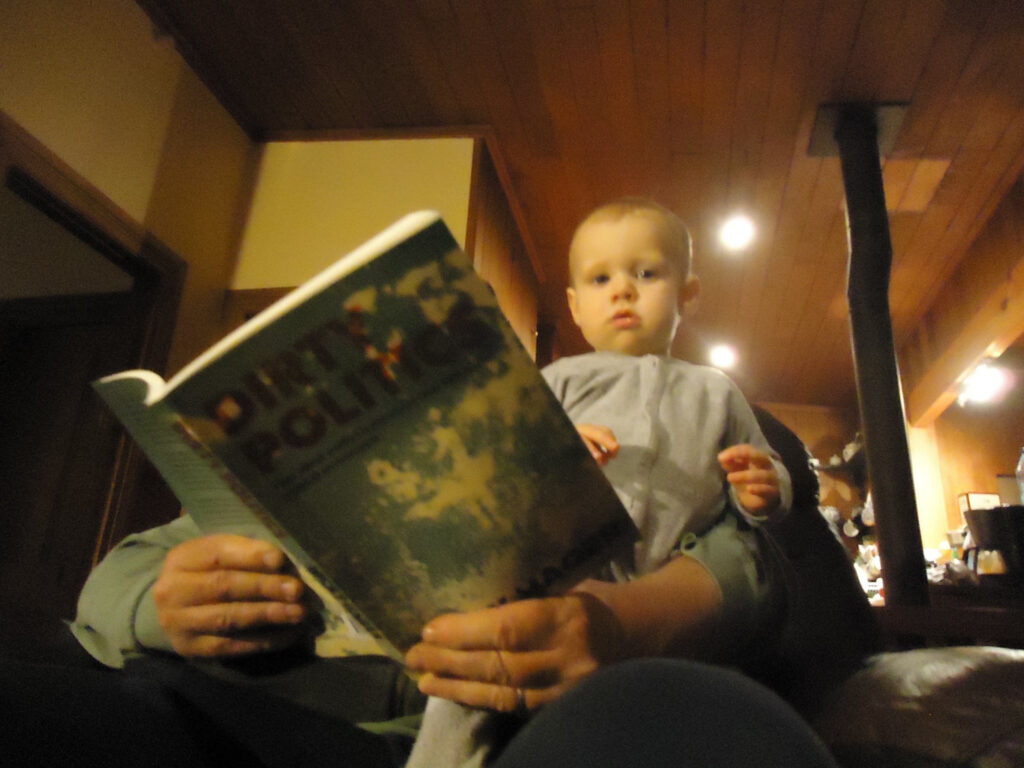
Well, I guess that it was inevitable that this day would come given that he is the son of Kate and I, but today Enda started reading the Communist Manifesto. Apparently the word “communist” is in his school history books regarding the anti-apartheid/Springbok tour protests in NZ in the early 1980s and he came home curious about its meaning. Then he watched some news with the imbecile in chief railing about communists as the biggest threat to the US. He asked us what the term meant.
As you can imagine, the first response from his mom and dad was “don’t get us started.” But we did, at length. Kate had been to an anti-Springbok protest with her parents when she was three (in a baby stroller) and I had been introduced to the Manifesto at age 14 after getting my first real summer job at an Argentine brake factory (courtesy of my dad, who believed in honest labor although he certainly was no commie). So we gave him a quick synopsis of what communism is and is not, and then Kate suggested that he read the Manifesto since, let’s just say, our bookcases are littered with commie subversive literature and then some (e.g. feminists, environmentalists, The Anarchist Cookbook).
So now he is buried in text about workers losing their chains. Almost immediately he asked us what “bourgeoisie” meant, and I tell ya, it is going to be a swift ride into the loss of political and economic innocence with that kid. We talked about lords and serfs, farmers and peasants, shopkeepers, factory bosses, proletarians, wage labor–let’s just that we are just getting started. Surplus value and the universal tendency of the rate of profit to fall, here we come!
It occurred to me that we should think of what other works might serve as nice bookends to the Manifesto (as an introduction to political writing). My first thought was de Tocqueville’s Democracy in America because it is short, succinct and written by a non-“American.” Kate suggest Machiavelli’s The Prince, which is also not overly long or burdensome on the eyes and mind. I have written some derivative essays about the applicability of Machiavelli to contemporary politics, so that appeals to me. But so does de Tocqueville’s optimism about American Democracy in a simpler time, as seen from the vantage point of this terribly unhappy moment in US history.
Anyway, we shall see if another Lenin, Stalin, Trotsky, Castro, Guevara, Mao, Fanon, Ho Chi Minh or Patrice Lumumba comes from his readings. Maybe a Chris Hitches if that is the way he rolls. Of course he could go the neo-Gramscian route or perhaps get all Althusserian or Poulantzas on us, but as long as he does not go full blown Foucaultian and po-mo, I can live with that.
But what about Hegel (as a context for dialectical materialism)? Wittfogel on Hydraulic Societies? Wittgenstein? I have already thought of the brilliant Para Leer al Pato Donald (On Reading Donald Duck). Remember, we want to keep things relatively short and simple and in some logical order of intellectual progression. That may or not be possible at this point, e.g., Nietzche might be too much at this stage (if ever).
This is not about being presumptuous. It is about introducing a young-but-keen reader to texts about the human condition, forms of social organisation, political representation and voice, etc. Instead, it is about what would be a good reading list for a curious kid with the makings of a political mind? He has already been introduced to the Greeks and Romans, so I am trying to steer him away from the “old pale, male and stale” point of view although to be frank that is exactly what I am and where I come from. Kate, on the other hand, may have some/many ideas on that score.
So what should he read n next (as a soon-to-be 13 year old)? Please drop your suggestions in a comment.
Hi Pablo, I always think that Jesus was a communist. ISN’T Communism about fair sharing of all resources, treating people equally? Isn’t that the message of Christianity?
Its the distortion of both Communism and Christianity wherein the trouble lies. Once the power grabbers and ego maniacs move in that’s when both doctrines go haywire.
JUST my own musing!
Thanks Barbara,
We briefed the boy on communitarianism and commune as linguistic precursors to the word communism, then added a bit about one party authoritarianism and state contro of the means of production. We noted our preference for democratic socialism as a political-economic combination, and that communism in real practice has never existed as intended (Stalinism, original Maoism and North Korean despotism are close but definitely get no cigar). It is early days yet, so we shall see where his mind leads him even if religion is unlikely to be an avenue in this house.
Pablo, as a lifelong student of informal military history, I wish your son well in his reading. I would like to offer a couple of 20th-century suggestions that are slightly off base.
For 20th-century history:
Andrew Roberts’ Walking with Destiny is an excellent biography of Winston Churchill.
Concerning T.E. Lawrence, I first read his The Seven Pillars of Wisdom when I was younger. I wasn’t able to get through that title. Lawrence’s long-winded writing style got the better of me. I successfully returned to that title as an adult. (I also gained an appreciation for the later arrival of ghostwriters.)
WW2:
If your son is interested and you would like to get him away from U.S. and ‘white guys won the war history.’ Robert Lyman’s books and podcast on the Burma campaign are an excellent starting point.
Concerning steering your son away from male-centric history and historians. One option is to introduce him to promising and emerging women historians.
I recommend Dr Victoria Taylor, the Luftwaffe historian. Her specialty is debunking the clean Luftwaffe myth. Alex Churchill is known for highlighting the role of French colonial troops in WWI and WW2.
Are there any game books that cover the subject material that your son is interested in? He might enjoy the interactivity of those books and decision games if they cover the related subject matter.
Thanks Luke.
You are right to suggest readings on history and grounded in (real) history. We have received good suggestions from friends about various accounts and podcasts about revolutions and although the kid is not particularly military oriented (and his mother objects to such things), he has a pretty acute interest on what really happened, especially now that he sees and understands what disinformation is. I do not know about the gamecocks angle. He does Minecraft and plenty of coding of his own, but we have banned interactive games while he lives with us and he shows no interest in them because he is an outdoorsy person anyway (we live on a lifestyle bloc in the Waitakeres). Plus, the poor internet service out here limits bandwidth consumption, so gaming would deplete our monthly allotment (yes, it is the crappy out here).
As I mentioned the post, our idea at this point, as he is about to turn 13, is to introduce him to different ways of thinking about ethics, morality, social organisation, forms of rule and economic systems. Since his mother and I are “of” the Left, he lives in a world of capitalist critiques, and he now gets to watch, courtesy of the news, not only post-modern feral capitalism (today we were talking about the skewed consent basis of so-called “Muskism”), but also the grotesque perversion of democratic rule in the form of MAGA/Trumpism and other rightwing populist regimes such as the Milei/Bolsonaro/Bukele/Kast/Fujimori/Noboa/de la Espriella-led governments now ruling in Latin America (to say nothing of European and Antipodean variants).
What we would like is for him to get a feel for different views on the “who rules?” “how rule?” “why rule? questions the frame our material lives. It is never too early to ponder such things.
Teach him some poetry for balance. Poetry distils experience to provide wisdom using all the nuance and power of language..
Thanks Barbara.
He was introduced to poetry at his one room primary school (one of the few remaining in NZ’s public education system) by a teacher who fashions herself as a poet. He even had to write a few himself. He has moved on to reading parts of the Iliad and Odyssey because of his interest in the Ancient Greeks and Romans. I am hoping to introduce him to Robert Frost, a favorite of mine. I eulogized my mother with his Nothing Gold Can Stay (1923).
Considering our current world events, I reckon a good start would be Catch-22 by Joseph Heller.
RegFeuz:
Excellent suggestion. Much obliged.