
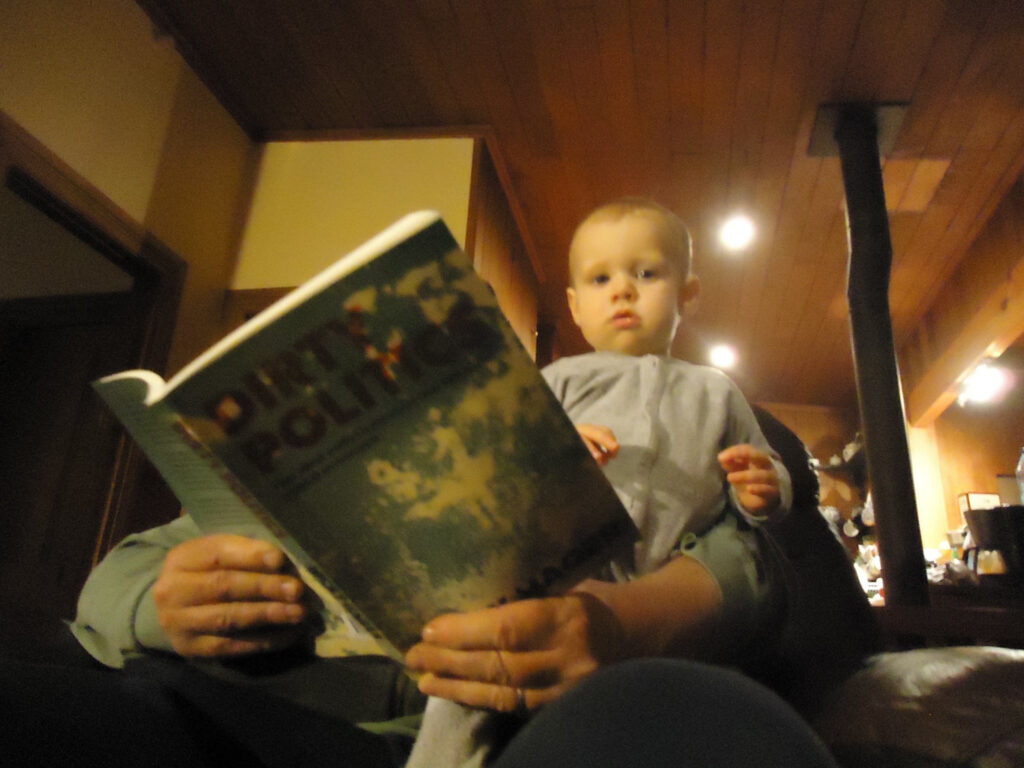
Well, I guess that it was inevitable that this day would come given that he is the son of Kate and I, but today Enda started reading the Communist Manifesto. Apparently the word “communist” is in his school history books regarding the anti-apartheid/Springbok tour protests in NZ in the early 1980s and he came home curious about its meaning. Then he watched some news with the imbecile in chief railing about communists as the biggest threat to the US. He asked us what the term meant.
As you can imagine, the first response from his mom and dad was “don’t get us started.” But we did, at length. Kate had been to an anti-Springbok protest with her parents when she was three (in a baby stroller) and I had been introduced to the Manifesto at age 14 after getting my first real summer job at an Argentine brake factory (courtesy of my dad, who believed in honest labor although he certainly was no commie). So we gave him a quick synopsis of what communism is and is not, and then Kate suggested that he read the Manifesto since, let’s just say, our bookcases are littered with commie subversive literature and then some (e.g. feminists, environmentalists, The Anarchist Cookbook).
So now he is buried in text about workers losing their chains. Almost immediately he asked us what “bourgeoisie” meant, and I tell ya, it is going to be a swift ride into the loss of political and economic innocence with that kid. We talked about lords and serfs, farmers and peasants, shopkeepers, factory bosses, proletarians, wage labor–let’s just that we are just getting started. Surplus value and the universal tendency of the rate of profit to fall, here we come!
It occurred to me that we should think of what other works might serve as nice bookends to the Manifesto (as an introduction to political writing). My first thought was de Tocqueville’s Democracy in America because it is short, succinct and written by a non-“American.” Kate suggest Machiavelli’s The Prince, which is also not overly long or burdensome on the eyes and mind. I have written some derivative essays about the applicability of Machiavelli to contemporary politics, so that appeals to me. But so does de Tocqueville’s optimism about American Democracy in a simpler time, as seen from the vantage point of this terribly unhappy moment in US history.
Anyway, we shall see if another Lenin, Stalin, Trotsky, Castro, Guevara, Mao, Fanon, Ho Chi Minh or Patrice Lumumba comes from his readings. Maybe a Chris Hitches if that is the way he rolls. Of course he could go the neo-Gramscian route or perhaps get all Althusserian or Poulantzas on us, but as long as he does not go full blown Foucaultian and po-mo, I can live with that.
But what about Hegel (as a context for dialectical materialism)? Wittfogel on Hydraulic Societies? Wittgenstein? I have already thought of the brilliant Para Leer al Pato Donald (On Reading Donald Duck). Remember, we want to keep things relatively short and simple and in some logical order of intellectual progression. That may or not be possible at this point, e.g., Nietzche might be too much at this stage (if ever).
This is not about being presumptuous. It is about introducing a young-but-keen reader to texts about the human condition, forms of social organisation, political representation and voice, etc. Instead, it is about what would be a good reading list for a curious kid with the makings of a political mind? He has already been introduced to the Greeks and Romans, so I am trying to steer him away from the “old pale, male and stale” point of view although to be frank that is exactly what I am and where I come from. Kate, on the other hand, may have some/many ideas on that score.
So what should he read n next (as a soon-to-be 13 year old)? Please drop your suggestions in a comment.