|
Posts Tagged ‘photography’
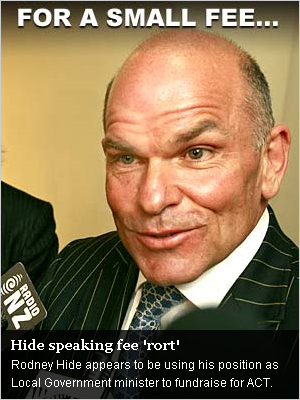
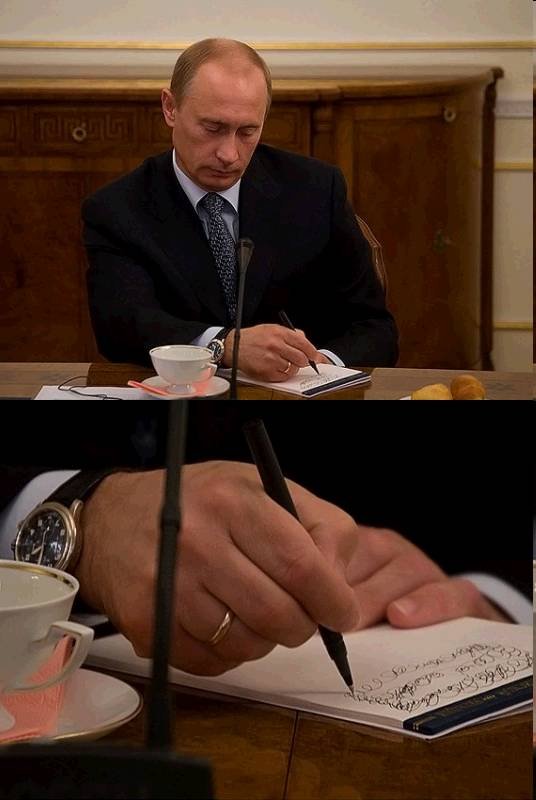
Crass news image o’ the dayThe story of Rodney Hide’s ministerial fundraiser is making headway — at present, it’s the splash spot on stuff.co.nz and is pretty prominent on the Herald site as well. This image is strong. Close-ups are rarely flattering, and this one has an unctuous, indignant defensiveness which evokes, well, just about every crooked politico in history. The text, leading with the universal refrain of officials on the take and following up hard with that beloved word ‘rort’, gives the audience all the necessary context. This is a position Hide has spent his political career avoiding, and one which he was once merciless in prosecuting. It’s a long way to fall. It seems that the credit for this should go to Eddie, who drew together its various strands into the narrative we now have. It’s been picked up by a few blogs, including Red Alert, where Phil Twyford published his own clearly-derivative-but-not-attributed riff on the topic earlier today, complete with Goff’s press release which forms the basis for the NZPA story. And it looks like Eddie even chose the photo which Stuff ran with — only one is flipped on the vertical. Well done. Update: Lyndon in the comments points out that the threads were in fact drawn together by North Shore mayor Andrew Williams in the first instance, and published on Scoop.co.nz – so Frist P0st credits there, although the Labour response seems more derivative of Eddie’s work than that, so my point largely remains. L Putin the scribblerIn contrast to last week’s vanity shots of Vladimir Putin, an illustration that you don’t get anywhere in the Russian political-security complex by writing down your thoughts on bits of paper. Or by looking idle. (Thanks to AG for the pic.) L Sovereign Democratic Realism
The wider photoset (you’ll have to google around for all the photos, since each website only contains part of the set) is a strong statement of Russia’s new national identity as a fit, keen, ruggedly independent nation which is the master of its own destiny, answerable to nobody. Vladimir Putin idealises Russia as it wants to see itself. The wider campaign propagandises Putin’s adopted doctrine of Sovereign Democracy, essentially ‘we call our system democracy, so democracy it is’. It fetishises Putin’s personal capability and authority; his command over nature, his idolisation by ordinary Russians (even those thousands of miles from Moscow), his statesmanship. Closely resembling what I/S calls Heinlein’s psychopathic frontier barbarism, Putin rides horses, treks in the mountains, fishes in a wild river, pilots a fast boat, builds a fire, helps rescue a beached whale, comforts an Ingushetian politician injured in a suicide bombing, works in a metallurgists’ plant, gives orders as to a train crash, visits a political youth camp, meets Alexander Solzhenitsyn’s widow, and shares tea with the locals. All with the cameras in attendance (and in some cases, with the sound guy in-shot – no attempt at pretending it’s not a propaganda exercise). There has been much speculation as to the import of this photoset, ranging from the suggestion that, by appearing bare-chested in the outdoors on a holiday with the Prince of Monaco, Putin is sending a signal of tolerance about homosexual rights, referencing Brokeback Mountain. The semi-official spin, naturally, is that it’s simply a demonstration that Putin knows how to relax – a signal that he will retire peaceably at the end of his second term as Prime Minister. I am not so convinced. This lays the groundwork for a perpetuation of Putin’s role as Russia’s eminent statesman of the 21st Century, and in a much more subtle and compelling way than either Hugo Chávez or Manuel Zelaya’s clumsy attempts at circumventing constitutional term-limits. The key to sovereign democracy is its illusory consent – the appeal to Russian independence, strength, unity and capability which Jonathan Brent and others have argued (audio) present the danger of sliding back to a new form of Stalinism, even with the support of those who would suffer under such a system. This is a strong warning to Dmitry Medvedev, who has criticised ’sovereign democracy’ as a form of authoritarian doublespeak, and to the Russian people that if a ‘real’ leader is needed, one exists. Former KGB officer Putin, here, is presenting himself as another Man of Steel. L Missed opportunity… to reuse a proper old-fashioned consonant headline. This Stuff title could have read “Bigger than Potter”, to better match the more-famous misquote of Lennon’s statement about Jesus, or better yet, could have stolen the headline best employed by the promoters of Twilight: Hotter than Potter, because ultimately that’s what this story (and image) are about: Emma Watson as the new see-brainy-girls-are-hot-too icon.
Watson might have better career prospects according to her fans but I reckon Daniel Radcliffe, by taking on serious and apparently demanding adult roles such as Equus, has made stronger moves to avoid ending up typecast. It seems that life after Potter will be easily more interesting than the series itself. L Polysemic text, context and objective meaningThe basic critique I and others have made about the s59 referendum question is that it only makes sense if you accept the implicit assertions with which it is loaded. Linguistic or semiotic texts don’t have wholly objective meanings – their meaning is partially subjective to the interpreter, and meaning approaches objectivity only to the extent to which people can (or will) agree on the interpretation of a text. What we call ‘objective’ meaning in a text really describes a particularly strong agreement on interpretation within a notional audience, and frequently what we call an absence of understanding or comprehension of a text really just describes an absence of agreement on the interpretation between one part of a notional audience and another. It’s easy to overstate this: usually within a given audience there is a reasonable degree of agreement on interpretation, and this is particularly true with regard to ordinary or mundane language or imagery. Some texts are more complex than others, and some are more controversial and will tend to divide the agreement of an audience more than others, but this is not a pure subjectivist or hyper-relativist argument that there is no useful meaning in anything or that definitions or the understanding of common referents are irrelevant or somehow unattainable. Just to say that meaning is not strictly encoded in a text but is as much a function of interpretation. Texts with more than one reasonable reading for a given notional audience (such that ordinary people within an audience group can reasonably differ on interpretation) are called ‘polysemic’, which is just a fancy technical way to say they have multiple meanings.
Broadly speaking the task of a propaganda campaign, or of political speech in general, is to pose a monosemic question or scenario – one which a reasonable person from within the target audience group can only read or answer in one way. This often relies on loading one’s text with as much implicit context as possible so as to avoid the possibility of part (or all) of your audience misreading it; shipping with instructions, as it were. In a strategic sense, it is not the text itself which is the payload – the frame and its implied norms enable the propagandist to construct (manufacture) the audience’s consent for their preferred reading of the wider text. Returning to the s59 referendum question, it is a fair and credible attempt at freighting a question with an implicit value judgement which renders the answer obvious if the question is read naïvely. But it goes too far; reasonable people don’t need to try very hard to see the payload, which is the implication that (a) a smack can be part of good parental correction and (b) such a smack is a criminal offence. In a successful propaganda campaign of this nature, the textual agenda is more obvious and the contextual agenda less so, and the referendum’s supporters have been working very hard to try to shut down contrary readings of their campaign in order to de-emphasise the frame and context, and emphasise the naïve text. They’ve failed in this, but it is instructive nevertheless, and that isn’t to say they haven’t achieved any of their objectives. The problem is that the referendum question and campaign is essentially preaching to the choir – it makes sense to a conservative segment of the population who care a lot about this issue and are riled up by the constraint on their “freedom” to smack, and it speaks to them because they already accept its premises. But it isn’t much use as a polemic device because, for those who don’t accept its premises, it just looks like a stupid question. This is the problem with developing political strategy in an echo-chamber – just because you believe your own hype doesn’t mean everyone does. To pervert Schneier’s Law: anyone can design a political campaign so clever that he or she can’t imagine why anyone wouldn’t agree with it. This feeds back into my ongoing critique of the state of Labour politics: toward the end they believed their own hype, in much the same way as the AAS lobby believes theirs. Campaigns which employ symbolic or propaganda methods, whether for beneficial purposes or not, are ultimately about social control. A society which responds uniformly and predictably is, all else equal, easier to control than a diverse society, so a great deal of effort is put into the crafting of messages, delivery systems, textual and contextual input to a society which will generate predictable output. Public campaigns, to be successful, require their audience to share strong agreement about interpretation and common understanding of context for their payload to be effective. Robbed of context and freighted assumptions, even something as apparently intuitive, important and uncontroversial as a FEMA public readiness campaign can be highly puzzling and confusing if read naïvely. Edit: And sometimes, when the context seems obvious, it’s not: Get the context at BAGnewsNotes or YouTube. If you read the video right, he’s being a gent, not a cad. L Welcome StandardistasLynn has linked through to us while The Standard is down – thanks. I won’t have time today to put much up, so in order that you’re not disappointed by the relative lack of content, here are a few other unusual suspects worth your attention:
Add your own unusual suspects in comments, if you like. Cheers, [If anyone has a post they'd like us to put up please email us (kiwipolitico @ kiwipolitico.com) and we'll get it posted! Anita] Mutual exploitationTeenager objects to school uniform policy is hardly news – unless the teenager is as photogenic as young Sheridan Marris, whose green streaks have landed her on the front page of today’s Rodney Times and Stuff’s splash image. It works – this non-story is (as of the time of writing) on Stuff’s `Most Viewed’ list, along with stories such as “League’s group sex romps to continue”; “Man finds wife and mate on porn DVD” and “Babysitter sentenced for sex with boy”. Sheridan now has excellent publicity for her petition to have the rules at Rodney College changed, while her image has been employed to the same effect as those headlines. That’s how the mutual exploitation model of the media works; but is the payoff worth it? Update 19:15: On the Stuff front page, the headshot of `world’s hottest woman’ Olivia Wilde is now positioned right next to the similarly-composed headshot of 13 year-old Marris. L Shame on who?This image is attached to the Stuff story on the death of a protester during the G20 protests in London: I know I’m not alone in noticing that since Stuff remodeled itself on the SMH that they’ve cranked up the alarm-o-meter somewhat, and this is an excellent example. A few facts are clear from the linked story, and a rudimentary bit of reading around reflects some others, to wit:
This should serve as one more bit of evidence that the media are not intrinsically biased for or against anyone in particular – they follow the story, and in some cases they lead it, for their own purposes rather than those of their masters in transnational capital. Edit: My mum points out that the composition evokes Brian Brake’s famous Monsoon Girl. Edit 20090408: Commenter Rich has linked to footage of police attacking Ian Tomlinson just before he died, here. If it’s real and legitimate, and there’s no reason to assume it isn’t, then it more or less invalidates my objections 2 and 3 above. Objection 1 stands, for what little that’s worth. L `progress’ in AfghanistanWikiLeaks has published four internal NATO briefing documents pertaining to the war in Afghanistan – including the Master Narrative which sets out the operational and strategic and symbolic parameters which guide ISAF’s media posture.
You can get the documents here. Interesting and revealing stuff but possibly more mundane than you might expect. If I get time over the next few days I’ll post a few observations (and if anyone else wants to do so, be my guest). In an epic security fail, the documents were distributed using Microsoft SharePoint, and protected with the absurd password `progress’. What significance the image of an ISAF sniper posing with the corpse of an Afghan, you ask? This is the amazingly political choice of image on the WikiLeaks editorial which announced this particular leak – saying it’s misleading doesn’t go far enough, it’s an outrageous association to make. But it’s also the polar opposite of the media agenda which these ISAF documents explicate, and in that regard it’s a crafty bit of work. (Via Bruce Schneier.) L |