Farewell to Vapidness–and hello to insipidness.

When I was in NZ in February-March, after a year away from the country, I was alarmed by the deterioration of what passed for news in the MSM. This was a continuation of a long-term trend that I have called the “Australianisation” of NZ news coverage, something that Lew and I talked about when we had lunch during my time in Wellington. But the gross decline over the last year was what disturbed me. Whereas the front pages of the major newspapers and lead segments of the major TV and radio news shows used to contain world and national stories of real import, by the time I arrived back in country in early 2010 even those were occupied by celebrity news, scandal and other so-called “human interest” rubbish that catered to the most purient, salacious aspects of public interest. There is war, famine, corruption, epidemics, natural disasters, corporate sleaze, international intrigue and host of other pressing news on any given day, but what is served up in the NZ media is pablum in which wardrobe malfunctions compete with drunken/drugged socialite antics and sex tapes for headlines. I blame Rupert Murdoch for the lot of it, because like PT Barnum and the Roman Emperors, he realised that by catering to the basest of human instincts and desires, media empires can be built. All you have to do is provide a carnival that diverts mass attention from the realities surrounding them, add a few creature conforts via sweepstakes and sponsor tie-ins and prizes, and voila!–you have both bread and cricuses for the masses. Worse yet, this media approach is something that very conveniently dovetails with the interests of political and corporate elites who would prefer to pursue their interests unencumbered by press or public scrutiny.

Which is why I do not lament the demise of the Sunrise program. Not withstanding the fact that all  “Australianised” morning shows are much puffery with little substance, that particular example was strinkingly moronic. Forget the tired use of yet another blond female to handle the  “soft” stories. Forget the organ grinder monkey act that passed for weather reporting. Forget the blokey rugby/cricket dude and or leggy former netballer who read sports. All of that is par for the course and shared by the risible Breakfast show as well.

No, what set Sunrise apart was the sheer rubbish that it passed off as stories, the sheer inanity of the commentary, and, with few exceptions, the sheer ignorance of the presenters of anything other than their own personae. For Pete sake, they even had a dog as a regular on the show, in an apparent effort to a) appeal to animal lovers; or b) appear more friendly/approchable/likeable. Crikey, it was bad.

Mind you, Breakfast is hardly better. But at least it first segment still contains some real news taken from sources other than its own radio affliliate (although in-house reporting has been cut back dramatically while reliance on newsfeeds from the BBC, CBS, ABC has increased, so perhaps the Mediaworks approach will eventually become the standard at TVNZ). But after 7:20 AM or so, save for the top and bottom of the hour news bulletins, the show deteriorates markedly, and after 8AM it might as well be called Sesame Street for adults. What I find particularly offensive with both of the morning shows on TV is that the content gets dumber as the morning progresses, and judging from the adverts, that is because the producers apparently believe that housewives are the main audience after 8AM, and housewives do not think much when watching a television show. Go figure.

The proof that vapidity has seeped deeply into the public consciousness is provided by the response to the announcement that Sunrise was cancelled. With very few exceptions, be it on talkback radio, newspaper reader comments, blogs or Facebook, most of the reaction pro and con is about the talking heads/presenters and their perceived “chemistry” or lack thereof when compared with the buffoon/giggles act playing over at the competitor during the same time slot.  Barely a word is mentioned about the lack of real substance in the show, or of the sheer idiocy that it passed off as news on a daily basis. Heck, if they needed that brick in human guise known as Rick Giles to increase their ratings, then it is clear that the writing was on the wall.

I fail to understand why a news content-driven morning TV show cannot succeed in NZ. There are successful news radio shows at that time of day, and while the presenter(s) is/are often a  media personality as well, their status is made by their being able to discuss news and current events in something approaching a rational and informed manner (I exclude Michael Laws and Leighton Smith from this category, although neither of them can touch John Banks when it comes to on-air hubris combined with ignorance). So why cannot that happen on TV? Could it be that the TV-watching public are, uh, less intellectually endowed than the radio-listening public? Cannot one be both?

At first it seemed like TV3 might decide to get serious and provide a real alternative to the morning carnival side show at TVNZ. But noooooooo. Sunrise is to be replaced with reruns of Magnum PI, Frasier, Everybody Loves Raymond and Campbell Live (which has gone from hard-hitting to ethically questionable rabble rousing and scandal mongering).  @#$% Me!

The goods news is that, having departed the Land of the Vacuous and Insipid Morning Shows, I do not have to watch this fare. The bad news is that in my current location there is more real news to choose from on radio and TV, but beyond that the situation is not much better. Heck, if you think “American Idol” is bad, then take a look at “Asian Idol” (or any number of other reality show rip-offs).

Best then, that I read a book or a “real” newspaper while having my morning tea.

Fighting symbolism with symbolism

So the Crown, having had their appeal against the Waihopai 3’s acquittal (about which Pablo wrote an excellent post) dismissed, is considering a civil case against them, to recover the $1.1 million cost of the damage to the dome and fences surrounding the satellite dish.

In politics it is usually best to fight symbolism with symbolism; once a topic or policy matter is being debated in symbolic terms, in general no amount of fact or logic or reason will prevail against it. This often promotes an arms race — the party to a debate who introduces symbolic aspects to their discourse gets to set the agenda, to define what the debate is about, and this is clearly so with the Waihopai 3. While the customary analysis of the protest action is that it took place one morning in April 2008, with a slight return in the criminal court during March 2010, but all this demonstrates is that people don’t really understand the nature of this protest. It is ongoing. This morning, Peter Murnane responded with some puzzlement to Sean Plunket’s question “Do you have any further protest actions planned?” by saying “No […] well, we’re busy with this one.” That’s the point: Defending their actions on truthful, legitimate and principled grounds in the full glare of public scrutiny is the protest. Contrary to another current case, the Waihopai 3 have stood up and said the non-blasphemous equivalent of “you’re goddamned right I did”, and are willing to accept the consequences of their actions — but only once they’ve made their position clear. And they expect that their commitment to principle and legitimate due process is reciprocated by the Crown, and if sued will call for representatives of the GCSB to face them in court. This places the Crown in an invidious position: it cannot permit senior intelligence and security staff to be dragged into this matter, but if it fails to do so it will cede the symbolic field to Ploughshares, and the legitimacy of its position will be further eroded.

For the Crown to seek reparation would be fair and just: the actions of the Waihopai 3 cost the NZ taxpayer money and the Crown has a right to recover that via legitimate legal means. But because the Waihopai Three have set the terms of the symbolic debate and have everything to gain and nothing whatsoever to lose from the case, it is a fool’s errand. While, as Bill Hodge says, the Crown has an “invincible case” in the civil court, the battle is not being waged in the court, but in people’s hearts and minds. The Waihopai 3 claim they have no money, and this seems plausible. So the only reason for the Crown to take a case against them is to demonstrate that the organs of power are not to be trifled with, and that even if a jury will acquit for a good cause, an appealing idealistic argument, or an integrous and principled stand such actions cannot be undertaken with impunity. A display of power, if you like, though not an especially vulgar one. Such a display may serve the social purpose of quelling the urges of overenthusiastic and legally (not to mention ethically) illiterate anti-abortionists, and will have some currency among the not-so-closeted authoritarians who bayed for the blood of these peaceful protesters in April 2008 and again in March 2010. But to the extent that the government seeks to retain its dignity, this will be cold comfort indeed.

L

An Armed Crowd is a Polite Crowd.

I heard this phrase when living on a ranch on the Arizona-Mexico border in the early 1990s. It was prompted by my asking a bartender at a local saloon if she felt threatened by the crowd of drunken, armed cowboys in the establishment one evening.  In that environment, it made perfect sense (in fact, Arizona has just legislated that a person can carry a concealed firearm without a permit, loosening the laws in force during my time in the state which allowed for the open carrying of firearms without a permit but which required a concealed weapons permit). In fact, on repeated visits to that watering hole I never once saw anyone raise their voice in serious anger.

I mention this because statistics have recently been released that show that the incidence of violent crime in NZ has increased exponentially in the last five years. That has led to the National government talking about “getting tough” on crime along the lines frequently barked by its ACT closet authoritarian partners.

But what does it mean to “get tough” on crime? More incarcerations? Longer sentences? More arrests? More convictions? More confiscations of property? More severe punishments? Reinstitution of the death penalty for heinous crimes? More tasering? Arming the community constables? Expanding the armed offenders squads? Increasing liquor bans in public places?  Having the police using more armed force when dealing with crowd control, gang and other collective disturbances? Increasing youth sentences?

I mention this because “getting tough” on crime, at least when phrased in the above terms, does not address the causal mechanisms behind the upsurge in violent crime (which I agree has increased and now become a serious pathology in NZ civil society). One can seek explanations for causes in many places: exposure to media-provided violence at a young age, dysfunctional familities, bullying culture, the pervasive influence of alcohol, the long-standing tradition of civil disobedience and passive resistance practiced by some communities and individuals, now taken to new extremes, the degeneration of popular and civic culture into venal self-absorption–the list of possible causes is long.  But what does “getting tough” have to do with any of these possible causes? Unless a more draconian criminal system is seen as a deterrent to violent crime (and there is much dispute about the deterrent value of things such as capital punishment), how exactly is “getting tough” on crime going to solve the problem?

I must confess to being of two minds, because as an immigrant from the US I have always felt that punishment for serious offenses was a bit of a joke in NZ and that there are not enough resources dedicated to crime-fighting  (in fact, I still believe that NZ is a country where one can literally get away with murder if cunning and meticulous). But I also know that the “tougher” US approach to crime also has done little to nothing to drive down crime rates (in fact, the “broken windows” approach to petty crime adopted in New York City in the 1990s, and in which worked marvels in lowering the overall crime rate in that city, was focused on early intervention at the lower end of criminality rather than on increased punishment for more serious offenses). Instead, US violent crimes rates, not surprisingly, lowered as the economy expanded in the late 1990s and early 2000s, and, not surprisngly, have increased since the recession began to bite hard in 2008. Which is to say, although the violence of socio and psychopaths is unaffected by economic cycles, much of the residual acts of violence tend to overlap with economic downturns when unmitigated by early intervention or causal prevention schemes.

Which brings back the cause-effect–response syllogism mentioned earlier. There is a reason why that crowd in the border town saloon was armed. At the time there were only 2 sherriff’s deputies avaliable to patrol over 1000 square miles of national forest and ranchland strung along the border and extending some 20-50 miles northward. Besides the various stinging and biting small critters and large predators (bears, big cats) that stalked the Sonoran high plateau and mountain ranges in which our properties were located, there were human dangers emanating from across the border as well as from within Arizona itself (organised crime drug smuggling and survivalist militas, respectively). Absent the protection of the state in such remote locales, people actually practiced the concept of self-defense because to not do so invited serious victimisation, often of a terminal sort. As the saying goes, the best home insurance policy one can have in such a personal threat environment is the sound of a pump action shotgun chambering a buckshot round. The point being, that armed crowd had reason to be so given the causal mechanisms at play in that particular crime environment (which I must say, remains one of the most beautiful landscapes I have had the pleasure to experience first hand). Unfortunately, perhaps, things changed after 9/11 and the region is now swarming with Border Patrol, National Guard, roadblocks, fences, audiovisual sensors and motion detectors as well as increased numbers of north-bound migrants, to the point that many long-term residents have moved away in search of solitude and workable land. It turns out, at least in that regard, I left just in the nick of time.

That brings me back to NZ, my adopted home since 1997 and in which I have seen a steady decline in civility during the last decade that is now confirmed by crime statistics. Not being a criminologist or a social welfare expert, I cannot offer any concrete prescriptions, much less a panacea for the upsurge in criminal violence now afflicting Aotearoa. But what I can say is that it does no good to play the role of chickenhawk or attack poodle by fulminating about getting tough on crime without linking the thirst for punishment to an understanding of what drives violence and insecurity in the first place. In fact, until the latter is identified, addressed and ameloirated, then the former is just another way of pouring salt into a gaping wound.

Chris hitting his stride

It’s well known to most that Chris Trotter and I have had considerable differences. But despite them, I must say that when he’s on form it can be a sight to behold.

So it is with his latest set-piece about Auckland governance, which gives voice to the intuitive disquiet felt by many, weaving many of the themes behind the sometimes tentative and incoherent criticism of the (aptly-named) Supercity plan into a cohesive polemic narrative, putting meat on those bones and placing these recent events in a historical context which resonates.

Required reading, whether or not you agree with it, and deserving of a wider audience than the blogosphere generally provides.

L

Being pro-Israel is not to be pro-Zionist or anti-Palestinian. To be anti-occupation is not anti-Semetic.

One of the ironies of the perennial Middle Eastern conflict is how the Western democratic Left shifted from a pro-Israeli position (held until the 1970s), to an anti-Israeli position during the last three decades. Much of this is Israel’s own fault, as its continued expansion into, and occupation of Palestinian lands in violation of the 1967 and 1973 war settlements, to say nothing of the Camp David accords, has re-cast its image to that of an imperialist oppressor rather than besieged liberal democracy surrounded by a sea of hostile Arab despots and medieval theocratic zealots.


Yet Israel remains the sole functioning democracy in Middle East (Turkey is further afield and excluded from this analysis for argument purposes), one that if, in a process of increasing decay (think the Olmert and Sharon corruption scandals),  internal polarisation (think of the political ascendence of the rabid orthodox Right and its impact on Israeli settlement policy) and restrictions on the political  and civil rights of Arab Israelis and the Arab inhabitants of the occupied territories, remains in stark contrast to the autocracies or facade democracies that, even if pro-Western, surround it. In terms of social toleration, gender and economic equality, and freedom of expression, Israel remains ahead of all of its neighbours. In fact, Israel is a classic social democracy whose betrayal of its basic principles has also been seen in the negative fortunes of its Labour Party, something that has only been partially been compensated by a rising peace movement in opposition to Likud and its religious zealot allies (it should be noted that most of the orthodix Jewish zealots are fairly recent foreign immigrants from the US and Russia, and not second or third generation Israelis).


But the view that Israel, in spite of its grave flaws, remains a country worth supporting  is a view that can no longer be safely voiced in Left circles and is in fact now a minority opinion. Instead, the Palestianian struggle has become the main Left cause celebre as an expression of anti-imperialism, no matter that both Hamas and Fatah are intensely authoritarian political organisations with little socialist inclination, the former acting not only as militant counter to the “betraying” moderation (and corruption) of the latter, but also acting as a proxy (along with Hizbullah) for Iranian influence in the Eastern Mediterrean (Iran being an elected authoritarian-theocratic regime in which basic civil liberties are, to put it gently,  seriously curtailed). Moreover, Hamas in government in Gaza has been anything but democratic in its treatment of internal dissent, so even if it was voted in fairly (much to the US and Israel’s dismay), it has not made good on its promises to bring democratic governance to its beleaguered people. The larger point being that Israel may suck as a democracy, but its neighbours and opponents may suck just as bad or worse.


Thus, if one is on the Left side of the Western political spectrum and expresses a sympathy for Israel in spite of its flaws, even if only in comparison to its neighbours and the character of Palestinian political society,  then one risks being pilloried by ideologically kindred spirits.


On the other hand, if one points out the illegality of Israeli occupation of land in Gaza and the West Bank, and the illegality of the ongoing settlement of Palestianian lands, and/or notes the deterioration of Israeli democracy, then one risks being labeled an anti-Semite by Israeli sympathizers and the political Right. These see no fault in Israel and no good in Palestianians. Their fear of Islamicism overrides their concern Israel’s political decadence and its overtly bellicose approach to regional affairs. They see and hear no evil when it comes to Israel.


There is no point in arguing, as many do, about who came first to that part of the world–Jews, Arabs or Christians. Arguing about who came first 2000+ years ago does not advance one iota the prospects for a peaceful settlement of current disputes (there is a parallel here to the “we were here first” arguments of some Maori activists). Nor does it do any good to re-visit the circumstances surrounding Israel’s founding as a nation-state (much like there is little point in arguing the legitimacy of European colonisation of Aotearoa). The fact is that Israel (like Pakeha) is (are) not going anywhere.


Israel is here to stay regardless of whether its neighbours or non-state adversaries may wish it not to or plan for its demise. Thus, the real point of departure for any prospect for peace is admission of the fact. Sadat recognised this and paid for it with his life. In turn Rabin recognised that Israel needed to deal as equals with its Palestianian counterparts and paid for that view with his life. Perhaps it is fair to say, then, that there are those on both sides (and inside and outside the Middle East) who have a vested interest in perpetuating the conflict rather than solving it, and they do so by dredging up historical grievances and past offenses as one means of doing so.


Needless to say there is a fair bit of anti-Semeticism in the opposition to Israel, particularly that voiced in Muslim and some Christian fundamentalist circles. And, needless to say, the heretofore seemingly blind US support for Israel has very much made it the tail that wags the US dog when it comes to Middle Eastern policy and has contributed to Israeli intransigence and defiance when it addresses international conventions (something that may be shifting as a result of the Netanyahu government’s latest affronts to US attempts to re-start the so-called “peace process”). But opposition to Israeli occupation is not reducible to anti-Semeticism or anti-US beliefs. Instead, it can rest on a principled opposition to illegal behaviour on the part of a democratic state that more than most should understand the long-term consequences of oppression and inequality. Israel may continue to feel besieged (although truth be told many Arab states de facto accept its existance, so much of the siege mentality is driven by domestic ideological competition) but much of the opposition to it now has to do not with its origins or ethno-religious character but with its current behaviour.


The current rift in US-Israeli relations is a moment to drive that point home, devoid of the emotional and ideological baggage that has impeded rational discussion about the way forwards towards a durable peace. It remains to be seen whether those with a vested interest in perpetuating the conflict, be they from the Left or Right, will accept that to be the case.


Forewarning: Comments that attempt to rehash historical disputes (i.e. the “who came first” or “Israel’s founding was illegal” arguments) will be deleted simply because they add nothing to what has been said ad nauseum already. Likewise for personal attacks on what some might take to be my position one way or the other. In the latter case the point will have been missed that what I am trying to do here is steer a middle course through the ideological minefield that surrounds discussion of the Israel-Palestinian conflict. 

Consider the birds

In the USA, the Spotted Owl evokes the spectre of trivial busybody environmentalism. This species has been extremely well propagandised by the forestry lobby and other anti-environmentalists as a symbol for “putting other species ahead of humanity”. But it is not so in New Zealand (although there is Powelliphanta augusta). For a hint of what the public response to Gerry Brownlee’s plan to mine Schedule 4 of the conservation estate could be like, look no further than the firestorm which has erupted over the YouTube video showing Norwegians shooting protected native birds, among other things.

kererū

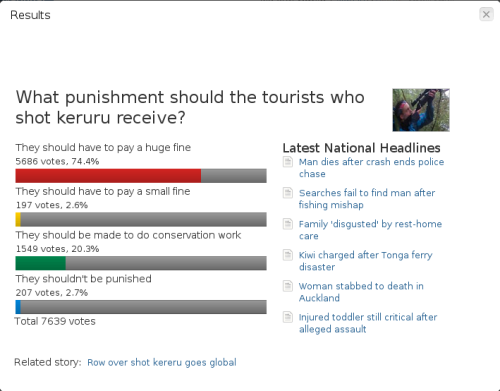
This has been a pretty persistent story. It’s been at or close to the top of the Stuff “most read” list for going on three days now; at the time of writing, it’s #1. It’s third on the NZ Herald website’s NZ section. It was in almost every dead-trees paper with a national news focus in the country on Friday. It’s featured prominently on One and 3 News (and consequently RadioLIVE), Radio NZ National, Newstalk ZB, and is at present the third-placed story on English-language Norwegian news website News and Views from Norway and has made Norwegian-language mainstream news there too, as well as action from Norway’s own environmental agencies. It’s drawn outraged official comment from DoC and the Conservation Minister; but notably not (as far as I can see) from the Minister of Tourism. There are 400-plus infuriated comments on the original YouTube clip, and 300-plus on the Fish’n’Hunt Forum, the oldest and most popular NZ internet site for discussion of hunting and fishing topics. Stuff.co.nz has a poll up, and the results are quite clear, for what they’re worth:
stuffkererupoll

This outpouring of righteous fury has not come about because of the death of a few birds. None of the species shot by these hunters are so close to extinction that the loss of an isolated handful of individuals will critically harm the population. The reason for the response is that this sort of thing offends us deeply and personally. It is antithetical to who we are as New Zealanders, and it is as if a little part of each of us dies with those birds.

I wrote a few days ago that the task for the opposition, for conservationists and those who love the land and its wildlife was to relegate mining Schedule 4 to the “political too-hard basket”. More specifically, that task for those people — and for the 74% of (notoriously reactionary) Stuff respondents for whom these events are a grave injury — is to see the proposal to mine Schedule 4 as the same thing on a much greater scale, which it ultimately is, and to respond in kind.

Update 30 March: A vivid event like the one discussed above often primes the media and public to pay closer attention to similar events which previously might not have been newsworthy. Dog attacks are a case in point. So it is with this case: the release and eventual death of a weka, hardly endangered but well-loved, from Hagley Park, is now news.

L

Overzealous spamtrap

spam
Hi folks, for the last few days Akismet has been eating legitimate comments, and since it’s usually so reliable I’ve not bothered to check. So I’ve just released them all. Thanks to Neil for letting me know. If a comment doesn’t show up, you can email lew@kiwipolitico.com and I’ll make sure it gets published.

Sorry about that. As you were. I’ll try to find time to reply, but it probably won’t be today.

L

Blog Link: Spinning the Spy Trade

As promised the latest “Word from Afar” column at Scoop focuses on the 2008-2009 NZSIS annual report. As I anticipated in an earlier post, there are a few nuggets of information about its work amid all the PR jargon and managerial double speak. Check it out here.

Torpedoes?

Paula Bennett’s damn-the-torpedoes attitude toward the Attorney-General’s advice regarding the Bill of Rights Act — and Idiot/Savant’s observation that this is just the latest bit of policy in breach of that act — has me wondering. What happens if there are torpedoes?

What happens when a widower has his benefit cut by WINZ, having refused a work test which a woman in identical circumstances would not be required to undergo? Surely he has recourse to sue WINZ for that breach. If that’s so, and it seems like in a civil society governed by the rule of law it should be so, the government will surely open themselves up to considerable legal liability by implementing and enforcing this sort of policy (quite apart from the symbolic side of such cases getting hauled through the courts, and so on).

Can some of you lawyerin’ types out there in the internets give me a pub-argument explanation of the issues in this situation?

L

Yours, not mines

Labour’s campaign against mining Schedule 4 land looks strong, especially at the iconographic level.

The slogan and to an extent the photo frames the issue as a matter of identity, echoing Phil Goff’s “the many, not the few” and Phil Twyford’s “not yours to sell” (though the visual style has come a long way since that campaign, and there’s some subject-object confusion). It also echoes Iwi/Kiwi, undoubtedly the most effective campaign of this sort in recent memory. The hard economic matters — the cost-benefit analysis between mining and tourism and so on — are there, as they should be, but backgrounded to the symbolic concerns.

Goff is clear that he’s not anti-mining, but wants to focus on the 60% of mineral resources outside the DOC estate. That’s the crucial point to make because it draws a bright line between acceptable and unacceptable which is still well north of Schedule 4 — to cross that line the government must first gain electoral consent to mine DOC land, and having done that must gain consent to mine the most precious areas of that estate. The point isn’t that mining is all bad; the point is that mining conservation land is worse than the alternatives. The job of the opposition, environmentalists and anyone who loves the fact that NZ still has wild places which are sacrosanct, or who thinks of those places as a part of them, is to relegate the idea of mining them to the political too-hard basket.

Labour and the Greens are also well-coordinated on this, with Metiria Turei pointing out the government’s duplicity in not revealing its intent to mine areas on Great Barrier Island which are under Treaty negotiations. The māori party should get in on this, as well. It looks good.

L