I voted Yes today

It is a sunny Wellington spring day; I walked past crocuses and the beginning of daffodils to get my ballot paper, and past trees starting to show their spring growth to post it.

I voted yes because I believe smacking children is wrong.

I voted yes because I want to reaffirm that the Christian right do not speak for me. Many many (many) Christians in New Zealand believe, as I do, that smacking is wrong.

I voted yes because countless people gained the signatures of 300,000 voters to give me the opportunity to say out loud what I believe.

I voted yes because I want to live in a country where children are hugged, held, comforted, and raised to be non-violent adults.

I voted yes because I love.

s169: enshrining a murderer’s right to blame the victim

Clayton Weatherston put a knife in his bag, went to his ex-girlfriend’s house and stabbed her to death. He admits to all of that but he is pleading not guilty to murder, and s169 of the Crimes Act means he may only be found guilty of manslaughter. s169 says that blaming her is a defence, it says that if she provoked him and he killed her it is not murder.

It sounds far fetched, but it’s happened many times before. In 2006 Tevita Noa was found not guilty of murder; he had beaten his wife to death with a cricket bat after finding explicit photos on her cell phone. Amsheen Arif Ali stabbed Colin Hart five times, only manslaughter because Hart had made sexual advances toward him. Phillip Edwards bashed David McNee in the face 40 times, stole his car and possessions and boasted about it afterwards, only manslaughter because McNee, paying Edwards for sex, had touched Edwards’ anus.

s169 enshrines blaming the victim in law – it says that in New Zealand a man may beat a woman or a gay man to death as long as it’s their fault, her fault for wanting to leave, his fault for being gay.

In 2007 the Law Commission recommended the repeal of the section and … nothing.

Earlier this year Simon Power’s office told me

I expect to consider these proposals later this year, and will assess, at that stage, how any reforms of this nature might fall within the Government’s current legislative priorities.

But … nothing.

So, if you want to live in a country which doesn’t enshrine victim blaming in law, write to Simon Power and ask him to repeal s169 of the Crimes Act, ask him to treat the murder of wives, gay men and ex-girlfriends as murder.

[Many thanks to Idiot/Savant who has kept this issue on the agenda]

Welcome Standardistas

Lynn has linked through to us while The Standard is down – thanks. I won’t have time today to put much up, so in order that you’re not disappointed by the relative lack of content, here are a few other unusual suspects worth your attention:

  • BAGnewsNotes, because politics sometimes needs to be seen to be believed.
  • The Dr Seuss propaganda cartoon archive.
  • My old mate Gabe runs a radio show on FleetFM called Playing Singles, Drinking Doubles, dedicated to outlaw country, honky tonk, gospel, rock & roll, western swing and the blues.
  • The Objective Standard, whose watchword is Exploit The Earth Or Die. Magnificent in its delusion. Even the ad links on this site are interesting – here’s one to a book called The Values of Harry Potter: Lessons for Muggles. Who knew Harry Potter (by implication: JK Rowling) was a Rand cultist? Or wait, is it that Rand cultists are actually wizards? Clearly, since I can’t figure this out, I’m a muggle.
  • Here’s a wonderful montage of Fox News screengrabs. It’s a big file, but truly the gift which keeps on giving.
  • Save The Media – career journalist Gina Chen blogs on how old media can learn from new media.
  • The Peoples Cube – life behind the irony curtain. So overdone it initially made me wonder whether it was propaganda or ironic counter-propaganda, but nevertheless, an almost-endless trove of remarkably original material. Particularly righteous is the Pascal’s Global Warming Wager.
  • Submit on the Auckland local government reforms. Last stop today; train’s going to keep on rolling until it reaches the end of the line or the engineer dies.
  • Why Obama really won the Democratic primary.

Add your own unusual suspects in comments, if you like.

Cheers,
L

[If anyone has a post they’d like us to put up please email us (kiwipolitico @ kiwipolitico.com) and we’ll get it posted! Anita]

Stealth march

A few thousand primary school kids, dressed mostly in high-visibility gear and carrying (or wearing) makeshift traffic cones, lollipop signs and banners, have just marched through Wellington CBD escorted by police motorcyclists, ambulances and led by a highland band (bagpipes and all).

I work in a media office. Most of us spend hours every day scouring the news as it comes in – on paper, over the airwaves and on the interwebs – as a matter of our daily work. Not one of us had the faintest inkling what the march beneath our window was about, who had organised it or what end it aimed to achieve. We guess from the (excellent) adornments worn by the wee nippers and their guardians that it’s to do with proposed speed limit reductions around schools. But that’s just a guess.

Whoever organised this has achieved a remarkable feat: coordinating thousands – ok, maybe it was hundreds – of kids (which is like herding cats), gaining approval from their parents, the police, the City Council and signing up a marching band, without anyone in our esteemed media establishment hearing a word about it. That person should probably be put in charge of corporate communications for a big company or government department with a lot of bad news – one of the power companies, perhaps, or a trading bank.

Incidentally, if school speed limits is the cause being protested, then I fully support it. There’s a school near where I live which is at the bottom of a 70k/h hill, and the thought of sending their precious dear things down that road each day must give local parents conniptions. I have it on good authority that the local AOS sergeant, who has a kid at the school, spends his off hours parked up there issuing tickets in addition to his ordinary policing workload. Not ideal.

L

Noticeboard: Events for Wellingtonians

Apologies to the rest of the country :)

Monday 18 May 12noon-1pm Cake stall to support Lane Walker Rudkin workers. Outside Westpac House on Willis St. Turn out to show the government and Westpac that the workers deserve to get their redundancy paid out now (plus for the baking of course :)

Wednesday 20 May 7pm- Wellington Hand Mixer

hand-mixer-wgtn

Saturday 23 May 7pm- Terrorizing Dissent & community solidarity dinner, New Crossways, Roxburgh St. Curries and movies to support NZ and US activists arrested in terror raids.

Hat tip: The Hand Mirror and Indymedia

A Green Neo-Realist Foreign Policy Manifesto

Now that the Green Party has matured into the third most important political party in NZ, it is time that it develop an equally robust foreign policy stance that moves beyond its visceral commitment to pacifism, human rights and civil liberties, international ecological defence and anti-imperialism. Although laudable goals that still have a place on the Green foreign policy agenda, these foundational pillars need to be supplemented by a more nuanced and less ideologically rigid, but no less idealist in principle, approach to New Zealand’s foreign affairs.

Lets start with defence and intelligence. The Green Party should maintain their absolute commitment to conventional and unconventional weapons non-proliferation, nuclear disarmament, prohibitions of chemical and biological weapons and bans on the manufacture and sale of land mines and other indiscriminate munitions. It should maintain its commitment to seeing the NZDF externally focused on peace-keeping and nation building as its major priority. It should resist efforts to turn the NZDF in to a mini Australian armed forces, and resist the calls for the NZDF to follow Australia, the US and the UK into battle no matter the context or justification. But it also has to realise that NZ’s own defence is premised on its being a good international security partner, and that it cannot abrogate its responsibilities in that field. To that end, the Greens should support efforts to restore a close air/ground support wing to the NZAF in order to provide NZ peace-keeping troops with independent air cover in foreign conflict zones. Even when under multinational military control such as the ISAF mission in Afghanistan, military protocols allow services of each country to protect their fellow troops as a priority. If NZ is going to continue its level of international troop deployments in conflict zones like Afghanistan, East Timor, the Solomons and elsewhere, the ability to provide protective air cover to its troops on the ground is surely a worthy cause. And, as it turns, out, be they rotary or fixed wing, surplus close air support platforms in the inventories of several NATO and other countries come relatively cheap when compared to the aborted F-16 purchase of a decade ago.

Likewise, the Greens needs to support the reinforcement of the Navy’s long-range patrol and interdiction capability, if for no other reason than to protect the resources located in the NZ Exclusive Economic Zone and to deter illegal poaching of whale and endangered fish in the waters adjacent to it. Moreover, such a capability can also serve in anti-piracy roles in the sea lines of communication most vital to new Zealand’s trade, and to keep track of the increasing presence of foreign submarine and surface fleets in and around New Zealand waters. Passivity in the face of such probes will likely be interpreted as acquiescence or inability to counter them, which will encourage further encroachments into the EEC, if not the territorial limit itself. That is also why the Greens need to support the continuing emphasis placed on the NZSAS as the country’s special operations branch. What it can do differently is question the deployments they undertake on behalf of foreign powers, perhaps broadening the scope of their activities to areas outside of the usual SOLIC (special operations and low intensity conflict) scenarios.

 Thus, the Greens should support efforts to increase NZDF spending to  1.5 percent of GDP, in line with the lower threshold of OECD nations, but with a specific focus on the Green “line” of defense and security priorities. No more over priced and ill-suited LAVs, no more $1 million-a-copy anti-tank shoulder fired rockets–just the best weapons and platforms for the NZDF’s unique “niche” role in international security affairs. Even if coat-tailing on previous Labour initiatives, a neo-realist Green approach to defence can provide a human security orientation that extends beyond the traditional security concerns of the major parties.

With regard to intelligence, the Greens must continue their valiant opposition to the unaccountable and often rogue behaviour of  the NZSIS and Police intelligence. But it must couple its demands for more democratic accountability and transparency–something that may begin with the appointment of Russell Norman and Tariana Turia to the Parliamentary Security and Intelligence Committee–with a more reasoned demand that external intelligence collection be separated from domestic intelligence collection and delegated to different agencies. Counter-intelligence functions can be shared because foreign espionage often follows commercial and criminal avenues, but the business of spying in foreign places is very different than spying on one’s own citizens. Thus the Police should be responsible for the latter, with all of the attendant legal safeguards that purportedly govern their operations, whereas the NZSIS can limit itself, along with the GCSB, to external intelligence collection and analysis. No other political party has even mentioned this, much less understood the multiple rationales as to why decentralisation of intelligence functions is actually an important step towards removing the authoritarian culture so deeply imbedded in New Zealand’s intelligence apparatus. In line with these reforms, the Greens should demand that the PSIC be elevated to the status of select committee allowed to review classified material in closed session. Only then will real parliamentary oversight of the intelligence apparatus be possible.

In terms of trade, the Greens need to modify their generic opposition to trade. Instead of a seeming blanket opposition to open economies, the NZ Green Party needs to understand that for a vulnerable isolated and resource-scarce country like NZ, trade is a lifeline. It is here to stay as the mainstay of macroeconomic policy. Therefore, the issue should not whether to trade or not to trade, but how to trade? The answer, as I have mentioned in previous posts, is to trade fairly as well as (or as opposed to) freely. Trading fairly means to concentrate not just on tariff reduction and other bi-or multilateral entry conditions, but on after-entry conditions pertinent to labour rights, working conditions, gender and indigenous issues, wages, health, safety and environmental standards. The goal is to promote a level of regulatory symmetry n the trade relationship, thereby leveling the playing field or at least standardising the rules of investment and competition in the interest of productivity, growth AND human dignity in the labour process. This is as true for NZ investment abroad as well as foreign investment in Aotearoa. The basic thrust is to do onto other (foreign) laborers as what one would do onto oneself (or one’s co-nationals). Capitalists may not like the impact on their short-term profits of promoting such trade agreements, but it is in their longer-term interests, in terms of a guaranteed restrained rate of profit, that they play fair and symmetrically. Moreover, such a stance places NZ at the forefront of trade debates that emphasize a balance between profit, growth and larger communitarian considerations.

Diplomatically, the Greens need to promote a strengthened constructivist-institutionalist approach to foreign policy. Constructivism in foreign policy is focused on normative value change in key policy areas (say, human rights and disarmament)  and institutionalism is focused on strengthening multilateral institutional approaches to conflict resolution and global peace and stability based on shared ideals.  Although Labour advocated such an approach, it too often has compromised its stance in order to curry favour with trade or defence partners. National has no commitment to idealism in foreign affairs. Thus it is left for the Greens to push hardest for an ongoing, if not increased commitment to finding multilateral institutionalised approaches to the sources of international disputes, and to push for progressive value change within international organisations and regional institutions. In doing so it will help continue New Zealand’s reputation as an honest international broker, mediator and arbitrator committed to supra-and transnational methods of grievance redress and resolution. After all, if the world is truly to move away from the anarchic” state of nature” that is the realist conception of international affairs, it needs to move beyond the nation-state as the ultimate adjudicator of international disputes. It is up to small countries to make the case. It is their self-interest to do so, and that is eminently realist in conception. It is, in other words, a bit of Green (neo) realism at play.

All of this is a big task and may run counter to the wishes of more militant elements in the “watermelon” constituency of the Green Party (which should be seen as a source of strength rather than as a weakness). Now is the time to move beyond the parochial environmentalism, classism and other foundational Green principles and towards an agenda that attracts more mainstream voters in pursuit of being a legitimate swing vote and therefore real power broker in the New Zealand political system. This foreign policy manifesto is a gesture in that direction. That does not mean abandonment of  the foundational principles, but the enhancing and expanding of them. This is important because only the Greens have the ability to contribute significantly to a shift in the status quo political discourse currently on display. No other party does.

 After all, with ACT having prostituted its libertarian principles to the crime and punishment authoritarians headed by Mr.Garrett (see Lew and Anita’s posts on the issue  below), the Greens are the only honest political party left in parliament–with them, what you see is what you get, full stop. Given that unique position of advantage, now is the time for the Green Party to develop more depth to their policy agenda, which is why this post is tabled.


Make a difference: Give blood, save a life (or three)!

Earlier this week the restrictions on blood donors changed, and some people who previously couldn’t give blood are now allowed to donate. This includes some men who have had sex with men and some people who have worked as prostitutes.

So, if you have wanted to give blood but been on the restricted list, check again because you might be ok to donate now.

If you’ve thought about giving blood but never quite got around to it, get in touch with the Blood Service and donate!

If you’ve donated in the past but haven’t donated in the last 3 months, get in touch with the Blood Service and donate!

I don’t know about the rest of the country, but Wellington’s really short on donors right now (so short they rang me today, the first possible day I could donate) so I’m sure the blood service would love to hear from all of you

P.S. They have not changed the restrictions on residence in the UK, France and Ireland.

Pay equity faxathon

Over at The Hand Mirror Julie is co-ordinating a pay equity faxathon.

This is a great way to mark International Working Women’s day by telling Tony Ryall that women deserve pay equity, and that National should uncancel the programmes that would have addressed the pay inequality affecting female social workers and school support staff.

So pop on over to The Hand Mirror, download the fax, collect some signatures, and tell National that women are worth it!

Blackout review

This morning’s blackout was quite widely observed. My impressions (and ratings) of some of the usual suspects’ efforts are presented below. Overall – I’m a bit underwhelmed.

The point of the action was not about colouring your site black – it was about withholding content. To black your site out and to obliterate all the content on it, demonstrating what might happen in a s92-safe world. Many did, many didn’t.

So, according to my totally unscientific rating scheme, if you didn’t remove the content the best you got is a bare pass. Other than that, it was points on or off for clarity of message, design, and general commitment to the cause. Don’t take this as me being uncharitable – I figure everyone benefits if actions like this are as well-produced as possible.

publicaddressPublic Address – clear, punchy, doesn’t get bogged down in detail, links through to information. A.

kiwiblogKiwiblog – One post blacked out, ads off, comments off. Given that KB is one of the banner sponsors and organisers of this action, you’d think it was important enough to do properly. Bloody weak. But then some time around 0945, the site redirected to http://creativefreedom.org.nz/blackout-homepage.html, thankfully. B overall.

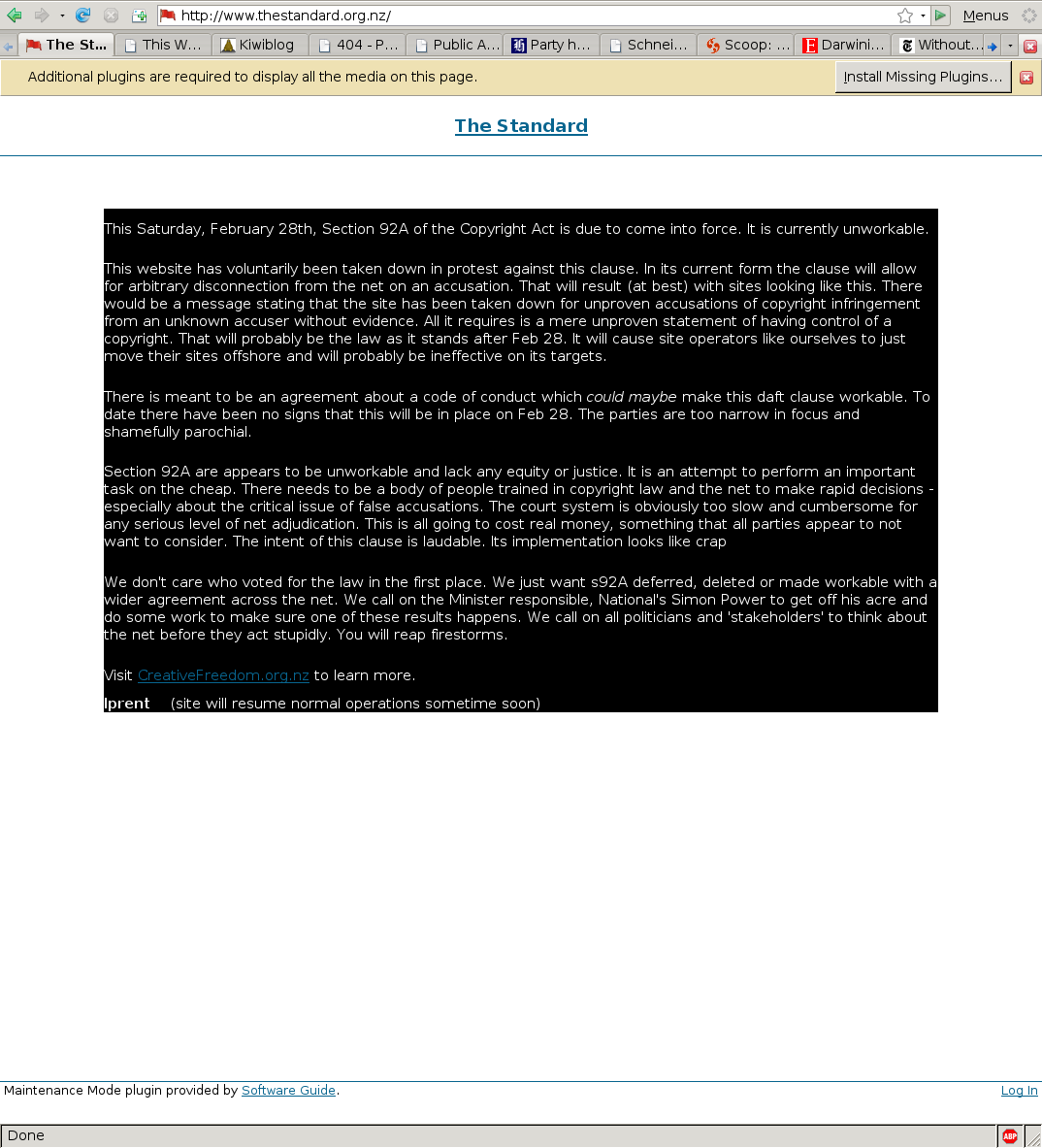
The Standard [shot] – Nuked the colour scheme and all content, but didn’t make it black! C+.

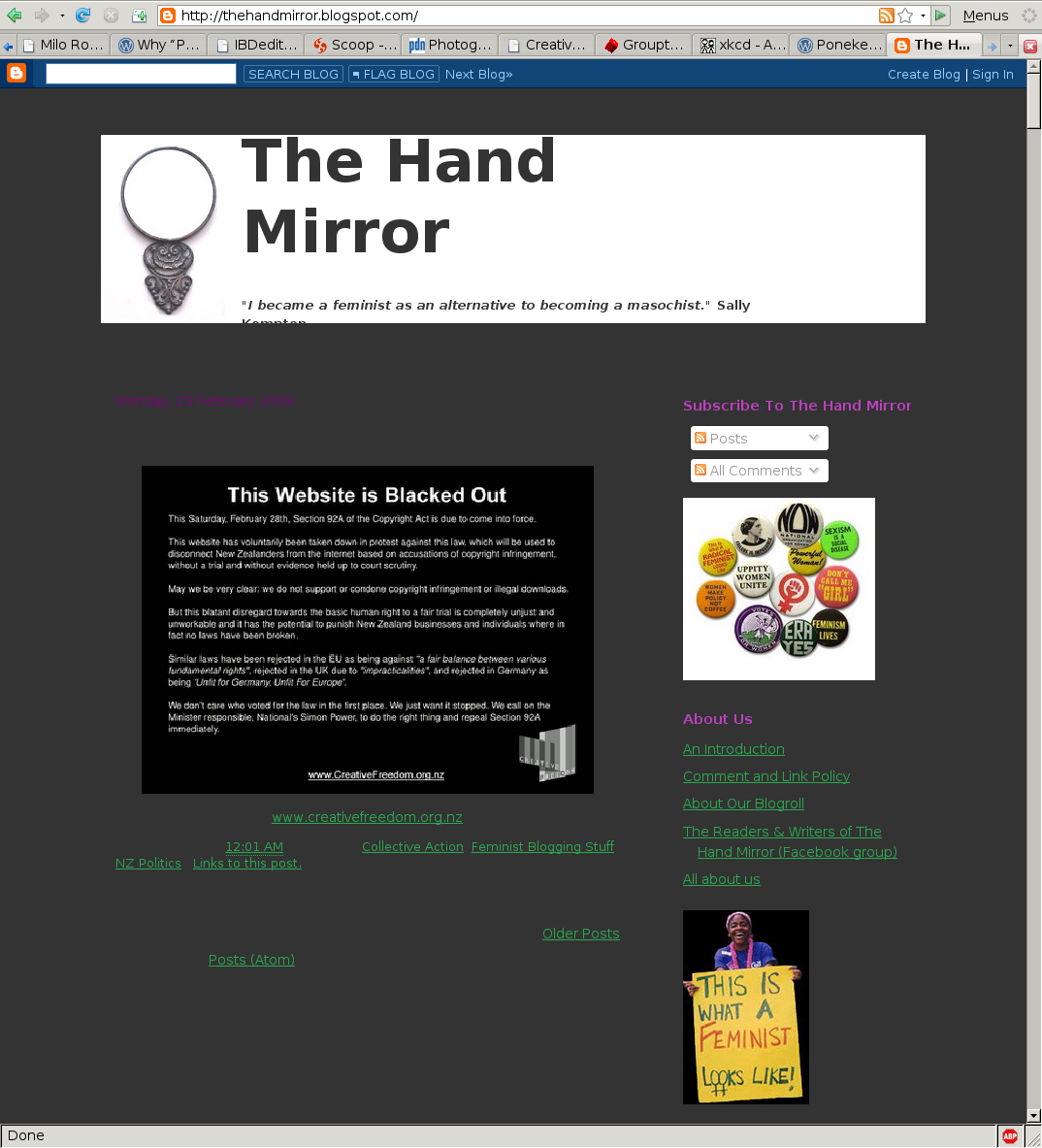
The Hand Mirror [shot] – Changed the colour scheme, but didn’t make it black. Page looks like it’s been haxx0red. Content still there too. D+.

Scoop [shot] – `404 Page Censored’. Mixed messages, but 404 is the http error meaning `file not found’, and this is what we’re looking at under s92. Requires people to engage (which they might not), but `page censored’ is a strong statement. A.

Not PC [shot] – Weak. Clearly not an important issue. D.

No Right Turn [shot] – Stock CFF page, nothing else. B.

noministerNo Minister – Partisan hackery plus no blackout and all the content still there – only the animated gif. Minor points for leaving up a full explanatory message. Not quite worse than useless, but almost. D-.

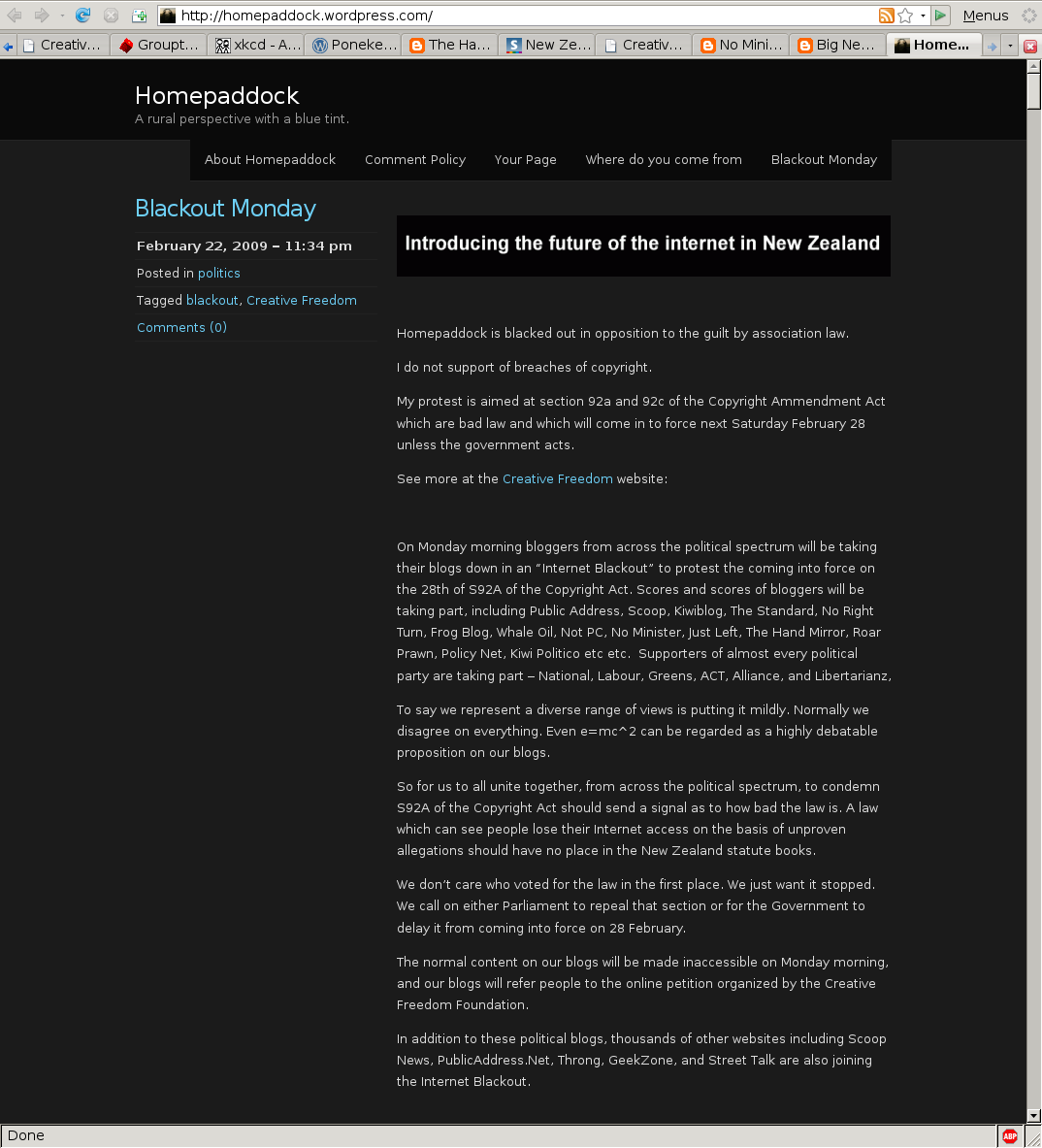
Homepaddock [shot] – Customised blog post and theme, which gets the full point across well. Content remains, however. C.

Macdoctor Moments [shot]- Properly blacked out, but busy and complicated design obscures the message somewhat. B-.

cbtpCapitalism Bad, Tree Pretty – Properly blacked out, Dylan Horrocks cartoon instead of s92 message is a nice touch. B+.

Kiwipolitico [shot] – Stock CFF page, nothing else. B.

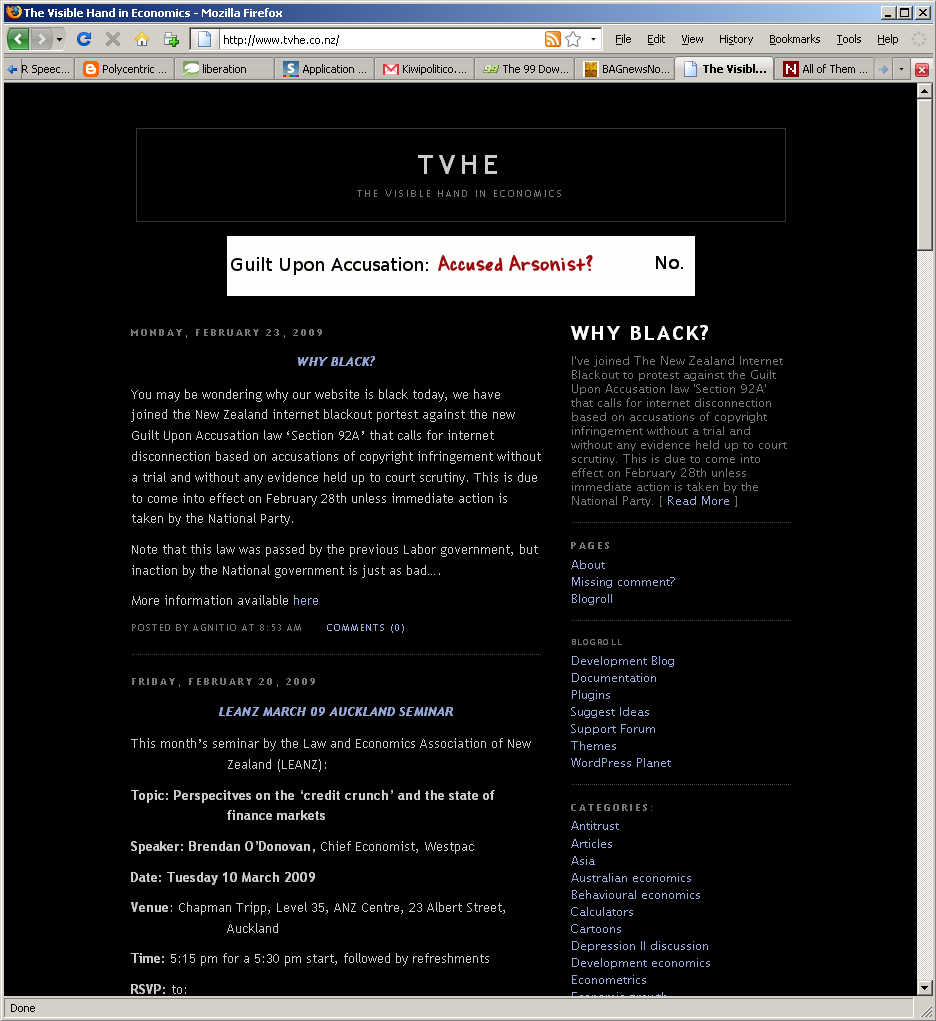
TVHE [shot] – Blacked out, but content remains. C.

frogFrogblog – Nice work on the theme, but content remains and the advertised cartoon isn’t actually showing. C-.

BK Drinkwater [shot] – Yeah, it looks like a plain black page, but that’s just because I took the screenshot while the animated GIF was all black. No other content. A-.

Monkeys With Typewriters [shot] – Animated gif and all the rest of the site as usual. D-.

Tumeke! [shot] – Just the banner; the rest of the page links through to CFNZ. Vivid, but not obvious. B-.

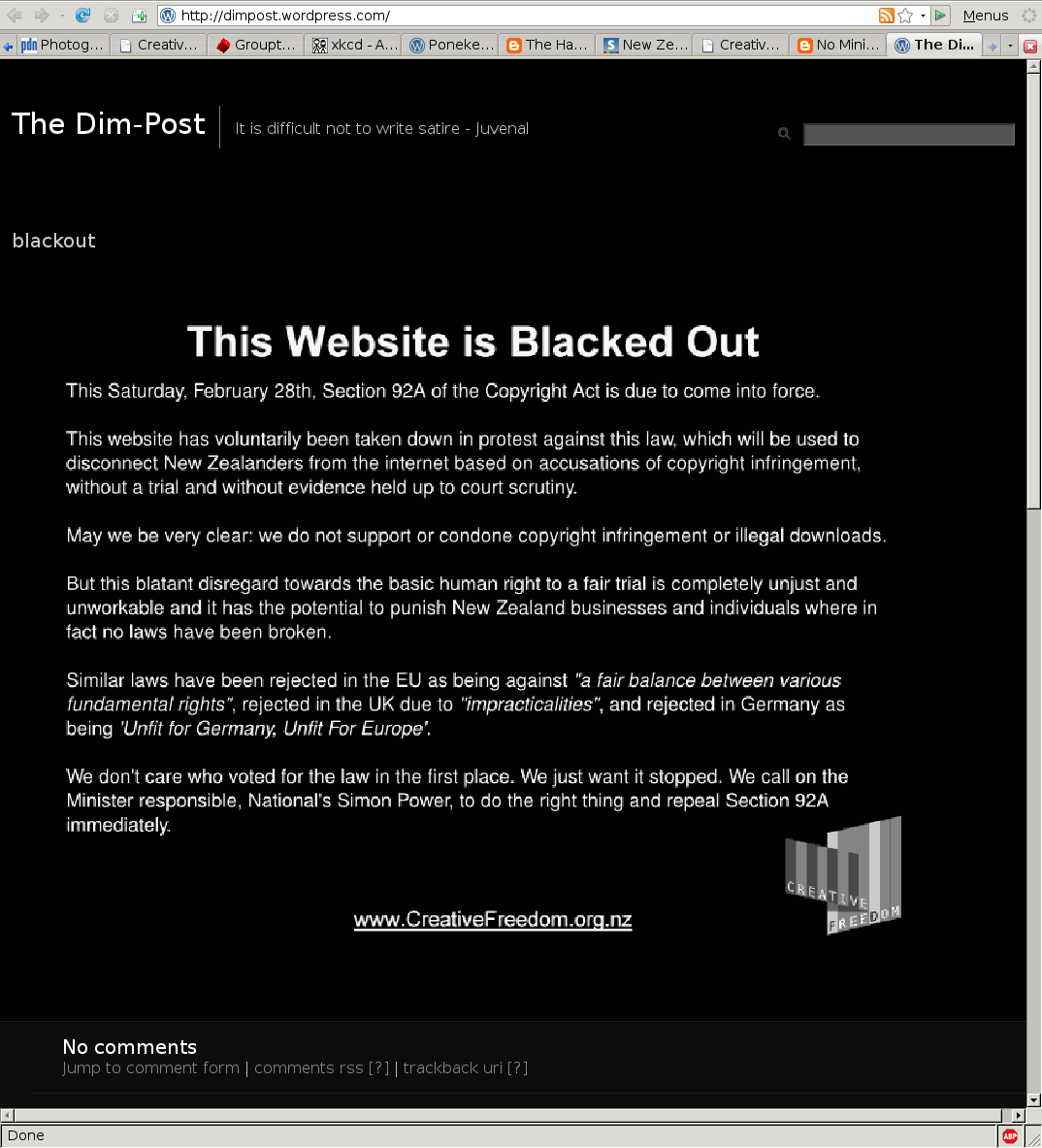
The Dim Post [shot] – Stock CFF page. B.

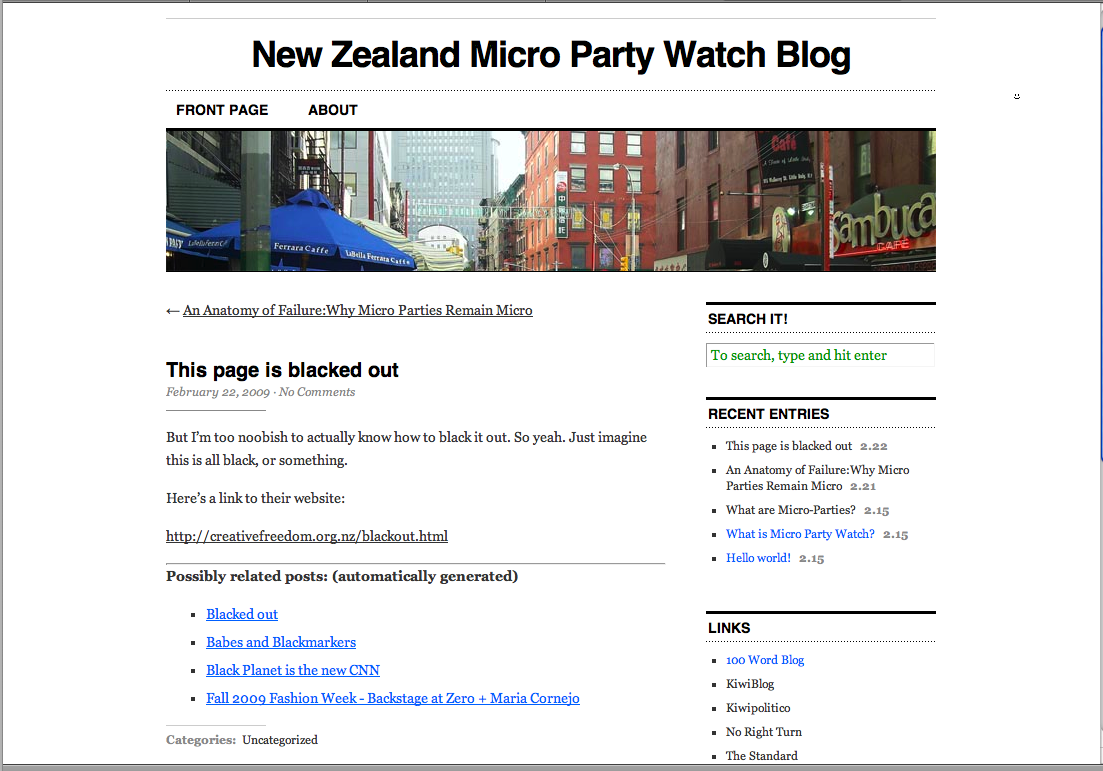
micropartywatchMicro Party Watch – Technical fail, but at least done with some humour. D.

I haven’t rated those who didn’t participate – they all just get `F’ for `Fail’. Also, these are just the sites I got around to checking – add others below, if they’re notable.