Insensitive … now wait for the “hypersensitive”

Commenter Alexandra at The Standard picked up on a report by Radio NZ that John Key joked about Tūhoe as cannibals:

“The good news is that I was having dinner with Ngati Porou as opposed to their neighbouring iwi, which is Tuhoe, in which case I would have been dinner,” [Key] said, “which wouldn’t have been quite so attractive.”

Now, a reference to cannibalism in any leader’s speech is bad enough, but joking about it in the context of the government’s betrayal of TÅ«hoe, and Key’s failed attempt to speak for the māori party regarding that betrayal would be absurd if it wasn’t so insulting. Not only that, but the reference to Ngāti Porou was all the worse, given the complex history of those two iwi, which was also in the news recently but of which Key appears to have no awareness.

Two main questions occur to me: first was this a calculated move to distance himself and the government from the sense he has “gone native”, or just an idiotic off-the-cuff remark? (Essentially: bad will, or just incompetence?) And second, what will it take to prevent the māori party from walking away? As Marty Mars says, this is a significant matter of the mana of TÅ«hoe, and the mana of Māori in general. It cannot just be left to lie: either the māori party walks away, or some sort of meaningful reparation — you might call it “mana enhancement” — must be offered by the government, not only to TÅ«hoe and the party, but to Māori in general. The māori party are in a tough spot; as I argued yesterday, Māori don’t have the luxury of just throwing their toys whenever they don’t get their way. But something has got to give.

Oh, and as per Pākehā Standard Operating Procedure on issues like this, wait for the Māori response to be declared hypersensitive.

Update: Same being asked by Lynn at The Standard.

Update (20:25) Much has become clear since I wrote the post. Some updated thoughts follow.

First, it’s clear that this wasn’t an inadvertent, casual comment — it was, if not a planned and sanctioned statement then clearly a calculated one intended, after apparently growing discord at the Lower North Island National party conference this weekend past, to win Key and the government back some of its reputation for driving a hard bargain with Māori, and for not being a PC pounamu-wearing hand-wringer. So the initial diagnosis is “bad will” rather than “incompetence”. This was a simple continuation of the negotiative process which Key chose to stall by unilaterally ruling out the return of Te Urewera National Park; Key providing an opening for TÅ«hoe to continue dialogue, or not.

Second, it’s pretty well-calculated. It would have been easy for TÅ«hoe (and others) to publicly overreact and confirm Pākehā New Zealand’s worst instincts about them. It would also have been easy for the māori party to walk away from the coalition deal, and I do think this is another factor in favour of that course of action. But they haven’t done so. Tamati Kruger’s response that the joke was “not funny, in poor taste and unbecoming of a prime minister” is pretty strongly-worded but shows its own sort of gallows-humour, indicating that Kruger (seasoned negotiator that he is) understands the game being played, and is prepared to continue playing it, given some caveats. Having today said that Key had lost his nerve Kruger has held his. He was magnanimous and humorous when speaking to John Tamihere and Willie Jackson about the topic on RadioLIVE this afternoon, but pretty clear that the deal is still to be closed, and it will now take some closing.

Third, Key has publicly insulted both TÅ«hoe and the māori party in the past week, and this does still need to be addressed. All parties seem to have chosen to address it around their respective negotiating tables, rather than in public, but behind closed doors these people will be furious at having been so treated, and for all that they’ve gained ground with the redneck street, that’s ground National will need to make up inside the wharenui. To put it in terms Key, as a former currency trader who worked a lot in Asia, would understand: the price of doing business just went up. And it went up quite a lot, because failure to accede to that increase means TÅ«hoe can now justifiably walk away from negotiations which are already almost two years underway, claiming that the negotiating team has no legitimacy, having been unilaterally overruled by their own prime minister, apparently just because he changed his minds. If they do that, expect every other current negotiation to go the same way. That’s an unacceptable political cost for Key before the next election, let alone the one after (by which all outstanding claims are supposed to be settled).

Fourth, a public sense is beginning to build of Key as the one who is endangering the relationship, after the opposite sense developed around Hone Harawira’s comments last year. If the coalition between National and the māori party fails, it will be seen as his failure to manage the relationship adequately, and that damages his own master narrative of being an efficient political manager and an all-round nice guy. As marty mars said in another comment on The Standard, the concessions granted to Māori by Key’s government are “barbed” — they can’t be revoked or withdrawn without sustaining substantial political damage, which means that if the māori party sees genuinely irreconcilable differences and an opportunity to dissolve the agreement without being seen as unreasonable, they are able to do so. But as Neil says in the comment thread below, and as I’ve been arguing to little avail for ages, the māori party’s best play vis-a-vis either major party is the threat to go with the other. Labour partisans and much of the wider left wish it were not so, but if Labour get a sense that they have a monopoly on the māori party’s attentions again, then further concessions will be rare and threadbare.

Fifth, the KBR response is just what you’d expect, complete with gratuitous references to the alleged taste of human flesh, and ginga jokes. Sigh.

Thanks for the discussion so far. Responses to other comments below.

L

Public airwaves talkback


Normally Radio NZ National’s The Panel is a pretty sound — if somewhat fluffy — current affairs show, in which the panelists are ideologically fairly diverse (though not occupationally diverse; mostly celebrities, PR flacks, or newspaper columnists). They tend to leave aside their more extravagant views to engage in a fairly civil and reasoned manner.

But when The Panel happens to have two people of similar ideological views or a common background, it tends to turn into an echo-chamber of congratulatory backslapping. Today it’s nothing more than talkback for self-righteous wealthy middle-aged people who — since they’re listening to National Radio — think talkback is beneath them, but like to have a good whinge about how society’s going to the dogs anyway. The guests are private investigator Julia Hartley Moore and former cop and current Police Ten-7 presenter Graham Bell, and the topics for discussion (and general timbre) are as follows (From memory, so I may omit some, but you get the idea):

  • TV harmful for very young children: “We never had TV in my day, we went outside! Parents are using TV as a babysitter! Never did that in my day! TV is rotting childrens’ brains! There’s no excuse for ever doing anything other than what’s perfect, we always did!”
  • Cellphones used to arrange and record fights: “I told you cellphones were bad, never come to any good, those things. We never had cellphones in my day, and even if we had them we’d never have gotten into fights. And even when we got into fights, it was all posturing, really, and nobody ever actually got hurt. It’s the parents’ fault, letting their kids watch TV.”
  • Kent State massacre 40th anniversary: “Yeah, that was pretty bad.”
  • People throwing litter from cars: “I can’t believe people do that, and people with flash cars as well! Never would have happened in my day.”
  • Young people should be allowed to drink because they can vote and fight for their country: “I don’t think they should be allowed to do any of those things! In my day we got a bit pissed, and some of us still do, but that was different. These new alco-pops are ruining society! I blame the parents, what are they doing about this? Disgraceful.”
  • No service at service stations: “PC OSH nanny state gone mad! Old ladies having to check their own oil and water? Total bollocks! Teenaged attendants who only take your money, was never like that in my day. And don’t get me started on pre-pay pumps…”
  • Hypochondria: “I blame the internet, and the expectation that the medical profession can just provide a magical pill which will fix everything!”
  • Roman Polanski reckons he’s done his time for drugging and raping a 13 year-old girl: “No way, he’s been living the good life. Throw the book at him — hang him high!”

Well, I sort of agree with the last one. But this is the sort of reactionary love-fest we expect from the rest of the opinion media, not from Radio NZ. It’s not the conservatism I can’t stand; it’s the absence of reflection and the naïve belief that the world really is that simple.

Update: To demonstrate the extent to which I’m not exaggerating, you can listen here.

L

Current events

I was reluctant to post while I had the chance on ANZAC day, since there was such a good debate going on, and now I’ve (temporarily) run out of time again. So just a few quick observations.

  • Phil Goff’s one-two punch on the top tax rate and Auckland governance is solid, and both are good orthodox Labour positions for him to take. But it’s more of the same: lacking verve and failing to get cut-through as a consequence. I mean to post on the positioning of the taxation pledge at some stage, but in case I don’t get to: this is a good opportunity for Goff to demonstrate compromise as well as differentiate himself, by coupling a reimplementation of the top rate with an increase of the threshold.
  • Even without Sunday’s tragic helicopter crash, Goff’s timing was poor in making these two announcements before ANZAC Day. I guess you take the opportunities you can get, but delaying things by a week would have been more useful in my view.
  • As an aside, my mum knew the three late airmen vaguely through Search and Rescue, and confirms the universal sentiment that they were of the very best sort. I’m pleasantly surprised that the crash hasn’t turned into a witchhunt about why we’re still using Vietnam-era hardware; as true as the sentiment might be, we can all do without people thundering “if we’re going to have a military, we owe it to our troops to have it decently-outfitted” under circumstances such as these. Such is the power of ANZAC day, I suppose.
  • On a related point, the discipline with which the military, government, police and media have adopted the Air Force’s framing terminology in this event is remarkable. All four groups are talking about “the Air Force family” and exploiting the metaphor for all it’s worth. Those words are used almost every time one of these people stands in front of a microphone, and in addition the three deceased are “brothers”; Mark Sainsbury reported live last night from the family’s “lounge”, the squad room at Ohakea air base; all four have referred to the Iroquois as being like “your grandfather’s axe” — the reference being that, although it’s very old, when the handle is worn it gets replaced, and when the head is worn it gets replaced, so while it’s his axe in spirit, it actually contains no parts of the original tool and is as good as new in function. On the one hand, this is compelling symbolic stuff: nobody who deviates from this framing can really be said to be showing the proper sort of respect and deference; on the other hand, it’s a bit creepy for everyone to be falling into lockstep behind Defence HQ communications. There are ways of saying these things without using the exact same words, and the constant repetition spooks me. Maybe I’m just sensitive. [Edit: There was a clean sweep for “Air Force family” or something similar in speeches supporting the Prime Minister’s parliamentary motion of condolence. No shock there, I suppose.]
  • On a somewhat lighter note, Councillor Tony Jack has picked the wrong district council to put a motion banning macrons in council materials. This is the Kāpiti Coast District Council, who moved to put the macrons into Paekākāriki and ÅŒtaki only a month ago. Jack’s motion was voted down, at which point he predictably declared that PC had gone mad. Bless. Of course, the Stuff article doesn’t contain the macrons, so I guess he wins as far as that goes.
  • Tim Watkin at Pundit continues to write excellent sense and ask smart questions about race relations in Aotearoa New Zealand. I think the emphasis in Tim’s piece is just right — there is a legitimate claim to indigeneity for non-Māori, but it’s not so obvious as Trevor Mallard’s “I was born in Wainuiomata”, and there’s a lot to work out before such definitions can be settled upoin comfortably. I’m all for having this discussion. I particularly like the ornithological allegory drawn by commenter “william blake” — we are all PÅ«keko!
  • Also on a lighter note, a (very) atheist friend whose six year-old daughter has chosen to go to Bible study classes recently asked him if, because Jesus had risen from the dead, that meant he was a zombie. It apparently took every ounce of his parental commitment to letting his girl make up her own mind to explain the origins of zombie stories, how myths come about, etc. rather than just saying, yes, Jesus is a zombie. Good on him — not sure I would have had the fortitude.
  • Speaking of things biblical, and of belonging, Joanna Newsom has a new album out, and here’s the first single — about tilling one’s own bit of the Garden of Eden:

Ok, so not so brief after all. Discuss. I’ll dive back in as I can. You can treat this as an open thread as well: post what you want to talk about.

L

Perspective and colonial counterfactuals

It’s hardly the stuff of rigorous historico-social investigation, but Simon Schama sees much to celebrate in NZ biculturalism — particularly in comparison to our Anglo comparators:

But it’s the story of Maori and pakeha, the settlers of European origin, that – for all the pain, betrayals and suffering – still deserve to be known and celebrated as offering a different model of cultural encounter than anywhere else in the world. […] Of course there have been serious problems of unequal social opportunity, of street gangs. But if there is anywhere in the post-colonial world where two cultural worlds truly live an engaged life alongside each other, it’s in New Zealand.
Such stories don’t come along very often. Cherish them. Chant them. Dance them.
Upane upane, kaupane, whiti te ra! Up the ladder, up the ladder, the Sun Shines.

This is broad-brush stuff, and minimises the genuine grievance and disquiet which exists on both sides of the cultural divide — his “divided no longer” caption to a stock photo is altogether too pat. And his assessment of Paul Holmes as a “tough” and “a reproach to dozy thinking” is marginal at best. But Schama’s observation that what we have in this country is quite unlike any other postcolonial nation is exactly right. It provides a glimpse at what might have been been elsewhere, and what might have been here if the post-Treaty settlement had been undertaken in better faith.

This raises a question Pablo and I discussed in email after he wrote this post (I didn’t want to hijack the excellent discussion there): do those who hate and fear Tino Rangatiratanga and consider the Treaty a “simple nullity” really believe that the people of Aotearoa — of all colours — would be better off if the typical colonial counterfactual were true — if Hobson’s marines and settlers had simply driven the natives into the sea or exterminated them as animals? In my email to Pablo, I wrote:

I’ve often argued (as a wind-up or a devil’s advocate position) that the Māori are ungrateful whingers who don’t appreciate what an incredibly good deal they got from Hobson, and that NZ would have been better off if Europeans had just landed with boatloads of armed soldiers and done to the natives what they did in the rest of the world. Anything for a peaceful life. What’s interesting is that, even when discussing the topic with people who genuinely believe that the Treaty is a gravy train and the natives are taking the piss and actually are ungrateful, they generally balk at this suggestion. That consent [given by the colonised to the colonisers], however fraught and limited, is important to how we see ourselves. That’s one of the reasons I’m generally pretty hopeful about the bicultural future.

I expressed somewhat similar views in comments to this post of Chris Trotter’s a short time later. Neither Chris, nor the other commenter to that post (RedLogix, with whom I’ve had robust but usually cordial disagreements on this topic) responded to my comments, which I took as a sort of confirmation of my thesis.* As I say, this is the usual response to the argument I’ve made many times before — all but the most unrepentant rednecks are repelled by the view that colonialism NZ-style was worse than what might have happened if we’d undertaken it Australian-style. This indicates to me that even for those who are highly critical of it grudgingly accept that the Tino Rangatiratanga movement, Waitangi Tribunal and attendant concessions to Māori in our political and social systems are better than the counterfactual alternative of a white monoculture in the South Pacific, even if it were more peaceful. The importance of this for a bicultural future is profound.

L

* I don’t want to put words in Chris and RL’s mouths, though — it may be that they simply thought my remarks too ridiculous to bother engaging with. Happy to accept clarification on this point.

(Schama article via Tim Watkin at Pundit. Thanks! And as it happens, Idiot/Savant at No Right Turn has excerpted it as well.)

Consider the birds

In the USA, the Spotted Owl evokes the spectre of trivial busybody environmentalism. This species has been extremely well propagandised by the forestry lobby and other anti-environmentalists as a symbol for “putting other species ahead of humanity”. But it is not so in New Zealand (although there is Powelliphanta augusta). For a hint of what the public response to Gerry Brownlee’s plan to mine Schedule 4 of the conservation estate could be like, look no further than the firestorm which has erupted over the YouTube video showing Norwegians shooting protected native birds, among other things.

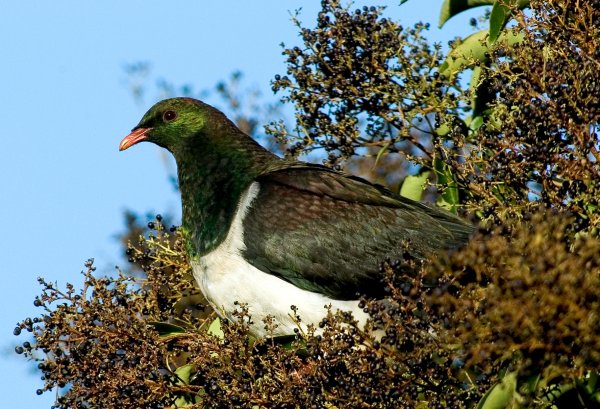
kererū

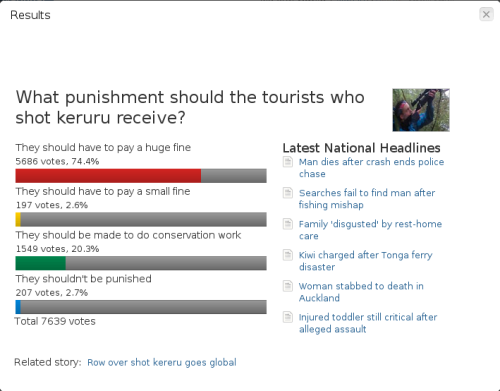
This has been a pretty persistent story. It’s been at or close to the top of the Stuff “most read” list for going on three days now; at the time of writing, it’s #1. It’s third on the NZ Herald website’s NZ section. It was in almost every dead-trees paper with a national news focus in the country on Friday. It’s featured prominently on One and 3 News (and consequently RadioLIVE), Radio NZ National, Newstalk ZB, and is at present the third-placed story on English-language Norwegian news website News and Views from Norway and has made Norwegian-language mainstream news there too, as well as action from Norway’s own environmental agencies. It’s drawn outraged official comment from DoC and the Conservation Minister; but notably not (as far as I can see) from the Minister of Tourism. There are 400-plus infuriated comments on the original YouTube clip, and 300-plus on the Fish’n’Hunt Forum, the oldest and most popular NZ internet site for discussion of hunting and fishing topics. Stuff.co.nz has a poll up, and the results are quite clear, for what they’re worth:
stuffkererupoll

This outpouring of righteous fury has not come about because of the death of a few birds. None of the species shot by these hunters are so close to extinction that the loss of an isolated handful of individuals will critically harm the population. The reason for the response is that this sort of thing offends us deeply and personally. It is antithetical to who we are as New Zealanders, and it is as if a little part of each of us dies with those birds.

I wrote a few days ago that the task for the opposition, for conservationists and those who love the land and its wildlife was to relegate mining Schedule 4 to the “political too-hard basket”. More specifically, that task for those people — and for the 74% of (notoriously reactionary) Stuff respondents for whom these events are a grave injury — is to see the proposal to mine Schedule 4 as the same thing on a much greater scale, which it ultimately is, and to respond in kind.

Update 30 March: A vivid event like the one discussed above often primes the media and public to pay closer attention to similar events which previously might not have been newsworthy. Dog attacks are a case in point. So it is with this case: the release and eventual death of a weka, hardly endangered but well-loved, from Hagley Park, is now news.

L

Heartless commuters


Image used without permission (but with thanks!), by David Fawcett.

Earlier in the week, while having lunch with Pablo and his partner (and a good time it was, too), I mentioned that I’d been meaning to blog about the shambolic state of Wellington’s rail network.

Without straying too far into Poneke’s territory, I catch the train frequently, and rarely does a week go by without some sort of unexplained service failure, mysteriously absent or egregiously late train — sometimes but not always replaced by a bus, or a random stop in the middle of nowhere for half an hour or so. I’ve spent a lot of time — weeks at a stretch — on trains, mostly in Asia where they’re cheap and reasonably comfortable, range in speed from 50 to 350 kilometres per hour and are often simply the most efficient means of getting around.

Let’s just say that almost none of these things hold true in New Zealand. And out of respect for the look of incredulity those two Aucklanders gave me when I mentioned the Wellington network, I won’t complain too much about it, but instead draw your attention to this incredible blog about the travails of taking twins on the Auckland trains. Now, I don’t care much for mummy-blogging, but this is serious in a country which considers itself to civilised and populated by friendly and open people:

So on Thursday night it was with resignation that I saw that most of the seats in the wheelchair section were taken. True to form, most of the passengers carefully ignored us, though if they had just squeezed up a bit there would have been room to lift a seat up and park the twins. Instead I put the pushchair in the doorway (carefully working out which door on the express train would not be used until my stop in Papakura) and sat on the floor. I’d been on the go for 11 hours already, and Finn was awake and fussy. I sat him on my knee and talked to him to keep him happy and quiet. I’m well aware that other people don’t want to listen to grumpy babies on their way home, so I work damn hard to keep them entertained.
The passenger operator for our carriage, an older Indian man, had been up and down the aisle without comment several times. Shortly before Manurewa, three-quarters of the way home, Finn got hungry. I started breastfeeding him, this being what you do with hungry babies. Suddenly the passenger operator freaked out. He finally asked the passengers to move, since we could not sit there! We had to move! It was for security reasons! We had to move now!
I asked him to wait two seconds, as I knew Finn was nearly finished. The PO pulled the pushchair with Vieve asleep in it away from me and the door, then left it in the middle of the aisle without the brake on, leaving me to try to detach Finn hurriedly and discreetly, stand up on a moving train with a baby on my hip, stop the pushchair rolling away with my foot, lift up a seat and secure it, and park the pushchair.
I was angry, but at least I had a seat, and the bubs were out of the way. And then the PO CLICKED HIS FINGERS IN MY FACE, stormed past and slammed the carriage door.
Apparently he went to get the train manager, as next thing I had another large angry man in my face. Who told me I wasn’t entitled to be on the train with my children.
When I challenged him on that, he backtracked to say that I was endangering my children by taking them on the train when there wasn’t room, and he would never take HIS kids on the train like that. (Presumably, if I’m allowed out of the kitchen, I should hang around in town until 8pm when the trains are emptier?)

One thing about trains everywhere I’ve used them — even in China, which is among the rudest countries in the world — is that people tend to look after the frail and elderly, and women with babies,as a matter of some sort of civic responsibility. This is true to an extent on the Wellington buses and trains, so Auckland public transport users, what the hell is your problem? Is this the neoliberal atomisation about which people have been ruminating of late, or what?

L

Are we?

While at the Save Radio NZ lunch-at-parliament today, it occurred to me that we’re probably the only country in the first world where you’re allowed to climb the trees on parliament grounds. Is this true?

If so, I think it says a lot about us.

L

The glow of the furniture, piled high for firewood

There’s been much analysis, wisdom, whimsy, and snark about Gerry Brownlee’s plans to mine the conservation estate. But rather than talk about it, I’m going to repair to a rather dubious poll from stuff.co.nz:

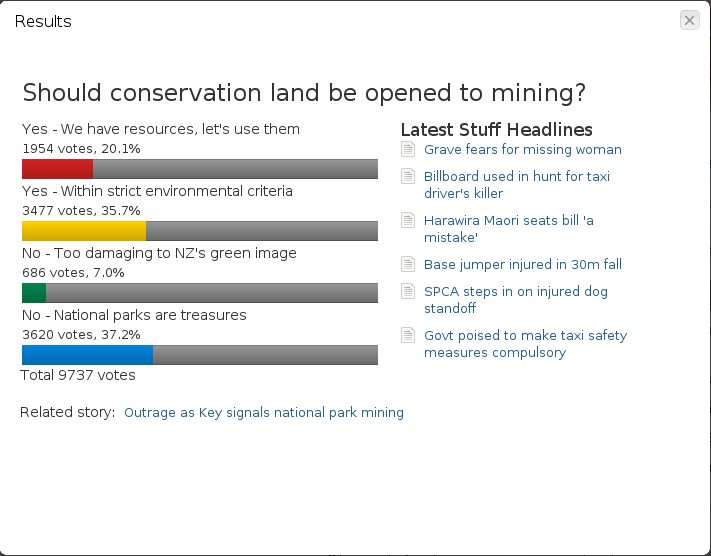
stuffminingpoll

Two things are interesting about this poll. First, for an internet poll, the options are uncharacteristically nuanced. This leads to the second interesting thing: these results are deeply incoherent.

I’m going to work from two assumptions (both of which are pretty arguable). First, I’m going to go out on a limb and assume that stuff.co.nz poll respondents are pretty similar to NZ Herald poll respondents and the commenters on “Your Views” and Stuff’s equivalent — putting it very charitably, let’s just suppose that they’re somewhat further economically to the right, less environmentally conscious and with stronger authoritarian tendencies than Gerry Brownlee. Second, I’m going to assume that a poll like this should break roughly along partisan lines, since it’s a government policy opposed by the opposition, part of an overall strategy to mimic Australia, a complex topic of national significance with which people generally have little first-hand experience (the sort of thing they tend to entrust to their representatives), and the poll answers are heavily propagandised using the government and opposition’s own sorts of terms.

The poll result is incoherent because it doesn’t break along (rightward-slanted) partisan lines, although it initially looks like it does. A total of about 56% of respondents approve of mining in principle, and this is roughly what I would expect given this framing, the current government position on the topic, and the demographic characteristics of this type of poll. It’s what the government is banking on in terms of support with this policy: if it drops much lower, they’ll probably back down. But where it gets incoherent is in the other two options. The third option (“too damaging to NZ’s green image”) is about what the Green party is polling, and the fourth (“National Parks are treasures”) is about what the Labour party wishes it was polling. That’s bass-ackwards, because the third option is the Labour party’s actual position on many environmental matters (even Carol Beaumont’s passionately-titled post falls back on NZ Inc. reasoning), while the fourth position is the Green party’s actual deeply-held position of principle. A second source of incoherence is the political framing of the second (most popular) question. By definition, if conservation land is mined it’s not being conserved any more.

Both Labour and the Greens have huge opportunities here, but they need to position themselves to properly take advantage of them. Labour, for its part, needs to tone back the NZ Inc. reasoning which plays into all the assumptions of the second question: that it is a simple trade-off of one type of economic value against another type and come out looking good on the margin. This is classic trickle-up politics, rationale which appeals to the brain instead of the gut. The people who are picking options one and two probably think they’re doing so on solid rational bases: more money, more efficient use of resources, etc. — but the real reasons are probably more to do with ideology (mastery of the environment) and nationalism (catching up with Australia). Labour’s best move here is to appeal to peoples’ identity: New Zealanders think of themselves as people who live in a wild and pristine country, and they like having that country to go and ramble about in (even if they hardly ever do it). The Greens could also adopt such a position, abandoning the wonkery for things which matter to people. Russel Norman tried with his speech in reply yesterday, but I swear, whoever wrote it needs the ‘G’, ‘D’ and ‘P’ keys removed from their keyboard. He needs to take a few hints from the team who got an organic farmer elected to the Senate in Montana on an environmentalist platform by telling him to stop talking about environmentalism and start talking about how much he loved the land. The Greens also need to rethink their deeply confused firearm policy, but that’s a minor thing. In a country with such a strong constituency of outdoorsfolk and wilderness sportspeople it’s an absolute travesty that the MP who represents the hunting lobby is the urbane Peter Dunne, and the only party who genuinely values wild places is represented by earnest city-dwelling vegetarians.

But Labour and the Greens can’t divide this constituency between them; they need to make this appeal positive-sum, and steal back some of those who voted option two. The way to do this is to attack the implicit logic of option two, the idea that you can mine something and still be conserving it, and to remove the idea that this sort of thing is for a government to decide, that it’s somehow too complex or technical for ordinary people to understand. This shouldn’t be hard to do — it’s a plain old political education campaign. But it requires framing and a narrative whereby reasonable people can really only bring themselves to choose the wilderness; causing them to lose faith in the assurances of the government’s “strict environmental criteria”. The narrative needs to be about who we are in New Zealand, and it needs to be one which appeals to socially-conservative rural and suburban folk who would never think of voting for earnest city-dwelling vegetarians even though they share many of the same bedrock values. It needs to be like the lyric in the title: we are burning our furniture, and that’s not what civilised people do. New Zealand is not a nation of environmental degenerates, except when insufferable environmentalist smugness forces them to choose degeneracy as the less-bad identity position.

This is an issue on which the left can win, because it’s already a pretty marginal issue for the government. It cuts against a long-standing bipartisan reverence for National Parks, and it cuts against New Zealand identity as New Zealanders see it. Even on what should be a pretty reactionary online poll, the government only wins by 6%. Turn one in six of those people around and the issue gets put on ice for good.

L

The “I” thing

iAs much as there are great expectations on John Key’s statement to Parliament today, the pressure on Phil Goff is only slightly less. He may not have the responsibility of running a country, but that’s the problem: little or nothing indicates he will have a country to run in the foreseeable future, the optimism of the activist left notwithstanding. Goff’s reply needs to be a game-changer; it needs to reframe the past year, foreshadow the coming “middle year” when the policy engine runs at full noise, and it needs to demonstrate that Goff has got some game and is willing to bring it.

It looks like Labour have just such an event in mind, but I have substantial misgivings about Goff’s planned reply to Key’s throne speech.

If the article in the Sunday Star Times is to be believed, the speech’s greatest asset will also be its greatest weakness: it’s to be delivered in the first person. There’s going to be a lot of “I have failed to” and “I should have” sort of statements coming out of Goff’s mouth which will undoubtedly be taken out of context, and on a more subtle level, it will reiterate the fact that Goff is in a pretty impotent position at present. Labour is disconnected from key constituencies, and there remains a perception that it still doesn’t really get why it lost. People will more naturally associate “failure” and “sorry” and so on with Labour than with National. The task of this speech and the coming months is to turn that around, but it will be hard work to sufficiently remind the audience that these things relate to Key rather than Goff himself, given that they’re coming from Goff’s mouth and because it runs counter to the established narrative about Key and what people want to believe about him.

He’s staking his own personal and political appeal against that of the PM. It’s a big risk, but hey, boldness is what’s needed. It’s not as if Goff has much to lose, and if he can make it work, it has potential to reframe the debate from being about the opportunities of the future to the missed opportunities of the past.

L