Horizontal versus Vertical Bigotry (somewhat revised but on point)

The national discussion about racism occasioned by Paul Henry’s ill-considered remarks have given me pause for reflection on the nature of bigotry. Although I claim no professional competence in the field, I offer the following by way of discussion points on theme.

Bigotry is the visceral attribution of negative traits to groups and individuals based on innate features, or the attribution of individual traits to perceptions of collective behaviour.  Most often, it is opprobrium directed at people for who they are rather than what they do. Racism is just one form of bigotry, which covers ethnic, religious, linguistic, gender, sexual orientation, mental state, physical handicap and other physical or cultural characteristics. It also has an economic component, as evident in the animosity between rich and working class beyond their often antagonistic positions within production. It can work deductively, where traits collectively ascribed to particular groups are attributed to all individuals in that group (e.g. all Latinos are lazy or take siestas, or all Jews are Zionist money-grubbers). It also works inductively, where individual behaviour or attributes are assigned to a whole group (e.g., I was cheated by a Chinese person so all Chinese must be cheats. Or, Chris Carter is a troughing, entitlement-addicted vindictive gay MP so all other gay MPs are the same.  Or better yet, because some Muslims are terrorists, all Muslims are (potential) terrorists). Above all, it is an expression of irrational fear and distrust of “otherness” phrased as negative stereotyping that can or cannot be rooted in a sense of historical grievance or sense of superiority.

Vertical bigotry is located in social hierarchy.Often rooted in socioeconomic class status but generally based on the social dominance of some groups over others, it is the attribution of negative traits to groups located below or above a particular reference group in the social hierarchy. Although most often visible in dominant group contempt for subordinate group characteristics, it is also evident in the contempt of subordinate groups for their dominators. One example of the latter is the general resentment of some members of indigenous groups towards descendants of colonial occupiers, be these Spanish, English, German, French, Portuguese or Dutch, and the attribution by these indigenous actors of collective guilt and attitudes on the part of colonial descendants. On the other hand, and much more prevalent, is the attitude of contempt of dominant groups towards subordinate groups and the attribution of negative cultural traits  to them (e.g. laziness, backwardness, savagery, etc.). 

There is more to the picture of vertical dimension of bigotry, but the point is that it is a two-way street, however asymmetrical the flow of bigotry may be, between dominant and subordinate groups in society. This is as true for capitalist as it is for non-capitalist societies (for example, Burmese treatment of ethnic minorities today or Chinese treatment of non-Han before and after the transition to capitalism), although capitalism tends to reinforce the non-economic stratification of society and the vertical bigotry that comes with it. What is important to note is that, contrary to the claims by some that subordinate groups cannot be racist or bigoted because they are historical victims of oppression, my view is that both dominant  and subordinate groups are quite capable of bigotry. Blaming historical oppression for “reverse racism” is just an excuse for but not a negation of it. Being justifiably aggrieved does not justify being bigoted.

Horizontal bigotry, in contrast, is the negative stereotyping between economically or socially similar groups. As classic case is the traditional loathing of Jews amongst Catholic and Protestant elites in Europe and North America, in which relative economic status of Jews did and does not preclude the use of pejoratives by Christian elites to characterise Jewish culture and modes of social interaction. Another example would be the animosity felt towards Europeans (read: whites) by Asian elites in a variety of countries, even though Europeans have been instrumental in the rise of the Asian “dragons.” Although this Anglophobic loathing may have its origins in 19th and 20th century Western imperialism, it defies the current state of global economic and political affairs, which has seen a reversion of the historical model and the evening of the socio-economic, cultural and political playing field between East and West. And yet it persists: whites are loud, hairy, dirty, smelly, promiscuous drunkards with a penchant for fighting (it would be tempting to insert some wisecrack about Ozzies or Poms here but I shall desist).

This form of bigotry is not confined to elites. Consider the animosity between African-Americans and Latinos (particularly Mexicans and Cubans) in the US, or the mutual prejudices of Maori and Pacific Islanders in NZ. Although it may be the case that such horizontal bigotry is not a generalised sentiment in any of these populations, it should be recognised that it does in fact exist, and by the mere fact of its existence it reinforces and perpetuates the vertical dimension of bigotry that serves as a non-structural barrier to subordinate group advancement in society. And here again, it demonstrates that members of historically subordinate groups can and are often bigoted in their approaches to others, including members of other subordinate groups as well as the descendants of their common historical oppressors.

Less readers think otherwise, I am not saying that any one group is more prone to bigotry than others, although that may be a valid point of discussion. Nor am I attributing bigotry to the majority of any one group, although it is clear that in some instances whole populations are socialised with primordial hatred of targeted out-groups regardless of the historical record between them. Finally, I do not equate bigotry with good natured yet sharp comedic parody, self-deprecation or barbed humour. For me, bigotry involves malice and malice posing as “humour” is what Paul Henry was expressing  when he made his disparaging remarks about a number of people or groups (including Mexicans, as it turns out) during the course of  his tenure on Breakfast.

Which brings up a very thorny question. Could it not be that Mr. Henry’s remarks evidence his anxiety about the vertical dimension of  NZ  bigotry becoming a horizontal contest of bigoted equals?

In any event, what I have merely tried  to do here is clarify my thoughts on the subject in light of my observations and experience in the hope that it serves as food for thought for those who may interested in such things.

Anchor me

Indian-born Hawkes Bay-resident overstayers Sital and Usha Ram are to be deported with or without their three children, who are New Zealand citizens aged eight and six. These are not ‘anchor babies’ in the US sense that that hate-term is employed; no attempt has been made by the Rams to mislead Immigration or to hide from the authorities, nor are they using their childrens’ citizenship status to thumb their noses at the powers that be. This is, for all intents and purposes, a model New Zealand family.

The children, as New Zealand citizens, have a “cardinal and absolute right of residence” according to a 2008 judicial ruling, which means they can on no account be deported. This is where they belong, it’s where they live, the only place in the world they can do so in full legality, since it is impossible to exchange their New Zealand citizenship for Indian citizenship until they turn 18 (and indeed, nobody can force them to do so).

As the article says, they face a terrible choice: return to India and condemn their children to a life of poverty, or return to India alone and leave their children behind. But it’s not really much of a choice: they can’t simply abandon their children in either sense. Fundamentally, the terrible choice is faced by the government, who must decide whether to tear a family quite literally apart, permanently. To demonstrate their loyalty both to their children and to their country and therefore to win this battle in the public view, the Rams need do nothing more than peacefully resist being separated from their children. Call the government’s bluff. Let Immigration enforcers tear apart mother and daughter, father and sons. Let them carry the parents bodily to the paddywagon, and from the paddywagon to the waiting aircraft. Let it be known that this is the government’s doing; their choice, not that of the parents. This is a chance to force the government to actually do the dirty work of eviction and deportation, to undertake the harsh deeds which their tough-on-everything rhetoric implies. And they should be forced to put their actions where their words are.

So my advice to Usha and Sital Ram is: invite John Campbell into your home. Let him and his camera crew be present at the time of the forcible separation; in your living room and at the airport, and let the whole world watch, and listen to the wailing. The narrative will be big bad Muldoonist Daddy State jack-boot dawn raids, breaking down doors and wrecking families in 2010 as in 1980, and the country will need to decide: is this who we are? Does this represent us and our aspirational, compassionate, multicultural society?

And, as Pablo suggests in his recent post about Paul Henry, it’s a question which needs to be answered.

Update: As usual it’s occurred to me that a poet has previously expressed my core argument in two lines:

Do not go gentle into that good night,
Rage, rage against the dying of the light.
(Dylan Thomas)

L

‘Ethnographic’ TV: compare & contrast

At the risk of courting Pablo’s disappointment, I’m descending briefly from lofty theoretical heights to make a few rather rambly observations about two new examples of ‘ethnographic’ reality television in New Zealand: How the Other Half Lives and Are You My Tribe? (both of which screen on TV One, Monday nights).

First, the similarities: Both shows follow a pretty well-established format popularised most thoroughly by Louis Theroux: ‘gonzo anthropology’ for the television audience. Both are journeys of discovery undertaken by middle-aged celebrities who have made their names and reputations by being all-round Kiwi blokes — former All Black Marc Ellis and broadcaster Mikey Havoc. Both have enthusiastically embraced their ignorance of those aspects of life in New Zealand which form their shows’ subject matter. Both possess the superficial characteristic required for such an endeavour: the ability to establish and maintain rapport with people whilst simultaneously objectifying them; or, put another way, the ability to make the objectification not seem quite so objectionable.

In HTOHL Ellis is explicitly using his status as a cultural elite to investigate defined sub- or counter-cultures within New Zealand society. In AYMT Havoc uses the same cultural elite status to gain entry to te Ao Māori in an attempt to make up for 38 years of having (as one Ngāi TÅ«hoe kaumatua put it) not bothered. Both Havoc and Ellis speak to — and for — ordinary Pākehā middle-class New Zealand; that swathe of folk who are, by any objective definition, in charge of the country economically, politically and culturally; and who yet harbour considerable uncertainty about whether they are or not. There’s an unselfconscious normative aspect to this; HTOHL’s blurb declares that Ellis “reckons he’s pretty normal” but in the show “he jumps the fence of normality”; the word ‘other’ is even in the show’s title. AYMT pointedly started with the most ‘scary’ iwi for its first show, which went to some lengths to emphasise TÅ«hoetanga as a distinguishing characteristic. So the clear subtext of both shows is to firm up that shaky sense of cultural identity by emphasising the fact that the cultural objects of his investigation — those, by definition, with a strong and distinctly-articulated identity — are on the margins, outside society’s norms and not really wholly accountable to them. The screening of the two shows back-to-back is a bit troublesome here; I’m vaguely disturbed by the equation of Māori with the sort of fringe subcultural ‘others’ which are the objects of Ellis’ investigations — Neo-Nazi survivalists, witches, born-again Buddhists and so on.* One of the key things the last few decades should have taught Aotearoeans of all hues is that Māori aren’t just another fringe group.

So much for the similarities. There are some pretty fundamental differences between these two shows, which are also emphasised by their consecutive timeslots. The first and most obvious of these is the specific objects and the host’s relationship to them. Ellis is lighthearted and superficial; he’s more interested in the gonzo than in cultural engagement, and the choice of fringe subcultures as his objects permits him to be flippant and dismissive when it suits. Havoc, playing for much higher stakes, doesn’t have this luxury: he can’t treat his objects as cultural curiosities or as a freakshow. He has to take his objects seriously, and this requires him to engage more deeply and more honestly with them than Ellis does, to put more of himself on the line, drawing more out from the objects of his investigation.

That difference gives rise to the second major difference: the presence and extent of judgement as to life according to ‘other’ norms. The heart of programming like this — and of comparative ethnography in general — is in the carefully-contained judgement of the investigator. The point is to examine the cultural fronts, where norms butt up against each other; and the key attribute of a host isn’t so much to be a jovial wise-cracking ‘good bloke’, it’s to do so whilst gaining genuine insight into where the cultural fronts lie, how they might be negotiated, and indeed whether it’s possible to negotiate them. This is a pretty rare quality; one which Louis Theroux has in spades and which permits him to make such eye-opening television: the objects of his investigation don’t feel like they’re being objectified. As a rule they are disarmingly frank, and sometimes frighteningly so. Theroux achieves this sort of dynamic by carefully constraining his judgement, but not abandoning it altogether. Theroux asks the question which needs to be asked and holds his own cultural ground, but does so in a way which does not threaten or attack his objects. Theroux refuses to become complicit in admiring whatever edifices of self-delusion his objects erect, but also does not make it his business to tear them down.

For all that Havoc exhibits maudlin and faintly embarrassing envy for the strong and rooted sense of identity possessed by Ngāi TÅ«hoe (honestly, how many generations will it take for people to realise that being Pākehā is not the absence of culture; it is a culture in and of itself!), he enters into the discourse in good and robust faith to find out what that identity is, and what it tells him about his own. His aim is not to disabuse them of their stranger notions, but nor is it just to impassively observe. Havoc puts himself in uncomfortable situations (such as powhiri and a raucous kitchen-table drinking session) but does not relinquish his own cultural ground, finding ways to ask the question — like addressing the fact that one in four young Māori end up in prison, and asking “how is ‘exclusive’ different from ‘racist’?” — and expecting good answers, without alienating those who must provide them.

Ellis, on the other hand, is not required to do anything more than the superficial, so he doesn’t. He exhibits a much stronger sense of his own identity than than Havoc does, but there’s almost nothing of it in the programme. His own reality is never challenged: the cultural front never emerges because instead of engaging and standing firm on his own ground, he withdraws into jocular trivialities, avoiding the conflict which is necessary for this sort of exercise. Discomfort is limited to banalities like sitting through three-hour chanting ceremonies and sleeping rough in the bush. He gets through the entire first episode of this season with Kyle Chapman, former leader of the National Front and probably New Zealand’s best-known neo-Nazi, without once initiating discussion about the ideological and racist foundations of Chapman’s Survive Club. What’s more, when one of the club members talks about how the ‘maaris’ — and Ngāi TÅ«hoe in particular — are the leading threat to New Zealand’s civil society, he fails to ask the question (in fact, judging by a posting on Survive Club’s website it seems that not being a “media hate monger” was part of the deal.) It takes a special sort of obliviousness to not remark on the irony of a group of racial-supremacist armed wannabe commandos training for the coming apocalypse in a remote part of the Southern Alps who think some other group are the real threat.

You don’t get to be Louis Theroux without asking that question.

L

* I can certainly see the counter here: Tūhoe training camps; rongoa Māori and modern religions like Hauhau and Ratana.

Depicting Julia Gillard

I’ll be watching with interest the characterisation — and caricaturisation — of Australia’s new PM, especially as compared to Helen Clark. Some of you might be aware that I once wrote a research paper on the characterisation of Clark by John Banks and Lindsay Perigo in talk radio during 2007. I was informed at the time that, via the usual academic networks, a copy made its way from Victoria University of Wellington to someone at the Australian National University in Canberra who had contacts within the then-Deputy Leader’s office, and that Gillard had read it with some interest. I’m not sure how true that is, but I do know she took a keen interest in Helen Clark’s public image, likely with this very eventuality in mind, so it isn’t altogether implausible.

The Clark-Gillard comparison is a natural one, due partly to geographical and temporal proximity; but also due to genuine similarities between their politics, manner and ascent to power. The comparisons have been highly ambivalent. The usual slanderers have already begun spreading the same ludicrous assertions that Gillard, like Clark, is a closet lesbian, on the grounds that she hasn’t had children and is more apparently bolshy than her husband. Apparently very deep in the closet, since she’s come out against gay marriage. (But then, she would, wouldn’t she?)

Peter Cresswell described her as Helen Clark with lipstick, which I guess is negative as to her politics but positive as to her perceived femininity, notwithstanding that Clark did in fact wear lipstick herself. Auckland University’s Jennifer Curtin pointed out some comparisons as to the two women’s assumption of their roles, though I can’t help but think she must have a more nuanced and complex position on the topic than was suitable for an AAP statement:

“They’ve both started off on the left but moved kind of to the centre of their party,” she said. They both appear to be hard workers, good speakers and have made similar choices in selecting their political allies and portfolios – opting to avoid women’s policies specifically. “If they represent women they do it in a more mainstream kind of way,” Curtin said.

Clark’s biographer Brian Edwards, speaking on ABC Radio National, outlined the similarities in more detail:

Well there are extraordinary similarities. I’ve been reading some of the reports about Julia Gillard in the papers here in New Zealand, and it’s absolutely uncanny, and what we’ve just heard is also true, that from the start, Helen Clark was a professional politician, she was absolutely focused, her intention I guess, long term, was to be prime minister, and she would do everything possible to do that. And if you look at the two women, as I say, the similarities are remarkable. Both unmarried, both decided, clearly, that being a politician and aiming to be prime minister did not go with having children, that was the decision, a positive decision which Helen Clark made, she and her partner, Peter Davis. Helen in fact, never wanted to get married and was actually more or less pushed into it by the Labour Party, and wept on her wedding day, which was relatively unusual. She was an atheist, she received some of the same sort of criticisms that I gather Julia Gillard has received in your country for her voice, she had a strong Kiwi accent, a rather deep voice; for her looks, people didn’t like the look of her hair, they didn’t like the look of her teeth; she was accused of being a lesbian, primarily by her opponents admittedly in those early days, and had an extraordinarily hard struggle to make it at all.
And these were all things that a man would not expect to happen at all in politics. None of those things would have come up if the man was a bachelor or was married or didn’t have any children, or any of those other things.

Clark fought these attacks, in part, by recourse to a “makeover” in mid-2005, when she appeared on the cover of women’s magazines — notably Woman’s Weekly — more heavily made up, more softly and sympathetically portrayed and generally appealing more directly to women, and to men who, if they had to be led by a sheila, wanted to be led by a real sheila. This was probably crucial to her winning the 2005 election. Gillard, The Australian tells us today, already has a similar glossy campaign well underway. It’s a good move. (Anyone who wants to call it fake or staged or a cheap trick or blatant media sycophancy to make such an appeal had better first recall John Key’s appearance on Gone Fishin’ (audio), and accompanying article by host Graeme Sinclair in — you guessed it — Woman’s Weekly. Incidentally, if anyone has or can find a copy of the video of that Gone Fishin’ episode, I’d love to see it. I missed it at the time.)

Other Gillard comparisons have also been made: to Margaret Thatcher (as Clark before her was), and to British Labour’s present acting leader Harriet Harman. In contrast with Jennifer Curtin’s observation that neither Clark nor Gillard emphasise their femininity in policy terms, The New Statesman‘s Alyssa MacDonald argues that the public treatment of Harman illustrates that it’s still not politically viable to be an overtly feminist female leader, even in 2010:

Both come from legal backgrounds, hold multiple political posts, have strong union connections, speak with distinctive voices and are always politically “on”. But while Gillard is popular and respected, Harman is often, very unfairly, spoken of as hectoring, dowdy and not very bright. Even before Gordon Brown’s departure, her chances of becoming Labour leader were the same as the number of forthcoming Harman biographies: zero.
Politically, there’s a glaring difference between Gillard and Harman. One has fought consistently for a feminist agenda, while the other has approached her political career with individualistic ambition. Not to do Gillard down — she’s very good at her job and she deserves her success — but her premiership isn’t necessarily any more of a great lunge forward for women than Margaret Thatcher’s was thirty years ago.
Meanwhile, Harman’s drive to push issues such as rape laws and the Equality Bill into the spotlight has undoubtedly been good for British women — and a huge contibuting factor to her unlovely public image.
Gillard’s success is still a symbolic step forward, signalling that the presence of women in Australian politics has become normal. And it looks likely to be good news for the country as a whole. But it’s not as if Australian women now have a Harman at the top to look out for their interests.

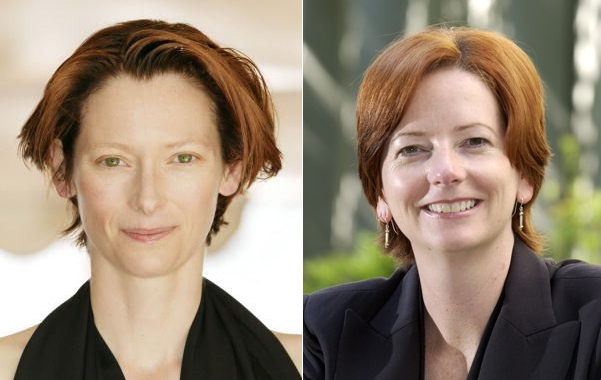
As MacDonald notes, Gillard is much more favourably-portrayed than Harman (and I would add, than Clark was at any point during her leadership). I think a lot of this is down to the “lipstick” to which PC refers: a metaphorical sort of lipstick which speaks to a particular notion of femininity, like the kind which Sarah Palin made famous. For one thing, Gillard’s attractiveness has been emphasised by the favourable comparison to Scottish actress Tilda Swinton:

This distinctive visage, the “bricklayer” voice to which Brian Edwards alluded, and her speaking style have been welcomed by the Australian media and satirical communities, who found Rudd “almost irritatingly bland”, according to editorial cartoonist Bill Leak. This from an article, also in today’s Australian on the topic:

Gillard’s wealth of striking anatomical attributes is almost too much of a good thing, says Cathy Wilcox of The Sydney Morning Herald and The Sun Herald. “She’s got so many features that if you just go for one, it isn’t enough. The challenge is how to get all those things in there without her head being enormous.”
Since Gillard took power, editorial artists have been studying her face with the obsessiveness of a lover, poring over photos and freeze-framing the TV to parse her every angle and expression.
Australia’s first female Prime Minister, seen through their eyes, has a “striking head of hair”, “incredibly beautiful skin”, eyes that manage to be simultaneously “squinty” and “big and distinctively shaped”, “chubby cheeks” with “pronounced cheekbones” and a mouth that “sits small and low” above “a small chin that tucks into an incredibly long neck”. Not even her earlobes escape attention.
And who else but an artist would notice that the new PM has “a reasonably ample bottom in relation to her head”?
But there is one facial feature in particular about which they all rhapsodise: Gillard’s “pointy”, “assertive”, “wonderful” nose. A nose, as Leak puts it, “that looks like you could chop wood with it”.
Fiona Katauskas, freelance cartoonist and producer of the Talking Pictures segment on the ABC’s Insiders, says Gillard’s nose is a defining feature that artists can utilise to express her character, just as the jutting lower-lip of former PM John Howard came to represent his determination, or obstinacy.
“I will take a punt and say Gillard’s nose will become the equivalent of Howard’s lip,” she says.

What’s interesting about all this is that, unlike most of the discussion of Clark and Harman’s appearance, it is robust but not unkind. Gillard’s relatively warm reception is being put down to her status as Australia’s first female PM, and I think there’s some legitimacy to that view; a genuine preparedness to “give her a go” tinged by a fear that bagging her too early would come off as sexist. We’ll see how long that persists, and how long her distinctiveness — of appearance, manner, and political character — is portrayed as quirky and endearing rather than bizarre and threatening.

L

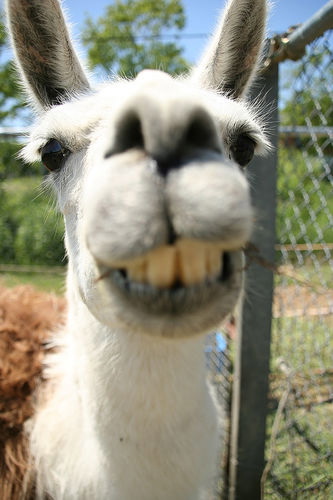
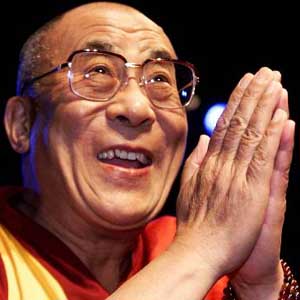
Of Llamas and Lamas

Public advisory, especially for DPF:

Llama


Lama


And to bring the post back around to the topic of Chinese authoritarianism and responses thereto, with a bonus llama connection: The Song of the Grass-Mud Horse made a splash a year or so ago, as a protest against the Chinese government’s internet “harmony” policy. The video is below (and contains necessary obscenity):

This graphically illustrates a point that shouldn’t need to be mentioned, but often does, and of which I was not fully conscious until I spent some time in China: for all that they are propagandised as such in the West, the Chinese are not simply mute automata struggling under the heel of their dictators. The public sphere, however constrained it might be by our standards, exists — and the diversity of views aired in it is increasing, not decreasing.

L

The dam breaks

“Where does the political correctness end?”

That’s the question from Michael Laws in response to the shocking news that local Māori are calling for “Rimutaka” to be changed to “Remutaka”. His dire predictions are coming to pass. The savage, foreign spelling of Whanganui has been coercively imposed by the forces of craven self-hating white PC liberality upon the good burghers of Wanganui — sorry, I mean Wonganewy — and now every Māori place-name in the country is going to be similarly stripped of the light patina of civilisation bestowed upon it by the linguistic touch of the God-fearing right-thinking settler.

As local councillor John Tenquist — or should that be Tinquist? — says, it’s always been that way for more than his 76 years, so that’s how it should always be:

What is wrong with the way it is? Once again we are pandering to a minority. We have some European heritage in this country and, rightly or wrongly, it has been Rimutaka for over 150 years, so if it ain’t broken, don’t fix it. The locals on either side of the hill will never change the name from what they have always known.

Of course. Those old people knew what they were doing back then when they changed the name. Wouldn’t have done it without a reason. Back in those days, they knew that eating at the dining table was the final bulwark against the collapse of Western civilisation, betokened nowadays by so much more than the creeping advance of Hori-fied place names. We are losing our grip, little by little. We even have to sing the national anthem in Māori — and the Māori version first, even though they didn’t write it! Our country’s most-trusted citizen and most-decorated war hero is a Māori. We’ve got a Māori flag, a Māori All Black team, and half our goals at the World Cup were scored by a Māori! I fully expect that by the time of the 2014 World Cup we’ll be fielding a team called the All Browns. In the unlikely event that we can qualify, given the well-known lack of footballing skill possessed by those not of European extraction.

And would you look at that: Mayor Michael was right all along. Once again, spearheading this frontal assault on all that is right and proper are those bloody river Māoris and their unpronounceable names:

The story behind the area’s name is that a Maori chief, Haunuiananaia, an ancestor of the Te Ati Hau a Paparangi people of the Whanganui region, left his home in southern Taranaki to pursue his errant wife Wairaka, who had run off with a slave.
During his journey, he sat down to rest on a mountain and think about his quest. He named the mountain Remutaka – which means to sit down.

The Mairist Republic of Whanganuistan draws ever closer. And we’re supposed to call the highest peak in the Wellington region after something some savage once sat his arse on?

It’s past time for New Zealand’s downtrodden, powerless, disenfranchised white majority to rise up, and let the clarion cry be heard: “Come and see the violence inherent in the system! Help, help, we’re being repressed!

L

From the Department of Random Ideas

How about Shane Taurima for Sean Plunket’s replacement on Morning Report?

A radically different style from Plunket, but he does have good interviewing chops, very extensive experience and strong credentials, especially in hard political news. His interviews with party leaders before the election were exceptional and demonstrated that he can’t be pigeonholed as a “brown issues” journalist. To my knowledge he has been scrupulously neutral with regard to politics, throughout both the present and previous governments. He is fluent in te reo, and has — dare I say — a deeper understanding of Māori issues than any other journalist who would be considered for the role. He would bring a marked change of style and perspective to the programme.

I am on record stating a preference for Radio NZ to elevate someone from within their existing journalistic ranks rather than head-hunting a star, but we sure could use some more Māori faces and voices in the mainstream broadcast news. There are a few: Julian Wilcox, Eru Rerekura, Willie Jackson, John Tamihere, Jenny-May Coffin and others all do good work, but at the fringes — on low-rating or niche channels, constricted bulletins and difficult timeslots, or in sports or talkback rather than proper news. There are a number of senior reporting and editorial/production staff — such as Duncan Garner, and Carol Hirschfeld’s departure from Campbell Live in particular is sorely missed — but all in all Mike McRoberts is the only Māori anchor of a mainstream news programme, and most people don’t think of him as such (which is in many ways a testament to his success).

Shane has just quit his job at Marae due to the impending format shift, and his role with TVNZ is apparently in doubt. John Bishara of Te Māngai Pāho says he must be “going to something better”, so I suppose one question is whether Morning Report is “something better”.

L

Brown still on the horse

Bless the Herald, burying the most important point of an article about the Auckland supercity mayoralty race at the very bottom:

Mr Brown also spoke of leadership and the need to deliver a resounding majority for the mayor so he or she could sit there with the mandate with the support of the community. [sic]
Judging from the mood of the meeting [in Point Chevalier], he won a resounding victory last night.

It seems remarkable to me that Brown could beat John Banks “resoundingly” in gentrified Pt Chev, of which (as I recall) Banks is himself a long-time resident. But then, I don’t know Auckland very well, and perhaps I’m misreading it. Is there something I’m missing or is this actually a biggish deal?

It apparently counterindicates DPF’s and Hamish Collins of No Minister’s reasoning that Len Brown is toast because Kerre Woodham reckons he’s a nutter and she is some sort of bellwether for this “Grey Lynn liberal” demographic. Because her status as a talkback host and columnist who recently came out in favour of three strikes didn’t disqualify her from that already.

Disclosure: According to 8 Tribes questionnaire, bogus pop-sociology though it might be, I’m very squarely a member of the Grey Lynn tribe myself. I’m sure you’re all shocked, just shocked.

L

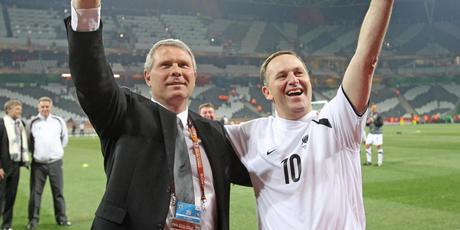
Visual perks of office

(NZ Herald.)

I don’t have much time today, but wanted to note the above image of John Key in an All White strip after this morning’s 1-1 victory over Italy. The significance of the event notwithstanding, the slightest chance of a result such as this, and its reflected glory, was surely a significant reason for Key to attend the All Whites-Italy match. Fair enough, too.

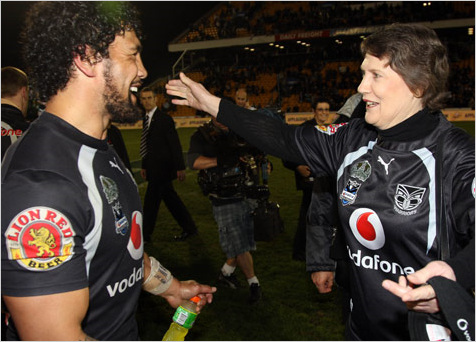
It also reminded me of when then-PM Helen Clark donned a Kiwis Warriors jersey after a momentous rugby league victory (2005 Tri-Nations?). But for the life of me, I can’t find a photo of that event. I know it was pretty well-seen at the time — footage of the team celebrations with Clark was part of the post-match TV broadcast and made the news, but it’s like the stills have just vanished down the memory hole.

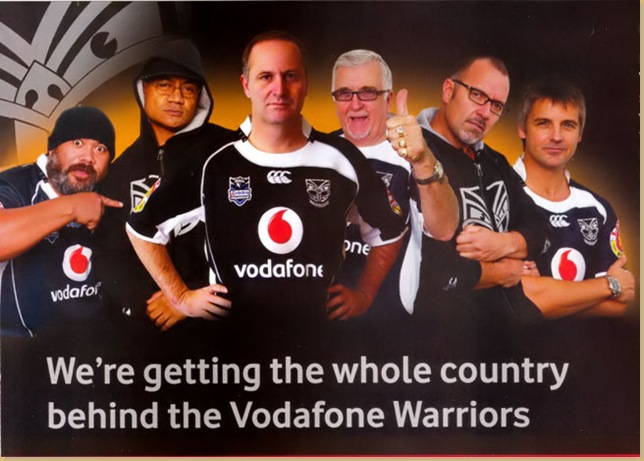
Ironically, while googling, I did find a photo of John Key as a Warrior, though this one is apparently advertising bumpf:

(H/T NZ Conservative, who asked “I wonder if Helen would have done it?” Well, wonder no more.)

Those look suspiciously like Steve Price’s forearms.

Edit: Pat, in the comments, points out that I’m probably remembering the Warriors, not the Kiwis. Probably right. There are certainly a bunch of PR shots of Clark with the team after their 19 September 2009 playoff win over the Roosters — conveniently just a couple of weeks before the general election.

(Stuff gallery.)

Thanks Pat.

L

Cannibalising society for the money proxy

This talk of not being jealous about tax cuts, and the unstated supposition that the rich are just better reminded me about a couple of posts I wrote a year or so ago about the “money proxy”: the idea of wealth as an easy quantifier for a person’s value. I’ve rehashed the argument here because I think it’s particularly apposite given the forthcoming budget. Paraphrasing myself:

Money is both the means by which we judge a person’s worth (in the human sense) and the resource needed to enjoy the comfort and dignity to which human beings are entitled by simple virtue of their being human beings. Because the same thing is used as both a means and an end, there is inevitable conflict: by denying people access to sufficient food, healthcare, accomodation, etc. on the grounds that they cannot afford to buy it for themselves, a society tacitly says: you are not worth it because you do not have enough money.

Previously, I had argued that while there’s considerable shared ground between National and Labour (both want economic growth, believe in the state’s role in providing some public services, etc.) the predominant difference between the two in economic terms is in the reflexive positions to which they repair when hard choices need to be made. National believes in supporting ambition, Labour in mitigating harm:

The former sees achievement as the highest goal, and failure as a necessary collateral effect of attempted achievement. They grade a society by its upper bound, by how much success its leading members achieve. In this regard, the ideology emphasises ambition, celebrating that qualities as the most beneficial to society while disregarding the worst consequences of its failure – destitution, disease, starvation, etc. The caricature of an ambitionist, if I may coin the term, sees the world as humanity’s oyster, and humanity in positive terms – as potentially successful and satisfied and healthy and secure, and considers that anyone who does not achieve these things has simply not tried hard enough, or for long enough, or lacks the innate characteristics needed to achieve those things and is therefore not entitled to them. Entitlement accrues to a person on the grounds of their success. In symbolic terms, the way to appeal to these people is in terms of opportunity, advantage, individuality, and the idea of just desserts for effort rendered.
On the other hand, the caricatured mitigationist (to coin the opposite term) grades society on its lower bound, by the extent to which the least successful members of the society are allowed to suffer by the more successful. They see the world as a dangerous, inhospitable place in which the default state is abject meanness, and humanity in negative terms of limiting those inhospitable forces, keeping out the cold and the hunger and the disease, while anything else is a bonus. Entitlement accrues to a person on the grounds of their humanity alone. The way to appeal to these people symbolically is in terms of compassion, brotherhood, sacrifice, cooperative achievement and that principle that none should suffer needlessly.

Emphasis added to identify the key symbolic points of the rhetoric around this budget, and highlight the fact that things are playing out exactly as you would expect. These battle lines were drawn long ago, and for all National’s “compassionate conservative” rebranding, there’s really nothing new in their focus here. They faced a clear choice between ambition and harm-mitigation, and chose according to their political identity. They simply don’t have a problem with the money proxy: it’s a measure as good as any other, and a nice clean “objective” one, because it’s determined by a market.

But I do. Following the first excerpt, I wrote:

This, to me, is not acceptable. If we cannot divorce the value of a person’s dignity, comfort and wellbeing from the monetary cost of sustaining it, what’s the purpose of society?

It’s bad in principle that people are treated (to a greater or lesser extent) as non-people by virtue of their material circumstances. And furthermore, I think it’s a bad decision in plain pragmatic utilitarian terms to attempt to swim against the economic tide and support ambition at the cost of significant harm:

Push comes to shove at times like this, when things are tight. When many people are deprived them, the human necessities of health, comfort and dignity can more readily be achieved by an idea of the common good than by the burning desire of ambition. […] In good times it’s easy to emphasise the greater good because a reasonable minimum standard can be expected to exist or be trivially provided for the few who need it. None need suffer except by a relative standard. In hard times, however, when raw success is less achievable, mitigating harm at the temporary expense of ambition becomes more valuable by its easy achievement.

So what we have with the budget, judging by the pre-release hype, is simply a return to form for the National party, and it should be countered by a return to form by the Labour party as well. National are retreating from the middle ground which won them the election and repairing to their reflexive, reptilian-brain adherence to the money proxy as an iron law of society. Labour must reclaim this ground; not that it ever really ceded it, rather permitting an occupation which is now beginning to withdraw.

The underlying calculation is a tradeoff of societal harm against economic growth. Another way of putting it, in more resonant terms, is: how much of society are we prepared to cannibalise, and for what gains, accruing to whom? This is the question around which Labour should orient its response. The words “many” and “few” will fit neatly into it.

L