That’s good advice

It is the judiciary’s job to apply the law as set by Parliament … this Government was elected on this sentencing policy. Judges are appointed to apply it. The Chief Justice’s speech does not represent Government policy in any way, shape or form.

Simon Power, Minister of Justice, 17 July 2009.

Read the Chief Justice’s speech before you judge it.

Lianne Dalziel, Labour Justice Spokesperson, 18 July 2009.

Lawyers should read proposals before criticising.

Simon Power, Minister of Justice, 24 July 2009.

You can’t judge an apple by looking at the tree
You can’t judge honey by looking at the bee
You can’t judge a sister by looking at the brother
You can’t judge a book by looking at the cover

Willie Dixon, 1962.

L

The role of the judiciary is to judge

There has been much wailing and gnashing of teeth over Dame Sian Elias’ remarks about the prison muster. Nevertheless, this is what Chief Justices (and their equivalents elsewhere) do from time to time – make pronouncements about the law and the state of the justice system, which carry no policy mandate but tend to get people talking.

I would note that the speech was much broader and more considered than ‘let the prisoners go free’ as it has been dramatised. But that Dame Sian has made a pronouncement so far out of step with government policy and public consciousness demonstrates either a remarkable sense of personal responsibility for the justice system or a desire to legislate from the bench.

There are three ways to slice it:

  1. The judiciary is right to involve itself in this sort of thing and you agree with the position taken
  2. The judiciary is right to involve itself in this sort of thing and you disagree with the position taken
  3. The judiciary is wrong to involve itself in this sort of thing, and should stay the hell out of wider matters of justice regardless

I’m the first, with Toad and most commenters on Eddie’s post on The Standard. Labour Justice spokesperson Lianne Dalziel is too. In another case I might be the second. Danyl Mclauchlan seems to be either in the first or the second; Idiot/Savant and Bomber are clearly the first; Madeleine Flannagan, herself a lawyer, seems somewhat grudgingly to be in the second camp. Peter Cresswell definitely is.

But it’s tricky; the third is a cover for the second. I think Simon Power and Garth McVicar (along with DPF and some stalwarts of the KBR hang’em-flog’em brigade) are taking the third position for rhetorical purposes when, if they were honest, they’d be defending the right of the judiciary to participate in NZ’s discourse of criminal justice but disagreeing with Dame Sian’s argument in this case – the second position. Dean Knight points out that, when it suits, the government does actually consider the judiciary’s views as integral to justice policy.

If the particulars of the Chief Justice’s speech had been different, I reckon they’d be singing from a songsheet other than the one which reads ‘butt out, you lily-livered liberal panty-waist’. Perhaps the one which reads ‘I disagree with your position but, as the head of NZ’s judiciary, you are entitled to take it’.

The flipside, I suppose, is whether those of us who agree with Dame Sian’s general position today would be supportive of her right to take it if we disagreed. We should be; all of us.

Edit: Andrew Geddis is in the first position; Stephen Franks is in the second.

L

It is what it is.

Having returned to my Asian redoubt after 5 weeks in the USA at the family homestead, I can now take stock and reflect on the tone and tenor of American public discourse. Every time I make the yearly pilgrimage back to my native country I notice changes in how people phrase the moment. A few years back, when Dubya was leading his crusade against evil-doers, it was all about “bring it on,” and “opening a can of ass-whuppin.” Last year it was about, paradoxically, ‘change we can believe in” and “being thrown under the bus.” This year’s social motif is caught in the phrase “it is what it is.”

From public officials, to celebrities to the (wo)man on the street, the answer to most thorny questions or complex issues is captured in that phrase. This is remarkable because normally Americans have a strong sense of optimism and unbrindled faith in controlling their own destinies. But the public mood this year is one of resignation and fatalism, if not powerlessness and pessimism. People appear universally resigned to being pawns in a larger game, to be at the mercy of “powers that be,” to being unable to shift the course of their lives based on hard work and idealism alone. Cynicism abounds, apathy is on the rise once again, and people just expect to be disappointed by their leaders or do not expect much from that at all. Somewhat perversely, this debased threshold of consent gives the Obama administration added cushion or leeway when pursuing its policy reforms–anything it manages to accomplish in the policy field will appear to be unexpected and seemingly heroic. Coupled with Obama’s personal charisma, this means his administration really has to do very little in order to impress the mass public.

For the moment the dark mood is pervasive. When asked about personal indiscretions or ongoing subservience to corporate interests (most evident in the stilted debate on national health care), politicians reply: “it is what it is.” When asked about lawsuits, deaths and scandals, celebrities reply: “it is what it is.” When asked about job losses, foreclosures and stifled dreams, average Joe replies “it is what it is.” When asked about the utility of either of the the two wars the USA is fighting, the universal response is that “it is what it is.”When asked if Sarah Palin’s resignation speech was drug-induced or merely incoherent, the reply inevitably is “it is what it is.” This is the 2009 version of the 1970’s adage “s**t happens.” In each instance the point of the phrase is not only to convey resignation; it also signals an end to the conversation on a particular subject.

There also has been is a signal turn in the American social psyche. In a country that already saw little value in public intellectuals and critical discourse, the turn symbolised in this one-sentence fatalism is a sign of despair. It also may be a sign of social rot.

In that spirit I am compelled to ask a few questions myself. Why is it that the Republican Party is the party of moral hypocrites, racists and corporate thieves? What happened to the party of Abraham Lincoln and Nelson Rockefeller? Why does it not have any responses or initiatives to counter the Obama administration’s projects on a variety of fronts? Why does it continue to cater to religious extremists, social bigots and media charlatans? Why does it allow Dick Cheney, of all people, to be the defender of the faith? Why is it mired in McCarthyite fear of “socialism” or “communism?” Why does it deny any wrong done by the Bush 43 administration, be it the constitutional subversions of the “war on terror,” the trillion dollar national debt, the national financial melt down or the erosion of US international prestige and power? Why does its de facto leaders openly call for Obama’s downfall, in an abject display of disloyal opposition? Why does it not see the need to undergo serious self-examination and rejuvination along new ideological lines given the abject failures of the Bush 43 administration and the electoral massacre suffered in 2008? 

All of this is the stuff of Democratic dreams, and short of arrogance born of unchecked power, the Democrats pretty much have a free run through 2012 (and beyond) so long as the Republicans continue to pursue their 1950s Barbie and Ken dreams in a country where Barbie is increasingly of mixed race and Ken just might be gay. Therein lies the problem, because devoid of a real political opposition that offers substantive alternatives on matters of policy to them (and which extend beyond the tired opposition to abortion and gay rights), the Democrats will, inevitably, succumb to their own greed and indifference. We might call the latter the Clinton syndrome.

The question then is why, in an age of fatalism, the Republican Party does not respond to the challenges of the moment in something other than retrograde fashion?The answer it seems is that it is what it is.

Optimism isn’t enough

I have, of late, been rather critical of Labour, and the reason for my critical tone is at least partially because the sort of Pollyanna bullshit exhibited by certain partisans on this thread (and elsewhere) is eerily similar to the rah-rah-it’s-all-good campaign of 2008, in which the True Believers grossly underestimated John Key and National, attacked him on his weaknesses and derided him as less than credible and not a proper threat, and got soundly and deservedly whipped at the polls for doing so. I don’t want to see that happen again, so I say: stop just assuming the electorate will come to their senses and vote Labour because they know it’s right, or because Labour’s policies will objectively benefit them. They won’t; that’s not enough. You have to convince them to do so; you have to make them want to support you; you have to lead them. So IrishBill’s advice is a good generic communication strategy; it’s also critical that it also be backed by a credible policy strategy (which, I hope, is brewing at present).

To all the True Believers: you don’t help your chosen party by being uncritical cheerleaders; you feed the echo-chamber. Stop it. Loyalists should be a party’s harshest critics and strongest agitators for change when things aren’t working – which, absent deep changes within Labour since the 2008 election, they aren’t. Good supporters ask hard questions, expect good answers, reward rigour, punish prevarication and do not live in awe of or aim to preserve the precious disposition of their representatives. They do not deride those who do so as traitors or try to hush them up for fear of giving the impression of disunity, killing any hope of dynamism in the process.

So far I see precious little of this on the left in NZ, and that does not fill me with hope for the future. The glimmers of hope I see are from the Green Party and the māori party, who have had the good sense to cut themselves loose from the drifting hulk of Labour, at least until its people start to set things to rights again.

L

Drifting toward a surveillance culture

As a propaganda geek, I’m concerned (some might say paranoid) about surveillance and its growing use as a means of social control, or as a tool to gather information used to justify and enact other social control mechanisms. Surveillance is the flipside of propaganda, and propaganda systems of social control can’t function properly without the feedback which surveillance provides; effectively, without surveillance, the controller is blind. This encompasses both the hard kind (cameras, enforced ID checking, enhanced search and detention rights) and the soft kind (data mining and data matching, consumer profiling, and so on). For this reason I don’t have a Facebook account, or a Fly Buys card, and I don’t use my gmail account for anything much other than website registrations as a spamtrap; and everything into or out of my webserver in Texas is encrypted. Although since they decided that registration wasn’t mandatory I do have a Snapper card (I wrote about potential surveillance problems with Snapper a bit over a year ago). I feed it with cash. Note: I’m not paranoid about hiding my identity; I’m paranoid about what other information might be matched to it and how an interested party might use that information to target me for use as part of their agenda.

Anyway. Surveillance is becoming increasingly ubiquitous, as people trade off privacy against security, but the problem is that the trade-off is implicitly framed as a matter of who you choose to trust – the ‘crims’ (those with something to hide and therefore something to fear), or those who maintain that security (and who necessarily have greater powers to put that information to use).

I’m working on a project at present which involves reviewing a great deal of media coverage about antisocial behaviour in Western Australia, and surveillance appears widely regarded as the key to cracking the (apparently endemic) problems they have over there. These include:

  • Cameras in streets, cameras in parking lots, cameras on nightclub doors; cameras above dance floors, cameras everywhere, in many cases mandated by liquor licensing regulators
  • Rights for police and other authorities to access footage in real time
  • Fingerprint scanners on club doors
  • The requirement to ‘sign in’ to clubs by giving over your ID as a condition of entry
  • Systems by which one club can (must? not sure about this) immediately share its patron database with other clubs in the area, so if a patron is ejected from one club they are barred from them all
  • Powers for police and licensing regulators to ban ‘problem patrons’ from every single licensed premise in the state for a period of up to five years, without them having been found guilty of any offence

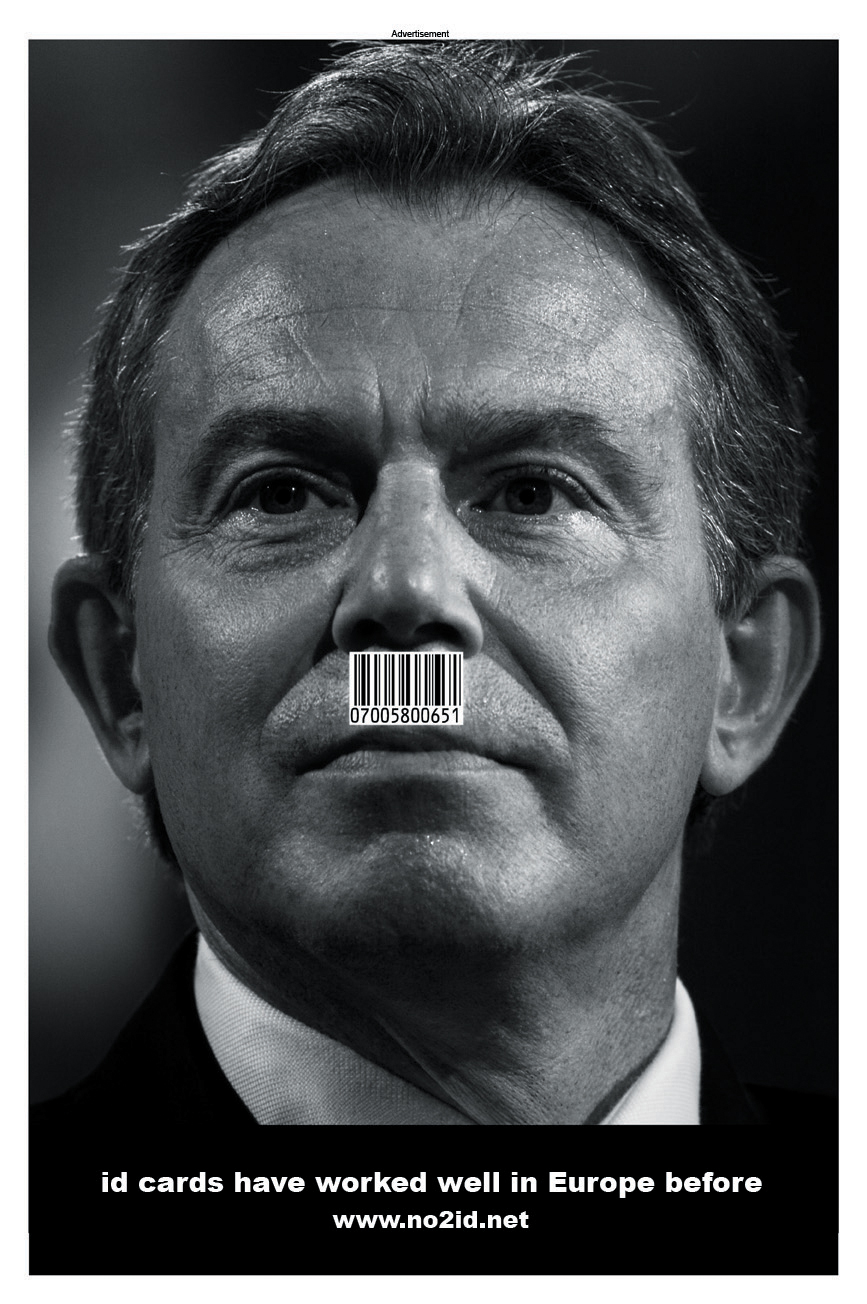
ID cards have worked well in Europe beforeFrankly, it’d be enough to put me off going to the pub. The culture there has become so accepting of surveillance that this is generally unquestioned by those in authority, and the electorate demands nothing more of its representatives. Perhaps even worse is the UK, whose national ID card scheme was the subject of an excellent but unsuccessful counter-propaganda campaign.

While we have some surveillance cameras (most notably in Queen Street and central Christchurch) and a reliance on RFIDs (in passports, for instance), and we have a police culture of aggressive surveillance and with strong authoritarian tendencies, things aren’t so bad in New Zealand. So it is with some dismay that I read yesterday’s op-ed by Chapman Tripp solicitors Simon Peart and Richard May on the NZ Herald website which warns of the alarming powers of surveillance and social control which could be exercised by regulatory bodies including the Commerce Commission, the Reserve Bank (!) and MAF under the newly (and quietly)-introduced Search and Surveillance Bill. They really are quite alarming – the right to covertly surveil ordinary citizens in their own homes, the extention of enforcement powers normally the preserve of the police to other regulatory bodies, the right to infiltrate and surveil computer networks and to secure premises against their legitimate owners, and, frighteningly, the nullification of legal privilege in some communications. Read the article. Read the bill if you can spare the time (it’s 196 exhausting and obfuscatory pages).

As I said, this comes down to trust. The problem is that, even though I generally trust governments, I don’t trust their regulatory and social control agencies which are not subject to electoral veto. That’s the problem with this bill – it seeks to remove the matters of surveillance and investigation from the political sphere where it belongs and create a new surveillance culture norm in NZ.

Edit: I have somehow missed the Gordon Campbell’s excellent piece on the same topic. Read that, too.

L

Typologies of military rule, types of coup and the Honduran sub-type.

The thread on the post about the Honduran coup made me realise that there is much misapprehension about coups and military regimes. I shall attempt to clarify the key terms and concepts involved.

Coups are the forcible resolution of a conflict between elites. They stem from the failure to resolve said conflicts within civilian institutional boundaries. They are not revolutions.

Revolutions are mass-based armed collective action leading to parametric change in society. Parametric change involves fundamental economic, social and political change beyond the change of regime. Revolutions are mass mobilisational; coups are demobilisational. In the 20th and early 21st century the only regimes overthrown by armed revolutions have been oligarchic authoritarian, with the collapse of the Eastern bloc being a mix of mass based collective resistance (not always armed) mixed with elite fracture in favour of reform. Hence they have been called by some scholars “peaceful revolutions,” although there is considerable debate about the authenticity of their revolutionary character. No democracy has been overthrown by a revolution (although some have been created by them), but many a democracy has  fallen to a coups.

Coups can be hard or soft depending on the amount of mass mobilization preceding the coup and the degree of repression involved in the military intervention. The equation is simple: The more there is mass based collective action, particularly armed collective violence, the harsher the coup. The harsher coup, the more militarised the state will become after the coup, and the higher the degree of repression of regime opponents. Thus student riots, middle class demonstrations and wildcat strikes will invite a modicum of repression, whereas guerrilla attacks or civil war will invite a far more deadly form of military intervention.

Military rule has two variants: ruler and arbitrator (or mediator) military regimes. Ruler military regimes are rule by the military as an institution, with a defined ideological project and no time limit on their tenure in power. The ideological project has specified economic, social and political objectives, which means that ruler militaries often have a specific class coalition underpinning them. The Latin American military-bureaucratic authoritarians of the 1960s, 1970s and 1980s were allied with the export bourgeoisie, finance capital and foreign MNCs (as examples think of the Pinochet regime in Chile or the Argentine, Guatemalan or El Salvadorean  juntas of the 1960s and 1970s), whereas the Arab military developmentalist regimes of the 1950s through the 1990s were allied with the secular domestic bourgeoisie and urban working classes (think Nassar in Egypt, Saddam Hussein in Iraq and post-Kemalist Turkey prior to 1980). The Burmese junta is a contemporary example. Note that although civilians may be present in ruler military regimes, and they may even have parties, parliaments and civilian courts as legitimating facades, it is the military as an institution that ultimately governs.

Ruler military regimes often come to power after their prior failures as arbitrator military regimes. Arbitrator military regimes only intervene in politics in order to restore a broken institutional order after a period of conflict. The military approach to intervention is much like a “time out” given by parents to bickering children, although in this case the bickering is between civilian elites and their political representatives. The arbitrator military sets a time table for withdrawal from power and demands that the civilian elites put their political house in order less there be a more severe intervention down the road. The military has no ideological project of its own and prefers to return to its security functions sooner rather than later, understanding that the major internal problem of being in government is erosion of its combat skills (which is the Achilles Heel of ruler militaries that stay in power for extended periods of time, since rather than training for combat, officers become military bureaucrats whose major activity is issuing edicts, writing memos and answering the phone. That invites attack by adversaries).

For much of its recent modern history Honduras has been governed by ruler military regimes (following on oligarchic rule in the 19th and early 20th centuries). After the installation of democracy it has attempted to professionalise in order to better serve the national defense (and recalling that it lost the soccer war with El Salvador). In the 1980s the US cast a blind eye on the counter-insurgency campaign conducted against local Marxist and Maoist guerrillas in exchange for allowing the stationing of counter-revolutionary forces and US advisors on the border with Nicaragua. The US currently maintains a military force of 600 troops (mostly special operations and counter-narcotics detachments) at a Honduran military air base in Soto Cano. In the 1990s the US pushed hard on the Honduran military to remove itself from politics altogether, making a variety of military assistance programs contingent upon it doing so. Until a week ago the Honduran high command upheld its end of the bargain.

It should be noted that in a small country like Honduras the elite is very interbred. Military commanders are related by blood to political leaders, high ranking clergy, large landowning families and the rising urban noveau riche. The officer corps cannot escape, even at dinner conversations, the bickering of politicians and other influential civilians. Thus the pull on them to intervene emanating from these civilians is unusually strong, and almost always in favour of protecting elite interests against “socialist” threats.

The current coup is, therefore, a variant or sub-type of the arbitrator military regime. The military removed President Zelaya and his government and allowed the installation of his designated civilian successor (and opponent), Roberto Micheletti, after Congressional and Supreme Court requests to do so. It maintains a strong presence on the streets of Tegucigalpa and the border regions, but has not resorted to blanket repression, arrest, detention and murder of Zelaya supporters (although some deaths in clashes have been reported), nor has it imposed a state of siege (although a state of emergency is in force). It has not militarised the state apparatus, has not assumed a larger governmental role,  and other than on specifically security-related matters, prefers to have the new civilian government do the talking. The speed in which it intervened and withdrew is a novel twist on the arbitrator military story. By all measures this has been a relatively benign coup.

But a coup is a coup, and by the standards of the OAS and international community in general, an illegal usurpation of the popular will as expressed through regular elections and civilian political institutions. Therefore, the military command should have resisted the move (and civilian entreties), as military upholding of the constitution means simply to abide by it, not necessarilly act as the guarantor of its enforcement. It will now be interesting to see how the political negotiations over Zelaya’s fate work out, but whatever the outcome and whether Zelaya is allowed to return to Honduras or not, he is finished as president. The one good thing to take from this political farce is that the Honduran military command apparently underestands, even if only out of self-interest, that its days as a ruler military are as over as are Zelaya’s dreams of re-election.

Convincing the Police we have a right to protest

It is good to see that – after a 12 year battle – the right to protest in Parliament grounds is finally being reaffirmed. The short version is that in 1997 the then speaker Doug Kidd authorised the arrest of 75 people protesting against education reforms in Parliament grounds and later trespassed them all. It has taken 12 years for the speaker’s office and the Police to finally agree to apologise and pay compensation.

It is frustrating that in a supposedly open democratic society there are so many example of the Police and authorities trying to stifle dissent, and that it takes many years and many costly lawyer hours to get to a point the courts finally make them back down. Recent examples that spring to mind are people being arrested and prosecuted for writing in chalk on a footpath, using a loud hailer and blowing a whistle again on a public footpath, and burning a NZ flag (which required a High Court appeal). If you’re interested in more examples I found this article while I was checking I remembered the chalk incident correctly.

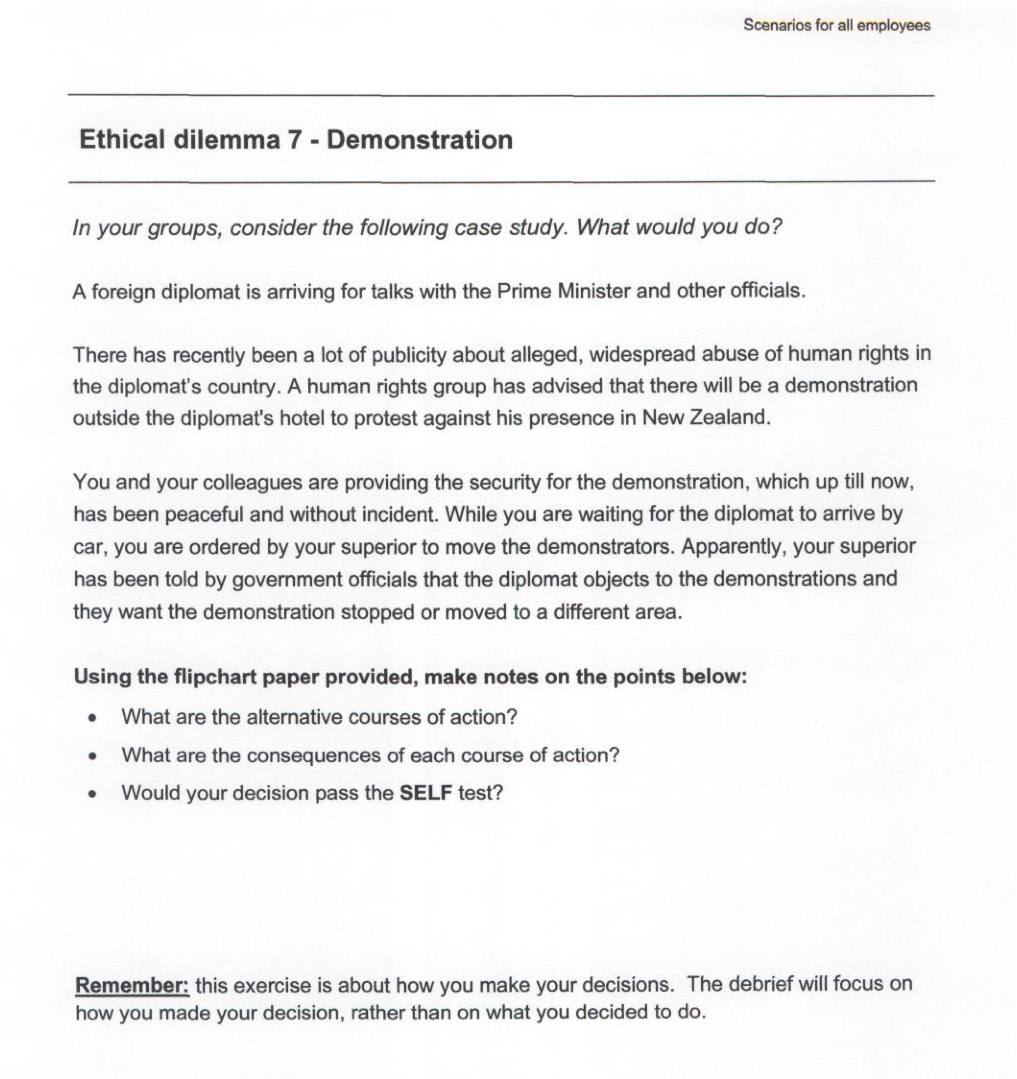
In theory the Police are there to protect our rights, including our right to participate in democratic protest, but it frequently feels like their main goal is to protect the dominance of the current power elite. It was interesting to see this scenario appear in the ethics training material the Police have developed since the Commission of Inquiry into Police Conduct (driven by the Police rape trials)

Ethical dilemma example 7
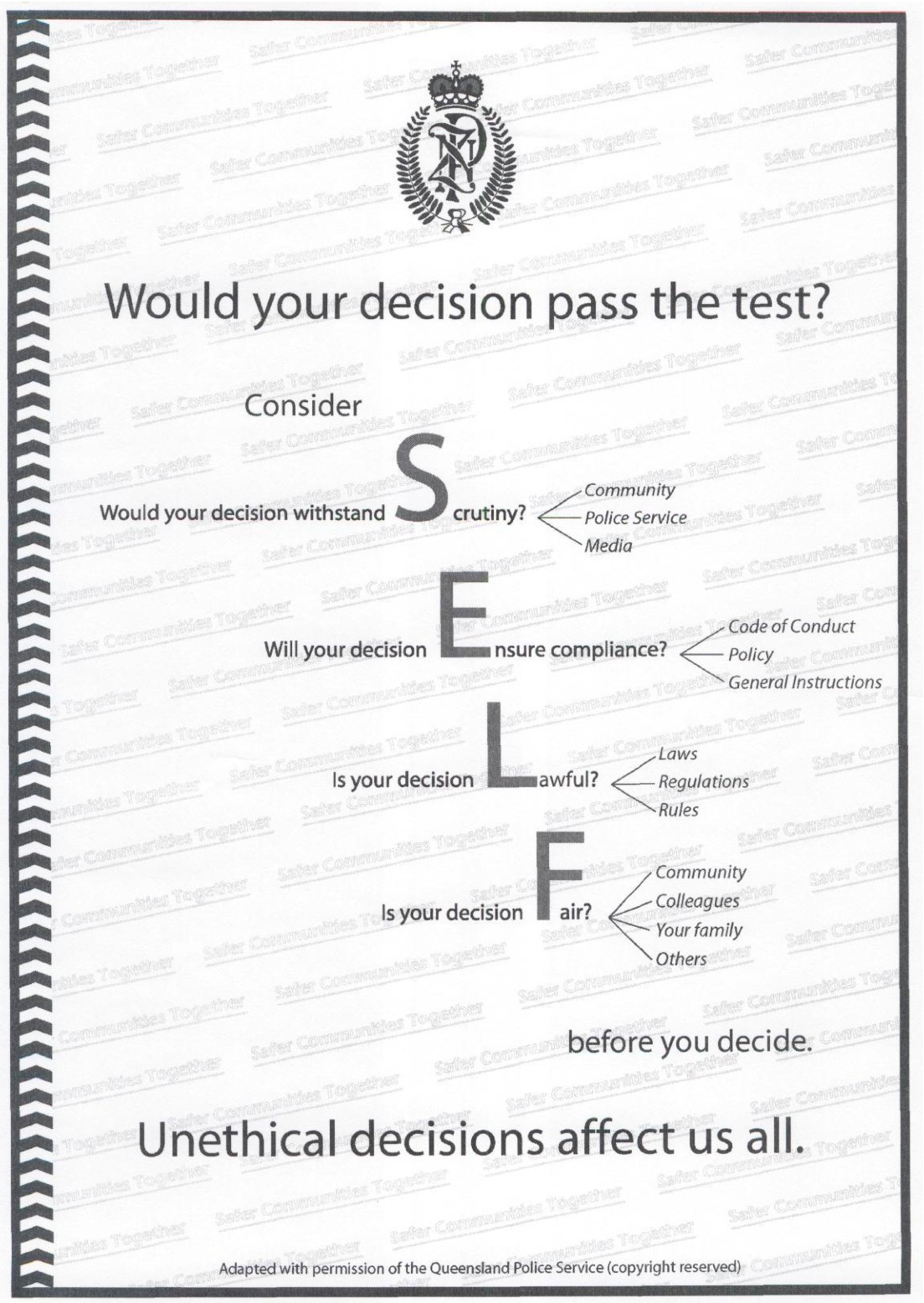
I would like to imagine this is a sign of a turning tide, and the Police will now be protecting our right to protest, but recent examples of deliberate and exploitative infiltration of protest groups, and the use of defenders of torturers like Mark Lowenthal by the Police for training and advice is hardly a good sign. Do these recent examples pass their own test?

NZ Police SELF test