Unions are to capitalism what opposition parties are to government.

In the debates about the proposed labour law reforms there appears to be fundamental misunderstanding or ignorance by National and ACT of the purpose of unions in capitalism. The latter are seen by NACT as at best a source of inefficiency and profit loss; at worst parasitic wealth destroyers. They appear to misunderstand that capitalism left to its own devices, with no collective counter-weight provided to workers, is akin to a political regime without opposition parties. That is, it is inherently an authoritarian status quo in which owners rule and workers obey. Thus, if we hold it self-evident that democracy is a better form of regime than dictatorship precisely because it allows for the existence of a freely organised competitive political opposition that can contest power and times compete for it, then we must also recognise that capitalism needs unions in order to be representative and fair to the society at large. The trade off between democracy and capitalism is exactly that: a diminished rate of exploitation in direct proportion to the measure of voice exercised by workers in pursuit of a fair share for all.

That is why unions were organised in the first place: to bring a subordinate group vehicle of voice and redress to the economic system. Whatever their very evident flaws (Leninist organisation, iron law of oligarchy bureaucratic rationales), unions provide a democratic counter-weight to unfettered capitalist exploitation. Just as it is preferable not to have a closed, unaccountable (or at least vertically unaccountable) oligarchical elite run the affairs of state, so too is it undesirable, from a democratic perspective, to have a closed, vertically unaccountable economic elite determine the social relations of production. If one believes in democratic capitalism, one must believe in a central partnership role for unions within it.

This is true whether labour-based or capitalist-oriented parties are in power, since in capitalist societies the material welfare of all is dependent on the investment decisions of capitalists. But capitalists need workers to realise their investment, and workers need to be productive for profits to occur. There is consequently a structural bias in favour of providing the working conditions and larger social context in which profitable production can occur over the long term. For that to happen workers need to accept the system as given, which is a function of them perceiving a partnership stake in it. That means a modicum of voice and representation. Democratic capitalists consequently understand the need to exchange super-exploitation and authoritarian control of the workplace for increased working class representation in both politics and production. In turn workers (and their political representatives) accept the capitalist foundations of society and the dominant role of capitalists within it (in other words, they forego a move towards socialism). This exchange is at the heart of democratic capitalism. Although negotiating the margins of the democratic capitalist social contract can occur depending on the nature of the government in power, “touching the essential” aspects of it is not.

Authoritarian capitalism offers many short term advantages to business, but it does not guarantee long term gains. Unmitigated authoritarian exploitation, be it in the workplace, politics or both, breeds resentment. Born of a lack of consent to the dominant system, resentment can be manifest in everything from petty acts of social defiance to industrial sabotage to revolution. Short term acquiescence may be bought with material rewards, but the long-term picture remains clouded so long as workers do not buy in to the system as given and instead resent their subordinate status in it. Absent mass consent and given the inevitability of working class resentment, the resort to the “weapons of the weak” negatively impinges on profit, if for no other reason then that the costs of repression grow larger the longer authoritarian control is maintained. After all, you cannot repress the same amount of people in the same measure over time.  Since capitalists abhor uncertainty and seek stable rates of secure return, a peaceful, consent based socio-economic and political order is preferable to an imposed one. That gives economic utility to democratic capitalism.

In fact, where democratic capitalist systems work best (hegemonically, as it were), many if not most workers strive to become capitalists themselves (small businesspersons, at a minimum). They see themselves on a continuum of upward mobility based on workplace fair play and merit. Socialism is not their preferred option. The proof is in the mythos: is this not the Kiwi, Ozzie and American dream?

Here is where NACTs reforms and the demands of the employer class says much about their true orientation. They claim belief in freedom of choice and the benefits of market competition as the great levelers of social ambition. If that were true, then they would welcome workers to freely organise without legal constraint or negative repercussion because true market competition and workers freedom of choice would improve overall economic (labour) market efficiency. After all, according to their own logic, the market works best when all have equality of opportunity, and it clears best when all actors enter into the market exchange exercising their full potential as free agents involved in the mutual supply and demand of goods and services. So if workers exercising their free choice want unions, then more the better from a market perspective. Why put constraints on that freedom?

Yet in practice NACT seeks to place constraints on working class collective choice and voice so as to better exercise owner/manager prerogatives in the workplace. They are, in other words, hypocrites who do not really believe in the power of the free market or closet authoritarians out of ignorance (unlikely) or by design. Or both. No amount of political spinning can disguise that fact.

What is more, NACT does not appear to comprehend, from a cynical perspective, that allowing for unionisation, including union workplace access, while reducing limitations on the right to strike and collectively bargain across economic sectors can actually serve very usefully as an alienation device in which workers are led to believe that they are real partners in production in a system in which the fruits (surplus value) of their labour are appropriated by others (in a variant of Lenin’s “democracy as capitalism’s best possible political shell” argument). Although unfettered collective action has the potential to open the door to worker challenges to control of production, the reality is that in democratic capitalism private ownership is reified from birth to grave and most workers live with the dream of being bourgeois in culture and consumption if not employment. So whether cynically or sincerely committed to workplace democracy, enlightened capitalists understand the long-term political utility of union representation in democratic society. NACT and its business supporters appear to be anything but enlightened.

As I mentioned in my previous post on the matter (“The Blues Go Black”), the proposed reforms owe their inspiration to the Pinochet Labour Code. The question is whether NACT have the same view of unions as Pinochet and “Pepe” Pinera did, and if so, why do they make any pretense as to being democratic? Could it be that what we are seeing in NZ is the first attempts to turn the economic bases of the democratic social contract into something akin to unchecked elite imposition under manipulated electoral conditions?
Of Leaks and Conspiracies.

Wikileaks has scored another major coup with its publication of more than 90,000 official and previously classified documents on the Afghan conflict. I am of two minds on its doing so. On the one hand I see it as a valuable instrument of accountability, both as instrument for holding the people directly responsible to account as well as a future deterrent to others who might engage in unlawful acts or cover-ups during wartime. On the other hand, publication of the document clearly jeopardises the national security of the US as well as the ISAF mission, and does so on several levels. The bottom line is that it gives the Taleban, al-Qaeda, Pakistani intelligence (the ISI) and other rogue states very valuable insight into US military operations and intelligence gathering efforts. Depending on where one stands in the ideological divide, that can be very good or very bad news. I believe that in this regard it is bad news.

In publishing this classified information Wikileaks has made itself an enemy of the state in the US. In the measure that it uncovers other state secrets, it could well become an international pariah, at least among the Western states that is its main focus. This is ironic. Although Wikileaks has complained about harassment from US security agencies, it has not (yet) suffered direct retribution for its actions. But imagine if it published extremely sensitive classified military documents from Russia, China, Iran, North Korea or even Israel. We can safely assume, given these country’s past records on breaches of  and threats to national security, that the Wikileaks community would have very good reason to fear for their lives. In fact, there may be two reasons why Wikileaks does not publish on these states: 1) the amount of secrecy in them is far superior to that of the US and other Western countries; 2) Wikileaks is afraid to do so for fear of mortal retaliation. Put another way, Wikileaks targets the US not only because of its concern about US military misdeeds, because it knows that it can get away with it due to the more benign nature of democratic regimes (to include the US) when it comes to confronting non-violent security threats.

That raises an item of note. Wikileaks is successful because it has people within the US and other Western security agencies leaking classified information to it. This is, of course, a crime, since public dissemination of classified information without official authorisation is outlawed in all states. For example, I am bound by an oath I signed in the 1990s to not divulge, release or comment directly on the classified issues that I worked on during my stint in the Pentagon, and after 25 years have passed must request permission from the agencies I worked with before attempting to do so. The penalities for breaching this contract are long federal prison terms. Similar laws bind people working in security agencies throughout the world. Thus any leak of classified material is by definition a crime against the state.

Yet in Western democracies people of conscience or feeling remorse regularly turn to the media as well as public watchdogs and government accountability agencies to reveal classified information that provides evidence of official wrong-doing. In fact, many consider it to be a public duty for them to do so. In addition, the size of security agencies often makes hermetic secrecy impossible. The US has 1.5 million people with top secret clearances. From my experience in the Pentagon and elsewhere, individuals often take home, either deliberately or (more often) inadvertently, classified work papers that are part of their normal desk load and which do not have the strict records controls of documents classified as Secret Compartmentalised Information (SCI) or higher. Between the two types of mishandling–deliberate leaks and misadvertent transfer–the US security apparatus is a huge porous sieve. The fact that a single US Army private provided the documentation (and video) on the Iraq helicopter assault on journalists and the Afghan war dossier proves just how far down the chain of command sensitive information flows. Imagine if it were a colonel or general who decided to pass along his secure file cabinet worth of documents! In fact, I am surprised that it was someone so far down the totem pole who managed to get so much information out of the system and into Wikileaks’ hands.

Which brings up the issue of purported US government conspiracies, those about 9/11 in particular. Unfortunately, due to some writing and public commentary I have made on 9/11, I have had to deal with conspiracy theorists who believe that it was an inside job, Zionist conspiracy, controlled demolition, rockets rather than planes involved, even holograms rather than the real thing. Some of these otherwise apparently sane people truly believe that the US government conspirators orchestrated the whole thing so as to launch the war on terrorism in a quest for complete global domination. Some even see a link between the JFK assassination, the fake moon walk and 9/11.

Well, I have two things to say to these folk. First, if the “9/11 as part of a drive towards global domination” scenario is true that those plans sure as heck are not working out too well. Second, in a context is which no secrets are safe, in which leaking has become an art form, is it really possible that the US government has been able to enforce one hundred percent secrecy at all levels of operation on the planning, execution and cover-up of the supposed inside job? Is it rational to think that not a single person involved in this monumental plot, which would have involved a cast of thousands, would not have come forward by this point with direct evidence of a conspiracy? Would Wikileaks not have received something along those lines by now?

Personal narrativium

From the NZ Herald, Why I should be the mayor:

Len Brown:

Every day I wake up and, for one thing, I’m thankful I do wake up. But secondly, I have the greatest job in the world and it’s a job that enables me to make a difference, to really change people’s lives, to deliver change, new direction and positive growth in the community. I can sort of perform little miracles around our place. When the change occurred I wondered whether I could shift this position to the community that has raised me since I was 7. I have very quickly found that passion. It has been an extraordinary journey thus far and the opportunity to deliver something by the way of step change and extraordinary redirection of Auckland and taking up of its potential, a marrying of our business dynamic with our community aroha and love is something I believe is an extraordinary opportunity, and I would like to take that opportunity.

John Banks:

At age 18, I decided that I would balance the family ledger by joining the police. The Auckland police told me in no uncertain terms that I was a lowlife son of two shitbags and there was no place for me in the New Zealand police. Twenty-five years later, I became the Minister of Police. I’m doing this to balance the family ledger.

So it’s “boundless enthusiasm for community miracles” squaring off against “individual crusade for redemption, nothing to do with Auckland” in the Supercity mayoral battle. If that’s all there was to it, Banksie would be a lost cause.

L

Sinecures and Shoulder-Tapping in another Small State.

It must be my week for thinking about small states in personal terms. I only took an interest in the specific dynamics of small states when I moved to NZ, having previously written mostly about larger states (although I did write a bit on Cuba and Uruguay before moving to NZ). Living in NZ exposed me not only to the political dynamics of a small democracy, but the social dynamics as well. Things like the 2 degrees of separation that make putting distance on ex-partners very difficult. Things like the rapidity with which one’s personal life becomes the object of professional speculation, and how quickly rumors in one dimension transfer to the other. Things like blacklisting, sinecures and shoulder-tapping.

I write this more as an open question to readers. My question rests against the backdrop of NZ being proclaimed as the least corrupt country on earth by one polling outfit, and the general consensus that it is one of the more successful liberal democracies in existence. But if liberal democratic success is defined as the absence of corruption in and ascriptive rationales for social advancement, plus the universal presence of merit, equality and transparency in public and private upward mobility, can we really claim that NZ is a “success” on those terms?

I may stand corrected on this, but it strikes me that for a democracy NZ has an unusually high incidence of shoulder-tapping and sinecure-mongering. Shoulder-tapping is the practice of rigging a competition by pre-selecting the favorite candidate or outcome, then going through the motions of a transparent and equitable process so as to disguise the pre-determined choice. As an example, consider this from NZ academia. A well-known academic with international credentials is encouraged by the Director of a university research centre to apply for a newly opened position. The invitation is accepted, letters, resume and referee names forwarded, only to have the application rejected within weeks. When asked for the reasons why the application was rejected after the applicant was encouraged to apply, the Director stated that internal competition for the position was fierce and better candidates emerged. Months later it is revealed that weeks before the “search” began for a candidate, an academic at another NZ institution with ties to the Director was approached for the job and eventually awarded it. The international candidate “search” in other words, was a cover for the selection of the shoulder-tapped individual.

In another instance drawn from academia, a search committee was formed to find suitable candidates for a specific disciplinary sub-field. Unbeknown to two of the committee members, the other three members, including the Chair, as well as the external faculty representative, were all co-authors of  a husband-and-wife candidate duo vying to be short-listed. Not surprisingly the duo were listed as the best candidates out of ten finalists by their four co-authors. No conflict of interest is declared. When one of the other committee members discovers the connection and complains to the Faculty Dean about the clear conflict of interest involved in the search process he is given a warning not to disparage the professional integrity of his colleagues. But his protestations continue. The search ends with a compromise candidate being selected, but in the next year the Chair resigns and joins the husband and wife team at a foreign university while the whistleblower winds up being (as it turns out unjustifiably) dismissed on another matter in which one of the committee members with a conflict of interest played a decisive role . The Lesson? Interfere with a shoulder-tapping exercise at your peril.

This are just two illustrations from one profession. I have been told of or have seen myself dozens of other cases–including in such places as my old surf lifesaving club–where the shoulder-tap, with or without a wink and a nod, is used as a means for advancement under the cover of ostensibly “fair” elections, tenders and searches. Sports associations, voluntary organisations, service societies, public bureaucracy, the education system, unions, the media, local councils, the legal profession, political parties, a wide swathe of private businesses and business interest aggregators, perhaps even the Police and Fire Services, hopefully not the military–is there any part of NZ society in which this is not part of the unwritten norms governing career and personal advancement? My question then is: am I wrong in seeing something amiss here? Am I exaggerating the extent to which this occurs?

Likewise goes for the issue of sinecures. A sinecure is a position offered to someone that entails little actual responsibility and is awarded not on merit but as a form of patronage or reward for services rendered. In NZ there appears, again to my uninformed mind, to be a lot of sinecurism in virtually every walk of life. Ex-politicians, ex-bureaucrats and ex-ministers get comfy senior positions in state entities and private boards regardless of their backgrounds or records in a given field. Individuals with much private wealth but little other distinction serve on boards, committees and trusts. There is an affirmative action sub-type in which persons from ethnic minorities are awarded well-paid “honorary” positions or those mentioned previously regardless of their qualifications. From local councils to national-level politics and enterprise, sinecurism seems to be endemic.

NZ is not alone when it comes to such practices, so my question is whether these are just more obvious in a small (democratic) state when compared to a  larger one, or is the practice itself more frequent in small democracies, NZ in particular? 

It needs to be noted that these practices are not equivalent to clientalism. Although shoulder-tapping and sinecurism are seemingly endemic in NZ and can be considered to be institutionalised, they are not recognised as such and in fact occur beneath the mantle of egalitarianism, transparency and merit. They are therefore informal, nepotistic institutional practices that operate under the cover of a rationalist meritocratic Weberian ideal. Clientalism, on the other hand, is a formal institutionalised practice whereby political or personal networking lines combine with merit-based criteria into channels of upward mobility. Such is the case in the small state in which I live, where political allegiance to the dominant party is a requirement, along with professional competence, for career advancement in both the public bureaucracy as well as in state enterprises. In the private sector personal networks outweigh political ones in the clientalist scheme, but here too there is an overlap between the personal and political.

What is different is that in clientalist systems patronage is based on the combination of relative merit and political or personal connections. In the sinecure and shoulder-tap system patronage has little or no relationship to relative merit–it is in fact a non-meritocratic form of favourtism based upon ascriptive rationales of social advancement and mutual entitlement.

As I said before, I could be all wrong about this and am merely extrapolating widely from my own personal observations and experience. Nor would any of this matter if NZ were not a liberal democracy supposedly committed to fair play, social justice and equal opportunity. But since it is, and because Kiwis tend to think of themselves as being better on these dimensions than most other democracies, then my questions about the role shoulder-tapping and sinecures play in NZ society are worth consideration.

I shall leave for another post the prevalence of professional blacklisting in NZ, but suffice to say that I have some experience with it.

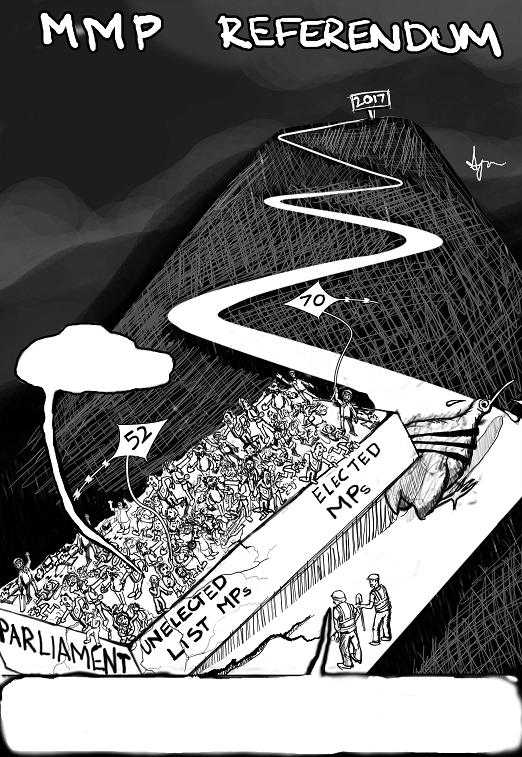
MMP in NZ is really safe

As I’ve said before, Peter Shirtcliffe’s campaign to scupper MMP (again) is probably a blessing in disguise for the electoral status quo in New Zealand. If any further evidence were required, the following should suffice for now:

The speech bubbles are blank because Peter is running a caption competition to find a punchline. Demonstrating piercing insight into his relevance to NZ politics, he has chosen the Kiwiblog Right for these words of inspiration. Personally, I think that leaving them blank perfectly captures the character of this campaign: inchoate, futile, tone-deaf irrelevance.

Hopefully he won’t be too disheartened by the far-from-enthusiastic response of Farrar’s captive authoritarians.

L

Conservative dementia in the US

One has to hand it to the US conservative movement. They have no shame, or at least plenty of chutzpah.

They love to bark about the evils of Democrats while having no regard for the consistency of their own positions. Take the issue of corporate responsibility. Conservatives railed against the bail-outs of the Wall Street banks and Detroit automakers, arguing against the “they are to big to let fail” logic of the W. Bush and Obama administrations when these came to the financial rescue of the beleaguered  giants. “Let ’em fail” they screeched, since “the market will sort ’em out.” Yet, when Toyota lied about the causes of sudden uncontrolled acceleration in its cars and delayed recalls while “investigating” the incidents (which resulted in over a dozen deaths and more than a hundred injuries), these same groups demanded that the US government step in to investigate and charge those responsible for everything from criminal negligence to consumer fraud. Likewise, the US right wing is now raving that the US federal government has done too little too late to respond to the BP oil spill even though–surprise surprise–the US federal government does not have the deep water capping technology available to the private oil industry, had previously deregulated that industry at its request in order to stimulate production (and profits) and was initially relying on that industry to give honest estimates of the disaster and rectify the situation based upon its own expertise and record in controlling spills of that nature. Some conservatives even demanded that the US accept offers of foreign assistance in controlling the spill, and scolded the Obama administration when it declined to do so. Fancy that, conservatives calling for foreign aid at a time of domestic crisis. Thus, when it comes to issues of corporate responsibility, US conservatives cannot make up their minds about the why, how and when of government intervention.

As far as taxation is concerned, the likes of the Tea party movement are opposed to current federal taxation rates and demand cuts across the board without considering that it is taxes that pay, as just one example, for the US military’s trillion dollar budgets and prosecution of a seemingly endless procession of wars abroad in defense of the “freedom” they so much rhetorically cherish. They appear ignorant of the fact that without taxation the US would not be able to maintain its preeminent global position, and that the current federal budget deficits originated in the W. Bush administration’s deficit spending to fuel the wars while lowering the taxation rates for corporations and high income individuals. In fact, in this regard W. Bush was emulating the champion of all American conservatives, Ronald Reagan, who massively increased defense spending and the overall size of the federal budget while lowering taxes for the upper third of the population. How is this “fiscally responsible?”

Finally, although all conservatives are self-styled “patriots” who literally wear their flags on their sleeves, bumpers and lapels, some are of the “America first” persuasion whereas others are of the “US superpower” kind. The former prefer that the US concentrate on its own affairs and limit its foreign entanglements, while the latter wants to see the US as the major player on the world stage. One view is isolationist; the other is imperialist. The two views are irreconcilable.

In effect, American conservatives are not the limited government champions they claim to be, nor are they consistent in their linkage of national necessities with taxation. They are divided on their views of the US role in the world. Instead they are a collection of blustering fools, economic retrogrades and illiterates, corporate toadies, religious zealots, assorted bigots, xenophobes and militarists mixed in with a minority of true libertarians and honest believers in the primacy of individual over collective rights and responsibilities. That means that even if they make major gains in the November 2010 elections, the centrifugal forces within the US conservative movement, as well as the lack of a coherent core rationale underpinning it, will prove deleterious to their chances for successful overhaul of the US political system. In fact, such a victory could well make the crisis of US politics even worse.

Incidentally: The Gruen Nation

While I’m on the topic of Australian politics, the news that the team behind ABC’s The Gruen Transfer will be producing a series of episodes on the upcoming federal election campaign, during the campaign.

For those who’re not familiar with it, the show is named for Victor Gruen, the architect who designed the now-ubiquitous shopping mall to disorient patrons and sap them of their agency — at which moment the “Gruen transfer” is said to have taken place. It’s a frank weekly look at the nuts and bolts, tricks and traps of advertising, fronted by comedians, tricksters and advertisers themselves and you can watch it on the ABC website.

Of course, the techniques employed to sell soap or soft drink or summer holidays can be and often are equally applied to politics — the howls of those who would rather pretend it were otherwise, that politics is somehow different notwithstanding. So during the campaign is the very best time to air such a look at how the same techniques apply to political marketing. Well done ABC. I’d love to see such a thing here. This is the machinery at the sharp end of democratic consent-manufacture.

(And for interest, here’s a long article about Gruen and mall design from The New Yorker.)

L

Rudd’s problems in a nutshell

Just a quick hit: this article in Sydney’s Sunday Telegraph from last Valentine’s Day details the less-than-lovey response Rudd received from students invited to the annual Parliamentary Q&A.

It’s not that they were set against him — young Australians overwhelmingly supported Kevin ’07, and continue to support Labor. It’s that he treated them with disdain. He didn’t prepare for what should have been a PR gift; made things up to suit the narrative he wanted to project; and then pulled rank and got angry when his prevarications were exposed.

Clearly rattled, Mr Rudd answered the perfectly legitimate questions like an annoyed schoolteacher, pointing his finger and disputing her claims. “Well, you’re shaking your head. Can I just say that is a fact, and if you ring up principals around the country it’s happening,” he said on air. The Australian National University student [Angela Samuels, 18] has since been backed by principals around the nation, saying they had not been given the laptops that were promised. “I was just shaking my head because I wasn’t happy with what was happening,” she said. “I’m in contact with schools. I know what he’s saying isn’t the truth. It’s annoying that he stands in front of cameras and says things that aren’t true.”
[…]
“He came in with the message that the Government was taking action,” Kate Campbell, 21, said. “He’s a very good political operator, he knows how to manage the media and manipulate people and their perceptions.” Andrew McDonnell, 22, said young people were now questioning their loyalties to the Government as a result of their experiences. “I respect him for his intelligence but if he tried to be more genuine and honest he’d be more popular,” he said.

Lesson: even when your gameplan is to emphasise style over substance (which is fair enough), it is imperative that you’re able to fall back on substance when style fails — as, under sustained and competent critique, it inevitably will.

L

Brown still on the horse

Bless the Herald, burying the most important point of an article about the Auckland supercity mayoralty race at the very bottom:

Mr Brown also spoke of leadership and the need to deliver a resounding majority for the mayor so he or she could sit there with the mandate with the support of the community. [sic]
Judging from the mood of the meeting [in Point Chevalier], he won a resounding victory last night.

It seems remarkable to me that Brown could beat John Banks “resoundingly” in gentrified Pt Chev, of which (as I recall) Banks is himself a long-time resident. But then, I don’t know Auckland very well, and perhaps I’m misreading it. Is there something I’m missing or is this actually a biggish deal?

It apparently counterindicates DPF’s and Hamish Collins of No Minister’s reasoning that Len Brown is toast because Kerre Woodham reckons he’s a nutter and she is some sort of bellwether for this “Grey Lynn liberal” demographic. Because her status as a talkback host and columnist who recently came out in favour of three strikes didn’t disqualify her from that already.

Disclosure: According to 8 Tribes questionnaire, bogus pop-sociology though it might be, I’m very squarely a member of the Grey Lynn tribe myself. I’m sure you’re all shocked, just shocked.

L

A Diplomatic Dilemma: Kowtow or Confront?

The manhandling of Green Party leader Russell Norman by Chinese security guards as they escorted a high-level delegation into Parliament raises some thorny questions for the government. Norman was protesting in favour of a free Tibet when his flag was taken from him and he was shoved to the ground. Technically speaking, he was exercising his democratic right to free speech and protest on parliament grounds, so the minute the guards laid hands on him they were guilty of assault. Of course, it remains to be seen if Norman did anything to provoke the guards reaction, such as by rushing at the visiting officials or uttering threats (neither of which appears at this juncture to have happened). Some commentators believe that he deserved what he got because he was being provocative merely by protesting , or because the whole episode was a PR stunt anyway. Even so, if the assault on him was provoked by his holding the flag or shouting “free Tibet”  rather than him posing an immediate physical threat to the delegation, then the guards were in fact violating his rights as well as NZ criminal law and parliamentary protocol. So what is the government to do?

China is now the second largest trading partner of NZ, which has secured the first bilateral free trade agreement between China and a Western country. The National government has worked hard to deepen ties with the PRC, to the point that it is working on the details of a military exchange program with the Asian giant and has not opposed the sale of strategic assets to Chinese consortia. In the past the 5th Labour government has coordinated with visiting Chinese delegations to prevent protesters from getting close to the visitors. There is, in other words, a history of NZ officials working to appease Chinese sensitivities about protest and dissent within a larger context of improving relations between the two countries.

But there has never been a direct confrontation between members of a Chinese entourage and NZ citizens, much less a shoving match between Chinese nationals and an MP inside of parliament itself (as far as I know previous protests by Ron Donald never escalated this far). So a precedent is about to be set. If the NZ Police charge the security guards with assault, or if the government declares them personae non grata and expels them, then NZ runs the risk of having these strengthening ties disrupted by a Chinese diplomatic backlash. Even of short lived or partial, any retaliatory curtailment of trade and investment could end up costing NZ millions of dollars in lost revenue (and the jobs that go with it). But if the Police or government do nothing, then they send the signal that NZ’s commitment to civil rights is secondary to its commitment to trade. Some might see that as kowtowing to an authoritarian one party state in the pursuit of profit. So far the Police have said that they will investigate Norman’s complaint about the incident, but  that does not mean it will result in charges being laid.

One line of argument could be that NZ has to look at the broader and longer-term picture and not jeopardise a relationship that is crucial to NZ’s future prosperity over a trivial incident. A counter-argument is that NZ has more to lose if it abandons its democratic principles in favour of the ethereal promise of cash down the road. One rationale privileges principle over practicality; the other privileges the reverse.

So, what is to be done? What should be Labour and ACT’s responses be (as the majority opposition party and supposed champion of individual rights, respectively)? Should pragmatism triumph over principle, or should principle outweigh economic and diplomatic considerations? Is there a compromise solution in which face is saved all around? Will the Police go through the motions of an investigation but do nothing, and if so, what will National do by way of official follow up?

Less one think that this conundrum could only occur because of the nature of the Chinese, consider this scenario:

A protester attempts to approach US Vice President Biden and/or Secretary of State Clinton at the Beehive entrance in order to deliver a petition demanding closure of Camp X Ray at Guantanamo, or better yet, a summons to the International Court of Justice for complicity in US “war crimes” in Iraq and Afghanistan. What do you think the Secret Service response would be, and if the Secret Service agents surrounding the US dignitaries were to react in a physical manner, would the NZ Police or government press charges against them?

Such are the quandaries of being an elf amongst giants.