Hide-ing to nothing

Two topics in this post, because I don’t have time to fully develop them.

First, John Key must not ignore the anti-smacking referendum. Although the question was leading, the result was decisive and will embolden people like the Copeland/Baldock/McCoskrie axis of evil to drive the stake deeper into the heart of NZ’s traditional social liberalism. Tinkering with guidelines won’t mollify them, and won’t stop the electorate from listening to them because it doesn’t address the substantive point about the status of a light smack in law. What will do that is the Borrows Amendment. With a view to neutralising further attacks on the discipline legislation, I think the government should adopt and pass the Borrows Amendment with due haste, and put the issue to bed (without its dinner). It’s a mutual-second-best solution, whereas the repeal as passed in 2007 was not and will not endure.

Second, Rodney Hide’s position on the Auckland mana whenua seats is consistent and his behaviour is responsible. The (proposed) mana whenua seats in the Auckland case aren’t the same as the Māori electoral seats – they’re appointed, not elected, and this gives him separate grounds to oppose them. It is not inconsistent that he favours entrenching Māori electoral seats if they exist, but not of implementing any more such seats, and not implementing any seats which aren’t elected. He’s being responsible in clearly signaling his intentions in a fairly measured way. He’s not trying to exercise any more power than he has, but simply saying ‘my resignation will be a cost of making this decision, just so you know’ and requiring John Key to consider whether that cost is worth it. In addition, he’s working with Pita Sharples on the issue rather than taking a reflexively oppositional approach. Finally, this is strengthening his core political brand. It’s smart politics all around because whether he gets his way or not, he comes out of this looking good.

Update: A third thing – eternal guest-poster r0b at The Standard continues to go from strength to strength.

L
The hits keep coming

Tara Te Heke has been reading from the Ayn Rand playbook with her idea of a DPB party. Classic troll, and devastatingly effective. There are some truly vile things being said there, and in amongst it, the earnest lunacy of a 3,000-word biblical anti-sermon apparently intended as a sort of Turing test. There’s so much baying on the thread that I’m not sure if anyone has come up with the quote about democracy being two cannibals and a vegetarian voting on what to have for dinner, but it can’t be far off.

The thing I can’t wait for is DPF getting back and answering his doubters, haters and watchers. Whatever else it is, this guest post experiment has been wonderful theatre.

L

Wanting to believe

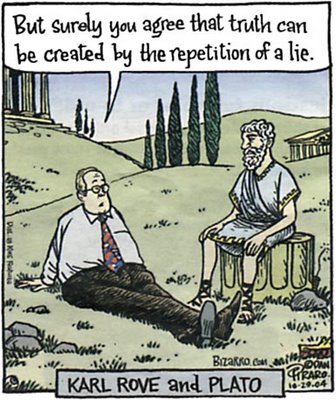
Now that Barack Obama’s Kenyan ‘birth certificate’ has been revealed as a fairly simple forgery, you’d reckon the birther nutcases would crawl back into their holes in shame, right? Not a chance. (Original site here – the fact it triggers anti-malware warnings is proof of a coverup, natch.)

So it is with any such theory. Evidence brought to bear simply points to a wider, stronger and better-resourced conspiracy.

roveplato

Memo to birthers: you’ve lost Karl Rove.

(Cartoon via Open parachute.)

L

Half-baked

Paint your roof white, Marty G urges, and save the planet:

Just painting the dark roof of a 100m2 house white offsets 10 tons of carbon emissions – over half of average annual emissions per person.

If only it were that easy. Partly it is, of course – some of the gain comes from the heat being directly reflected back, and that bit still holds. But the paper refers to carbon emissions saved from people in white-roofed houses not needing to run air conditioners. That might be fine in Texas or California, or Australia but in NZ the problem set is completely different. Most people don’t have aircon, beyond the windows. Those who do probably use it for a couple of months a year, at most. A much greater problem in NZ is heating – so in NZ we should be painting our roofs dark in order to save on heating, right?

Perhaps what we need is a switchable system which can be dark or light when needed. But the lesson is a much more elementary one – house design should suit the locale.

Eagerness, again, is no substitute for thought.

L

DPF pulls pin, leaves town

… and the resulting explosion is nothing short of spectacular.

Tara Te Heke is one of David’s four guest posters holding the reins while he’s on holiday. She is a single mum on the DPB who had three kids with a violent partner who left her in the lurch. Her story illuminates one of the problems with the bootstraps bootstraps bootstraps ideology commonly espoused on David’s side of the fence: not everyone can be on the top of the pile. Achieving the status Paula Bennett has may be something to strive toward, but those who fail to achieve such status aren’t necessarily failures – after all, there are only a few hundred such jobs in the country. Holding Paula up as an example is one thing; it’s quite another to say ‘Paula did it – there’s no reason you can’t too’. It just isn’t so. Markets are stratified by nature: there are some to whom the whole market is open; many more who may only access the lower reaches.

Perhaps it’s Tara’s awareness of the KBR culture, her status as an outsider to it, and her ironic adoption of the its lexicon (‘rorting the taxpayer’ to describe her drawing the DPB, etc) which has stimulated responses from the laudatory to the self-congratulatory, to the defensive, the typically heartless to the genuinely compassionate and understanding, and even questioning whether she’s a Hone Carter-esque ringer. It’s a rare beast, the second thread, and worth reading in its crazy two-hundred-plus-comment entirety.

Update: But wait, there’s more! Watch, as (when they don’t suit your argument) stereotypes are declared, well, stereotypical. Or just plain made up.

L

KP search terms: objectivism, werewolves and tumeke bro!

I happened to be looking at our logs (weird malformed URLs which 404 *shrug*) and noticed our search terms listing, odd as usual, so here are some of my favourites from the last week:

  • objectivism and harry potter
  • should women only use provacation as a defence
  • werewolf ian wishert – 5 hits, really!
  • who is matthew hooton
  • why is new zealand racist sexist and homophobic
  • Latin America progressive forces on the decline
  • tumeke bro
  • herald mental illness 2009
  • mutual exploitation model of the media
  • social movement unionism
  • what will happen if there’s no intellectual property
  • taliban negotiating table afghanistan mission territories

and finally, the ever present reminder of this post:

  • pink

Looking at the search terms always makes me marvel at the eclectic readership we must have, but today I’m concerned that we’re not meeting your expectations. So, in the spirit of BLiP, can anyone answer in 25 words any of the implicit questions? After all, what is the connection between objectivism and Harry Potter? Why is New Zealand racist, sexist and homophobic? and who really is Matthew Hooton?

John A at The Standard – hypocritical and spiteful at the same time

Today John A on The Standard decided to post the street address of the Deputy Prime Minister’s wife and children. It was unnecessary, it was hypocritical, and it was spiteful.

I would love to see The Standard playing a clean fair game, but if they’re not going to then they could at least stop picking on politician’s kids and families.

Update: Exact same criticism of Toad at Greenvoices, again unnecessary, and spiteful.

Update 2: Some good-hearted Standardista has removed the address detail, good on you!

Update 3: Toad too – thanks!!

Word of the Day

Thanks again to James at Editing Teh Herald.

Hypocryptical: Being deliberately unclear while accusing someone else of doing something that you yourself are doing.

The each-way bet of glass-house-dwelling stone-throwing blog hackery.

L

On media bias and distortion

BK Drinkwater has posted a good response to some of the comments on Bryce Edwards’ synopses of chapters from the book Informing Voters? Politics, Media and the New Zealand Election 2008 (edited by Chris Rudd, Janine Hayward and Geoff Craig of the University of Otago Politics department). In comments to BK’s post, Eric Crampton recommended Groseclose & Milyo‘s paper on the topic. Having not read the book, I’ll constrain my comments to the posts, comments and paper which I have read.

[Apologies, this is a long and dry post on a topic very dear to my heart. I also banged it up in a spare couple of hours while I ought to have been sleeping, and haven’t proofed it, so it may be incoherent. I reserve the right to subedit it without notice. The rest is over the break.]

Continue reading “On media bias and distortion”