I’ve written an awful lot on the topic of the UN Declaration on the Rights of Indigenous Peoples on The Standard today. But my argument is essentially unchanged from what I wrote on 8 May 2009.
You can read it here.
L
 I agree with Kelvin Davis’ criticism of the eagerness of certain MÄori groups to be involved in owning and operating the new private prison, and I think it’s a strong and principled argument.
My clear preference is for no private prisons. But if there are going to be private prisons (and it looks like a certainty), then all else being equal, wouldn’t it be better if they were (part-)run by MÄori, with a kaupapa MÄori focus (on rehabilitation, restorative justice, etc)? As I remarked, and as Eddie C sketched in slightly more detail in comments to my last post on the topic, the incentives are screwy for private prisons and rehabilitation, it’s hard to measure and hard to manage and as a consequence rehabilitation is even less effective than usual. But I can’t help but think that attaching a cultural incentive — the knowledge that one’s whanaunga are actually or potentially involved — might change that picture and take a few of the harsh edges off the “business of punishment” model employed by mainstram private corrections agencies.
L
Good practice is to build new power generation near load. And prison town syndrome is pretty well-known. So what South Auckland really needs is New Zealand’s first public-private-partnership prison, right?
L
It’s hardly the stuff of rigorous historico-social investigation, but Simon Schama sees much to celebrate in NZ biculturalism — particularly in comparison to our Anglo comparators:
But it’s the story of Maori and pakeha, the settlers of European origin, that – for all the pain, betrayals and suffering – still deserve to be known and celebrated as offering a different model of cultural encounter than anywhere else in the world. […] Of course there have been serious problems of unequal social opportunity, of street gangs. But if there is anywhere in the post-colonial world where two cultural worlds truly live an engaged life alongside each other, it’s in New Zealand.
Such stories don’t come along very often. Cherish them. Chant them. Dance them.
Upane upane, kaupane, whiti te ra! Up the ladder, up the ladder, the Sun Shines.
This is broad-brush stuff, and minimises the genuine grievance and disquiet which exists on both sides of the cultural divide — his “divided no longer” caption to a stock photo is altogether too pat. And his assessment of Paul Holmes as a “tough” and “a reproach to dozy thinking” is marginal at best. But Schama’s observation that what we have in this country is quite unlike any other postcolonial nation is exactly right. It provides a glimpse at what might have been been elsewhere, and what might have been here if the post-Treaty settlement had been undertaken in better faith.
This raises a question Pablo and I discussed in email after he wrote this post (I didn’t want to hijack the excellent discussion there): do those who hate and fear Tino Rangatiratanga and consider the Treaty a “simple nullity” really believe that the people of Aotearoa — of all colours — would be better off if the typical colonial counterfactual were true — if Hobson’s marines and settlers had simply driven the natives into the sea or exterminated them as animals? In my email to Pablo, I wrote:
I’ve often argued (as a wind-up or a devil’s advocate position) that the MÄori are ungrateful whingers who don’t appreciate what an incredibly good deal they got from Hobson, and that NZ would have been better off if Europeans had just landed with boatloads of armed soldiers and done to the natives what they did in the rest of the world. Anything for a peaceful life. What’s interesting is that, even when discussing the topic with people who genuinely believe that the Treaty is a gravy train and the natives are taking the piss and actually are ungrateful, they generally balk at this suggestion. That consent [given by the colonised to the colonisers], however fraught and limited, is important to how we see ourselves. That’s one of the reasons I’m generally pretty hopeful about the bicultural future.
I expressed somewhat similar views in comments to this post of Chris Trotter’s a short time later. Neither Chris, nor the other commenter to that post (RedLogix, with whom I’ve had robust but usually cordial disagreements on this topic) responded to my comments, which I took as a sort of confirmation of my thesis.* As I say, this is the usual response to the argument I’ve made many times before — all but the most unrepentant rednecks are repelled by the view that colonialism NZ-style was worse than what might have happened if we’d undertaken it Australian-style. This indicates to me that even for those who are highly critical of it grudgingly accept that the Tino Rangatiratanga movement, Waitangi Tribunal and attendant concessions to MÄori in our political and social systems are better than the counterfactual alternative of a white monoculture in the South Pacific, even if it were more peaceful. The importance of this for a bicultural future is profound.
L
* I don’t want to put words in Chris and RL’s mouths, though — it may be that they simply thought my remarks too ridiculous to bother engaging with. Happy to accept clarification on this point.
(Schama article via Tim Watkin at Pundit. Thanks! And as it happens, Idiot/Savant at No Right Turn has excerpted it as well.)
… but they’re really useful. Here’s another one.
After the election, I ruminated upon the future of the Labour party, employing a fairly hackneyed rugby analogy to describe the crossroads at which they stood. I’ve been meaning to follow it up and write about the fact that they’re very much playing the Crusaders game, rather than the Hurricanes game, but I’ve struggled to find the motivation to do so because it’s just so bleeding obvious that that’s what they’re doing.
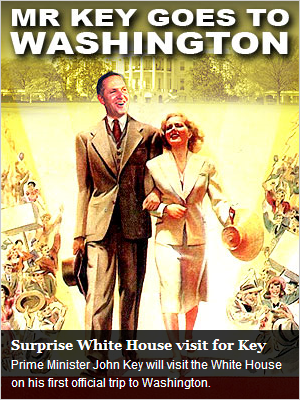
But yesterday’s comment by Trevor Mallard on the “Mr Key goes to Washington” story is pretty revealing — especially from such a die-hard Hurricanes fan:
In Super 14 terms this is like a loss with a bonus point.
And what are the odds of the President putting his head into the meeting to give John another chance to smile and wave to the cameras.
Will almost certainly happen but will still be a loss with two bonus points.
Sort of like the Hurricanes rather than the Crusaders –- may be a bit of feel good but no one believes they are really going to be there when the real business is done.
And he has a good point: who wants to back the Hurricanes if they can’t actually do the business, win the matches and bring home the silverware? All the razzle-dazzle in the world is hollow if it doesn’t yield results.
But Trevor could just as well be describing Labour’s performance in opposition. He characterises National and its government as playing the Hurricanes game, while it’s clear that Labour are playing the Crusaders game — but the problem is that Labour are playing the Crusaders game badly. They’re trying to be defensively strong, but they’re not really; the consensus is just that their opponents lack strike power out wide. They’re struggling to win even their own set-piece ball. Despite plenty of opportunities they’ve been almost singularly unable to punish mistakes — and the mistakes they’ve taken aim at have often been the wrong ones. They’ve tried various tactics which are analogous to infringing at the ruck, but have been caught out by the ref, making them look desperate rather than enterprising.
So what’s the half-time talk? I don’t know. It would probably be worse to try to change the gameplan at this stage than to persist, but absent a stunning second-half rally, it’ll be a long and humiliating off-season. Good thing relegation isn’t a possibility.
Update: Naly D reckons I’ve described the Chiefs game, rather than a poor version of the Crusaders game. So if that suits you, imagine it thus. But it sort of ruins the symmetry. Too much accuracy in an analogy isn’t always a good thing.
L
So the Crown, having had their appeal against the Waihopai 3’s acquittal (about which Pablo wrote an excellent post) dismissed, is considering a civil case against them, to recover the $1.1 million cost of the damage to the dome and fences surrounding the satellite dish.
In politics it is usually best to fight symbolism with symbolism; once a topic or policy matter is being debated in symbolic terms, in general no amount of fact or logic or reason will prevail against it. This often promotes an arms race — the party to a debate who introduces symbolic aspects to their discourse gets to set the agenda, to define what the debate is about, and this is clearly so with the Waihopai 3. While the customary analysis of the protest action is that it took place one morning in April 2008, with a slight return in the criminal court during March 2010, but all this demonstrates is that people don’t really understand the nature of this protest. It is ongoing. This morning, Peter Murnane responded with some puzzlement to Sean Plunket’s question “Do you have any further protest actions planned?” by saying “No […] well, we’re busy with this one.” That’s the point: Defending their actions on truthful, legitimate and principled grounds in the full glare of public scrutiny is the protest. Contrary to another current case, the Waihopai 3 have stood up and said the non-blasphemous equivalent of “you’re goddamned right I did”, and are willing to accept the consequences of their actions — but only once they’ve made their position clear. And they expect that their commitment to principle and legitimate due process is reciprocated by the Crown, and if sued will call for representatives of the GCSB to face them in court. This places the Crown in an invidious position: it cannot permit senior intelligence and security staff to be dragged into this matter, but if it fails to do so it will cede the symbolic field to Ploughshares, and the legitimacy of its position will be further eroded.
For the Crown to seek reparation would be fair and just: the actions of the Waihopai 3 cost the NZ taxpayer money and the Crown has a right to recover that via legitimate legal means. But because the Waihopai Three have set the terms of the symbolic debate and have everything to gain and nothing whatsoever to lose from the case, it is a fool’s errand. While, as Bill Hodge says, the Crown has an “invincible case” in the civil court, the battle is not being waged in the court, but in people’s hearts and minds. The Waihopai 3 claim they have no money, and this seems plausible. So the only reason for the Crown to take a case against them is to demonstrate that the organs of power are not to be trifled with, and that even if a jury will acquit for a good cause, an appealing idealistic argument, or an integrous and principled stand such actions cannot be undertaken with impunity. A display of power, if you like, though not an especially vulgar one. Such a display may serve the social purpose of quelling the urges of overenthusiastic and legally (not to mention ethically) illiterate anti-abortionists, and will have some currency among the not-so-closeted authoritarians who bayed for the blood of these peaceful protesters in April 2008 and again in March 2010. But to the extent that the government seeks to retain its dignity, this will be cold comfort indeed.
L
It’s well known to most that Chris Trotter and I have had considerable differences. But despite them, I must say that when he’s on form it can be a sight to behold.
So it is with his latest set-piece about Auckland governance, which gives voice to the intuitive disquiet felt by many, weaving many of the themes behind the sometimes tentative and incoherent criticism of the (aptly-named) Supercity plan into a cohesive polemic narrative, putting meat on those bones and placing these recent events in a historical context which resonates.
Required reading, whether or not you agree with it, and deserving of a wider audience than the blogosphere generally provides.
L
In the USA, the Spotted Owl evokes the spectre of trivial busybody environmentalism. This species has been extremely well propagandised by the forestry lobby and other anti-environmentalists as a symbol for “putting other species ahead of humanity”. But it is not so in New Zealand (although there is Powelliphanta augusta). For a hint of what the public response to Gerry Brownlee’s plan to mine Schedule 4 of the conservation estate could be like, look no further than the firestorm which has erupted over the YouTube video showing Norwegians shooting protected native birds, among other things.
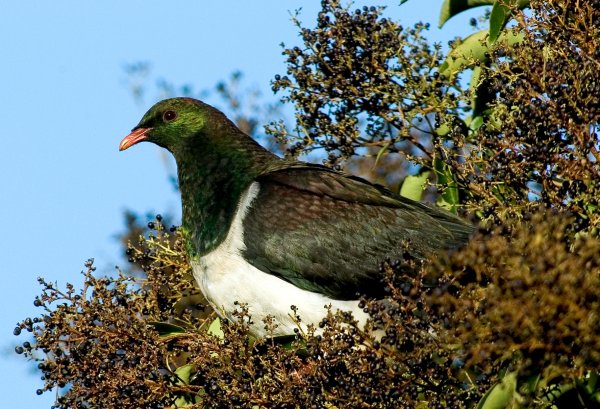
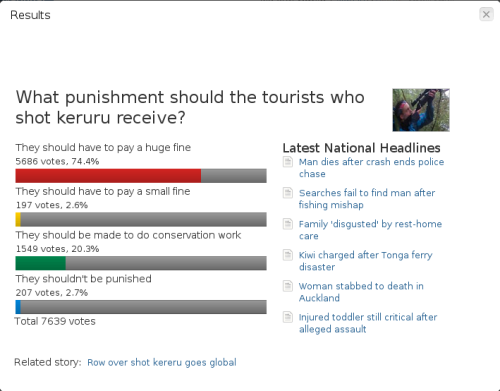
This has been a pretty persistent story. It’s been at or close to the top of the Stuff “most read” list for going on three days now; at the time of writing, it’s #1. It’s third on the NZ Herald website’s NZ section. It was in almost every dead-trees paper with a national news focus in the country on Friday. It’s featured prominently on One and 3 News (and consequently RadioLIVE), Radio NZ National, Newstalk ZB, and is at present the third-placed story on English-language Norwegian news website News and Views from Norway and has made Norwegian-language mainstream news there too, as well as action from Norway’s own environmental agencies. It’s drawn outraged official comment from DoC and the Conservation Minister; but notably not (as far as I can see) from the Minister of Tourism. There are 400-plus infuriated comments on the original YouTube clip, and 300-plus on the Fish’n’Hunt Forum, the oldest and most popular NZ internet site for discussion of hunting and fishing topics. Stuff.co.nz has a poll up, and the results are quite clear, for what they’re worth:
This outpouring of righteous fury has not come about because of the death of a few birds. None of the species shot by these hunters are so close to extinction that the loss of an isolated handful of individuals will critically harm the population. The reason for the response is that this sort of thing offends us deeply and personally. It is antithetical to who we are as New Zealanders, and it is as if a little part of each of us dies with those birds.
I wrote a few days ago that the task for the opposition, for conservationists and those who love the land and its wildlife was to relegate mining Schedule 4 to the “political too-hard basket”. More specifically, that task for those people — and for the 74% of (notoriously reactionary) Stuff respondents for whom these events are a grave injury — is to see the proposal to mine Schedule 4 as the same thing on a much greater scale, which it ultimately is, and to respond in kind.
Update 30 March: A vivid event like the one discussed above often primes the media and public to pay closer attention to similar events which previously might not have been newsworthy. Dog attacks are a case in point. So it is with this case: the release and eventual death of a weka, hardly endangered but well-loved, from Hagley Park, is now news.
L

Hi folks, for the last few days Akismet has been eating legitimate comments, and since it’s usually so reliable I’ve not bothered to check. So I’ve just released them all. Thanks to Neil for letting me know. If a comment doesn’t show up, you can email lew@kiwipolitico.com and I’ll make sure it gets published.
Sorry about that. As you were. I’ll try to find time to reply, but it probably won’t be today.
L