
[Updated 10 July 2011 to account for Don Brash’s statements in response to John Ansell, and Ansell’s resignation from ACT.]
Many have remarked on the appropriateness of the website of the ACT Party Parliamentary leader’s press-secretary, SOLOpassion, and many have made jokes about the sound of one hand clapping, or fapping, as it were. It is therefore entirely appropriate that ACT should become the butt of these same jokes, since they appear to have swallowed (implication most definitely intended) Lindsay Perigo’s paranoiac auto-stimulatory tendencies whole. His hand-work is evident in the party’s ever more deranged press releases, speeches, and most recently in this morning’s advertisement in the New Zealand Herald, titled “Fed up with pandering to Maori radicals?” and strategically timed for the end of Te Wiki O Te Reo MÄori. The advertisement is worth reading; the image below is stolen from The Dim-Post. Read the comment thread over there; it’s magnificent.
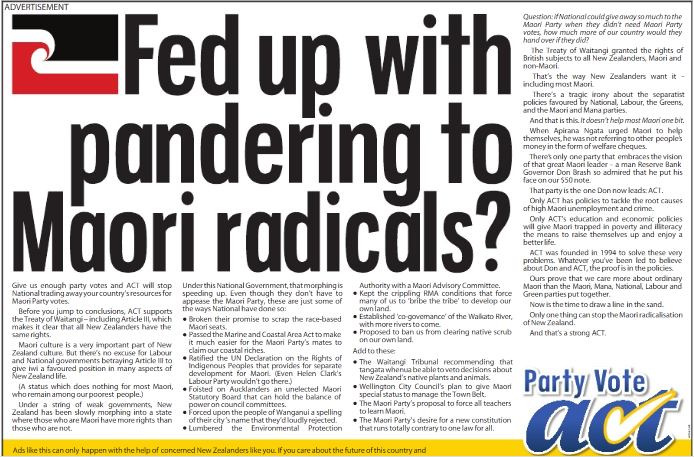
There’s an awful lot wrong with this, but aside from the warlike verbiage, none of it is much different from ACT’s or Brash’s prior form, and since I’ve been over most of the arguments before I will spare you the full repetition. You can trawl through the Take MÄori section of this blog if you want the detail. But just a couple of obvious things: the reasoning privileges Article III of the Treaty; that is, the article which gives the Crown a colonial payday, while neglecting Articles I and II, upon which the consideration of Article III rests. In terms of a contract, which is a way of thinking about the Treaty that ACToids might be expected to understand, Brash’s reasoning emphasises the payment for services rendered, while materially ignoring the requirement to actually render those services. (More on this theme here). Secondly, it’s more of the same selective history we’ve come to expect: our history as PÄkehÄ matters and has value; theirs, as MÄori, doesn’t — except for the bits PÄkehÄ can turn to their advantage, like the decontextualised appeal to NgÄta.
But there is a broader point that this development illuminates. Race relations in Aotearoa has changed enormously in the past seven years. In the winter of 2004, the country was in the throes of Orewa madness. The mÄori party had just been formed, promising to deliver “an independent voice for MÄori” in parliament. Eight years ago tomorrow Tariana Turia won her by-election, seeking to deliver on that promise. Don Brash was the leader of a resurgent National party who held a strong lead in the polls, and whose race-relations platform dominated the policy agenda. Now, Turia leads a hollowed-out party whose mandate and credibility are under severe threat from one of their own. Don Brash, having been ejected from the National leadership disgrace, now leads a party with less than one-twentieth of the electoral support he once commanded; a party he was only able to colonise after it was fatally weakened by a series of appalling political scandals, and then only by the narrowest of margins.
Under Brash National’s popularity stemmed from the fear of a brown nation that emerged from the foreshore and seabed debate and the mÄori party’s formation. As far as the general electorate of Aotearoa is concerned, those fears were not realised. As far as MÄori are concerned, the mÄori party’s results have been disappointing to say the least. As far as the established political power blocs are concerned, the mÄori party has proven a very dependable agent their political agendas; even while disagreeing with many of their positions, both National and Labour recognise that the mÄori party are invested in constructive collaboration with the PÄkehÄ mainstream, not in its destruction. I’ve long argued that the initial purpose of the mÄori party wasn’t to effect sweeping policy change, but to create cultural and political space for kaupapa MÄori politics, and to establish the credibility of same. For all their policy failures, they have succeeded at this task in spades; perhaps they could have afforded to succeed at this task a little less. But largely as a consequence of the sky not falling after the passage of the Foreshore and Seabed Act and the emergence of the mÄori party as a credible political force, neither National nor Labour have any truck with ACT’s vitriol. Don Brash, his “one law for all” rhetoric, and his scaremongering are firmly on the outer.
Even further out on that slender but flexible branch is the architect of Brash’s Iwi/Kiwi campaign, probably the best campaign of its type in our recent political history and certainly one of the most memorable: John Ansell. Ansell’s rhetoric had become distasteful enough by the time of the last election that even the ACT party — then under the leadership of Rodney Hide — refused to use much of his best work. Thereafter he was picked up by the Coastal Coalition. A less credible gang of fringe loonies it’s hard to imagine; one of its principals, Muriel Newman (who, shamefully, was invited by Radio New Zealand to speak as an authoritative expert on the WAI262 Treaty claim) believes that pre-Tasman Aotearoa was settled not only by Polynesians but by “people of Celtic and Chinese ancestry as well as Greek, French, Portuguese, Spanish and others“. Ansell’s own views on race are similarly bizarre; MÄori, he reckons, are “not a race, but a religion“.
Ansell is now reduced to ranting in Kiwiblog comments, and is as critical of ACT as he is of everyone else. Even there, though, his views hardly find great favour, with more people objecting that his campaign is distracting from the “real issues” than supporting him. His contribution to the thread about the Brash advertisement — it’s not clear whether he was involved in the ad’s production or not — is a magisterial display of racist, misogynist essentialism, and I think it really gets to the heart of the paranoiac auto-stimulatory tendencies to which I referred earlier. I quote his initial comment in full:
The problem with New Zealand is it’s full of white cowards who are too frightened of being called names to stand up for the truth.
(And that’s just the ACT Party.)
And the truth (if we are honest enough to admit it) is: for the last quarter-century, our country has been brownwashed by a bunch of scammers (aided and abetted by legions of white ‘useful idiots’) into feeling guilty for the supposed sins of our British great-great-grandparents.
A sober reading of the facts reveals that some of these sins were actual (though far less sinful than the crimes perpetrated by Maori on Maori). Many others were highly exaggerated and delivered with lashings of emotional blackmail, for the purposes of extorting compensation.
But of course we are New Zealanders and we are not allowed to tell our truth (as Alasdair Thompson recently found out to his cost).
We are not allowed to speak out about state suffocation, Maorification, feminazism, National socialism, teacher unionism or any of the other evils that are dragging our country into the third world.
Those who do have the guts to tell the truth are called nasty names like racists in the hope that, like snails, one light contact with politically-correct criticism will be enough to make them shrink back into their shells.
And of course it works a treat.
There are plenty of parties for pessimists, backward-looking Maori and white bedwetters. But there’s only one for optimists, achievement-oriented people and forward-looking Maori.
ACT will not succeed until it champions the latter and tells the dishonest others to go to Hell.
In short, their catchment is men and women who think like men. Not men and women who think like women. ACT is the party of the strong father, not the soft mother.
(By strong father I include strong women like Rand, Richardson and Thatcher, and by soft mother I include weak men like Key.)
I hope you people will think about that.
[Update: A NZ Herald article titled Act ad man blasts ‘apartheid’ contains more such statements from John Ansell, who is ACT’s creative director; and in it Don Brash distances himself from them, saying “I don’t want to associate myself with those kind of views at all”. He may not want to, but he is. His own press release issued in conjunction with the advertisement above calls any form of “preferential treatment” — such as concessions granted under Article II of the Treaty, which ACT apparently does not recognise — “a form of apartheid”. Perigo is fond of the term, and also of referring to MÄori, Muslims and anyone else who doesn’t quack like an Aryan duck as “savages”. Moreover the prospective MP for Epsom, John Banks — who represents the kinder, gentler face of the ACT party — also has form on this issue, having previously referred to MÄori TV as “Apartheid Television”, and holding views generally very comparable with those of Ansell and, in some cases, with Perigo. So Brash’s will to not be associated with such views really raises a question: will he, in order to dissociate ACT from these views, fire his creative director, the press secretary for his Parliamentary leader, and the only MP likely to win an electorate? I rather doubt it, but I believe Aotearoa deserves answers.]
[Update 2: Ansell is gone. One down; how many to go?]
As Russell Brown said, Ansell’s comment is “essentially an incitement to race war“, and I don’t believe Ansell himself would deny that. But it’s more than that; it’s also an incitement to sex war. It’s easy enough to dismiss as the usual sort of dark mutterings, but hang on a minute: this fool is claiming to speak for me, and if you’re a man (or a woman who thinks like a man, whatever that is), he’s claiming to speak for you too. But he doesn’t speak for me. To head off the inevitable speculation, I’m hardly what you’d call a feminised liberal pantywaist; I have a beard, I hunt, I fish, I provide for a family; I like whisky and brew my own beer; I like rugby and rock’n’roll and Rachmaninov, and breaking things to see how they work; I’ve spent years studying martial arts and I’m trained to do or have done most of the things on Heinlein’s list. I wear a Swanndri to work in an office on Victoria Street, for crying out loud.
But in my world, masculinity isn’t measured by warrior prowess or the vulgar ability to force one’s will upon others, whether by physical, social or legislative means. Those things, as anyone who’s studied totalitarianism will tell you, only garner a mean and hollow sort of respect; the sort which dissipates as soon as the heel is lifted from the throat of the oppressed. No, in my world, masculinity is judged by honest work, truth and wise counsel, respect and tolerance, forbearance and understanding, accommodation and partnership; from love and support, and strength of a kind which intersects with but is not eclipsed by that to which Ansell appeals. As I have argued before, that sort of view — the dictator’s view that power comes from the barrel of a gun, that only the whims of the mighty matter — is a bare and miserly sort of humanity. And if that’s how Aotearoa actually is, then I say: come the feminised, MÄorified revolution, because we desperately need it.
Of course, it’s not. Ansell no more represents Aotearoa’s men than Muriel Newman does its women, Lindsay Perigo its homosexuals or Don Brash does PÄkehÄ. Their methods have become unsound. As Conor Roberts put it, “if you gaze for long into the sub-5 percent abyss, the sub-5 percent abyss gazes also into you.” Let’s see how long they can keep gazing.
L

