Insensitive and hypersensitive

In the Insensitivity and hypersensitivity paper I referred to previously, Raymond Nairn and Timothy McCreanor studied submissions to the Human Rights Commission in response to the Haka Party Incident in which He Taua, including one Hone Harawira, broke up an offensive Auckland University engineering school mock-haka (this is poorly documented on the internets, but see here). They found that Pākehā responded by conceding that while the students may have been insensitive, He Taua were hypersensitive. This was and remains the default mode of rationalising race relations incidents in NZ: no matter whether it’s having their haka mocked or their Foreshore and Seabed nationalised, those Māoris are always complaining about something.

The insensitive-hypersensitive contrasting pair is a victim-blaming technique: the assertion that while we may have been insensitive, they are hypersensitive. This is presented as a concession but is in fact an attack which minimises the ‘insensitive’ party’s wrongdoing and magnifies the other party’s ‘hypersensitivity’ as a character flaw:

The term ‘hypersensitive’ carries a psychological load for which there is no parallel in ‘insensitivity’. Insensitivity is represented as deriving from ignorance; as such it can be dispelled by information. It is to be regarded as transitory, incidental, and non-deliberate. From a state of insensitivity an individual can act in ways similar or identical to those who are malevolent but is less culpable because a plea of ignorance can be made in mitigation.
[…]
In contrast, hypersensitivity is represented as deriving from emotional sources and is thus internally mediated. Such psychological phenomena are seen as part of the person’s nature and are not easily accessible to adjustment. Hypersensitivity is thus regarded in the same way as aggression, introversion and other personal characteristics. […] The association of hypersensitivity with emotion and indeed with extremes of emotion facilitates the marginalising of the actions and beliefs of people so labelled in ways which removes them from serious contention in social debate.

… and it’s ‘Warrior Gene’ all over again. Moreover, the common lexical root of the terms produces a false equivalence which amplifies this imbalance:

Blaming both sides, albeit one more than the other appeals to readers’ commonsense lore. […] It doesn’t matter that the unequal weighting of the ideas of hypersensitivity and insensitivity prejudices the judgement.

The sweet irony of this device is that, where there is a genuine imbalance of offence perpetrated by one group against another, it requires the offending group to be both insensitive to their own actions, and hypersensitive to the response of the group against whom the major offence was given. So it is with Hone Harawira’s deeply foolish, divisive and unhelpful comments of late: Pākehā New Zealand took hypersensitive umbrage at the terminology while insensitively ignoring the much greater offence caused by the repeated injustices visited upon Māori. I do not defend Harawira; the purpose is only to illustrate that this remains very much the standard means of reasoning around such incidents.

And so it is with Phil Goff, who played the insensitive/hypersensitive Pākehā role to the hilt in his response to Harawira, and has compounded that ill-considered reactionary stance by extending the narrative to the Foreshore and Seabed and the māori party’s decision to coalesce with National. This implies that Labour still thinks that Māori were unreasonable to object to the mass nationalisation of resources to which they had a legitimate claim in law, and that by cutting loose and forming another party they had somehow given greater offence to Labour than the original nationalisation had justified.

The message from Goff’s Labour party is loud and clear: we make no apologies for the decisions taken while being chased by the Brash Iwi/Kiwi monster, and are now prepared to do it all again if need be. This is a damned shame for the country, and for the party. Labour had a great opportunity to mend its bridges with Māori, as the māori party is burdened with an appalling ETS and its more and more fraught partnership with National — and instead of doing so they set another charge and detonated it. The Māori electorate will not support a Labour party which has declared itself the party of blue-collar Pākehā rednecks who are sick of ‘those Māoris’ and their complaining about things which happened the century before last. Where will they go? What will Labour do without them?

L

Goff is the new Brash

Perhaps this speech is an attempt by Phil Goff to reclaim the term and concept of “Nationhood” from the clutches of rampant colonialism. If so, it is an abject failure. It compounds Labour’s cynical appeasement of National’s race-war stance in 2003 with a reactionary, resentful re-assertion of the same principles before which Labour cowered in 2004. It is the very epitome of what Raymond Nairn and Timothy McCreanor called “insensitivity and hypersensitivity“. More on this here

I had an incandescent rant underway, but I’ve said it all before. If you refer to the tag archive under the terms “Chris Trotter” and “Michael Laws” you can read most of it — which should give you an idea of the company Goff’s speech deserves to keep. And in the mean time, Idiot/Savant has summed up my thoughts in several thousand fewer words than I would have. I can do no better than to quote him (and please excuse the transitory obscenity in this instance):

This is the same cynical attempt to whip up racism so memorably used by Don Brash at Orewa. I despised it then and despise it now. Goff knows better, just as much as Brash did. But he’s willing to pander to racists to get a short-term boost in the polls, and bugger the long-term damage such pandering does to racial harmony.
Well, fuck him. Racism has no place in our society, and a proper left-wing party would be fighting against it, not engendering and exploiting it for political gain.
[…]
Despite Labour’s dear wishes, the Maori Party is not going to go away. Instead, it looks likely to be a permanent feature of our political landscape. More importantly, it looks to be setting itself up as the swing bloc which makes or breaks governments. That’s certainly likely to be the case at the next election, unless the government really screws up.
What this means is that if Labour wants to regain power, it will have to sit across the table from and work with the Maori Party. And that will simply be impossible if they are running on a racist platform. By following Brash’s path of cheap racism, Labour is alienating the party it desperately needs to win over. And the result may see it locked out of government for far longer than if it had kept its hands clean.

I’m trying very hard to find an image of that “white is the new black” All Whites poster/shirt with which to adorn this post — because that’s what Goff is driving at here: what you thought was colonial paternalism wasn’t, and what you thought was self-determination isn’t. It’s a disgrace.

L

Dreams and realities

This morning at The Standard, vto* questioned how anyone can figure that the TVNZ7 ad featuring Bill English could be political advertising, since it doesn’t contain any baldly partisan political statements.

What is party political about it? Nobody has come with anything specific to support the contention – merely, “it looks political” “I know political when I see it” etc etc. Specifics folks, specifics.

Although I tend to think vto is either being purposefully obdurate or is just simply oblivious, it’s a fair question. Since in my experience he is usually genuinely puzzled rather than just shilling for the blues,** I undertook to do an analysis of the clip for his edification (or ridicule). As I said in the comments thread, you don’t create this sort of thing by accident:

This is a form which has been finely tuned and crafted over half a century to serve a very specific set of purposes — it’s a complex and very challenging medium where every frame, every word, every note is loaded up with as much subtle meaning as possible. With apologies to Tolkien, one does not just walk into political advertising.

A few basics of political discourse, first. While in the case of video, a text is made up of sounds and images, this is different from the ‘words’ and ‘pictures’ vto talks about. There is also a temporal dimension to video: editing, mise-en-scene and lighting changes, camera and focal movement, etc. which I’ll lump in with ‘image’ for these purposes. Likewise, most of the sound is spoken words, but there is also music, which is non-trivial in terms of meaning. The point is that nothing is in there by accident. When you have a limited budget and the requirement to work within a 45 second ad slot, nothing is optional or discretionary.

Given that there are images and sounds, and that they’re all there for a reason, it should be clear that there’s more to analyse than just the words and pictures, and so an apparent absence of political meaning in the words and pictures doesn’t mean the text lacks political meaning; it just means that it’s not overt (or not overt to everyone). The meaning lurks in how the various parts of the text hang together as much as in the ‘words’ and ‘pictures’ themselves. This, also, is purposeful: people are natively suspicious of political messages, and it helps to be able to communicate them via means which people aren’t accustomed to analysing closely. People are very well accustomed to interpreting political speech (‘words’), but much less accustomed to parsing video texts and the subtexts which emerge when multiple texts are intercut with each other in a dense and coordinated fashion. This is what makes video such a strong medium for political communication; why Eisenstein and Riefenstahl and Capra were given such prominent positions in their respective regimes, and why practically every US presidential election since 1960 has been predicted by which candidate’s TV coverage was the stronger.

The clip in question presents a dual narrative which appeals simultaneously to peoples’ cautious, empirical, rational side and to their hopeful, nationalistic, emotional side in order to produce a sense of hope. It is composed of two separate video texts intercut: one featuring footage of Bill English, Minister of Finance and Deputy Prime Minister; and the second of Bill English, kiwi bloke. The topic is the same, and the visual edit minimises the visual difference between the two narratives, while the voice remains constant throughout. This continuity of voice leads us to interpret the statements of Serious Bill and Chipper Bill as if they are uttered by the same person (which they are) and in the same role and context (which they certainly are not). The context is provided by the image, not the sound, and demonstrates that one person can (and should) hold both opinions simultaneously although the relationship between the two narratives is arguable. Of course, people can hold both views simultaneously (though whether they should is another matter).

The first, Serious Bill, establishes the Minister of Finance at a respectful social distance in a dark suit (with cut-ins to tie and face); the Sky Tower and the bright lights of NZ’s commercial capital in the background, a composition chosen to provide authority and credibility. This is a fairly soft form of the tycoon shot, a wealthy man overlooking his glistening domain. He speaks calmly and in technical terms, playing NZ’s economic problems with a straight bat. He uses the first person plural (“we”) throughout in order to include the audience in his statements. He looks the camera (audience) square in the face, talking directly to us.

The second, Chipper Bill, is established in a full-frame headshot, cut from a full-frame headshot of Serious Bill. This is what I mean by ‘minimising the visual distance’ between the Two Bills. He starts with “Y’know”, a commonplace employed more often to tell people what they (should) know than to genuinely appeal to shared common knowledge. This also marks a distinction between the complex, technical language used by Serious Bill and the colloquial, understandable terms and sentiments which follow. It is a relief to hear someone speaking ‘plain english’ after all that techno-jargon, right? Especially when he’s saying something we want to hear: good news about how “we can beat those Aussies”, after the bad news which Serious Bill was talking about, how our we’ve been “underperforming” when compared to them.

Chipper Bill — smiling and personable, an approachable everyman in a patriotically black polo shirt, continues to be intercut speaking in exhortative platitudes about how we just need to “back ourselves” (cut briefly to Chipper Bill gazing into the middle distance) and “apply some old-fashioned Kiwi can-do”, and so on, in response to Serious Bill’s authoritative but somewhat dry and gloomy facts. This use of “old-fashioned” is a hint of a dig at the previous government, the one responsible for “underperforming”; this dig is made a bit more explicit with the enthusiastic “we’re nearly through the tough times and things are looking up” — just leave it to good old National and everything will be well, not like that other lot, who were opposed to everything traditional, right?

The two narratives describe the reality of how things are (described by Serious Bill) and a dream of how things could be (described by Chipper Bill), as the music gradually rises in the background. The clincher, and the factor which makes this more a political advertisement than anything else, is that Bill English is the connection between the two narratives: if you accept the narrative line, he is the key to turning the dream into reality. This is essentially an overarching ‘hope’ narrative, a most powerful sort in troubled times, as Barack Obama realised, and as expressed by Drew Westen in the first chapter of his book The Political Brain, which opens with an analysis of two contrasting video advertisements for Democrat presidential candidates: one successful, for the Clinton campaign, and one unsuccessful, for the Kerry campaign. What was Clinton’s narrative? Hope.***

This ad was not about policy. Its sole purpose was to begin creating a set of positive associations to him and narrative about the Man from Hope — framed, from start to finish, in terms of hope and the American Dream. […] The ad created in viewers a vivid, multisensory network of associations — associations not only to the word hope but to the image of Hope in small-town America in an era gone by.

This “Two Bills” ad creates a similar hope narrative around the putative Kiwi Dream of “beating the Aussies” with “good old Kiwi can-do”. How could anyone not like that?

Just so you’re not starved of policy analysis, there are unstated, non-trivial National party assumptions about what’s important all through the ad too. The prime one among these is a focus on financial metrics (GDP growth, productivity growth) to the exclusion of other considerations. A Labour ad along these lines might have emphasised a balance between economic and environmental and other outcomes such as quality of life — the fact that this ad mentions no other metrics than wealth is not value-neutral or void of political meaning: it demonstrates the writer’s policy priorities and direction. As well as that, the “beating the Aussies” narrative is a core plank of the government’s current policy of “closing the gap” — it’s not policy-neutral either, but is a function of the government’s own preferences and their political strategy of measuring themselves against previous governments on metrics which favour them. And hang on a minute: are we really “through the tough times”, and are things really “looking up”? Depends who you ask; this is a matter of opinion and legitimate professional dispute among Those Who Know About Such Things, it’s not a slam-dunk even if the Finance Minister says so: after all, it’s his job to say so. And will “old-fashioned Kiwi can-do” on its own really be sufficient to bridge the significant productivity and GDP growth gaps between NZ and Australia? What the hell is “old-fashioned Kiwi can-do” anyhow, and if it were that easy, why haven’t we done it all before? The entire narrative is constructed of politically-charged assumptions, but it is formed in such a way as to discourage the audience from thinking too hard about it.

There’s one other thing, too: Plain English is Bill’s newsletter to his constituents, and it looks like the similarities don’t end there. It was a catch-cry of his 2002 election campaign. Perhaps if he’d had this production team working on that campaign he’d have won, or at least done well enough to prevent Don Brash from taking over.

So that’s a reasonably thorough teasing out of the political content of this seemingly-innocuous 45-second commercial. As I said in the comment thread at The Standard, the only thing more absurd than this ad getting made and screened with a straight face is Eric Kearley employing the Lebowski Defence when challenged on the fact that the ad quacks very much like a propaganda duck. Regardless of whether it was bought and paid for, as the more conspiratorial commentators think, or whether the use of the form was simply a (very successful) ploy to garner attention, it’s idiotic to pretend that this isn’t political advertising in function. While I tend to find industrial explanations for apparent media bias more compelling than political explanations, people like Kearley obstinately denying the bleeding obvious doesn’t make it especially easy to keep doing so.

L

* Stands for ‘Vote Them Out’, as I recall.
** What else this implies about vto I leave as an exercise to the reader :)
*** It helped that Bill Clinton was from the town of Hope, Arkansas.

Protesting a little bit too much

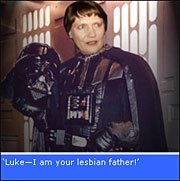
21clarkyoungnats_smallDPF published two posts yesterday about prominent lefties comparing righties to fascists: Minto comparing Bush to Hitler and Amin, and Carter comparing Key to Mussolini. I agree with him that both comparisons are entirely unjustified, and do a great disservice to political discourse in this country.

But without taking away from that, let’s not forget that David, his commentariat, his blogging cohort and indeed some of his ideological allies have spent most of the past decade making political hay by comparing Helen Clark to various dictators. David was central to the Free Speech Coalition whose billboards protesting the Electoral Finance Act evoked Mao Zedong and Frank Bainimarama; he wrote a weekly column entitled ‘Dispatch from Helengrad’, perpetuating the Clark=Stalin syllogism; his blog permits and tacitly endorses the almost daily comparison of left-wing political figures to tyrants; his closest blogging acquaintance Cameron Slater has constructed his political profile almost entirely of such cloth. The National and ACT parties themselves have a very large portfolio of such comparisons — from the Young Nats publishing the famous image above, to Heather Roy talking about the Clark government’s ‘feminazi’ welfare agenda to Bill English’s frequent comparisons of the Clark government to the Mugabe regime in Zimbabwe, both in the House and in the media. And how could I forget John Banks — former National party cabinet minister and now Citizens & Ratepayers Mayor of Auckland — whose public comparisons of Clark to Hitler, Stalin, Mao and Pol Pot and references to her as the ‘Chairman of the Central Committee’ among others only ceased when he decided to run for Mayor and they were no longer politically tenable. To say nothing of the foaming of various branches of the libertarian and objectivist movements, who are admittedly further from National than Labour are, but nevertheless have been occasional allies of convenience. Although typically less egregious than Carter’s and Minto’s comparisons, these are all the same in principle. The difference is one of magnitude, not of type. And the very worst examples of the type are exclusively from the right.

I should imagine that many of those who engaged in these sorts of attacks on Clark and her government but who are wide-eyed with mock outrage now that the shoe is on the other foot believe (to themselves if not in public) that the former comparisons were rooted in reality, while these latter are not and so are not justified. This demonstrates a phenomenal absence of political or historical perspective: Clark, like Bush, was removed peacefully from office by the ordinary process of democratic action, and the comparison of their programmes with those of the named dictators simply does not bear comparison, and it is disrespectful to history to draw it. David is right to point out that Labour are wrong for stooping to the level of National and ACT and their less-savoury constituents, but that does not erase the initial wrongness which spawned it, and in which he played a role.

L

[Edited to add Banksie and the libertarians to the list of offenders, and add the image at top.]

Winner does not take all

Peter Shirtcliffe is furious (audio), and well he might be, because the government’s plans for electoral reform are eminently sensible, subject to wide bipartisan support, and most critically, not at all hasty. This is electoral reform done right: for change, a majority of voters must reject the status quo system outright at two consecutive general elections, with plenty of time for reflection, consultation and campaigning before each.

Shirtcliffe’s proposal for a one-off vote on which electoral system to use at the 2011 election makes only one concession from his holy grail of government decisiveness: he thinks it should be preferential. His scheme aims to deliver that grail to his beloved National party wholesale and for good, by springing fundamental constitutional change upon the NZ electorate with less than two years’ notice and discussion, with no societal safety net, no cooling-off period, no opportunity for reflection. It would turn the time between now and the 2011 general election into an all-out propaganda war for the future of democracy in New Zealand, a war in which the National government and its allies hold all the strategic ground: unprecedented popular support and an opposition at its nadir; confused and rebranding environmental and social justice movements; the recent memory of an unpopular and dysfunctional government which represented all that people thought was wrong with MMP; a political environment in which many people will simply vote for what That Nice Man John Key recommends; and an anti-MMP lobby which is practiced, prepared and very well-resourced. Shirtcliffe’s careful circumspection — refusal to express opinions on such matters as what system should be adopted, and how campaign funding should be managed — and flattery of the plebiscite (“we’ve got an intelligent electorate out there”) seeks to hide this behind a high-handed neutrality of purpose, masking the fact that the process he advocates yields his own cause very great advantages.

Shirtcliffe’s decisiveness imperative insists that the winner must take all, in elections and in constitutional reform as in heavyweight boxing: a few ceremonial minutes in an enclosed space which determine who is the winner and who is the loser, and all that happens in between bouts is meaningless hype. It is not a democratic model, it is not a consultative model, it is not a model which gives adequate consideration to the views and opinions of the electorate at large; far from respecting electors as intelligent and capable actors, it reduces politics for the individual voter to a single, somewhat inconvenient event which happens once every three years, or in the case of something as important as changing the electoral system, once every generation or so if we’re very fortunate. Fortunately for New Zealand, and indeed to the great credit of the National party, he has been denied. The proposed framework should yield a legitimate and durable result, and one which should be supported even by those whose preferred option is not selected.

There’s much which could go awry yet, but this framework is as good as we could hope for. Idiot/Savant’s assertion that “if we want to protect MMP, its not enough simply to vote for no change in 2011 – we also have to chuck out National, just to be on the safe side” seems a little overwrought — National under Key has taken to MMP like a duck to water, learning to play both ends against the middle in a way the Clark government never did. And although there have been some recent cat-herding problems to do with keeping errant ministers in line, and around the rugby world cup, I can’t see a desire to return to the bad old days of one party rule. I do think National will campaign hard for SM as an it’s-the-same-really-only-better option, and this provides Labour and the Greens a good opportunity to differentiate itself — by pushing for MMP-as-it-is-now, or MMP-with-some-changes; although it must be said Labour aren’t behaving much like MMP-aware political actors these days. A larger threat from the National party, I believe, is the possibility of rolling the abolition of Māori seats into the new electoral system, or choosing to support an electoral system in a second referendum which (they may claim) renders the seats obsolete. This will be a strong wedge, and will enable National to frame the debate in terms beneficial to its own interests.

I await the further propagandisation of electoral systems with interest. Meanwhile, I/S’s conclusion is unarguable: “we need to make it clear to both parties: our democracy is non-negotiable.” And I’m still interested in peoples’ responses to the question: what kind of electoral system do we actually want?

L

Hōiho trading

So much of Labour and the economic left’s criticism of the māori party and its conduct in government with National is little more than the howling of self-interested Pākehā angry that the natives aren’t comporting themselves in the approved fashion. But in this case, criticism of the māori party’s support for National’s amended ETS is entirely justified — not because it goes against the principles of the labour and environmentalist movements, but because it goes against the māori party’s own stated principles and demonstrated political strategy. Idiot/Savant has a thorough fisking of the differences.

Whereas previous criticisms have mostly been leveled at the māori party for trading away tactical gains against strategic gains (going into government with National; refusing to quit any time National capitalised on its majority; etc), this decision sacrifices the strategic for the tactical, swapping a few relatively token benefits to some industry sectors in which Māori have strong interests and to low-income people among whom Māori are strongly represented, against a huge intergenerational moral hazard by which the general populace will subsidise emitters, robbing the general tax fund of revenue which could otherwise have been channeled into targeted poverty relief and social services, of which Māori are among the most significant consumers. The upshot must surely be the Foreshore and Seabed; but this seems to me a very heavy price to pay for a concession which seemed likely to go ahead in any case.

While the māori party is not — and Māori are not — ‘environmentalists’ in the western conservation-for-conservation’s-own-sake sense, a core plank of their political and cultural identity is rooted in their own kind of environmentalism, and by acceding to an ETS which does not enforce carbon limitations on industry and society, they have put this role in jeopardy and severely weakened their brand and alliances.

There is a silver lining in this for Labour and the Greens, however. The māori party’s deal has prevented Labour from succumbing to a similarly tempting compromise on the ETS, and it can retain its relatively high moral ground. Labour and the Greens now have a clear path on which they can campaign for the 2011 and future elections, a definite identity around which to orient their policies, and the real possibility of significant strengthening of the ETS in the future. Where this leaves the māori party I’m not sure; no doubt those who shout ‘kupapa!’ will be keen to consign them to the annals of history, but I don’t think redemption is impossible — especially if the māori party shepherds the FSA review through to its desired conclusion, it will remain a political force too significant to be ignored.

L

It’s our public service, why don’t we get a say?

The government is

  • considering merging a variety of departments,
  • carving up others,
  • busy shutting down big chunks of others,
  • abolishing some services,
  • taking control of Institutes of Technology and Polytechs away from communities,
  • studying opening up national parks to mining,
  • re-re-restructuring the health system,
  • oh, the list goes on.

Every one of those changes is to our public service and it affects the public, yet the government is not allowing for public consultation on any of them. They can’t get away with the “we were elected on this platform” excuse or even this government’s TINA (“the recession forces us to do this”), this is straight forward exclusion of public participation.

We, both the left and the right, didn’t let Labour get away with it, why are we allowing John Key and friends to exclude us from decisions that so directly affect our lives?

Getting what you voted for

It’s nearly 10 months since the election and the parties have just about found their feet. Bloggers on the left are delighting in saying to National, Act and Māori Party voters “look at what they’re doing, you didn’t vote for that!” which makes me curious, how many of us got what we voted for?

ACT

If you voted for hard-on-crime you’re probably feeling ok right now, it might not be as hard or as fast as you like, but the art of vengeance is definitely on its way back. If you voted for Rodney Hide, hurrah you have Rodney Hide. If you’re a small business owner frustrated with regulation, again you’re probably feeling pretty good at the signs of what’s coming. The neoliberals might not think things are happening fast enough, but they’re sure happening. It’s only the old ACT libertarian core who must be feeling cheated by the concessions to the crime-and-punishment lobby, and who else could you have voted for anyway?

Greens

I voted Green looking for a genuinely left wing party, and I’m feeling a bit let down: the MOU and the lack of visibility over the pain National’s policies are causing the poor and the vulnerable. That said, I also know that the Greens don’t have any parliamentary power so I expect some compromise. If you voted for the environment it’s probably feeling pretty good, while we lost the election the Greens are being effective at raising the issues and progressing a handful of them – about as good as you could hope for in the current political climate.

Labour

You lost, that’s all bad, but how’re you feeling about this incarnation of Labour-in-opposition? Labour’s actually doing ok I reckon for the centrist middle class left voters, and for the co-opted unions – they’re making the right noises about National policy, they’re sounding union and struggling middle-class friendly. People on the left of the party, however, are perhaps less happy: the current strategy appears to be a fight for the centre rather than a return to Labour’s working class roots.

Māori Party

Possibly it’s enough to be part of government, but at some point doesn’t the lack of policy wins start to hurt?

National

Well… if you voted for that nice John Key you’re probably happy with the smiley vacuous man who gets to go on Letterman. If you voted against Labour you were once happy with the lack of Helen Clark, but National’s starting to look a bit nanny state-ish. If you voted for the agriculture sector you’re probably adequately pleased by the reversals on the ETS and RMA, big business should be similarly happy. So the ideological backers are probably happy, but the soft centre?

Progressives & United Future

You got Jim Anderton and Peter Dunne, you must be rapt! :)

Suppressing resident participation

Auckland

The National-Act government are going against the Royal Commission’s recommendations in an attempt to weaken resident participation, consultation and influence.

Wellington

The National-aligned mayor, Kerry Prendergast, and centre-right Council are trying to remove the public’s right to be consulted on buildings on our beautiful public waterfront.

Christchurch

Labour MP, Clayton Cosgrove, is trying to remove residents’ right to be heard using the Resource Management Act in an attempt to give the airport carte blanche to create as much noise whenever and however they like.

Guidelines on a website are not advice

I’m not a big-city lawyer either, but Paula Bennett might have done well to consult one here.

In response to a parliamentary question from Charles Chauvel asking whether she’d taken advice as to whether the two women whose details she revealed after they questioned the government’s decision to cut the Training Incentive Allowance could be deemed to have given consent for the rest of their details to be released by going to the medias. Her answer was, more or less, “I looked at the guidelines that were on the Privacy Commissioner’s website” and a wee bit of misdirection about the previous Labour government.

The guidelines specify that a minister “need only believe, on reasonable grounds, that the individual has authorised the disclosure”, and later admitting that she did not make enquiries of “her officials or anyone else” as to the details she released. Without checking precedent or taking legal or policy advice, how can she claim “reasonable grounds” for implicit consent from a few brief and specific quotes in the Herald on Sunday?

The problem her stance raises – and perhaps the very reason for her taking it – is its chilling effect on political speech. If anyone who is dependent on the government for any part of their income (or other services) is liable to have the details of their cases made public for criticising the department upon which they rely, then that department is very effectively insulated from criticism. Being insulated from criticism means not being held to account for failings, and not being held to account for failings leads to a culture of impunity, a central plank of National’s election campaign against the former government.

I expect there will be a few smart privacy lawyers who’ll offer their services to the two women in question for a nominal fee, and the government would do very well to sharpen up. This is political gold for the opposition if the minister does not immediately back down and offer mea culpas of some sort. If the Prime Minister is required to pick sides, this is an important juncture for the government. She didn’t take advice. She can’t know what reasonable grounds are. Being a cabinet minister requires high standards of conduct and certainty. An employer would never get away with ‘I checked the website and then fired him’. If this goes to court, it won’t matter who wins or loses the case – the government will lose a bit of its shine, and so will its beleaguered Minister of Social Development.

There are good threads about this at the Dim Post.

Edit: Eddie has done some further digging to nail this down, too.

Edit 2: Woah, simultaneous linkage. There is no cabal, really.

Edit 3: It occurs to me that this is a political n00b’s monkey-see-monkey-do response to the Burgess case, where Labour and the media released some but not all details, and National used the remainder of the details to invalidate the political points being made. The differences with this case are that someone’s property holdings are a matter of public record, not information held by the government; and even if they were, property holdings are directly relevant (implied consent clearly applies) since the issue at hand hinged on the Burgesses losing their house, a matter which they brought into the public sphere.

I reckon Bennett saw what a big win the government had with the Burgess case, figured she’d do the same with this case, and overreached. Schoolgirl mistake. But I think it’s giving far too much credit to call this a rope-a-dope by Labour.

L