Master-race baiting

[Updated 10 July 2011 to account for Don Brash’s statements in response to John Ansell, and Ansell’s resignation from ACT.]

Many have remarked on the appropriateness of the website of the ACT Party Parliamentary leader’s press-secretary, SOLOpassion, and many have made jokes about the sound of one hand clapping, or fapping, as it were. It is therefore entirely appropriate that ACT should become the butt of these same jokes, since they appear to have swallowed (implication most definitely intended) Lindsay Perigo’s paranoiac auto-stimulatory tendencies whole. His hand-work is evident in the party’s ever more deranged press releases, speeches, and most recently in this morning’s advertisement in the New Zealand Herald, titled “Fed up with pandering to Maori radicals?” and strategically timed for the end of Te Wiki O Te Reo Māori. The advertisement is worth reading; the image below is stolen from The Dim-Post. Read the comment thread over there; it’s magnificent.
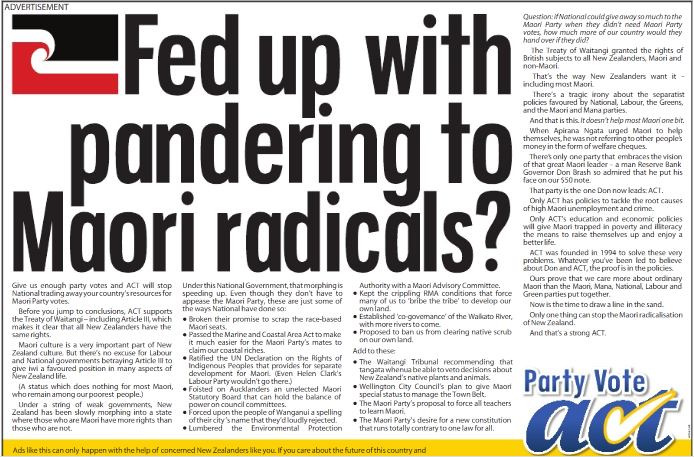
There’s an awful lot wrong with this, but aside from the warlike verbiage, none of it is much different from ACT’s or Brash’s prior form, and since I’ve been over most of the arguments before I will spare you the full repetition. You can trawl through the Take Māori section of this blog if you want the detail. But just a couple of obvious things: the reasoning privileges Article III of the Treaty; that is, the article which gives the Crown a colonial payday, while neglecting Articles I and II, upon which the consideration of Article III rests. In terms of a contract, which is a way of thinking about the Treaty that ACToids might be expected to understand, Brash’s reasoning emphasises the payment for services rendered, while materially ignoring the requirement to actually render those services. (More on this theme here). Secondly, it’s more of the same selective history we’ve come to expect: our history as Pākehā matters and has value; theirs, as Māori, doesn’t — except for the bits Pākehā can turn to their advantage, like the decontextualised appeal to Ngāta.

But there is a broader point that this development illuminates. Race relations in Aotearoa has changed enormously in the past seven years. In the winter of 2004, the country was in the throes of Orewa madness. The māori party had just been formed, promising to deliver “an independent voice for Māori” in parliament. Eight years ago tomorrow Tariana Turia won her by-election, seeking to deliver on that promise. Don Brash was the leader of a resurgent National party who held a strong lead in the polls, and whose race-relations platform dominated the policy agenda. Now, Turia leads a hollowed-out party whose mandate and credibility are under severe threat from one of their own. Don Brash, having been ejected from the National leadership disgrace, now leads a party with less than one-twentieth of the electoral support he once commanded; a party he was only able to colonise after it was fatally weakened by a series of appalling political scandals, and then only by the narrowest of margins.

Under Brash National’s popularity stemmed from the fear of a brown nation that emerged from the foreshore and seabed debate and the māori party’s formation. As far as the general electorate of Aotearoa is concerned, those fears were not realised. As far as Māori are concerned, the māori party’s results have been disappointing to say the least. As far as the established political power blocs are concerned, the māori party has proven a very dependable agent their political agendas; even while disagreeing with many of their positions, both National and Labour recognise that the māori party are invested in constructive collaboration with the Pākehā mainstream, not in its destruction. I’ve long argued that the initial purpose of the māori party wasn’t to effect sweeping policy change, but to create cultural and political space for kaupapa Māori politics, and to establish the credibility of same. For all their policy failures, they have succeeded at this task in spades; perhaps they could have afforded to succeed at this task a little less. But largely as a consequence of the sky not falling after the passage of the Foreshore and Seabed Act and the emergence of the māori party as a credible political force, neither National nor Labour have any truck with ACT’s vitriol. Don Brash, his “one law for all” rhetoric, and his scaremongering are firmly on the outer.

Even further out on that slender but flexible branch is the architect of Brash’s Iwi/Kiwi campaign, probably the best campaign of its type in our recent political history and certainly one of the most memorable: John Ansell. Ansell’s rhetoric had become distasteful enough by the time of the last election that even the ACT party — then under the leadership of Rodney Hide — refused to use much of his best work. Thereafter he was picked up by the Coastal Coalition. A less credible gang of fringe loonies it’s hard to imagine; one of its principals, Muriel Newman (who, shamefully, was invited by Radio New Zealand to speak as an authoritative expert on the WAI262 Treaty claim) believes that pre-Tasman Aotearoa was settled not only by Polynesians but by “people of Celtic and Chinese ancestry as well as Greek, French, Portuguese, Spanish and others“. Ansell’s own views on race are similarly bizarre; Māori, he reckons, are “not a race, but a religion“.

Ansell is now reduced to ranting in Kiwiblog comments, and is as critical of ACT as he is of everyone else. Even there, though, his views hardly find great favour, with more people objecting that his campaign is distracting from the “real issues” than supporting him. His contribution to the thread about the Brash advertisement — it’s not clear whether he was involved in the ad’s production or not — is a magisterial display of racist, misogynist essentialism, and I think it really gets to the heart of the paranoiac auto-stimulatory tendencies to which I referred earlier. I quote his initial comment in full:

The problem with New Zealand is it’s full of white cowards who are too frightened of being called names to stand up for the truth.

(And that’s just the ACT Party.)

And the truth (if we are honest enough to admit it) is: for the last quarter-century, our country has been brownwashed by a bunch of scammers (aided and abetted by legions of white ‘useful idiots’) into feeling guilty for the supposed sins of our British great-great-grandparents.

A sober reading of the facts reveals that some of these sins were actual (though far less sinful than the crimes perpetrated by Maori on Maori). Many others were highly exaggerated and delivered with lashings of emotional blackmail, for the purposes of extorting compensation.

But of course we are New Zealanders and we are not allowed to tell our truth (as Alasdair Thompson recently found out to his cost).

We are not allowed to speak out about state suffocation, Maorification, feminazism, National socialism, teacher unionism or any of the other evils that are dragging our country into the third world.

Those who do have the guts to tell the truth are called nasty names like racists in the hope that, like snails, one light contact with politically-correct criticism will be enough to make them shrink back into their shells.

And of course it works a treat.

There are plenty of parties for pessimists, backward-looking Maori and white bedwetters. But there’s only one for optimists, achievement-oriented people and forward-looking Maori.

ACT will not succeed until it champions the latter and tells the dishonest others to go to Hell.

In short, their catchment is men and women who think like men. Not men and women who think like women. ACT is the party of the strong father, not the soft mother.

(By strong father I include strong women like Rand, Richardson and Thatcher, and by soft mother I include weak men like Key.)

I hope you people will think about that.

[Update: A NZ Herald article titled Act ad man blasts ‘apartheid’ contains more such statements from John Ansell, who is ACT’s creative director; and in it Don Brash distances himself from them, saying “I don’t want to associate myself with those kind of views at all”. He may not want to, but he is. His own press release issued in conjunction with the advertisement above calls any form of “preferential treatment” — such as concessions granted under Article II of the Treaty, which ACT apparently does not recognise — “a form of apartheid”. Perigo is fond of the term, and also of referring to Māori, Muslims and anyone else who doesn’t quack like an Aryan duck as “savages”. Moreover the prospective MP for Epsom, John Banks — who represents the kinder, gentler face of the ACT party — also has form on this issue, having previously referred to Māori TV as “Apartheid Television”, and holding views generally very comparable with those of Ansell and, in some cases, with Perigo. So Brash’s will to not be associated with such views really raises a question: will he, in order to dissociate ACT from these views, fire his creative director, the press secretary for his Parliamentary leader, and the only MP likely to win an electorate? I rather doubt it, but I believe Aotearoa deserves answers.]

[Update 2: Ansell is gone. One down; how many to go?]

As Russell Brown said, Ansell’s comment is “essentially an incitement to race war“, and I don’t believe Ansell himself would deny that. But it’s more than that; it’s also an incitement to sex war. It’s easy enough to dismiss as the usual sort of dark mutterings, but hang on a minute: this fool is claiming to speak for me, and if you’re a man (or a woman who thinks like a man, whatever that is), he’s claiming to speak for you too. But he doesn’t speak for me. To head off the inevitable speculation, I’m hardly what you’d call a feminised liberal pantywaist; I have a beard, I hunt, I fish, I provide for a family; I like whisky and brew my own beer; I like rugby and rock’n’roll and Rachmaninov, and breaking things to see how they work; I’ve spent years studying martial arts and I’m trained to do or have done most of the things on Heinlein’s list. I wear a Swanndri to work in an office on Victoria Street, for crying out loud.

But in my world, masculinity isn’t measured by warrior prowess or the vulgar ability to force one’s will upon others, whether by physical, social or legislative means. Those things, as anyone who’s studied totalitarianism will tell you, only garner a mean and hollow sort of respect; the sort which dissipates as soon as the heel is lifted from the throat of the oppressed. No, in my world, masculinity is judged by honest work, truth and wise counsel, respect and tolerance, forbearance and understanding, accommodation and partnership; from love and support, and strength of a kind which intersects with but is not eclipsed by that to which Ansell appeals. As I have argued before, that sort of view — the dictator’s view that power comes from the barrel of a gun, that only the whims of the mighty matter — is a bare and miserly sort of humanity. And if that’s how Aotearoa actually is, then I say: come the feminised, Māorified revolution, because we desperately need it.

Of course, it’s not. Ansell no more represents Aotearoa’s men than Muriel Newman does its women, Lindsay Perigo its homosexuals or Don Brash does Pākehā. Their methods have become unsound. As Conor Roberts put it, “if you gaze for long into the sub-5 percent abyss, the sub-5 percent abyss gazes also into you.” Let’s see how long they can keep gazing.

L

In which I endorse Cactus Kate’s ACT candidacy

I’ve just gone through my post archive and added the tag ‘open government’ to posts I’ve written on the topic of elected or senior civil society representatives telling their constituents what they really think. I think this sort of disclosure is essential to democratic politics, and as much as I might disagree with the sentiments many such representatives express, my gratitude to them for their candour is entirely genuine.

It is in this vein that I endorse the rumoured candidacy of Cathy Odgers, aka Cactus Kate, for the ACT party in the forthcoming general election. If true, Odgers will be doing Aotearoa a genuine service, showing us all what ACT really stands for. She has never been backwards about coming forwards, and her often outrageous opinions have routinely appeared on her blog. Consequently, we can be assured of what we’re getting.

What we’re getting is someone who represents the elites; those who, if they weren’t born in possession of a silver spoon, quickly set about acquiring one by any means necessary. Hers is a devil-take-the-hindmost sort of social Darwinism which evinces general scorn for ordinary people, and outright contempt for anyone who fails to succeed by her own materialistic standards. She is perfectly frank about her view that only the wealthy net taxpayers should be able to vote, that ‘DPB’ should stand for ‘don’t pay breeders‘, and a host of other repugnant views which should further alienate her and her party from the New Zealand electorate; and which should increase the risk to a second-term Key government if it chooses to associate itself with the new ACT. We can only hope she will remain as candid as a candidate.

But this endorsement isn’t all about foreshadowed electoral schadenfreude. Odgers, for all that I disagree with nearly every aspect of her politics, is intelligent, articulate and possessed of a sharp and analytical wit. By reputation she is driven, hard-working and will not tolerate time-wasters or time-servers. If her boasts about the expat lifestyle and her drinking habits are to be believed, she will be taking a considerable cut in pay and increase in workload if elected to parliament, so we might reasonably assume her intentions are genuine. In other words, aside from her politics — which is admittedly a very big aside — she’s just the sort of person we need more of in Parliament. It may be that the rigours of public office mellow her, or it may be that her prickly public persona hides one more rounded and reasoned. They often do.

L

Notes on democratic fundamentalism

Perhaps I’m reading a bit much into Jordan Carter’s declaration that he’s a libertarian socialist — as he said on the tweets, “it’s just a pun, an oxymoron. Which I found amusing”. So I may be overreacting in the particular case, but if you’ll forgive that, it’s made me look at and consider my own perspective in a way which lends itself well to writing down.

I think Jordan is cherry-picking his definitions; co-opting two existing pieces of fashionable terminology for the sake of provocative pretension. I think what he’s described is really just liberal-social-democracy of the relatively ordinary modern kind — a pretty far cry from anything resembling either libertarianism or socialism in actual history — and I don’t see what’s gained by smacking an ill-fitting label on it. But there’s a fair bit to lose. For a start, by doing so you alienate all those who really do call themselves libertarians and the socialists (though perhaps that’s not a great loss).

Moreover, as a matter of political branding it’s braindead. By applying what is, unjustly or not, heavily loaded and controversial terminology to what is actually a thoroughly mainstream political movement you risk marginalising it. ‘Socialist’ and increasingly ‘libertarian’ are markers of political extremism, at least in the Anglo world. They breed mistrust and fear, and rightly so: you can carry on all you like about how the horrors of 20th Century socialism and communism weren’t worthy of the names, but the fact is those were the names which stuck. They’re beyond reclamation. (I’ve argued this before, and I understand it’s not a line which is popular with wishful socialists, and you’re free to disagree — but I’d prefer not to argue the toss at too much length again; it’s really a sidebar in this post.)

‘Libertarian’, although Ayn Rand hated the term and its baggage, has been similarly redefined from its original usage by her heirs, and the authoritarian-conservatives who are busily colonising that movement (Tea Party, UKIP, ACT etc; collectively I call them ‘liberthoritarians’). Association with that lot is anathema to social democracy and left praxis of any sort. On the other flank you have the link with anarchism, whose symbolic currency among the social mainstream to whom a political vehicle like the Labour party must appeal is little better.

That’s all really just a preamble, though, to the following more important bit of the post, which is about my own rather amorphously-defined political perspective (bearing in mind that this is also a massive topic which I hope do deal with in about a thousand words and a couple of hours). The reason I think it’s daft and a bit pretentious to adopt titles like ‘libertarian socialist’ is that I’m less interested in what people declare to be their philosophy and more interested in the mechanisms they choose to promulgate that philosophy. Being a “socialist” or a “libertarian” or whatever else is one thing, but if your commitment to achieving the aims of your chosen creed is via democracy, that implies a commitment to fulfilling the expressed wishes of your society whether or not they accord with your own. If the electorate really does decides it wants a full-scale neosocialist agenda and votes in a government which will deliver it, a genuinely democratic libertarian movement will not impede the progress of such an agenda except by legitimate legal means; and by the same token, if the electorate seriously votes for the neutering of government and the implementation of a social-Darwinist Nightwatchman State, then a genuinely democratic socialist movement will grudgingly accede to that. The trouble is that many, if not most, libertarian and socialist movements are only democratic movements insofar as democracy is convenient.

Although I think I have previously disclaimed the title, I am essentially a democratic fundamentalist — I consider the commitment to democracy to undergird the rest of a political-philosophical agenda, rather than sitting on top of it. The reasoning is a mix of principled and pragmatic arguments which I’ve also made many times before, mostly derived from uncontroversial old-fashioned liberalism — that people have the right to determine the shape and nature of their society (right or wrong), that the government must answer ultimately to the governed, that there’s no other proven method of ensuring smooth, regular and nonviolent power transfer, and so on. For these reasons I have no truck with non-democratic movements on either side of the aisle; the authoritarian socialists who killed a millions in the last century, or the modern-day liberthoritarians who call for the violent overthrow of legitimate governments with which they happen to disagree, or those who argue that democracy is broken because voters make ‘bad’ choices (with the inference that, for society’s sake, the power to make such choice should be stripped from them).

Such movements don’t hold with democracy; they may tolerate democracy as long as it gives them results they like, but democracy doesn’t work that way. You take the bad with the good, on the understanding that you will have the opportunity to win back the fort and set things to rights again, if you can persuade the electorate that you’re worth supporting. So to merit consideration as a legitimate political movement, this commitment to democracy is a necessity. And to a large extent such a commitment — assuming bona fides can be demonstrated — is sufficient to grant legitimacy. For this reason, as much as I despise the ACT and New Zealand First parties, for instance, I do accept that they have legitimacy inasmuch as they generally conform(ed) to and support(ed) the robust, existing democratic norms of society. Regardless of the policy mix which sits on top of it, I can tolerate a genuinely democratic movement because in a robust democracy, you should only get away with doing what the electorate permits you to do.

Explained this mechanical sort of way it’s a naïve view, but to be useful, notions such of these do need to be considered in light of what lies beneath. Determining whether a given system constitutes a democracy worthy of the name is often non-trivial, particularly at the margins. Even within generally robust democratic systems, there exist distortions and imbalances which warp access to and exercise of power in favour of one group or another. There is even a pretty wide tolerance within which a democratically-elected government with a mandate to do so can fiddle with the levers, creating advantages for itself while not fundamentally rendering the system undemocratic. The authority of democracy is also not ironclad, it does not obtain outside the existing normative moral, ethical and legal frameworks of humanity; if 51% of an electorate decide it’s ok to slaughter all blue-eyed babies, it being democratically certified does not make such a provision legitimate. So in this way what I’m talking about it isn’t really democratic fundamentalism at all — there are sound arguments to be had all down the line about these and other factors, and indeed recognising and addressing the (many) limitations of democracy isn’t something to be shied away from.

The question of ultimate sovereignty also can’t be ignored. The ultimate authority for how a society ought to be configured rests with the people, and if this means that a government, democratically-elected or not, is acting egregiously counter to the electorate’s wishes in ways which democracy can’t fix, stronger medicine must sometimes be applied.

This is the reasoning the Tea Partiers claim when calling for Obama to be overthrown; and that Lindsay Perigo (now shilling for a noted authoritarian who is the parliamentary leader of a noted authoritarian party) appealed when he declared the Clark government illegitimate. But while some legitimate grievances exist(ed) in both cases, those calls were and are vexatious. In reality a stronger standard is needed to maintain the balance between democracy and ultimate sovereignty. Of course, in both cases the calls for insurrection came to nought — they were manifestly idiotic and consequently did not attract support; and moreover, in both cases subsequent democratic elections under the systems that both provocateurs claimed were invidious returned strongly in favour of the opposition parties, utterly disproving the assertion. In the New Zealand case, the incoming government repealed the offending Electoral Finance Act, doubling that proof (and then proceeded to enact something very substantively similar, to very scarce outrage from anyone).

Of course, this principle of the peoples’ sovereignty means the electorate can relinquish its power, vest it permanently or semi-permanently in some other mechanism of power. I’ll get the obvious out of the way now: this is what happened to the Weimar Republic; the existing democratically-legitimate rulers of Germany ceded their authority to Hitler, who enjoyed impunity from democratic censure (and, it must be said, who brilliantly exploited the constitutional arrangements of the republic to engineer the ongoing popular support for his cause and the ineffectuality of his opponents). What happened in the years following 1933 is an example of why a movement’s commitment to robust democracy must be treated as fundamental, but the ultimate recourse to power must remain with the people.

For me what it all really boils down to is the comment usually attributed to Tocqueville, that a democratic society gets the government it deserves. But this is both misattributed and misquoted — it was Joseph de Maistre, and the original quote omits ‘democratic’. The implication is that any society gets the government it deserves. A sham democracy exists because those governed by it do not demand more — more representation, more transparency, more robustness, more accountability. A dictatorship is such because its victims didn’t do enough to prevent one from becoming entrenched, or overthrow it once it had become entrenched. This is a harsh view, and strictly incorrect — there is little the Ukrainian peasantry of the Holomodor could have done to prevent their expurgation as a result of Stalin’s decrees, and nothing they did to deserve such a fate, for instance — but the essence of truth in the quote is generally that, in the final analysis, nobody has a greater responsibility or ability to ensure that their government carries out the wishes of the people it governs than the people themselves.

L

Primary thoughts on Te Mana

My thoughts on Te Mana aren’t very mature — they are very mixed, and quite primary, and I’m afraid I’m not very well informed. I’ve also been insanely busy the past few months — and especially the past month, and have had little time to focus on it. But last week I received a request by email from a regular KP commenter to post my thoughts on Te Mana, and what follows is a somewhat expanded edit of the reply I sent to him.

The initial comments suggested concern that Te Mana might be “opportunistically” taken over by the Pākehā “far left”, and I do agree that Te Mana needs to be Māori-led, and its functions need to be safeguarded against hijack by the usual bandwagon-jumpers — among whom I include folk like John Minto, Socialist Aotearoa and so on. The māori party, I think it’s now pretty clear, has been significantly colonised by Pākehā interests on the right, and if Te Mana is to prove any more robust, it must insure itself against the same happening from the other side. As a minor party, above all it needs to have focus and discipline, and too many chiefs (as it were) will lead to factionalisation, and that’s to everyone’s detriment. I’m not opposed to diversity within a movement, but I am against the leaders of one noisy faction taking over a movement for their own ends. That’s the major risk I see from people like John Minto and the principals of Socialist Aotearoa taking a prominent role: their vision isn’t the same as Hone’s, and although I expect they understand that, I’m certain the rank and file they command do not. Moreover, I think they’re a liability — even more than Hone is a liability, if possible — because they will turn off Māori as well as non-socialist Pākehā. That’s as far as my reasoned thoughts on the party’s internal dynamics go, and I welcome comment from anyone better informed on this topic than I am.

As far as where the party sits within NZ’s wider political context I think I have a better handle on things. The conventional wisdom about ACT and Te Mana engaging in a bit of mutual base-engagement is pretty good, but still a sideshow. The main event is (as ever) between National and Labour, and Te Mana’s relevance here rests on four main points.

First, Te Mana, with Hone likely to win Te Tai Tokerau, should be self-sustaining, at least for now. It needs to stand tall in the by-election to prove to people that they should support it in the general election. As far as Te Mana’s brand goes, the establishment Left distancing themselves is not really a bad thing (much more on this later). Te Mana needs to attract disenchanted māori party voters, and those who can’t be bothered voting for those parties. Its constituency needs to be positive-sum to as great an extent as possible, because the existing electoral offerings are broadly zero-sum.

Second, this is the establishment Left’s opportunity to say “for the past decade and a bit, National have been scaremongering about how we’re loony fringe extremists; socialists, communists, environmentalist haters of humanity, run by anti-family lesbians and all that — now Aotearoa gets to see what a real radical left party looks like.” The truth is that the Greens are perfectly moderate and gentle, and Labour are so ferociously orthodox they pose no meaningful threat to the established order of things, and Te Mana gives them a chance to illustrate that.

Third, and further to the second point, Te Mana provides Labour a crucial opportunity to differentiate from National. While historically the right has taken great glee in painting the Greens as the left’s equivalent of ACT, this is bogus. ACT is a genuine extremist party, espousing positions abhorrent even to many right-wingers, whose electoral existence in New Zealand relies upon them gaming the MMP threshold exemption because for most of the past decade they have been unable to persuade even one in 20 voters to support them. The Greens, on the other hand, represent a global movement whose positions and support are becoming more, not less, mainstream, and while not exactly rocketing skyward, their support remains strong and is steadily climbing. As much as the right wishes to claim the Greens are ACT’s left-wing equivalent, it is Te Mana who more appropriately fills that role. John Key was swift to label ACT and Don Brash ‘extremist’. He’s right, but he’s also protecting National’s voter base. This was tactically smart but strategically foolish, because Labour now get to label Te Mana as ‘extremist’ (‘radical’ is more correct, but that’s a technicality) and then say “National are working with the guy they admit is an extremist — we’re ruling out working with the extremist Mana Party. We’ve been telling you this whole term that John Key is a wolf in sheep’s clothing, and now he’s proven it.” They’ve done the first bit and I can only hope they have a plan to do the second bit, reclaiming the boring harmless sensible moderate ground they so richly deserve to hold.

Fourth (this wasn’t included in the email but is something I’ve argued elsewhere): while many people have pointed out that the by-election will cost money, which the three parties contesting it don’t have much of, by the same token it gives those parties an opportunity to go into the general election with a bit of momentum. It will give them a fair bit of media exposure (not all of which will be favourable), an opportunity to field-test their lines and positions. Most importantly, it will give the people involved — the candidates themselves, and the campaign managers and organisers and doorknockers and drivers and ringawera — valuable frontline experience. Falling into a rugby analogy: it gives the parties a chance to build match-fitness for the main event which follows.

Finally, I think the best outcome for both Labour and Te Mana here is the one Morgan has persuasively argued is most likely — for Hone Harawira to beat Kelvin Davis by a slim margin. Davis is a strong MP, if inexperienced, and although marginally placed at 33 on the list, should get in at the general election if Labour can at least maintain their polling. A tight contest will light a fire under both parties, which is valuable in and of itself. Hone Harawira has remained mostly true to his principles, undoubtedly represents a constituency and thus possesses at least a moral mandate to represent those who vote for him; Davis, also, but those principles are also represented by the Labour party. Hone would (on present polling of about 3%) bring in a couple of others, who would be in a position to advocate radical positions and apply pressure to the māori, Labour and Green parties while permitting Labour and Green to solidify their claim to the middle-ground, and would give the parties of the left an opportunity to feel each other out and reposition. More to the point, in terms of November 27 realpolitik, the lesson of NZ First in 2008 should be clear: if Hone doesn’t win his electorate and Te Mana doesn’t pass 5%, those votes are wasted, and National will be the main beneficiary. Labour’s future — in 2012 as it was in the past — is not to go it alone as the all-singing, all-dancing united left party, but at the core of a wider movement including the diverse and often misguided voices which characterise the wider left. Those horses (as has been exhaustively demonstrated by the NewLabour, Alliance and Progressive parties) cannot be bound by the same rope, and sometimes must be given their head.

L

White Queen

Andrew Geddis has a good post up on Pundit about Hilary Calvert and her apparent ignorance of the Humpty Dumpty scene from Through the Looking-Glass.

The extent of Calvert’s idiocy being so egregious, it seems a mite churlish to point out — in addition to failures of basic logic and lawyerly literary culture — the flaws of historical and legal reasoning in her now-famous speech on the foreshore and seabed topic. But Calvert dug her own pit when she wittered on about tangata whenua “crawling on the seabed” like some sort of primitive bottom-dwelling life forms, holding their breath for the better part of two centuries, and the length of a cannon-shot — and the following can’t go unmentioned. Despite being a big-city property lawyer, Hilary Calvert apparently hasn’t done the first bit of research into the basic legal history of this particular property-rights debate. The Muriwhenua report of the Waitangi Tribunal (Wai 22), one of the mechanisms which resulted in fishery rights being vested in various iwi (the “Sealord deal”), is a very well-known and documented case, and covered the matter of indigenous control of coastal waters in considerable detail. Its findings were robust, and were summarised as follows in the report of the Foreshore & Seabed Review Panel:

The Tribunal, which heard detailed evidence on that particular district, concluded that there was an ‘inner’ zone related to the continental shelf, stretching 12 miles out from shore. The hapū and tribes of Muriwhenua had full control over fishing and passage inside that zone. They claimed the same rights further out, but only insofar as they could be enforced against challengers. In the ‘Māori idiom the hapū and tribes of Muriwhenua held the “mana” or “authority” of the whole of the Muriwhenua seas’ within a minimum of the 12-mile zone. The nearest British cultural equivalent, the Tribunal found, ‘is to consider that they exercised “dominion” over that part, or “owned” it as part of their territorial waters’. We accept this view that Māori tribes had dominion over their territorial waters as at 1840, and that in the particular circumstances of the Muriwhenua district, it extended for at least 12 miles out to sea.

So neither Calvert nor anyone in the ACT research unit who checks speeches for accuracy (yeah, permit me a little poetic liberty) has even read the definitive public document from which this replacement law has emerged — let alone attained even a passing familiarity with the basic historical situation which underpins the argument around customary property rights to the coastal marine area. ACT don’t even understand the legal situation regarding the foreshore and seabed review; they oppose it viscerally, without even really knowing or thinking about why. Let me be clear: there are good reasons to oppose the passage of this bill. Although I don’t personally agree, I’ll even go so far as to say that there could be good, principled reasons to oppose this bill because it goes too far in compensating tangata whenua. The reasons being stated by ACT in general and Hilary Calvert in particular are not such reasons, by any meaningful standard.

ACT’s position prior to this week was bad enough; this week it has degenerated into farce. In Through the Looking-Glass the White Queen believes six impossible things before breakfast, and lives in backwards, looking-glass time. On the basis of this performance one has to wonder whether Calvert, once apparently a pretty sharp operator, is finding that her faculties of critical and professional reasoning are becoming atrophied. Though, as someone on Danyl’s blog remarked yesterday, it pays to remember that she was ranked below David Garrett on the party list.

L

Shame on the Herald

… for trying to run game on New Zealand, scaremongering the Foreshore and Seabed hÄ«koi:

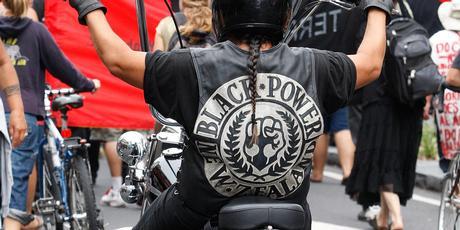
That was on page four of the dead tree edition, and online here, under the headline “Opponents put up roadblocks to bill”. Use of this outrageously unrepresentative photo makes a number of unjustified implications which aren’t present in Claire Trevett’s generally factual and balanced article. These include:

  • Most obviously, the suggestion that the marchers are gang members, with the implication of violence and public menace that creates, despite the fact that the march was peaceful having been mentioned in the opening sentence of Trevett’s article;
  • Creation of a general equivalence between Māori protesters and gang members, with all the racism that implies;
  • The suggestion that opponents of the foreshore and seabed legislation are acting on a separatist “black power” imperative, when the article makes clear that the opponents mentioned in the headline are an ideological grab-bag consisting of the ACT and Green parties, and Hone Harawira;
  • The suggestion that the marchers are literally blocking roads, when the article makes clear that the roadblocks referred to in the headline are metaphorical, and little more than the usual sort of procedural delaying tactics employed in Parliament to drag out the progress of a bill — in this case until next week, when the hÄ«koi reaches Wellington.

The core message of this choice of photo to accompany what is mostly a story about the trivial frustrations of a government trying to pass an unpopular law is this: Māori radicals and gangs are forcibly blocking this law, and they will block you from the beach as well.

It would be absurd if it wasn’t so offensively misleading.

(via Pascal’s bookie)

L

Gulp!

ACT MP and lawyer Hilary Calvert, on the Marine & Coastal Area (Takutai Moana) Bill, in Parliament last night:

“Historical use of the seabed any significant distance from the shore seems impossible to prove, and allowing for title over it to be granted over it to iwi allows for unjust and potentially divisive future claims. No one historically crawled about on the seabed miles from shore. There was just no chance of anybody holding their breath from 1840 til now on the seabed. It’s not gonna happen.

(My emphasis.)

Once again, I think we all owe a debt of gratitude to the ACT party for illustrating so plainly to us what — and how — they really think.

L

Revealed preference

Former National leader Don Brash addressed the ACT party conference at the weekend, which was half “catching Australia” boilerplate and half a warming-over of the infamous “nationhood” speech given at Orewa in January 2004 (for a thorough rebuttal of which see Jon Johansson, Orewa and the Rhetoric of Illusion). During his address at the weekend (although no mention is made of this in the text of the speech on his website, linked above), Brash correctly stated that the Treaty of Waitangi was ahead of its time, because the contemporary Australian approach, by contrast, was to “shoot the natives”.

At this point, a heckler in the audience piped up: “let’s bring it in“. (Audio).

Moments like these, when people are put in the position of genuinely involuntary response to some stimulus or other, are pretty rare in a political environment dominated by strict stage-management, spin and counter-spin. Their type and quality can tell you a whole lot about a political movement, especially when the response is collective, spontaneous, and embedded within a heightened or aroused political context, such as in the middle of a keynote speech.

What happened next was that the delegates in attendance at the ACT party laughed. At the suggestion that New Zealand implement a system of genocide against its indigenous people which, even back in 1840, was a source of shame for Australia, those in attendance at the annual conference of a New Zealand government party whose ranks include two ministers of the crown laughed. It is hard to be sure from the audio, but it sounds like Don Brash also laughed — someone on-mike did, and in such circumstances only the speaker is miked. Quickly, the laughs turned to disapproving murmurs, and Brash continued speaking as if nothing had happened. But by then the moment was over — the ACT delegates’ true colours had been revealed.

Not all of them, to be sure. No doubt there were those who were agape at the suggestion. Stony, stunned silence from the delegation at large would certainly have been an appropriate response and one which I don’t think would have been too hard to muster. Eric Crampton has suggested (though I suspect he’s by no means committed to this line of argument) that nervous laughter is a fair response to shock; admitting also that nobody seems to be claiming that the laughter was nervous. Eric also placed one in five odds on the heckler being a ringer whose plan was to elicit just this sort of response, in order to discredit the ACT party. Fair enough, I suppose. But it’s not the heckle itself which was disturbing — every party contains its fringe lunatics, those who fly off the handle and say embarrassing things. What’s disturbing is the response, the spontaneous, reflexive, collective reaction to the suggestion of genocide.

Just as Labour are the party of humourless, tuneless harridans after their “John the Gambler” song at the 2008 annual conference, and the Greens are the party of morris dancing hippies because of their 2001 annual conference, the fundamental take-away here is that ACT is the party who laughs at genocide jokes. The ACT delegates own that moment of laughter, just as much as they own the disapproval which followed it. It’s not even out of character for a party which has for some years now campaigned on the basis of arguments that indigenous people represent barriers to the white man’s progress, and was at the time of the interjection revelling in a sustained argument to that very effect: get rid of the bloody natives, and things’ll be a lot easier around here, and then we might catch up with Australia, who solved their bloody native problem good and proper. It speaks to the core beliefs of those in attendance, and what’s more, it largely reiterates what most peoples’ impressions of the ACT party are, based on their rhetoric, their policy positions, and their steadfast opposition to every bit of legislation giving the slightest acknowledgement to Tino Rangatiratanga.

Whether a ringer or an organic outgrowth from the party delegation, whether speaking his own truth to power or having just had a few too many free glasses of capitalist sauvignon, the people of New Zealand are indebted to this anonymous heckler. He has granted the nation a unique insight into the ACT party, and rare basis upon which to judge its underlying character. That’s good for democracy.

L

Double-tracking

Danyl Mclauchlan posits a conspiracy theory:

there is a pretty great opportunity to use the Maori seats to rort the system: if you had two Maori Parties, one that ran electoral candidates in six out of the seven electorates and only canvased for electorate votes, and another that had a safe seat in the seventh electorate and only canvased for party list votes in the other regions then you could, conceivably, end up with a dozen MPs (albeit with some overhang due to your electorate imbalance) and hold the balance of power in perpetuity.

Danyl’s scheme is essentially what the Greens tentatively proposed before the last election: green voters in Māori electorates consider casting electorate votes for the māori party candidate, and māori party voters cast their party vote for the Greens. The proposal was rejected by the māori party, which at the time was (in my view) a tactical error but a wise strategic choice.

It was a tactical error because of the efficiency argument (a positive-sum alliance permitting the two parties to extract more parliamentary representation from the same base of electoral support). But without the benefit of hindsight it was a good strategic move because the māori party’s whole point was not to be shackled to the ‘Pākehā’ parties, and its long-term survival still likely depends on its establishing its own persistent powerbase; one which could stand a chance of surviving even the abolition of the Māori seats. The only way to do that is to grow the party vote by strengthening ‘brand’ support among its electorate. (Also the proposal was made quite late in the campaign, and the potential for voter confusion was high.)

Those factors which made the plan a strong strategic risk for the māori party in 2008 now no longer obtain, or at least not so strongly. It has largely sacrificed its independence from the Pākehā political mainstream anyway, and could potentially lose considerable support for that reason. It may hang onto electorates, but it is likely that ‘brand’ support is lower than before. So with the benefit of hingsight, they might as well have gone with the Greens last time. Nowadays, they have a radical wing-man in Hone, who will work with them and who shares, despite all the rhetorical ructions, considerable common ground with the party’s other members and its foundational kaupapa. They can work together; Hone working to attract the ‘brand’ support for an independent indigenous party, the existing māori party maintaining their electorate positions and continuing to work within the mainstream.

I’m not convinced this will happen — as the Richards say in comments to Danyl’s post, a lot of it is personality-bound — but it could work in principle.

There’s one other factor, though. Although ACT and National have been collaborating in this way since Rodney Hide was gifted Epsom, the moment the māori party and a new radical wing led by Hone start doing it, the headline will be “Maaries rorting democracy to establish an apartheid state”. Those who’ve been benefiting from this sort of positive-sum electoral coordination for years will be those most urgently banging that drum and waving those banners. That’s a powerful disincentive.

Edit to add: Of course, there’s also a referendum on MMP on the day of the election. A scheme such as this would be an outstanding means of undermining MMP’s popular support and endangering its future.

L

The Perils of the Dark Side

Via 3 News journalist Patrick Gower on Twitter, the news that Pita Sharples is the keynote speaker at the Destiny Church annual conference this Labour weekend. Concerning news.

Except I’m not sure it’s completely accurate. According to the Destiny press release, Sharples is the keynote speaker at the Friday night Awards & Recognition event which kicks the conference off, while (who else) Bishop Brian Tamaki is the “keynote preacher” for the weekend-long event. I think this is an important distinction: it’s appropriate for Sharples, with a lifetime of support for Māori excellence, to be present for an event which celebrates achievements in “business, management, the health and social services sectors, Pacific arts, family breakthrough and contribution to at-risk youth” for a large and largely Māori organisation, featuring pasifika and kapa haka performances to boot.

But that’s quite a different thing to lending the imprimatur of his status as the co-leader of a government party and Minister of Māori Affairs to the shady cultishness of Destiny’s main event. This is not to say that Sharples should shun Destiny outright: after all, as a kaupapa Māori politician he does represent some of the group’s members, and many non-members who share some of their values. Such ‘Dark sides’ of support exist for almost every party; the Greens have their crazed dark-green environmentalists; Labour has the blue-collar rednecks about whom I’ve written previously; ACT has mostly sucked away the white-collar rednecks (and doesn’t mind admitting it) from National, but the Nats still have the worst offenders among the farming lobby and many of the least-savoury Christian sects (much of Destiny undoubtedly included). For all that they might be abhorrent to some, these are all legitimate interest groups and — within reasonable bounds — they must be tolerated and their needs entertained in a free society. Their members have as much right to democracy as anyone else, but (as with any fringe group) politicians must be extremely circumspect about the type and quantity of support that they grant.

There is a danger that Pita Sharples will be seen to pander too much to Destiny; and indeed a danger that he does pander to them. The māori party paddles turbulent waters at present; having compromised very heavily on the Marine & Coastal Area/Takutai Moana legislation to replace the Foreshore & Seabed Act, and now finds that Faustian bargain under attack both from the ACT party without and from Hone Harawira within. Despite the former, and probably because of the latter, they have been very quiet lately. Although they — ironically — share some common ground with Labour on the Takutai Moana bill, there remains a very large gulf between them; not least because Labour’s own conference signals a much more classical materialist direction than that which has previously obtained. Sharples and Turia are no fools, and can see that remaining a client of Key’s pragmatic-instrumentalist National party is a hiding to nothing — even with the ACT party likely out of the picture after the next election, the likelihood that they can maintain common cause once the other has outlived its immediate use seems slender. So they feel like they need another support base, and it must be very tempting to team up with a charismatic leader such as Brian Tamaki at a time like this.

It would be ruinous to do so. Most obviously, this is because outside of his most loyal followers — his 700 Sons — Tamaki’s is an illusory sort of strength, based on the smoke and mirrors of a showman’s art rather than upon deep loyalty and conviction. This much was clearly shown in the 2005 and 2008 elections, where the Destiny Party (and later the Family Party with Destiny’s express endorsement) failed to come close to success, due largely to a lack of internal cohesion. Destiny has failed to demonstrate — even at the height of its profile five years ago, under a government largely hostile to it — that it could mobilise a meaningful number of votes.

The second, and by far the more important reason, is the abhorrent nature of the policies and principles Destiny stands for — crude Daddy State authoritarian Christian conservatism with a brownish tinge; illiberal, intolerant, homophobic and misogynistic, quite opposed to where Aotearoa is heading. And that’s to say nothing of the corruption and appalling social dysfunction endemic to the evangelical cults of which Destiny is an example. The sorts of scandals which currently rock the church of Tamaki’s own “spiritual father” Eddie Long in the USA must undoubtedly also exist within Destiny. This is essentially the same package of qualities which turned the Exclusive Brethren to political poison for Don Brash’s National party in 2005. Because of this deep and fundamental disconnect, and New Zealanders’ innate distrust of folk who think they’re ‘exclusive’ (especially if they’re brown, wealthy or religious), the reality is that an alliance between the māori party and Destiny would likewise be poison, and would probably circumscribe any future prospects of working with either of the two main parties, not to mention utterly ruling out the Green party — with whom the māori party shares the most policy in common.

So there is no easy course for the māori party in the long term; the swell is heavy and the winds both strong and changeable. But to extend the nautical metaphor, Destiny is a reef; not an island. Better that they paddle on by their own course and seek more solid ground.

L