Brown still on the horse

Bless the Herald, burying the most important point of an article about the Auckland supercity mayoralty race at the very bottom:

Mr Brown also spoke of leadership and the need to deliver a resounding majority for the mayor so he or she could sit there with the mandate with the support of the community. [sic]
Judging from the mood of the meeting [in Point Chevalier], he won a resounding victory last night.

It seems remarkable to me that Brown could beat John Banks “resoundingly” in gentrified Pt Chev, of which (as I recall) Banks is himself a long-time resident. But then, I don’t know Auckland very well, and perhaps I’m misreading it. Is there something I’m missing or is this actually a biggish deal?

It apparently counterindicates DPF’s and Hamish Collins of No Minister’s reasoning that Len Brown is toast because Kerre Woodham reckons he’s a nutter and she is some sort of bellwether for this “Grey Lynn liberal” demographic. Because her status as a talkback host and columnist who recently came out in favour of three strikes didn’t disqualify her from that already.

Disclosure: According to 8 Tribes questionnaire, bogus pop-sociology though it might be, I’m very squarely a member of the Grey Lynn tribe myself. I’m sure you’re all shocked, just shocked.

L

Visual perks of office

(NZ Herald.)

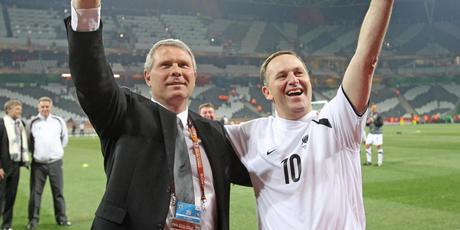
I don’t have much time today, but wanted to note the above image of John Key in an All White strip after this morning’s 1-1 victory over Italy. The significance of the event notwithstanding, the slightest chance of a result such as this, and its reflected glory, was surely a significant reason for Key to attend the All Whites-Italy match. Fair enough, too.

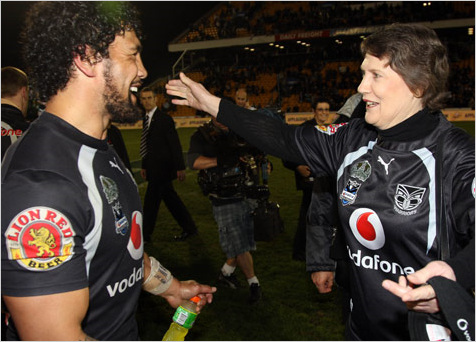
It also reminded me of when then-PM Helen Clark donned a Kiwis Warriors jersey after a momentous rugby league victory (2005 Tri-Nations?). But for the life of me, I can’t find a photo of that event. I know it was pretty well-seen at the time — footage of the team celebrations with Clark was part of the post-match TV broadcast and made the news, but it’s like the stills have just vanished down the memory hole.

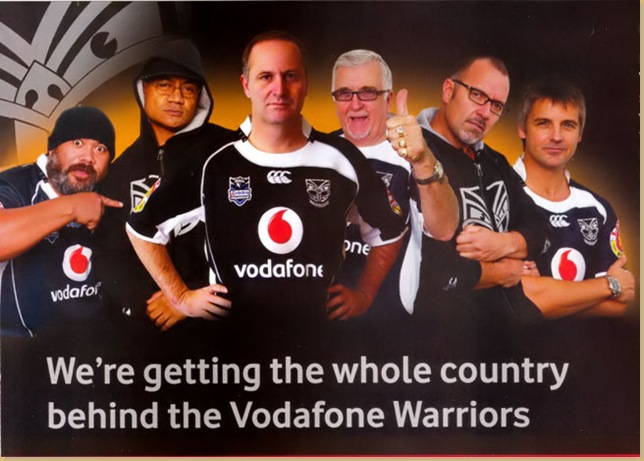
Ironically, while googling, I did find a photo of John Key as a Warrior, though this one is apparently advertising bumpf:

(H/T NZ Conservative, who asked “I wonder if Helen would have done it?” Well, wonder no more.)

Those look suspiciously like Steve Price’s forearms.

Edit: Pat, in the comments, points out that I’m probably remembering the Warriors, not the Kiwis. Probably right. There are certainly a bunch of PR shots of Clark with the team after their 19 September 2009 playoff win over the Roosters — conveniently just a couple of weeks before the general election.

(Stuff gallery.)

Thanks Pat.

L

A Diplomatic Dilemma: Kowtow or Confront?

The manhandling of Green Party leader Russell Norman by Chinese security guards as they escorted a high-level delegation into Parliament raises some thorny questions for the government. Norman was protesting in favour of a free Tibet when his flag was taken from him and he was shoved to the ground. Technically speaking, he was exercising his democratic right to free speech and protest on parliament grounds, so the minute the guards laid hands on him they were guilty of assault. Of course, it remains to be seen if Norman did anything to provoke the guards reaction, such as by rushing at the visiting officials or uttering threats (neither of which appears at this juncture to have happened). Some commentators believe that he deserved what he got because he was being provocative merely by protesting , or because the whole episode was a PR stunt anyway. Even so, if the assault on him was provoked by his holding the flag or shouting “free Tibet”  rather than him posing an immediate physical threat to the delegation, then the guards were in fact violating his rights as well as NZ criminal law and parliamentary protocol. So what is the government to do?

China is now the second largest trading partner of NZ, which has secured the first bilateral free trade agreement between China and a Western country. The National government has worked hard to deepen ties with the PRC, to the point that it is working on the details of a military exchange program with the Asian giant and has not opposed the sale of strategic assets to Chinese consortia. In the past the 5th Labour government has coordinated with visiting Chinese delegations to prevent protesters from getting close to the visitors. There is, in other words, a history of NZ officials working to appease Chinese sensitivities about protest and dissent within a larger context of improving relations between the two countries.

But there has never been a direct confrontation between members of a Chinese entourage and NZ citizens, much less a shoving match between Chinese nationals and an MP inside of parliament itself (as far as I know previous protests by Ron Donald never escalated this far). So a precedent is about to be set. If the NZ Police charge the security guards with assault, or if the government declares them personae non grata and expels them, then NZ runs the risk of having these strengthening ties disrupted by a Chinese diplomatic backlash. Even of short lived or partial, any retaliatory curtailment of trade and investment could end up costing NZ millions of dollars in lost revenue (and the jobs that go with it). But if the Police or government do nothing, then they send the signal that NZ’s commitment to civil rights is secondary to its commitment to trade. Some might see that as kowtowing to an authoritarian one party state in the pursuit of profit. So far the Police have said that they will investigate Norman’s complaint about the incident, but  that does not mean it will result in charges being laid.

One line of argument could be that NZ has to look at the broader and longer-term picture and not jeopardise a relationship that is crucial to NZ’s future prosperity over a trivial incident. A counter-argument is that NZ has more to lose if it abandons its democratic principles in favour of the ethereal promise of cash down the road. One rationale privileges principle over practicality; the other privileges the reverse.

So, what is to be done? What should be Labour and ACT’s responses be (as the majority opposition party and supposed champion of individual rights, respectively)? Should pragmatism triumph over principle, or should principle outweigh economic and diplomatic considerations? Is there a compromise solution in which face is saved all around? Will the Police go through the motions of an investigation but do nothing, and if so, what will National do by way of official follow up?

Less one think that this conundrum could only occur because of the nature of the Chinese, consider this scenario:

A protester attempts to approach US Vice President Biden and/or Secretary of State Clinton at the Beehive entrance in order to deliver a petition demanding closure of Camp X Ray at Guantanamo, or better yet, a summons to the International Court of Justice for complicity in US “war crimes” in Iraq and Afghanistan. What do you think the Secret Service response would be, and if the Secret Service agents surrounding the US dignitaries were to react in a physical manner, would the NZ Police or government press charges against them?

Such are the quandaries of being an elf amongst giants.

Life mimicking art: outrageous vainglory

This is John Galt.
“This is John Galt.”

If there lingers any doubt the film production of Atlas Shrugged is going to be an epic adolescent ego-stroking festival, it must surely be dispelled by the news that the director (Paul Johansson, of teen-angst-dram series One Tree Hill) is also the hero: John Galt. The resonant hubris of this is so stark that the fact he’s never directed a feature film before barely deserves a mention.

There’s one point of interest for New Zealand viewers, though: Grant Bowler, probably better known as Wolf from Outrageous Fortune, is down for Hank Rearden.

There is no such thing as a temporary (career) suicide.
“There is no such thing as a temporary (career) suicide.”

Grant Bowler has some chops, and he suits the character. My previous misgivings notwithstanding, I reckon that’ll be reason enough to watch it. But, my goodness, what a brush to risk being tarred with.

(H/T to Peter Cresswell and his always-excellent ramble.)

L

Bestest

Stuart Dye’s column which uses perfectly sound* logic to reach the conclusion that the All Whites are the world’s fifth-equal-best football team,** is a bit of fun. The only problem is that while reading it I kept getting flashbacks to the flimsiest rationalisations of the left’s 2008 election campaign. By careful selection and weighting of the criteria by which to judge the political field it was possible to argue — at times convincingly — that Labour and the Greens had it in the bag, and that’s what many people did instead of taking a long hard look at their team’s performance.

Ironically enough, I’m pretty sure those picking the criteria and making the rationalisations weren’t surprised in the slightest when their outcomes failed to eventuate.

Delusional partisan jingoism in a sport where we have a snowball’s chance: harmless. In politics: not so harmless.

L

* For unusual values of “perfectly” and “sound”.
** Above us are Brazil, Germany, the Netherlands and Argentina — and by now Mexico and Nigeria Greece, which I suppose makes us seventh equal.

Len Brown shows how it’s done

I don’t know much about Manukau mayor and Auckland Supercity mayoral candidate Len Brown, but this I do know: the guy has fire in his belly, and is prepared to stand and be judged by the authorities and his constituents.

This speech (audio, or edited video here if you can get it to work) is old-fashioned public-sphere politics — both rhetorical and substantive — done properly. He admits misusing his council credit card, calls in the highest authority in the land to investigate it, and says let the cards fall as they may.

This is an object lesson on accountability and due process for Chris Carter. Two senior progressive politicians, both fighting for their political lives over the same issue, and two radically different approaches. Where Carter has recoiled from public scrutiny and repeately refused to take any responsibility for his wrongdoing, Brown has done the opposite, calling for the highest standard of oversight and demonstrating that he will accept its outcome. He has both appealed to the values and culture of liberal democracy in asking that assessments be made on the substance of the allegations against him, and appealed to liberal democracy’s civic institutions to provide the best possible basis for that judgement.

Win or lose the election, Brown has acted with integrity and demonstrated his commitment to democracy, and as far as that goes, he’s already beaten Carter hands-down. But even in terms of electoral advantage, he has played a huge liability into a potential — depending on what the A-G’s investigation shows up — advantage. While such heartfelt contrition is a poor substitute for not having done wrong in the first place, the electorate likes a candidate who is prepared to stand up and be counted like this, and moreover, it tends to like a candidate whose commitment to the job is as strong as Brown’s clearly is. So this mayoral race just got interesting.

L

Response to Phil Sage on the FSA

Phil at No Minister has written a long and pretty useful post on the background and consequences of the FSA and its coming repeal, titled Customary rights, free access and the beginning of the end for Socialism in New Zealand?

I have a couple of things to quibble about, and since I dare say there’s not a huge crossover between the readership of KP and No Minister, I’ve reproduced my comment below.

Continue reading “Response to Phil Sage on the FSA”

Not dark yet, but it’s getting there

Allan's beach at dusk, Dunedin, New Zealand
(Image, “Allan’s beach at dusk, Dunedin, New Zealand”, stolen from Nicola Romanò)

The Foreshore and Seabed deal is not over yet, at least not as far as Hone Harawira is concerned. He has come out swinging (audio) against the government, saying the consultation process which resulted in the agreement was “bullshit”, that Key has shown poor faith and “pandered to rednecks” with a Foreshore and Seabed repeal proposal which is all take and no give:

[The government] took the two things which would make Pākehā happy and refused to give the one thing which would make Māori happy.

The two things are guaranteed public access and inalienability; the one thing is Māori title. Furthermore, he’s reaffirmed a commitment to ongoing struggle for a more equitable resolution:

We may have to wait for another Labour government, we may have to wait for a formal coalition between the māori party and the Greens together, we may have to wait for hell to freeze over and ACT to give it to us, I don’t know.

This is good, and in my view it’s the position the party ought to be taking. But paradoxically, he supports the party’s decision to accept the agreement, saying it’s “a step in the right direction”. This can only make sense if whatever legislation which replaces the FSA is non-enduring; essentially, another step along that road laid down by the Good Intentions Paving Company, rather than the full-and-final settlement which will carve the proposal in legislative stone.

But I think if they follow this path, it will be all over. I don’t think they have a hope of being able to play this as an ongoing struggle, having consented to it. As Bright Red said at The Standard yesterday, both major parties will see this issue as settled and will suffer terribly if they bring it back to the table. The only reason the FSA was even up for debate is that even National could see the manifest injustice of legislation being rammed through against the vehement opposition of the group most subject to it; while many among National derided the FSA as being too generous, nevertheless the process of its passage was repugnant to them.

Hone Harawira and many others no doubt think that this process was similarly repugnant, but that view has little legitimacy since the Iwi Leadership Group and the māori party have willingly agreed to it. This is how liberal society works; this is tino rangatiratanga in action: you make your decisions and you live with their consequences. The only hope now, it seems, is that the eventual bill drawn up from the Agreement in Principle signed yesterday will provide some pretext for the party and the ILG to withdraw its support. This will come at an enormous cost in terms of goodwill, but I have no doubt that despite his protestations to the contrary, Hone Harawira is getting to work on setting the stage for such action already.

L

What changed for the Iwi Leadership Group?

So the māori party has accepted the government’s Foreshore and Seabed Act repeal proposal.

As I posted the other day, the Iwi Leadership Group, chaired by Mark Solomon, was dead-set against the proposal, with Solomon speaking in very strong terms against it. But now, while residual concerns remain, the ILG has now issued an admittedly grudging and vague endorsement. But there is a lot of daylight between Solomon’s words previously and the content of this acceptance. So my question is: what’s changed? While writing this, I was pleased to hear that Brent Edwards and Barry Soper asked the same thing during the PM’s presser. According to Turia, what changed is that:

In terms of customary title and customary rights, we have been given an assurance that those rights will be as sacrosanct as any other rights to title.

That’s very squishy. The problem hasn’t really been the veracity of the rights in question; it’s been the barriers to their acquisition and the limitations on their extent. Neither of those problems have been addressed. The matter of ownership isn’t trivial, and in particular the glaring difference between nascent Māori title-holders whose potential rights have been largely circumscribed while the possessions of existing, mostly Pākehā, title-holders are retained, was of particular concern to Mark Solomon — has not been addressed. More than that, the requirement that claimants not be disadvantaged in their claims by a prior Treaty breach is nowhere to be seen. This is particularly crucial, since it distinguishes to an extent between legitimate and illegitimate alienation. Under such a proposal (as I understand it, and in general) a claimant would be able to claim rights to privately-owned raupatu land and resources, whereas under the present scheme any land in private ownership — no matter whether it was originally confiscated at gunpoint — cannot be subject to a claim. That’s a big deal.

There are some positives in this scheme. As I’ve said, I dislike the “public domain” aspect of it; but I think the recognition of two distinct levels of customary title is good (particularly when set against the FSA’s draconian all-or-nothing approach in which all would get nothing). I generally approve of the mechanisms by which those claims can be tested. But it’s my view that this proposal grants little to Māori that they didn’t already have under the FSA, and although the barriers to test a claim are lower, and the mechanisms are more robust, and there’s generally better faith between the crown and Māori now than there was in 2004, it’s fundamentally the same sort of beast: iwi petition the Crown for rights that, according to the common law of the land, were never extinguished and ought never have been abridged; Māori debased as supplicants, begging the very agent of the crimes perpetrated against them for recompense.

Anyway, my initial position of criticism in the former post was that the māori party would be acting against their mandate if they accepted the government’s offer, it having first been unanimously rejected by the ILF. But the ILF having turned on a dime leaves me in two minds: I don’t like this proposal and I don’t think it has sufficient merit to be acceptable to Māori; but regardless of that the māori party is fulfilling its mandate by accepting it, acting in accordance with the guidance given it by the Iwi Leadership Forum as representatives of the iwi groups with claims to test. What puzzles me is not why the māori party have agreed to it — although the blame will no doubt be laid at their feet more than anyone else’s, and I agree that they ought to have done better — but why the ILF changed so rapidly and so completely. I’m left feeling much like I did when Michael Laws claimed victory about the h when the result of the government’s decision would be to establish Whanganui as a new orthodoxy, and relegate those wanting to use Wanganui to quirky outsider status:

Who knew that all Michael Laws wanted for his cause was an emasculating partial endorsement and a prolonged death sentence? He could have saved everyone (and his own reputation) a great deal of trouble by making this plain at the beginning.

There are a few possible explanations. One is that Solomon’s position as articulated on the Sunday politics shows and later on NatRad was not truly representative of the ILG’s position, and he has since been hauled back into step. DPF favours this line of argument and reproduces a Ngāti Porou press release in evidence. Another is that Solomon’s remarks were an aggressive negotiating position. But he’s not usually the sort to play brinksmanship games, and this government, with its solid parliamentary majority and two-winged coalition structure, is a poor choice of target for such a strategy. Another possibility is that something really did change, and they’ve received more than just assurances. A fourth, and no doubt very popular possibility is that Turia, Sharples, Solomon, Mahuika and all the other Hori Tory tribal elites have been bought off with baubles of office, beads, blankets and limousines.

I guess we’ll see when the final bill is drafted and introduced. And, of course, the response from the flaxroots will be important, because if they feel like they’ve been sold down the river, no amount of baubles will keep them from abandoning the māori party. And nor should they.

L

John 8:7-11 (a.k.a. I don’t care about Shane Jones’ movie viewing)

To all the people to whom I have said today “Yes, I am a feminist, but I really don’t care” I would like to offer this longer explanation…

I care a great deal about how politicians behave in the roles, and how they spend public money – what they do with their credit cards and their appropriations. I also care a great deal about the exploitation of women, men and children. But I don’t care that Shane Jones watched porn, I really don’t.

There are many terrible things about so much of the porn industry, about the ways it exploits the women and men on film, the way it perpetuates damaging stereotypes about sex and gender.

Before you judge Shane Jones for viewing the products of that exploitation, however, look down at yourself for a moment – where were those clothes made? Any sweatshop labour in there? Any women, men and children exploited for your convenience?

The media and commentator focus on the porn films are because it’s “naughty” or “dirty”; after all it’s about sex and that is something we must never admit wanting or enjoying, and that we must never ever talk about.

And you know what? That there, that exact taboo – strengthened today in all the prurient chatter – does far more damage to New Zealand women than all the porn watching put together. That taboo is responsible for many teen pregnancies, for much sexual abuse being hidden, and for a lot of STD transmission. It also results in (and this matters too) many people having a far less joy from sex than they could.

So, when you express outrage about Shane Jones watching porn and expect me to back you up because I’m a feminist you can expect me to check your clothing labels, and make sure that you know it’s ok to talk about sex, and even to want and enjoy it.