Depicting Julia Gillard

I’ll be watching with interest the characterisation — and caricaturisation — of Australia’s new PM, especially as compared to Helen Clark. Some of you might be aware that I once wrote a research paper on the characterisation of Clark by John Banks and Lindsay Perigo in talk radio during 2007. I was informed at the time that, via the usual academic networks, a copy made its way from Victoria University of Wellington to someone at the Australian National University in Canberra who had contacts within the then-Deputy Leader’s office, and that Gillard had read it with some interest. I’m not sure how true that is, but I do know she took a keen interest in Helen Clark’s public image, likely with this very eventuality in mind, so it isn’t altogether implausible.

The Clark-Gillard comparison is a natural one, due partly to geographical and temporal proximity; but also due to genuine similarities between their politics, manner and ascent to power. The comparisons have been highly ambivalent. The usual slanderers have already begun spreading the same ludicrous assertions that Gillard, like Clark, is a closet lesbian, on the grounds that she hasn’t had children and is more apparently bolshy than her husband. Apparently very deep in the closet, since she’s come out against gay marriage. (But then, she would, wouldn’t she?)

Peter Cresswell described her as Helen Clark with lipstick, which I guess is negative as to her politics but positive as to her perceived femininity, notwithstanding that Clark did in fact wear lipstick herself. Auckland University’s Jennifer Curtin pointed out some comparisons as to the two women’s assumption of their roles, though I can’t help but think she must have a more nuanced and complex position on the topic than was suitable for an AAP statement:

“They’ve both started off on the left but moved kind of to the centre of their party,” she said. They both appear to be hard workers, good speakers and have made similar choices in selecting their political allies and portfolios – opting to avoid women’s policies specifically. “If they represent women they do it in a more mainstream kind of way,” Curtin said.

Clark’s biographer Brian Edwards, speaking on ABC Radio National, outlined the similarities in more detail:

Well there are extraordinary similarities. I’ve been reading some of the reports about Julia Gillard in the papers here in New Zealand, and it’s absolutely uncanny, and what we’ve just heard is also true, that from the start, Helen Clark was a professional politician, she was absolutely focused, her intention I guess, long term, was to be prime minister, and she would do everything possible to do that. And if you look at the two women, as I say, the similarities are remarkable. Both unmarried, both decided, clearly, that being a politician and aiming to be prime minister did not go with having children, that was the decision, a positive decision which Helen Clark made, she and her partner, Peter Davis. Helen in fact, never wanted to get married and was actually more or less pushed into it by the Labour Party, and wept on her wedding day, which was relatively unusual. She was an atheist, she received some of the same sort of criticisms that I gather Julia Gillard has received in your country for her voice, she had a strong Kiwi accent, a rather deep voice; for her looks, people didn’t like the look of her hair, they didn’t like the look of her teeth; she was accused of being a lesbian, primarily by her opponents admittedly in those early days, and had an extraordinarily hard struggle to make it at all.
And these were all things that a man would not expect to happen at all in politics. None of those things would have come up if the man was a bachelor or was married or didn’t have any children, or any of those other things.

Clark fought these attacks, in part, by recourse to a “makeover” in mid-2005, when she appeared on the cover of women’s magazines — notably Woman’s Weekly — more heavily made up, more softly and sympathetically portrayed and generally appealing more directly to women, and to men who, if they had to be led by a sheila, wanted to be led by a real sheila. This was probably crucial to her winning the 2005 election. Gillard, The Australian tells us today, already has a similar glossy campaign well underway. It’s a good move. (Anyone who wants to call it fake or staged or a cheap trick or blatant media sycophancy to make such an appeal had better first recall John Key’s appearance on Gone Fishin’ (audio), and accompanying article by host Graeme Sinclair in — you guessed it — Woman’s Weekly. Incidentally, if anyone has or can find a copy of the video of that Gone Fishin’ episode, I’d love to see it. I missed it at the time.)

Other Gillard comparisons have also been made: to Margaret Thatcher (as Clark before her was), and to British Labour’s present acting leader Harriet Harman. In contrast with Jennifer Curtin’s observation that neither Clark nor Gillard emphasise their femininity in policy terms, The New Statesman‘s Alyssa MacDonald argues that the public treatment of Harman illustrates that it’s still not politically viable to be an overtly feminist female leader, even in 2010:

Both come from legal backgrounds, hold multiple political posts, have strong union connections, speak with distinctive voices and are always politically “on”. But while Gillard is popular and respected, Harman is often, very unfairly, spoken of as hectoring, dowdy and not very bright. Even before Gordon Brown’s departure, her chances of becoming Labour leader were the same as the number of forthcoming Harman biographies: zero.
Politically, there’s a glaring difference between Gillard and Harman. One has fought consistently for a feminist agenda, while the other has approached her political career with individualistic ambition. Not to do Gillard down — she’s very good at her job and she deserves her success — but her premiership isn’t necessarily any more of a great lunge forward for women than Margaret Thatcher’s was thirty years ago.
Meanwhile, Harman’s drive to push issues such as rape laws and the Equality Bill into the spotlight has undoubtedly been good for British women — and a huge contibuting factor to her unlovely public image.
Gillard’s success is still a symbolic step forward, signalling that the presence of women in Australian politics has become normal. And it looks likely to be good news for the country as a whole. But it’s not as if Australian women now have a Harman at the top to look out for their interests.

As MacDonald notes, Gillard is much more favourably-portrayed than Harman (and I would add, than Clark was at any point during her leadership). I think a lot of this is down to the “lipstick” to which PC refers: a metaphorical sort of lipstick which speaks to a particular notion of femininity, like the kind which Sarah Palin made famous. For one thing, Gillard’s attractiveness has been emphasised by the favourable comparison to Scottish actress Tilda Swinton:
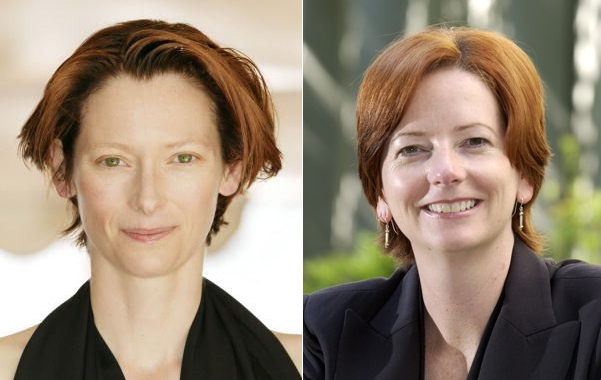
This distinctive visage, the “bricklayer” voice to which Brian Edwards alluded, and her speaking style have been welcomed by the Australian media and satirical communities, who found Rudd “almost irritatingly bland”, according to editorial cartoonist Bill Leak. This from an article, also in today’s Australian on the topic:

Gillard’s wealth of striking anatomical attributes is almost too much of a good thing, says Cathy Wilcox of The Sydney Morning Herald and The Sun Herald. “She’s got so many features that if you just go for one, it isn’t enough. The challenge is how to get all those things in there without her head being enormous.”
Since Gillard took power, editorial artists have been studying her face with the obsessiveness of a lover, poring over photos and freeze-framing the TV to parse her every angle and expression.
Australia’s first female Prime Minister, seen through their eyes, has a “striking head of hair”, “incredibly beautiful skin”, eyes that manage to be simultaneously “squinty” and “big and distinctively shaped”, “chubby cheeks” with “pronounced cheekbones” and a mouth that “sits small and low” above “a small chin that tucks into an incredibly long neck”. Not even her earlobes escape attention.
And who else but an artist would notice that the new PM has “a reasonably ample bottom in relation to her head”?
But there is one facial feature in particular about which they all rhapsodise: Gillard’s “pointy”, “assertive”, “wonderful” nose. A nose, as Leak puts it, “that looks like you could chop wood with it”.
Fiona Katauskas, freelance cartoonist and producer of the Talking Pictures segment on the ABC’s Insiders, says Gillard’s nose is a defining feature that artists can utilise to express her character, just as the jutting lower-lip of former PM John Howard came to represent his determination, or obstinacy.
“I will take a punt and say Gillard’s nose will become the equivalent of Howard’s lip,” she says.

What’s interesting about all this is that, unlike most of the discussion of Clark and Harman’s appearance, it is robust but not unkind. Gillard’s relatively warm reception is being put down to her status as Australia’s first female PM, and I think there’s some legitimacy to that view; a genuine preparedness to “give her a go” tinged by a fear that bagging her too early would come off as sexist. We’ll see how long that persists, and how long her distinctiveness — of appearance, manner, and political character — is portrayed as quirky and endearing rather than bizarre and threatening.

L
New Zealand and Uruguay as sporting equivalents.

As some readers know, I was raised and have worked professionally in South America, primarily in Argentina, with extended stays in Brazil, Chile and Uruguay. I also played soccer for 30 years and coached and refereed for ten of those. Eventually, injuries took their toll but the blessing is that even while growing slower I was able to play into my 40s. Then I moved to NZ.

Needless to say, I am following the World Cup closely and am quite pleased with the results so far. Before the games began my rooting  preferences (as in fan support, less the dirty-minded get other ideas) were 1) Argentina; 2) Uruguay; 3) Chile; 4) Paraguay; 5) USA; and 6) Brazil. Being an adoptive Argentine I am not a big fan of Brazil (because the rivalry is pretty intense and often ugly), but will take any South American country over others in the final. So far so good.

What struck me as I watched Uruguay advance to the semi finals is how much they are the mirror image of NZ when it comes to sporting history. Uruguay is a small, agro-export dependent country with a population of 4 million. It has won two soccer world cups, the last 60 years ago, and has never fully realised its footballing potential ever since. Uruguayans love their soccer with passion and most boys grow up dreaming of being soccer heros (it remains a largely male sport in Uruguay). But until now, the last decades have been one of World Cup frustration for the “charruas.”

NZ is another agro-export dependent country of about 4 million. Rather than soccer it is rugby that is the national sport. In spite of being a perennial favorite it has only won one World Cup, and that was 25 years ago. In spite of dominating the world rankings and being the stuff of boyhood dreams, the All Blacks have failed to live up to the hopes and expectations many Kiwis place on them when it comes to the ultimate rugby prize.

Which is what makes the All Whites accomplishments all the more remarkable in comparative perspective. In making the World Cup and then achieving three ties against teams ranked far higher than them, including defending champions Italy, the national soccer team overachieved beyond reasonable expectation. This would be the equivalent of Uruguay qualifying for the rugby World Cup, then managing to tie Scotland, Ireland and South Africa in the group stage! The latter is simply inconceivable even though rugby is in fact played in Uruguay and some of its players have played professionally abroad. 

All of which is to say that what the All Whites did, however modest their ambitions, is truly remarkable. Now if only the All Blacks can emulate the charruas and at a minimum make the semi-finals of the rugby World Cup next year. Playing at home should at least guarantee that, which makes the charrua return to form in a tournament held abroad all the more satisfying for supporters like me. That having been said, my heart and hopes always rest with Argentina in spite of their mercurial coach, who may seem crazy to outsiders but who has hit all the right buttons in bringing his team to the verge of World Cup glory (and I must admit to being very skeptical about Maradona’s coaching abilities until the World Cup began). Should the albicelestes get by Germany tonight (no  mean feat), they stand a good chance of making the nation proud, although that could mean playing Uruguay in the final. So, for the moment, all I can say is “Viva Uruguay!’ and “Vamos Argentina!”

PS: Kate Nicholls and I wrote a book in 2003 that explicitly compared NZ and Uruguay in terms of their insertion in the global political economy and their labour politics, so it is not that crazy to see the sporting parallels as well. I am also aware of Kiwi accomplishments in a slew of other athletic endeavours (such as triathlon, my other sporting love), but am limiting this comparison to the major national sport and its lesser valued (male) team equivalent in terms of how they have performed on the world stage.

You can’t mess with the messers

[Note: Idiot/Savant stole my initial title for this post — word for word! — forcing me to get more creative. The definitive version is here. Not sure about the video, though.]

Education minister Anne Tolley has tacitly threatened to go nuclear on primary principals who refuse to comply with National Standards directives, or who speak out against them. In a speech to the Principals’ Federation conference in Queenstown today, she said:

It’s much quicker [contacting me with concerns] and you will get results, rather than going to the media and making threats, which is just politicking, and achieves little.
And while we’re on that subject, you are pretty unique among public servants who can speak freely in the media. May I remind you that I made representations to make sure that continues.
However – no public servants have ever been granted the privilege of picking and choosing which Government laws they choose to administer. Lawyers, accountants and all the other professionals working in Ministries can offer opinions. But it’s the Government that makes policy decisions.

Now, there’s an implication here that the minister might retract her “representations” to make sure that the rights of teachers to speak freely are preserved, but there’s nothing to this. Any move to constrain teachers’ views or their expression would immediately draw furious and justified denunciations of the government for politicising and propagandising the education system, such as no liberal political movement could withstand.

In the final analysis she’s 100% correct about the government setting policy and the sector implementing it. By way of remedy, the ministry can take over the running of a school which fails to implement education policies adequately, and Trevor Mallard suggests the ERO has already started heavying truculent schools to set an example to others.

But it is an empty threat. For one thing, you can’t play the bossy schoolmarm with schoolteachers and principals — they wrote the book on it, and know all the tricks of the game, having put up with them from students for their entire professional lives. Not to mention that, as career educators they have far more invested in the quality of their education system than a minister who’s only been in the job two years and could be gone in the next cabinet reshuffle.
More crucially, though, the minister is up against old-fashioned collective action: a heavily unionised workforce which knows it is indispensable and irreplaceable. So what happens if it’s not just one school? What happens if it’s a dozen, or a hundred, or almost all the primary schools in the greater Auckland area, or the schools of two National heartland electorate regions at either end of the country, or as much as 94% of the sector overall?

Later in the speech, Tolley said:

I’ll say it again – we are going to get this right, for the students, and for their parents.

But when push comes to shove, National Standards simply cannot be implemented by fiat. Teachers, directed by principals, are those who must undertake the implementation of the policy. While I cite them reluctantly because I don’t entirely agree, it’s somewhat like what the Randians are saying about Obama’s response to the BP oil spill: no amount of threat or bluster can provide any additional incentive to progress a cleanup whose failure or undue delay will spell a certain end to the company. No matter how you slice it, there are not enough Ministry of Education staff members, non-unionised part-time relievers or teachers who are happy with National Standards as proposed to do the complex and important work of assessing all the students who need to be assessed; cataloguing, moderating and communicating those assessments to parents and the ministry in a coherent manner. This is ignoring the fact that you can’t simply parachute a compliant teacher or apparatchik into an unfamiliar classroom and have them do it with any legitimacy. The teachers who stand up in front of that class of kids day-in and day-out are the only ones who can properly assess them, and they know it.

The sector also knows it’s in the right. Educators’ opposition to National Standards is neither ideological nor capricious, and they have have consistently levelled principled and pragmatic arguments against only the proposed implementation of the policy, backed by the best local and international experts in the field. They support assessment standards in principle, and have repeatedly suggested reasonable alternatives to the proposed implementation. The problem isn’t with their willingness to work with the minister; it’s that the minister isn’t interested in working with the sector.

So ultimately one of two things will happen: one side or the other will compromise sufficiently for the issue to progress, or the minister will be faced either with backing down in abject failure or sacking a significant proportion of the education workforce, with the consequent failure of the policy by default, not to mention a massive outcry from parents who’re forced to take time off work because their kids can’t go to school (and from their bosses, and bank managers, and almost everyone else). There’s no better way to bring the country to its knees.

Tangentially, this situation illustrates a branding risk I’ve been meaning to post on for a while: if you name a policy initiative after your party or some other core bit of your identity, you had better be damned sure you can get it through to full implementation without a hitch, lest its failure tarnish your good brand. Quite apart from any concerns with the policy, his National government has failed to do so with its National Standards. Not only is the policy programme and its attempted implementation against the wishes of the only people who can implement it a catastrophic mistake, but its naming looks like a spectacular failure as well. If it’s not pulled out of the fire soon, in future, all National’s political enemies will have to do to score a point is recount some of the more embarrassing events of this episode and say “these are National’s Standards”. It’s already happening — I’ve seen that very sentence used at Red Alert, for instance, regarding something unrelated to education reform. Instant conversion of a wonkish policy criticism to a gut-level identity observation which will resonate with the folk who just wanted their kids to go to school, those who wanted nothing more than to teach them as best they could, and ultimately the kids themselves. For this reason, my instinct is that the long-term damage to National’s brand and electability on this matter will become too high a price to pay for the perceived win over the sector, and those with a more strategic view of National’s situation will require that the wound be cauterised. Although it’s a backdown, over the long term this will be good for the party. More importantly, it will be good for the country.

L

Broad Bows Out.

I cannot say that I regret the news that Howard Broad is ending his tenure as Police Commissioner. Regardless of what positives he brought to the job–and I know that certain people on the Left think that he is a great guy who can do no wrong–for me he is to the NZ Police what Richard Woods was to the NZSIS: a person who allowed overtly political criteria to intrude on what should have been autonomous decision-making based on assessments of real threat and practical priorities. Just like Wood’s disgraceful behaviour in the Zaoui case, Broad was the man at the helm during the Urewera raids, raids that just happened to be timed to coincide with the final reading of the revised (and more draconian) Terrorism Suppression Act and which targeted well-know dissidents who, whatever their crazed (or intoxicated) rhetoric and antics in the bush, were as far removed from a terrorism plot as are medieval war reenactment societies. Broad is the man who has lobbied in favour of expanded (domestic) surveillance and search powers for the Police and other state agencies. Broad is the man who ran the show at a time when a culture of criminal abuse within the Police was exposed, only to preside over a corporate whitewash of the culture rather than a wipeout of it. Truth be told, Broad was handpicked for the job by the Labour leadership  because of his ties to the party, and given the position when his  (less compliant) predecessor committed a personal  indiscretion that cast doubts on his professional judgement. In sum, Broad may be a nice guy in person, but under the 5th Labour government he allowed his political masters to exert too much influence on the Police as an institution, IMO.

All of which makes Pita Sharples’ tribute to Howard Broad, particularly his honoring Broad for services to the Maori community, as sickening a piece of political syncopathy as has been seen in recent years. On this one, I think Hone Harewira is right: the less said the better.

Having stated my view, let me also state that I do not believe that National will do anything to diminish the politicisation of Police decision making. In fact, Key and co. could well make it worse.

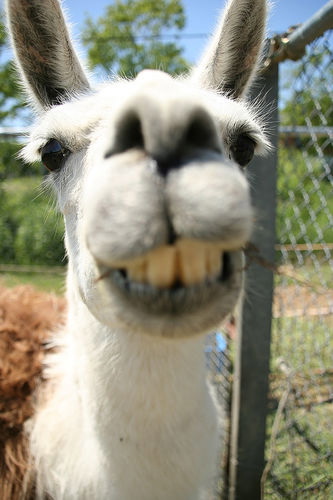
Of Llamas and Lamas

Public advisory, especially for DPF:

Llama


Lama


And to bring the post back around to the topic of Chinese authoritarianism and responses thereto, with a bonus llama connection: The Song of the Grass-Mud Horse made a splash a year or so ago, as a protest against the Chinese government’s internet “harmony” policy. The video is below (and contains necessary obscenity):

This graphically illustrates a point that shouldn’t need to be mentioned, but often does, and of which I was not fully conscious until I spent some time in China: for all that they are propagandised as such in the West, the Chinese are not simply mute automata struggling under the heel of their dictators. The public sphere, however constrained it might be by our standards, exists — and the diversity of views aired in it is increasing, not decreasing.

L

The dam breaks

“Where does the political correctness end?”

That’s the question from Michael Laws in response to the shocking news that local Māori are calling for “Rimutaka” to be changed to “Remutaka”. His dire predictions are coming to pass. The savage, foreign spelling of Whanganui has been coercively imposed by the forces of craven self-hating white PC liberality upon the good burghers of Wanganui — sorry, I mean Wonganewy — and now every Māori place-name in the country is going to be similarly stripped of the light patina of civilisation bestowed upon it by the linguistic touch of the God-fearing right-thinking settler.

As local councillor John Tenquist — or should that be Tinquist? — says, it’s always been that way for more than his 76 years, so that’s how it should always be:

What is wrong with the way it is? Once again we are pandering to a minority. We have some European heritage in this country and, rightly or wrongly, it has been Rimutaka for over 150 years, so if it ain’t broken, don’t fix it. The locals on either side of the hill will never change the name from what they have always known.

Of course. Those old people knew what they were doing back then when they changed the name. Wouldn’t have done it without a reason. Back in those days, they knew that eating at the dining table was the final bulwark against the collapse of Western civilisation, betokened nowadays by so much more than the creeping advance of Hori-fied place names. We are losing our grip, little by little. We even have to sing the national anthem in Māori — and the Māori version first, even though they didn’t write it! Our country’s most-trusted citizen and most-decorated war hero is a Māori. We’ve got a Māori flag, a Māori All Black team, and half our goals at the World Cup were scored by a Māori! I fully expect that by the time of the 2014 World Cup we’ll be fielding a team called the All Browns. In the unlikely event that we can qualify, given the well-known lack of footballing skill possessed by those not of European extraction.

And would you look at that: Mayor Michael was right all along. Once again, spearheading this frontal assault on all that is right and proper are those bloody river Māoris and their unpronounceable names:

The story behind the area’s name is that a Maori chief, Haunuiananaia, an ancestor of the Te Ati Hau a Paparangi people of the Whanganui region, left his home in southern Taranaki to pursue his errant wife Wairaka, who had run off with a slave.
During his journey, he sat down to rest on a mountain and think about his quest. He named the mountain Remutaka – which means to sit down.

The Mairist Republic of Whanganuistan draws ever closer. And we’re supposed to call the highest peak in the Wellington region after something some savage once sat his arse on?

It’s past time for New Zealand’s downtrodden, powerless, disenfranchised white majority to rise up, and let the clarion cry be heard: “Come and see the violence inherent in the system! Help, help, we’re being repressed!

L

Rudd’s problems in a nutshell

Just a quick hit: this article in Sydney’s Sunday Telegraph from last Valentine’s Day details the less-than-lovey response Rudd received from students invited to the annual Parliamentary Q&A.

It’s not that they were set against him — young Australians overwhelmingly supported Kevin ’07, and continue to support Labor. It’s that he treated them with disdain. He didn’t prepare for what should have been a PR gift; made things up to suit the narrative he wanted to project; and then pulled rank and got angry when his prevarications were exposed.

Clearly rattled, Mr Rudd answered the perfectly legitimate questions like an annoyed schoolteacher, pointing his finger and disputing her claims. “Well, you’re shaking your head. Can I just say that is a fact, and if you ring up principals around the country it’s happening,” he said on air. The Australian National University student [Angela Samuels, 18] has since been backed by principals around the nation, saying they had not been given the laptops that were promised. “I was just shaking my head because I wasn’t happy with what was happening,” she said. “I’m in contact with schools. I know what he’s saying isn’t the truth. It’s annoying that he stands in front of cameras and says things that aren’t true.”
[…]
“He came in with the message that the Government was taking action,” Kate Campbell, 21, said. “He’s a very good political operator, he knows how to manage the media and manipulate people and their perceptions.” Andrew McDonnell, 22, said young people were now questioning their loyalties to the Government as a result of their experiences. “I respect him for his intelligence but if he tried to be more genuine and honest he’d be more popular,” he said.

Lesson: even when your gameplan is to emphasise style over substance (which is fair enough), it is imperative that you’re able to fall back on substance when style fails — as, under sustained and competent critique, it inevitably will.

L

Blog Link: Two Sides of the Afghan COIN.

In the most recent “Word from Afar” column at Scoop I examine the broader context in which General Stanley McChrystal was forced to resign from his position as commander of US and ISAF forces in Afghanistan. Beyond the issue of his insubordination and civilian control of the military in a democracy, the incident has brought to the surface the tensions between two competing views on how the US should prosecute counter-insurgency. One involves hearts and minds and nation-building, the other involves what I describe as a “drones and bones” approach that focuses on discrete operations against high value targets using high technology weapons and special forces. Although both are in place at the moment, there is competition between the two views with regard as to which ultimately will prove more successful at countering Islamicist threats to the West. Whether or not the ISAF mission succeeds may well depend on which perspective gains greater traction in coalition circles during the next twelve months (since the timetable for the gradual withdrawal of US troops from Afghanistan begins in June-July 2011).

From a principled but pragmatic to a pandering approach to foreign policy.

My latest article on New Zealand foreign policy after the Cold War has appeared in Political Science Quarterly. Unfortunately the article is behind a pay wall but there is a synopsis that outlines its basic thrust (copyright provisions prevent me from reproducing it here). In the essay I examine the economic, diplomatic and military threads of New Zealand foreign policy after 1990, arguing that New Zealand has combined realist, idealist and constructivist approaches in a “principled but pragmatic” foreign policy that has allowed it to punch above its weight in international affairs. The reason for that was because the principled but pragmatic foreign policy  gave New Zealand diplomatic autonomy and independence even as it maintained traditional alliances and UN commitments while forging new foreign relations. That provided NZ with room for policy maneuver  and an international role uncommon to small states. Since the article is in a refereed professional journal there is a fair bit of theoretical discussion and conceptual framing, but for the lay reader the important thing to note is that by the end of the 1990s and some minor differences notwithstanding, this broad approach to foreign policy was shared by Labour and National alike, something that gave consistency, continuity and respect to New Zealand’s international endeavours.

Not any more. Over the last year it has become apparent that National has de-emphasised, if not abandoned the idealist and constructivist strands of post Cold War foreign policy, and has replaced true realism with what can only be characterised as a pandering approach to international affairs. The latter is characterised by obsequious solicitation of  larger states in pursuit of material favours, no matter how unsavory the regime, unhappy the involvement or demeaning of Kiwi notions of democracy, universal human rights and international peace that approach may be. Be it the shifting rationale for having NZDF troops in Afghanistan (and shifting assessments of their chance of success), trade deals with Arab oligarchies and Asian despots, reorienting NZ aid programs towards cronyistic business ventures, the failure to pursue justice over the sinking of the NZ-flagged Ady Gill (and the illegal arrest and trial of its skipper), or  in John Key personally apologising to the PRC for Russell Norman’s antics at parliament during a visit by the Chinese vice president, it appears that the National government will bend as far over as it can to accommodate the desires of its foreign patrons, even if at the expense of its hard won reputation in the international arena. Career diplomats must be shaking their heads in disbelief as they see New Zealand’s image as an honest international broker and independent global citizen tarnished by this pandering, solicitous approach to foreign affairs.

To put things bluntly: After a long history of of conducting itself with dignity and autonomy on the international stage, New Zealand has become just another cheap trick on the boulevard of small states. Like the difference between house call escorts and street hookers, the difference between National’s foreign policy and that of small island states that exchange their votes for cash and credit in the International Whaling Commission is one of degree, not substance. That is a shame, and quite shameful. After all, a reputation built over decades can be ruined in days due to impaired judgement, narrow self-interest and opportunistic alignment. When it comes to foreign affairs, National appears to be saddled with all three vices.

The question is whether the damage it is doing to New Zealand’s international reputation will outlive National’s hold on government. One can only hope that MFAT is working hard to ensure that it does not.

From the Department of Random Ideas

How about Shane Taurima for Sean Plunket’s replacement on Morning Report?

A radically different style from Plunket, but he does have good interviewing chops, very extensive experience and strong credentials, especially in hard political news. His interviews with party leaders before the election were exceptional and demonstrated that he can’t be pigeonholed as a “brown issues” journalist. To my knowledge he has been scrupulously neutral with regard to politics, throughout both the present and previous governments. He is fluent in te reo, and has — dare I say — a deeper understanding of Māori issues than any other journalist who would be considered for the role. He would bring a marked change of style and perspective to the programme.

I am on record stating a preference for Radio NZ to elevate someone from within their existing journalistic ranks rather than head-hunting a star, but we sure could use some more Māori faces and voices in the mainstream broadcast news. There are a few: Julian Wilcox, Eru Rerekura, Willie Jackson, John Tamihere, Jenny-May Coffin and others all do good work, but at the fringes — on low-rating or niche channels, constricted bulletins and difficult timeslots, or in sports or talkback rather than proper news. There are a number of senior reporting and editorial/production staff — such as Duncan Garner, and Carol Hirschfeld’s departure from Campbell Live in particular is sorely missed — but all in all Mike McRoberts is the only Māori anchor of a mainstream news programme, and most people don’t think of him as such (which is in many ways a testament to his success).

Shane has just quit his job at Marae due to the impending format shift, and his role with TVNZ is apparently in doubt. John Bishara of Te Māngai Pāho says he must be “going to something better”, so I suppose one question is whether Morning Report is “something better”.

L