Primary thoughts on Te Mana

My thoughts on Te Mana aren’t very mature — they are very mixed, and quite primary, and I’m afraid I’m not very well informed. I’ve also been insanely busy the past few months — and especially the past month, and have had little time to focus on it. But last week I received a request by email from a regular KP commenter to post my thoughts on Te Mana, and what follows is a somewhat expanded edit of the reply I sent to him.

The initial comments suggested concern that Te Mana might be “opportunistically” taken over by the Pākehā “far left”, and I do agree that Te Mana needs to be Māori-led, and its functions need to be safeguarded against hijack by the usual bandwagon-jumpers — among whom I include folk like John Minto, Socialist Aotearoa and so on. The māori party, I think it’s now pretty clear, has been significantly colonised by Pākehā interests on the right, and if Te Mana is to prove any more robust, it must insure itself against the same happening from the other side. As a minor party, above all it needs to have focus and discipline, and too many chiefs (as it were) will lead to factionalisation, and that’s to everyone’s detriment. I’m not opposed to diversity within a movement, but I am against the leaders of one noisy faction taking over a movement for their own ends. That’s the major risk I see from people like John Minto and the principals of Socialist Aotearoa taking a prominent role: their vision isn’t the same as Hone’s, and although I expect they understand that, I’m certain the rank and file they command do not. Moreover, I think they’re a liability — even more than Hone is a liability, if possible — because they will turn off Māori as well as non-socialist Pākehā. That’s as far as my reasoned thoughts on the party’s internal dynamics go, and I welcome comment from anyone better informed on this topic than I am.

As far as where the party sits within NZ’s wider political context I think I have a better handle on things. The conventional wisdom about ACT and Te Mana engaging in a bit of mutual base-engagement is pretty good, but still a sideshow. The main event is (as ever) between National and Labour, and Te Mana’s relevance here rests on four main points.

First, Te Mana, with Hone likely to win Te Tai Tokerau, should be self-sustaining, at least for now. It needs to stand tall in the by-election to prove to people that they should support it in the general election. As far as Te Mana’s brand goes, the establishment Left distancing themselves is not really a bad thing (much more on this later). Te Mana needs to attract disenchanted māori party voters, and those who can’t be bothered voting for those parties. Its constituency needs to be positive-sum to as great an extent as possible, because the existing electoral offerings are broadly zero-sum.

Second, this is the establishment Left’s opportunity to say “for the past decade and a bit, National have been scaremongering about how we’re loony fringe extremists; socialists, communists, environmentalist haters of humanity, run by anti-family lesbians and all that — now Aotearoa gets to see what a real radical left party looks like.” The truth is that the Greens are perfectly moderate and gentle, and Labour are so ferociously orthodox they pose no meaningful threat to the established order of things, and Te Mana gives them a chance to illustrate that.

Third, and further to the second point, Te Mana provides Labour a crucial opportunity to differentiate from National. While historically the right has taken great glee in painting the Greens as the left’s equivalent of ACT, this is bogus. ACT is a genuine extremist party, espousing positions abhorrent even to many right-wingers, whose electoral existence in New Zealand relies upon them gaming the MMP threshold exemption because for most of the past decade they have been unable to persuade even one in 20 voters to support them. The Greens, on the other hand, represent a global movement whose positions and support are becoming more, not less, mainstream, and while not exactly rocketing skyward, their support remains strong and is steadily climbing. As much as the right wishes to claim the Greens are ACT’s left-wing equivalent, it is Te Mana who more appropriately fills that role. John Key was swift to label ACT and Don Brash ‘extremist’. He’s right, but he’s also protecting National’s voter base. This was tactically smart but strategically foolish, because Labour now get to label Te Mana as ‘extremist’ (‘radical’ is more correct, but that’s a technicality) and then say “National are working with the guy they admit is an extremist — we’re ruling out working with the extremist Mana Party. We’ve been telling you this whole term that John Key is a wolf in sheep’s clothing, and now he’s proven it.” They’ve done the first bit and I can only hope they have a plan to do the second bit, reclaiming the boring harmless sensible moderate ground they so richly deserve to hold.

Fourth (this wasn’t included in the email but is something I’ve argued elsewhere): while many people have pointed out that the by-election will cost money, which the three parties contesting it don’t have much of, by the same token it gives those parties an opportunity to go into the general election with a bit of momentum. It will give them a fair bit of media exposure (not all of which will be favourable), an opportunity to field-test their lines and positions. Most importantly, it will give the people involved — the candidates themselves, and the campaign managers and organisers and doorknockers and drivers and ringawera — valuable frontline experience. Falling into a rugby analogy: it gives the parties a chance to build match-fitness for the main event which follows.

Finally, I think the best outcome for both Labour and Te Mana here is the one Morgan has persuasively argued is most likely — for Hone Harawira to beat Kelvin Davis by a slim margin. Davis is a strong MP, if inexperienced, and although marginally placed at 33 on the list, should get in at the general election if Labour can at least maintain their polling. A tight contest will light a fire under both parties, which is valuable in and of itself. Hone Harawira has remained mostly true to his principles, undoubtedly represents a constituency and thus possesses at least a moral mandate to represent those who vote for him; Davis, also, but those principles are also represented by the Labour party. Hone would (on present polling of about 3%) bring in a couple of others, who would be in a position to advocate radical positions and apply pressure to the māori, Labour and Green parties while permitting Labour and Green to solidify their claim to the middle-ground, and would give the parties of the left an opportunity to feel each other out and reposition. More to the point, in terms of November 27 realpolitik, the lesson of NZ First in 2008 should be clear: if Hone doesn’t win his electorate and Te Mana doesn’t pass 5%, those votes are wasted, and National will be the main beneficiary. Labour’s future — in 2012 as it was in the past — is not to go it alone as the all-singing, all-dancing united left party, but at the core of a wider movement including the diverse and often misguided voices which characterise the wider left. Those horses (as has been exhaustively demonstrated by the NewLabour, Alliance and Progressive parties) cannot be bound by the same rope, and sometimes must be given their head.

L

A Response to Chris

Chris Trotter has written a response to the previous discussions regarding the Treaty, titled Talking Past Each Other (a crisp description of the comments threads on both prior posts). I would usually respond there, but Blogger comments are presently down and I have time now, so here it is. It’s a bit more than a comment, at any rate.

I think Chris’ post is intended as a critique of my political and historical naïveté (a common theme), and a perception that I’m treating the history of Aotearoa as a ‘morality play’, to borrow Scott Hamilton’s phrase. In spite of that I find in it quite a lot to agree with. In particular, the characterisation of the agendas of the parties to the Treaty, which captures well the diversity, lack of cross-cultural and long-term perspective, and motive chaos within each camp; and the final affirmation that, whatever the history, the future of Māori and Pākehā must be together. The final paragraph, especially; I cannot agree more strongly.

I also have some problems with the piece; in particular the argument that violating the Treaty was necessary to the establishment of a functional colony and that, ultimately, it was for the best that the Crown did breach the Treaty because we ended up with this lovely country. I don’t agree, and to my mind this sort of let-bygones-be-bygones, it-all-turned-out-for-the-best thinking is a very convenient position to take when it’s not your land which was taken. But our differences on this point are well documented and I don’t intend to relitigate this disagreement here (or in comments; honestly, there’s enough of it on the other two thread!s)

Nevertheless, I do also think the piece mischaracterises my position. There are two main aspects to this. First, Chris says it is naïve to view the Treaty as a contract — and I agree, if it is to be viewed only as a contract. My framing of the two preceding posts in these terms was deliberately simplistic, as I noted to Hugh in comments to the first. But it was deliberate inasmuch as there exists such a paucity of understanding of the actual historical context of the Treaty as it actually occurred, and of its significance as a founding or mediating document, that a simple and clearly Pākehā frame of reference is needed to explicate it. It was not just a contract, but the Treaty was among its other roles, a contract laying out the grants and consideration of an agreement to colonise undertaken between the Crown and local rangatira. Viewing it as a contract, I think, forms a useful minimum basis for understanding, and in particular for the establishment of expectations of what should and could have occurred following its signing.

Of course, history isn’t so simple as that, and this gives rise to the second point: Chris (and others, particularly the commenters on the posts) seem to have interpreted my call for the Treaty to be honoured in the most literal terms — that, if my argument is true, Pākehā have a responsibility to return every square foot of raupatu land; pay reparation for every man killed in the Land Wars; and that Pākehā in 2011 must beat their breasts and prostrate themselves before the descendants of those fortunate enough to survive with whakapapa intact. I mean nothing of the sort. What I mean is that, even if it were for the best, even if breaches were necessary, there exists a moral responsibility to recognise these breaches. I disagree that admission of breaches is “accurrate but trivial”, as Chris puts it; if the agreement was made in good faith (as, having been authorised by the Queen, we have a right to assume it was) then the breaches matter, and give rise to an obligation on the part of the party in breach. Where my point has been lost, I think, is that this obligation extends to making reparation for the breaches to the mutual, minimal satisfaction of both parties. Māori, as I have kept pointing out, have not been unreasonable in this regard, invariably accepting reparations of a tiny fraction of the value of the initial breach, or of no economic value whatsoever — settling for symbolic gestures, apologies and recognition. The obligation, I argue, is to negotiate in similarly good faith. Inevitably, neither party will be entirely happy, but that’s not a realistic object — the object may be to reach a state of ‘minimal satisfaction’, a solution which, although merely tolerable to both parties, does enough to prevent further disputes.

And the end goal of this is the same as what Chris hopes for — a future together. By demonstrating good faith and making just reparation, we make progress toward solving two significant problems: one is the cultural and material circumstances in which Māori find themselves, largely as a consequence of successive governments’ lack of adherence to the Treaty. The other is the status of Pākehā society, which by acting in such poor faith has too long denied its own kaupapa; successive leaders, including the odious Prendergast, denying the existence and authority of a Treaty signed in the name of their own sovereign; and even having eventually recognised it, doing so only in a mean and grudging fashion. These circumstances — both the material circumstances and the lack of good faith by Pākehā — give rise to the ‘attitude’ problems among Māori referred to extensively in the prior comments by Andrew W and Phil Sage, which they argue creates a cycle of dysfunction. The same circumstances give rise to the Pākehā guilt to which Chris refers, and of which he has accused me in the past of being victim.

But I say again: this isn’t about guilt; none of us Pākehā held the sabre in hand or pulled the trigger. Many of us, myself included, have no ancestors who were here at the time of the Treaty’s signing and its most egregious breaches (mine were still in Skye, Kerry, Eindhoven and Brabant labouring under their own troubles at the time). But as Chris says, we have — and our society has — grown and prospered at the expense of the country’s original inhabitants, and we share in the responsibility to make that right. It’s not about dwelling in the past — it’s about moving into the future, which we cannot only do once the misgivings of the past have been settled. Although Pākehā have tried to do so, it should be clear now that we cannot force Māori to forget — and nor should we. But we can work together — as much as possible without self-flagellation or haughty defensiveness — toward squaring the ledger, purging the bad blood and cleaning the slate so that we can go forward, unencumbered, into a future as iwi tahi tātou.

L

Violating ourselves, redux

A long and largely futile discussion has been running in response to my latest post about the Treaty, and the responsibility that Pākehā have to honour it, according to our own standards of conduct.

This post is nothing more than a formal clarification of the argument. There are really only two contentious points of principle in my case, and they are the following:

(1) Whether the Treaty was materially breached.

(2) Whether honouring one’s agreements in good faith is, in fact, a philosophical baseline of Pākehā culture.

The first premise is the subject of a very considerable literature. The legal weight of the Treaty and its breaches have been exhaustively documented: authoritative accounts have been written by (at least) Walker; King; Belich; Kawharu (junior and senior); Durie (two of) and Orange; not to mention the reams and reams of material deliberated upon by the Māori Land Court and the Waitangi Tribunal. Treaty breaches are simply a matter of historical reality. Anyone who denies them is ignorant of the facts of the country’s history; is at odds with the views of every qualified expert in the field; the courts, and the official position of the Crown. If you don’t believe the Treaty exists in force and has been materially breached, you quite literally don’t know what you’re talking about.

The second premise is also the subject of a very considerable literature from within the European enlightenment tradition which also gave us the philosophy of liberalism which underpins most of our society — Locke, Mill, Smith, many others. Strong contracts are at the foundation of our pluralist-capitalist society, and in this system, strict enforcement of contracts is a fallback position when good faith and the honour of the two parties fails. Since there is no ultimate authority to enforce the Treaty of Waitangi and to compel the Crown to make good its breaches, as a matter of practicality it falls to the Crown’s adherence to its own stated principles.

If (1) and (2) are both true, Pākehā have a responsibility to negotiate with Māori in good faith to achieve a mutually satisfactory resolution of the breaches. This is my argument. It is not, contrary to the beliefs of those who appear to accept neither of these propositions, a very contentious one.

L

Violating ourselves

This post is more rantish and more polemic than even my usual here, and although I’ve said all this before (it seems like hundreds of times) I feel the utter dearth of understanding of what the Treaty of Waitangi is all about — particularly among Pākehā — necessitates it being said again. Forcefully.

Danyl Mclauchlan is someone who, for the most part, gets it, and over the past few days he has put up a couple of very smart posts on the topic. Both are worth reading, and the comments to both also, if only for a view of the howling gulf which passes for understanding of Aoteatoa’s fundamental history among what is probably one of the largest, smartest, and most liberally-minded blog communities in the country. But I refer to the second, and in particular the three points which Danyl argues nullify Don Brash’s claim that Māori should be treated no differently to any other ethnic group in New Zealand:

  • Maori as a people were signatories to a treaty that was not honored.
  • Maori, their culture and language are unique to New Zealand. If we don’t try and preserve, say, the Chinese culture and language in New Zealand and it is subsumed by the dominant culture then that’s a little sad, but not a tragedy because the culture and language flourishes in other countries. But if the state doesn’t cultivate Maoritanga and it goes then it’s gone forever.
  • Maori are overrepresented in negative statistics like crime and morbidity, and it’s sometimes more effective to target these problems culturally rather than at the wider population.

The first really is the beginning and the end here. The other two are good and worthy, but rest on the utility of those particular goods (value of the culture, wellbeing of Māori people) rather than on hard principle. That permits the “One Nation” lot to argue the waffly details and ignore the fundamental point, which is this: the Treaty of Waitangi provides a settlement right to Tau Iwi, and in particular grants the Crown the right to establish government, from which all future settlement (and other legal and civil society) rights devolve. Nothing else in the factual historical record of New Zealand history grants that right. Nothing else. You take that right and you accept the terms under which it was agreed, or you leave it. Successive generations of settlers have chosen to accept it, and that’s a wonderful thing. But it is not a right which can be enjoyed without obligation.

Hobson and his lot had no rights to settle here until they were granted by the Treaty. Sure, he could have tried — but they were outnumbered 20 to one by well-armed, well-trained soldiers who’d by that point been fighting wars on land and sea for generations, who had a complex internal economy and international trade systems up and running for more than a decade, and who were swiftly becoming cognisant of the realpolitik of the day. You could argue the settlers would have prevailed in the end, and you’d probably be right — but in point of fact that’s not what happened. In any case, if Don Brash or anyone else want to go down the repugnant path of claiming swordright over Aotearoa, they’re welcome to try.

Hobson drafted the Treaty and agreed its terms on behalf of the Crown, and consequently Tau Iwi were granted by Tangata Whenua the right to settle, to implement laws and so on, under conditions stipulated in the Treaty. The opening words of Article 3, the one which Don Brash and the other “one nation” bangers love to quote is “in consideration thereof”; the deal is contingent on the agreement being honoured. One other thing. To all those folks who argue it’s a “relic”, there was no expiry date on the Treaty. It gets amended or disbanded according to the wishes of its signatories, the two parties to it, or their descendants as appropriate. And by no other means. People of today remain bound by the decisions of the governments of yesterday. On the other thread Psycho Milt makes this crystal clear.

So it’s really very simple: as Tau Iwi, if we live here in Aotearoa, we have an obligation to do our bit in ensuring the Treaty gets honoured. Because to the extent it remains unhonoured, we’re in breach of the only thing which grants us any enduring legitimacy, the only agreement which gives us a right to be here. One of the basic, fundamental principles of the English civil society which Hobson represented, and which New Zealanders continue to hold dear today is the notion of adhering to one’s agreements; acting in good faith. In fact, Hobson’s instructions were to deal with the Māori in good faith as equals.

Pākehā society, by refusing to honour the Treaty, isn’t honouring its contract with the Tangata Whenua of this land. That breach is not the breach of some airy fairy notion of being nice to the natives. This is not some set of alien strictures; it is not some Mosaic law handed down from on high, to which we must adhere for fear of divine punishment, and most certainly it is not a set of principles insisted upon by Māori in order to weaken the Pākehā bargaining position. This is Pākehā culture in its purest, most idealised form! By failing to honour the Treaty Pākehā society is in breach of its own most fundamental and hallowed principles. The economically dry parties — ACT and (lately to a much lesser extent) National — who are most strongly opposed to honouring the Treaty are doubly guilty in this regard, because they know better than anyone that reliable contracts are the foundations of good society. The responsibility of adhering to one’s agreements is at the core of their philosophy.

Well, I’m Pākehā, and even if those other pricks won’t live up to their own declared standards, I want to honour my agreements, and those of my forefathers; and those made by people from whom I’m not descended but from which my 20th-Century immigrant grandparents benefitted. This Pākehā, at least, pays his debts. I do not carry guilt for the 170-odd years of breaches to date — I carry the responsibility for making right. What form will that take? Well, that’s a wider question and one to be properly decided by society at large.

By failing to honour the Treaty Don Brash is in violation of his own stated principles as the representative of a party which believes in responsibility. By failing to honour a Treaty drawn up by Pākehā, on Pākehā terms and according to Pākehā custom, we as New Zealanders are, more than anything, violating ourselves.

L

There’s a follow-up to this post and discussion here.

Maui Street

For some weeks now I’ve been meaning to give a big up to Morgan Godfery and his blog Maui Street.

Over the past six months Morgan has been writing prolifically on NZ society, politics and constitutional topics. He is unapologetically indigenist, but with a sensitivity to the political realities of indigeneity in a Pākehā political and social system. Unsurprisingly, this balance means he and I share similar perspectives on many subjects; notably the uselessness of the Labour party and the desperate need for a genuine contest of political ideas within New Zealand’s left. On other topics, not so much: he supports banning gang patches and is considerably more critical of the Iwi Leadership Group in and ‘corporate iwi’ (in which he broadly includes the leadership of the māori party) than I am.

One major difference is that Morgan is actually Māori himself, so speaks more authentically on many of these issues than I can — and indeed, than almost anyone in the NZ blogosphere can. Especially useful are his evaluations of the māori party (parts one and two); the KÄ«ngitanga; the best and worst-performing Māori MPs; and of the Welfare Working Group report and what it means for the māori party.

But there’s a lot more than that. So go and read his archive, join the kōrero. Aotearoa needs more discussions like this sort of writing could kick off.

L

White Queen

Andrew Geddis has a good post up on Pundit about Hilary Calvert and her apparent ignorance of the Humpty Dumpty scene from Through the Looking-Glass.

The extent of Calvert’s idiocy being so egregious, it seems a mite churlish to point out — in addition to failures of basic logic and lawyerly literary culture — the flaws of historical and legal reasoning in her now-famous speech on the foreshore and seabed topic. But Calvert dug her own pit when she wittered on about tangata whenua “crawling on the seabed” like some sort of primitive bottom-dwelling life forms, holding their breath for the better part of two centuries, and the length of a cannon-shot — and the following can’t go unmentioned. Despite being a big-city property lawyer, Hilary Calvert apparently hasn’t done the first bit of research into the basic legal history of this particular property-rights debate. The Muriwhenua report of the Waitangi Tribunal (Wai 22), one of the mechanisms which resulted in fishery rights being vested in various iwi (the “Sealord deal”), is a very well-known and documented case, and covered the matter of indigenous control of coastal waters in considerable detail. Its findings were robust, and were summarised as follows in the report of the Foreshore & Seabed Review Panel:

The Tribunal, which heard detailed evidence on that particular district, concluded that there was an ‘inner’ zone related to the continental shelf, stretching 12 miles out from shore. The hapū and tribes of Muriwhenua had full control over fishing and passage inside that zone. They claimed the same rights further out, but only insofar as they could be enforced against challengers. In the ‘Māori idiom the hapū and tribes of Muriwhenua held the “mana” or “authority” of the whole of the Muriwhenua seas’ within a minimum of the 12-mile zone. The nearest British cultural equivalent, the Tribunal found, ‘is to consider that they exercised “dominion” over that part, or “owned” it as part of their territorial waters’. We accept this view that Māori tribes had dominion over their territorial waters as at 1840, and that in the particular circumstances of the Muriwhenua district, it extended for at least 12 miles out to sea.

So neither Calvert nor anyone in the ACT research unit who checks speeches for accuracy (yeah, permit me a little poetic liberty) has even read the definitive public document from which this replacement law has emerged — let alone attained even a passing familiarity with the basic historical situation which underpins the argument around customary property rights to the coastal marine area. ACT don’t even understand the legal situation regarding the foreshore and seabed review; they oppose it viscerally, without even really knowing or thinking about why. Let me be clear: there are good reasons to oppose the passage of this bill. Although I don’t personally agree, I’ll even go so far as to say that there could be good, principled reasons to oppose this bill because it goes too far in compensating tangata whenua. The reasons being stated by ACT in general and Hilary Calvert in particular are not such reasons, by any meaningful standard.

ACT’s position prior to this week was bad enough; this week it has degenerated into farce. In Through the Looking-Glass the White Queen believes six impossible things before breakfast, and lives in backwards, looking-glass time. On the basis of this performance one has to wonder whether Calvert, once apparently a pretty sharp operator, is finding that her faculties of critical and professional reasoning are becoming atrophied. Though, as someone on Danyl’s blog remarked yesterday, it pays to remember that she was ranked below David Garrett on the party list.

L

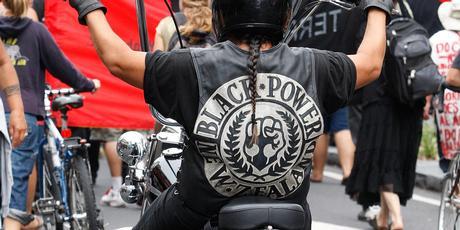
Shame on the Herald

… for trying to run game on New Zealand, scaremongering the Foreshore and Seabed hÄ«koi:

That was on page four of the dead tree edition, and online here, under the headline “Opponents put up roadblocks to bill”. Use of this outrageously unrepresentative photo makes a number of unjustified implications which aren’t present in Claire Trevett’s generally factual and balanced article. These include:

  • Most obviously, the suggestion that the marchers are gang members, with the implication of violence and public menace that creates, despite the fact that the march was peaceful having been mentioned in the opening sentence of Trevett’s article;
  • Creation of a general equivalence between Māori protesters and gang members, with all the racism that implies;
  • The suggestion that opponents of the foreshore and seabed legislation are acting on a separatist “black power” imperative, when the article makes clear that the opponents mentioned in the headline are an ideological grab-bag consisting of the ACT and Green parties, and Hone Harawira;
  • The suggestion that the marchers are literally blocking roads, when the article makes clear that the roadblocks referred to in the headline are metaphorical, and little more than the usual sort of procedural delaying tactics employed in Parliament to drag out the progress of a bill — in this case until next week, when the hÄ«koi reaches Wellington.

The core message of this choice of photo to accompany what is mostly a story about the trivial frustrations of a government trying to pass an unpopular law is this: Māori radicals and gangs are forcibly blocking this law, and they will block you from the beach as well.

It would be absurd if it wasn’t so offensively misleading.

(via Pascal’s bookie)

L

Gulp!

ACT MP and lawyer Hilary Calvert, on the Marine & Coastal Area (Takutai Moana) Bill, in Parliament last night:

“Historical use of the seabed any significant distance from the shore seems impossible to prove, and allowing for title over it to be granted over it to iwi allows for unjust and potentially divisive future claims. No one historically crawled about on the seabed miles from shore. There was just no chance of anybody holding their breath from 1840 til now on the seabed. It’s not gonna happen.

(My emphasis.)

Once again, I think we all owe a debt of gratitude to the ACT party for illustrating so plainly to us what — and how — they really think.

L

Revealed preference

Former National leader Don Brash addressed the ACT party conference at the weekend, which was half “catching Australia” boilerplate and half a warming-over of the infamous “nationhood” speech given at Orewa in January 2004 (for a thorough rebuttal of which see Jon Johansson, Orewa and the Rhetoric of Illusion). During his address at the weekend (although no mention is made of this in the text of the speech on his website, linked above), Brash correctly stated that the Treaty of Waitangi was ahead of its time, because the contemporary Australian approach, by contrast, was to “shoot the natives”.

At this point, a heckler in the audience piped up: “let’s bring it in“. (Audio).

Moments like these, when people are put in the position of genuinely involuntary response to some stimulus or other, are pretty rare in a political environment dominated by strict stage-management, spin and counter-spin. Their type and quality can tell you a whole lot about a political movement, especially when the response is collective, spontaneous, and embedded within a heightened or aroused political context, such as in the middle of a keynote speech.

What happened next was that the delegates in attendance at the ACT party laughed. At the suggestion that New Zealand implement a system of genocide against its indigenous people which, even back in 1840, was a source of shame for Australia, those in attendance at the annual conference of a New Zealand government party whose ranks include two ministers of the crown laughed. It is hard to be sure from the audio, but it sounds like Don Brash also laughed — someone on-mike did, and in such circumstances only the speaker is miked. Quickly, the laughs turned to disapproving murmurs, and Brash continued speaking as if nothing had happened. But by then the moment was over — the ACT delegates’ true colours had been revealed.

Not all of them, to be sure. No doubt there were those who were agape at the suggestion. Stony, stunned silence from the delegation at large would certainly have been an appropriate response and one which I don’t think would have been too hard to muster. Eric Crampton has suggested (though I suspect he’s by no means committed to this line of argument) that nervous laughter is a fair response to shock; admitting also that nobody seems to be claiming that the laughter was nervous. Eric also placed one in five odds on the heckler being a ringer whose plan was to elicit just this sort of response, in order to discredit the ACT party. Fair enough, I suppose. But it’s not the heckle itself which was disturbing — every party contains its fringe lunatics, those who fly off the handle and say embarrassing things. What’s disturbing is the response, the spontaneous, reflexive, collective reaction to the suggestion of genocide.

Just as Labour are the party of humourless, tuneless harridans after their “John the Gambler” song at the 2008 annual conference, and the Greens are the party of morris dancing hippies because of their 2001 annual conference, the fundamental take-away here is that ACT is the party who laughs at genocide jokes. The ACT delegates own that moment of laughter, just as much as they own the disapproval which followed it. It’s not even out of character for a party which has for some years now campaigned on the basis of arguments that indigenous people represent barriers to the white man’s progress, and was at the time of the interjection revelling in a sustained argument to that very effect: get rid of the bloody natives, and things’ll be a lot easier around here, and then we might catch up with Australia, who solved their bloody native problem good and proper. It speaks to the core beliefs of those in attendance, and what’s more, it largely reiterates what most peoples’ impressions of the ACT party are, based on their rhetoric, their policy positions, and their steadfast opposition to every bit of legislation giving the slightest acknowledgement to Tino Rangatiratanga.

Whether a ringer or an organic outgrowth from the party delegation, whether speaking his own truth to power or having just had a few too many free glasses of capitalist sauvignon, the people of New Zealand are indebted to this anonymous heckler. He has granted the nation a unique insight into the ACT party, and rare basis upon which to judge its underlying character. That’s good for democracy.

L

Double-tracking

Danyl Mclauchlan posits a conspiracy theory:

there is a pretty great opportunity to use the Maori seats to rort the system: if you had two Maori Parties, one that ran electoral candidates in six out of the seven electorates and only canvased for electorate votes, and another that had a safe seat in the seventh electorate and only canvased for party list votes in the other regions then you could, conceivably, end up with a dozen MPs (albeit with some overhang due to your electorate imbalance) and hold the balance of power in perpetuity.

Danyl’s scheme is essentially what the Greens tentatively proposed before the last election: green voters in Māori electorates consider casting electorate votes for the māori party candidate, and māori party voters cast their party vote for the Greens. The proposal was rejected by the māori party, which at the time was (in my view) a tactical error but a wise strategic choice.

It was a tactical error because of the efficiency argument (a positive-sum alliance permitting the two parties to extract more parliamentary representation from the same base of electoral support). But without the benefit of hindsight it was a good strategic move because the māori party’s whole point was not to be shackled to the ‘Pākehā’ parties, and its long-term survival still likely depends on its establishing its own persistent powerbase; one which could stand a chance of surviving even the abolition of the Māori seats. The only way to do that is to grow the party vote by strengthening ‘brand’ support among its electorate. (Also the proposal was made quite late in the campaign, and the potential for voter confusion was high.)

Those factors which made the plan a strong strategic risk for the māori party in 2008 now no longer obtain, or at least not so strongly. It has largely sacrificed its independence from the Pākehā political mainstream anyway, and could potentially lose considerable support for that reason. It may hang onto electorates, but it is likely that ‘brand’ support is lower than before. So with the benefit of hingsight, they might as well have gone with the Greens last time. Nowadays, they have a radical wing-man in Hone, who will work with them and who shares, despite all the rhetorical ructions, considerable common ground with the party’s other members and its foundational kaupapa. They can work together; Hone working to attract the ‘brand’ support for an independent indigenous party, the existing māori party maintaining their electorate positions and continuing to work within the mainstream.

I’m not convinced this will happen — as the Richards say in comments to Danyl’s post, a lot of it is personality-bound — but it could work in principle.

There’s one other factor, though. Although ACT and National have been collaborating in this way since Rodney Hide was gifted Epsom, the moment the māori party and a new radical wing led by Hone start doing it, the headline will be “Maaries rorting democracy to establish an apartheid state”. Those who’ve been benefiting from this sort of positive-sum electoral coordination for years will be those most urgently banging that drum and waving those banners. That’s a powerful disincentive.

Edit to add: Of course, there’s also a referendum on MMP on the day of the election. A scheme such as this would be an outstanding means of undermining MMP’s popular support and endangering its future.

L