A Culture of Impunity?

During the dark years of dictatorship in South America in the 1970s and 1980s, there emerged a phrase to capture the attitude of the elites who benefitted from such rule: the culture of impunity. It referred not only to the attitude of the uniformed tyrants who ran the regimes, but more to that of the civilian elites who gave them social and economic support, and who benefitted lavishly thanks to the repression and restrictive laws on basic rights of association, dissent and movement. These civilian elites literally lived above the law, since they could, if not be directly protected by the regime’s thugs, be immune from prosecution or liability for crimes and other transgressions they committed simply because of who they were. Murders, rapes, abuse of servants, violent attacks on members of the public–all of these type of behavior were excused, ignored or bought off rather than be held legally accountable (I do not mention justice simply because it is impossible to have real justice under dictatorial conditions). Although there was variation in the attitude of some elites and cross-country differences appeared as well, the bottom line is that during the authoritarian period in South America a culture of impunity developed that was one of the salient social characteristics of the regimes in question.

With that in mind I ask readers if such a culture of impunity exists in NZ. I ask because it strikes me that although diluted and less repressive in genesis, there appears to be an attitude of impunity in the political and economic elite. They can buy silence and name suppression when they misbehave; with a wink and a nod they accommodate employment for their friends and provide sinecures for each other (think of various Boards); they consider themselves better informed, in the know, more worldly and therefore unaccountable to the popular masses when it comes to making policy (think of the use of parliamentary urgency to ram through contentious legislation and the NZDF command lies about what the SAS is actually doing in Afghanistan); they award themselves extraordinary powers in some  times of crisis (Christchurch) while absolving themselves of  responsibility in others (Rena). They use the Police for their own purposes (Teapot Tapes and Occupy evictions, the latter happening not because of public consensus but done by summary executive fiat). More generally, think of the lack of transparency in how government decisions are made and the duplicity of elite statements about economic issues (say, the price of wage goods) and political matters (e.g., recent internal security legislation). Coupled with equally opaque decision-making in NZ’s largest publicly-traded firms, or the cozy overlap between sectors of the judiciary and other elites, the list of traded favors and protections is long.

None of this would matter if NZ was run by Commodore Bainimarama. It would just be another Pacific island state ruled by a despot and his pals. But as a liberal parliamentary democracy NZ regularly scores highly on Freedom House and Transparency International indexes, to the point that it is often mentioned at the least corrupt country on earth (which is laughable on the face of things and which raises questions about the methodologies involved in such surveys). To be sure, in NZ traffic cops do not take cash bribes and judges do not have prostitutes procured for them by QCs representing defendants, but corruption does not have to be blatant and vulgar to be pervasive. And in the measure that elite sophistication in accommodating fellow elites outside of the universal standards applicable to everyone else is accepted as routine and commonplace, then a culture of impunity exists as well.

My experience in NZ academia, two respectable volunteer organizations and in dealing with national and local government officials suggests to me that such a culture of impunity does exist. It may not be that of Pinochet, Videla, Stroessner, Banzer or Geisel, but it seems pervasive. It appears to have gotten worse since I arrived in 1997, which may or may not be the fault of market-driven social logics and the “greed is good” mentality that has captured the imaginations of financiers, developers and other business  magnates (or it could just be a product of a long-established tradition of bullying, which has now spilled over into elite attitudes towards the country as a whole).

Mind you, this does not make NZ a bad place. It simply means that there is an encroaching, subversive authoritarian sub-culture at play amongst the NZ political and economic elite that undermines the purported egalitarianism and equality on which the country is ostensibly founded (I am sure there are sectors of Maoridom who will take reasoned exception to that claim). And if so, has the corrosive culture seeped into the body politic at large so that almost anyone is a relative position of power vis a vis others thinks that s/he can get away with behavior otherwise contrary to normal standards of decency and responsibility?

Does NZ has a culture of impunity?


Sleepytime.

When I moved to NZ in 1997, one happy aspect that I had not considered prior to arrival was that I was headed back to the Southern Hemisphere. That meant that Xmas and New Year’s are summer events (well, most of the time), and my childhood memories are littered with snippets of summers gone by spent in Argentina, Brazil, Chile and Uruguay. Although I also spent many years in the Northern Hemisphere and came to embrace, within limits, the winter version of the holiday season, the prolonged interlude that is the Southern Hemisphere festive season has always been my preference.

In the winter version the return to work and school routines is quick, with no more than 2 weeks of down time usually taken between Xmas and New Years. The further North one goes the less incentive there is to holiday: the days are short, wet and very cold, when not frozen. In the South the turn of the year is a turn to warmth and light so the incentive is to maximize exposure to them as well as take respite from work and other daily routines. Annual and sick leaves are extended and mixed in order to maximize the statutory holidays. Commodified life cuts back to idle so that personal and inter-personal issues can be addressed and renewed at some length.

How one spends one’s time depends on the nature and proximity of those relationships. I have spent several years of solitude, North and South, over the year end hiatus, which gave plenty of room to reflect on my condition while otherwise occupying time. I have had an equal if not greater number of holidays spent with family and friends, to include family in New Zealand. What strikes me in either instance is that the summertime makes the experience better: there is more to physically do outdoors, there is less corporate incentive to rush back to work,  the nature of social events is more open, and things just get silly.

In a way, the Southern Hemisphere year end holidays are a turn inwards as well as renewal. The point of reflection and the pause to refresh are simply longer in summer. It may give the appearance to some (in the North) of a sleepy third world village approach to life. To  me it simply represents a better way to spend a holiday.

Better than marching like lemmings to shopping malls and fighting grid-locked traffic in the search for a better bargain (which pretty much sums of the notions of commodity fetishism and false consciousness). The consumerist lemming movement appears to have taken root in NZ and the vehicular exodus to choice destination spots is often akin to driving across Manhattan at rush hour. Even so, in NZ as in other Southern Hemisphere locations, the summer holiday experience is preferable to that in the Northern Hemisphere. The global North may have the doldrums of July and August to disport in (and my exposure to Southern Europe in summer suggests that pretty much everything is put on hold for the duration), but they do not have the holidays to enjoy at the same time. The global middle–those from 20 degrees North to 20 degrees South–take their holidays more leisurely, given the distribution of pre-modern, modern, colonial, imperial and post-modern identifications.

Which is to say that I hope that NZ and other Southern Hemisphere readers are taking full advantage of their down time. As our first full summer back in NZ after 3 years away, my partner and I have spent the holidays quietly, mostly devoted to garden and landscape work, dog training, some small varmint hunting and the inevitable bbqs (although mine are done Argentine-style), with a little bit of reading and writing thrown in. Whatever suits your fancy and wherever you are, I hope that yours has been as restful as ours and wish you all the best for a productive and happy New Year, Southern Hemisphere style.


Turning Negatives into Positives.

One of the more vexing problems in politics is to turn opposition to something into a virtue. Being anti-something is reactive and defensive rather than a path with which to move forward. It is the antithesis of a proactive, innovative posture where the power of a better future is conveyed in order to secure implicit agreement to the unspoken “Yes” latent in the electorate. The latter is a positive reaffirmation, often couched in crude nationalism or other symbols of consensus and collective identity. In contrast, the implicit or explicit “No” embedded in negative campaigns carries with it connotations of obstructionism, obstinacy and lack of vision.

The negative connotations of a “No” campaign suffer from a structural disadvantage when it comes to mass political psychology. All things being equal, it is harder to successfully engage in “No” campaigns rather than “Yes” campaigns, especially when the former is confronted by the latter in electoral competition. Negative campaigns can also be a sign of defeat. Although all political challengers must attack incumbents on their record, there are ways to do so in addition to simple rejection of the opponent’s policies. In practice, opposition parties that fail to cloak their campaigns in a positive and proactive message are often conceding the outcome and using the electoral process for party rejuvenation rather than truly competitive purposes.

Yet it is possible for negative campaigns to convey a positive message. An example of a successful negative campaign is the opposition to the 1989 referendum on the nature of the Chilean regime. After 16 years of market-oriented military-bureaucratic authoritarianism, General Pinochet sought to continue as a civilian president in a “guarded” democracy installed by “controlled” elections. He and his supporters formed a political party to that effect, relaxed restrictions on the political opposition, and held a referendum that proposed that voters say”Yes” to constitutional revisions that would guide the installation of the “guarded” democratic regime. Pinochet and his followers banked on their control of the media and relative economic successes to ensure that the “Yes” outcome would prevail. The language of the referendum spoke to this fact by asking voters to vote “Yes” or “No” on continuing the unfinished process of national reconstruction under a Pinochet presidency.

Opposition to the “guarded” democracy plan came from a diverse array of groups, who preferred a full transition to democracy and the removal of Pinochet from politics. It did not necessarily have the support of the majority when the referendum campaign began, and besides the advantages accrued to the Pinochet regime, it was hampered by tight campaign regulations, lack of access to publicity, restrictions on public gatherings and the fact that many of its leaders were in exile.

Even so, the Opposition campaigners phrased their negative message so that a “No” vote was a vote for democracy as well as a vote against authoritarianism. It played on the knowledge that most Chileans understood that whatever its successes, the Pinochet regime was an aberration rather than a model, and that the price for its success was not worth the benefits supposedly gained. This organic understanding of Chilean “good sense” in the face of elite-purveyed common sense shifted popular perceptions of the referendum, and the “No” vote won a commanding majority. Confronted by defeat, Pinochet was abandoned by his supporters and the stage set for a fuller transition to democratic rule (I say “fuller” because the terms of the foundational election and the character of the political system for the first post-authoritarian decade were fixed by post-referendum constitutional reforms made by the outgoing Pinochet regime under executive fiat, which were heavily weighed in favour of the elites who benefitted from the Pinochet regime and which was backed by a military commitment to defend them. It was not until the 2000s (and Pinochet’s death in 1999) that Chilean democracy was fully consolidated, and even then the structural and institutional changes wrought by the authoritarians and their successors skewed socio-economic and political power in favour of those who prospered under Pinochet).

Regardless of what happened later, the “No” campaign on the 1989 referendum succeeded in shifting the terms of the Chilean transition to democracy away from those preferred by the authoritarians and towards those of a long-repressed opposition. It is therefore a good example of turning a negative stance  into a political positive.

The success of the 1989 Chilean “No” campaign might provide some insights for Labour as it enters the final phase of the 2011 election. Labour has staked its campaign on opposition to National’s economic policies, epitomized by the “No” on Assets Sales plank.  A little more subtly, the proposal to raise the retirement age is an admission that not all is well in Aotearoa. In other words, it is an admission of a negative, which is also the case for the repeated references to job losses via immigration to Australia. Most importantly, although Labour has “positive” planks in its electoral platform, these appear to be overshadowed (at least to me) by the negative aspects of its campaign. For its part, National can play the role of positive campaigner, using the upbeat character of the Prime Minister, the hopeful nature of its policy message (however devoid of positive content that it may be) and incidentals such as the All Blacks WRC victory to cement its pro-active and affirmative image in the eyes of voters.

Given the late stage of the campaign, it might be worth considering how Labour might cast its “negative” planks in a positive light. The key is to use the implicit “No” as an affirmation of Kiwi (as opposed to class or ethnic) identity, be it in its quest for economic and political independence or in its reification of  individualism as a national trait. Here differences can be drawn with National on issues such as security policy, where National has basically subordinated its military perspective to those of Australia and the US, or on foreign investment in an increasingly deregulated domestic economic context, where National would prefer to ease restrictions on foreign capital flows into the country regardless of their impact on strategic assets, local capital or the integrity of resident labour markets and environmental conditions. Saying “no” to such things is not being obstructionist or reactionary, it is about reaffirming who we are.

I have no expertise in political marketing, but it seems to me that if the 1989 Chilean opposition could turn a negative campaign into a positive statement given the severe restrictions and disadvantages under which it operated, then Labour might consider how to cast its campaign in a way such that its opposition to National’s policy proposals becomes a reaffirmation of Kiwi autonomy and independence. Other than that, it has little else to go on.*

* I am well aware that on economic fundamentals Labour and National are two sides of the same slice of bread, and that many National policies are mere continuations of those originally set by the 5th Labour government. My point here is to show that there is a way, however improbable, for Labour to rescue its election campaign.

Gaddafi is Gone.

The brutal end of Muammar Gaddafi’s life marks a political new beginning for Libya. The circumstances of his demise speak volumes about the road ahead.

Gaddafi was summarily executed after being captured by rebel fighters (the term “rebel” rather than revolutionary is correct in that it properly places the armed opposition in a civil rather than revolutionary war whose outcome was largely determined by external interference).  His non-military convoy was attempting to flee the rebel’s final advance on Surt, his hometown, when it was struck by a NATO airstrike (in violation of the rules of engagement NATO publicly announced when it declared a no-fly zone that included attacks on land-based military targets that posed an imminent threat to civilians). Concussed and wounded by shrapnel, Gaddafi and a few loyalists took shelter in a culvert. They were discovered and some were killed then, while Gaddafi was dragged out and manhandled by a growing mob. Disarmed, confused, pleading for mercy and bleeding, at some point soon thereafter he was head shot at point blank range (images of his wounds show powder bruns at the entry point). He was not caught in cross-fire, as there was none.

Killing a captive after surrender or capture is a war crime, including in civil wars. The rage and thirst for revenge of Gaddafi’s killers is understandable, but it shows a lack of discipline and foresight. Gaddafi and his inner circle could have provided valuable intelligence on a broad range of subjects, be it the terms of the exchange that led to the release of the Lockerbie bomber, the grey arms networks in which Libya operated, or the extent of Gaddafi’s funding of influential Western agencies such as the London School of Economics or Harvard’s private political and strategic consulting firm. Similarly, although the outcome would have been pre-determined, his trial would have provided the Libyan people with a facimilie of representative justice in which his crimes could be publicly aired, and which could serve as a foundation for a new justice system once the new regime was installed. Even Saddam Hussein was allowed that much.

The barbarism of putting Gaddafi’s decomposing corpse on display in Misurata for public viewing speaks to the levels of distrust and base nature of the sectarian divisions within Libya. These will not go away simply because Gaddafi and his clan have been removed from power. The tactical alliance against his regime will not hold now that it is gone, and given that all of the main factions are armed, this raises serious questions about the political future of the country. The cross-cutting divisions are multiple and overlapped: Eastern versus Western, Islamicist versus non-Islamicist, Berber versus Arab, Benghazian versus Tripolian, urban versus rural, coastal versus land-locked, elite versus commoner, old royalist versus new upper class. Although the role of foreign military advisors and logistical support was crucial to victory, many rebel military commanders have carved out power centres of their own, and not all of the rebel political and military leadership are democratic in inclination.

The National Transitional Council (NTC) headquartered in Tripoli has announced the formation of an interim government within a month and presidential elections in 18 months. Both goals are very ambitious and the latter is inherently flawed. Imposing a presidential system in a multi-tribal society with no history of democracy and a long history of conflict  is a recipie for authoritarianism, as political contenders will vie for and hold presidential power in pursuit of sectarian rather than national objectives. A parliamentary system with multiparty proportional representation would be a better fit given the realities on the ground, as it would force power contenders to negotiate and compromise in pursuit of coalition objectives, which in turn would put constraints on executive authority.

To put the issue in comparison, the Libyan polity is more fragmented than that of Iraq and does not have an occupying force that imposes transitional order and around which national opposition can coalesce. Iraq has a parliamentary system that recognises sectarian control of parts of the country as well as grant participation to key clans, and yet has yet to be free of violence or have fully cemented the institutional base of the post-Baathist regime. This portends darkly for the immediate prospects of a post-Gaddafi Libya.

The issue of disarmament and creation of a national military, to say nothing of disposition of Gaddafi’s purported chemical weapons stores and other sophisticated armaments, is bound up in the negotiations over the interim government and rules of the game for the political transition. Given that NATO allies are not the only foreign actors involved in Libya, and given that some of these actors are non-state or state-sponsired in nature and have conflicting agendas with NATO, this means that the post-Gaddafi situation may descend back into conflict sooner rather than later. To this can be added the purge and reconstitution of the Libyan state as a functioning sovereign entity, a process that will also be driven by mindsets as much focused on the division of spoils as it is by notions of the common good. That overlaps with the issue of oil resource control and distribution, as well as the status of contracts signed during the Gaddafi regime, both of which involve tribal politics as well as the interests on non-NATO foreign actors such as China.

All of which is to say that the circumstances of Gaddafi’s death tells us much about what the future holds in store for Libya, at least over the near term: chaos, violence and imposition rather than consensus, forgiveness, reconciliation and compromise.


Rioting Poms.

A short while ago we were treated to the spectacle of a Royal Westminster wedding, a royal tour of Canada and the US, then another lesser royal wedding. The UK and colonial media went crazy with 24/7 coverage of the fairy tale personae involved, and the image conveyed was of stability and continuity in British foundational politics.  All was well in the Realm.

In the months since the first royal celebration things have grown dimmer. There is the hacking scandal in which politicians and the police appear to be complicit in the illegal tapping of private information by media corporations (primarily but not exclusively Murdoch-owned assets). Added to this sign of elite criminal coziness, now there is a police shooting followed by wildcat riots that represent criminal opportunism rather than outrage about the death itself. The UK media are swamped with reporters, police spokespersons and politicians all chanting in unison about the “mindless thuggery” and criminality of the youth who are widening the scope of violence beyond Tottenham and London itself.

The official emphasis on criminality cannot hide a number of things that depict a reality that s a far cry from royal bliss. The youth involved, while criminally opportunistic in their looting and vandalism, are a mix of ethnicities, but all seeming of working class or unemployed status (On TV I actually saw some young Hassidic Jews amongst the rioters in Tottenham). Some may have participated in earlier demonstrations and rioting about restrictions on access to higher education and the cost of basic services. They appear to be coordinated–in yet another tweeter and smart phone fashion–enough to stay a step ahead of the thinly stretched British Police. The fire service is not attending to full alarm fires because of fears for their security and the Police cannot predict when the next smash, burn and grab will happen. The mob is ahead of the Man, and the mob is angry.

So far the British government has declined to send in the army even though suggestions have been made that they have very robust anti-riot capabilities in Northern Ireland. The language used to justify that non-action is precious: the government states that it does not deploy such hard assets on British soil. So the riot police in London chase rioters using shields, helmets, horses and batons while the British Army uses armoured personnel carriers, water cannon trucks and live ammunition to keep the peace in Belfast and beyond. Some Imperial habits are hard to break, even though the Empire is long gone and its post-colonial consequences have come home to roost in the capital itself.

The hard fact is that the criminality of the rioters is a political act whether or not those involved or the government and corporate media would like to admit it. At a time when the PM, Police Commissioner, Mayor of London, and assorted other leading officials were on vacation in places like Ibiza, Tuscany and Milos, the youth now on riotous display swelter in the housing estates where unemployment, racial separatism, ethnic conflict and everyday economic insecurity are rife. Like their counterparts in any number of less developed countries, they can see up close the material lifestyles and commodity consumption of the royals, celebrities, sportsmen and corporate elites, but do not have (and likely will never have) the means of access to them. Worse yet, they live in a world where the institutional framework is stacked against them, leading to the violent turn inwards when the opportunity presents itself. The Police response is to ask parents to lock up their children.

Be it Marx, Luxemburg, Lenin, Guevara, Marighella, Ayman al-Zawahari, or Muqtada al-Sadr, revolutionaries understand the potential of the criminal mass engaged in collective violence. Lumpenproletarians are the street vanguard who, however unconsciously, help to bring social contradictions to a head and expose the weakness of the elite response and the inherent fragility (sclerosis?) of the status quo as a whole. Where instigated or abetted by politically conscious cadres (and there is some evidence of this at play here), their actions are designed to accelerate the organic crisis of the State, in which economic, social and political cleavages overlap and congeal into compound fractures not resolvable by force, reform-mongering or after-the-fact piecemeal pacification. Given the ongoing repercussions of the 2008 recession and the increasingly global debt crisis, and no matter how they are disguised by ethnic and religious division, the structural foundations for a larger class war in the UK may be fixing in place.

This does not mean that the British government will not be able to quell the disturbances this time around. But what these riots may be is a dress rehearsal for more to come, perhaps in conjunction with the Olympics next year, where militant planners accelerate the pace, focus and intensity of mass collective violence at a time when the British elite are exposed to global scrutiny and their security resources are already working at full capacity. That raises the issue of whether the official approach to rioters will shift to the more lethal Northern Irish “solution” set, and whether those charged with adopting a more lethal approach will have the ideological conviction to respond in such a way to the actions of fellow citizens rather than foreigners (I note that it will be possible for the official narrative  to scapegoat “outsiders” drawn from minority ethnic communities that hold non-Western beliefs, but even that may fail to overcome foot soldier or beat police reluctance to turn their weapons on their own).

In any event, we should see the riots for what they really are: an expression of mass subordinate discontent and disaffection, the product of profound alienation, expressed through collective criminal violence operating in seemingly opportunistic and decentralised fashion in the face of official incompetence or lack of will. That, by most reasoning, is a good sign of a pre-revolutionary situation, one that has the potential to become more of an existential threat to the status quo should tactical guidance and coherent ideological justification be given to it. After all, if what we are experiencing is a crisis of capitalism in the liberal democratic world, then it was only a matter of time before superstructural conditions and precipitating events would combine into a violent rejection of the system as given in countries in which the societal contradictions were most apparent. Be it in Greece, in France, in Spain or now in the UK, should these contradictions continue to fester and combine, it will not be Tea Party-type clones that will lead the insurrectionary charge, nor will they be as polite.


PS: Before Red Dave and other ideologically militant readers opine that I am belatedly joining their ranks, let me state that I do not see this as the beginning of a global revolution or necessarily of one in the UK. It is a pre-revolutionary moment, which means that the UK government still has the ability to engage in divide-and-conquer, selective application of force and reform-mongering tactics (along the lines I mentioned with regard to the Arab uprisings in an earlier  post dedicated to them). There is a fair bit of ground to cover before the Arab Spring gives way to a Red European summer.

By their works ye shall know them

We are presently being treated to the rather undignified and unedifying spectacle of the political right — particularly the authoritarians and liberthoritarians — crying foul because people are drawing cautious, well-documented linkages between their own rantings and those of the Norwegian killer Anders Behring Breivik. We had a dry-run of this following the Tucson massacre. Russell Brown has NZ’s most thorough treatment of this argument, and Peter Cresswell has NZ’s most succinct whine about it, with links to more examples.

One such piece bears particular mention: by Merv Bendle, it was published in Quadrant, and questioned whether Breivik’s attacks were “a covert, ‘false-flag’ operation, carried out to give just this impression that it was conducted by anti-Muslim, right-wing extremists, but actually conceived and directed by other forces?” Quadrant is edited by Keith Windschuttle, whose statements at a seminar given in New Zealand in 2006 (and chaired by Matthew Hooton) were quoted by Breivik in way that Windschuttle states is “not inaccurate or misleading. I made every one of these statements and I still stand by them.” The argument is essentially that “civilisation” is under threat from “the perverse anti-Westernism of the cultural elite”. There are many, many more such cases in overseas forums and I trust readers will have no difficulty finding them.

But Pascal’s Bookie, in comments at the Dim-Post, has found the nub:

They either need to disown the claim of existential threat, or explain why an existential threat does not justify violence.

This is exactly it. The right-wing commonplace that “Western civilisation is under threat” is at the heart of all the rhetoric being compared to Breivik’s nominal casus belli, and in many cases the similarities are more than merely cosmetic. This general line of argument has been popularised in its modern form by Samuel Huntington, but is much older in its essence (and I must note that Huntington’s theory is considerably more robust than the arguments I’m talking about here.) The problem for the wingnuts presently whining about these comparisons is that their bluff has been called. They’ve been squawking about the existential threat posed by “others”, much as Breivik has, but he has gone one better and actually done something about it. And so they must pick a side: either “Muslims” (or “Māori”, “socialists”, “teacher unions” or the “cultural elite” or whoever “Western civilisation” is at war with this week) actually are the existential threat the wingnuts claim they are, or they are not. If the former case is true, by their own logic the wingnuts would not only be justified in taking up arms in defence of their civilisation, they would be practically required to do so, as Breivik did. If the existential threat is real, they must hail Breivik as a hero. If they don’t, we can assume there is no existential threat, and that they’ve merely been spouting melodramatic masturbatory fantasy this whole time.

By their works ye shall know them. If there really is an existential threat, as they claim, then surely we can expect the rallying cry “wingnuts of the world, unite!” to go up from the towers where they reside, and their legions pour forth with tacticool assault rifles, iPods full of Wagner and Muse and Mario Lanza, and neoprene bodysuits with faux unit patches on them. And if they do not, then surely by their own admission, there is no threat, and there never was.

I know which I’m picking.

L

Update: ‘Nemesis’ at Crusader Rabbit has answered the clarion call to action with …. yet more words. But they are fighting words:

Continue reading “By their works ye shall know them”

Two current events

Since I’m in the middle of deadline crush, and I spent yesterday afternoon socialising instead of working, just a couple of quick notes.

Vulnerability of Labour’s Capital Gains Tax:
Overall my initial impressions of the CGT and associated policy is that it’s pretty good, but vulnerable to attack. There are the usual economic and ideological objections — full of loopholes, won’t raise enough revenue, raises rents, punishes people for getting ahead, will require more borrowing in the medium term, and so on — but for mine the best attack line rests on the coincidence of taxation rates between CGT and GST. If I were running the National party’s attack campaign, I’d be leading with “Tax off fruit & veg, tax on houses”, or better yet, “tax on bricks & mortar”. Just another of many reasons why GST off fruit & veg is bad policy.

Misunderstanding of Hone Harawira’s Oath Stunt:
So Speaker Lockwood Smith ejected Hone Harawira from Parliament for swearing his oath to the Treaty of Waitangi rather than to the Crown — despite having pulled a similar stunt in 2005 without incident. There is the usual sort of wailing and gnashing about this around the traps, and it seems to have pressed everyone’s ‘sanctimonious outrage’ buttons. What I find strange is that people seem reluctant to see the stunt for what it is — mutual base-arousal, brand politics for both Harawira and Smith. Hone Harawira was, to a large extent, elected to anger and infuriate uptight honkeys like Smith and the KBR and the talkback haters, and inasmuch as his defiance of procedure has achieved that he’s winning. Smith, for his own, has brought a new dignity and solemnity to Parliament, and his personal brand of conservatism requires that he takes a firm stance. Both acted perfectly well to type, and in a sense each has done the other a favour, by granting an opportunity to grandstand. The people who are hating on Hone were never going to vote for him; and likewise for Smith. To an extent there’s also some base arousal by the māori party, too — they have fallin in behind Hone, and are calling for the Treaty to be included in the oath. That’s a useful societal discussion to have.

I find it particularly ironical that the sort of people who are so scathing and disrespectful about Māori ceremony have their dander up regarding this rather minor infraction of procedure; many seem to be raising the counterfactual of ‘imagine the outcry if this happened on a marae!” The thing is, though, in Te Ao Māori as elsewhere, kawa are made to be broken. How and when and why they are broken, and by whom, is key. With suitable mana, ihi, wehi, you can get away with a lot. There is a famous account of Dame Whina Cooper lifting her skirts to remind the men present to respect where they came from. I think, in these terms, it was much worse for Hone that his korowai fell off.

Contra this view, however, Annabelle Lee-Harris from Native Affairs says she’s heard from left-wing Māori who are angry with Hone for trivialising and causing another sideshow; that they thought he was “indulgent when Māori in Te Tai Tokerau are in dire straits’. So maybe I’m wrong. But the bottom line is: Hone Harawira was elected to Parliament by a higher power than the Speaker; all else is procedural.

L

An Open Letter to the ACT Party Regarding Candidate Selection

Dear ACT Party Leaders,

As you may know, I was brought up in Wanganui, and keep an eye on events there. So it was with great interest that I received the below letter, published in the Wanganui Chronicle on 8 July 2011.

ACT’s announcement of the second ‘Don’ in the ‘Don and John’ lineup today was well-received, and if I may be so bold as to say so, I think the author of this letter also has a lot to bring to their table. I quote it in full:

Taniwha real
In reply to Dusty Miller (letters, July 1), I’m not one of those experts, but I do believe the taniwha to be real, not imagined, and I’ll tell you why.

Perhaps the ancient Celts of New Zealand may never have known war or possessed weapons, as prior to Maori being brought here by Zheng He New Zealand had never been threatened internally nor externally and there was no need.

However, New Zealand was visited by Viking ships and Scottish birlinns (a birlinn is similar to a Viking ship) which used to trade with resident Celts. The sailors of these vessels were fierce, battle-hardened warriors with far superior weaponry and military discipline compared with Maori.

As the bow and stern design of these ships is similar to the head and tail of the taniwha, I could well imagine that the sight of them would strike paralysing fear into the heart of any Maori confronted by them, and for this reason I believe the taniwha represents these ships.

Believing this to be the truth of the taniwha, I would not think these ships could be found in a small creek or marshland because of their size.

Taniwha artwork is yet another example of Maori following the culture of those who came here before them, the Celts.

IAN BROUGHAM
Wanganui

I believe Mr Brougham’s Qualifications for Candidacy are Strongly Evident in this Letter. It provides a striking yet unconventional Insight into New Zealand history, weaving back together the varied strands of the rich Tapestry of our origins which Revisonist Historians who hate their own Culture have spent hundreds of years unpicking. In particular, he illustrates comprehensively how Maori, far from being Indigenous, were simply the first wave of Hostile Asian Immigrants to these fair shores. He shows due respect for our Noble Celtic Elders, who were clearly Men who thought like Men, and he recognises their manifest superiority over the Maori, in Warfare, Navigation, Art, and undoubtedly in other Fields as well. Despite his modest claim to not being an Expert, he is clearly Learned, but this does not prevent him Sharing his bountiful wisdom with others, as Readers can see by his patient Explanation of what a ‘birlinn’ is.

Furthermore, Mr Brougham has confirmed himself to be of Sound Mind regarding other crucial policy topics of our Time — protesting strongly against the ‘h’ being forced into ‘Wanganui’ by those same forces of Revisionism, and against the Emissions Trading Scam, by supporting the Endeavours of that noble veteran of the ACT ranks, Muriel Newman — herself also a believer in the undeniable Truth of New Zealand’s Celtic Settlement, and who herself certainly thinks like a Man.

Moreover, Mr Brougham already has more than a Decade’s political experience, having stood under the mighty Equal Rights banner in local body Elections, and for the OneNZ Party (a Sister to the redoubtable One Nation party in Australia) at the National Level. Indeed, while the 0.67% of the Vote he received in the 2005 General Election is unjustly low, it is similar to what the ACT Party is presently polling.

As one final thing, everyone knows that to succeed in politics you need a strong Hand. With the unfortunate departure of John Ansell, ACT presently has Two Pair — Don Brash and Don Nicolson, John Banks and John Boscawen. As everyone knows, Two Pair is a strong Hand, but not strong enough to ensure Victory. Adding Mr Brougham would restore ACT to Full House status, giving the party a Hand that could only be beaten by Four of a Kind (which I think we can all agree is unlikely); or a Smith & Wesson which, as the lore of our American brethren confirms, even beats Four Aces (this is also unlikely because the Liberal Culture-Hating Revisionists are too afraid to permit Noble Celts from arming themselves against Tyranny). Mr Brougham would complete the Full House because, as you wise Celts of the ACT leadership are surely aware, “Ian” is simply a Celtic rendition of “John”.

Mr Ian Brougham is well Qualified to join the Great ACT party, and he has the courage to speak Truth to Power. New Zealand needs him to return it to Celtic Glory. Nevertheless I must state I have not Approached Mr Brougham to ascertain his Willingness to stand for ACT, an exercise I shall leave to the ACT Leadership.

Trusting that you will consider this Recommendation with all the Gravity it deserves,

L

Master-race baiting

[Updated 10 July 2011 to account for Don Brash’s statements in response to John Ansell, and Ansell’s resignation from ACT.]

Many have remarked on the appropriateness of the website of the ACT Party Parliamentary leader’s press-secretary, SOLOpassion, and many have made jokes about the sound of one hand clapping, or fapping, as it were. It is therefore entirely appropriate that ACT should become the butt of these same jokes, since they appear to have swallowed (implication most definitely intended) Lindsay Perigo’s paranoiac auto-stimulatory tendencies whole. His hand-work is evident in the party’s ever more deranged press releases, speeches, and most recently in this morning’s advertisement in the New Zealand Herald, titled “Fed up with pandering to Maori radicals?” and strategically timed for the end of Te Wiki O Te Reo Māori. The advertisement is worth reading; the image below is stolen from The Dim-Post. Read the comment thread over there; it’s magnificent.
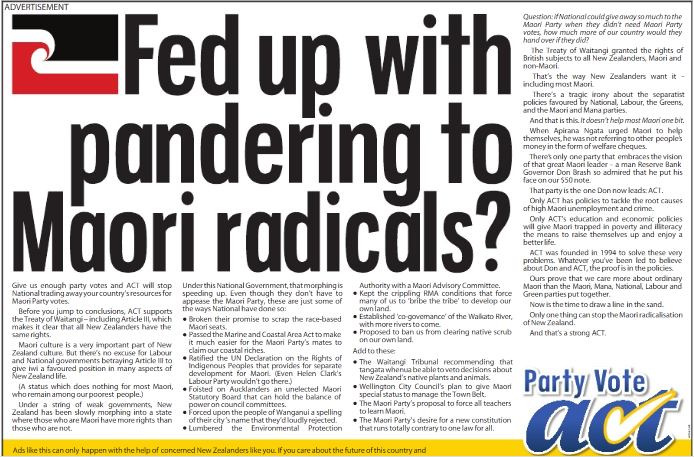
There’s an awful lot wrong with this, but aside from the warlike verbiage, none of it is much different from ACT’s or Brash’s prior form, and since I’ve been over most of the arguments before I will spare you the full repetition. You can trawl through the Take Māori section of this blog if you want the detail. But just a couple of obvious things: the reasoning privileges Article III of the Treaty; that is, the article which gives the Crown a colonial payday, while neglecting Articles I and II, upon which the consideration of Article III rests. In terms of a contract, which is a way of thinking about the Treaty that ACToids might be expected to understand, Brash’s reasoning emphasises the payment for services rendered, while materially ignoring the requirement to actually render those services. (More on this theme here). Secondly, it’s more of the same selective history we’ve come to expect: our history as Pākehā matters and has value; theirs, as Māori, doesn’t — except for the bits Pākehā can turn to their advantage, like the decontextualised appeal to Ngāta.

But there is a broader point that this development illuminates. Race relations in Aotearoa has changed enormously in the past seven years. In the winter of 2004, the country was in the throes of Orewa madness. The māori party had just been formed, promising to deliver “an independent voice for Māori” in parliament. Eight years ago tomorrow Tariana Turia won her by-election, seeking to deliver on that promise. Don Brash was the leader of a resurgent National party who held a strong lead in the polls, and whose race-relations platform dominated the policy agenda. Now, Turia leads a hollowed-out party whose mandate and credibility are under severe threat from one of their own. Don Brash, having been ejected from the National leadership disgrace, now leads a party with less than one-twentieth of the electoral support he once commanded; a party he was only able to colonise after it was fatally weakened by a series of appalling political scandals, and then only by the narrowest of margins.

Under Brash National’s popularity stemmed from the fear of a brown nation that emerged from the foreshore and seabed debate and the māori party’s formation. As far as the general electorate of Aotearoa is concerned, those fears were not realised. As far as Māori are concerned, the māori party’s results have been disappointing to say the least. As far as the established political power blocs are concerned, the māori party has proven a very dependable agent their political agendas; even while disagreeing with many of their positions, both National and Labour recognise that the māori party are invested in constructive collaboration with the Pākehā mainstream, not in its destruction. I’ve long argued that the initial purpose of the māori party wasn’t to effect sweeping policy change, but to create cultural and political space for kaupapa Māori politics, and to establish the credibility of same. For all their policy failures, they have succeeded at this task in spades; perhaps they could have afforded to succeed at this task a little less. But largely as a consequence of the sky not falling after the passage of the Foreshore and Seabed Act and the emergence of the māori party as a credible political force, neither National nor Labour have any truck with ACT’s vitriol. Don Brash, his “one law for all” rhetoric, and his scaremongering are firmly on the outer.

Even further out on that slender but flexible branch is the architect of Brash’s Iwi/Kiwi campaign, probably the best campaign of its type in our recent political history and certainly one of the most memorable: John Ansell. Ansell’s rhetoric had become distasteful enough by the time of the last election that even the ACT party — then under the leadership of Rodney Hide — refused to use much of his best work. Thereafter he was picked up by the Coastal Coalition. A less credible gang of fringe loonies it’s hard to imagine; one of its principals, Muriel Newman (who, shamefully, was invited by Radio New Zealand to speak as an authoritative expert on the WAI262 Treaty claim) believes that pre-Tasman Aotearoa was settled not only by Polynesians but by “people of Celtic and Chinese ancestry as well as Greek, French, Portuguese, Spanish and others“. Ansell’s own views on race are similarly bizarre; Māori, he reckons, are “not a race, but a religion“.

Ansell is now reduced to ranting in Kiwiblog comments, and is as critical of ACT as he is of everyone else. Even there, though, his views hardly find great favour, with more people objecting that his campaign is distracting from the “real issues” than supporting him. His contribution to the thread about the Brash advertisement — it’s not clear whether he was involved in the ad’s production or not — is a magisterial display of racist, misogynist essentialism, and I think it really gets to the heart of the paranoiac auto-stimulatory tendencies to which I referred earlier. I quote his initial comment in full:

The problem with New Zealand is it’s full of white cowards who are too frightened of being called names to stand up for the truth.

(And that’s just the ACT Party.)

And the truth (if we are honest enough to admit it) is: for the last quarter-century, our country has been brownwashed by a bunch of scammers (aided and abetted by legions of white ‘useful idiots’) into feeling guilty for the supposed sins of our British great-great-grandparents.

A sober reading of the facts reveals that some of these sins were actual (though far less sinful than the crimes perpetrated by Maori on Maori). Many others were highly exaggerated and delivered with lashings of emotional blackmail, for the purposes of extorting compensation.

But of course we are New Zealanders and we are not allowed to tell our truth (as Alasdair Thompson recently found out to his cost).

We are not allowed to speak out about state suffocation, Maorification, feminazism, National socialism, teacher unionism or any of the other evils that are dragging our country into the third world.

Those who do have the guts to tell the truth are called nasty names like racists in the hope that, like snails, one light contact with politically-correct criticism will be enough to make them shrink back into their shells.

And of course it works a treat.

There are plenty of parties for pessimists, backward-looking Maori and white bedwetters. But there’s only one for optimists, achievement-oriented people and forward-looking Maori.

ACT will not succeed until it champions the latter and tells the dishonest others to go to Hell.

In short, their catchment is men and women who think like men. Not men and women who think like women. ACT is the party of the strong father, not the soft mother.

(By strong father I include strong women like Rand, Richardson and Thatcher, and by soft mother I include weak men like Key.)

I hope you people will think about that.

[Update: A NZ Herald article titled Act ad man blasts ‘apartheid’ contains more such statements from John Ansell, who is ACT’s creative director; and in it Don Brash distances himself from them, saying “I don’t want to associate myself with those kind of views at all”. He may not want to, but he is. His own press release issued in conjunction with the advertisement above calls any form of “preferential treatment” — such as concessions granted under Article II of the Treaty, which ACT apparently does not recognise — “a form of apartheid”. Perigo is fond of the term, and also of referring to Māori, Muslims and anyone else who doesn’t quack like an Aryan duck as “savages”. Moreover the prospective MP for Epsom, John Banks — who represents the kinder, gentler face of the ACT party — also has form on this issue, having previously referred to Māori TV as “Apartheid Television”, and holding views generally very comparable with those of Ansell and, in some cases, with Perigo. So Brash’s will to not be associated with such views really raises a question: will he, in order to dissociate ACT from these views, fire his creative director, the press secretary for his Parliamentary leader, and the only MP likely to win an electorate? I rather doubt it, but I believe Aotearoa deserves answers.]

[Update 2: Ansell is gone. One down; how many to go?]

As Russell Brown said, Ansell’s comment is “essentially an incitement to race war“, and I don’t believe Ansell himself would deny that. But it’s more than that; it’s also an incitement to sex war. It’s easy enough to dismiss as the usual sort of dark mutterings, but hang on a minute: this fool is claiming to speak for me, and if you’re a man (or a woman who thinks like a man, whatever that is), he’s claiming to speak for you too. But he doesn’t speak for me. To head off the inevitable speculation, I’m hardly what you’d call a feminised liberal pantywaist; I have a beard, I hunt, I fish, I provide for a family; I like whisky and brew my own beer; I like rugby and rock’n’roll and Rachmaninov, and breaking things to see how they work; I’ve spent years studying martial arts and I’m trained to do or have done most of the things on Heinlein’s list. I wear a Swanndri to work in an office on Victoria Street, for crying out loud.

But in my world, masculinity isn’t measured by warrior prowess or the vulgar ability to force one’s will upon others, whether by physical, social or legislative means. Those things, as anyone who’s studied totalitarianism will tell you, only garner a mean and hollow sort of respect; the sort which dissipates as soon as the heel is lifted from the throat of the oppressed. No, in my world, masculinity is judged by honest work, truth and wise counsel, respect and tolerance, forbearance and understanding, accommodation and partnership; from love and support, and strength of a kind which intersects with but is not eclipsed by that to which Ansell appeals. As I have argued before, that sort of view — the dictator’s view that power comes from the barrel of a gun, that only the whims of the mighty matter — is a bare and miserly sort of humanity. And if that’s how Aotearoa actually is, then I say: come the feminised, Māorified revolution, because we desperately need it.

Of course, it’s not. Ansell no more represents Aotearoa’s men than Muriel Newman does its women, Lindsay Perigo its homosexuals or Don Brash does Pākehā. Their methods have become unsound. As Conor Roberts put it, “if you gaze for long into the sub-5 percent abyss, the sub-5 percent abyss gazes also into you.” Let’s see how long they can keep gazing.

L

Royal Hubris.

As an ex-pat yank I am not much for royals. Its a war of independence, ex-colonial legacy type of thing, I imagine, but the idea that some otherwise useless people connected by traceable bloodlines can claim superiority and the right to “lead” just grates on me. The universal law of genetic decline comes to mind here (previously posted upon).

So it is with bemusement that I read that the 2nd in line to the British throne and his new bride have decided to skip a NZ visit this year because “it might influence the elections.”

Are they high (legally or not)? Sheeeeet. I suspect anyone who believes this to be true to be absolutely chronic.

Whatever the numbers of royalist fools in NZ, it takes a stoner quantity of imperial hubris to think that Wills and Kate could influence the outcome of the November elections. In fact, I reckon that Alisdair Thompson’s strong National links (including his reported blokey relationship with the PM) will be more decisive in November than these two over-privileged parasites on a party holiday.

If you ever want to see an egregious example of dole-bludgeing, go no further than Royalty.  Some of the men may do military service while living lifestyles way above their pay grade, but the wimin do nothing other than charity socials and token appearances to excite the hoi polloi.

I say **** that. Lets get rid of the bludgers and go for full independence ASAP. After all, what have we to lose other than our symbolic colonial chains?