I’ve been following Speak You’re Branes for a while, since a mate linked me to it, and it is made of win and awesome. We need a blog like it in NZ.
L
I’ve been following Speak You’re Branes for a while, since a mate linked me to it, and it is made of win and awesome. We need a blog like it in NZ.
L
There’s an interesting range of responses to the Tony Veitch guilty plea of reckless disregard causing injury to Kristin Dunne-Powell, his conviction and sentence to a fine and community service.
Some are baying for blood. The KBR aren’t quite unanimous that he should go to jail, but they’re close (though there is a foul stench of `men have rights [to kick the shit out of people who don’t behave]’ as well). Haiku Dave is particularly grim:
should have got jail, then
he’d know what it’s like to be
attacked from behind
Idiot/Savant is arguing it’s Bruce Emery all over again (and he’s not wrong). Commenter Alison at The Hand Mirror shows some sense, figuring that if prison isn’t a good thing for a random violent offender, it’s not going to be a good thing for Veitch either. Heather Henare, of Women’s Refuge, is similarly cool-headed. The Herald’s Your Views is divided, as are the talkback hordes. A particularly inspired friend and colleague of mine suggested he be made to front the ACC back injury ad campaign, needing to stand on a rickety chair or somesuch in order to reach something up high. Humiliation comes in many forms.
Judge Doogue told told Veitch he was the architect of his own misfortune, and I think that if he does genuinely intend to take legal action against the media for their treatment of the case this past year, then Tony Veitch will also become the architect of his own humiliation. The facts of the case are fairly simple: there is no possible justification he can give for his attack on Dunne-Powell, no argument he can make which will put him on the side of right, and any moral high ground he tries to occupy will come under sustained fire from more sources than he and his team of lawyers can possibly afford to shut down because public sympathy toward celebrities evaporates pretty rapidly when they are seen to be taking advantage of their celebrity status. At this point anything Tony Veitch says or does will play against him. If he tries to smack down the media establishment, any publisher who chooses to fight gets the chance to put the whole stinking mess on the public record. Tim Pankhurst, if he were still editor of the Dominion Post, would pick it up in a moment out of sheer bloody-mindedness. Veitch might be planning to go back to work for The Radio Network, and that might mean APN goes easy, but that’s a great risk to them – while NewsTalk ZB and Radio Sport might not need to demonstrate their lack of fear or favour, the NZ Herald surely does.
My advice to Tony Veitch: keep your head down and take your lumps like you made Kristin Dunne-Powell take hers [though you deserve yours, and she didn’t]. If you want to show us you’re better than we think you are, there is no short-cut, no easy atonement which you can buy or create from words or gestures. You can’t fix this by becoming a legal bully as you are (or were) a physical bully. If you genuinely want to be known and recognised as a good and righteous person, then the time to undertake good and righteous action is now. For your own sake if for nobody else’s.
L
Axe bounces off ministers – Tracy Watkins, The Dominion Post
Nice and cynical, that’s what we like. Pity it’s attached to something so trivial.
L
This image is attached to the Stuff story on the death of a protester during the G20 protests in London:
I know I’m not alone in noticing that since Stuff remodeled itself on the SMH that they’ve cranked up the alarm-o-meter somewhat, and this is an excellent example. A few facts are clear from the linked story, and a rudimentary bit of reading around reflects some others, to wit:
This should serve as one more bit of evidence that the media are not intrinsically biased for or against anyone in particular – they follow the story, and in some cases they lead it, for their own purposes rather than those of their masters in transnational capital.
Edit: My mum points out that the composition evokes Brian Brake’s famous Monsoon Girl.
Edit 20090408: Commenter Rich has linked to footage of police attacking Ian Tomlinson just before he died, here. If it’s real and legitimate, and there’s no reason to assume it isn’t, then it more or less invalidates my objections 2 and 3 above. Objection 1 stands, for what little that’s worth.
L
Despite Fairfax papers the Dominion Post and the Waikato Times cheerfully running their “iwi tax” racist propaganda line, eel fishermen working (or not working, presently) in Lake Ellesmere/Te Waihora now claim in The Press it’s nothing to do with race:
“It’s not a Maori-Pakeha issue, but a bullying corporation treating some small people badly.”
That’s Clem Smith, the same person to whom the `iwi tax’ line was attributed a few days ago. What appears to have happened is that their `iwi tax’ line didn’t get as much traction as they expected – even the normally-rabid comments section on the original article was fairly split between the rednecks and the propertarians – and a NgÄi Tahu former Treaty negotiator came out in their defence, making their anti-MÄori position somewhat untenable.
Still, it’s good that they’ve backed down. I still believe the levy is a legitimate means of raising revenue to clean up the waterway, but I also agree with Rik Tau’s argument in principle that NgÄi Tahu ought to act within the spirit of the agreement rather than exploiting it strictly to the letter. The fundamental problem in MÄori-PÄkehÄ relations isn’t a lack of agreements, it’s a lack of goodwill in their implementation. Including the first one – the Treaty.
L
Hard on the heels of my article about giving the overworked minions of the Corporate News Machine ready fodder to work with, The Dominion Post this morning proves my case by running ready-made racist propaganda soundbites from the fisheries industry.
The linked article makes it quite explicit that the fee levied by NgÄi Tahu is nothing to do with them being MÄori and the fishermen being PÄkehÄ – it’s to do with them being the owners of a resource which they (as owners) consider to be in need of investment. Their business model is to extract a rent from that resource, and they have decided to raise that rent by constraining commercial access to those who are prepared to support continued investment in the resource by paying a commercial use levy. This is no different in principle than the Transit Agency increasing road-user charges to increase investment in roads, or from a landowner charging higher fees for Fonterra producer-shareholders to graze his property because he wants to adhere to the Clean Streams Accord (and that costs money), or from a resort owner increasing his fees in order to improve the quality of the accommodation.
The fisherfolk and their lobby group the Seafood Industry Council are not trying to play on the economic issues, because they know they have no case. So they’re playing this on symbolic issues – the (coincidental) facts that the product of the lake (tuna) is a NgÄi Tahu tÄonga, and the fact that NgÄi Tahu are MÄori, they (the commercial fishermen) are (I assume) PÄkehÄ, and the ownership of the lakebed is the result of a Treaty settlement. None of these facts are actually relevant to the case in point – there’s no evidence that there is any discrimination, and it doesn’t matter by what legitimate means the owners acquired control of the resource. Just because it’s the result of a Treaty settlement doesn’t mean they somehow have less right to extract rents from it. So NgÄi Tahu’s case seems invulnerable on material grounds, but it is vulnerable on symbolic grounds. The commercial interests here are cynically trying to leverage the undercurrent of anti-MÄori-development racism, pushing the Iwi/Kiwi button in service of their legally invalid cause.
It’s not an `iwi tax’ – it’s a `conservation levy’, and only payable by commercial users. They can’t come out and declare themselves anti-conservation, but it seems that in NZ it’s just fine for them to come out and declare themselves anti-iwi.
L
DPF’s post mentioning MediaCom, which allows you to get/send press releases via NZPA feed, reminded me of this, which I’ve been meaning to post for awhile. The reason PR companies need to spam people with press releases is because at a basic level they’re so easy to write that almost any idiot can hack one out in half an hour, and so people do. If you’re someone who relies on them, by the time you’ve read the title and the first three paragraphs in order to figure out whether the press release has anything relevant for you, its writer has already won.
Not to say that writing good press releases is easy – far from it, writing genuinely good press releases is extremely hard; so hard that very few people actually can, and even for those people it can seem futile because nobody knows whether your press release is any better than all the rest of the guff which is clogging their intertubes until they’ve read the title and the first three paragraphs. If you’re a CommsTart,* this is a very important skill, however, because by writing good press releases you give the overworked, underpaid minions of the Corporate News Machine a labour-saving device, and if you can consistently write to spec they will gladly shortlist your releases for pre-publication, sight unseen, because they don’t have time to read the title and the first three paragraphs because … well …
That stuff in them there press releases ends up in your media. I don’t have it to hand (Kate, can I have it back?), but I seem to recall that very thorough Cardiff University research commissioned by Nick Davies’ for his excellent book Flat Earth News found that no more than 12% of articles published in major British papers were entirely free from material published by someone’s PR department or agency. In my work as a media analyst, if I actually want to find out about a major issue I go to Scoop and try to triangulate the facts from everyone’s press releases before I bother with the actual end-user media outlets. It’s rare they can tell me something the stakeholders’ CommsTarts haven’t already.
These facts – it’s easy to do badly, hard to do well, indispensable and ubiquitous – are not lost upon the wags of the media world, who have taken delight in lampooning this most cherished aspect of their craft. There are lots of press release generators out there. Most are good for a black bit of fun – this by one of our few remaining satirists Lyndon Hood only deals with the the one topic of child abuse, but it has good bones.
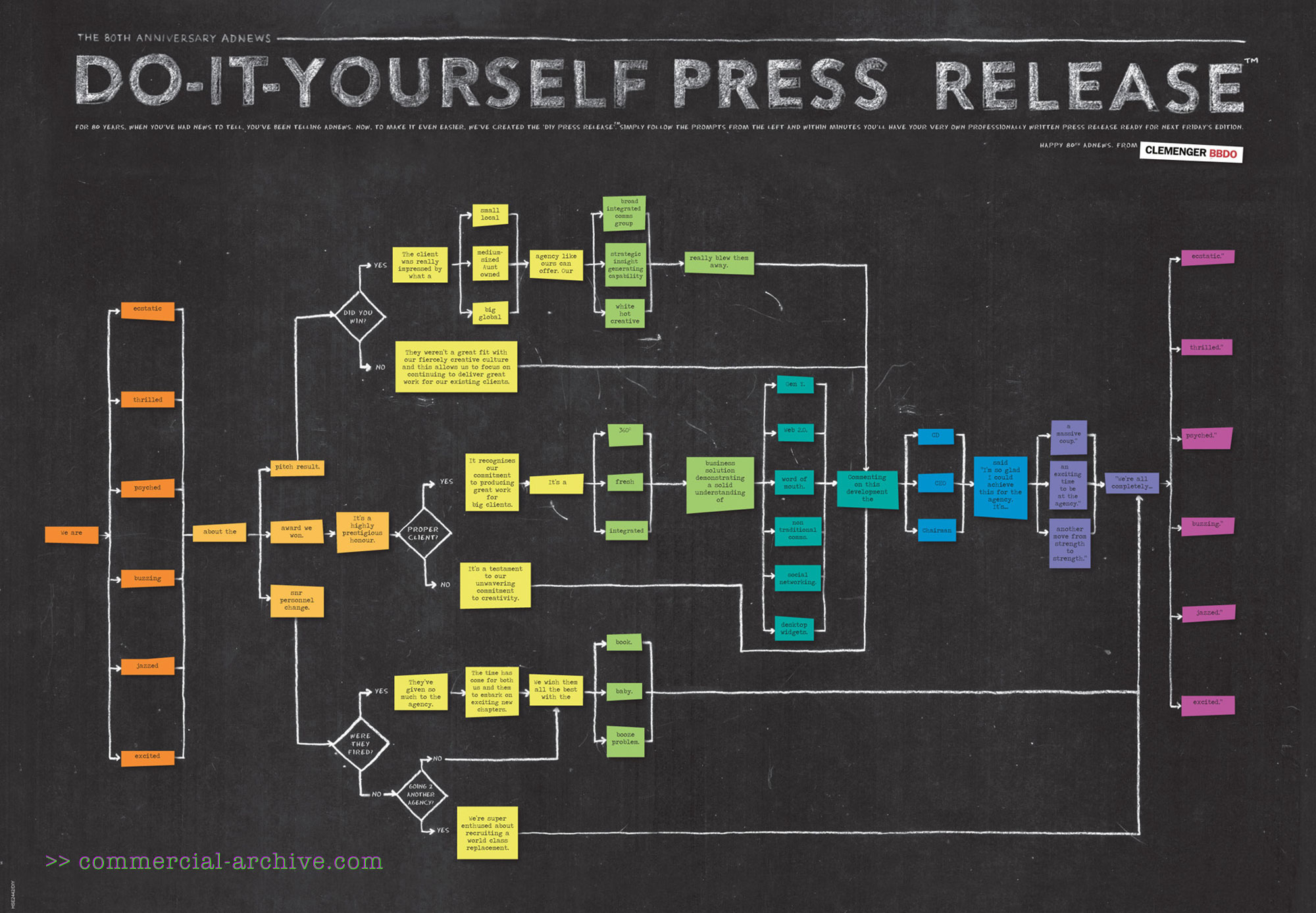
For the 80th birthday of AdNews, the Sydney office of Clemenger BBDO made this handy visual self-congratulatory press release generator:

(From commercial-archive.com.)
They know their stuff: this remains one of the best ways of quickly and efficiently putting together a quality press release – chop all the information up into bits of paper and arrange it so it flows, with just (barely) enough glue to keep people reading. Remember: the title and three paragraphs, and you win.
If you want industrial-strength, this one is made of much sterner stuff. Written by a computer programmer back in the Nineties and endlessly hacked on since, it and its variations will generate a dense blob of impressive verbiage – Bush-speak, web jargon, whatever you want. If fed the right source material, it would probably generate a halfway-competent press release.
It goes the other way, too – David Slack, in homage to George Orwell and Christopher Ketcham, created a DuckSpeak Translator which, if fed media-ready prose, would deliver you a lot of QUACKs and perhaps (if you were very fortunate or the author was very clever) a few actual words and even an idea. The DuckSpeak Translator is sadly no more, brought to its knees by the fact that David allowed any old idiot to add phrases to its vocabulary, so that by the time I got to using it sometime in 2006 it was so thoroughly clogged that you could put anything in and get nothing back but quacks – which may have been the intention after all. I think the project should be revived with a clean database, and phrases only admitted to its vocabulary if they have been taken cleanly from some rich source of such matter – such as the Hansard, or press releases. That’d be something worth quacking about.
L
* I use the term in gender-neutral reference to anyone whose work is tarting up their client’s self-interest so it can be mistaken for news.
Edit: Heh, the `or three’ on the end of the title was an afterthought added without reference to the previous post, which also contains it :)
As a dedicated media geek, I wake up each morning to New Zealand’s broadcast news of record – the masterful Geoff Robinson, the muscular Sean Plunket, and the metronomically-consistent Nicola Wright on Radio NZ National’s Morning Report. These three I consider to be among the top talent in the NZ media industry, and we are fortunate to have them.
I also have a lot of time for Checkpoint‘s Mary Wilson – not quite so obdurate as Sean Plunket, but with as little patience for prevarication. It seems the producer who put together the advertising frob for Checkpoint which aired between the sport and weather segments of yesterday’s 0600 bulletin also has a good ear. You can listen to it here, but I’ve transcribed the good bits:
First speaker: We are not a country of whiners, we are not a country of slackers and we are not a country of selfish individuals. We are a gritty little country with the smarts and determination needed to weather this storm.
(Mary Wilson introduces Checkpoint)
Second speaker: You feel as though you’ve been marched out with a blindfold on and tied up to a pole, and your own army is there as the firing squad.
Now, neither of the speakers either side of Wilson is identified. That’s an important point – the first speaker is immediately recognisable as John Key, and his words are clearly to do with the recession and economically troubled times ahead (in fact, from his opening speech at the Job Summit); a bold bit of chin-up-what-what jingoism. Even if you don’t know who the second speaker was or what he’s talking about, his statement is so strongly worded and his tone so far removed from Key’s that they jar in relation to one another; and although the statements are topically different, their contrast and proximity to one another implies a relationship. Although they’re not obviously linked, a listener (in principle) goes away associating John Key’s upbeat jingoism with one’s own army as the firing squad – a hugely disturbing mental picture if you care to think about it. This is an example of the semiotic technique of associative montage, perfected by Soviet filmmakers, where parts of a text are contextualised and given affective weight by their relationship to other parts of the text (in this case, audio; in the classical case, still or moving images on film).
Because I failed to listen to Checkpoint last week when the story about the Army raincoats was in the news, it took a bit of research to find out it was Davey Hughes of Swazi who said the second bit. And it turns out that there is a link between the statements – but not the link you might expect; a real army but a metaphorical firing squad, and nothing to do with John Key. As a matter of reality, the government isn’t in a position to force the NZDF to choose one supplier over another mid-term, and to do so would set a dangerous precedent and open the government up to well-justified allegations of protectionism.*
Not that this makes any difference to the message as received by a naïve listener to this piece. Montage, like other semiotic grammars but perhaps to a greater extent because we’re unused to it, transmits its meaning subconsciously. Actual rational reality doesn’t necessarily get a look in. Now, I’m not arguing that there’s a wily frob-producer at NatRad who’s employing Soviet montage techniques to propagandise John Key in the minds of loyal public-service broadcasting listeners, though I suppose if you were especially paranoid you could argue that airing it at wake o’clock in the morning makes it easier to prey upon the weakened rationality of the half-asleep.
This is the stuff of which peoples’ impressions are made – people have a feeling about a leader, they can’t quite put a finger on it and haven’t necessarily given it any serious thought, but nevertheless it’s their opinion and they cling to it. Despite Labour’s technically excellent but somewhat nasty `Mary’ ads in the dying days before the election, there seem to be very few such impressions of John Key. But he’s a leader going into a long term of economic downturn, and he can look forward to more such as this.
L
* You could argue that the NZDF should choose NZ-made gear – and the All Blacks should use Canterbury rather than adidas – but the fact is that Key can’t simply make it so.
Once again Indymedia is the only place providing coverage of worker organised resistance against the current government’s policies.
While the media, major political parties and even the left wing blogs have concentrated on what was going on inside the Jobs Summit a good old fashioned protest was going on outside. Despite the great messages, the photo friendly images and reality of the protest the coverage we’ve seen has focussed only on the centre-left’s response.
Even the left wing commentary on the lack of men at the summit has been full of images of men (to show the absence of women) rather than images of strong women raising their own voices.
I also haven’t seen any mainstream coverage of the Christchurch picket against the 90 day sacking law which attracted a variety of workers groups and unions.
Sometime in the next few years the left needs to realise that we’re no longer part of the orthodoxy, it’s ok to protest (in fact it always was). We can take our banner and loudspeakers out on the street and tell the world that our voices and our rights are important.
This excellent article did the rounds in my department at work today, about the methodological rigour (or lack thereof) in ratings, on which I’ve been meaning to write a post for a while.
I refer almost daily to such demographic information – ratings, audience/circulation, readership and particularly advertising value equivalents – as `the department of made-up numbers’ because, basically, that’s what they are. At best, they are a set of figures which, while deeply flawed, are horizontally and vertically consistent, and well-enough understood that their failings can be accounted for (this approximates a definition of any useful long-term demographic data). At worst, they are the patina of officious statistical rigour over a set of numbers tuned to tell people whatever the media outlet, its owners, or its PR company want people to know – and that means they’re designed to fool. Most often, a given dataset lies in between – in the murky liminal zone where it’s impossible to tell whether it’s the former or the latter or something else entirely without access to the raw data and its provenance, which is nearly always impossible to get, and would entail phenomenal amounts of very specialised, expensive, time-consuming work to make sense of even if you could get it.
Despite these dire problems, demographic data, ratings, audience/circulation and advertising value equivalent data are the mainstay of the media and communications industry’s performance measurement infrastructure, for two simple reasons: First, it gives you nice clear figures to prove your department is doing its job; and second, nothing else does, because media demographics is the art of measuring the unmeasurable. So people who are otherwise cautious and crafty and suspicious just accept the numbers at face value and trust them implicitly because the alternative is no data, and with apologies to the Bard, nothing will come of nothing.
This reliance on demographic figures is highly detrimental to the health of the media industry, because the data can’t be verified, and there exists an inflation imperative. I dislike comparisons to communism as a rule, but there’s a parallel in this sort of reporting in the media/PR/comms industry as it presently is to the problems of productivity reporting seen in the 20s in the USSR and the 50s in China. When both producers and their supposedly independent auditors are ranked according to the quantity – not the quality – of the figures they produce, there inevitably emerges a tendency to inflate those figures.
In the USSR and China, wheat and rice yields were inflated in this way, because the producers would be punished if their yields fell, and the municipal authorities didn’t look too closely at the production figures because they would be punished if their municipality’s yields fell. Central government assumed these figures were correct, and based budgets and food allocations and projections and such upon them, planning more than they could realistically achieve because there was in fact less food than they thought in the granaries.
If we substitute `food’ for `ratings, I think the parallel is pretty clear: the media are relying on bad data to demonstrate that their product has value to advertisers first and journalistic merit second and to boost the egos of their stable of opinion leaders third; internal communications departments use it to measure the effectiveness of their campaigns and initiatives; external PR firms use it to prove their worth to client companies; boards of directors rely on it to make decisions about what publicity campaigns to fund, which products to launch, and who to promote. All this is good money thrown after bad – frankly, it’s a miracle it hasn’t all come tumbling down sooner.
L