Balance of scrutiny

One of the major issues in this Richard Worth affair, like the Tony Veitch affair, is the degree of scrutiny to which the various parties are being subjected, and the degree to which their assertions are accepted without scrutiny.

Richard Worth’s motives, alleged actions and responsibility generally have not been subjected to significant public scrutiny or discussion (although his reputation has). The victim’s motives, supposed actions and responsibility for her position as a victim have been subject to a much higher degree of investigation; that is, expected to withstand closer scrutiny in order to be considered credible, as have those of her political agent Phil Goff. In most cases this has not been subtle, although some has.

I know, who’d have thunk it. Sexual harrassment victim held to account more strongly than alleged harrasser, sky blue and water wet. But this case, where the differentials in power and standard of acceptable conduct between alleged harasser and alleged victim could not be more stark, illustrates more than most why it’s arse-backwards.

But I think we are seeing a change in the public attitude toward this sort of thing. Although Louise Nicholas, Kristin Dunne-Powell and the anonymous victim here are still subjected to undue scrutiny and speculation, the media have in each case gradually begun to treat the incidents more seriously. As John Key is discovering, it is no longer politically viable to simply ignore this sort of thing and hope it goes away.

L

We don’t need to know

Richard Worth has resigned from his ministerial positions citing “personal reasons” and taken a fortnight’s leave of absence from Parliament, John Key has said this is related to a criminal investigation for matters unrelated to his actions as a Minister or MP.

Why, other than a desire for gossip, do we need to know what Worth is being investigated for?

He, and any victim(s) that may exist, have all the same rights they would have if he were not in Parliament. If one of my neighbours was being investigated by the Police I would have no expectation of being informed of the existence of the investigation, let alone the substance of any allegations. Why is this any different?

Civil disobedience is not an attack

Paul Henry led TV One’s Close Up the other evening with disbelief that GetAcross – “just a few protesters” – could bring Auckland to “a virtual standstill”, and that the police were “powerless to stop them – almost unwilling to stop them”.

Yes, that is amazing.

But he goes on:

But that’s what happened yesterday when protesters broke through barriers and walked across the Harbour Bridge, raising the spectre of just how vulnerable we are to civil disobedience.

Hang on a minute. “Vulnerable” denotes susceptibility to attack, and this construction therefore defines “civil disobedience” as an attack on society, or at least on Auckland. But civil disobedience as a form of activism, an agent of social change or a means of engaging people in the wider political process is by definition not an attack, but one of the `institutions of societal democracy’ referred to in Pablo’s recent post on the topic; a civic duty, to use Thoreau’s formulation, rather than an act of social destructiveness. That the police didn’t – or couldn’t – prevent it by force seems to me a good thing for our society, and I might add a refreshing change from former attitudes toward peaceful protest.

This wasn’t an attack which weakened society, it was an action which could strengthen it by demonstrating that when you want something, there’s no better way to get it than to make your views known. The GetAcross action didn’t result in violence, property damage, serious disorder or anything of the sort – all it did was show up a critical weak link in Auckland’s infrastructure chain. When a couple of thousand – at most – people on bikes can cause tens of thousands of people to become stuck in traffic just by crossing one bridge, once, there are more serious problems than the protest action. If by simply adding a lane two metres wide, ARTA could prevent this from ever having to happen again – then why wouldn’t they? If not, then aren’t they asking for the weak link to be tested, again and again?

L

Update: To my great delight, James at Editing The Herald has skewered Garth George’s latest set of authoritarian mutterings about this topic on the sharp spike of the the black civil rights movement. Party on, James.

“Stolen emails”

It is nearly impossible to steal emails, because to be stealing you have to take something so that the owner no longer has it (not only blindingly obvious but also in the Crimes Act).

So if we go with the common rumour that Brash’s emails were printed out, and imagine someone with legitimate access to them made copies then it’s not theft, in fact I can’t see how it would even be criminal. Another scenario, someone forwards the emails on to someone else, again not theft, and I can’t see how it’s criminal.

The Nats know this, they know it won’t have been theft and is really unlikely to have even been criminal but they keep saying “stolen emails” over and over. They say it because it’s spin – the exact same kind of spin documented in The Hollow Men – they say it because it smears Nicky Hager and it distracts from what the emails show about their behaviour. That makes sense, that’s politics: dirtier than I’d like it to be but no more dirty that we expect from the Nats.

So the question becomes, why do the media keep repeating that National spin?

It ain’t news

Late last year I wrote to the Police asking them for the current status of the recommendations of the Bazley Report (the report of the Commission of Inquiry into Police Conduct). Several months later, after much to-ing and fro-ing and the involvement of the Ombudsmen, I have some documents, some redacted documents, and an out of date status report. I’ve probably got more paperwork about their non-answers, denials, forgetting and delays than I do in answers.

I still don’t know the current status of the implementation of the recommendations, I do know that the out of date status report says they’re still slipping and not making progress at the rate they’d committed to. I also know that if you redact a report, repaginate it but release it with the original table of contents and index it’s really annoying.

So, if Guyon Espiner, Tracey Watkins, TV3 or Rob Hosking would like to run big high profile stories saying it’s a “whitewash” or a “cover up” I’m totally open to that! Plus if any right wing blogs would like  to weigh in and show that it’s all part of a massive conspiracy run by the Labour government that would be grand too.

But seriously, it just ain’t news.

Mutual exploitation

marris

Teenager objects to school uniform policy is hardly news – unless the teenager is as photogenic as young Sheridan Marris, whose green streaks have landed her on the front page of today’s Rodney Times and Stuff’s splash image.

It works – this non-story is (as of the time of writing) on Stuff’s `Most Viewed’ list, along with stories such as “League’s group sex romps to continue”; “Man finds wife and mate on porn DVD” and “Babysitter sentenced for sex with boy”. Sheridan now has excellent publicity for her petition to have the rules at Rodney College changed, while her image has been employed to the same effect as those headlines. That’s how the mutual exploitation model of the media works; but is the payoff worth it?

Update 19:15: On the Stuff front page, the headshot of `world’s hottest woman’ Olivia Wilde is now positioned right next to the similarly-composed headshot of 13 year-old Marris.

wilde-marris
Classy.

L

How well did the media do on the Napier siege?

Ethical Martini asked the question on Sunday. Out of largely professional interest I watched, read and listened to the coverage on the two main TV newses, National Radio, Stuff, the Herald online and their various dead-tree editions from Thursday to Monday so perhaps I’m too close to it, but I’ve been pondering the question since, unsure how to answer because it comes down to one’s assumptions about what the media is supposed to do in such a case. That’s a tricky question.

If it’s supposed to maximise value for its shareholders, then it sure as hell did that, with garish wall-to-wall coverage and plenty of breathless speculation, really hitting the spectacle out of the park in such a way as to ensure that the name of Jan Molenaar will long be remembered as shorthand for `paranoid survivalist with guns, dope and death-wish’; our own little Ruby Ridge (but without all that annoying moral/ethical/legal equivocation).

If it’s supposed to perform a civil defence or public order function, keeping those in immediate need of information informed for the purpose of ensuring their safety, security, peace of mind, etc, then I would have thought they did a pretty decent job – from Wellington, I thought I had a pretty clear picture of what was going on, despite not ever having been to the place in question or in such a situation. Comments from those in the local area, however, are mixed on this count – and those who know Napier express some frustration at the constant mangling of street names, landmarks, etc.

If it’s supposed to be keeping the wider public informed on a matter of national significance, then I think the media did an exceptional job of keeping everyone engaged and updated with massive amounts of information, although with the proviso that much of that information was speculative at best.

If it’s supposed to act as a communication medium from authority to gunman in the sense of megaphone diplomacy, then I think it failed miserably. Although this was largely down to police command not using it in such a way, the media also framed coverage of Molenaar in the third person and spoke to his family members in othering ways, hardly making it possible to reach out to him. I think the first broadcast message I heard which addressed him directly was on Friday night.

If it’s supposed to act as a balm for a shocked nation, then I think it did a pretty good job of that as well, bolstering public confidence in the Police by portraying them as calm and disciplined rather than vengeful and reactive, and local businesses, charities, schools, Civil Defence and local government as united in solidarity, working well together for the public good, as we might hope they would in what I hope it isn’t too churlish to term `a proper emergency’.

If it’s supposed to tell us who to cheer for and who to boo at, once again it did a cracking job. You know you’re dealing with a real villain when all the people who can’t go home for their own safety are classified as `victims’ and even the people who make cups of tea for them are `heroes’.

If it’s supposed to stimulate and inform public debate on the wider political and social issues which are germane to the case – drug law, gun law, alienation, the role of the coercive arm of the state in private affairs, police doctrine and posture, the complexities of entrenched tactical operations – then it gets a bit more complicated.

On the one hand, I’m inclined to think it did an execrable job. If I may cram a whole lot of mixed metaphors in here: the lobby groups, armchair experts and those with an axe to grind on such matters have played the media like a fiddle, and the media has tuned itself up and rosined the bow to allow it. We’re going to get an awful lot of heat and precious little light. Instantly we have people calling for more guns, less guns, more guns but only for some people, guns to be licensed like cars rather than owners being licensed, the absurd notion I heard on NatRad this morning that all privately-owned firearms should be stored at a central, secure facility and be checked out and back in again. The battle of the slogans is well underway – `if you’ve nothing to hide you’ve nothing to fear’ counterposed against `when you outlaw guns, only the outlaws have guns’, for a start. And then there’s the debate about marijuana, with the frankly idiotic counterfactual that if the police didn’t prosecute minor drug crime then they wouldn’t have been in this sorry mess at all – possibly true, but only until something else brought the red mist down on Jan Molenaar.

On the other hand, the free flow of information around this case – the fact that every idiot on Your Views and talkback radio gets to listen to the so-called experts and decide what to think – should mean in principle that we have the basis for a good fact-based debate. Is not free expression via the media, with everyone putting their arguments up to be judged in a market of information, the most efficient means of determining which views have merit and which are bogus? If not, by what other means should we determine the relative merits of conflicting views and arguments?

I’m still no closer to an overall answer to the question Martin posed. I think it’s pollyanna-ish to say that the coverage did what it needed to do because everyone got a say, we all got our little reality TV fix and all the experts got a chance to climb up on their hind legs and argue the world to rights, but I think it’s curmudgeonly to decry the whole affair as a lurid farce.

What do you reckon?

L

Weldon: not very reassuring

Perhaps sadly, the highlight of my week is sometimes Mediawatch on Radio NZ National, due largely to interviews by Colin Peacock such as this one about Media Biz 09 (on which I blogged here), and the one with Mark Weldon which aired this morning (interview starts at 06:40).

In it, NZX CEO Mark Weldon doesn’t so much defend the stock exchange’s acquisition of rural publisher Countrywide Publications as attack those who dare to query the conflicts of interest which arise from the acquisition. Rather than accepting that there are perceived conflicts of interest from the fact that the NZX makes a lot of revenue from argicultural market data, and that Fonterra chairman Henry van der Heyden is a director of the NZX board (among other issues), he responds by alleging a conspiracy:

“I think that’s completely bonkers. That’s the second time today I’ve heard that actually, so someone’s doing a reasonably good job of getting that around, and I’ve got a reasonable idea who it is.”

In almost the next breath, he accuses those raising questions of van der Heyden’s conflict of being wide-eyed and credulous:

That’s just nonsense. I think it’s just typical conspiracy theorist tall-poppy crap.

… before going on to emphasise how CPL is a good down-home NZ company, and that the NZX is holding its Christmas party at their HQ in Feilding this year, as if that’s relevant. This echoes his tone in response to similar questions by Fran O’Sullivan. It gets worse: he then resorts to indignant sarcasm when answering the sort of questions which any credible journalist would rightly be criticised for not asking:

Peacock: Have assurances been sought or given to Farmer’s Weekly and other publications, Dairy Exporter, that they will be entirely free to carry on reporting and publishing as they have been in the past?
Weldon: No, I myself actually am going to write all the articles for these farmer’s weeklies, because I’m an expert in all of this stuff.

Essentially he’s trying to argue that the NZX and the people who lead it are above reproach, beyond being held to accountability by the media, and should simply be allowed to get on with their business without having to answer pesky questions like this. He seems to completely misunderstand what the media is for by arguing that businesses – and especially regulators – should not need to be held accountable by them. Not a very reassuring position for someone who now is part of the media to take. Even less reassuring, as picked up by Peacock from O’Sullivan’s article linked above, is his attitude toward commentator Alan Robb, whose work is published in CPL titles and who has been publicly critical of the decision:

There is, I have to say, a fair degree of disappointment from myself and internally that we’ve got this person Alan Robb whom we now pay who apparently has issues with presuming what our level of integrity about editorial is.

Subtext: “Why are we sponsoring criticism of our decisions?”, and perhaps an answer to the question of who Weldon thinks was “putting about” the idea that conflicts of interest exist, as if it takes a rocket scientist to see that they do. Not very reassuring at all.

The stupid thing is that Weldon gets it. He understands the media ecology well enough to know why the CPL publications must be, and must be seen to be scrupulously independent from the NZX, van der Heyden and anyone else. Carrying on in response to Peacock’s ongoing questions:

We have no interest whatsoever in writing for Farmer’s Weekly or Dairy Exporter. What we do have an interest in is ensuring that the most information can be distributed the most broadly, because that’s how everyone is better off and that’s ultimately how markets work … It would be absolutely stupid on a monetary and financial level for us to prevent anything like [criticism of Fonterra, etc] because all it would do would be immediately undermine the brand which undermines the value of the franchise. There is no economic alignment whatsoever in changing the approach that is currently taken. The second thing is, readers are incredibly astute, we’re very aware that the media will look at this with a reasonable amount of cynicism and anything that we did try and do like that would be picked up in a second and would become a story in and of itself, as I can tell, and even my brain can figure out from this interview that that’s sort of what’s on the mind. So it would be incredibly stupid for us to do that because it would be seen for what it is.

Quite some self-awareness, all of a sudden; he’s dead right on both counts, and it would undermine the credibility of the NZX as well. CPL is a small fish in this ecology. So why, instead of trying to make out that the NZX should be above reproach and assumed to be doing things right and properly – in the same way that those responsible for the current financial crisis were assumed to be infallible and benign – would Mark Weldon not have welcomed the media scrutiny on the basis that he, the others at the top, NZX and CPL had nothing to hide and were quite prepared to be subjected to the full gaze of the press? Such a response would have resulted in people saying “this Weldon chap understands the role of the media in the economy, and his company can therefore probably be trusted to own some of them”.

I suppose there’s one good thing come from it. By protesting too much at the fairly gentle going-over the acquisition has received to date, Mark Weldon has ensured that the watchful eyes of people like O’Sullivan, Peacock and others (perhaps including the Commerce Commission) will not stray far.

L

Agenda setting

While I don’t intend to post on the substance of what has become known as the Napier siege, this sort of event happens rarely and has profound consequences for NZ’s political-media agenda. Maxwell McCombs’ view (based on a study of the 1968 US Presidential campaign) was that it wasn’t so much that the media tell you what to think as what to think about. Currently there’s only one game in town. How might stakeholders respond?

Under the radar: With wall-to-wall coverage (good commentary on its ghastly nature at Ethical Martini), now is the ideal time to sneak out news which must be released but which the releaser doesn’t want to receive wide coverage. Good comms managers will be instructing their minions to air all their dirty laundry this afternoon, before the black hole that is this weekend, and while the media agencies’ resources are stretched. Watch the Scoop wires; there might be some interesting releases.

Police image rehabilitation: Not that it’s intentional, and certainly not to imply that it’s somehow a beneficial thing to lose an officer in the line of duty, but this event and its coverage is manna from heaven for a police force beleaguered by public image problems and allegations of incompetence and corruption. From the facts which are available, it seems the police are 100% in the right here – they arrived unarmed and without intention to provoke any sort of conflict on a mundane policing matter and were met with deadly force. All their dealings with gunman, media and the public have been calm, patient and disciplined. If they succeed in their stated objective of ending this situation without further loss of life (including the life of Jan Molenaar) then they will rightly enjoy a huge resurgence of public sympathy.

Crime and punishment lobby: This looks to be a case which doesn’t tick too many hang’em-flog’em boxes, in that it’s a drug crime but (apparently) not a high-level drug crime; there is no gang involvement; committed by a middle-aged white man in a nice middle-class suburb. It may be difficult to turn this into an iconic crime case, although there are some ready angles: gun control for instance. That won’t stop the usual suspects from trying to make political capital of it – some commenters around the ‘sphere already are.

The future of NZ policing: This will undoubtedly have enormous implications for police doctrine and practice. It seems likely that, at a minimum, it will result in the Police Association calling for police to be better-armed and equipped, at least when conducting any sort of invasive operation. It will probably provide a basis for a more militaristic, less community-based approach to policing – in international relations terms, a more strongly realist law enforcement posture.

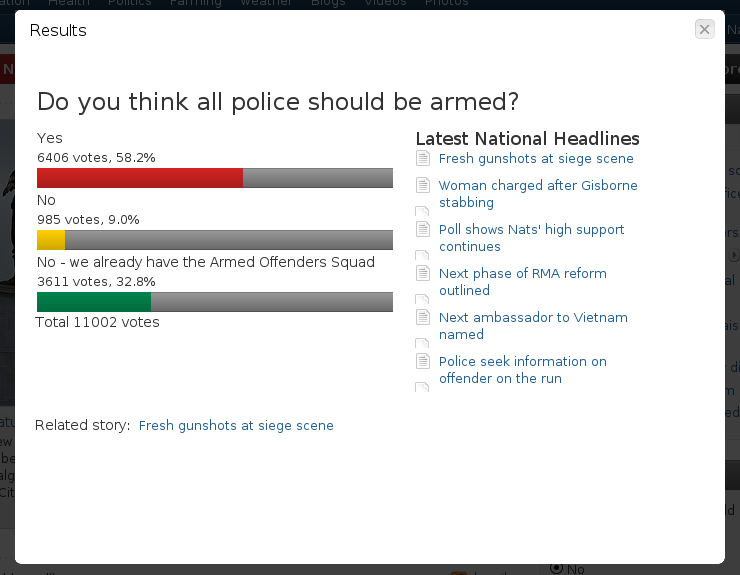
(Update 19:20: Stuff’s opinion poll has been updated to ask “Do you think all police should be armed?”, surprisingly not overwhelmingly in the affirmative (screenshot). Smart opportunistic stuff by the Fairfax Digital editors, in contrast to the Herald, who’re still asking for predictions on the Rugby League. Comments on the article are a fairly predictable mix of outrage, condolence, disbelief and armchair expertise.)

Whatever the case, we’re in for interesting times. I hope, as the police do, that the situation is resolved quickly, cleanly and without bloodshed.

There are plenty more possible issues in play here – feel free to discuss them in comments. But I won’t allow this to descend into ideological arguments about the specifics of the case, so please don’t try.

L

Press complaint: exploitation of mental illness

This is my first try at a press complaint, so I’d appreciate suggestions and feedback before it goes in the mail next week. As you can see I’m struggling to address only the issue of coverage of the actions of the mentally ill.

The process is that I have to complain to the editors first, so this will go to all three sunday papers.


Dear <title>.

Complaint: exploitation of mentally ill individual

On Sunday 19 April 2009 <paper> ran a story about the actions of an mentally ill man titled <title>. This story included personal details including details of a suicide attempt and communication with the media when his thinking was clearly disordered and altered by his mental illness. I believe the publication of this article was unethical, is inconsistent with the principles of the New Zealand Press Council, and sets an unacceptable precedent for media coverage of the actions of the mentally ill. It is also damaging for other mentally ill New Zealanders by diminishing the privacy which they can expect to be provided.

The principles of the New Zealand Press Council not only identify privacy as a core principle, but also touch on issues such as individuals suffering from trauma or grief and children and young people. They provide clear guidance that vulnerable people must be protected from unnecessary scrutiny and from exploitation by the media.

While, in this particular case, the mentally ill individual has clearly voluntarily previously engaged with the media over his personal life, no reasonable person could be sure he was capable of genuine consent given the state of his mental health described in the article. The article, therefore, significantly breached his privacy. It may be possible to argue that this case was exceptional, but the underpinning principles of privacy and fairness are not exclusive to people who have no previous media engagement.  People in New Zealand have a right to have their privacy protected, particularly when they are vulnerable or suffering from disordered or delusional thinking which prevents them from actively protecting their own privacy.

Stories like this have two important negative impacts on mentally ill people in New Zealand. Firstly they set a precedent that the media may freely publish information either about the disordered actions of mentally ill individuals, or information they may disclose while disordered or delusional. Secondly they create a culture in which the expectation of privacy of the mentally ill is diminished and increases expectation that the stories of mental illness should be made public for the titillation and curiosity of acquaintances, strangers and colleagues.

I am requesting three remedies to balance the damage done by the article:

  1. An acknowledgement that the publication of the article was inappropriate.
  2. The dissemination of clear guidelines for staff addressing the requirement to respect the privacy of the mentally ill (and other vulnerable groups which may feel some obligation to disclose private information). Training for some staff may be appropriate.
  3. The publication of an in depth article on mental illness in New Zealand focussing on the issues of privacy and the impact of disclosure and the attitudes of acquaintances.

If you or your staff would like to get in touch to discuss…

Yours…