Identity is politics

(Or: How the activist left learned to stop worrying and love identity politics.)

Here and elsewhere I spend much time railing against the notion that “identity” is somehow distinct from “politics”, or that “identity politics” is anathema to the idealised “real politics” of class and ideology. I don’t accept that those with politicised identities — in our context most often women, Māori and LGBTI people — ought to fall in behind the straight white able-bodied men of The Cause on the understanding that The Cause will lend its support to their subordinate issues when the time is right. Moreover, I don’t accept that a person’s politics can meaningfully be divorced from their identity. Identity is politics. I am far from alone in these views.

Recently it has come to my attention that many of those who claim to oppose “identity politics” are pretty happy with it too, given the right circumstances. The contest between Grant Robertson, Shane Jones and David Cunliffe provides a good example.

Right out of the gate the contest was framed in terms of identity — Grant Robertson’s sexual identity. “Is New Zealand Ready For A Gay Prime Minister?”, the headlines asked, proceeding then to draw dubious links between unscientific vox-pops and the reckons of sundry pundits, all of whom were terribly keen to assure us that they, personally, were ready, even if the country isn’t yet. But while Robertson’s identity is what it is, his campaign is not an identity politics campaign in any meaningful way. In this it differs sharply from the campaigns of the other two contenders.

Shane Jones
Shane Jones is expressly running an identity politics campaign: he’s Māori, and his goal to win all five seven of the Māori electorates for Labour is one of many explicit appeals to his Māoritanga, and well he might appeal: it is an attribute sorely lacking among our political leaders, and a particularly stark omission in Labour, with its long claim to being the, um, native party of Māori.

But Jones’ Māoritanga isn’t the only identity pitch: he has made overt masculinity a part of his brand. When he came clean about charging pornographic movies to Parliamentary Services, his explanation was “I’m a red-blooded male”. He recently doubled down on this in relation to Labour’s proposed gender-equality measures, saying New Zealanders didn’t want “geldings” running the country, and that “it was blue-collar, tradie, blokey voters we were missing”. His value proposition for the Labour leadership is that he can expand the party’s electoral base into the archetypally-masculine realm of the “smoko room” where such voters are said to dwell. It seems likely that this strategy will alienate a good number of female voters into the bargain.

David Cunliffe
David Cunliffe’s identity pitch is doesn’t look like an identity pitch, because we’re not used to seeing identity pitches from straight white men. But identity politics isn’t the sole domain of women and minorities — the US Republican Party has been running a long identity politics campaign for most of a decade against Barack Obama and Hillary Clinton.

Cunliffe’s claim is his identity as a guy who greets his supporters in a dozen different languages and whose announcement of a candidacy is greeted with a waiata, wearing a lei like it ain’t no thing. He is a mutual-second-best candidate for a bunch of different identity groupings — he’s male, but he has strong caucus support from Labour women, including his previous running-mate Nanaia Mahuta and marriage equality champion Louisa Wall. He’s straight, but he’s not homophobic or chauvinistic about it. He’s Pākehā, but his multicultural bona fides are clear, and he has strong support from Māori and Pasifika caucus members. He studied at Harvard, but he’s the working-class son of an Anglican minister. He’s comparatively young — Generation X — but not so young as to be seen as a whipper-snapper by the Baby Boomers. Homo Sapiens Aotearoan is David Cunliffe’s identity; a modern native of the biggest Pacific city in the world.

Grant Robertson
Grant Robertson’s campaign is quite unlike the others, which are pitched at the electorate, or parts of it. Robertson’s campaign is focused on unifying the Labour Party, on the basis that a unified party will be a more effective machine for building electoral support. His isn’t a pitch based around his individual brilliance or personal character, but his ability to organise, strategise, and forge an effective team out of his diverse and complicated group of colleagues. Robertson’s identity is a part of this — his advocacy and work in passing the marriage equality bill earlier in the year indicates where his politics lie, and make clear he’s no shirker — but this is by no means the focus.

And yet last night’s story by Brooke Sabin basically wrote Grant Robertson’s candidacy off on the basis of a series of ad-hoc buttonholes with workers at a union rally who apparently didn’t like that he was gay. Sabin reported that only two of the 40 people spoken to would support Robertson, and in the studio introduction to the piece anchor Hilary Barry inflated this to:

Labour leader hopeful Grant Robertson was dealt a blow today. Many in the religious and socially-conservative faction of the party, out in force at a rally this afternoon, don’t like that he’s gay, and won’t vote for him.

There are a swag of problems here: most obviously that repeatedly and urgently raising the issue (“not that there’s anything wrong with that”) sets the agenda. Further, the footage suggests that the only thing these vox pops were given to go on when assessing Grant Robertson’s fitness to be Prime Minister was that he was gay — so it was the only thing on the agenda. Worse yet; one respondent, when prompted to choose between Jones and Cunliffe, asked “Shane Jones … is he a gay too?” suggesting that not only was she not very well placed to make an informed assessment of the comparative merits of each candidate, but that asking her to do so anyway, taking her word as an indication of general union sentiment and then playing her naïve answer on national TV bordered on exploitation. (At least part of my assessment is shared by Neale Jones from the EPMU, who was there, and said on Twitter, “Sabin went around repeatedly badgering workers about whether they had a problem with Grant’s sexuality. Got story he wanted.”)

The Identity Agenda
Jones’ identity pitch is clear, and Cunliffe’s is less so, but not much less so. Robertson’s identity pitch is inferred from his sexuality and inflated. The only aspect of the archetypal “identity politics” candidate’s campaign which is focused on “identity politics” is the “ready for a gay PM” agenda, which is set by commentators and the media, outside Robertson’s control (but which he must tolerate, lest he be reframed as a “bitchy gay” rather than as the solidly masculine, rugby-playing sort we are possibly prepared to tolerate.)

So that’s ironic. But the deeper irony of this is that David Cunliffe is the darling of many of the people on the activist left who have railed most fiercely against “identity politics” all these years. (Check the list of endorsements here). There’s no policy to speak of in this contest — Cunliffe’s campaign is identity politics through and through, and yet the activist left loves him for it. I don’t think it’s unfair to observe that they love him, and they love it, because now it feels like their identity being prioritised in politics, as if it hasn’t ever been before. All that evil old “identity politics” they railed against before — the problem wasn’t that it was identity politics, but that it wasn’t their identity politics.

But I’m glad they love it. It works, after all. We have a strong sense of who David Cunliffe is, where he comes from and what motivates him, and that helps us understand, and more importantly to believe, his strategic vision and the policy platform he articulates. I think he genuinely does speak to a wider audience of potential Labour supporters than any recent leader, and that can only be a good thing for the party and the polity as a whole. If he wins, and I think he will, I hope it will go some distance to demonstrating that identity and ideology aren’t zero-sum; they’re complementary. Maybe once that realisation sinks in we’ll be really ready for a gay Prime Minister, or a Māori one.

The bin-Laden legacy.

Nearing the second anniversary of Osama bin-Laden’s death, it might be wise to pause and reflect on his legacy. The purpose is to give an objective appraisal rather than to engage in emotive debate or prejorative discourse.

Bin-Laden’s major legacy is one of ideological inspiration: he cemented in the minds of some sectors of the global Islamic community the idea that Western encroachments on Muslim societies, particularly that of the US, could be resisted with irregularly deployed armed force. These actions need not be spectacular, such as the 9/11 attacks. They could equally be low-level, localized and home-grown so long as they were persistent and unpredictable. There cumulative effect would increase the anxiety of the targeted (mostly but not exclusively Western) populations while prompting an over-reaction by their respective security authorities that impacted on basic notions of civil liberties, individual freedoms and collective rights. The sum effect would be risk aversion by non-Muslims when it came to imposing non-traditional values and interests on Muslim societies.

With regard to the US, bin-Laden’s broader strategic objective, as former CIA officer and bin-Laden profiler Michael Scheuer has pointed out, was to over-extend the US military in an ongoing global unconventional conflict unconfined to national borders or specific regions, which would result in economic bankruptcy and ensuing political polarization within the US. That in turn would prompt the resurgence of isolationist and pacifist tendencies within the US public that would erode support for foreign policies of intervention in Muslim lands.

Although the strategic concept vis a vis the US has not been fulfilled to its ideal, it seems to have been in some measure successful: the costs of the wars in Afghanistan and Iraq contributed to the fiscal crisis that led to the 2008 recession and ensuing politics of austerity. Iraq was a strategic over-reach (and mistake) by the Bush 43 administration intent of demonstrating its resolve as well as its military might. Increasingly polarized over basic notions of identity and values, the US public has nevertheless become more collectively risk adverse when it comes to engagement in foreign conflicts, something reflected in the tenor of politics within the Washington beltway.

Likewise, the Afghanistan conflict went from being an attack on al-Qaeda and its Taliban protectors to a war of occupation without end under the guise of “nation-building” and “security assistance.” The material costs of both wars have been phenomenal and the human costs, if not counted in the billions, have been equivalent to those of Vietnam and the Korean Conflict. Previously dormant ethno-religious tensions have been awakened in Asia, Europe and North America with ill political and social effect. The politics of toleration, once a hallmark of Western democracy, now competes with xenophobia and religious separatism for electoral favor. Even Australia and New Zealand are not immune from the syndrome.

In terms of the armed conflict itself, there are now two broad fronts involving two very different strategies at play from a “jihadist” point of view. On the one hand, attacks in stable nation-states with minority Muslim populations have devolved into dispersed, decentralized, self-radicalized grassroots small cell operations in which elements of the Muslim diaspora use their local knowledge to conduct symbolic attacks on host societies. Modeled on Che Guervara’s “foco” (wildfire) theory of guerilla warfare as channeled by Carlos Marighella with his “two-prong” strategy of simultaneous urban and rural insurgency, the objective is not just one of symbolic protest but also to prompt a blanket over-reaction by local authorities in which many are targeted for the crimes of a few.

The lock-down in Boston during the one suspect manhunt after the marathon bombings, a clear violation of the fourth amendment to the US BIll of Rights prohibiting unwarranted searches and seizures (ostensibly done in the interest of “public safety”), is a case in point. More generally, the suspension of civil liberties under a variety of anti-terrorist legislation in a number of Western democracies, to include New Zealand, demonstrates just how successful bin-Laden’s strategy has been at eroding the constitutional pillars of these societies.

That is all the more poignant because Islamic terrorism does not constitute an existential threat to any stable society, Western democratic or not. In fact, one can argue that terrorist acts are more acts of desperation in the face of permanent value or cultural change than it is a defense of tradition or promotion of a preferred alternative (think of the attacks of armed Marxist groups in Europe in the 1970s and 1980s). It may be injurious and tragic for those involved, but in the larger scheme of things it is more akin to the last grasp of a drowning person than it is a serious challenge to the socio-econmic and political status quo.

However, in fragile or unstable states where Muslim populations are a majority or a significant minority, the strategic objective is to gain state control waging more conventional wars. The confluence of historical grievances rooted in traditional forms of discrimination superimposed on territorial or resource disputes lends popular support to jihadist attempts to wrest sovereign control away from pro-western regimes in places like Yemen, Mali, Somalia, and increasingly, Nigeria. Likewise, Muslim irredentists with local grievances engage in guerrilla wars in Chechyna, Thailand, Pakistan the Philippines and Kazakstan, among other places.

In a twist of fate, the so-called “Arab Spring” has allowed battle hardened jihadists from places such as Chechnya, Iraq and Afghanistan to exploit the window of opportunity offered by civil war in places like Libya and Syria to promote their Islamic agendas in solidarity with their local brothers. Courageous, ferocious and determined, these forces provide discipline to otherwise rag-tag resistance movements who in the absence of such help are more likely to be defeated than to prevail.

The impact of these internationalists was felt in Libya, where in spite of covert Western military assistance the jihadists gained a significant toe-hold that has yet to be dislodged. Likewise, the resistance in Syria is increasingly led by black flag fighters drawn from throughout the Sunni world. The possibility of these forces eventually securing power in both countries remains very real.

Not all has gone to plan according to bin-Laden’s dream. The use of lethal drones as a favorite anti-terrorist weapon has decimated al-Qaeda leadership ranks. The military and intelligence campaigns against militant Islamicists have prevented the organization of large-scale attacks such as 9/11 because the number of people and logistics involved invite early detection and proactive response. With the exception of Pakistan, which has strategic reasons for playing both sides of the fence in the so-called “war on terrorism,” Muslim states have largely joined the anti-Islamicist campaign (although Sunni Arab support for the fight against the Gaddafi and Assad regimes is clear). Thus the decentralization of jihadist operations was a practical necessity as much as the second part of a long-term plan.

The bottom line is that although the bin-Laden legacy is mixed, it has been indelible: the world is a changed place as a result of his actions, for better or for worse. But the world is also a different place because of the response to his actions, for better or worse. It is the latter that will determine the fundamental impact of the former long after his death.


Recognising the enemy

Last night the New Zealand parliament voted 77-44 on the third reading of the Marriage (Definition of Marriage) Amendment Bill, passing it into law. The strategy I wrote about after the first reading has been spectacularly successful, and marriage equality will be a reality as soon as the bill receives the royal assent.

There were many powerful speeches last night. Louisa Wall discussed the spectrum of cultural traditions around sexual and gender diversity, and called a huge roll of supporters from almost every corner of the political compass.

Maurice Williamson lampooned the supposed “gay onslaught”, celebrated the “big gay rainbow” that had appeared in his electorate this morning as a sign, and hilariously used his training in physics to calculate the amount of time a person of his mass and humidity would burn for in the fires of Hell. “I will last for just on 2.1 seconds — it’s hardly eternity, what do you think?”

Tau Henare gave his old party leader Winston Peters a lesson in political history, why referenda aren’t the answer to everything, and why exactly he is no longer a member of the New Zealand First party.

Mojo Mathers spoke of the pride she felt when her daughter attended the school formal with her girlfriend. And following the vote, in scenes that have been viewed all around the world, the House stood and broke into song.

There were others. But for me the heaviest work of the night was done by Kevin Hague, who got to the very heart of enmity to this bill, and to this cause in general. I’ve quoted him at length, emphasis mine:

“I remember travelling to Auckland’s North Shore to protest against one of our opponents, Pastor Richard Flynn, who called publicly for homosexuals like me to be put to death. Over the years I have campaigned hard for the right of our communities to not be outsiders any more, to assume a full place in New Zealand society. With every new reform, the same group uses the same strategy, raising fears of terrible consequences which always fail to materialise.
[…]
“Mr Speaker, that’s why this bill is about so much more than achieving equality under the law, a basic human right that has been denied us until this day. It’s about saying ‘these lives matter: our society is big enough for us all.’ With this bill, our parliament stretches out its arms to my communities and says ‘our society is big enough for you, too — you belong, unequivocally, and without compromising who you are.’

“When the debate started, I thought all of the people like Richard Flynn had thankfully gone. The early comments from opponents were refreshingly free from fire and brimstone. There is no doubt that New Zealand has grown up over the past 27 years, as we have become a more modern, vibrant, and pluralistic society. But as the debate has worn on we have seen the re-emergence of a hard core whose opposition to this bill has lost its veneer of reasonableness. Their problem with this bill is that they believe that we gay and lesbian people are morally inferior. They don’t want to include us as as full participants in New Zealand society. They recognise — correctly — what full legal equality, what this signal means. And they don’t like it.

Kevin Hague’s measured words and calm delivery obscure a stark and clear-sighted analysis: This is war. The enemy does not regard us as human, and they never will, so we must defeat them utterly. When it comes to GLBTI people, adherents to this creed of brimstone will be satisfied with nothing less than extermination and erasure: they are an existential threat. Although it is often couched in such terms, beneath the veneer theirs is not a rational objection founded in philosophy or pragmatism, in science or honest assessment of tradition; it is simply fear and hatred that burns like the fires they preach. This is not confined to the religious sphere — variants of the brimstone creed exist within secular society, and across a broad ideological spectrum, but they share extremism in common. Much of the discourse around marriage equality, and much of the discourse around related matters, rests on ignoring, minimising or mocking those who stand up for the brimstone creed, but the brilliance of Kevin’s analysis is that he meets them — and it — kanohi ki te kanohi, staring it in the face and recognising it for what it is.

But marriage equality won because it isn’t just an issue for GLBTI people. Ghettoising it as a “gay issue”, (as feminism for generations has been ghettoised as a “women’s issue” and racial equality has been ghettoised as a “black” or a “brown issue”) was a delaying strategy that worked for a time. But no longer. Marriage equality passed because a bill introduced by a gay Māori woman was supported not only by gay Māori women, but by men and women, young and old, homosexuals and heterosexuals and bisexuals, liberals and conservatives, socialists and libertarians, atheists and agnostics and Christians and Muslims, Māori, Pākehā, Pasifika, Chinese and Indians.

All of us who believe in a just society, and an equal society, who believe in a place where ancient prejudices, cultural inertia or the maintenance of privilege cannot justify erasure must fight these battles too. The brimstone creed isn’t just an existential threat to “teh gays” — it is an existential threat to a free and decent society, and we will not have won until we defeat them utterly. There are many more battles like this, and with the clear vision and fierce determination of people like Louisa Wall and Kevin Hague, I am strangely optimistic about fighting them.

L

Journalistic license.

Over the years I have been repeatedly misidentified by NZ media types and others in the public domain as to what I am or have been. I have been called a Middle East expert, White House aide, CIA agent, Zionist agent, 9/11 conspirator, Nazi war criminal, anti-Muslim racist, security expert and assorted other niceties. The trouble with these characterizations is that they are all wrong. Worse yet, some of them have invited unwanted and unpleasant personal attention.

Imagine then my dismay to see Andrea Vance of Fairfax identify me as a “former US spy” in an article about the GCSB report. How did she get that label? I certainly made no such claim so it is difficult to understand why she felt that she could publish such a characterization, especially since it carries in some minds a very negative connotation. Shame on her.

The reality is that I simply am a former defense policy analyst and consultant to US security agencies who alternated government service with academia. My background is in international relations and comparative politics with emphasis on unconventional warfare, intelligence analysis, Latin American politics, regime dynamics and labor relations. Lots of field and documentary research, but no spying involved.

Bonus question: readers are invited to suggest who might be on the list of 88 people spied on by the GCSB. I imagine that the Urewera 18 were and that some in the NZ Muslim community may continue to be. The Zaoui defense team might be a good bet. Environmental, animal and anti-FTA activists could be targets. John Minto and Valerie Morse believe that they have been (Val, of course, was part of the Urewera crowd). Any other suggestions?


Pick a side

Commenter Chris (not THAT Chris), says:

For all I know, [Dame Susan Devoy] may be a complete dud, or a wonderful race relations mediator. But whatever she is, you are being totally unrealistic passing judgement on her because she refused to appear on TV within a day of starting her (part-time) job.

Well, no. A part-time job that pays $270k per year? Someone appointed to a role like this should not need on-the-job training to be able to answer basic questions about it. Nobody is asking for detailed policy analysis or in-depth engagement with specific issues — only for broad discussion in principle, so we can get a sense of where she stands, and how her qualifications on race relations differ from those of some random person down the pub.

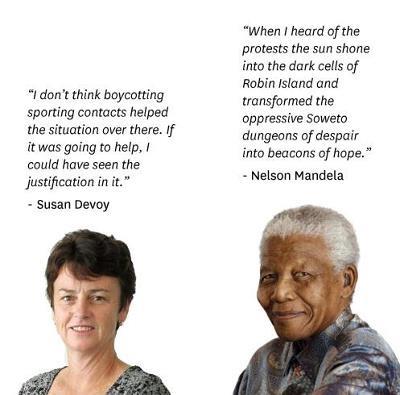
On previous performance I’d have thought there wasn’t that much to distinguish her from someone down the pub on these issues. But recently Toby Manhire dug up this wee gem from her autobiography, in which she reveals that the only thing preventing her from playing the “sunshine circuit” in apartheid South Africa was the threat of sponsorship being cancelled and that “media coverage could damage my reputation in this country.”

She also doesn’t think sports boycotts helped the situation there. Here are two people who do:

Dame Susan’s words were probably written in 1992, and it is possible she holds a different view now. I hope someone will ask her. But by 1992 the end of apartheid was already nigh, several years of negotiations to end it having already been undertaken between the government of FW de Klerk and Nelson Mandela (who had been out of prison since 1990). South Africa fielded a “non-racial” team at the 1992 Olympic Games in Barcelona — the first Olympics it had been permitted to compete in since 1960. The notion that sport had not been an important factor in its end is simply not credible, and was not credible in 1992 either.

So I know whose side I’m on. Still, it beats the Prime Minister’s claim that he didn’t know what side he was on. At least Dame Susan is open about her ignorance of the issue.

L

Selections matter

Justice Minister Judith Collins has appointed Dame Susan Devoy as Race Relations Commissioner.

She replaces Joris de Bres, who has served two five-year terms and is very well-regarded in Māoridom (at least) because (in part) he understands the importance of his own Dutch whakapapa, and the complexity of his place as an immigrant in Aotearoa. As Bryce Edwards and Morgan Godfery have noted, he has also shown an unusual willingness to comment on issues related to his mandate of opposing racism.

No doubt this fact has informed Collins’ decision to appoint someone less feisty. Dame Susan has little or no high-level experience in the field, and I suppose the thinking is that she brings a clean slate to the role or, to put it another way, her thinking and the degree of her engegement with the issues will be more easily influenced by the prevailing governmental culture. But Dame Susan is not a blank slate. A week ahead of Paul Holmes’ now-infamous Waitangi Day a complete waste column, she wrote one of her own that, although it employed language more befitting a Dame, nevertheless expressed similar sentiments. One year ago our new Race Relations Commissioner wished that instead of Waitangi Day we could have “a day that we don’t feel ashamed to be a New Zealander” and pined after a holiday like that celebrated in Australia, where — a few recent and grudging obeisances aside — 50,000 years of history and the brutal facts of the settlement of that land are blithely ignored in a jingoistic celebration of Ocker Pride.

That would be bad enough, but it gets worse: Dame Susan doesn’t have a clue what she’s doing:

Jacob McSweeney: “She admits she doesn’t have a wealth of experience in race relations, but she says the job isn’t overly complicated.”
Susan Devoy: “I don’t think it’ll make it any more difficult than dealing with any other issues, I mean, you know, this is all under the Chief Human Rights Commission [sic], and so therefore whether it’s disability or gender or employment or race, you know, the issues are not dissimilar. This is just about making it right for every New Zealander.”

(From Checkpoint.)

This is a terrible appointment. Anyone who thinks Aotearoa’s race-relations culture isn’t complicated is by definition not equipped for the job of guiding and guarding it. Not only is our new Race Relations Commissioner ashamed of our national day, but as far as she’s concerned it’s just another ism — revealing how little she must know about disability, employment or gender issues into the bargain.

So as far as that goes, she looks like the perfect post-ideological, post-identity selection for such a job: a common-sense managerialist who, to the limited extent that she understands the issues in play, finds them distasteful.

What a good opportunity for Labour! The National government, at a time when racial and cultural tensions are a major issue, clearly doesn’t value race relations sufficiently to put anyone competent in the job. But the Labour party has selection problems of its own: an Ethnic Affairs spokesperson who is a former race relations commissioner (Rajen Prasad) so far down the list that he doesn’t get a ranking; and a Māori Affairs spokesperson — and former minister — Parekura Horomia, also unranked. Labour is perilously short on brown faces, with none in the top five and one — Shane Jones — in the top 10, and him only recently returned from purgatory. Morgan Jack McDonald has some advice on this topic.

The hard truth is that Labour isn’t in a position to criticise the government on race relations issues. This is due to their internal failures of strategy, not due to exigencies forced upon them. For all that the appointment of Dame Susan Devoy to Race Relations Commissioner is terrible, the Key government has done a lot more than expected in other areas of race relations, particularly with regard to progressing Treaty settlements. That gives them cover. They’ve gotten away with worse than this appointment, and they’ll keep getting away with it as long as the major party of opposition lets them.

L

(Thanks to James Macbeth Dann for drawing my attention to Dame Susan’s column, which was plucked from obscurity by Coley Tangerina.)

With stereotypes, timing is everything.

Richard Prosser’s xenophobic and bigoted remarks about Muslims (which are not racist, since he was targeting a religion, not an ethnic or racial group) has rightfully met with wide-spread opprobrium. More than a comment about Muslims, his remarks say a lot about him on several levels. Let’s just leave it at this: That he was prompted to air his views by having his pocket knife confiscated at an airport security gate, then actually took the time to write out his thoughts in a magazine op-ed, make it clear that somewhere in Aotearoa a village is missing its idiot, and that idiot has been found spending lots of time in the Beehive.

However, the current repudiation of his views has not always been as wide-spread, and in fact his appeal to negative Muslim stereotypes was, if not all the rage, widely accepted just ten years ago.

Consider that when Ahmed Zaoui attempted to seek political refuge in New Zealand in late 2002, his arrival was met with official alarm and a chorus of exactly the sort of xenophobic invective that Prosser has voiced. The Fifth Labour government branded him an “Islamicst” with ties to al-Qaeda, then worked with the SIS to manufacture a “terrorist” case against him in order to justify his indefinite detention and eventual expulsion. It even changed domestic spying laws and created new anti-terrorist legislation (both still on the books and enhanced by National) so as to counter the Islamicist threat. The SIS went so far as to claim in its 2005 annual report that local jihadis and their sympathizers were a serious threat to New Zealand, only to drop the claim entirely in the 2006 report.

Zaoui was not the only Arab who got the heavy treatment. In 2006 Rayed Mohammed Abdullah Ali, a Yemeni-Saud flight school student overstayer, was summarily deported and handed over to Saudi security officials after he was caught (apparently following a tip-off to Winston Peters from a member of the public related to Ardmore Flying School). Despite concerns about his fate once he was turned over to the Saudis, he disappeared after being placed in their custody. The Fifth Labour government, through then-Immigration Minister David Cunliffe, refused to comment on his whereabouts or well-being and did not seek assurances from the Saudis regarding his treatment. As a justification for his summary deportation under escort, the Fifth Labour government claimed that he was a threat to national security, with his alleged “crime” being that he briefly flatted and shared pilot training with one of the 9/11 hijackers. No evidence has been produced to suggest that Abdullah Ali was aware of, much less involved in, the 9/11 conspiracy. Yet in the eyes of the New Zealand authorities at the time, relying in part on disputed FBI reports, he was guilty by association.

Shortly after Zaoui’s arrival Winston Peters, who now says that there is an element of truth to Prosser’s remarks but that his choice of words was unwise, demanded that Zaoui be expelled forthwith and went on to say that the NZ Muslim community was a “hydra” with extremist cells within it. Along with NZ First, National supported Labour on the Zaoui matter. Only the Greens questioned the official narrative (and Keith Locke needs to be congratulated for his staunch defense of Zaoui’s rights). Eventually, and with the help of some steadfast supporters and a few critical media types, the courageous work of Deborah Manning, Richard McLeod and Rodney Harrison destroyed the government attempt to frame and scapegoat Mr. Zaoui. After nearly five years the case against Zaoui was withdrawn and he was set free (he now runs a kebab place on K Road). For a good documentary overview of the case, see here.

My point is that timing is everything when politicians choose to stereotype so-called “out” groups. Back then Islamophobia ran rampant and it was fine if not fashionable to Muslim-bash, which the Clark government did adroitly and with aplomb. It did so by being subtle in its talk and thorough and focused in its actions. It publicly maintained it had nothing against Muslims or Islam, yet ordered its security apparatus to increase its surveillance of Muslim males (something that is ongoing) and enacted draconian security legislation with an eye towards the purported Islamicist threat to NZ (although truth be told, it first tried to use its new anti-terrorist legislation against the Urewera 18, and we know how that turned out).

Today all of that is water under the bridge although the laws remain on the books. NZ Muslims are no more of a threat today then they were a decade ago, but with the exception of the usual right-wing fanatics ranting in the blogosphere, the public mood is largely relaxed on the issue of the danger to NZ posed by Islamic extremism. Most politicians understand that even in election years scapegoating Muslims is now a losing campaign strategy. Thus Prosser is being made to wear a hair shirt over his contemporary remarks when he would have been applauded as a non-PC realist just a few years ago.

I would simply say that more than his stupid words, his timing if off. Politics is the art of hypocrisy disguised as righteousness, but the key to a successful disguise lies in the timing of the public posture. The Fifth Labour government timed its stereotyping just right, which allowed it to curry favor with its Western security partners in the anti-Islamic crusade by strengthening its anti-terrorism laws and internal security legislation. Zaoui was the precipitant and scapegoat used to that effect.

Prosser, on the other hand, is simply an uncouth political neophyte spouting rubbish at the wrong time. Had he made his remarks ten years ago he would have fared far better in the court of public and political opinion.


Maori Socialism versus Maori Capitalism?

Woe be it for me to venture into the minefield of Maori politics on Waitangi Day. Yet the ructions around “Escortgate” at Te Tii Marae got me to thinking that perhaps there is more to the story than arguments within Ngapuhi and the inevitable displays of division that seem to mark the yearly event. At risk of stating the obvious, it is not just about different forms of identity politics.

Instead, what may be on display is the fundamental conflict between what might be called maori socialism and maori capitalism. By that I mean maori identity superimposed on a class base. Maori socialism is a view that is working class and lumpenproletarian in perspective, while Maori capitalism is propertied and bourgeois in orientation. The Hareweras and the Mana Party are a good examples of the former while the Maori Party and entities such as the so-called “Brown Table,” to say nothing of numerous trusts and boards, constitute examples of the latter. The conflict between them is not so much rooted in personalities, iwi and hapu (although there is clearly a strong element of that), but in fundamental differences in economic perspective and the proper approach to the Pakeha-dominated socio-economic and political status quo.

To be clear, I am not referring in this instance to pure forms of socialist or capitalist thought. Communal and egalitarian beliefs are as strongly represented in maori economics and society as are ownership and hierarchy. In the realm of Maori politics it seems that hybrid approaches rooted in one or the other ideological perspective have come to dominate political discourse. But the broad division between “Left” and “Right” seem fairly distinct.

The “militant” (although it is not truly that), “socialist” (although it is also not really that) approach is to largely reject the Pakeha rules of the game as given while working on what generously can be called a war of position strategy: raising consciousness amongst subaltern groups within whom lower class maori constitute the core around which issues of praxis are addressed. In this strategy alliances with Pakeha leftists are feasible because the ideological line vis a vis the common class enemy is roughly the same.

The “moderate” (phrased nicely) capitalist approach is one of pragmatic accommodation and incremental gains within the elite system as given. Alliance with Pakeha elites is possible given the division of potential spoils available in a system constructed by and for elites, but which increasingly has the potential to be colour and ethnicity-blind. Here the strategy is also one of a war of position, but in this case from within rather than from without.

Needless to say, there is some blurring between the two (e.g. Mana plays within the institutional rules of the political system and the Maori Party is not averse to relying on extra-institutional means of getting their point across). There are also significant agent-principal problems on both sides.

Even so, it seems that the main source of conflict within maoridom is grounded in class orientation and its corresponding strategic approach as much if not more than anything else. Put vulgarly in leftist terms, it is a conflict between the staunch and the sell-outs. Put bluntly in capitalist terms, it is a conflict between losers and realists.

From a practical standpoint, the underlying class differences are more difficult to resolve than other aspects of maori identity. It is in the Pakeha elite interest to keep things so.

Given my ignorance of Maori politics I could be wrong. I defer to Lew, Anita and more informed readers in any event. My intent is not to stir.  Instead, this post is written as an inquiry rather than a statement. Your views on the issue are therefore welcome.

Interpreting the conservative take on the US elections.

If I read the conservative commentariat correctly with regard to tomorrow’s US elections, the following will happen:

Obama wins: As the fifth rider of the apocalypse, Obama will bring the end of days, armageddon, leading to the imposition of a debt-ridden, welfare-spending LBGT atheistic Islamofascist Zionist-Stalinist-Orwelian state in which children and the elderly are eaten after being vivisected and animals and dirt will have more rights than natural gas. The walls of the shining White house on the hill will crumble. Locusts will plague and fire will belch from the skies in non-industrial areas as the ground turns to dust and the rivers run dry. The seas will retreat and the icecaps will melt, but not due to man-made climate change. Female sports will become dominant.

Romney wins: Milk, honey, money and expensive Eau de Cologne will rain down upon the chosen debt producing and debt reducing Christian people and hedge fund managers, sunshine will spring eternal, a million flowers will bloom, all dole-bludging, illegal alien LBGT atheist Islamofascist Zionist-Stalinists will be rendered asunder by lightning strikes from the heavenly Father and world peace and prosperity will obtain in our time. White folk will become cool again. Soccer will be purged from the global landscape because it is un-American and does not involve teams with American Indian names, padding, helmets or blunt instruments and has a penchant for shorts that is second only to League in terms of questionability. White shirts and somber ties will once again be suitable apparel. Shoes will be tied. The help will know their place.

Gaming Gay Marriage

I have never quite understood the argument that gay sex is “unnatural.” Unless one believes that the only natural sex is that which reproduces the species, then how one chooses to express sexuality is as natural as differences in hair or skin color. If we admit that sex can be a means of expressing love, affection and physical pleasure rather than purely a reproductive act, then how one goes about doing that is as natural as variations in climate or on a theme. It does not matter if sexual preference is by “choice” or genetics or some combination thereof. Once the reproductive imperative is removed as the sole reason for having sex, then how one chooses to partake is almost limitless (I say “almost” because I adhere to convention that sex should be between consenting adults, or in the case of teenagers, between those of similar age, and that no coercion or exploitation can be involved).

I introduce the subject of gay marriage this way because I simply fail to understand why it is an issue. When I hear opponents argue against it I am reminded of the old Argentine saying about Catholic clergy opposed to divorce: if they do  not like divorce they should not marry. Or the more recent retort: if one does not like gay marriage then one should not marry a gay.

One thing is clear. The reproductive imperative does not apply to the legal recognition of straight marriages. Many heterosexual couples are childless by choice or circumstance. Some fulfill their parental instinct via adoption or with the help of surrogates, but others do not. In all cases they are legally free to marry.

Having thought about it a bit in light of recent arguments arising out a parliamentary bid to legalize gay marriage, it strikes me that the debate can be seen in simple game theoretic fashion.

Those opposed to gay marriage see the outcome if it is legalized in zero or negative sum terms. Awarding the right to marry to homosexuals will directly and negatively impact on heterosexual marriage. The belief is that awarding gays the right to marry comes at the immediate expense of heterosexual marriages, and that something will be directly lost or detracted from the latter if the former is permitted. Worst yet, the situation could become collectively negative sum if gays are allowed to marry: both gays and straights will suffer losses as a result (this is usually seen in the “children need hetero parents” argument, but extends to the costs of awarding full rights to married gay couples when it comes to family-oriented taxation, insurance and health benefits). The bottom line is that awarding equal marriage rights to gays (as a sexual minority) will impose costs or losses on the sexual majority, and therefore should not allowed under the lesser evil principle because collectively it is a lose-lose proposition.

Those in favor of gay marriage see the issue in even or positive sum terms. They see gay marriage as taking nothing from nor adding to hetero marriage, or in the most optimistic view, enhancing the value of marriage as an institution by extending the franchise to those of same-sex persuasion who wish to monogamously commit to each other in the eyes of the state (I will leave aside issues about non-monogomous unions and plural marriages in order to make the first-order point). In this view gay marriage should be encouraged as it deepens the familial bases of social stability and is therefore a greater good for society as a whole. It is a win-win solution.

Whatever other issues are put forth pro and con, it seems to me that this is the real crux of the issue. The rantings of bigots and extremists are not addressed here simply because they do not matter. I include in this God-botherers and other repressed and closeted people who act out of irrational psychological fear. Nor do I care to indulge the arguments of some extremists who think anything goes and there should be no prohibitions on sexual contact (say, the Man-Boy Love Association crowd). Here I am simply trying to distill the rational arguments in favor and against.

For me the issue is certainly even sum and probably positive sum. If we accept that one major source of social decay is the decline of the “traditional” family defined by heterosexual marriage, then it seems to me that one good response is to encourage the rise of “non-traditional” families as a complement. After all, “traditional” gender roles have been altered over the years (I would say for the better) without killing off the majority notion of marriage and family as the pillars of society, so I do not see how non-traditional marriage and families will be any more harmful to social stability than allowing women the vote or non-whites to have equal civil rights.

With regard to marriage specifically, there are already precedents for taking what was non-traditional or even taboo and making it commonplace. For example, marriages of mixed race or inter-faith couples, or those with intellectual or physical disabilities, once were viewed as suspect or dangerous (often on reproductive grounds), and in some cases legally proscribed. Today they are additional and welcome threads that rather than harm have added to the vibrancy of the matrimonial fabric of complex societies.

Anyway, this may be obvious to KP readers given their ideological dispositions. The point I am trying to make is that marriage is not a pie with a finite number of slices, where giving one slice to gays will mean that there is not enough left for straights. To the contrary, marriage should be seen as an expanding pie in with we can all share regardless of sexual preference because we commonly appreciate the order and stability it helps bring to our individual and collective lives. I reckon that is a very traditional way of thinking.