Letters from America, take eleven: Secular rituals and the commercialization of everything.

Thanksgiving Weekend is ending here in Boston. For the first time in 15 years I spent it in the US with family and friends. It struck me that Thanksgiving is one of the few remaining symbols of common values left in the US. Independence Day, Christmas, New Years and Super Bowl Sunday all have broad appeal, but only Thanksgiving has the single unifying thread of family to keep it above partisan, religious, ethnic, racial and assorted other divisive tendencies within US society.

Buchanan family Thanksgiving table in The Barn, Holliston, MA.. Photo courtesy Kathy LaCroix Buchanan

Not that all believe Thanksgiving to be controversy-free. Plenty of indigenous people believe that the Pilgrims were complicit in the subjugation and expulsion of eastern tribes from their ancestral lands. The Pilgrims, we may recall, were 40 religious refugees (“Separatists” or “Saints”) who were among the 102 passengers from England who landed first at what became known as Provincetown (on Cape Cod), then Plymouth, Massachusetts (on the mainland) on November 11, 1620 after crossing the Atlantic from the southern English port of Plymouth on the Dutch-made merchant (“fluyt’) ship Mayflower. Originally intending to settle on the Hudson River where an earlier European settlement was already in place, the Pilgrims were thwarted by bad weather and sailing conditions and decided to seek shelter further East. Armed with a grant from the London Company and Crown for the exchange of goods for religious autonomy and self-governance, the Saints/Pilgrims and their fellow travelers were decimated by illness and harsh winter conditions, with only half surviving until the next winter.

Conventional history has it that the Pilgrims arrived in peace and interacted amicably with the native Wampanoag and their sub-tribes (mostly grouped as Alonquian peoples). They also established the Mayflower Compact as the governing framework for the new colony, something that guaranteed all male colonialist participation in collective decision-making and which is considered to be one of the foundations of US democracy. It was in this context that the first shared meal with the local Pokanoket tribe was held in 1621, something that has passed into folklore as Thanksgiving. That meal followed on the heels of the Wampanoag-Pilgrim Peace treaty of April 1, 1621, which bound the settlers and all Wampanoag tribes together against other tribes (such as the Mohawk and Mohegan).
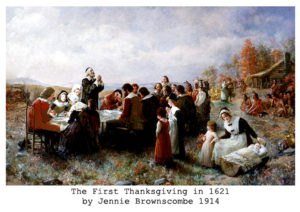
Critical interpretations paint a less rosy picture, noting prior conflict between earlier European settlers and Eastern tribes, with the first shared meal being less an act of cross-cultural friendship than a forced terms of settlement ceremony by which the Pilgrims began a divide-and-conquer process against the indigenous people. Whatever the intent of that breaking of bread, and admitting that colonization did result in the loss of land and displacement of the indigenous majority over the next centuries, “Thanksgiving Day” entered into US mythology as a moment to pause in order to give thanks for the blessings received and ties that bind.

Fast forward to today and one can see that the divide and conquer process is now being used on the settler colonizers in an extremely effective way, yet one that is different to that used on the original indigenous inhabitants. The instrument of division is called “commercialization” and it employs retail therapy as a form of community dismemberment.

For the last decade consumer non-durable retailers have pushed the day after Thanksgiving as “Black Friday,” not so much because it is a deadly day to be avoided but because it is a day for so-called “black” sales of retail goods: everyone gets a heavy discount on whiteware, electronics, toys,clothes and other merchandise so long as they are able to get their hands on the discounted goods. This causes thousands of commodity fetishistic numbskulls to line up 24 hours in advance of opening at assorted malls and other shopping venues in the hope of snagging a 20 dollar 60 inch TV and whatever else is within grasp amongst the grappling hordes. This has caused crushes, riots and a few deaths over the years, but the urge to shop on Black Friday is now reified in the media and popular culture to the extent that the original point of Thanksgiving–to give thanks for family and the benefits at hand–has been replaced by the urge to engage in competitive shopping. This no joke: on Black Friday the retail zombies literally fight each other over bins of discounted goods less than a day after the day of thanks. The media cover the crowded malls and traffic chaos as if they were national celebrations (or disasters, depending on your point of view), with person-in-the-street interviews suggesting that for many the importance of the weekend is the sales, not in spending time with family.

Although the day after Thanksgiving Thursday is not a statutory holiday, it has traditionally been treated as the middle of a long family weekend. Football has been added to the mix, with a range of college “rivalry” games and professional football contests serving as backdrops to the reunions. In recent years it has morphed into Black Friday, which in turn has also become a weekend affair culminating in Cyber Monday: the day in which telecommunications devices are fire-sold, especially via on-line retailers. In fact, on-line sales are rapidly approaching in-store sales, which has prompted shopping outlets such as malls to turn the Thanksgiving weekend into a sales event masquerading as a cultural moment, but without the historical linkage back to 1620. Today it is all about pumpkins, autumn colors, pilgrims and turkeys as caricatures rather than historical legacies, and the vibe is about using Thanksgiving as an icon in order to sell an infinite array of product. Fathers and sons can bond over ride-on lawn mowers and ratchet sets as they undertake autumn outdoor chores; moms and daughters can get their pumpkin baking mojo going together with the latest Martha Stewart oven accessory line. Granddads and grandmas can hug the little ones as they fiddle the consoles of their Pilgrim-themed electronic games.

The commercialization frenzy brought on by Black Friday has not only eclipsed the meaning of Thanksgiving but is in fact just the start of a month-long sales push leading towards Christmas, which in turn is followed by its own returns-and-exchanges day (Boxing Day). The entire month between the two holidays is an orgy of conspicuous consumption and brand tie-ins (to the military, football, Santa Claus and whatever else can entice a purchase). Whatever the spirit of togetherness fostered by the communal offering of thanks in late November, the ensuing four weeks is an exercise is materialist self-gratification.

This extends to petty thieves. The advent of on-line shopping has led to a proliferation of so-called package thefts, whereby thieves follow delivery vehicles around and steal packages from front doorsteps. The distinctive packaging used by Amazon is particularly irresistible to the low-lifes, but the general trend is to let others do the shopping and treat doorsteps deliveries as an invitation to help oneself to the surprises that they contain. Let here be no doubt about it: there is a country-wide epidemic of this type of theft, something that is a microcosmic distillation of how the spirit of Thanksgiving is well and truly gone.

Therein lies the tale. What wars and internal political divisions could not do (even Trump was silent on Thanksgiving Day!), the consumerist mentality and grotesque commercialization of everything has done. It has further broken many of the horizontal solidarity ties that once held communities together and promoted a form of nihilist alienation that is abetted and deepened by the advent of social media and individual telecommunication devices. The result is a society of self-gratifying materialists unconcerned with and unencumbered by the responsibilities of civic engagement.

There are just 2700 Wampanoag left today and they are dependent, as is the case with so many tribes, on gambling for economic sustenance. Things might have been different had they discovered that the best way to undermine the Mayflower Compact and its historical sequels was to push commodities on the white man rather than share a meal and foster community with him.

PS: Here is the RadioLive interview counterpart to this post. It begins with Thanksgiving, then wanders into a range of other subjects: http://www.radiolive.co.nz/home/audio/2017/11/-thanksgiving-is-being-degraded-in-the-states—-paul-buchanan.html

Letters from America, take eight: on the fear of “good negro government.”

One notable aspect of contemporary US politics is the re-emergence of so-called culture wars. Orchestrated by Steve Bannon, assorted alt-Right platforms and Murdoch media outlets in response to what could be called the de-WASP (White Anglo Saxon Protestant)-ification of US society, the conflict is centered on symbols and messaging. The regression into appeals to tradition, “culture” and “values” (read: white privilege) is a modern version backlash against what author and sociologist W.E.B. Du Bois (1868-1963) called “good Negro government” after the Reconstruction Era in US history (1863-1877). The theme that today’s culture wars hark to the backlash against “good Negro government”  has been picked up by the writer Ta Nehisi Coates in his latest book “We Were Eight Years in Power,” where he argues that Trump’s electoral victory in 2016 was in large part due to white voters fears that Barack Obama had conclusively proved that people of color could run the federal government competently and that whites could no longer claim that colored people were ill-suited, emotionally, tempermentally, intellectually and culturally, to govern. It is one thing to have “good” Negros portrayed as equals on TV shows. It is quite another for them to actually wield power over whites.

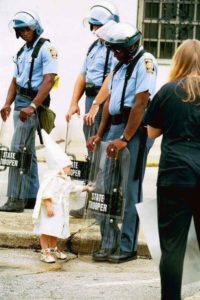
Du Bois outlined his thoughts on “good Negro government” by watching the sequels to post Civil War reconstruction in the South, in South Carolina in particular. After the civil war US authorities mandated a period of social reconstruction in the defeated Confederacy in which free slaves were, by federal mandate, integrated into municipal and state governments and other social institutions. This forced intervention was designed to lay the foundations of a more egalitarian Southern society, and in many instances free Negros took up managerial positions in a variety of public and private agencies. However, after Reconstruction and federal government intervention ended (along with the withdrawal of federal troops), Southern states set about undoing the social changes that it had wrought. In 1895 South Carolina held a state constitutional convention in which most of the gains made by blacks were reversed and they were legally reduced to second class citizens prohibited from holding political offices and purged from public and private bureaucracies. This was also the time when the Klu Klux Klan was founded (as an extrajudicial enforcement arm of the socially revanchist South), the period of building monuments to heroes of the Confederacy was begun and the foundations of Jim Crow were laid.

For Du Bois, this backlash demonstrated that what White Southerners feared most was not a “bad Negro government” rife with incompetence and corruption, something that was already evident in pre-war Southern white governments. Instead, the greatest fear of Southern whites was of “good Negro government” that did the things that only whites were purportedly capable of doing due to their supposedly superior attributes. To that was added the battlefield record of black Union troops, who Southerners thought would be cowards and run from battle but who instead proved to be very competent soldiers, and the fact that instead of rioting, raping and pillaging once they were freed, former slaves went about peacefully rebuilding the South without major problems of their own (in fact, the majority of violence during the Reconstruction was white-on-black as white Southerners resisted treating recently freed slaves as equals).

This combination of factors destroyed the myth of white supremacy that Southerners clung to, so legislative reforms such as the 1895 South Carolina constitution were enacted in order to restore and enshrine the “proper” racial hierarchy under slave-free conditions. In effect, although unable to return to slavery, post-reconstruction legal reforms that restricted the citizenship and human rights of free slaves amounted to an early American version of apartheid, the origins of which were rooted in the fear of usurpation of white privilege.

Coates sees the Trump phenomenon as a repetition of the fear of “good Negro government.” The election of Barack Obama and the success of his administration in the face of disloyal opposition by Congressional Republicans and the Right-wing media was a nightmare for white (mostly working-class male) social revanchists who had been forced to suppress their racism and bigotry since the 1960s, when the Civil Right Act (1964), opposition to the Vietnam War and the adoption of anti-status quo and “countercultural” lifestyles upended traditional hierarchies. In the ensuing 40 years the white wage labouring classes have seen their social status eroded along with their jobs vis a vis competitors, most of them people of colour, emanating from home as well as abroad.

Objective explanations for white working class decline offer no relief to those suffering within it. It is bad enough for them to have to compete on US wages with undocumented immigrants and foreign wage slaves. It is particularly bad for them to have to compete with robotics and other aspects of computer generated productive automation. They have to find explanation for their plight in something other than the inevitable progression of US capitalism in a globalised system of production, communication and exchange. For the white demographic in decline, the answer to their plight lies in no fault of their own under conditions of capitalist competition, but in the social changes occuring corollary to it. That is, the explanation for white decline has to be socio-cultural rather than structurally capitalist in nature, specifically seen in the decline of WASP “values” and emergence of non-WASP perspectives as dominant influences in contemporary US society.

In that light the election of Barack  Obama to the presidency and his subsequent success at mastering the art of governance compounded white social revanchist fears by promoting and celebrating Hispanics, Asians, gays and other minorities in leadership roles in government, business, academia and communities, and by openly embracing minority cultures as part of the mainstream of US society.

Steve Bannon has seized on this to lead the cultural charge in support of “tradition” and against “unAmerican” values, which are now open code words for a return to white supremacy. He and his political acolytes have been successful in orchestrating a pushback that has prompted a regression in US social development, with a white backlash against the gains made by minorities of all persuasions now growing stronger than in the previous three decades. The cultural wars are between an ascendant multicultural, multi-ethnic, poly-religious yet increasingly secular, pro-choice, pro-gun control, pacifist, sexually diverse and egalitarian-minded, “keep your hands off unless invited,” post-modern demographic with a rationalist and normatively relative global perspective, on the one hand, and a monocultural, white dominant, Judeo (but mostly) Christian, heterosexist, patriarchical, sexually aggressive hands -on, pro-gun, militarist, anti-choice, anti-science, industrial, xenophobic, normatively absolutist and economically insular demographic on the other. For the moment, the struggle is even but the numbers do not lie: given current and projected birth rates, the Bannon target demographic is in decline.

The last time there was a cultural clash in the US anywhere similar in scope was in the mid-60s. Until the early 60s the US was run in the image that Bannon and Trump supporters now hark back to: Dad at a good paying manufacturing job that allowed him to own his own home, Mom happily tending to the domestic front, both regularly attending a Christian church with 2.2 kids and a car in every garage (or, for those who may remember such things, basically operating as Ozzie and Harriet of 1950s TV fame).

But the 1964 Civil Rights Act, opposition to the Vietnam war and counter-cultural lifestyles pushed by rock music broke the consensus on the national myth and prompted a major ideological struggle. In that instance, progressive forces won over the rednecks and defenders of tradition. Now the struggle is being repeated but is sparked, as it were, from the other side–conservative whites are pushing back against the progressive secularization and egalitarianism of US society, as exemplified by Barack Obama and his good Negro government. The champion of these social revanchists is Trump, but it is Bannon who is the puppeteer.

There is a popular saying in the US these days: “Stay in your lane.” It is taken from car culture and references highway traffic dynamics. But it has a subtext of implicit or threatened road rage and it is in fact a substitute for “know your place.”  “Stay in your lane” is now used widely to address stroppy females, uppity Negros, recalcitrant children, surly teens, overly camp gays or butchy lesbians–basically any minority individual or community that dares to challenge WASP conventional wisdom about social hierarchy. For Steve Bannon, who has been doing the rounds of talk shows and conservative conventions this past week, it is all about getting the usurpers of white privilege to either get back into their traditionally prescribed roles or return to hiding.

Bannon believes that his 20-25 percent of the electoral base is homogenous, scared and united through social and corporate media. It is a short term vision, but given the uncertain shadow of the future it is possible that short term political gains based on a socially revanchist ideology could seep into the broader electoral fabric. Whatever their antipathy towards Trump aand the GOP, his opponents are heterogeneous, hopeful and yet fractious and divided. The erosion of horizontal solidarities in an age of ideological individualism is abetted and pushed by adavances in telecommunications technology–the same technology that social revanchists use so effectively.  Bannon has already invited Democrats to continue to play the identity politics game (and there is a lesson for New Zealand here), because that allows him to successfully impose the weight of his demographic against those aligned against it. The Bernie Sanders/versus Hillary Clinton campaigns show one end of the “liberal” internecine division in the US; the feminist arguments about the #metoo hashtag show another. There are many more sources of liberal/progressive cleavage, and in Bannon’s eyes they spell “Achilles Heel.”

The success of the cultural wars pushback is concerning. The Right-wing (including alt-Right) media, both corporate and social, have very much influenced the discourse with their attacks on the Obama legacy (him being “weak” in foreign affairs etc.) and in their support for Trump’s demeanour and his dismantling of that legacy via Executive Orders. The impact is real. Things that one would have thought were done and dusted years ago–arguments about gender differences as they apply to employment and wages, racial differences as they apply to law and order, whether being native born as opposed to foreign born should be a criterion for security clearances, are homosexuals trustworthy with kids, what constitutes patriotism, etc.–are now back in the public domain in a measure not seen in decades.

All of which is to say that things in the US are pretty tetchy at the moment, and the possibility of physical conflict between those who embrace “good Negro government” and those who fear it are quite real.

Let us not think that this is exclusively a US problem. Be it in the “I told you so” comments of white South Africans or Zimbabweans about the bad Negro governments that followed the abolition of white supremacy in those countries, or in the similar comments about poor governance of black-ruled cities like Detroit or the District of Columbia in the US, or those who point to problems with aboriginal self-governance in the Northern Territory, there are many who find comfort in black failure and find threats in black success. That is true for some quarters in Aotearoa, where the possibility of “good Maori government” or “good Pasifika government” is dismissed out of hand not so much because of their outright impossibility due to some instrinsic traits of those involved, but because of Pakeha fear that they could do no worse, and perhaps even better than Pakeha dominated government.

Let’s remember this if there is pushback against the notion of “good Negro government” in New Zealand.

Letters from America, take three: a scab got picked.

Donald Trump picked a scab during his campaign for the presidency and now the pus is draining out. It will be a while before the wound is cleansed. The pus is racism, xenophobia and bigotry.

When I left the US to settle in NZ race relations were arguably the best they had ever been. The economy was thriving, incomes were rising as unemployment dropped, and a black middle class was re-emerging in numbers and across regions as had never been seen before (the previous rise of the historical black middle class was limited to selected East and South urban centers). By 1997, the year I emigrated to NZ, black culture had been embraced and internalized in mainstream US society (i.e., outside of sports and music) and most importantly, there was at least the appearance of racial tolerance and harmony. It turns out that if that was not an illusion then, it certainly is now.

Trump spent his election campaign dog whistling to his alt-Right base. This base is not conservative in the traditional sense of the term. Instead, it is a collection of white supremacists, neo-Nazis, KKK supporters, anti-Semites, violent misogynists, gun freaks and assorted other sociopaths, many of whom claim to be Christians and some of whom are in fact part of the evangelical and Tea Party movements. What is most disturbing is that, like in his treatment of Russian president Vladimir Putin, Trump was and is open in his embrace of this base. He may be forced from time to time to distance himself from both Russians and neo-Nazis, but when he does so he does so reluctantly, under duress.

Think about it: for the first time ever a sitting US president openly touts as his core constituency a collection of violent retrograde extremists–truly deplorable in every sense of the term–while he simultaneously embraces the virtues of the authoritarian leader of what the US security community has identified as the US’s greatest adversary, one that has worked to usurp US foreign policy goals, repeatedly intruded in US cyber networks and even interfered in its political processes (and yes, the irony of the US complaining about foreign interference in its elections is not lost on me). He has ordered the defunding of programs oriented at combating racist groups while his Department of Justice undertakes a rollback of affirmative action legislation designed to redress historical injustices and discrimination against minorities. His Secretary of State orders the elimination of departments focused on fighting genocide and upholding human rights. All in the name of making America Great again.

In the last ten years, especially after Barak Obama’s election, these groups found an echo chamber in the rightwing media, both in its corporate expression (Fox News, various commercial radio outlets) and in its on-line presence (Brietbart is very much in the news but if you really want to see how these people think, check out the Storm Front web site that I will not link to). The synergy between extremists and their media enablers seeped into the political discourse of the Republican Party, and in the 2016 campiagn it grew into a torrent of vitriol and hatred directed at Hillary Clinton and everything that she ostensibly represented when it came to the cultural divisions rendering the country. Now, with Trump as president, it has institutional support in, if not outright ratification by, the Oval Office.

Trump’s ascendance has empowered and emboldened what used to be a fringe element on the US Right, who have now openly taken to the streets to reassert their supremacy over all others. This move out of the sewer coincided with efforts by Southern state governments to remove symbols of the Confederacy from public spaces, leading to the unhappy convergence of racists focusing on defending these artifacts (flags, statues, street names and plaques) on historical, cultural or transparently racist grounds. Charlottesville was a perfect storm of this convergence.

Even so-called “quiet” or “polite” racists feel comfortable publicly stating the view that things have “gone too far” or that “people need to know their place” in a fashion I had not seen in a very long time during my regular  sojourns in the South (where I still am at the moment). Bigotry is again acceptable in certain quarters of polite society.

I must confess that I have been surprised by the re-emergence of this openly racist discourse and the human vermin that champions it. When I left the US they seemed to be reduced to a small and disparate assortment of disgruntled losers with low IQs going nowhere fast. But it seems that, for whatever combination of factors–and I should note that the areas in which these people appear to be most strongly evident are the decaying white working class regions that make up the epicenter of Trump’s red state support and the opioid epidemic–racism just went underground. There it stewed in a vexatious brew of internet conspiracies, resentment against so-called PC culture and “liberal” media, post 9/11 xenophobic fear of foreign aggression, hatred of supposedly job stealing immigrants, gun fetishism and the fear of gun confiscation by a Zionist and UN-controlled federal government run by treasonous Democrats (and even a foreign-born Muslim president for eight years!) aided and abetted by smug, effete coastal academic and economic elites with disdain for “real” Americans.

Now these frotherers have scuttled into the sunlight, armed and dangerous. They have killed one and injured many others in the six months since Trump was inaugurated. Charlottesville was not the only staging ground for a racist gathering in the US this past weekend, and more confrontations are planned.

The good news is that, like the draining of a septic wound after a scab is lifted, Trump’s reluctance to repudiate his base of deplorables has ripped the veneer of deference and  respect (or at least what was left of it) from his office. The military, many corporations, numerous politicians (including those from the GOP), celebrities of all stripes, most of the media and hundreds of thousands of regular people have denounced the events in Charlottesville and the president for his cowardice in the face of them. Confederate symbols have been toppled by flash mobs, industry titans have resigned from presidential advisory boards, peaceful vigils and marches have materialized spontaneously thanks to social media dissemination, and the  general mood, at least as I can gather down here in SE Florida, is one of incredulity and dismay that this clown is POTUS.

More and more, I hear word that the endless cycle of scandal and crisis in the White House, some of which appears to be part of a strategy to replace one outrage with another in order to normalise the tumult, make people forget past offenses and divert public attention from the ongoing investigation of Trump’s Russia ties, is taking its toll on congressional republicans looking at the 2018 midterm elections. After all, they have themselves and their party to think of next year, and if the pace of scandal and crisis does not relent–and it shows no sign of doing so–then it is simply not sustainable for them to continue to support Trump without dragging themselves and the GOP down into defeat next year. As it is, even with control of both legislative chambers they have not passed a single piece of significant legislation and, to the contrary, have instead passed with overwhelming majorities presidential veto-proof sanctions on Russia and prohibitions on presidential recess appointments. So Trump is being increasingly and openly defied, when not politically emasculated, by the people in his own party that he most desperately needs to enact his agenda. With his dog whistling of racists now turned into an open field call, the chances of him doing so are slim to none.

In a few weeks or months, Special Counsel Robert Mueller will bring the hammer down on him with regards to the Russia investigation. With a reputation for being relentless and methodical, assisted by a crack team of prosecutors specialised in wire fraud, organized crime and counter-espionage (three of whom speak and read Russian), Mueller has already panelled three grand juries and ordered a dawn raid on Trump’s first campaign director’s house. He has been deposing dozens of Trump aides and campaign staffers, including his son-in-law and first national security advisor. Rumors of plea bargains in exchange for damaging information about Trump are openly circulating. Mueller is also looking into Trump’s dealings with the Russians prior to announcing his candidacy, and the relationship between the Trump organization and Russian organized crime.  As a friend of mine from DC noted, Mueller is the last person you want chasing you, and he is chasing Truimp hard.

Trump can, of course, order that Mueller be fired. Mueller knows that and we can be sure that he has prepared contingency plans so that the investigations continue in his absence. But should Trump order his Attorney General minion, Jeff Sessions (also someone with a checkered past on issues of race), to fire Mueller, than not only will it likely cause a revolt within the Department of Justice and FBI. It will force Congress’ hand when it comes to filing articles of impeachment against him (the “high crime and misdemeanor” required for impeachment being obstruction of justice). Again, with an election looming next year, any such move by Trump will see large swathes of the GOP abandon him.

So the news is mixed. Trump picked the scab of racism and the pus is in the streets. But it also has energised antiseptic forces throughout the country and made congressional Republicans reassess their positions vis-a-vis him in light of his reluctance to thoroughly drain his camp of the putrid emulators of bygone ideologies. Because, as it turns out, as of January 20  the swamp that needs most urgent draining is located at 1600 Pennsylvania Avenue rather than in DC as a whole.

Careful with that eugene, ACT

Beth Houlbrooke

Eugenics

ACT’s brand new deputy leader, Beth Houlbrooke, is into eugenics.

That’s what’s behind her emergence from the dusty old crypt of “if you can’t afford children, don’t breed” this week. I called it eugenics because when you use welfare to restrict fertility you’re targeting people who are overrepresented among welfare recipients, which in Aotearoa means you’re targeting Māori and Pasifika people. I was not alone.

And what happens when these benefit cuts produce increased rates of hunger, homelessness, sickness, neglect, and abuse among those families? Well, the government’s brand-new Ministry for Vulnerable Children will take them away from their parents. Welcome to your first glimpse of Aotearoa’s next stolen generation, just days after the government refused to consider redress for the last generation of children abused in state care.

Does this all seem a bit of a stretch? Well, we know what government-mandated child welfare agencies do when they decide parents are not doing well enough: they “manage” those parents. This is explicit in the ACT policy:

ACT WILL:

  • Push for a life-time limit of five years for support under the Sole Parent Support programme, and a life-time limit of three years for support under the Jobseekers Benefit, with “income management” being applied to beneficiaries when those limits are reached.
  • Extend income management to any parent who has additional children while on a benefit.

We know what happens when governments micromanage welfare: people find it a bit harder to buy smokes and booze, sure, but they also are forced to shop at a limited range of expensive outlets, they can’t buy cheap healthy produce at markets, they can’t barter or pay cash, and they are incentivised to game the system rather than working within it. The ACT Party hates perverse incentives, but not this one. And in Australia, it costs a fortune to administer. It would literally be cheaper to give each NT recipient an extra $100 per week than to give them a Basics Card. And we know what the ultimate government sanction is for “bad” parents: the removal of children from their custody. Draw your own conclusions.

As to eugenics. ACT leader David Seymour’s press secretary helpfully confirmed this aspect when he compared the ACT policy to abortion, which has the distinction of being the leading eugenic technique currently in use worldwide (largely for sex-selection). I gave him several opportunities to walk it back but he bravely refused them.

Read the whole thread, and draw your own conclusions. (And yes. Louis Houlbrooke appears to be Beth’s son. Rumination on the political wisdom of appointing the leader’s press sec’s mum as deputy leader are left as an exercise for the reader.)

This is not just ACT’s bag. That nice man John Key — himself raised on welfare — spoke in 2002 of women “breeding for a business” under Labour’s DPB rules. Current PM Bill English, while he would surely disavow the abortion analogy, was happy to compare welfare recipients to drug addicts. This kind of thinking goes all the way to the top.

Class eugenics

My response to the policy was the sort of fury that educated white dudes don’t usually get in welfare discussions: that’s me they’re talking about! After my father died my mother brought three young kids up on the benefit, and we will never forget that. Attacks on welfare, and especially on welfare mothers, are attacks on us. I had a wee rant about it that you can read if you can stand the swearing.

Dozens of others on twitter did likewise. Some are a bit famous. One is a Member of Parliament. A list put together by The Spinoff of notable children of welfare recipients includes millionaires, war heroes, All Black legends, and no fewer than three Prime Ministers. I was amazed by how many people had grown up on welfare and yet, somehow, had managed to become productive, decent human beings. I shouldn’t be, but there you go: that’s how deep anti-welfare stigma goes. Few of us in Aotearoa are many generations from being dirt poor, and it would pay us to remember that and not be ashamed of it.

The fact that so many people not only benefited from welfare, but understand its continuing importance in the age of busted unions, stagnant wage growth, casualisation, and the “gig economy” represents a threat to parties like ACT and National. The social purpose of the welfare is to support people out of poverty and into work and prosperity. It is a system that creates and nourishes the working class, and prevents the worst excesses of capitalism from destroying workers. And it works.

So of course the right-wing want rid of it. They can’t erase welfare kids from my generation, but in terms of long-term strategy, preventing today’s generation of poor people from having kids like us probably seems a pretty sound way to destroy class consciousness.

The way this breaks down illustrates how class politics is not distinct from but a necessary adjunct to identity politics in leftwing praxis. On paper I am pretty middle class, but this is temporary. Few of us welfare kids ever forget how little it takes to fall into economic uncertainty, so culturally, I will always be working class. Purists might bridle at this as just another identity, and some will continue to deride me as a bourgeois liberal managerialist, but I know where I came from.

This is how identity politics intersects with class politics. The same factors which make ACT’s intended victims — young, poor, brown women — vulnerable to this policy means they also stand to benefit most from Labour’s Families Package and Best Start policies, which provoked Houlbrooke’s statement in the first place. So bringing class and identity politics together, even if it was inadvertent, is good: it is brave policy, directly targeting people who already suffer from a lack of equitable access to the political and economic system. And those of us who remember what it was like to be brought up on the benefit, who now enjoy the privileges of a middle-class life and access to the political system, can show solidarity. We must show solidarity. Doing otherwise would be a betrayal of our ancestors.

The lack of a robust response to ACT’s latest attack on poor people from Labour is disappointing. It has largely been left to people on social media to fight the fight, and to my knowledge nobody in the party has used the e word. This is perhaps understandable in light of the party’s own history of man-on-the-roof welfare-bashing, and, you know, I grew up on that benefit under Rogernomics. They’re not blameless on this stuff. But let’s not be churlish. While Labour in 2017 might not be ideal, at least they’re not trying to breed poor people out of existence.

Still think it is all about postmodern identity?

Long term readers may recall something I wrote a few years ago about the issue of Left praxis and the need for a class line above all other strategic perspectives. That post was done in part because of the prevalence of identity politics and other post-modern forms of association within the NZ Left (such as certain “polyamorous” factions present in local progressive circles). This focus on non-class based forms of identification has been eloquently defended at some length by my colleague Lew here at KP, so there is merit in it, at least in some instances.

However, I believe that a major contributing factor to the decline of the Left as an ideological force and political alternative to currently dominant market-supportive ideologies and parties is the turn away from a class line, be it by the 3rd Way Labourites that NZ Labour emulates or the NZ Green Party with its election campaign emphasis on youthful (primarily female Pakeha) candidates over policy substance (which has completed the turn away from “watermelon” politics where class was at the core of its environmental philosophy and grassroots demographic and towards a business-friendly largely urban metrosexual orientation). The fact that many on the Left welcomed the victory of Emmanuel Macron, an investment banker, over Marine Le Pen, a neo-fascist, in France and failed to understand Donald Trump’s populist appeal to white American working class and lumpenproletarians (a sin I was guilty of) demonstrates the intellectual and practical vacuum at the core of what passes for modern progressive politics in some parts of the world, Aetoroa in particular.

It puzzles me that even in the face of Bernie Sanders’ remarkable primary campaign in the 2016 US presidential election and UK Labour’s rise under Jeremy Corbyn’s leadership in the UK snap elections of a fortnight ago, that many in the US, UK and NZ Left still cling to the (false consciousness) notion that centrist policies and identity politics are the way to play the game. The truth is that centrist politics have bottomed out under the polarising conditions produced by Alt-Right provocations and disinformation and the futility of the Left trying to successfully play a “soft” version of the market-oriented election game. The corporate and media Right have been quicker to realise this and seized the opportunity to deepen neoliberal era policies of economic deregulation and public sector cost-cutting by adding to it the politics of cultural conflict, immigration control and other methods by which the underlying bases of class conflict are downplayed in order to harvest the political fruits of cross-class uncertainty and fear.

The effect of three decades of market-driven ideological socialisation and post 9/11 politics of fear has been to prompt vulnerable sectors of liberal democratic societies to revert to primal and centrifugal forms of identification–race, religion, ethnicity, culture, nationality–all of which divert attention from the commonality of wage labour class subservience and its increased precariousness under the rule of a predatory type of post-industrial capitalism. Clearly non-class forms of identification need to be factored into any  discussion of praxis in a given socio-economic and political context, but adding non-class identification into the mix as the main focus of progressive struggles only serves to further dilute the solidarity bonds created by the one commonality workers have in the social division of labour of contemporary advanced capitalism.

And yet, in the face of this much of the Left appears to be suffering a form of post-modern paralysis where it is unwilling or unable to recognise that the advances made on superstructural issues like gender and LBGTI rights have their genesis in (but are not reducible to) the class driven struggles of the industrial and post-industrial eras, many of which persist to this day.

With that in mind, rather than prattle on as an old white male former academic, I defer to a genuine organic intellectual of the Left. The context is the aftermath to the Grenfell Tower fire in London:

https://www.facebook.com/thedeepleft/videos/649061075299366/?pnref=story

Sailing aboard the SS Futility.

The RNZN is celebrating its 75 anniversary through this upcoming weekend, with 18 foreign warships attending the events. There will be fleet review on Saturday and an open house on the ships on Sunday.  An exhibition of international naval history will be open throughout the week on the Auckland waterfront.

For the first time in three decades the US is sending a warship to NZ waters as part of the event. In doing so the US acknowledges and accepts NZ’s non-nuclear stance and the NZ government confirms that it can verify that the ship is non-nuclear propelled and armed via independent means (and quiet diplomacy). The ship in question is the USS Sampson, an Arleigh Burke class destroyer. Other nuclear powers represented at the celebration are China and India (and France and UK in lesser capacity), as well as a host of regional navies including Australia, Indonesia, Japan and several Pacific Island states. Ships from Singapore, South Korea and Canada will also participate.

The NZ Defense Industry Association is running its annual Forum concurrently with the RNZN celebrations. It gives NZ defense-oriented businesses an opportunity to take advantage of the presence of foreign military commanders in order to hawk their wares as well as exploit the opportunities provided by the NZ$20 billion in capability upgrades announced by the MoD/NZDF for the next fifteen years. Needless say, the combination of events has elicited opposition from a variety of groups.

Protestors have already blocked the venue of the defense industry meetings and more protests are scheduled for the next four days, including a flotilla on Saturday when the fleet will be on review in the Waitemata Harbour. Interestingly, some moron posing as a National MP suggested that the Terrorism Supression Act be amended to include protest flotillas as “terrorists” because they might terrorise the crews of the warships by accidentally getting run over by them. So much for intelligent representation but who knows, maybe someone at the defense industry Forum will have a marketable idea about non-lethal anti-dinghy defences that are designed to deal with such contingencies.

There seems to be several different elements in the protests. There are pacifists who are against the presence of warships of any sort as well as those who profit from the misery of war. There are those who are against the so-called “death merchants” but who do not necessarily object to naval forces (perhaps seeing them as a necessary evil). There are those who are anti-nuclear. There are those who are anti-imperialist. There are those who support indigenous sovereignty. There are those who are anti-American. There is some overlap between these factions but the core appears to be focused on two things: the defense industry Forum and the presence of the USS Sampson as symbolic of conjoined war-mongering evils.

Although one can not really argue against being opposed to “death merchants,” the reality is that like the tip of an iceberg, weapons manufacturers are a relatively small percentage of those exhibiting at the Forum (although major weapons providers like Lockheed Martin are major sponsors of it). Most of the NZ defense industry are logistics and support providers who often also have civilian branches to their businesses (for example, drone manufacturers, navigational technology suppliers and search and rescue equipment providers). At worst, one might consider them “enablers” rather than direct purveyors of instruments of death. Be that as it may, it is understandable why pacifists are opposed to the Forum. Simplistic, naive and righteous, but understandable.

The issue of the warships is a bit more complex. Although there are plenty of pacifists who are opposed to the entire notion of celebrating naval forces, many of the protestors appear to be more focused on protesting the presence of a US warship. This includes some of the ostensibly anti-nuclear types, who seem to have given a pass to the Chinese and Indians while focusing on the US boat. The same is true of the anti-imperialist crowd, who also are concentrating their attentions of the USS Sampson but seem unconcerned about the neo-imperialist ventures of other countries represented, to say nothing of the unhappy histories of places like Indonesia or Chile (whose visiting training ship Esmeralda was used as a prison for political prisoners during the Pinochet era). So that basically means that much of the protesters are anti-American more than anything else.

That stance has been made a bit harder to justify now that the USS Sampson has been diverted to do earthquake relief duties in Kaikura. After all, it is hard not to look silly when the focus of your protests is on a ship that is involved in humanitarian relief operations on your home soil and yet you ignore the authoritarian and often repressive histories of other countries represented in the visiting fleet. This is particularly true if the crowds at the naval expo, watching the fleet review and waiting to board the ships on open house day are larger than the number of demonstrators. Clearly they are not getting the message the protestors want to impart on them.

So the question is: what is the point of the protests?

If the answer is to support pacifism in its opposition to anything connected to war regardless of the ancillary civilian benefits of naval power such as disaster relief and regardless of public attitudes towards the military, then so be it. But if the answer is to selectively protest against the US and defense industry regardless of circumstance, well, that seems to be more of a futile gesture than a public education action.

The last thing the NZ Left needs to be seen as is silly and futile.

Social origins of the Politically Absurd.

The 2016 US presidential election is a an existential crisis of American society politically manifest as a theatre of the absurd. The story line revolves around a clash of visions over what constitutes the preferred America. On one side is what could be called the “old” vision. The vision is “old” not only because it harks to so-called traditional values rooted in nostalgic reimagining of the 1950s, but because those who most ardently adhere to it are lower educated whites aged 45 and over who are or were employed in blue collar, service sector and small business occupations.

This vision privileges the dominance of white heterosexual christian male values. It is both laissez faire and  economically nationalist in orientation, patriarchal and socially insular in perspective, wary of “outsiders,” and believes in a natural order where rules are made to be obeyed without question. It prizes conformity and stability and respect for authority.

On the other side is a “new” vision. This vision is “new” because it is multiracial, multicultural, heteroreligious and secular, plurisexual, post-feminist, economically internationalist, global in orientation and polyarchical when it comes to power distribution, legitimate authority and social hierarchy.

In reality the two visions bleed into each other in specific instances to form a hybrid social orientation in many groups that is not as dichotomous or binary as it otherwise might be. I say “bleed” rather than “blend” into each other because the overlap and cross-fertilisation between the two social perspectives is not uniform or universally applied: Mexican American IT specialists may enjoy rap as much as Norteno music while dutifully practicing their Catholic faith and adhering to its moral codes, while middle aged white professionals  can find identity in the mores and practices of non-traditional cultures and religions while engaging in post-modern leisure pursuits.

The battle between the old and new perspectives began in the 2008 presidential election when a representative of the “new” vision, Barak Obama, took on an old white man, John McCain, for the highest office in the land. That continued in 2012 when Obama confronted another old white man, Mitt Romney, in his re-election bid. It continues today in the form of another “new” candidate, Hillary Clinton, facing yet another old white man, Donald Trump. Clinton may not be the archetypical “new” candidate as described above, but the mere fact that she is female is a break from the traditional mould.

For his part, Trump represents a grotesque caricature of the traditional alpha male, and in the absurdity of his candidacy lies the last gasps of a dying culture. In his sociopathic narcissism, his sexually predatory behaviour, his racism, bigotry and xenophobia, his abject greed, his pathological lying, his thin-skinned obsession with revenge, his insensitivity to others, his ignorance of basic economic, political, military and diplomatic facts, and in his adolescent resort to crude insults and derision as a weapon of last resort, Trump is the antithesis of the self-made, strong and independent straight-talking man on horseback. And yet, because he acts as if he were and the GOP and conservative media enabled his deception, those who embrace the “old” vision see in him a saviour. But they are wrong, for what he is to them and the culture that they cling to is an angel of death.

That culture is dying because over 45 year old lower educated whites have the highest rates of suicide, alcoholism and opiod addiction in the US, so they are quite literally leaving the mortal coil at higher rates than everyone else. That is not a demographic on which to base a presidential campaign and yet Trump and the GOP have dog whistled, incited, pandered and courted it as these people will live forever or at least until the mythical past can become the future once again.

The “old” vision will lose this election but it will not be its death rattle. Its adherents will fight against the king tide of social change with  the fervour of a drowning man, and some of them will become violent. The obstructionists in the GOP will do everything in their power to undermine the Clinton presidency, and they will front another “old” visionary in the 2020 presidential campaign. But regardless of what they do and how much they resist, the hard fact is that demographic, socio-economic and cultural change are irresistible forces that work against them.

They are doomed and within a generation they will be gone.

Note: I write this the day before the election simply to give my brief read on the broader context that explains why Clinton will win. Depending on how poorly the GOP does in the House and Senate races, the bloodletting within the Republican camp could be epic. That will be fun to watch.

Many waka, one star to guide them: The Maori Party as a vehicle for Maori politics

When I started posting on this blog it was not my intent to do a party by party round up of NZ Politics (I originally wanted to focus on my areas of specialty in Asia, The Middle East and military matters) but once I started I found myself compelled to continue. I do want to look at the media and the body public a bit later but this post is the last in this vein until something interesting arises in the NZ political sandpit*.

This post has taken a while to write, mostly because there was not much to actually write about without straying into territory that was a lot deeper than I wished to go (something Chris Trotter noted recently in the media) but also because the subject in question, the Maori Party, has not been around as long as most of the other political parties and as such does not have as much of a history that people might want to read about in a blog post such as this.

But things have taken a turn recently and there has been a spate of activity within the party and the subsequent media focus, so suddenly there has been a lot more material to work with which means that a post I was putting off can now be completed.

To begin the recent outburst of media activity seems to relate to the party gearing up for the election in 2017 with the olive branch being extended to Hone Harawira and Mana, the Maori King saying he would not vote Labour and the party refusing to support Helen Clark’s bid for UN secretary general.

Whose behind all this seems to be Tukoroirangi (Tuku) Morgan, through his election as the president of the party. Morgan was previously an adviser to the Maori King (which goes a long way to explaining why the King might suddenly bag Labour in his speech) and his recent comments in the media about rebuilding the party and winning back all seven Maori electorate seats from Labour fit in nicely with the current tone of the messages the party is sending.
All of this is a clear signal that Labour won’t be able to count on the support of the Maori Party come the next election (something which John Key has welcomed) and that the party wishes to re-build the bridges with Harawira (something which Key has not welcomed) and that that the losses of Pita Sharples and Tariana Turia in leadership have not been made good with the addition of Tu Ururoa Flavell or Marama Fox.

And part of the problem with the party is leadership. Flavell and Fox have not really filled the shoes left by Sharples and Turia (at least not yet) and it looks like the task has fallen on Morgan’s shoulders to do the strategic thinking for them. It’s not that Fox and Flavell are doing a bad job steering the party’s ship but for a party becalmed in the polls and electorate there has to be more than a steady as she goes approach on the tiller**.

Currently the party has two MPs in parliament by virtue of Flavell winning the Maori electorate seat of Waiariki and bringing Fox in with him as a list MP. All of the six remaining Maori electorate seats are currently in Labour hands.

In the polls, the party has languished around the 1% mark for so long that they are now in the same position as Peter Dunne and United Future; reliant on a single seat in marginal circumstances for access to parliament.

Policy wise the party can claim to have had some successes with Whanau Ora programme and related funding aspects and while there have been some minor successes in respect to their other policy planks (health especially but also in housing, employment and family violence) these have yet to translate into either the general or Maori electorates, as increases in their polling.

Another problem is that there have been nearly a dozen different vehicles for Maori politics in the last 45 years. From Labour in the 80s (until the fallout over the economic reforms), to NZ First in 96 (when the scooped all Maori electorate seats), to the various splinter parties that formed out of the Tight Five when they left NZ First to a range of others (including representation in ACT and National (although how genuine these were is questionable)) which makes the Maori Party just the current vehicle in a long list of vehicles for representing Maori in Parliament.

So at this time Morgan’s actions to beef the party up are definitely needed but have yet to show any fruit.

Nothing seems to have come out of their overtures to Mana (and given Hone Harawira’s dislike of National and the Maori party’s alliance with them as well as the internal squabbles which lead to him leaving and forming Mana (now dead in the polls after its bizarre alliance with Kim Dotcom) it seems that the band will not be getting back together soon.

The attacks on Labour also may yet backfire given that the majority of the Maori electorate seems to prefer Labour to the Maori Party at this time and how much influence the Maori King has is not currently clear. Perhaps in time his words will have an effect but the issue may be less the message and more the medium (the King) as in other countries, royalty usually tries to appear neutral or apolitical for good reason (that being that once you choose sides its somewhat hard to reverse position and if your horse does not win, then you no longer have friends in the big house).

So 10 out of 10 to Morgan for taking action but minus several million*** for not thinking things through because the real issue, which seems to have dogged the Maori party is somewhat the same as the situation into which they have put the King; that being a partisan one.

The formation of the Maori Party was in direct relation to Labour’s Foreshore and Seabed Legislation in the mid 2000’s and the party remained in opposition until National took power where it decided to throw in its lot with them. This lead to the party getting into government (a definite success) and the previously mentioned policy successes but at the cost of playing the partisan card.

In the case of the other political parties such partisan antics are normal and can be suspended when there is general common ground (the recent security and intelligence legislation is a good example) but since the Maori party is formed around a defined racial and not political core this has issues.

As the parties own goals/kuapapa state, the project of the party is to represent all Maori and to respect all parties but in these circumstances, by coming out swinging at Labour, they have done just the opposite. This is not likely to resonate well with any Maori who have voted Labour (or Green or even NZ First) in either the Maori or general electorates.

And with 16% of the population identifying as Maori and the party’s own 1% polling this means that there are more people this message will drive away than appeal to.

The party’s siding with National has never sat well with many people and Sharples and Turia have defended it in the past by pointing to the successes they achieved only by being in parliament, something which I agree with, but by playing such a partisan position now and signalling no future co-operation with Labour they have (whether they believe it or not) just shifted the party out of the middle and well towards the right.

Now there is no valid argument for saying that National is anti-Maori but it would be hard to defend the range of National government policies which have had negative outcomes for Maori in both the current and previous National Governments.

Conversely there is no real argument to say that Labour is pro-Maori but the biggest bone of contention between Labour and Maori seems to be the previously mentioned foreshore and seabed issue and the biggest reservoir of angst over that seems to be the Maori party itself rather than the Maori electorate.

In short Tuku “underpants” Morgan may have just cut the Maori Party’s throat in a well-meaning but ultimately suicidal plan to bring the party back to life. The party currently lives on Flavells single seat alone and I would bet my bottom dollar that Labour will be campaigning hard in that electorate in 2017 to remove it from him seeing that there is no room for compromise in the other camp.

So come the 2017 election we may see the Maori Party waka run aground on rocks that were on the chart but ignored due to hubris or bad captaining. The problem being that in and of itself the party was one of the better vehicles for bringing Maori issues into parliament than many of the others. The star to which they all steer is always the same but the vehicles do not seem to be able to complete the voyage.

*-knowing my luck probably sooner rather than later.

**-Yes I was trying to pack in as many nautical metaphors as possible.

***-Zaphod Beeblebrox in Hitchhikers Guide to the Galaxy


Bulk Collection, Mass Surveillance, Targeted Spying and the Issue of Consent.

I was invited to speak at a forum in Wellington on the “Privacy Security Dilemma.” It included a variety of people from government, the private sector, academia and public interest groups. The discussion basically revolved around the issue of whether the quest for security in the current era is increasingly infringing on the right to privacy. There were about 150 people present, a mixture of government servants, students, retirees, academics, foreign officials and a few intelligence officers.

There were some interesting points made, including the view that in order to be free we must be secure in our daily lives (Professor Robert Ayson), that Anglo-Saxon notions of personal identity and privacy do not account for the collective nature of identity and privacy amongst Maori (Professor Karen Coutts), that notions of privacy are contextual rather than universal (Professor Miriam Lips), that in the information age we may know more but are no wiser for it (Professor Ayson), that mass intrusions of privacy in targeted minority groups in the name of security leads to alienation, disaffection and resentment in those groups (Anjum Rahman), and that in the contemporary era physical borders are no impediment to nefarious activities carried out by a variety of state and non-state actors (various).

We also heard from Michael Cullen and Chris Finlayson. Cullen chaired the recent Intelligence Review and Finlayson is the current Minister of Security and Intelligence. Cullen summarised the main points of the recommendations in the Review and was kind enough to stay for questions after his panel. Finlayson arrived two hours late, failed to acknowledge any of the speakers other than Privacy Commissioner John Edwards (who gave an encouraging talk), read a standard stump speech from notes, and bolted from the room as soon as as he stopped speaking.

Thomas Beagle gave a strong presentation that was almost Nicky Hageresque in its denouncement of government powers of surveillance and control. His most important point, and one that I found compelling, was that the issue is not about the tradeoff between security and privacy but between security and power. He noted that expanded government security authority was more about wielding power over subjects than about simply infringing on privacy. If I understand him correctly, privacy is a commodity in a larger ethical game.

Note that I say commodity rather than prize. “Prize” is largely construed as a reward, gain, victory or the achievement of some other coveted objective, especially in the face of underhanded, dishonest, unscrupulous and often murderous opposition.  However, here privacy is used as a pawn in a larger struggle between the state and its subjects. Although I disagree with his assessment that corporations do not wield power over clients when they amass data on them, his point that the government can and does wield (often retaliatory) power over people through the (mis) use of data collection is sobering at the very least.

When I agreed to join the forum I was not sure exactly what was expected from me. I decided to go for some food for thought about three basic phrases used in the information gathering business, and how the notion of consent is applied to them.

The first phrase is “bulk collection.” Bulk collection is the wholesale acquisition and storage of data for the purposes of subsequent trawling and mining in pursuit of more specific “nuggets” of actionable information. Although signals intelligence agencies such as the GCSB are known for doing this, many private entities such as social media platforms and internet service providers also do so. Whereas signals intelligence agencies may be looking for terrorists and spies in their use of filters such as PRISM and XKEYSCORE, private entities use data mining algorithms for marketing purposes (hence the targeted advertisements on social media).

“Mass surveillance” is the ongoing and undifferentiated monitoring of collective behaviour for the purposes of identifying, targeting and analysing the behaviour of specific individuals or groups. It is not the same thing as bulk collection, if for no other reason than it has a more immediate, real-time application. Mass surveillance is done by a host of public agencies, be it the Police via CCTV coverage of public spaces, transportation authorities’ coverage of roadways, railroads and airports,  local council coverage of recreational facilities and areas, district health board monitoring of hospitals, etc. It is not only public agencies that engage in mass surveillance. Private retail outlets, shopping centres and malls, carparks, stadiums, entertainment venues, clubs, pubs, firms and gated communities all use mass surveillance. We know why they do so, just as we know why public agencies do so (crime prevention being the most common reason), but the salient fact is that they all do it.

“Targeted spying” is the covert or surreptitious observation and monitoring of targeted individuals and groups in order to identify specific activities and behaviours. It can be physical or electronic (i.e. via direct human observation or video/computer/telephone intercepts). Most of this is done by the Police and government intelligence agencies such as the SIS, and most often it is done under warrant (although the restrictions on warrantless spying have been loosened in the post 9/11 era). Yet, it is not only government security and intelligence agencies that undertake targeted spying. Private investigators, credit card agencies, debt collectors, background checking firms and others all use this as a tool of their trades.

What is evident on the face of things is that all of the information gathering activities mentioned here violate not only the right to privacy but also the presumption of innocence, particularly the first two. Information is gathered on a mass scale regardless of whether people are violating the law or, in the case of targeted spying, on the suspicion that they are.

The way governments have addressed concerns about this basic violation of democratic principles is through the warrant system. But what about wholesale data-gathering by private as well as public entities? Who gives them permission to do so, and how?

That is where informed consent comes in. Informed consent of the electorate is considered to be a hallmark of robust or mature democracies. The voting public are aware of and have institutional channels of expression and decision-making influence when it comes to the laws and regulations that govern their communal relations.

But how is that given? As it turns out, in the private sphere it is given by the phrase “terms and conditions.” Be it when we sign up to a social media platform or internet service, or when we park our cars, or when we enter a mall and engage in some retail therapy, or when we take a cab, ride the bus or board a train, there are public notices governing the terms and conditions of use of these services that include giving up the right to privacy in that particular context. It may be hidden in the fine print of an internet provider service agreement, or on a small sticker in the corner of a mall or shop entry, or on the back of a ticket, but in this day and age the use of a service comes attached with it the forfeiture of at least some degree of privacy. As soon as we tick on a box agreeing to the terms or make use of a given service, we consent to that exchange.

One can rightly argue that many people do not read the terms or conditions of service contracts. But that is the point: just as ignorance is no excuse for violation of the law, ignorance of the terms of service does not mean that consent has not been given. But here again, the question is how can this be informed consent? Well, it is not.

That takes us to the public sphere and issues of governance. The reality is that many people are not informed and do not even think that their consent is required for governments to go about their business. This brings up the issue of “implicit,” “implied” or inferred” consent. In Latin American societies the view is that if you do not say no then you implicitly mean yes. In Anglophone cultures the reverse is true: if you do not explicitly say yes than you mean no. But in contemporary Aotearoa, it seems that the Latin view prevails, as the electorate is often uninformed, disinterested, ignorant of and certainly not explicitly consenting to many government policy initiatives, including those in the security field and with regards to basic civil liberties such as the right to privacy and presumption of innocence.

One can argue that in representative democracy consent is given indirectly via electoral processes whereby politicians are elected to exercise the will of the people. Politicians make the laws that govern us all and the people can challenge them in neutral courts. Consent is given indirectly and is contingent on the courts upholding the legality if not legitimacy of policy decisions.

But is that really informed contingent consent? Do we abdicate any say about discrete policy decisions and legislative changes once we elect a government? Or do we broadly do so at regular intervals, say every three years, and then just forget about having another say until the next election cycle? I would think and hope not. And yet, that appears to be the practice in New Zealand.

Therein lies the rub. When it comes to consenting to intrusions on our privacy be they in the private or public sphere, we are more often doing so in implicit rather than informed fashion. Moreover, we tend to give broad consent to governments of the day rather than offer it on a discrete, case by case, policy by policy, law by law basis. And because we do so, both public authorities and private agencies can collect, store, manipulate and exchange our private information at their discretion rather than ours.