Royal Hubris.

As an ex-pat yank I am not much for royals. Its a war of independence, ex-colonial legacy type of thing, I imagine, but the idea that some otherwise useless people connected by traceable bloodlines can claim superiority and the right to “lead” just grates on me. The universal law of genetic decline comes to mind here (previously posted upon).

So it is with bemusement that I read that the 2nd in line to the British throne and his new bride have decided to skip a NZ visit this year because “it might influence the elections.”

Are they high (legally or not)? Sheeeeet. I suspect anyone who believes this to be true to be absolutely chronic.

Whatever the numbers of royalist fools in NZ, it takes a stoner quantity of imperial hubris to think that Wills and Kate could influence the outcome of the November elections. In fact, I reckon that Alisdair Thompson’s strong National links (including his reported blokey relationship with the PM) will be more decisive in November than these two over-privileged parasites on a party holiday.

If you ever want to see an egregious example of dole-bludgeing, go no further than Royalty.  Some of the men may do military service while living lifestyles way above their pay grade, but the wimin do nothing other than charity socials and token appearances to excite the hoi polloi.

I say **** that. Lets get rid of the bludgers and go for full independence ASAP. After all, what have we to lose other than our symbolic colonial chains?

Does small always have to mean provincial?

Here is a question for readers. Just because NZ is small does that mean it has to be provincial? Having returned–and happily so–to NZ after a 3+ year absence, I am struck as to how insular public debates tend to be. Leave aside the grating RWC ads and hype. Although it makes much ado about a second tier sporting event, it is being hosted here and there is money to be made as well as sporting prestige on the line. So the hoopla could happen anywhere. I also understand the focus on Christchurch given the earthquakes, but am struck by how most attention is on the human dramas and not on the policy response and consequences of the disasters (which seem to this uninformed eye to be slow and not considerate of long-term implications). More broadly, be it in the tone of political debate, the focus of popular culture, or the economic preoccupations of the moment, it all seem a bit inbred to me. Am I just being precious or unduly judgmental?

I ask because I came back from Singapore, which is small but is incredibly cosmopolitan because of its strategic location and thriving expat culture (native Singaporeans are quite insular as well but have been forced to cope with the influx of more worldly people as part of their national transformation project). Switzerland, San Marino, Andorra, Monaco, Ireland and Malta are small but their location in Europe makes them acutely sensitive to and knowledgeable of their larger neighbour’s actions and interests. The same can be said for Uruguay, surrounded by larger States, or Central American republics, dwarfed by Mexico and the US. This is not to say that the masses as a whole in these countries are always on top of international affairs or erudite in their discussions of global trends, but that they seem to have a better appreciation of the world around them than what is evident in NZ. That seems counter-intuitive.

I say so because the tyranny of distance should have been overcome by advances in telecommunications and transportation, NZ is increasingly a nation of immigrants, including many from non-traditional source countries, its commercial ties are more varied and distant than in earlier generations, its has high standards of literacy and access to news sources, it has a good percentage of citizens returning from OE’s and its diplomatic connections reflect all of these trends. So why is it that, if I am correct, NZ remains rooted in a seemingly mythical short-and-gumboots, rugby-fixated mentality unconcerned about the larger world in which it is inserted? After all, unlike like large states that can “afford” to be ignorant of world affairs because of their economic weight and territorial size (e.g., the US), Kiwis are constantly told that their well-being is directly linked to NZ’s position in the international community. If that is true I would expect that average Kiwis would take an interest in global issues and ask questions of national elites about them.

Why, for example, has the NZ government made no public pronouncements on Syria (and muted comments about Libya) given its purported commitment to human rights? Why has issues like human trafficking, child labour and environmental degradation not entered into the debate about undertaking trade agreements with Asian despotic states? Why have tensions between Fiji and Tonga only been awarded two days of media attention, especially given the role of other powers behind the scenes and NZ’s connections to both countries? Why is there no debate about the NZDF role in Afghanistan given the beginning of the US military withdrawal in July? Why is it assumed that “privatisation” and public expenditure reductions are sacrosanct when in many faster developing parts of the world that are also commodity export-dependent (Latin America, SE Asia) such market-driven zealotry has been abandoned in favour of more judicious public management schemes that see public welfare and employment as requisite part of the social contract (and long-term stability)? Why is draconian anti-terrorist legislation and expansion of domestic intelligence powers passed when NZ security elites admit that the threat of a terrorist event is extremely low and that domestic threats are more likely to be criminal than political in nature (with some of that criminality being a direct result of NZ’s permissive attitude towards trade conditions and regulatory requirements on foreign investment and corporate accountability). Why are national leaders allowed to dismiss those who raise such concerns as extremists or unhinged?

In fact, what the heck happened to policy debates in general? Why is it that when not rugby the entire country seems to be fixated on human dramas and political sleaze rather than the pressing issues that impact they very way society is organised?

I realise that NZ may not be alone in this syndrome, should it in fact be real. It just strikes me as incongruous that a country with such an abundance of human capital should be so inward-focused, especially if it’s material, social and political status is directly connected to, and dependent upon, its ties to the outside world. Provincialism may serve the interests of elites who can govern and do business without considered scrutiny so long as a few popular sops are thrown the public’s way, but it seems to me to be an unfortunate comment on national consciousness if indeed it is a reality rather than a figment of my imagination.

A Response to Chris

Chris Trotter has written a response to the previous discussions regarding the Treaty, titled Talking Past Each Other (a crisp description of the comments threads on both prior posts). I would usually respond there, but Blogger comments are presently down and I have time now, so here it is. It’s a bit more than a comment, at any rate.

I think Chris’ post is intended as a critique of my political and historical naïveté (a common theme), and a perception that I’m treating the history of Aotearoa as a ‘morality play’, to borrow Scott Hamilton’s phrase. In spite of that I find in it quite a lot to agree with. In particular, the characterisation of the agendas of the parties to the Treaty, which captures well the diversity, lack of cross-cultural and long-term perspective, and motive chaos within each camp; and the final affirmation that, whatever the history, the future of Māori and Pākehā must be together. The final paragraph, especially; I cannot agree more strongly.

I also have some problems with the piece; in particular the argument that violating the Treaty was necessary to the establishment of a functional colony and that, ultimately, it was for the best that the Crown did breach the Treaty because we ended up with this lovely country. I don’t agree, and to my mind this sort of let-bygones-be-bygones, it-all-turned-out-for-the-best thinking is a very convenient position to take when it’s not your land which was taken. But our differences on this point are well documented and I don’t intend to relitigate this disagreement here (or in comments; honestly, there’s enough of it on the other two thread!s)

Nevertheless, I do also think the piece mischaracterises my position. There are two main aspects to this. First, Chris says it is naïve to view the Treaty as a contract — and I agree, if it is to be viewed only as a contract. My framing of the two preceding posts in these terms was deliberately simplistic, as I noted to Hugh in comments to the first. But it was deliberate inasmuch as there exists such a paucity of understanding of the actual historical context of the Treaty as it actually occurred, and of its significance as a founding or mediating document, that a simple and clearly Pākehā frame of reference is needed to explicate it. It was not just a contract, but the Treaty was among its other roles, a contract laying out the grants and consideration of an agreement to colonise undertaken between the Crown and local rangatira. Viewing it as a contract, I think, forms a useful minimum basis for understanding, and in particular for the establishment of expectations of what should and could have occurred following its signing.

Of course, history isn’t so simple as that, and this gives rise to the second point: Chris (and others, particularly the commenters on the posts) seem to have interpreted my call for the Treaty to be honoured in the most literal terms — that, if my argument is true, Pākehā have a responsibility to return every square foot of raupatu land; pay reparation for every man killed in the Land Wars; and that Pākehā in 2011 must beat their breasts and prostrate themselves before the descendants of those fortunate enough to survive with whakapapa intact. I mean nothing of the sort. What I mean is that, even if it were for the best, even if breaches were necessary, there exists a moral responsibility to recognise these breaches. I disagree that admission of breaches is “accurrate but trivial”, as Chris puts it; if the agreement was made in good faith (as, having been authorised by the Queen, we have a right to assume it was) then the breaches matter, and give rise to an obligation on the part of the party in breach. Where my point has been lost, I think, is that this obligation extends to making reparation for the breaches to the mutual, minimal satisfaction of both parties. Māori, as I have kept pointing out, have not been unreasonable in this regard, invariably accepting reparations of a tiny fraction of the value of the initial breach, or of no economic value whatsoever — settling for symbolic gestures, apologies and recognition. The obligation, I argue, is to negotiate in similarly good faith. Inevitably, neither party will be entirely happy, but that’s not a realistic object — the object may be to reach a state of ‘minimal satisfaction’, a solution which, although merely tolerable to both parties, does enough to prevent further disputes.

And the end goal of this is the same as what Chris hopes for — a future together. By demonstrating good faith and making just reparation, we make progress toward solving two significant problems: one is the cultural and material circumstances in which Māori find themselves, largely as a consequence of successive governments’ lack of adherence to the Treaty. The other is the status of Pākehā society, which by acting in such poor faith has too long denied its own kaupapa; successive leaders, including the odious Prendergast, denying the existence and authority of a Treaty signed in the name of their own sovereign; and even having eventually recognised it, doing so only in a mean and grudging fashion. These circumstances — both the material circumstances and the lack of good faith by Pākehā — give rise to the ‘attitude’ problems among Māori referred to extensively in the prior comments by Andrew W and Phil Sage, which they argue creates a cycle of dysfunction. The same circumstances give rise to the Pākehā guilt to which Chris refers, and of which he has accused me in the past of being victim.

But I say again: this isn’t about guilt; none of us Pākehā held the sabre in hand or pulled the trigger. Many of us, myself included, have no ancestors who were here at the time of the Treaty’s signing and its most egregious breaches (mine were still in Skye, Kerry, Eindhoven and Brabant labouring under their own troubles at the time). But as Chris says, we have — and our society has — grown and prospered at the expense of the country’s original inhabitants, and we share in the responsibility to make that right. It’s not about dwelling in the past — it’s about moving into the future, which we cannot only do once the misgivings of the past have been settled. Although Pākehā have tried to do so, it should be clear now that we cannot force Māori to forget — and nor should we. But we can work together — as much as possible without self-flagellation or haughty defensiveness — toward squaring the ledger, purging the bad blood and cleaning the slate so that we can go forward, unencumbered, into a future as iwi tahi tātou.

L

Violating ourselves, redux

A long and largely futile discussion has been running in response to my latest post about the Treaty, and the responsibility that Pākehā have to honour it, according to our own standards of conduct.

This post is nothing more than a formal clarification of the argument. There are really only two contentious points of principle in my case, and they are the following:

(1) Whether the Treaty was materially breached.

(2) Whether honouring one’s agreements in good faith is, in fact, a philosophical baseline of Pākehā culture.

The first premise is the subject of a very considerable literature. The legal weight of the Treaty and its breaches have been exhaustively documented: authoritative accounts have been written by (at least) Walker; King; Belich; Kawharu (junior and senior); Durie (two of) and Orange; not to mention the reams and reams of material deliberated upon by the Māori Land Court and the Waitangi Tribunal. Treaty breaches are simply a matter of historical reality. Anyone who denies them is ignorant of the facts of the country’s history; is at odds with the views of every qualified expert in the field; the courts, and the official position of the Crown. If you don’t believe the Treaty exists in force and has been materially breached, you quite literally don’t know what you’re talking about.

The second premise is also the subject of a very considerable literature from within the European enlightenment tradition which also gave us the philosophy of liberalism which underpins most of our society — Locke, Mill, Smith, many others. Strong contracts are at the foundation of our pluralist-capitalist society, and in this system, strict enforcement of contracts is a fallback position when good faith and the honour of the two parties fails. Since there is no ultimate authority to enforce the Treaty of Waitangi and to compel the Crown to make good its breaches, as a matter of practicality it falls to the Crown’s adherence to its own stated principles.

If (1) and (2) are both true, Pākehā have a responsibility to negotiate with Māori in good faith to achieve a mutually satisfactory resolution of the breaches. This is my argument. It is not, contrary to the beliefs of those who appear to accept neither of these propositions, a very contentious one.

L

Violating ourselves

This post is more rantish and more polemic than even my usual here, and although I’ve said all this before (it seems like hundreds of times) I feel the utter dearth of understanding of what the Treaty of Waitangi is all about — particularly among Pākehā — necessitates it being said again. Forcefully.

Danyl Mclauchlan is someone who, for the most part, gets it, and over the past few days he has put up a couple of very smart posts on the topic. Both are worth reading, and the comments to both also, if only for a view of the howling gulf which passes for understanding of Aoteatoa’s fundamental history among what is probably one of the largest, smartest, and most liberally-minded blog communities in the country. But I refer to the second, and in particular the three points which Danyl argues nullify Don Brash’s claim that Māori should be treated no differently to any other ethnic group in New Zealand:

  • Maori as a people were signatories to a treaty that was not honored.
  • Maori, their culture and language are unique to New Zealand. If we don’t try and preserve, say, the Chinese culture and language in New Zealand and it is subsumed by the dominant culture then that’s a little sad, but not a tragedy because the culture and language flourishes in other countries. But if the state doesn’t cultivate Maoritanga and it goes then it’s gone forever.
  • Maori are overrepresented in negative statistics like crime and morbidity, and it’s sometimes more effective to target these problems culturally rather than at the wider population.

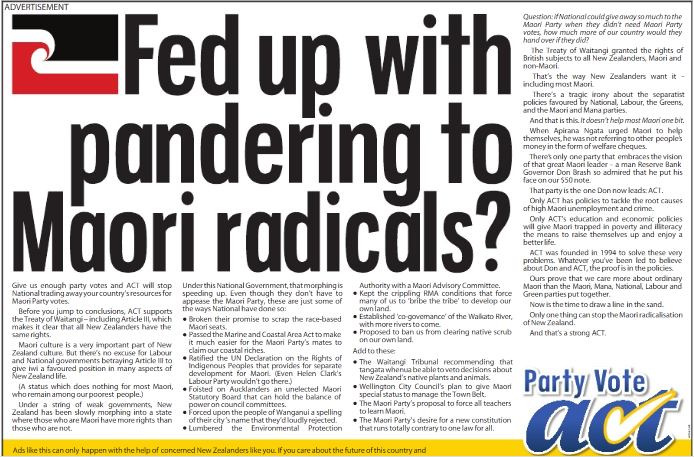
The first really is the beginning and the end here. The other two are good and worthy, but rest on the utility of those particular goods (value of the culture, wellbeing of Māori people) rather than on hard principle. That permits the “One Nation” lot to argue the waffly details and ignore the fundamental point, which is this: the Treaty of Waitangi provides a settlement right to Tau Iwi, and in particular grants the Crown the right to establish government, from which all future settlement (and other legal and civil society) rights devolve. Nothing else in the factual historical record of New Zealand history grants that right. Nothing else. You take that right and you accept the terms under which it was agreed, or you leave it. Successive generations of settlers have chosen to accept it, and that’s a wonderful thing. But it is not a right which can be enjoyed without obligation.

Hobson and his lot had no rights to settle here until they were granted by the Treaty. Sure, he could have tried — but they were outnumbered 20 to one by well-armed, well-trained soldiers who’d by that point been fighting wars on land and sea for generations, who had a complex internal economy and international trade systems up and running for more than a decade, and who were swiftly becoming cognisant of the realpolitik of the day. You could argue the settlers would have prevailed in the end, and you’d probably be right — but in point of fact that’s not what happened. In any case, if Don Brash or anyone else want to go down the repugnant path of claiming swordright over Aotearoa, they’re welcome to try.

Hobson drafted the Treaty and agreed its terms on behalf of the Crown, and consequently Tau Iwi were granted by Tangata Whenua the right to settle, to implement laws and so on, under conditions stipulated in the Treaty. The opening words of Article 3, the one which Don Brash and the other “one nation” bangers love to quote is “in consideration thereof”; the deal is contingent on the agreement being honoured. One other thing. To all those folks who argue it’s a “relic”, there was no expiry date on the Treaty. It gets amended or disbanded according to the wishes of its signatories, the two parties to it, or their descendants as appropriate. And by no other means. People of today remain bound by the decisions of the governments of yesterday. On the other thread Psycho Milt makes this crystal clear.

So it’s really very simple: as Tau Iwi, if we live here in Aotearoa, we have an obligation to do our bit in ensuring the Treaty gets honoured. Because to the extent it remains unhonoured, we’re in breach of the only thing which grants us any enduring legitimacy, the only agreement which gives us a right to be here. One of the basic, fundamental principles of the English civil society which Hobson represented, and which New Zealanders continue to hold dear today is the notion of adhering to one’s agreements; acting in good faith. In fact, Hobson’s instructions were to deal with the Māori in good faith as equals.

Pākehā society, by refusing to honour the Treaty, isn’t honouring its contract with the Tangata Whenua of this land. That breach is not the breach of some airy fairy notion of being nice to the natives. This is not some set of alien strictures; it is not some Mosaic law handed down from on high, to which we must adhere for fear of divine punishment, and most certainly it is not a set of principles insisted upon by Māori in order to weaken the Pākehā bargaining position. This is Pākehā culture in its purest, most idealised form! By failing to honour the Treaty Pākehā society is in breach of its own most fundamental and hallowed principles. The economically dry parties — ACT and (lately to a much lesser extent) National — who are most strongly opposed to honouring the Treaty are doubly guilty in this regard, because they know better than anyone that reliable contracts are the foundations of good society. The responsibility of adhering to one’s agreements is at the core of their philosophy.

Well, I’m Pākehā, and even if those other pricks won’t live up to their own declared standards, I want to honour my agreements, and those of my forefathers; and those made by people from whom I’m not descended but from which my 20th-Century immigrant grandparents benefitted. This Pākehā, at least, pays his debts. I do not carry guilt for the 170-odd years of breaches to date — I carry the responsibility for making right. What form will that take? Well, that’s a wider question and one to be properly decided by society at large.

By failing to honour the Treaty Don Brash is in violation of his own stated principles as the representative of a party which believes in responsibility. By failing to honour a Treaty drawn up by Pākehā, on Pākehā terms and according to Pākehā custom, we as New Zealanders are, more than anything, violating ourselves.

L

There’s a follow-up to this post and discussion here.

Depiction of masculinity in rock radio.

As I flip through the NZ radio airwaves I have been much humoured by the depiction of masculinity in advertising on rock radio (for purposes of definition, that is FM radio stations that feature AC/DC, Metallica, Tool, Shihad and other old and new bands that play up tempo, guitar driven, blues derived sound. This does not include Lady Gag, Madonna, boy and girl bands, Justin Beiber, Millie Cyrus, rappers and their ilk). Some of the imagery conjured in these ads is funny but disturbing, and I realise that the depiction is concocted by advertising companies selling product to a 15-35 year old male demographic. But three things stand out about the depiction of ideal NZ men in these ads.

The first is that the general thrust of the ads is framed as a negation or antithesis of an extant others–metrosexuals and women. These are not moccachino-sipping, quiche eating, emo or poncy little dog carrying (in a man purse!) financial advisors or lawyers. More implicit than explicit, the intimation is that these are mates, dudes, fun-luvin’ rascals that have to live on the edge of a PC world. But the positive message (such as it is) is sublimated under the representation of what it is not. The majority thrust of the bottom line is a negation. These are not post-modern poseurs or dandies, and they do not want to relate to chicks other than at a primal level.

The second noteworthy aspect of the ads is the objectification of masculinity. Men’s identities lie in the commodities they prefer (consumer non-durables, mostly): utes and V8s, rugby, some more rugby, league, more league, cheap alcohol, cheaper beer, red meat (ideally hunted, then cooked on a bbq), fishing gear, racy magazines, grubby clothes, stereos and farm equipment. They do not wear cologne.

The third and perhaps most interesting aspect of the depiction is its representation of “manly” values. Men are mates; hard drinking, carousing, happy go lucky, staunch (especially when drinking), fast driving, opportunistic and impulsive horn dogs working hard on the ladies. Nowhere in the depiction are there notions of honour, valour, courage, sacrifice, sincerity, solidarity (except with mates), humility, basic intelligence and knowledge of current global affairs, or interest in the needs of women, children and the family. That is a bit odd simply because the early 20 to 35 male demographic is the one that is reproducing the most (presumably a manly trait), has young families, is starting careers and otherwise has the burdens of post-adolescence crashing down on it. Yet the values being reified appear adolescent.

I have seen this type of representation on rock radio programming in Florida and Arizona. In those cases the demographic was male 15-23, simply because the size of the population allows that age group to sustain specific types of commercial music programming. I presume that there is an Ozzie variant. NZ has its own, over a wider age range.

The success of advertising campaigns based on this type of symbology appears to lie in the deep unhappiness of 15-35 year old NZ men with the evolution of society. It speaks for a desire to not only be rebellious adolescent in social perspective, consequences be damned.  It also speaks to a desire to be in another era that, however mythological represents the antithesis of NZ society today. The question is: was there ever anything remotely close to this depiction in NZ historical reality?  If not, what explains the appeal of these ads? And if it is true that there is a deep antipathy to the current social order, what does that say about prospects for assimilation of this demographic? In other words, what are the prospects of these angry and nostalgic (mostly Pakeha) young men, if indeed the advertising thrust is a window on their souls?

(Of course, I defer to Lew for a more professional interpretation of the subject).

Class, identity, solidarity and dissent

Recently commenter Tiger Mountain raised the parallel between solidarity with Actor’s Equity regarding The Hobbit and support for the māori party given their coalition with National and sponsorship of some bad legislation. I explained how they’re not equivalent, but leaving aside the main difference of mandate (which the māori party has and AE doesn’t) the wider issue of critical solidarity is an important one, and one which has been raised several times recently. In the wake of The Hobbit fiasco matters of class, identity and solidarity are high in everyone’s minds, and I think in spite of our many differences, we can agree that’s a good thing.

Another contribution to the wider debate is by Eddie at The Standard. For once I find myself agreeing with Eddie’s opening sentence about the māori party, which is:

The problem with any identity-based political movement is it pre-supposes that the common identity of its members surpasses their conflicting class interests.

It’s true, although I would have phrased it as follows:

The problem with any class-based political movement is it pre-supposes that the common class of its members surpasses their conflicting identity interests.

I wrote at length about this dynamic tension at a time when it looked like Labour was going to force Māori to choose between their class identity and their identity as tangata whenua — and how foolish forcing such a choice would be. (It’s still not clear whether Labour has abandoned it, but it at least seems obvious that they don’t have a full-blooded commitment to the blue collars, red necks strategy. But that’s by the way.)

What tends to follow from statements like that one is a series of value judgements about which set of interests ought to take precedence. This can be valuable, but is often tiresome, particularly when those making the pronouncements are “fighting a corner” for only one half of the equation (usually, it must be said, the “class” corner). But Eddie has mostly (not entirely) resisted the urge to do so and focused on the internal dispute within the māori party, and in particular the rather dictatorial stance taken by Tariana Turia regarding opposition to the new Marine & Coastal Area (hereafter MCA) Bill. That’s an important debate and examination of it is valuable, but what’s not really valuable is Eddie’s attempt to frame Turia’s stance as a matter of māori identity v class identity. It’s not. It’s a matter of the tension between moderate and radical factions within the movement; part of the internal debate within Māoridom.

Class is an element of this internal debate, but it is not the only element, and I would argue it is not even the predominant element. I think it’s clear that the conciliatory, collaborative, third-way sort of approach to tino rangatiratanga taken by Turia and Sharples under the guidance of Whatarangi Winiata (and whose work seems likely to be continued by new president Pem Bird is the predominant force. I also think the main reason for the left’s glee at the ascendance of the more radical faction is largely due to the fact that there’s a National government at present (and recall how different things were when the boot was on the other foot from 2005-2008). Those leading the radical charge against the MCA bill — notably Hone Harawira, Annette Sykes and Moana Jackson (whose primer on the bill is required reading) are not Marxists or class advocates so much as they are staunch advocates for tino rangatiratanga, who oppose the bill not so much for reasons based on class, but for reasons based on kaupapa Māori notions of justice. The perspectives of all three are informed by these sorts of traditionally-leftist analyses, but those analyses are certainly not at the fore in this dispute (as they have been in some past disputes). In fact, the strongest (you could say “least refined”) Marxist critiques of the bill advocate for wholesale nationalisation of the F&S, unapologetically trampling on residual property rights held by tangata whenua in favour of collective ownership.

For Eddie’s caricature of the dispute as “identity” v “class” to hold strictly, Turia, Sharples, Flavell and Katene would need to occupy the “authentic” kaupapa Māori position, the legitimate claim of acting in the pure interests of mana motuhake and tino rangatiratanga; while Harawira, Sykes and Jackson (among others) would need to be largely denuded of this “identity” baggage, and be more or less pure class warriors. Neither is true; Harawira, Sykes and Jackson’s critique of the bill isn’t a Marxist critique; they’re arguing that the bill doesn’t serve the imperative of tino rangatiratanga and is therefore not an authentic kaupapa Māori position; an assertion that Sharples has tacitly accepted with his response that the Maori Party must accept compromise. (This is true, of course; I agree with Sharples and Turia as far as that goes. I just disagree that this bill is the issue upon which to compromise so heavily. Because of that, I come down on the side of Harawira, Sykes and Jackson.)

The other misguided thing is how Eddie frames Turia’s insistence that Harawira and others adhere to the party line as some sort of manifestation of Māori over class identity within the party — the quelling of dissent and insistence on loyalty to the leadership elite’s position as a “Māori” way of doing things, opposed to a “Left” way of doing things. This is absurd. The “left” does not automatically stand in defence of dissent or the public airing of heterodox views, much though Eddie (and I) might wish that it should. As I already mentioned, this is shown by Labour’s response to Turia in 2004 and the māori party’s first full term, suspicious at best and hostile at worst. The AE dispute is also an excellent illustration. In that case, the prevailing, “authentic” left position (including that taken by many writers at The Standard, though not — as far as I can recall — by Eddie) was to insist on total public solidarity with the union. In other words, precisely what Turia is insisting upon. I disagreed with this position in AE’s case, and I disagree with it in the māori party’s case. Dissent of this sort (or the imperative of its suppression) is not some innate part of “the left”, nor is it absence a characteristic of “identity politics”. It can exist or not in movements of either type, depending on the merits and specifics. It’s my view that such dissent is the beating heart of a movement, and it is peril to quash it. It is a shame that Turia seems to be making the same error as Helen Clark made regarding this issue in 2004.

But despite these objections, ultimately I agree with Eddie about one other thing: the dispute is really interesting, and the emergence of radical critiques and challenges within the movement is exciting and important. The māori party has a mandate to agree to the MCA act as drafted; after all, according to Edmund Burke’s famous saying, representatives owe their constituents not only their efforts but their judgement on what is just and right and possible. They’re not elected to always take the easy route of political martyrdom, and because of this they may find themselves staring down their constituents. Sometimes they may win. But nowhere are representatives guaranteed that those constituents must not try to stare back. If those who oppose the bill can raise a hÄ«koi in support of their cause, then let them do so, and more strength to their waewae. And let members of the “left” movements, if their enmity to the bill is genuine, rather than a reflexive attack on a National-led government and the māori party orthodoxy which supports it, march alongside them in solidarity. That will be some sort of justice.

L

Bananazelandia.

There is a small island country in which, in spite of their avowedly private market-oriented ideology, government leaders have directly involved themselves in negotiations with foreign film makers in order to keep production of a film series on the islands. The foreign studio bosses threaten to take their production elsewhere; the famous director–a local boy made good– fumes and blames union organisers for raising production costs (in a film that is mostly based on computer animation and special effects rather than humans acting, in a country where the local currency is less than 80 cents of the US dollar). Although the film production is no long-term investment and will not bring employment stability or trickle down benefits beyond those connected to its production and its purported positive impact on tourism (supposedly because foreign tourists will come to the islands to see a movie set called “Hobbitown” in which gnomes abound), the government agrees to offer the foreign studio bosses NZ$100 million in tax and marketing breaks and to change local employment law so that actors are classified as contractors rather than employees while working on feature films (should the law apply to all actors this could well extend to TV, stage and radio actors working on local productions as well).

Although the film industry is currently an significant source of revenue for the country and has spawned a considerable technological base associated with it, it does not add to the long-term national development growth of the island state. Compared to core national industry, it is much like a diamond in a coal mine–a source of pride and joy but not a basis for long-term prosperity.

All of which is to say: foreign corporate masters involved in an industry that does not add long-term value to a nation’s economy have managed to get the island country’s leaders to bow before them in order to secure short term economic gain for a small local industry with limited direct ancilliary impact and a more hypothetical than concete follow-on revenue generation effect. To do so, not only was money offered to appease the foreign masters. The basic law of the land was changed at their behest as well.

Since the country has been engaged in a long-term debate about changing its national flag and its status relative to its colonial master, perhaps it is time to also consider changing its name.

Bananazelandia. Say it with a Spanish, French or Portuguese accent and it just rolls off the tongue.

The Perils of the Dark Side

Via 3 News journalist Patrick Gower on Twitter, the news that Pita Sharples is the keynote speaker at the Destiny Church annual conference this Labour weekend. Concerning news.

Except I’m not sure it’s completely accurate. According to the Destiny press release, Sharples is the keynote speaker at the Friday night Awards & Recognition event which kicks the conference off, while (who else) Bishop Brian Tamaki is the “keynote preacher” for the weekend-long event. I think this is an important distinction: it’s appropriate for Sharples, with a lifetime of support for Māori excellence, to be present for an event which celebrates achievements in “business, management, the health and social services sectors, Pacific arts, family breakthrough and contribution to at-risk youth” for a large and largely Māori organisation, featuring pasifika and kapa haka performances to boot.

But that’s quite a different thing to lending the imprimatur of his status as the co-leader of a government party and Minister of Māori Affairs to the shady cultishness of Destiny’s main event. This is not to say that Sharples should shun Destiny outright: after all, as a kaupapa Māori politician he does represent some of the group’s members, and many non-members who share some of their values. Such ‘Dark sides’ of support exist for almost every party; the Greens have their crazed dark-green environmentalists; Labour has the blue-collar rednecks about whom I’ve written previously; ACT has mostly sucked away the white-collar rednecks (and doesn’t mind admitting it) from National, but the Nats still have the worst offenders among the farming lobby and many of the least-savoury Christian sects (much of Destiny undoubtedly included). For all that they might be abhorrent to some, these are all legitimate interest groups and — within reasonable bounds — they must be tolerated and their needs entertained in a free society. Their members have as much right to democracy as anyone else, but (as with any fringe group) politicians must be extremely circumspect about the type and quantity of support that they grant.

There is a danger that Pita Sharples will be seen to pander too much to Destiny; and indeed a danger that he does pander to them. The māori party paddles turbulent waters at present; having compromised very heavily on the Marine & Coastal Area/Takutai Moana legislation to replace the Foreshore & Seabed Act, and now finds that Faustian bargain under attack both from the ACT party without and from Hone Harawira within. Despite the former, and probably because of the latter, they have been very quiet lately. Although they — ironically — share some common ground with Labour on the Takutai Moana bill, there remains a very large gulf between them; not least because Labour’s own conference signals a much more classical materialist direction than that which has previously obtained. Sharples and Turia are no fools, and can see that remaining a client of Key’s pragmatic-instrumentalist National party is a hiding to nothing — even with the ACT party likely out of the picture after the next election, the likelihood that they can maintain common cause once the other has outlived its immediate use seems slender. So they feel like they need another support base, and it must be very tempting to team up with a charismatic leader such as Brian Tamaki at a time like this.

It would be ruinous to do so. Most obviously, this is because outside of his most loyal followers — his 700 Sons — Tamaki’s is an illusory sort of strength, based on the smoke and mirrors of a showman’s art rather than upon deep loyalty and conviction. This much was clearly shown in the 2005 and 2008 elections, where the Destiny Party (and later the Family Party with Destiny’s express endorsement) failed to come close to success, due largely to a lack of internal cohesion. Destiny has failed to demonstrate — even at the height of its profile five years ago, under a government largely hostile to it — that it could mobilise a meaningful number of votes.

The second, and by far the more important reason, is the abhorrent nature of the policies and principles Destiny stands for — crude Daddy State authoritarian Christian conservatism with a brownish tinge; illiberal, intolerant, homophobic and misogynistic, quite opposed to where Aotearoa is heading. And that’s to say nothing of the corruption and appalling social dysfunction endemic to the evangelical cults of which Destiny is an example. The sorts of scandals which currently rock the church of Tamaki’s own “spiritual father” Eddie Long in the USA must undoubtedly also exist within Destiny. This is essentially the same package of qualities which turned the Exclusive Brethren to political poison for Don Brash’s National party in 2005. Because of this deep and fundamental disconnect, and New Zealanders’ innate distrust of folk who think they’re ‘exclusive’ (especially if they’re brown, wealthy or religious), the reality is that an alliance between the māori party and Destiny would likewise be poison, and would probably circumscribe any future prospects of working with either of the two main parties, not to mention utterly ruling out the Green party — with whom the māori party shares the most policy in common.

So there is no easy course for the māori party in the long term; the swell is heavy and the winds both strong and changeable. But to extend the nautical metaphor, Destiny is a reef; not an island. Better that they paddle on by their own course and seek more solid ground.

L

PC priorities

The media beat-up du jour is the non-story of Te Papa Tongarewa “barring” (or “banning”, “forbidding”, other such absolute terms) pregnant and menstruating women from entry due to the nature of some tāonga on display.

Except they’ve done no such thing. The “ban” isn’t actually a restriction at all — they’ve been clear that it’s a request, not an ironclad edict; and in any case, the exhibit isn’t open to the public, but to staff from other museums. It’s an invite-only behind-the-scenes tour. And the crucial point is that the tāonga in question have been given to Te Papa on condition that this advice is given to prospective viewers. Let me be crystal clear: nobody would be barred from attending on the grounds that they are pregnant or menstruating. If someone wanted to turn up and say “bollocks to all of that, me and my unborn child are going to see those taiaha!”, it’s been made clear that she would be permitted to do so. That might be inflammatory and offensive, like farting in church or wearing a bikini to a funeral, but nobody is forbidding it. And that’s as it should be: Te Papa is our place and nobody should be barred outright. If the condition required exclusion, then that would be fair enough on the part of the owners — who can reasonably impose whatever conditions they please — but quite explicitly not ok for Te Papa, who would be better to decline the opportunity outright to maintain its public mandate.

Of course, this hasn’t stopped everyone with a platform from winding up to rage against the imposition of archaic, alien superstitions upon their civil liberties. But almost without exception, the restriction-which-isn’t-really-a-restriction doesn’t apply to them, since — as far as I’m aware — none of those objecting are in fact museum staff who would be eligible for the tour. And amongst this vicarious umbrage there’s an awful lot of squawking about misogyny and imposition of cultural values, and much more uncritical repetition of the misleading language of “bans” and such. It goes as far as idiotic and lurid suggestions about personal searches using sniffer dogs, for crying out loud.

All this has manifested as a soft and rather opportunistic sort of anti-Māori racism, where Māori are the casualties of our sticking up for the rights of pregant and menstruating women. There’s a common implication that they are the oppressive stone-age patriarchy using whatever means they can to victimise our women; and “forcing” their rude barbarian culture into our civilised and noble times. This is understandable from the usual PC gone mad crowd who’ve suddenly — conveniently — found their inner feminist, but somewhat more disappointing from those who would often be described as the hand-wringing PC liberals, people who ought to know better that it is possible to reconcile conflicting cultural values of this sort in an amicable fashion via the standard tools of live-and-let-live liberalism. And while those same hand-wringing PC liberals do rail against the worst excesses of those illiberal institutions which make up mainstream NZ society — chief amongst them the Catholic church — the response to this case has generated anger out of all proportion. Te Papa had to make the decision: take the tāonga on with the advisory condition, or not at all. Perhaps those objecting to this policy would prefer that nothing of this sort ever go on display. There is a genuine cultural conflict here, but it can quite simply be resolved: those pregnant and menstruating women who believe their right to attend trumps the request to the contrary may do so then and there. Not only are they not prevented from doing so by those hosting the tours, they actually have the right to do so should they choose, and that right should be defended. Those who do not may do so at another time which is convenient to them. The tragedy is that for most of the liberals in this battle of PC priorities, women must be given categorical superiority over Māori. They are arguing for their own culture to be imposed across the board; the very illiberalism they claim to oppose.

There are (at least) two people who are making good sense on this matter: Andrew Geddis, whose liberal argument is very close to my own views, but much better formed; and Lynne Pope who, almost uniquely among the bullhorns sounding around this topic, is a Māori woman who’s actually been on the tour in question. Neither of them have lapsed into the myopic, reflexive Māori-bashing which is the most unbecoming aspect of this situation.

The lesson for New Zealand’s liberals is this: it isn’t necessary to trample on the cultural needs of Māori to accomodate the needs of women. Liberalism itself provides tools to reconcile these differences. They just need to be used.

Update 20101018: As usual, Scott Hamilton makes good sense on this topic.

L