The US as the new Greece.

Watching the lead up to what will be a major Republican and Tea Party comeback in the upcoming US midterm elections, and having spent an earlier part of the year in Greece, I cannot but help but be struck by the parallels between the two countries. This may seem crazy, but sometimes what is obvious is not necessarily apparent.

The US and Greece are saddled with immense debt, most of it public. Both have extremely large state bureacracies that consume an inordinate amount of the tax base. Both have lived, in their personal and public consumption, way beyond their means over the last two decades, riding the wave of financial sector excess and lving off real estate and other speculative bubbles that did not, in fact, significantly contribute to national productive rates.

In each case immediate past centre-right governments contributed to the false sense of security by allowing the financial sector to operate with considerable degrees of autonomy and lack of oversight, reduced taxes for the wealthiest sectors of the population and corporations, and spent money well in excess of state revenues. In Greece state expenditures went into a bloated welfare system that was designed to prop up living standards that are seen as a birthright of all Greeks; in the US, the excess state spending went into war. In both instances the center-right governments increased state spending and the public deficits that accompanied them. In both cases they were turned out at the polls in the past two years.

Center-left governments replaced the discredited right. They inherited unsustainable deficits that will take years to redress and embarked on economic reform programs that were designed to cut the public deficit and increase economic efficiency over the long term. In Greece this meant slashing the public workforce, decreasing public salaries and welfare benefits while offering a package of tax incentives to small and medium business so that they could innovate, expand and thereby take up the slack produced by reductions in the public workforce.

In the US the economic stimulus program was designed to prop up and revitalise at-risk major industries (the automobile and financial sectors in particular) while providing tax relief for 95 percent of the working population. A national health program was instituted that, even though watered down and more pro-business than pro-consumer and nowhere close to socialised medicine,  provides for minimum health coverage for the majority of the population. Selective regulation on the financial sector was legislated, although this worked more on the margins of the system rather than at its core. Military spending was cut at the corners, and in a number of cases companies that received financial bail-out packages have begun to re-pay their debts.  In effect, although in the US public spending increased over the short term with the stimulus and health care packages, the design is oriented towards lowering the overall public spending bill within five to ten years while maintaining a  disproportionate emphasis on “defense.” That is the American way.

In both instances some or most of the center-right opposition in the legislature supported the economic reform packages of the government, but backtracked when confronted by public reaction. In both cases that backtracking led them to move towards the zealot wing of their popular base. That has consequences.

The reason? In each case there was an immediate, reflexive and largely unthinking  public backlash against the reform measures. Following Greek protest tradition, often violent strikes and demonstrations have engulfed the country from the moment austerity measures were announced. Although the protests are led by unions and other elements of the agitational Left, the real beneficiaries of the crisis are the hard Right, who have seen an opportunity to engage in nationalist-populist demagogery in which “foreign interests,’ illegal migrants, “Communists” and a host of other suspected culprits are blamed for the country’s woes.

In the US attempts at reform have been met by a wave of right wing backlash among the mostly white middle classes, who also blame illegal migrants, “Socialists” and other purported “progressives” as well as atheistic liberal homosexual-enabling secular humanists for the decline of Empire. At public forums many vented their anger by calling for a “revolution” or at least the ovethrow of the Washington elite. Some of them turned up armed to make their point.  They have a movement not unlike the Greek ultra-nationalists. It is called the Tea Party.

What is striking about both hard right wing resurgences is that they stand to gain the most from upcoming elections simply by blaming the governing center left administrations without offering a plausible solution to the problems of the day and near future. Both want to return to something long gone. Both want lower, not more taxes, apparently not understanding that in the case of Greece that national pasttimes of tax avoidance, island vacation homes and reliance on the state for pensions, social security and universal health care are contradictory and incompatible. In the US the pejoratively labeled “Tea Baggers” apparently have not connected the dots between maintaining a massive military apparatus that consumes 6 percent of GDP, is fighting two wars of occupation and at least a dozen small irregular conflicts simultaneously, has a presence in 150 countries and deploys three carrier task forces comprised of 7 ships and 75 aircraft at sea at any one time (no other country can deploy even one), and the need for a substantial tax base. Nor can they see that the party that they support is the one that has the most extensive ties to the Wall Street giants that played loose with their money in the game of financial roulette known as the sub-prime lending market that has now come a cropper. Instead they rail against welfare queens and “illegals” stealing the jobs most Americans disdain.

In both countries the conscious anti-intellectualism of the Right is manifest.  They want simple solutions to complex problems, they want the solutions to benefit them without requiring any sacrifice, and they want it all to happen yesterday. Reflexively ignorant political champions lead the charge and rally the masses in each case.

Most of all, it is historical myopia, an overdeveloped sense of entitlement, the lack of acceptance of responsibility and the shifting of blame that ties the US and Greek public together in their rightwards march. Both cultures prefer to forget the immediate past that led to these tough times and instead focus on a mythical past in which the Nation was strong, proud and united in its demographic homogeneity and cultural mores. Both cultures believe that they are special and especially deserving because fortuitous circumstance determined that they were born Greek or American. Neither culture embraces the notion of individual and collective responsibility as a majority ethos anymore. Instead, the common approach is to blame others for individual failure and collective misfortune.  Both right wing movements have little to offer than hatred for central government elites, current reform policy, bankers of “dubious” persuasion and all the “others” who instigated the entire mess. Mutatis mutandis, there are faint echoes of interwar Europe in all of this.

That may be a basis for victory in any contemporary elections given the circumstances, but it is certainly no blueprint for national regeneration. History has repeatedly shown that national-populist lurches to the right produce more anomie and retrogression than progress. For the latter to occur, people will have to first take individual and collective responsibility about their role in the process of decline. Then they will have to accept the costs of redressing that decline which means that they will need to assume the burden of altered lifestyles no longer easily bought on the back of cheap credit, deficit spending and overinflated notions of national grandeur. They will then have to grin and bear it during the tough times so that their children and grandchildren will prosper under different conditions.

None of that is going to happen anytime soon.
Lessons from The Hobbit: more unionisation, not less

The Hobbit saga has been an ugly but edifying lesson in the realities of how industrial action interacts with political posturing and national identity. My own view is that Actor’s Equity did their industry and their country — I would say ‘their membership’, but when they set this ball rolling they didn’t have one — an enormous disservice. Lacking a mandate and any legal standing, they undertook almost the worst possible course of action of calling an international SAG boycott. They attempted to hold a national icon and his nationally-iconic production to ransom at the apparent behest of an Australian union (the MEAA) with a history of this sort of aggressive mismanagement and who stands to gain from any reputational damage suffered by the New Zealand film industry. Their cause is worthy, but they picked the wrong fight with the wrong person at the wrong time, on the wrong basis, employing the wrong tactics, and did so without the support of their industry. Almost everything they could do to lose this battle, they did.

But too much has already been written on that topic, and I won’t add to it any further. The point I’d rather make is that the incompetence shown by AE in this dispute would never have thrived in a more robust industrial relations culture: that is to say, one in which union membership and participation was the norm rather than the exception, in which more workers had an understanding of what their union was there for and the union in question understood their industry’s needs and agenda better.

Fundamentally, the entire problem here is AE’s lack of a mandate: even leaving aside the fact that they had no legal standing as a NZ union until this time last week, the trouble is that they represent a tiny fraction of the actors who form a tiny fraction of those responsible for the production of any film, and yet they have the apparent ability to blacklist that entire industry (whom they don’t represent). Even the most ardent trade unionist can surely see the moral hazard here. All those who we’ve seen fronting AE have been the best-respected and most-established actors; actors whose careers aren’t in material danger regardless of the outcome of The Hobbit. But what of those actors who are genuinely struggling, whose faces don’t appear in tens of thousands of living rooms every Tuesday night, and who don’t top “best-of” lists? And what of the silent legions of drivers, designers, artists, labourers, riggers, electricians, carpenters and caterers who are the real motive engine behind the film industry? Are their needs well-served by the actions of a few prima donnas who represent them without their consent? Apparently not, which is why a thousand of them turned out to protest the actions of that unelected few. Orcs, Chris Trotter called them; useful idiots said Idiot/Savant.

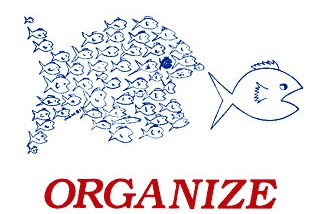
To an extent it’s their fault for not being adequately organised to mount a counter-insurgency against AE’s hijack of their industry. And that’s why my suggestion is for film industry workers to arm themselves and prepare to fight for their needs. Whether it’s in separate unions by sector or a single, unified screen workers’ union doesn’t much matter, as long as there is strong and robust organisation behind it which elects leaders who hold a genuine mandate to speak for the real needs of their industry. Nature abhors a vaccuum, and the only way that a handful of pretty faces and household names with little or no industrial relations experience and an Australian carpetbagger with a reputation for mischief-making get to speak for an entire industry is when the alternative is nothing. Conventional wisdom — particularly from the government — is to de-unionise, and already the veiled threats about the consequences of a general strike during the 2011 Rugby World Cup are beginning. But de-unionisation at a time like this simply cedes the field. Efforts must be redoubled — not only to negotiate the sorts of concessions gained by Irish actors for collective bargaining among independent contractors, but to ensure that whoever claims to have a union mandate in future has the crowd with the torches and pitchforks following them, rather than chasing them.

L

Coming this Fall: the Battle for America’s Soul

Imagine that title in scary-movie-narrator-voice. Via Pascal’s Bookie, a simply magnificent piece of propaganda from Personhood USA.

This two-minute ad is superbly done. It frames Colorado’s 1967 abortion law as the beginning of the end, and Amendment 62 in Colorado, which aims to declare that personhood begins at the moment of fertilisation, as the beginning of the battle to save America. Amendment 62 is up for the vote at the mid-term elections in November.

What we have here is clearly not the work of amateurs, nor of itinerant cranks in trailer parks, as many (including myself) have mocked the Tea Party movement. It draws together all the conventional Tea Party wisdom about what’s wrong with America into powerfully truthy narrative: start with a misappropriated Jefferson quote; follow up with Semitic “men in black robes” who hate truth, justice and the freedom and “legislate from the bench”; portray the fringe radical rump of conservative white folk as a valiant oppressed minority group; intolerant millennial-cult hypervigilance as the American Way; Obamacare as morality and human life being bought and sold as a commodity (oh, the irony!); and most crucially, Obama himself as the Grim Reaper, the lynchpin of it all, with the caption “Then the Angel of Death arrived, and Hell followed with him”. The whole thing is capped with fireworks and the Statue of Liberty, a Daisy-esque girl fading to black and a fist-pumping don’t-tread-on-me baby. And the soundtrack really just speaks for itself.

The whole thing is absolutely barking. In the cold light of day it’s nothing more than a Dan Brown plot. It’s fevered stuff, wound up to eleven to inflame passion and suppress reason. But that’s the whole point: this ad is basically the movie trailer for the upcoming battle for America’s soul, coming soon to a screen near you. Just sit back, let it wash over you, and marvel at what that country has become.

L

The Perils of the Dark Side

Via 3 News journalist Patrick Gower on Twitter, the news that Pita Sharples is the keynote speaker at the Destiny Church annual conference this Labour weekend. Concerning news.

Except I’m not sure it’s completely accurate. According to the Destiny press release, Sharples is the keynote speaker at the Friday night Awards & Recognition event which kicks the conference off, while (who else) Bishop Brian Tamaki is the “keynote preacher” for the weekend-long event. I think this is an important distinction: it’s appropriate for Sharples, with a lifetime of support for Māori excellence, to be present for an event which celebrates achievements in “business, management, the health and social services sectors, Pacific arts, family breakthrough and contribution to at-risk youth” for a large and largely Māori organisation, featuring pasifika and kapa haka performances to boot.

But that’s quite a different thing to lending the imprimatur of his status as the co-leader of a government party and Minister of Māori Affairs to the shady cultishness of Destiny’s main event. This is not to say that Sharples should shun Destiny outright: after all, as a kaupapa Māori politician he does represent some of the group’s members, and many non-members who share some of their values. Such ‘Dark sides’ of support exist for almost every party; the Greens have their crazed dark-green environmentalists; Labour has the blue-collar rednecks about whom I’ve written previously; ACT has mostly sucked away the white-collar rednecks (and doesn’t mind admitting it) from National, but the Nats still have the worst offenders among the farming lobby and many of the least-savoury Christian sects (much of Destiny undoubtedly included). For all that they might be abhorrent to some, these are all legitimate interest groups and — within reasonable bounds — they must be tolerated and their needs entertained in a free society. Their members have as much right to democracy as anyone else, but (as with any fringe group) politicians must be extremely circumspect about the type and quantity of support that they grant.

There is a danger that Pita Sharples will be seen to pander too much to Destiny; and indeed a danger that he does pander to them. The māori party paddles turbulent waters at present; having compromised very heavily on the Marine & Coastal Area/Takutai Moana legislation to replace the Foreshore & Seabed Act, and now finds that Faustian bargain under attack both from the ACT party without and from Hone Harawira within. Despite the former, and probably because of the latter, they have been very quiet lately. Although they — ironically — share some common ground with Labour on the Takutai Moana bill, there remains a very large gulf between them; not least because Labour’s own conference signals a much more classical materialist direction than that which has previously obtained. Sharples and Turia are no fools, and can see that remaining a client of Key’s pragmatic-instrumentalist National party is a hiding to nothing — even with the ACT party likely out of the picture after the next election, the likelihood that they can maintain common cause once the other has outlived its immediate use seems slender. So they feel like they need another support base, and it must be very tempting to team up with a charismatic leader such as Brian Tamaki at a time like this.

It would be ruinous to do so. Most obviously, this is because outside of his most loyal followers — his 700 Sons — Tamaki’s is an illusory sort of strength, based on the smoke and mirrors of a showman’s art rather than upon deep loyalty and conviction. This much was clearly shown in the 2005 and 2008 elections, where the Destiny Party (and later the Family Party with Destiny’s express endorsement) failed to come close to success, due largely to a lack of internal cohesion. Destiny has failed to demonstrate — even at the height of its profile five years ago, under a government largely hostile to it — that it could mobilise a meaningful number of votes.

The second, and by far the more important reason, is the abhorrent nature of the policies and principles Destiny stands for — crude Daddy State authoritarian Christian conservatism with a brownish tinge; illiberal, intolerant, homophobic and misogynistic, quite opposed to where Aotearoa is heading. And that’s to say nothing of the corruption and appalling social dysfunction endemic to the evangelical cults of which Destiny is an example. The sorts of scandals which currently rock the church of Tamaki’s own “spiritual father” Eddie Long in the USA must undoubtedly also exist within Destiny. This is essentially the same package of qualities which turned the Exclusive Brethren to political poison for Don Brash’s National party in 2005. Because of this deep and fundamental disconnect, and New Zealanders’ innate distrust of folk who think they’re ‘exclusive’ (especially if they’re brown, wealthy or religious), the reality is that an alliance between the māori party and Destiny would likewise be poison, and would probably circumscribe any future prospects of working with either of the two main parties, not to mention utterly ruling out the Green party — with whom the māori party shares the most policy in common.

So there is no easy course for the māori party in the long term; the swell is heavy and the winds both strong and changeable. But to extend the nautical metaphor, Destiny is a reef; not an island. Better that they paddle on by their own course and seek more solid ground.

L

Local Government Elections 2010

Just bullet points from me:

  • Len Brown by 60,000 votes over John Banks for Supercity Mayor. How about all those people who said his so-called outburst would be the death of him? Len Brown knows who his people are; he knows how to speak to them, and now he speaks for them. I can’t take any credit for the prediction, but this looks to me like the tale of differing personal narratives.
  • But the biggest surprise isn’t Brown’s win: it’s Annette Main narrowly beating Michael Laws’ sock-puppet and long-term deputy Dot McKinnon for the Whanganui mayoralty. McKinnon apparently didn’t stand for council, so she’s gone. Main is an utterly different politician from Laws and his lot; this represents a genuine change of direction. Laws will remain as a councillor, and his being forced to submit to the leadership of a woman he can’t control will be worth the price of admission on its own.
  • It pays to vote. Some results tweeted by Philip Lyth make this clear: election contests decided by 23, five and just three votes in Upper Hutt and Carterton. More crucially, for the Wellington mayoralty, Celia Wade-Brown is just 40 votes behind incumbent Kerry Prendergast, with about 900 specials still to count. Damn, that’s a lot of policy difference resting on very little. Stephen Judd tweets the following: “I’m totally serious: if Celia WB needs to lawyer up for a recount etc, I’ll donate.” I’ll bet he’s not alone, and if it’s this close after the specials are counted it’ll be a worthy cause.
  • On the other hand, Eric Crampton makes a reasonable case about why he doesn’t vote. It’s as good an argument as I’ve seen, but I still don’t really buy it.
  • Jim Anderton: I’ve got a lot of time for you, but honestly, you were well beaten by Bob Parker and there’s no use complaining about the earthquake and your inability to campaign. It’s churlish. Shut up, step down gracefully, and be remembered for your many good deeds rather than for being an inveterate whinger. Even Banksie is putting you to shame.
  • People, hope springing eternal, will be keen to call this a ‘swing to the left’ and similar; especially given wins by Brown and people like Main and Duynhoven, and Celia Wade-Brown’s strong performance. I don’t think there’s sufficient evidence to support such an argument at present; at the very least, translating local body election results into central political partisan loyalty is something of a fool’s errand.
  • Christine Prentice got predictably thrashed by Tim Shadbolt in Invercargill. But rumours I’ve heard from down that way suggest the point wasn’t ever to win, but that the candidacy was a profile-raising exercise to enable Prentice to mount a credible campaign to replace sitting National MP for Invercargill Eric Roy when he retires. I’m not sure how much credence to give these rumours; given Roy’s 7,000-ish margin and the milk boom Southland is currently enjoying they could probably stand a dairy cow with a blue rosette and win.
  • Andrew Williams failed to even win a ward seat in the North Shore, which is a testament to his powers of self-delusion in standing for the Supercity Mayor. More frightening, though, is the fact that Cameron Slater, who entered the race late as a joke (probably conceived during a boozy lunch with DPF and Cactus Kate) got more than a thousand votes.Yikes. Watch out for him in 2013.
  • Phil Quin remarked that local body politics is a de-facto retirement scheme for former (Labour) MPs: Harry Duynhoven has won in New Plymouth; Martin Gallagher in Hamilton; Paul Swain in Upper Hutt, and George Hawkins in South Auckland are among those he mentions. Duynhoven’s beaten rival for the mayoralty, Pauline Lockett, complained on Radio New Zealand that he had ‘name recognition’ on his side. I expect that has an awful lot to do with it.
  • Daljit Singh didn’t get elected to the Otara-Papatoetoe Local Board. Thank goodness for that.

That’s all I’ve got. All in all, a pretty big day capping a pretty fierce election.

L

Drawing Blood from a Stone.

The government’s decision to file a civil suit against the “Waihopai 3” is vindictive and a gross waste of taxpayer dollars. Much like the Zaoui case, which could have been concluded years before it actually did at far less cost than the amount on the final bill, this is a classic example of a vexatious state litigation. Vexatious state litigation, to coin a phrase, is an instance when the state (exemplified here by the Crown) continues prosecutions, appeals or defenses long after legal defeat is obvious and, as in the case here, judicially administered. Even so, there are a few aspects of the case worth reviewing.

As I mentioned in an earlier post titled “Political Idealism Trumps the Law,” the Waihopai 3 expertly exploited the claim of right defense to defend their direct action against the eavesdropping station. Contrary to most direct action proponents, they did not admit their crimes and accept their due punishment, but instead used the claim of right defense to argue their innocence based on moral grounds. Among other things that defense states that even if mistaken in their motives, people who honestly believe that their acts will prevent a greater harm are exonerated of responsibility for the consequences of those acts. Thus, although I (and presumably the government) believe that they are mistaken in claiming that the Echelon station at Waihopai facilitates torture, war crimes, crimes against humanity and human rights violations, the important point is that Peter Murnane, Adrian Leason and Sam Land were found by a jury of their peers to be innocent because they sincerely believed that their actions were helping to prevent a greater harm. So long as the claim of right defense exists in the law and juries are willing to accept that defense as legitimate, then the verdict should stand and, in the absence of irregularities in the administration of the case, no appeals or civil lawsuits filed. In other words, that should be the end of the story.

If the government does not like the claim of right clause in the law, it can work to change it. But suing for civil damages to the tune of 1.2 million dollars, including the cost of pies, beer and savories for repair workers, smacks of imperial hubris. Moreover, the claim is unrecoverable even if the Crown were to win the lawsuit. Father Peter has no tangible assets, and since neither the Dominican Order or the Catholic Church were party to his actions, they cannot be made parties to the suit. As for Land and Leason, what is the Crown going to do–confiscate Land’s organic farm and repossess Leason’s house while garnishing his salary, thereby throwing their families onto the street (and dole)? Even if it did so, the amount recovered from the sale of the assets of all three men would not come close to paying the full bill. So what is the point if the full costs are not anywhere close to recoverable?

The Crown also has not thought through the consequences of its lawsuit. The GCSB refused to front up at the original trial in order to refute the defendant’s allegations. That pretty much left their claims uncontested, which was instrumental in the jury’s verdict. Is the GCSB now going to show up at a civil trial and be prepared to re-litigate the original claims under the claim of right defense? If not, then there is no case for damages because a verdict of innocence under the right of defense absolves defendants of financial liability stemming from their acts. To put it bluntly: a verdict of innocence under the claim of right defense means full absolution from liability. That is why the right of defense is such a dramatic line to take and so difficult to argue successfully, which is why most direct action militants do not even bother with it and opt to plead guilty and ask for judicial mercy citing mitigating factors. But in this case the right of defense was made and it prevailed. Unless the GCSB wants to testify as to the merits of the claim of right defense as well as to the extent of the damages incurred (which I believe have been exaggerated) then there is no case to be made. If there is no case to be made, the pursuing the lawsuit is a waste of time and public money.

If the government allows this civil suit to continue it will be another example of politicians and state bureaucrats playing loose with taxpayer money in order to prove a vengeful point regardless of the merits of the case. The suit is clearly designed to be a warning to others who would dare to use the claim of right defense for direct actions, and therefore not only a form of vexatious state litigation but also an act of official intimidation against those who would dare speak (their) truth to power. For a supposed liberal democracy, that is a bad look.

Hang ’em high

Labour Supercity candidate Daljit Singh, standing for election to the Otara-Papatoetoe Local Board, has been revealed as one of those charged with voting fraud-related offences. As Idiot/Savant says, it’s awful that this information didn’t come out earlier so that he could be punished electorally as well as judicially, but this is part of the price we pay for a robust justice system.

However, the fact that Singh has avoided his due scrutiny thus far (and, farcically, may yet be duly elected to the board) makes strict attention to his case all the more important, and places a heavier burden on those who are associated with him –and in particular on the Labour party whom he represents — to respond swiftly and decisively to divorce themselves from Singh and his alleged misdeeds. This must take cognisance of the fact that he has not yet been convicted of anything and it may be conditional and hypothetical, but if Labour have learned anything at all from the Taito Phillip Field scandal, it’s that a lesser test than ‘convicted in a criminal court’ must apply with regard to such matters.

In the interim Singh’s erstwhile allies must assess the evidence and base their response on judgements as to its veracity, but the moment his guilt is admitted or proven, they must be the first to call for his (figurative) hanging; because they stood to benefit from his fraud, they must condemn it all the more loudly. Singh and Labour’s enemies can be relied upon to do so; his allies must also. Andrew Little has initially done so, and this is heartening. IrishBill at The Standard, as an allied third party, has done likewise.

It is also perfectly legitimate to draw links between Singh and others’ alleged wrongdoing and Labour’s own fundamental standards and character, since candidates by definition represent the party. While one rotten apple does not (as many will certainly argue) imply a party of inveterate crooks, this latest incident on top of the Field affair, Labour’s steadfast support for Winston Peters through the Owen Glenn donation scandal, and continuing perverse behaviour by Chris Carter (I could list more examples) do certainly speak to crucial failures of judgement when it comes to the party’s selection and endorsement of both candidates and allies. If the rumoured pecadilloes of Richard Worth, the overt bigotry and criminal background of David Garrett, and the blundering damfoolishness of Melissa Lee (there are more examples here also) can be said to illustrate the character of the ACT and National parties (and I believe they can) then the same must surely hold true for Labour. Whatever speaks to character speaks to the heart and soul of a political movement, and by this standard Singh’s implication in voter fraud, if proven, will be a lifelong stain on the party which admitted and endorsed him.

And if anyone so much as breathes words like courageous corruption in apologia for Singh and whoever else, hoist them by the same rope. Democracy’s ends are only as good as the weakest part of its means.

L

Anchor me

Indian-born Hawkes Bay-resident overstayers Sital and Usha Ram are to be deported with or without their three children, who are New Zealand citizens aged eight and six. These are not ‘anchor babies’ in the US sense that that hate-term is employed; no attempt has been made by the Rams to mislead Immigration or to hide from the authorities, nor are they using their childrens’ citizenship status to thumb their noses at the powers that be. This is, for all intents and purposes, a model New Zealand family.

The children, as New Zealand citizens, have a “cardinal and absolute right of residence” according to a 2008 judicial ruling, which means they can on no account be deported. This is where they belong, it’s where they live, the only place in the world they can do so in full legality, since it is impossible to exchange their New Zealand citizenship for Indian citizenship until they turn 18 (and indeed, nobody can force them to do so).

As the article says, they face a terrible choice: return to India and condemn their children to a life of poverty, or return to India alone and leave their children behind. But it’s not really much of a choice: they can’t simply abandon their children in either sense. Fundamentally, the terrible choice is faced by the government, who must decide whether to tear a family quite literally apart, permanently. To demonstrate their loyalty both to their children and to their country and therefore to win this battle in the public view, the Rams need do nothing more than peacefully resist being separated from their children. Call the government’s bluff. Let Immigration enforcers tear apart mother and daughter, father and sons. Let them carry the parents bodily to the paddywagon, and from the paddywagon to the waiting aircraft. Let it be known that this is the government’s doing; their choice, not that of the parents. This is a chance to force the government to actually do the dirty work of eviction and deportation, to undertake the harsh deeds which their tough-on-everything rhetoric implies. And they should be forced to put their actions where their words are.

So my advice to Usha and Sital Ram is: invite John Campbell into your home. Let him and his camera crew be present at the time of the forcible separation; in your living room and at the airport, and let the whole world watch, and listen to the wailing. The narrative will be big bad Muldoonist Daddy State jack-boot dawn raids, breaking down doors and wrecking families in 2010 as in 1980, and the country will need to decide: is this who we are? Does this represent us and our aspirational, compassionate, multicultural society?

And, as Pablo suggests in his recent post about Paul Henry, it’s a question which needs to be answered.

Update: As usual it’s occurred to me that a poet has previously expressed my core argument in two lines:

Do not go gentle into that good night,
Rage, rage against the dying of the light.
(Dylan Thomas)

L

The perils of Paul (updated).

The flap over Paul Henry’s latest remarks got me to thinking. First, why was John Key smirking and downplaying the obvious racist content of Henry’s questions about what a “proper” Kiwi should look like? Why did Key instead not point blank admonish Henry for his remark, or at least give him the rope to hang himself with by asking him what HE thought a New Zealander looked like? Why did Phil Goff say that  the incident was “Paul being Paul” rather than put the wood into him? Why did the TVNZ spokesperson claim that Henry says what other people think but do not want to say? Is that a fact that I missed somewhere? Am I being too PC in thinking that with this latest remark Henry has truly jumped the shark? Or is the silent majority in NZ really a bunch of closet bigots for whom Paul Henry is a champion? (and if so, that is too close to the Tea Party/Sarah Palin connection for comfort). Has the turn to market egotism driven so deep into the NZ collective psyche that such remarks are considered tolerable or even funny?

For a guy about to return to NZ and seek citizenship after 13 years of permanent residency, these are more than casual questions.

UPDATE: Henry really is the bigot gift that keeps on giving. In his on-air (non) “apology” the day after his first comments about the GG, not only does he not apologise for the remarks themselves (instead he apologies for any offense they may have caused), but he then goes on to use a slur for Roma (gypsy) while saying that he is of a less distinguished background than Sir Anand because he (Henry) is of half Roma descent apparently. So the bottom line for Mr. Henry is that there are in fact superior and inferior people based upon their inherent characteristics rather than their individual merits or flaws, and using pejorative slurs is Ok so long as one can claim kinship to the insulted group. In sum: Henry uses an ethnic slur while falsely apologising for a racist question. Priceless.

Voting in the Dark Ages

The voting papers arrived at my house over the weekend and present something of a dilemma. One member of our household is in the UK for the election; he still, not unreasonably, wants to exercise his vote. After ringing the assistance number on my voting paper I was told that the only possible legal way for him to vote is for me to mail or courier his papers to him, then he should fill them out and mail them back.

It is, apparently, impossible to cast any sort of vote in local body elections using faxes, scans, emails, or any other new fangled contraption, or in fact any other means to allow overseas voting. In central government elections overseas voting is entirely permitted and supported.

New Zealand Post lists international mail as 3-10 working days, so it’s impossible to be sure he could actually vote if I did mail them to him. My cheapest option is “International Economy Courier” (2-6 working days) at $30 to get the papers to him, then he’d have to courier them back presumably at a similar cost.

So, three questions:

1) What would be wrong with allowing faxed, scan-and-emailed or election office supported overseas voting in local body elections?

2) Is it reasonable that voting in our local body elections should cost someone ~$60?

3) Doesn’t this provide a rather strong incentive for some illegal (but entirely ethical IMO) voting practices in households like mine?