The Agony of Defeat.

Well, it was a grim morning of the day after in my household on Sunday. The evil-doers prevailed and the forces of righteousness and progress were soundly spanked, with the exception of a formerly progressive party that now has gone managerial as it mainstreams to the political centre. Sure, there were some points of solace in the otherwise dark landscape of electoral outcomes, but overall the egalitarian side of the NZ political spectrum got hammered.

But all is not lost. In the scheme of things, this was not the worst election defeat I have experienced as a voter. For me, as an ex-pat Yank, that dubious honor rests with the election of Ronald Reagan in 1980. The idea that someone who epitomized prejudice, elitism, ignorance, racism, war-mongering, corporate-backed chickhawk cowardice and the utter insipidness of campaign promises could defeat a decent fellow such as Jimmy Carter actually made me fear for basic freedoms and civil rights in that country. Sure, it was not as bad as living through coups or revolutions in Latin America, where losers in the regime change had very real reason to fear for their lives. But is was as close as I have felt in a democracy to being politically at risk as a result of an election. That feeling was reaffirmed a few months later when Reagan was shot, where the response on the working class African American street where I lived was to “hope that a brother did not do it.” Such was the tone of the times that we worried more about the backlash then the fact that the president was almost killed off (and boy, were we relieved when it turned out to be a white nutter who fired the shots).

I felt nearly as bad when W. Bush was fraudulently installed as president after losing the US popular vote in 2000. However, by that time I had moved to NZ and did not have to worry about directly suffering the consequences of yet another silver spoon-fed corporate chickenhawk imperialist stealing his way into power. But I feared for what he was about to wreak on the US (where my family and close friends live) and the world at large. A decade later the proof of his folly is everywhere to be seen. Helen Clark was right: things would have been different had Al Gore rightfully been awarded the 2000 election. But all that is water under the bridge and the person copping the most flak in the aftermath is Barack Obama. Talk about inheriting a mess!

Given that backdrop I am not catatonic because the currency speculator and his band of money-grubbing bullies have been re-elected under the banner of “stability.” It could be worse, and I am thankful that when compared to the US, the bulk of the NZ political spectrum is less reactionary or retrograde. Even so, with expanded anti-terrorism laws and powers of search, surveillance and seizure all passed by the National government in recent years (something that went unnoticed in the buildup to the election), I can see encroaching authoritarianism in its second term. One only has to watch the Prime Minister’s response to hard questions to see his sense of arrogance and entitlement on display. This is a guy who is used to getting his way, however he can, without much regard for the consequences except with respect to his corporate peers. So regardless of public opinion, the PM will push his asset sales agenda, will continue to suck up to both the US and the Chinese while pursuing trade for trade’s sake, and will play as loose with the rules of the democratic game as his weakened opposition will allow him.  And by playing divide and conquer with the Maori Party and the Greens, he could well get his way across the board.

I take solace in the fact that electoral defeats are the lifeblood of democratic politics. It is not so much what the victor does after an election. It is how the losers respond that makes the difference. Losing allows parties to remove the sclerosis from their ranks and rejuvenate both personnel and policy platforms. Losing allows parties to reinvigorate in opposition. Losing forces parties to explore new policy options and ideological possibilities. Should Labour understand this simple law of democratic politics, it can regroup and compete more effectively in three years. If it does not, we could be saddled with the corporate-cuddling cabal for a third term. The question is: does Labour have it within itself to make the serious changes required for it to have relevance in the years forward?

I do see the Green Party vote increase as a positive sign even if its support is coming from disaffected Labour voters more than anywhere else. Between the Greens and Labour there is still a solid 35-37 percent of the vote, figures that could grow should National’s economic policies continue the trend of growing income disparities, elite enrichment, environmental degradation and foreign control. Since voter turnout was so low this year, a mere rise in those who vote in 2014 is bound to increase support for the Left (such as it is) because people tend to vote when they are unhappy about the status quo (apathy such as that seen in this year’s election had less to do with serious discontent and more to do with complacency and belief in a foregone outcome). Thus this moment of defeat is a ripe time for Labour to undertake the necessary changes required to come back and compete successfully in 2014. That means a major leadership shuffle as well as policy change away from the “National-lite” pro-market stance it has maintained for nearly 20 years. In other words, it needs to turn back Left, both in terms of recapturing a class line as well as more sincerely embracing post-modern progressive causes.

I do not claim any particular expertise in NZ politics and this ramble was merely sparked by my reflection on which electoral defeats were the worst for me as a voter in a democratic country. But I do think that one big redeeming feature of liberal democracy, no matter how manufactured, manipulated and corrupted it has become, is that losers are allowed to compete again at regular intervals, which gives them the opportunity to engage the internal reforms that will allow them to emerge from the ashes of even a catastrophic defeat in a better condition to win down the road. This holds true not only for the biggest loser in this year’s election, Labour, but also for such parties as ACT. After all, Winston Peters has shown that even political mummies can be resurrected without being reconstituted, so there is hope yet for even the smallest losers this time around.

Election Day

It is an offence to publish any material that might dissuade people from voting, or encourages voting for or against any party or candidate, on election day. So from midnight until after polling closes all comments to KP will be moderated by Anita, Pablo and myself.

But it is not an offence to exhort others to vote, in a nonpartisan fashion. The old cynic’s argument is that if voting made a difference, they would have banned it. In fact, in plenty of places they have banned it for just that reason. Whatever your view of the state of Aotearoan politics, it could be worse. Zimbabwean immigrant Peter Heath this evening called our election-day media ban “quaint”, and it certainly is when compared to the situation there, where (as he says) “officials are too busy with hacked off limbs to worry abt the odd tweet”. Long may it remain so.

We honour democracy by supporting it, and in addition to the other aspects of political participation that ultimately means turning out to vote. But people who feel disengaged from the political process, who feel it doesn’t serve their interests, or who refuse to vote on principled grounds shouldn’t be forced to add noise to an already-fuzzy democratic signal. So vote if you have the slightest inclination to do so, and if you haven’t the slightest, don’t.

But remember, this time around you have four votes: your two electoral votes are for New Zealand’s political body for the coming three years, but your two referendum votes are for its political soul.

L

Impoverished

The other day David Farrar got in a pre-emptive whinge about Bryan Bruce’s Inside New Zealand documentary on child poverty that aired last night on TV3 (you can watch it on demand if you missed it).

Maybe the outrage expressed by David and others of his ilk is somewhat justified. This is not a grey, respectful, nominally-neutral sort of a work; it’s an impassioned and at times ideological work of advocacy arguing that New Zealand society, and in particular its governments, ought to be ashamed at the circumstances many of our children live in, and a significant portion of that burden of shame can be directly linked to the policies of National governments. It airs four days before the general election. The Labour and Green parties bought lots of advertising during it.

So if David or anyone else wants to bring a BSA complaint against the broadcaster, or — as David implies by calling it a “free hour” for Labour — if he wants to complain to the Electoral Commission that the documentary should have included an authorisation statement as a campaign advertisement, then I think they should do so. Fair enough, if they can make something stick.

But consider the response: a documentary about child poverty, covering the appalling housing, health and nutritional outcomes borne by children in our society, and the immediate response is to launch a ideological defence of the National party and deride the work as nothing but partisan propaganda. But an interview Bruce gave to Glenn Williams (aka Wammo) yesterday, before the screening, contained the following exchange:

Wammo: “Politically, though, it’s tough, isn’t it, to remove that money from the ambulance at the bottom of the cliff and put it at the top.”
Bruce: “Politically?”
Wammo: “Yeah.”
Bruce: “This is not a political question, this is an ethical and a moral question. We all have to get together and figure out how we’re going to solve this, and what I’d like to see is a commitment from all the politicians that, after the election, whatever shade of colour they are, they sit down and talk about this and come up with a long-term plan for our children, just in the same way as we came up for the over-65s with our superannuation. The only problem is kids can’t vote.”

Yeah, it’s election week, and yeah, Labour are emphasising their poverty alleviation focus on the back of this documentary. But I haven’t heard a peep out of National about what they plan to do about the problems since it aired. Isn’t it more telling that National and its proxies immediately and reflexively go on the defensive, rather than acknowledging the problems of child poverty and renewing its commitment to resolving them? As Bruce makes clear to anyone who actually watches the film, the root cause is a bipartisan commitment to trickle-down neoliberalism over the past 30 years, and indeed, the illness and malnutrition that affects these children did not happen in the past three years; these were problems under the last Labour government as well.

But National are the government now, and their defensiveness, I think, signals that they know they bear some responsibility for child poverty. And yet they’re apparently not willing to do much about it, beyond the tired old saw of “a rising tide lifts all boats”, and announcements that they will further constrict the welfare state to force the parents of these sick children to seek jobs that aren’t there. (And yes; National bought time during the documentary as well: the “cracking down on benefit fraud” ad was a particularly cynical form of irony.)

They’d rather whinge about media bias and electioneering, casting themselves as victims, than concede the problem and tell us what they plan to do about the victims of their policies. That’s what I call impoverished.

L

Blog Link: The unspoken election issue.

Given that foreign policy has rarely been addressed in this year’s election campaign, and then only briefly in the form of PR releases and sound bites rather than genuine debate, I used this month’s Word from Afar column at Scoop to point out why that is not such a good thing.

Teapot Tapes poll: political moral suasion

I recently tore into Chris Trotter’s argument that polls are deployed to promote a “spiral of silence”, to demoralise those holding non-majority views, and to deter them from political speech and action. I stand by that post, and I still don’t think the argument holds in the general case, but this morning I think we saw an example where polling data was used in just such a way.

National campaign chair Steven Joyce appeared on Morning Report defending the party’s handling of the “teapot tapes” strategy. Joyce came to his Morning Report interview armed with overnight polling data that he says shows 81% of people are sick of the coverage of the teapot tapes, only 13% think the issue is a big deal, and that some in the media ought to take a long, hard look at themselves. Russell Brown covers the topic in more detail; this post began as a comment there).

Leaving aside questions about the veracity of these figures (they could be utterly fabricated and we’d be none the wiser; Bomber reckons they’re bollocks), this actually is a case of a politician deploying polling data to send a message, not only to the media, but to the public: If you care about this you’re out of touch, disconnected, in the minority, obsessed with trivia, and you ought to be ashamed of yourselves. While I disagree with his assessment, what’s more interesting is how he framed that assessment: as a normative argument about what election campaigns ought to be about, and what “real New Zealanders” care about; echoing John Key’s “issues that really matter” rhetoric, which is precisely what all the National supporters I’m in touch with have been saying: nothing to see here, it’s a sideshow, can we get back to the substance, and all that.

Which is pretty ironic given that the Nats have done extremely well for most of the preceding five years by staying the hell away from policy arguments wherever possible. It’s a pretty remarkable position from a National party whose strategic success has been largely founded on a ruthless commitment to campaign realism, expressed by avoiding “noble” pursuits such as the robust policy focus and appearances in the hard-news media in favour of what is effective — personality and brand-focused campaigns, point-scoring, agenda domination, and routine appearances in sympathetic forums, for example. It’s even more remarkable since Joyce himself has been the architect of this strategy since the 2008 campaign.

So I am cynical about National’s sudden love for the “real issues”. They have touched on them before — the election-year launch of the privatisation policy that I wrote about in February is the best recent example — but this has hardly been their preferred route. What seems more likely is the “spiral of silence” imperative — marginalise, shame and heap scorn upon those who genuinely see a substantial public interest in the way the teapot tapes episode has played out, not out of a prurient interest in the contents of those tapes but because — as Danyl notes, it “keys into a huge range of really substantive issues: the Prime Minister’s integrity; media ethics; surveillance”. This deployment of normally-secret polling data — probably collected for this exact purpose using carefully-framed questions — seems like an attempt to bully into silence those who aren’t willing to ignore an unprecedented breakdown in the relationship between the Prime Minister and the media, and a nearly-unprecedented glimpse into the internal workings and political culture of the National party and its leader.

It has had the desired effect on other political parties — Phil Goff and Peter Dunne have sung from the same songsheet today, leaving only Winston Peters to reap the electoral harvest from these events. Given that, it is not unlikely that it would have a similar effect on voters, especially in Epsom. Of course, there may not be an electoral harvest; the polling data might be accurate and it may genuinely be perceived as a “Bowen Triangle” sideshow. I don’t think so, but then, I would say that.

Update: Since writing this, Fairfax has released a poll of their own that suggests the public are over the teapot tapes. Its numbers are considerably more ambivalent than those released by Steven Joyce, however; the strongest result was for the obviously-correct proposition that politicians should be able to discuss controversial topics privately (63%). On this basis Matthew Hooton is now praising the strategy as “genius”. It’s also important to realise that this isn’t a pure popularity contest, but a balance of complex factors — the intensity of sentiment on either side matters. As Danyl remarked in the Public Address thread, “If 4% of National supporters switch their vote over to Winston Peters on the basis of this affair, then that’s a strategic catastrophe for Joyce’s party, no matter what the other 96% do.” There’s no indication that this has happened, of course, but there’s no really definitive indication of the fallout from these events at all. The Herald on Sunday tomorrow will be fascinating.

L

Against Centrism.

The iron law of oligarchy states that the first duty of the organization is to preserve itself. This means that agents will go against the interests of principals for tactical and strategic reasons. For class-based parties the two main sources of rank and file betrayal are vanguardism and centrism. Vanguardism refers to the centralization of decision-making authority within a party elite, which sees organizational democracy in instrumental terms rather than as a social good.  The elite agenda is, foremost, about self-preservation justified in ideological terms.

Centrism refers to the tendency of class-based parties to move to the ideological centre in pursuit of wider mass appeal. This often means turning on what were once considered foundational principles of such parties, particularly adherence to a class line. The 20th century saw the emergence of a number of these type of party, New Zealand Labour being one of them. Once that “centrist” ideological space was captured electorally by the likes of NZ Labour (the permutations of the centrist shift by Socialist and Social Democratic parties are many), other parties emerged to fill the void and stand on principle. Few of them have survived, and those that do have married indigenous and environmental planks to an amorphous anti-capitalist platform.

One such party is the Green Party of New Zealand. It emerged as a party dedicated in principle to advancing the causes described above. It championed the environment as well as indigenous rights within it, and worked hard to provide an anti-imperialist, pacifist, human rights focused and anti-corporate counter-narrative to the market-oriented discourse of Labour and the collective Right. The composition of the Green Party caucus through its first decade in parliament showed a clear class consciousness. For many Left voters the Greens provided a tactical option under MMP, since a five percent party vote coupled with electorate votes for Labour candidates helped keep Labour ideologically “honest” when in government. Or so the Greens thought.

In practice the Green experience with the 5th Labour government was less than ideal, and in fact was marked by an increasing distance between the two erstwhile Left partners. Yet, as it replenished its ranks of MPs the Green Party began to emulate Labour and other Left-based “centrist” parties: it moved away from a strong class-based orientation and towards a more moderate stance on all original three ideological pillars. It saw an increased party vote in 2008, although it is unclear if the added support came from disgruntled Labour voters or genuine voter preference for a “reasonable” Left alternative to Labour’s increasingly corporate orientation. Whatever the cause, by 2011 the Greens have stripped out the Red in their ideological watermelon. There are no longer a working class-oriented party, and in fact have shifted to one that seeks the support of middle class voters who are not so much opposed to the status quo as they are seeking NIMBY relief within it.

The Greens are predicted to get 10 percent of the party vote in the 2011 election, with some estimates rising to 12-15 percent. The surge in support clearly has roots in voter disgust with National and Labour, but also is believed to be coming from moderate Left voters who feel more comfortable with Green occupying the ideological “space” formerly held by Labour. By moderating its policies and compromising on its foundational principles, the Greens have gone mainstream. The billboard vandalism scandal may be a perverse indication of that (with grassroots activists going outside the caucus mandate to make their point).

For voters who saw the Green party as the honest Left alternative, this is unfortunate. The Green march to the centre leaves those who believe in the essence of class conflict in capitalism (and its cousin, class compromise) devoid of electoral alternatives. Specifically, there is no longer a competitive Left option that challenges the fundamental logics of the contemporary New Zealand socio-economic system. Instead, there are only accommodationists of various centrist stripes, the Greens now being one of them. They may challenge along the margins of the dominant project, but they do not question the fundamentals. Despite the presence of Leftists and anti-imperialist/corporate rhetoric in the Mana Party, it appears to be more personality-driven and ideologically incoherent than a proper class-based party. That means that there is no genuine, politically viable alternative to the Left-centrist logic.

This type of political centripidalism is a natural aspect of  first past the post party systems, especially presidential ones. But MMP is supposed to give voice to parties of principle as well as catch-all parties, and is in fact considered to be a hedge against centralism. For both methodological individualists such as those on the libertarian Right as well as the collective good advocates on on the class-based Left, the move to centralism under MMP could well be a death knell (which ACT may prove in this election, and which the demise of the Alliance previewed in the last one).

In effect, what is good for the Green Party leadership and organization is not good for those at the grassroots who want a legitimate Left parliamentary alternative that is electorally viable and committed to questioning the status quo. In order for the Greens to have remained as such they would have had to eschew the temptation of centrism and accept their role as a minor party on the ideological margins that speaks truth to power rather than be a contender for power as given. That would have meant keeping to a more “militant,” or “activist” line that did not deviate from the foundational principles of the Party.  The iron law of oligarchy suggests that never was going to be the case (and perhaps membership preferences have changed so that it would not be so), and given that Labour sold out the rank and file a long time ago (its corporatist relationship with the CTU, EPMU and other trade unions notwithstanding, since these also subscribe to the iron law), that means that in this election there is no real choice for those on the Left who want to vote for a party that can substantively influence policy rather than provide a minor corrective or circus side show to the dominant political discourse.

That being said, I am sorely tempted to vote Mana in order to try and keep the Greens honest from the Leftish fringe!

PS: Left for another time is discussion of the fact that in the absence of institutional (party) avenues of voice and redress, ideological militants of all stripes gravitate to extra- or illegal means of doing so. In the measure that formerly principled parties go centrist or are not replaced by successful others, the ideological void they leave behind is often filled by those of less institutionalist persuasion.

On Billboards

To state the bleeding obvious: the coordinated actions of a group of Green activists to deface National party billboards is bad form. This is not so much because of the defacement itself (that’s bad enough), but because of the scale and extent of the organisation by members and representatives of another political party, and one which claims to be a good electoral citizen.

The method of defacement — stickers with snarky slogans, mimicking National party campaign material but conveying opposing messages — was clever, well-executed, and the slogans might arguably be true, but that doesn’t excuse the offence against our democratic loix de la guerre, such as they are. That having been said, I would not be so concerned if it had been undertaken on a smaller scale, had been less organised and more “organic”, and particularly if it had not been coordinated and undertaken by members of a rival parliamentary organisation that stands to gain a zero-sum advantage from National’s embarrassment. A certain amount of public-sphere critique and satire is to be expected within a democracy, and at times that means having to tolerate a little vandalism. But these actions crossed well beyond what most people would consider reasonable.

Fortunately for National, and unfortunately for the Greens, this sort of transgression brings its own punishment, and the episode should be a clear lesson to all political parties that dirty tricks of this nature aren’t on (or, more cynically, if you’re going to go there, you need to outsource it). This goes double for the Greens, whose political brand of good-faith, play-the-ball-not-the-man politics would have been ruined if this were seen to be an integral part of the Green strategy. It seems not to have been seen that way, and I think this is largely due to the exemplary response by Russel Norman (and to the best of my knowledge, other senior Greens), coming clean as early as possible (only a few hours after co-leader Metiria Turei urged the Prime Minister to do likewise regarding the “teapot tapes”), and offering the time of Green party volunteers to repair the harm done. This shows excellent faith and genuine respect for the democratic process, and in an ideal world such a response would also be its own reward — though in reality a public opportunity to demonstrate such a commitment may not be worth as much as a dose of (in this case, justified) outrage. It is a black mark against the Greens’ institutional competence that such a stunt could be arranged so close to the leadership, but this shouldn’t be overstated. In general they are pretty good, and given the size, diversity and ideological fervour of their activist community, that this sort of thing doesn’t happen more often is itself quite remarkable.

An unrelated observation regarding National party billboards: most days I travel between Kapiti and Wellington, and on the weekend for my sins I drove to Palmerston North and back. Leaving aside the demographic changes between electorates, it puzzles me that the National billboards are erected in such a slapdash manner. If you’re going to have a billboard campaign setting out an ordered list of priorities, why on earth would you not stage the billboards in order following peak traffic flows so as to establish a coherent, narrative communication platform? Perhaps they have attempted this, but some billboards have been knocked over, obscured or whatever. But I have been able to distinguish no clear patterns, and it seems a missed opportunity.

L

Poll dancing

Chris Trotter suggests that frequent and heavily-publicised polls favour the right and result in a self-fulfilling prophecy, depressing support for the left. Bomber Bradbury has made similar arguments in the past.

There are two parts to this: first, the question of whether polls are inaccurate vis-a-vis the actual views of the electorate, and if so whether they do in fact favour the right; and second, whether this, on its own, has a substantive impact on actual real-world support.

Lyndon Hood FTW

I am aware of no robust research on this topic in the NZ context (which isn’t to say that it doesn’t exist; although if it did I’d expect the many proponents of this line of argument to be citing it all day long.) So to kick off, let me concede that if there was a significant ideological bias to the polls it certainly could have an impact on voter behaviour. But I suspect any impact would be more complicated than the simple “low showing for a party causes low turnout and/or low support” reading of the “spiral of silence” model Chris cites (which is nevertheless a useful model). For one thing, it’s not clear that the impact is very strong in case of a secret ballot; also, the argument doesn’t take into account New Zealanders’ oft-cited peeriness about single-party majority governments in the wake of Muldoon, Lange and Bolger which could have a moderating effect, and it doesn’t take into consideration the usual “narrowing” that occurs in the latter stages of an election campaign as wavering voters begin to make up their minds. So I doubt the size of this effect on Labour’s polling at least; any shift should not be large, and certainly not sufficient to change the election outcome. However where NZ First is concerned it’s different — a percentage point or two makes all the difference in the world there, and whether NZ First returns to parliament or not rests on the collective spirit of Winston’s faithful. Assuming they still make up fiveish per cent of the voting population they must not waver, and must cast their votes together regardless of what they are told about the polls. If they fail to do so NZ First is out, and all those votes are wasted, and that is certainly an outcome that could result from widespread reporting of polls that show NZ First under the threshold (and one that could change the election outcome).

Note, however, that all that is contingent on those polls showing NZ First to be under the threshold actually being wrong. I’m not persuaded of this, and I’m also dubious about the contention that polls favour the right. As Bomber is fond of pointing out, the polls run in the leadup to the Auckland Supercity election favoured John Banks, while in the election Len Brown won handsomely. That’s important to remember, but it’s only one data point so I’m hesitant to draw meaningful conclusions from it, and if it’s evidence of anything, it’s against the simple reading of the “Spiral of Silence” thesis, according to which Brown’s demoralised supporters should have stayed home.

There is also some evidence out of the US to suggest that landline-only polls favour the Republican party over the Democrats (when compared to polling samples that include cellphones). It’s not clear is that this trend is also in effect in New Zealand. Based on no data, I think it has some influence, but our situation here differs in important ways; most notably, we have more than two parties so variance of this sort is more dilute and less zero-sum. And the likely effect would be ambivalent — if landline-only polls tend to exclude the young and the poor and tech-savvy urban liberals, they should overstate support for NZ First, not understate it.

The matter of bias isn’t readily testable because, as an Australian poll analyst put it recently when looking at bias between pollsters in that market, “we just don’t have elections every week to determine the true state of public opinion“.* There is also evidence to suggest that people’s voting behaviour differs in important ways from how they answer opinion polls. So we need to rely on other forms of measurement; proxies being measured against proxies. There are focus-groups, vox pop interviews and 75c text-polls and coffee-bean polls, and the Horizon poll with its radically different weighting system, but I see no firm grounds to believe any of these would be any more reliable than the major phone poll companies. One very strong point in favour of the usual sort of phone-based opinion polling is that it has remained more or less methodologically consistent for a very long time. This gives us extremely large, continuous datasets that we can plot against real-world events including policy releases, major speeches, current events and elections. In this regard they are much like audience/circulation ratings in the media. The utility of these well-established systems isn’t that they have no flaws — they certainly do, and much of the criticism is valid — it’s that they have a reasonably well-known set of flaws that are consistent over time, and we can use the historical record to make inferences about the present day (too few people, I think, are actually doing this, but that’s a different matter). By contrast other systems — Horizon, in particular — are less well-known, and serious questions need to be asked about the quality of their results. They’re worth watching, but they are not as yet a substitute for what we already have.

Returning to the argument. So if the polls systematically favour the right, and if they do so in such a way as doesn’t also favour NZ First’s older, wealthier and more conservative demographic, and if the extent of that bias is significant enough to have a significant zero-sum election night impact despite all the confounding variables of voter behaviour, then Chris might be right.

But that’s a lot of ifs, and a claim as bold as “polling companies and the media steal elections from the left” demands extremely robust evidence to be given credence. I’m open to the argument, but what we have here isn’t evidence, much less the robust kind; it’s supposition, and what’s more it’s supposition derived from partisan loyalty. The argument is unfalsifiable — if the election does deliver a substantial defeat to Labour and NZ First they will take that as proof-positive that they were right all along and the voters were robbed; if it doesn’t no doubt they will cheer those who battled valiantly and overcame the oppressive regime imposed by the forces of evil. In this regard the argument is nearly indistinguishable from that made in 2008 by the Free Speech Coalition who, despite their howls about Stalinist restrictions on political marketing, managed to help their political representatives to a handy win.

My view of Chris and Bomber’s general line of argument is that it’s more of the usual excuse-making and blame-shifting that I see from lefties who can’t bear that their tribe is staring down the barrel of a(nother) heavy defeat. It’s an attempt to make the evil media cabal responsible for poor performance, and to minimise the effect of weak leadership, institutional incompetence, lacklustre campaign and — in Peters’ case — public self-immolation during the last term. It’s a myth; something to keep the faithful warm at night, in the absence of actual victory. Myths certainly have a kernel of essential truth, but they should not be mistaken for evidence. Moreover, as regards Chris’ concerns about the election accurately reflecting voters’ wishes; these would have more credibility if his own history of respecting the solemn integrity of electoral politics was itself less one-eyed. He thunders:

hundreds-of-thousands of New Zealanders will not only be perfectly entitled to say “bugger the pollsters”, but they will also be entirely justified in asserting that the election has been stolen from them

This would ring less hollow if, following the 2005 election, he had not so cravenly excused the Labour party’s own admitted breach of electoral law as being “acceptable corruption” inasmuch as it served the greater ideological purpose of preventing National from being elected. Given that history, his complaints about polling and media conduct look like nothing more than an appeal to ideological tribalism with a bright red smear of electoral integrity lipstick on.

And yet, he has a strong point: if NZ First’s share of the party vote on November 26 comes in fractionally below the 5% threshold, democracy will have been poorly served in 2011, as it was in 2008. My personal views of that party aside, as a matter of natural justice anyone commanding a twentieth of the vote should be entitled to roughly a twentieth of the representation in Parliament. But however unsexy it might be, the solution to this isn’t injustice to attack the pollsters or the media. The argument isn’t supported by the evidence; even if it was nobody’s going to change on Chris and Bomber’s say-so, and we all saw what happened to the Clark government’s regulatory overreach. The pragmatic response here is to work towards reducing or removing the electoral threshold so as to ensure that natural justice is served and variance is less likely to simply exclude a party from representation, and to turn back to the process of returning political rigour to the political left by building competence, vision and leadership so it can succeed despite the obstacles before it. Less myth, more reality.

L

* Pollytics’ analysis plots polling companies against each other, measuring each pollster’s bias from the other polling companies. David Winter has had a go at doing something similar for the NZ context, though he has much less data to work with. While interesting, it’s important to reiterate that none of this addresses the concerns about poll accuracy vis-a-vis the electorate.)

Stop/Go

National’s initial Stop/Go TV ad is a pretty good one. Clean, to the point, not bogged down in detail but jampacked with symbolism:

Toby Manhire, writing on The Listener‘s excellent new website, has already done the analysis so I’ll quote him:

Red STOP Labour sign-guy looks a bit tense, uncomfortable, slouchily off-centre. His fist is closed, zip sloppily undone, and look at the state of those shoes.

He looks like he might just call in sick tomorrow because he feels like it, even though the country’s economy will suffer, while he just lies around, stuffing his face all day.

Green-blue GO National sign-guy looks comfortable but focused. Shoes are good. Sensible. He’s a little unshaven, but that’s because he’s a bit like the All Blacks, don’t you think? Like John Key is a bit like the All Blacks.

Check out the clouds, too. Fluffy, familiar things above Green-blue GO sign-guy; grey, foreboding, riskier bastards above that Red STOP man.

It can be no coincidence, what’s more, that the shadow GO Blue Green GO sign GO the All Blacks sign guy casts a shadow pointing where? The centre, people, the centre of the road.

But hang on a moment. The symbolism of a lazy Labourite and a clean-cut Tory is laid on a bit thick — and the scruffy old Labour guy looks just a tiny bit “ethnic”, if you know what I mean. Moreover the whole Stop/Go metaphor is a bit trite — trite enough that it was the basis for a satirical diary piece by David Slack in December last year:

And If you think about how traffic control actually works, the metaphor has coherence problems. Last night, Anna Hodge tweeted the following observation, which in hindsight seems so obvious:

Also, does National understand road works? Or fairness? You need sign-holding dudes with both GO *and* STOP to keep traffic flowing.

Um, quite. For some to go, others must stop (at least until we get reef-fish-inspired traffic management systems.)

Anna’s tweet generated a bunch of responses as the narrative of the ad began to unravel. Mine was that if you’re at the front of the queue, only the GO sign matters; others were about the size of your SUV, the increase in inequality between north- and south-bound traffic flows, and the fact that Stop and Go signs are the same sign, just viewed from different angles.

Aaron Hicks remarked that the STOP sign at road works means that there’s actually work going on, a point you’d have thought might be clear to a government undertaking such an aggressive roading policy. And did the green of the go sign hint at a National alliance with the Greens? But they’ve spent the last decade and a half telling us that the Greens’ green means stop so green is basically red, and now their own green (not even a Blue-green!) means go?

The more you think about it, the more tangled and incoherent the narrative gets. And yet for all its flaws the ad works. It relies on people not thinking too hard about it — upon audiences swallowing whole the top-level symbolic material Toby described, making what Stuart Hall called a hegemonic reading of the text. In Hall’s model the second audience position is a ‘negotiated’ reading — such as Toby’s analysis itself, which recognises the hegemonic aspects of the discourse but doesn’t necessarily accept them, and the third position is ‘contrary’; consciously reading against the text’s hegemonic meaning — what Anna did, as did those of us who responded to her observation.

A lesson from this is that reading a tightly-encoded text counter-hegemonically is hard work. Audiences are not sponges or “sheeple”; they will often take a negotiated position, but in general such a position doesn’t prevent the text from having some impact. This illustrates a point of strategy that my regular readers must be bored tears with by now: you can’t rebut a text like this head-on with wonkish facts and figures. Dry details about Labour’s record and plans on economic progress wouldn’t make a blind bit of difference to the effectiveness of this particular ad, for two reasons: first because the hegemonic material doesn’t lodge in the head, it lodges in the guts (it’s truthiness, not truth); and second because such a rebuttal implicitly accepts the framing of the original text, and that framing is half the payload. But subverting the paradigm, man, that’s where the action is.

I’m not suggesting a comprehensive strategy to counter the National party campaign could be composed around a response to one 15-second ad, but if a counter-strategy was to be composed, that’s how you’d do it. Don’t berate people for accepting the hegemonic position, or for negotiating: find ways to make them see it in a different light.

L

Mr Self Destruct

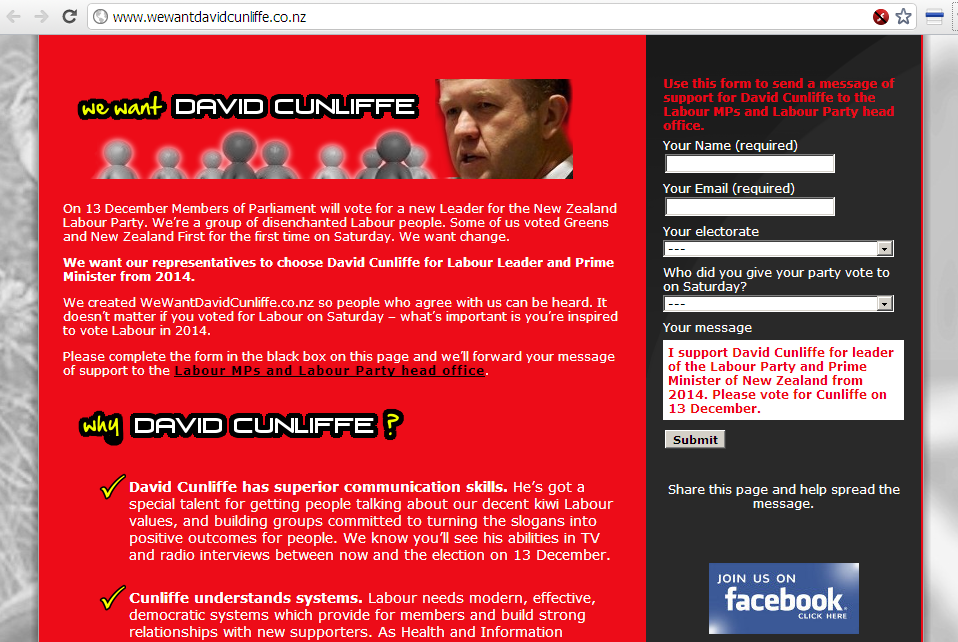
Labour seems to believe that it’s easier to seek forgiveness than permission. With the missing figures in the Press Debate, they’ve sought forgiveness for failing to perform on the night, with predictable effect, and yesterday on the wireless with Paul Henry, Labour’s finance spokesperson David Cunliffe remarked about Police minister Judith Collins that if she were the last woman on earth “the species would probably become extinct”. That’s a couple of pretty big steps beyond the usual (and also unjustified) fat jokes about Gerry Brownlee and others, and it’s the sort of behaviour we’d expect in Berlusconi’s Italy, from some of the viler denizens of the lunatic fringe, or perhaps from Paul Henry himself — but it is not conduct becoming a former minister and possible Prime Minister-in-waiting.

I anticipate we’ll see a cringing apology today or tomorrow once the media cycle gets hold of it, but it’s too late — the damage is already done. Some lefties will inevitably claim that having a bit of “mongrel” is crucial to win back “Waitakere Man” (more on this later), or will point to examples of comparable outrage on the other side, but again, it doesn’t matter: Labour is dead in the water if it holds itself to the standards of the rabid right, and this reeks of desperation more than it does of strategy. As Pablo wrote recently, negative campaigning isn’t always a losing strategy, but it has to be done right — and this isn’t. [Edit to add: this sort of behaviour also negates a tactical advantage of being able to criticise Key for his media engagements, such as with Tony Veitch.]

As Labour partisans take great delight in reminding me, I have no knowledge of the inside of Labour’s organisation, and all my Kremlinology about its dysfunction is based on near-obsessive observation of what public evidence is on display. With that caveat, let me advance a thesis: Goff is actually coping pretty well with the campaign so far, but Cunliffe is not. After all, Goff’s only major failure has been an inability to produce costings for the fiscal policy — Cunliffe’s portfolio. Goff, as leader, bears ultimate responsibility for not demanding a better performance from his finance spokesperson, but since Goff has enough on his plate as it is, producing those numbers was surely a responsibility delegated to Cunliffe and his people, and they did not do so. Whether we interpret Cunliffe’s outburst about Collins as (charitably) cracking under pressure or (less charitably) the mask of civility slipping, it looks like he’s feeling the heat more than Goff who is performing better than most people expected (and knows it).

Just a final word about Waitakere Man. Yesterday Stuff.co.nz ran a wee video package they called the bloke test in which journalists asked Key and Goff the same set of questions in order to measure their purported blokiness. This has been widely derided (mostly by the same people who think Labour is running good strategy) as an exercise in vapid idiocy, but that’s not so. Just as much as we have a right to demand political and institutional competence from our leaders, we have a right to judge them on their instinctive, bedrock responses; and this was a case where two leaders were asked a series of unpredictable personal questions and expected to answer them off-the-cuff.

While its utility in measuring “blokiness” is highly dubious, this exchange contained a lot of other information about how the leaders respond to pressure, to humour, their attitudes towards social transgression and their place in society and a sense of who they “really” are. In a representative democracy where voters can be expected to have neither the time nor the expertise to become proficient in every policy field that impacts them, they rely on other indicators to determine who is more likely to make appropriate decisions in their stead. I’ll leave the interpretation of who “won” the Waitakere Man test as political rorschach, but suffice it to say that anyone who thinks this sort of thing is irrelevant trivia needs remedial classes in voter behaviour.

L