A Modest Proposal, Poe’s Law and Libertarian views on welfare

I quote one of our friendly neighbourhood sociopaths from the gloriously-named SOLOPassion, in full:

NZ Politics: I Have a Cunning Plan – Tax Childbirth
I know! I’m suggesting a tax. Bear with me …
On TV3 Firstline this morning, after picking myself up from the floor when political reporter Patrick Gower dropped it so casually into his ‘reportage’ that the Green’s idea of Government setting up its own Kiwisaver scheme to distort the free market even further was a fabulous one, and he couldn’t understand why Labour and National hadn’t thought of it, it was then reported that pursuant to some overseas agency of or other that one in every four New Zealand children was living in poverty.
I don’t think it is then spurious to draw the logic line to the social welfare commentator Lindsay Mitchell statistic that 23% of all babies born over 2010 (for the State educated, that’s almost one in four) were in ‘homes’ reliant on a hard benefit to live by the end of the first year of life.
Mmmm.
That has set me to pondering. Rather than the Save the Children lady’s solution, when she was then interviewed, of spending yet more money on welfare, and creating yet new layers of bureaucracy, and working on the theory that you can’t fix the problems of welfare by more welfare, I think a radical rethink is necessary.
Hence my proposal to fix this problem in just one generation: rather than taking from all taxpayers as we do currently, and subsidising childbirth, which I pose has led to these two related statistics, I think we should be doing the reverse – taxing childbirth.
This would force parents to assess their financial ability to have children, and only start families when they could afford to. This will mean within one generation, we will have virtually wiped out the horrendous 23% statistic, and with it, child poverty, in the one blow. Further, the childbirth tax could be put toward the State functions that those children will be using: education and health.
There will be a hue and cry, obviously: babies for the rich only, Occupiers in maternity wards, all founded on the protest that governments should not decide such important lifestyle choices as who has babies and who doesn’t. The last of which I entirely agree with, whether it be via a subsidy or a tax, for therein lies my cunning plan ;)

This is a perfect example of Poe’s Law, which states:

Without a winking smiley or other blatant display of humor, it is impossible to create a parody of fundamentalism that someone won’t mistake for the real thing.

It’s a perfect example because literally the only thing about it that’s vaguely implausible is that it’s a Randroid proposing a tax.

Swift’s A Modest Proposal was far enough removed from the prevailing norms of his intellectual circle to be distinguishable from them. This isn’t. It’s in the uncanny valley of political discourse.

L

PS: Check the comments, if you think you can stomach them.

Gaddafi is Gone.

The brutal end of Muammar Gaddafi’s life marks a political new beginning for Libya. The circumstances of his demise speak volumes about the road ahead.

Gaddafi was summarily executed after being captured by rebel fighters (the term “rebel” rather than revolutionary is correct in that it properly places the armed opposition in a civil rather than revolutionary war whose outcome was largely determined by external interference).  His non-military convoy was attempting to flee the rebel’s final advance on Surt, his hometown, when it was struck by a NATO airstrike (in violation of the rules of engagement NATO publicly announced when it declared a no-fly zone that included attacks on land-based military targets that posed an imminent threat to civilians). Concussed and wounded by shrapnel, Gaddafi and a few loyalists took shelter in a culvert. They were discovered and some were killed then, while Gaddafi was dragged out and manhandled by a growing mob. Disarmed, confused, pleading for mercy and bleeding, at some point soon thereafter he was head shot at point blank range (images of his wounds show powder bruns at the entry point). He was not caught in cross-fire, as there was none.

Killing a captive after surrender or capture is a war crime, including in civil wars. The rage and thirst for revenge of Gaddafi’s killers is understandable, but it shows a lack of discipline and foresight. Gaddafi and his inner circle could have provided valuable intelligence on a broad range of subjects, be it the terms of the exchange that led to the release of the Lockerbie bomber, the grey arms networks in which Libya operated, or the extent of Gaddafi’s funding of influential Western agencies such as the London School of Economics or Harvard’s private political and strategic consulting firm. Similarly, although the outcome would have been pre-determined, his trial would have provided the Libyan people with a facimilie of representative justice in which his crimes could be publicly aired, and which could serve as a foundation for a new justice system once the new regime was installed. Even Saddam Hussein was allowed that much.

The barbarism of putting Gaddafi’s decomposing corpse on display in Misurata for public viewing speaks to the levels of distrust and base nature of the sectarian divisions within Libya. These will not go away simply because Gaddafi and his clan have been removed from power. The tactical alliance against his regime will not hold now that it is gone, and given that all of the main factions are armed, this raises serious questions about the political future of the country. The cross-cutting divisions are multiple and overlapped: Eastern versus Western, Islamicist versus non-Islamicist, Berber versus Arab, Benghazian versus Tripolian, urban versus rural, coastal versus land-locked, elite versus commoner, old royalist versus new upper class. Although the role of foreign military advisors and logistical support was crucial to victory, many rebel military commanders have carved out power centres of their own, and not all of the rebel political and military leadership are democratic in inclination.

The National Transitional Council (NTC) headquartered in Tripoli has announced the formation of an interim government within a month and presidential elections in 18 months. Both goals are very ambitious and the latter is inherently flawed. Imposing a presidential system in a multi-tribal society with no history of democracy and a long history of conflict  is a recipie for authoritarianism, as political contenders will vie for and hold presidential power in pursuit of sectarian rather than national objectives. A parliamentary system with multiparty proportional representation would be a better fit given the realities on the ground, as it would force power contenders to negotiate and compromise in pursuit of coalition objectives, which in turn would put constraints on executive authority.

To put the issue in comparison, the Libyan polity is more fragmented than that of Iraq and does not have an occupying force that imposes transitional order and around which national opposition can coalesce. Iraq has a parliamentary system that recognises sectarian control of parts of the country as well as grant participation to key clans, and yet has yet to be free of violence or have fully cemented the institutional base of the post-Baathist regime. This portends darkly for the immediate prospects of a post-Gaddafi Libya.

The issue of disarmament and creation of a national military, to say nothing of disposition of Gaddafi’s purported chemical weapons stores and other sophisticated armaments, is bound up in the negotiations over the interim government and rules of the game for the political transition. Given that NATO allies are not the only foreign actors involved in Libya, and given that some of these actors are non-state or state-sponsired in nature and have conflicting agendas with NATO, this means that the post-Gaddafi situation may descend back into conflict sooner rather than later. To this can be added the purge and reconstitution of the Libyan state as a functioning sovereign entity, a process that will also be driven by mindsets as much focused on the division of spoils as it is by notions of the common good. That overlaps with the issue of oil resource control and distribution, as well as the status of contracts signed during the Gaddafi regime, both of which involve tribal politics as well as the interests on non-NATO foreign actors such as China.

All of which is to say that the circumstances of Gaddafi’s death tells us much about what the future holds in store for Libya, at least over the near term: chaos, violence and imposition rather than consensus, forgiveness, reconciliation and compromise.


By their works ye shall know them

We are presently being treated to the rather undignified and unedifying spectacle of the political right — particularly the authoritarians and liberthoritarians — crying foul because people are drawing cautious, well-documented linkages between their own rantings and those of the Norwegian killer Anders Behring Breivik. We had a dry-run of this following the Tucson massacre. Russell Brown has NZ’s most thorough treatment of this argument, and Peter Cresswell has NZ’s most succinct whine about it, with links to more examples.

One such piece bears particular mention: by Merv Bendle, it was published in Quadrant, and questioned whether Breivik’s attacks were “a covert, ‘false-flag’ operation, carried out to give just this impression that it was conducted by anti-Muslim, right-wing extremists, but actually conceived and directed by other forces?” Quadrant is edited by Keith Windschuttle, whose statements at a seminar given in New Zealand in 2006 (and chaired by Matthew Hooton) were quoted by Breivik in way that Windschuttle states is “not inaccurate or misleading. I made every one of these statements and I still stand by them.” The argument is essentially that “civilisation” is under threat from “the perverse anti-Westernism of the cultural elite”. There are many, many more such cases in overseas forums and I trust readers will have no difficulty finding them.

But Pascal’s Bookie, in comments at the Dim-Post, has found the nub:

They either need to disown the claim of existential threat, or explain why an existential threat does not justify violence.

This is exactly it. The right-wing commonplace that “Western civilisation is under threat” is at the heart of all the rhetoric being compared to Breivik’s nominal casus belli, and in many cases the similarities are more than merely cosmetic. This general line of argument has been popularised in its modern form by Samuel Huntington, but is much older in its essence (and I must note that Huntington’s theory is considerably more robust than the arguments I’m talking about here.) The problem for the wingnuts presently whining about these comparisons is that their bluff has been called. They’ve been squawking about the existential threat posed by “others”, much as Breivik has, but he has gone one better and actually done something about it. And so they must pick a side: either “Muslims” (or “Māori”, “socialists”, “teacher unions” or the “cultural elite” or whoever “Western civilisation” is at war with this week) actually are the existential threat the wingnuts claim they are, or they are not. If the former case is true, by their own logic the wingnuts would not only be justified in taking up arms in defence of their civilisation, they would be practically required to do so, as Breivik did. If the existential threat is real, they must hail Breivik as a hero. If they don’t, we can assume there is no existential threat, and that they’ve merely been spouting melodramatic masturbatory fantasy this whole time.

By their works ye shall know them. If there really is an existential threat, as they claim, then surely we can expect the rallying cry “wingnuts of the world, unite!” to go up from the towers where they reside, and their legions pour forth with tacticool assault rifles, iPods full of Wagner and Muse and Mario Lanza, and neoprene bodysuits with faux unit patches on them. And if they do not, then surely by their own admission, there is no threat, and there never was.

I know which I’m picking.

L

Update: ‘Nemesis’ at Crusader Rabbit has answered the clarion call to action with …. yet more words. But they are fighting words:

Continue reading “By their works ye shall know them”

If you’re looking to get silly, you’d better go back to from where you came

Dear Martin Warriner,

In objecting to the addition of macrons to Māori place names on the Kāpiti coast, you are quoted as saying that you “emigrated to New Zealand, not to “Māoriland”.” For your information, this is New Zealand, this is how we do. I understand you feel as if your colonial superiority is under siege, but how’s this: we won’t tell you how to represent your culture, and you don’t tell us how to do ours. Fair enough?

If not, it isn’t too late to piss off back home if you don’t like it. Perhaps you could take John Ansell with you.

L

Katerina Mataira, moe mai ra

Dame Katerina Te Heikoko Mataira has died. Dame Katerina’s contribution to the survival of te reo Māori was enormous. She was one of the driving forces behind the renewal of the reo following generations during which its use in the education system was officially punished, causing matua and kaumatua to become reluctant to teach it to their tamariki mokopuna. She did this largely by what are essentially traditional methods; by promulgating the Te Ataarangi immersion-teaching method. Most simply and perhaps most crucially, she used the reo, illustrating that it is a living language, coining terms in reo which previously existed only as loanwords or bare transliterations; the most famous is probably ‘rorohiko’ (literally ‘lightning brain’; computer). She was also one of few authors to write prose novels in te reo, among her other works.

Her passing made me think of what is probably the greatest recent achievement of Māori — the Kōhanga Reo and Kura Kaupapa Māori immersion schooling systems, which have probably done more for Māori cultural wellbeing than any other set of initiatives. Beyond a simple mode of communication, a language represents a store of knowledge which cannot be losslessly translated; it has encoded within it māori (in the pre-Williams sense of ‘normal’ or ‘ordinary’ rather than referring to a race) cultural and historical meaning; and its use enables its users to tap into that baseline culture, granting them access to a resource they cannot find elsewhere. Sir James Henare described te reo as “the core of our Māori culture and mana” and asked, “if the language dies, as some predict, what do we have left to us?” and further, “the language is like a cloak which clothes, envelopes, and adorns the myriad of one’s thoughts.” Sir Mason Durie, who quoted Henare, also argues that the struggle for te reo “typifies Māori determination to assert a positive cultural identity in a contemporary world” (in Te Mana, Te Kawanatanga, p59). Many others have described the importance of te reo to Māori; these are just examples close to hand.

Dame Katerina’s death brought kōhanga and kura to my mind not only for these reasons, but because they are exemplars of effective public policy delivered through and mostly by the communities they target. They are what, if we are very fortunate and work very hard, Whānau Ora could be like. Looking at their success and looking at the potential for similar achievements in other fields, it is disappointing that the left so dogmatically opposes more initiatives along these lines, deriding them as “privatisation of welfare”, or as “pork and puha politics for Tariana’s mates” before they’ve even gotten started.

L

Two current events

Since I’m in the middle of deadline crush, and I spent yesterday afternoon socialising instead of working, just a couple of quick notes.

Vulnerability of Labour’s Capital Gains Tax:
Overall my initial impressions of the CGT and associated policy is that it’s pretty good, but vulnerable to attack. There are the usual economic and ideological objections — full of loopholes, won’t raise enough revenue, raises rents, punishes people for getting ahead, will require more borrowing in the medium term, and so on — but for mine the best attack line rests on the coincidence of taxation rates between CGT and GST. If I were running the National party’s attack campaign, I’d be leading with “Tax off fruit & veg, tax on houses”, or better yet, “tax on bricks & mortar”. Just another of many reasons why GST off fruit & veg is bad policy.

Misunderstanding of Hone Harawira’s Oath Stunt:
So Speaker Lockwood Smith ejected Hone Harawira from Parliament for swearing his oath to the Treaty of Waitangi rather than to the Crown — despite having pulled a similar stunt in 2005 without incident. There is the usual sort of wailing and gnashing about this around the traps, and it seems to have pressed everyone’s ‘sanctimonious outrage’ buttons. What I find strange is that people seem reluctant to see the stunt for what it is — mutual base-arousal, brand politics for both Harawira and Smith. Hone Harawira was, to a large extent, elected to anger and infuriate uptight honkeys like Smith and the KBR and the talkback haters, and inasmuch as his defiance of procedure has achieved that he’s winning. Smith, for his own, has brought a new dignity and solemnity to Parliament, and his personal brand of conservatism requires that he takes a firm stance. Both acted perfectly well to type, and in a sense each has done the other a favour, by granting an opportunity to grandstand. The people who are hating on Hone were never going to vote for him; and likewise for Smith. To an extent there’s also some base arousal by the māori party, too — they have fallin in behind Hone, and are calling for the Treaty to be included in the oath. That’s a useful societal discussion to have.

I find it particularly ironical that the sort of people who are so scathing and disrespectful about Māori ceremony have their dander up regarding this rather minor infraction of procedure; many seem to be raising the counterfactual of ‘imagine the outcry if this happened on a marae!” The thing is, though, in Te Ao Māori as elsewhere, kawa are made to be broken. How and when and why they are broken, and by whom, is key. With suitable mana, ihi, wehi, you can get away with a lot. There is a famous account of Dame Whina Cooper lifting her skirts to remind the men present to respect where they came from. I think, in these terms, it was much worse for Hone that his korowai fell off.

Contra this view, however, Annabelle Lee-Harris from Native Affairs says she’s heard from left-wing Māori who are angry with Hone for trivialising and causing another sideshow; that they thought he was “indulgent when Māori in Te Tai Tokerau are in dire straits’. So maybe I’m wrong. But the bottom line is: Hone Harawira was elected to Parliament by a higher power than the Speaker; all else is procedural.

L

An Open Letter to the ACT Party Regarding Candidate Selection

Dear ACT Party Leaders,

As you may know, I was brought up in Wanganui, and keep an eye on events there. So it was with great interest that I received the below letter, published in the Wanganui Chronicle on 8 July 2011.

ACT’s announcement of the second ‘Don’ in the ‘Don and John’ lineup today was well-received, and if I may be so bold as to say so, I think the author of this letter also has a lot to bring to their table. I quote it in full:

Taniwha real
In reply to Dusty Miller (letters, July 1), I’m not one of those experts, but I do believe the taniwha to be real, not imagined, and I’ll tell you why.

Perhaps the ancient Celts of New Zealand may never have known war or possessed weapons, as prior to Maori being brought here by Zheng He New Zealand had never been threatened internally nor externally and there was no need.

However, New Zealand was visited by Viking ships and Scottish birlinns (a birlinn is similar to a Viking ship) which used to trade with resident Celts. The sailors of these vessels were fierce, battle-hardened warriors with far superior weaponry and military discipline compared with Maori.

As the bow and stern design of these ships is similar to the head and tail of the taniwha, I could well imagine that the sight of them would strike paralysing fear into the heart of any Maori confronted by them, and for this reason I believe the taniwha represents these ships.

Believing this to be the truth of the taniwha, I would not think these ships could be found in a small creek or marshland because of their size.

Taniwha artwork is yet another example of Maori following the culture of those who came here before them, the Celts.

IAN BROUGHAM
Wanganui

I believe Mr Brougham’s Qualifications for Candidacy are Strongly Evident in this Letter. It provides a striking yet unconventional Insight into New Zealand history, weaving back together the varied strands of the rich Tapestry of our origins which Revisonist Historians who hate their own Culture have spent hundreds of years unpicking. In particular, he illustrates comprehensively how Maori, far from being Indigenous, were simply the first wave of Hostile Asian Immigrants to these fair shores. He shows due respect for our Noble Celtic Elders, who were clearly Men who thought like Men, and he recognises their manifest superiority over the Maori, in Warfare, Navigation, Art, and undoubtedly in other Fields as well. Despite his modest claim to not being an Expert, he is clearly Learned, but this does not prevent him Sharing his bountiful wisdom with others, as Readers can see by his patient Explanation of what a ‘birlinn’ is.

Furthermore, Mr Brougham has confirmed himself to be of Sound Mind regarding other crucial policy topics of our Time — protesting strongly against the ‘h’ being forced into ‘Wanganui’ by those same forces of Revisionism, and against the Emissions Trading Scam, by supporting the Endeavours of that noble veteran of the ACT ranks, Muriel Newman — herself also a believer in the undeniable Truth of New Zealand’s Celtic Settlement, and who herself certainly thinks like a Man.

Moreover, Mr Brougham already has more than a Decade’s political experience, having stood under the mighty Equal Rights banner in local body Elections, and for the OneNZ Party (a Sister to the redoubtable One Nation party in Australia) at the National Level. Indeed, while the 0.67% of the Vote he received in the 2005 General Election is unjustly low, it is similar to what the ACT Party is presently polling.

As one final thing, everyone knows that to succeed in politics you need a strong Hand. With the unfortunate departure of John Ansell, ACT presently has Two Pair — Don Brash and Don Nicolson, John Banks and John Boscawen. As everyone knows, Two Pair is a strong Hand, but not strong enough to ensure Victory. Adding Mr Brougham would restore ACT to Full House status, giving the party a Hand that could only be beaten by Four of a Kind (which I think we can all agree is unlikely); or a Smith & Wesson which, as the lore of our American brethren confirms, even beats Four Aces (this is also unlikely because the Liberal Culture-Hating Revisionists are too afraid to permit Noble Celts from arming themselves against Tyranny). Mr Brougham would complete the Full House because, as you wise Celts of the ACT leadership are surely aware, “Ian” is simply a Celtic rendition of “John”.

Mr Ian Brougham is well Qualified to join the Great ACT party, and he has the courage to speak Truth to Power. New Zealand needs him to return it to Celtic Glory. Nevertheless I must state I have not Approached Mr Brougham to ascertain his Willingness to stand for ACT, an exercise I shall leave to the ACT Leadership.

Trusting that you will consider this Recommendation with all the Gravity it deserves,

L

Dollar dollar bill y’all

Tonight’s Native Affairs debate between Pita Sharples and Don Brash is now up on their website, and it is must-watch television for a few reasons. The first and most immediately evident is Julian Wilcox’s quality as an interviewer and moderator — this was not a structured debate, with time allotted and mechanical switches between speakers, nor preset, pre-scripted questions. It was a free-flowing affair, with Wilcox acting as both interviewer and moderator; and throughout the two speakers were respectful, genuine, and both had ample opportunity to get their points across. It was superbly done. (Hone Harawira, in a later discussion, twice jokingly invited Wilcox to stand for Te Mana, but for mine he’s too valuable in the media.)

Another reason it was remarkable was because of Don Brash’s bizarre, out-of-touch equation of sentimental or cultural attachment to natural features — maunga, awa, moana and so on — with “animism”. It’s a perverse position to take, given the deep connection New Zealanders — both Māori and Pākehā — have to their landscape, about which I’ve written before. Imagine, if you will, a series of billboards featuring Aoraki Mt Cook, the Waitemata Harbour or Rangitoto, the Waikato or the Whanganui, Wakatipu, Taupo, or my own ‘home’ mountain of Taranaki — with the legend “Brash thinks this is just a lot of water”, or “Brash thinks this is just a rock”. If ACT were politically relevant, it might be worth doing.

Cash Rules Everything Around Me
C.R.E.A.M, get the money
Dollar dollar bill y’all
— Wu-Tang Clan

Like the gangstas of Staten Island legend, this sense that only what’s literal and material matters, that when push comes to shove, money trumps everything is integral to the faux-rational actor model to which ACT subscribes, and this leads into the major thing which made this interview important:

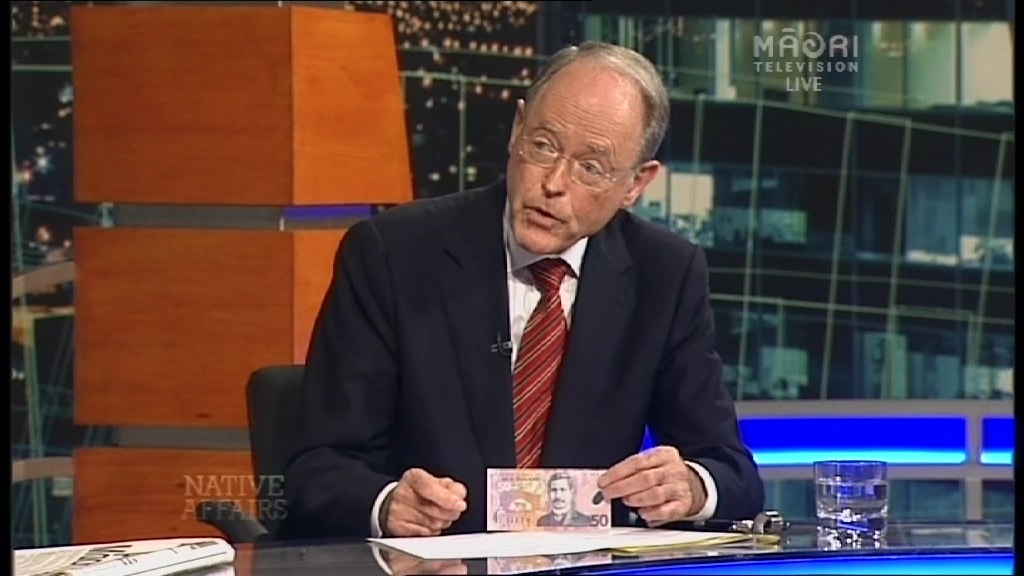
(Image snapped by Michael John Oliver, via twitter, thanks!)

And a brief transcript:

Brash: “Pita, I put …”
Sharples: “No, you didn’t.”
Brash: …”Apirana ta…Ngata on …”
Sharples: “The country put that on. Let’s be clear about that.”
Brash: “I made the decision. I made the decision, as governor. And I put him on that because I think he’s one of the greatest ever New Zealanders.”

Don Brash, the archetypal white rich guy, brought along a fifty dollar note — a note that many poor Māori voters rarely even see — to a debate that was substantively about the reasons why Māori are politically, socially, and economically deprived.

To appeal to Sir Apirana Ngata in a newspaper advertisement — as Brash did this weekend — is merely crass. To bring that actual visage in as a prop in an argument to dismantle the Aotearoa that Ngata and others had worked to build — that, as Sharples said, Ngata was criticised for being a “radical” by rich white guys like Don Brash — and seeking to imprint his divisive and offensive policies with Ngata’s mana is offensive to the man’s memory. To seek to take personal credit for Ngata’s mana being properly recognised — “I made the decision” — is obscene. To play a statesman’s memory like a chip on a weak hand at the last-chance saloon is no sort of respect. It is the ultimate “I’m not racist” gambit — “look, some of my best banknotes have Maaris on”. I wonder if he would treat the memory of Sir Edmund Hillary or Kate Sheppard in this way. Distancing himself from John Ansell’s misogyny by saying “hey, I put a broad on the $10” would be a thing to see. He had a decent crack at “I’m not racist, my wife’s from Singapore” back in the day.

Don Brash, during his brief run in politics, accumulated a series of bad images — “poor optics” as the lingo goes. Walking the plank, struggling to climb into the racing car, scooping mud out of his mouth at Waitangi, and so on. This image — of Brash big-noting to Māoridom, if you’ll excuse the phrase; showing them who’s got the Benjamins, or the Apis — should be one of the enduring memories of the campaign. Brash probably thinks it’s a smart symbolic play, but it calls to mind a bunch of things he doesn’t want to call to peoples’ minds — his own wealth, the extent to which he’s economically out of touch with those he claims to want to represent, and perhaps most of all an almost unspeakably flawed sense of political and historical reverence, which places him out of touch at a deeper level; a level of shared sentiment and aspiration, of common culture and values.

In television, the rule is: don’t tell, show. No matter how often he tells Aotearoa that he shares our views and aspirations, we won’t believe it unless he shows us. Since storming the lofty heights of the ACT party Brash is busily telling us that what we stand for what he stands for, despite 98.3% of the evidence contradicting that assertion. And now he’s showing us exactly the same.

L

Master-race baiting

[Updated 10 July 2011 to account for Don Brash’s statements in response to John Ansell, and Ansell’s resignation from ACT.]

Many have remarked on the appropriateness of the website of the ACT Party Parliamentary leader’s press-secretary, SOLOpassion, and many have made jokes about the sound of one hand clapping, or fapping, as it were. It is therefore entirely appropriate that ACT should become the butt of these same jokes, since they appear to have swallowed (implication most definitely intended) Lindsay Perigo’s paranoiac auto-stimulatory tendencies whole. His hand-work is evident in the party’s ever more deranged press releases, speeches, and most recently in this morning’s advertisement in the New Zealand Herald, titled “Fed up with pandering to Maori radicals?” and strategically timed for the end of Te Wiki O Te Reo Māori. The advertisement is worth reading; the image below is stolen from The Dim-Post. Read the comment thread over there; it’s magnificent.
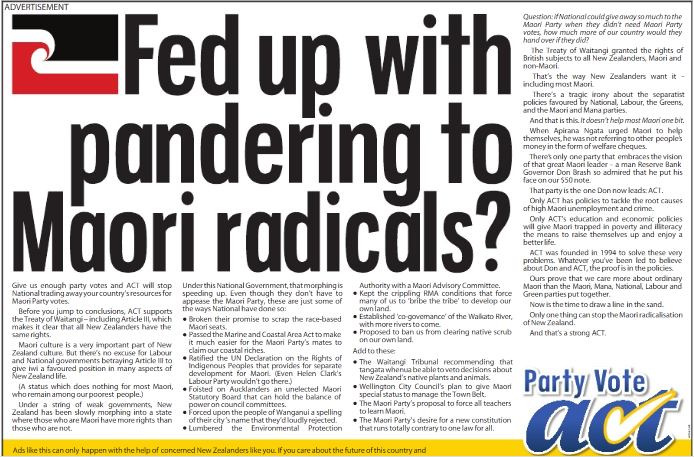
There’s an awful lot wrong with this, but aside from the warlike verbiage, none of it is much different from ACT’s or Brash’s prior form, and since I’ve been over most of the arguments before I will spare you the full repetition. You can trawl through the Take Māori section of this blog if you want the detail. But just a couple of obvious things: the reasoning privileges Article III of the Treaty; that is, the article which gives the Crown a colonial payday, while neglecting Articles I and II, upon which the consideration of Article III rests. In terms of a contract, which is a way of thinking about the Treaty that ACToids might be expected to understand, Brash’s reasoning emphasises the payment for services rendered, while materially ignoring the requirement to actually render those services. (More on this theme here). Secondly, it’s more of the same selective history we’ve come to expect: our history as Pākehā matters and has value; theirs, as Māori, doesn’t — except for the bits Pākehā can turn to their advantage, like the decontextualised appeal to Ngāta.

But there is a broader point that this development illuminates. Race relations in Aotearoa has changed enormously in the past seven years. In the winter of 2004, the country was in the throes of Orewa madness. The māori party had just been formed, promising to deliver “an independent voice for Māori” in parliament. Eight years ago tomorrow Tariana Turia won her by-election, seeking to deliver on that promise. Don Brash was the leader of a resurgent National party who held a strong lead in the polls, and whose race-relations platform dominated the policy agenda. Now, Turia leads a hollowed-out party whose mandate and credibility are under severe threat from one of their own. Don Brash, having been ejected from the National leadership disgrace, now leads a party with less than one-twentieth of the electoral support he once commanded; a party he was only able to colonise after it was fatally weakened by a series of appalling political scandals, and then only by the narrowest of margins.

Under Brash National’s popularity stemmed from the fear of a brown nation that emerged from the foreshore and seabed debate and the māori party’s formation. As far as the general electorate of Aotearoa is concerned, those fears were not realised. As far as Māori are concerned, the māori party’s results have been disappointing to say the least. As far as the established political power blocs are concerned, the māori party has proven a very dependable agent their political agendas; even while disagreeing with many of their positions, both National and Labour recognise that the māori party are invested in constructive collaboration with the Pākehā mainstream, not in its destruction. I’ve long argued that the initial purpose of the māori party wasn’t to effect sweeping policy change, but to create cultural and political space for kaupapa Māori politics, and to establish the credibility of same. For all their policy failures, they have succeeded at this task in spades; perhaps they could have afforded to succeed at this task a little less. But largely as a consequence of the sky not falling after the passage of the Foreshore and Seabed Act and the emergence of the māori party as a credible political force, neither National nor Labour have any truck with ACT’s vitriol. Don Brash, his “one law for all” rhetoric, and his scaremongering are firmly on the outer.

Even further out on that slender but flexible branch is the architect of Brash’s Iwi/Kiwi campaign, probably the best campaign of its type in our recent political history and certainly one of the most memorable: John Ansell. Ansell’s rhetoric had become distasteful enough by the time of the last election that even the ACT party — then under the leadership of Rodney Hide — refused to use much of his best work. Thereafter he was picked up by the Coastal Coalition. A less credible gang of fringe loonies it’s hard to imagine; one of its principals, Muriel Newman (who, shamefully, was invited by Radio New Zealand to speak as an authoritative expert on the WAI262 Treaty claim) believes that pre-Tasman Aotearoa was settled not only by Polynesians but by “people of Celtic and Chinese ancestry as well as Greek, French, Portuguese, Spanish and others“. Ansell’s own views on race are similarly bizarre; Māori, he reckons, are “not a race, but a religion“.

Ansell is now reduced to ranting in Kiwiblog comments, and is as critical of ACT as he is of everyone else. Even there, though, his views hardly find great favour, with more people objecting that his campaign is distracting from the “real issues” than supporting him. His contribution to the thread about the Brash advertisement — it’s not clear whether he was involved in the ad’s production or not — is a magisterial display of racist, misogynist essentialism, and I think it really gets to the heart of the paranoiac auto-stimulatory tendencies to which I referred earlier. I quote his initial comment in full:

The problem with New Zealand is it’s full of white cowards who are too frightened of being called names to stand up for the truth.

(And that’s just the ACT Party.)

And the truth (if we are honest enough to admit it) is: for the last quarter-century, our country has been brownwashed by a bunch of scammers (aided and abetted by legions of white ‘useful idiots’) into feeling guilty for the supposed sins of our British great-great-grandparents.

A sober reading of the facts reveals that some of these sins were actual (though far less sinful than the crimes perpetrated by Maori on Maori). Many others were highly exaggerated and delivered with lashings of emotional blackmail, for the purposes of extorting compensation.

But of course we are New Zealanders and we are not allowed to tell our truth (as Alasdair Thompson recently found out to his cost).

We are not allowed to speak out about state suffocation, Maorification, feminazism, National socialism, teacher unionism or any of the other evils that are dragging our country into the third world.

Those who do have the guts to tell the truth are called nasty names like racists in the hope that, like snails, one light contact with politically-correct criticism will be enough to make them shrink back into their shells.

And of course it works a treat.

There are plenty of parties for pessimists, backward-looking Maori and white bedwetters. But there’s only one for optimists, achievement-oriented people and forward-looking Maori.

ACT will not succeed until it champions the latter and tells the dishonest others to go to Hell.

In short, their catchment is men and women who think like men. Not men and women who think like women. ACT is the party of the strong father, not the soft mother.

(By strong father I include strong women like Rand, Richardson and Thatcher, and by soft mother I include weak men like Key.)

I hope you people will think about that.

[Update: A NZ Herald article titled Act ad man blasts ‘apartheid’ contains more such statements from John Ansell, who is ACT’s creative director; and in it Don Brash distances himself from them, saying “I don’t want to associate myself with those kind of views at all”. He may not want to, but he is. His own press release issued in conjunction with the advertisement above calls any form of “preferential treatment” — such as concessions granted under Article II of the Treaty, which ACT apparently does not recognise — “a form of apartheid”. Perigo is fond of the term, and also of referring to Māori, Muslims and anyone else who doesn’t quack like an Aryan duck as “savages”. Moreover the prospective MP for Epsom, John Banks — who represents the kinder, gentler face of the ACT party — also has form on this issue, having previously referred to Māori TV as “Apartheid Television”, and holding views generally very comparable with those of Ansell and, in some cases, with Perigo. So Brash’s will to not be associated with such views really raises a question: will he, in order to dissociate ACT from these views, fire his creative director, the press secretary for his Parliamentary leader, and the only MP likely to win an electorate? I rather doubt it, but I believe Aotearoa deserves answers.]

[Update 2: Ansell is gone. One down; how many to go?]

As Russell Brown said, Ansell’s comment is “essentially an incitement to race war“, and I don’t believe Ansell himself would deny that. But it’s more than that; it’s also an incitement to sex war. It’s easy enough to dismiss as the usual sort of dark mutterings, but hang on a minute: this fool is claiming to speak for me, and if you’re a man (or a woman who thinks like a man, whatever that is), he’s claiming to speak for you too. But he doesn’t speak for me. To head off the inevitable speculation, I’m hardly what you’d call a feminised liberal pantywaist; I have a beard, I hunt, I fish, I provide for a family; I like whisky and brew my own beer; I like rugby and rock’n’roll and Rachmaninov, and breaking things to see how they work; I’ve spent years studying martial arts and I’m trained to do or have done most of the things on Heinlein’s list. I wear a Swanndri to work in an office on Victoria Street, for crying out loud.

But in my world, masculinity isn’t measured by warrior prowess or the vulgar ability to force one’s will upon others, whether by physical, social or legislative means. Those things, as anyone who’s studied totalitarianism will tell you, only garner a mean and hollow sort of respect; the sort which dissipates as soon as the heel is lifted from the throat of the oppressed. No, in my world, masculinity is judged by honest work, truth and wise counsel, respect and tolerance, forbearance and understanding, accommodation and partnership; from love and support, and strength of a kind which intersects with but is not eclipsed by that to which Ansell appeals. As I have argued before, that sort of view — the dictator’s view that power comes from the barrel of a gun, that only the whims of the mighty matter — is a bare and miserly sort of humanity. And if that’s how Aotearoa actually is, then I say: come the feminised, Māorified revolution, because we desperately need it.

Of course, it’s not. Ansell no more represents Aotearoa’s men than Muriel Newman does its women, Lindsay Perigo its homosexuals or Don Brash does Pākehā. Their methods have become unsound. As Conor Roberts put it, “if you gaze for long into the sub-5 percent abyss, the sub-5 percent abyss gazes also into you.” Let’s see how long they can keep gazing.

L

Does small always have to mean provincial?

Here is a question for readers. Just because NZ is small does that mean it has to be provincial? Having returned–and happily so–to NZ after a 3+ year absence, I am struck as to how insular public debates tend to be. Leave aside the grating RWC ads and hype. Although it makes much ado about a second tier sporting event, it is being hosted here and there is money to be made as well as sporting prestige on the line. So the hoopla could happen anywhere. I also understand the focus on Christchurch given the earthquakes, but am struck by how most attention is on the human dramas and not on the policy response and consequences of the disasters (which seem to this uninformed eye to be slow and not considerate of long-term implications). More broadly, be it in the tone of political debate, the focus of popular culture, or the economic preoccupations of the moment, it all seem a bit inbred to me. Am I just being precious or unduly judgmental?

I ask because I came back from Singapore, which is small but is incredibly cosmopolitan because of its strategic location and thriving expat culture (native Singaporeans are quite insular as well but have been forced to cope with the influx of more worldly people as part of their national transformation project). Switzerland, San Marino, Andorra, Monaco, Ireland and Malta are small but their location in Europe makes them acutely sensitive to and knowledgeable of their larger neighbour’s actions and interests. The same can be said for Uruguay, surrounded by larger States, or Central American republics, dwarfed by Mexico and the US. This is not to say that the masses as a whole in these countries are always on top of international affairs or erudite in their discussions of global trends, but that they seem to have a better appreciation of the world around them than what is evident in NZ. That seems counter-intuitive.

I say so because the tyranny of distance should have been overcome by advances in telecommunications and transportation, NZ is increasingly a nation of immigrants, including many from non-traditional source countries, its commercial ties are more varied and distant than in earlier generations, its has high standards of literacy and access to news sources, it has a good percentage of citizens returning from OE’s and its diplomatic connections reflect all of these trends. So why is it that, if I am correct, NZ remains rooted in a seemingly mythical short-and-gumboots, rugby-fixated mentality unconcerned about the larger world in which it is inserted? After all, unlike like large states that can “afford” to be ignorant of world affairs because of their economic weight and territorial size (e.g., the US), Kiwis are constantly told that their well-being is directly linked to NZ’s position in the international community. If that is true I would expect that average Kiwis would take an interest in global issues and ask questions of national elites about them.

Why, for example, has the NZ government made no public pronouncements on Syria (and muted comments about Libya) given its purported commitment to human rights? Why has issues like human trafficking, child labour and environmental degradation not entered into the debate about undertaking trade agreements with Asian despotic states? Why have tensions between Fiji and Tonga only been awarded two days of media attention, especially given the role of other powers behind the scenes and NZ’s connections to both countries? Why is there no debate about the NZDF role in Afghanistan given the beginning of the US military withdrawal in July? Why is it assumed that “privatisation” and public expenditure reductions are sacrosanct when in many faster developing parts of the world that are also commodity export-dependent (Latin America, SE Asia) such market-driven zealotry has been abandoned in favour of more judicious public management schemes that see public welfare and employment as requisite part of the social contract (and long-term stability)? Why is draconian anti-terrorist legislation and expansion of domestic intelligence powers passed when NZ security elites admit that the threat of a terrorist event is extremely low and that domestic threats are more likely to be criminal than political in nature (with some of that criminality being a direct result of NZ’s permissive attitude towards trade conditions and regulatory requirements on foreign investment and corporate accountability). Why are national leaders allowed to dismiss those who raise such concerns as extremists or unhinged?

In fact, what the heck happened to policy debates in general? Why is it that when not rugby the entire country seems to be fixated on human dramas and political sleaze rather than the pressing issues that impact they very way society is organised?

I realise that NZ may not be alone in this syndrome, should it in fact be real. It just strikes me as incongruous that a country with such an abundance of human capital should be so inward-focused, especially if it’s material, social and political status is directly connected to, and dependent upon, its ties to the outside world. Provincialism may serve the interests of elites who can govern and do business without considered scrutiny so long as a few popular sops are thrown the public’s way, but it seems to me to be an unfortunate comment on national consciousness if indeed it is a reality rather than a figment of my imagination.