Uncitizens

A lot of self-described liberals or libertarians are arguing that the extent of peoples’ membership in society should be determined by their economic contribution to it, and a few, ignorant of reality, are even arguing that their membership in society is determined by their economic contribution.

People like Peter Cresswell, who asks “What gives bludgers a right to privacy?” The answer, of course, is that they have the same rights as anyone else. Peter, citing an imaginary selection of rights which apparently does not include any right to privacy, argues that the beneficiaries’ rights impinge upon his, and theirs should give way. Beneficiaries, to him, are uncitizens.

People like Cactus Kate, who reverses the rallying cry of the American Revolution to read “no representation without taxation” under the delusion that its meaning persists unchanged. She argues that franchise should be restricted to those over the age of 25, except where they earn $60,000 per annum or more. With reference to the current case, she restates the common refrain that “the taxpayer is paying for their lifestyle therefore should have knowledge when the beneficiary is whinging about benefits paid to them”, which essentially translates to “beneficiaries don’t have rights to privacy”, per PC. Beneficiaries, and those under 25, and the poor, are uncitizens to Kate.

People like David Farrar, who makes the same argument that, because the information concerns welfare, the people in question have reduced rights to privacy; but realising the paucity of that stance, goes on to rationalise it with ever-decreasing logical circles. I needn’t even specify the depths to which the KBR have sunk on this issue; so much for David’s moderation policy.

People like Bill Ralston, who argues that when one screws with the media bull, one gets the horns, and when one reveals any details to the media about one’s case, it’s open slather. For Bill, it’s not beneficiaries who are uncitizens – it’s ‘people who speak to the media’ who have reduced rights. I wonder if he realises the chilling effect of this could do him out of a job.

People like jcuknz in the comments here who, to be fair, is only repeating what he’s read elsewhere.

People like the callers to Paul Holmes’ and Michael Laws’ talkback shows this morning, who think their right to know trumps another’s right to have their personal information remain private.

People like Matthew Hooton who, like Ralston, thinks that by going to the media the women in question waived their rights to privacy but, paradoxically, who also thinks that people going to the media with personal information should sign a privacy waiver to prevent disputes such as this. Hooton also has the gall to refer to the information control methods of Soviet Russia in criticising their actions – not, mind you, the government’s punitive use of personal information for political purposes, which bears a much stronger resemblance to the authoritarian methods of the Soviets.

Far from being liberal, or libertarian, these arguments belong to oligarchs. Far from the liberal creed of holding the rights of all people to be self-evident, these explicitly call for rights to be attached to wealth or some other form of privilege. They believe that people who are dependent on the state ought to be at the mercy of the state. It is perhaps no surprise that it is these people whose rhetoric and iconography is littered with terms and images like “slave of the state” – for that is what they imagine being otherwise than independently wealthy should be. These are people who would restrict participation in democracy to economic status – who pays the piper calls the tune, and who pays tax may vote, presumably in corresponding measure.

These people are just as bad and foolish as the doctrinaire Marxists who argue that nothing matters other than what is strictly material. Their argument is the one which holds that, if a group of people share a meal, it’s not relevant where they eat, what they eat, what they drink with it, who chooses, what they talk about during dinner, what concessions are made for the purpose of sharing – the only things which matter to them is who pays for the meal and how much it costs.

That is a bare and miserly sort of humanity. Other things matter. A person’s a person, no matter how small.

L

Aren’t they precious?

DPF is trying – on an experimental basis, mind, without any predetermined outcome in mind, no horse-scaring intended – to impose standards on his comment threads at Kiwiblog. The proposed standards are not especially onerous:

  1. Respond to the topic and the arguments
  2. Don’t get personal

Even these are too much for the commentariat on the announcement thread (which at time of writing has only been going for a bit over an hour and a half); plenty of high dudgeon, snark and poorly-masked animosity. They just can’t help themselves, dear wee things.

I’ll watch with interest, but it looks to me like David will need to give up his day job to keep on top of it, or appoint some of the usual suspects as deputies to enforce these standards (presumably with zero tolerance for misbehaviour and draconian penalties for miscreants). At worst, one dysfunctional community culture (of incessant attack disguised as ‘robust debate’) could end up replaced with another which is just as bad (of obsequious positioning, sucking up to authority, and (where that fails) of alleged bias being transferred from commenters to the moderators). The General Debates will remain a lawless free-for-all, and I predict also that the worst vitriol will simply spill over into them. Can anyone say “you wanna take this outside?”

At best, though, the move could result in a culture which might actually do some justice to David’s frequently thoughtful and relevant content.

If he has time to write any.

L

The role of the judiciary is to judge

There has been much wailing and gnashing of teeth over Dame Sian Elias’ remarks about the prison muster. Nevertheless, this is what Chief Justices (and their equivalents elsewhere) do from time to time – make pronouncements about the law and the state of the justice system, which carry no policy mandate but tend to get people talking.

I would note that the speech was much broader and more considered than ‘let the prisoners go free’ as it has been dramatised. But that Dame Sian has made a pronouncement so far out of step with government policy and public consciousness demonstrates either a remarkable sense of personal responsibility for the justice system or a desire to legislate from the bench.

There are three ways to slice it:

  1. The judiciary is right to involve itself in this sort of thing and you agree with the position taken
  2. The judiciary is right to involve itself in this sort of thing and you disagree with the position taken
  3. The judiciary is wrong to involve itself in this sort of thing, and should stay the hell out of wider matters of justice regardless

I’m the first, with Toad and most commenters on Eddie’s post on The Standard. Labour Justice spokesperson Lianne Dalziel is too. In another case I might be the second. Danyl Mclauchlan seems to be either in the first or the second; Idiot/Savant and Bomber are clearly the first; Madeleine Flannagan, herself a lawyer, seems somewhat grudgingly to be in the second camp. Peter Cresswell definitely is.

But it’s tricky; the third is a cover for the second. I think Simon Power and Garth McVicar (along with DPF and some stalwarts of the KBR hang’em-flog’em brigade) are taking the third position for rhetorical purposes when, if they were honest, they’d be defending the right of the judiciary to participate in NZ’s discourse of criminal justice but disagreeing with Dame Sian’s argument in this case – the second position. Dean Knight points out that, when it suits, the government does actually consider the judiciary’s views as integral to justice policy.

If the particulars of the Chief Justice’s speech had been different, I reckon they’d be singing from a songsheet other than the one which reads ‘butt out, you lily-livered liberal panty-waist’. Perhaps the one which reads ‘I disagree with your position but, as the head of NZ’s judiciary, you are entitled to take it’.

The flipside, I suppose, is whether those of us who agree with Dame Sian’s general position today would be supportive of her right to take it if we disagreed. We should be; all of us.

Edit: Andrew Geddis is in the first position; Stephen Franks is in the second.

L

Duelling imperatives

So, the National Business Review has decided to (partially) monetise its interweb presence.

In a rather petulant letter, publisher Barry Colman takes aim at the enemies of journalism and backs his team to be able to make a paid content model work where very few have done so before, and never in such a tight and competitive media ecology as we have in NZ.

As you know, there has been endless discussion for a number of years about the crazy model adopted by newspapers in most parts of the free world in which they pay the enormous costs of running professional newsrooms only to give their content away free – while at the same time slashing newsroom numbers to save money as circulation and advertising revenues fall.
And to add to the madness it has been the aggregators that have profited the most from the supply of that free news copy. Worse still the model has spawned a huge band of amateur, untrained, unqualified bloggers who have swarmed over the internet pouring out columns of unsubstantiated “facts” and hysterical opinion.
Most of these “citizen journalists” don’t have access to decision makers and are infamous for their biased and inaccurate reporting on almost any subject under the sun (while invariably criticising professional news coverage whose original material they depend on to base their diatribes).
It is only a matter of time before the model collapses. The alternative is newsrooms decimated to the point of processing public relations handouts or unedited government propaganda from their fully staffed team of spin doctors.

Good luck to them. Unfortunately, blaming competitors (yes; bloggers are competitors for reader time and attention) for the (slow) failure of one’s business never made the business suddenly work better, and this sort of competition-blaming is typically the refuge of people who believe they have an ordained right to profits. As Dan Conover says:

This spring and early summer has been a continuous parade of naked emperors and specious arguments. There’s the Cable TV argument. The iTunes argument. They’ve argued the Watchdog Case and the Piracy Case. And as the combined knowledge of the network ground each of these quickly down to dust, the salespeople moved on to the next one. Did the “blame the bloggers” approach flop? OK: Blame Google.

(Conover has links in his post, which you can follow if you go there. He was a newsman; now he’s a blogger. Go figure.)

Blame anyone except the industry itself for failing to sufficiently move with the market. But perhaps that’s what Barry Colman thinks he’s doing. There are good reasons behind the decision, chief among which is the importance of maintaining a strong and well-resourced newsgathering apparatus. He’s aware that a move to a pay model needs to be accompanied by a dramatic increase in quality, and posits the fairly reasonable idea that people will pay for it.

The trouble with artificial scarcity is partly highlighted by Cactus Kate:

For the pay-per-view am I to be reading low paid first-jobbed twenty-something children repeating the news, or will I read serious senior business journos actually breaking stories that matter?

Good question. If you withhold your best content from the market, you’re cutting off your nose to spite your brand. The imperatives which drive your business conflict: you want to put your best content in front of as many people as possible because it’s the best content (not the ordinary content) which drives your readership and reputation; by locking it away, you hide your light under a bushel so few people know about it, and even if people chance to find out about it (from those relatively few who do have a subscription) then they can’t access it anyway. This is not the way to become a news or commentary source of record. And if you don’t, And if you don’t put your best content up there, then what are you offering again?

At best it seems like this model will rob Peter to pay Paul – that is, the NBR’s ordinary content (and readership) will suffer for the benefit of those few subscribers. This is also what online commenters the NBR site seem to think, and online opinion is predictably scathing.

There has to be a better way.

Edit: I should add that artificial scarcity can potentially work if the content is strong enough. Fairfax’s Australian Financial Review is probably the best daily newspaper in Australasia, and because of its exceptional content, extremely strong commitment to journalistic practice and authoritative market position it is able to dictate such strict terms of access that it causes major headaches for media analysis companies, archivers and researchers. The AFR has no real competition, and that’s what enables it to call the shots. But the NBR is not the AFR – nowhere near, more’s the pity.

L

Optimism isn’t enough

I have, of late, been rather critical of Labour, and the reason for my critical tone is at least partially because the sort of Pollyanna bullshit exhibited by certain partisans on this thread (and elsewhere) is eerily similar to the rah-rah-it’s-all-good campaign of 2008, in which the True Believers grossly underestimated John Key and National, attacked him on his weaknesses and derided him as less than credible and not a proper threat, and got soundly and deservedly whipped at the polls for doing so. I don’t want to see that happen again, so I say: stop just assuming the electorate will come to their senses and vote Labour because they know it’s right, or because Labour’s policies will objectively benefit them. They won’t; that’s not enough. You have to convince them to do so; you have to make them want to support you; you have to lead them. So IrishBill’s advice is a good generic communication strategy; it’s also critical that it also be backed by a credible policy strategy (which, I hope, is brewing at present).

To all the True Believers: you don’t help your chosen party by being uncritical cheerleaders; you feed the echo-chamber. Stop it. Loyalists should be a party’s harshest critics and strongest agitators for change when things aren’t working – which, absent deep changes within Labour since the 2008 election, they aren’t. Good supporters ask hard questions, expect good answers, reward rigour, punish prevarication and do not live in awe of or aim to preserve the precious disposition of their representatives. They do not deride those who do so as traitors or try to hush them up for fear of giving the impression of disunity, killing any hope of dynamism in the process.

So far I see precious little of this on the left in NZ, and that does not fill me with hope for the future. The glimmers of hope I see are from the Green Party and the māori party, who have had the good sense to cut themselves loose from the drifting hulk of Labour, at least until its people start to set things to rights again.

L

Brogressives and fauxgressives

Chris Trotter doesn’t want to debate, which is good, because there’s really no point to it – his arguments and mine are at cross purposes because we differ on a key point: whether support for independent self-determination for power minorities is necessary to call oneself a ‘progressive’. Chris doesn’t think so. As far as he’s concerned, Māori self-determination is a nice idea, so long as it doesn’t try to take a different line to the honkey Marxist agenda which he misdefines as ‘progressivism’. If that were the case, then this “well-meaning but misguided political naïf” would need to turn in his cloth cap. But progressivism hasn’t ever just been about the white working classes dictating the political agenda to other power minorities; it’s never held that the needs of all power minorities be crushed by the worker solidarity agenda. That’s why my previous post was directed at the “Marxist left”, not at the progressive movement. I’m ok with not being part of that clique – comfortable, as Danyl Mclauchlan said, having no ideological flaws that a few decades digging canals in Fiordland wouldn’t set straight.

The progressive movement has been about power minorities supporting each others’ political agendas against those who would keep political power in the hands of patrician elites. Diversity is a political strategy. You should support peoples’ right to make their own political decisions, even if you disagree with those decisions, because if you don’t you could find support for the right to make your own political decisions to be somewhat lacking. So while Chris is playing the No True Scotsman game, I can play, too: if you don’t support the rights of indigenous people to determine their own political destiny, you’re not a progressive. More in the nature of a slogan: if you’re not a brogressive, you’re a fauxgressive.*

Until we can come to some sort of sense on this matter there’s no point in continuing the discussion. Chris, by his repeated denial and denigration of indigenous rights to political self-determination, criticising the independence of the Greens from Labour, and in denying that women ought to be free from sexual predation as of right, seems well on his way to becoming one of those conservative baby-boomers which are the subject of his latest column. For shame.

Edit: I withdraw and apologise for the redacted paragraph above, as a response to Chris’ justified complaints about my conduct here. This wasn’t up to the KP standard, and I’m sorry for that. I’ve replied to Chris in the comments of his thread on the hope of more meaningful engagement.


Meanwhile, Relic and Imperial Zeppelin have posted good responses to my last post on this matter, which are worth responding to and which I think neatly illustrate the problems I have with this sell-out / kupapa / brown tories / haters & wreckers line of argument.

Imperial Zeppelin, first:

Where do the Maori and Labour Parties come into the equation? Both these political entities may well claim to advocate on class and/or race issues, but do they?
[…]
It would appear reasonable to expand on Marty Mars’ statement and contend simply that race and class issues (along with all the others) will not be resolved as long as you leave the resolution to others; never mind others who are beholden to interests inimical to class, race, gender and environmental interests.

I both agree and disagree, but this gets to the nub of the matter: power minorities need to drive their own political agendas. My view is that while neither the Labour party nor the māori party perfectly represent their nominal constituencies, they are nevertheless best-placed to advocate for those constituencies. Nobody else can do it for them; the degree of their success or failure will or ought to be be reflected in their electoral support.

Relic:

how about a quote from V.I. Lenin to back up the bus a little-“politics are the concentrated expression of economics”

This is precisely what’s wrong with the Marxist approach. Going back to a higher authority than Lenin, I consider politics to be the ‘master science’ – the discipline which governs which other disciplines are considered worthwhile. Far from being just economics, it encompasses religion, morality, ethics, war, epistemology, identity, history, actual science and more to boot. Politics is how people organise themselves in society. There are many referents of political identity, and it is for each individual to choose their own primary identity. Marxists who say it’s only economics tend to be those who, ironically, care mostly about money and the power which it brings.

The Maori Party is led by the likes of Prof. Winiata and embodies the hierarchical inclinations of certain tribal elites.

And the Labour party doesn’t embody the hierarchical inclinations of academic and public servant elites? Let’s not pretend that any party in parliament is actually a workers’ party – in the democratic systems we have, credible political vehicles are by necessity elite-dominated. So all you’re saying is that you prefer elites of one flavour to those of another.

The capitalists via their primary parliamentary representatives National/ACT recognise the need to embrace the large and growing Maori economic sector, unlikely to be sold off overseas at this stage, and needing to be diverted from potential co-operative (socialistic) forms asap. Yes, there is the parliamentary numbers game but it is not the main prize as I see it. Getting Maori to embrace the colonisers kaupapa-private property relations, is.

This is a much better point, but (like other criticisms of the māori party, it rests on two false premises: first, that Māori don’t know what’s best for Māori; and second, that Labour are substantially better.

Second issue first. With the Foreshore and Seabed Act, Labour did more damage to Māori access to resources, mana whenua status, equality before the law and collective resource control than any government of any colour had done for the better part of a century. The passage of that act was the most recent shot fired in the war of colonialism, which told Māori that they were not entitled to due process and redress in law, as other citizens were; that they had no right to even try to assert mana whenua rights to historic resources no matter how strong their claim; and that hapū-level ownership was not an option. And all this from their historic allies, whom Māori had supported without fail for generations.

It’s not that Labour had no choice, as they and their apologists claim – they had the choice of losing and retaining their principles and the loyalty of Māori, or winning without either. They chose the former, before the gauntlet was properly thrown down at Orewa, and subjugated tino rangatiratanga to political expedience, forcing Māori to once again lie back and think of Ingarangi in service of the ‘greater good’ which served the Pākehā majority. That was Labour’s decision to make, but the expectation that there would be no consequences was simply absurd, and speaks to the level of entitlement Labour felt it had to Māori loyalty. The māori party, more than anything else, was founded to demonstrate that government needs to earn the support of Māori, rather than enjoy it as of right, use it, and abuse it as convenience dicatates. So far it is doing that, though whether it will do so in the long term remains to be seen.

Many objections to the māori party decision to side with National focus solely on the losses, ignoring the possibility of gains or arguing that National have no intention of fulfilling any of their undertakings. It is true that National’s policies will probably inflict more acute economic harm on Māori in the short term, but there’s more to intergenerational indigenous politics than small-scale tactical gains and losses in economics, and the calculus is that short-term losses may be worth it for long-term gains.

The integrity of the tino rangatiratanga movement is just such a strategic gain. The first big test of the māori party’s strategy comes this Tuesday, when the Foreshore and Seabed Act review panel reports its recommendations to Chris Finlayson. Further tests will come in the next year as National and Labour begin to bid in earnest for the brown vote, supposing Labour begins to campaign at all. Even if the māori party is turfed out off parliament in 2011, if they have raised the importance and profile of kaupapa Māori politics such that no party in the future believes they can act as Labour did in 2004, they will have succeeded.

As for the argument that Labour policies help Māori because most Māori are working class and Labour policies help working class people, therefore all Māori should. This is simply a reverse ‘rising tide lifts all boats’ argument. The point is that Māori have different needs and, under the Treaty framework, different entitlements to the rest of the working class. A political movement which treats Māori simply as brown proles ignores this historical reality, and is an insult to all those who have fought for recognition and redress.

On to the first issue. After generations of relying on Pākehā elites to redress the abuses of the land wars and following, a group of Māori leaders have taken it upon themselves to develop a principled strategy to find redress by their own means. Some Māori have supported them, and if they fail to make progress toward that redress, or do so by sacrificing other, more important things (such as the kaupapa of collective ownership) then the party will (or should) lose that support. This is fundamentally the point: the decision as to whether the calculus described above is worthwhile for Māori is for Māori to make, not for “well-meaning but misguided” honkeys who want to co-opt the politics of tino rangatiratanga as part of their worker solidarity movement.

Self-determination is a fundamental component of liberty. If you approve of political self-determination only for those movements which serve your own political ends, you’re little better than the Iranian clerics, for whom any political candidate is acceptable, as long as they’re a Shi’a fundamentalist. Let a thousand political agendas bloom; that is the liberal way.

L

* With thanks to Melissa McEwan, whose blog is well and truly open for business again.

Welcome Standardistas

Lynn has linked through to us while The Standard is down – thanks. I won’t have time today to put much up, so in order that you’re not disappointed by the relative lack of content, here are a few other unusual suspects worth your attention:

  • BAGnewsNotes, because politics sometimes needs to be seen to be believed.
  • The Dr Seuss propaganda cartoon archive.
  • My old mate Gabe runs a radio show on FleetFM called Playing Singles, Drinking Doubles, dedicated to outlaw country, honky tonk, gospel, rock & roll, western swing and the blues.
  • The Objective Standard, whose watchword is Exploit The Earth Or Die. Magnificent in its delusion. Even the ad links on this site are interesting – here’s one to a book called The Values of Harry Potter: Lessons for Muggles. Who knew Harry Potter (by implication: JK Rowling) was a Rand cultist? Or wait, is it that Rand cultists are actually wizards? Clearly, since I can’t figure this out, I’m a muggle.
  • Here’s a wonderful montage of Fox News screengrabs. It’s a big file, but truly the gift which keeps on giving.
  • Save The Media – career journalist Gina Chen blogs on how old media can learn from new media.
  • The Peoples Cube – life behind the irony curtain. So overdone it initially made me wonder whether it was propaganda or ironic counter-propaganda, but nevertheless, an almost-endless trove of remarkably original material. Particularly righteous is the Pascal’s Global Warming Wager.
  • Submit on the Auckland local government reforms. Last stop today; train’s going to keep on rolling until it reaches the end of the line or the engineer dies.
  • Why Obama really won the Democratic primary.

Add your own unusual suspects in comments, if you like.

Cheers,
L

[If anyone has a post they’d like us to put up please email us (kiwipolitico @ kiwipolitico.com) and we’ll get it posted! Anita]

Turns out I am a Sensible Moderateâ„¢ after all

Normally I despise and distrust political quizzes as misleading trivia, but since this one confirms my existing prejudices about myself I’ll post it anyhow.

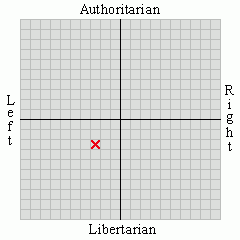
My Political Views
I am a center-left moderate social libertarian
Left: 2.64, Libertarian: 2.48

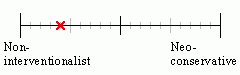
My Foreign Policy Views
Score: -6.04

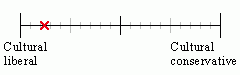
My Culture War Stance
Score: -7.51

Hat-tip: Dave at Big News; and ScrubOne (who seems to be my polar opposite) is apparently compiling another chart of the NZ blogosphere, so everyone knows which canned propaganda terms correctly apply to whom.

L

Lawsome

David Haywood has posted a mighty mashuptastic bit of Lawsery on the Richard Worth case which you should all read. Judging by some of his (Laws’, or should that be Lawses?) comments on the wireless this morning, I’d say it’s not too far off the mark.

L

Update: The actual column is somewhat, err, flaccid by comparison.