Half-baked

Paint your roof white, Marty G urges, and save the planet:

Just painting the dark roof of a 100m2 house white offsets 10 tons of carbon emissions – over half of average annual emissions per person.

If only it were that easy. Partly it is, of course – some of the gain comes from the heat being directly reflected back, and that bit still holds. But the paper refers to carbon emissions saved from people in white-roofed houses not needing to run air conditioners. That might be fine in Texas or California, or Australia but in NZ the problem set is completely different. Most people don’t have aircon, beyond the windows. Those who do probably use it for a couple of months a year, at most. A much greater problem in NZ is heating – so in NZ we should be painting our roofs dark in order to save on heating, right?

Perhaps what we need is a switchable system which can be dark or light when needed. But the lesson is a much more elementary one – house design should suit the locale.

Eagerness, again, is no substitute for thought.

L

DPF pulls pin, leaves town

… and the resulting explosion is nothing short of spectacular.

Tara Te Heke is one of David’s four guest posters holding the reins while he’s on holiday. She is a single mum on the DPB who had three kids with a violent partner who left her in the lurch. Her story illuminates one of the problems with the bootstraps bootstraps bootstraps ideology commonly espoused on David’s side of the fence: not everyone can be on the top of the pile. Achieving the status Paula Bennett has may be something to strive toward, but those who fail to achieve such status aren’t necessarily failures – after all, there are only a few hundred such jobs in the country. Holding Paula up as an example is one thing; it’s quite another to say ‘Paula did it – there’s no reason you can’t too’. It just isn’t so. Markets are stratified by nature: there are some to whom the whole market is open; many more who may only access the lower reaches.

Perhaps it’s Tara’s awareness of the KBR culture, her status as an outsider to it, and her ironic adoption of the its lexicon (‘rorting the taxpayer’ to describe her drawing the DPB, etc) which has stimulated responses from the laudatory to the self-congratulatory, to the defensive, the typically heartless to the genuinely compassionate and understanding, and even questioning whether she’s a Hone Carter-esque ringer. It’s a rare beast, the second thread, and worth reading in its crazy two-hundred-plus-comment entirety.

Update: But wait, there’s more! Watch, as (when they don’t suit your argument) stereotypes are declared, well, stereotypical. Or just plain made up.

L

Passion and reason about climate change

While I agree with most blogging folks that John Key was a fool to try to smack down Keisha Castle-Hughes for her role in the Greenpeace climate change campaign, I do still have concerns about the specifics of how she fronts it.

BK Drinkwater posted on this recently, and then took it back after some criticism. I don’t think his first instinct was that far wrong, but it was framed poorly – in terms of expertise as granting a right to advocacy, rather than expertise as being necessary to meaningful advocacy. I don’t have concerns about Keisha’s views or her right to advocate for them, or about her position as a young mother concerned about the future of humanity rather than a scientist or a policy expert, or about her being exploited for a cause. The problem for me is that Keisha’s advocacy is apparently based entirely in passion, and not at all in reason.

Her breathless and slightly incoherent performance on Close Up (horrible flash video) the other night, while it may have been inspiring for some, left me in little doubt that she doesn’t know anything much about the topic. She completely avoided answering Sainsbury’s question (from about 01:50) as to whether she knew anything about it – saying (again and again) that she was passionate about climate change and wanted to know what she could do about it. This is the problem with celebthorities (actorvists, pseudo-experts, etc.) – they frequently substitute passion for reason, and in doing so they encourage the wider public to do the same.

While I don’t expect celebrities (or anyone, really) to be an expert before they’re allowed to advocate, their passion for a cause should be somehow proportionate to their knowledge of it. Keisha’s passion seems to far (far) outweigh her knowledge, and passion without reason is dangerous. It may be that she does know more than the first thing about it – any reasonably intelligent person can familiarise themselves with the scientific orthodoxy in a few hours and after a few days of reading will probably know more than 90% of the general population – but as a media person, having not prepared a convincing answer to that question of credibility gives me serious doubt that she has any, even as little as the average celebthority. The same goes for her published response to Key on the signon blog. At the very least she should demonstrate some knowledge of the subject matter. Perhaps she’s saving this for the proposed tête-à-tête. Extreme optimism if that’s so.

Don’t get me wrong – both passion and reason are necessary weapons in the campaign arsenal. Al Gore’s passion was instrumental in breaking the issue into the mainstream, which no amount of science or evidence could have done. But passion without reason is especially dangerous when the task, as with climate change, is to convince people to believe and accept science, reason and evidence instead of uninformed opinion, ‘I reckons’, conspiracy theories and convenient misinterpretations of the evidence which perpetuate a particular lifestyle to which they’re accustomed. The primary tactic of climate change denialism is to muddy reason with passion, and get people thinking with their gut rather than their brains, and by privileging passion so completely over reason Keisha risks weakening the strongest weapons the climate change environmental movement has – science and reason and evidence.

Advocacy is great – but let it be based on something.

L

Sovereign Democratic Realism

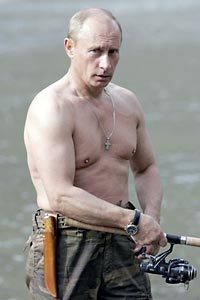
2003849206Via Scott Yorke’s excellent Imperator Fish, pics of Russian Prime Minister Vladimir Putin’s Siberian vacation photo-op.

The wider photoset (you’ll have to google around for all the photos, since each website only contains part of the set) is a strong statement of Russia’s new national identity as a fit, keen, ruggedly independent nation which is the master of its own destiny, answerable to nobody. Vladimir Putin idealises Russia as it wants to see itself.

The wider campaign propagandises Putin’s adopted doctrine of Sovereign Democracy, essentially ‘we call our system democracy, so democracy it is’. It fetishises Putin’s personal capability and authority; his command over nature, his idolisation by ordinary Russians (even those thousands of miles from Moscow), his statesmanship. Closely resembling what I/S calls Heinlein’s psychopathic frontier barbarism, Putin rides horses, treks in the mountains, fishes in a wild river, pilots a fast boat, builds a fire, helps rescue a beached whale, comforts an Ingushetian politician injured in a suicide bombing, works in a metallurgists’ plant, gives orders as to a train crash, visits a political youth camp, meets Alexander Solzhenitsyn’s widow, and shares tea with the locals. All with the cameras in attendance (and in some cases, with the sound guy in-shot – no attempt at pretending it’s not a propaganda exercise).

There has been much speculation as to the import of this photoset, ranging from the suggestion that, by appearing bare-chested in the outdoors on a holiday with the Prince of Monaco, Putin is sending a signal of tolerance about homosexual rights, referencing Brokeback Mountain. The semi-official spin, naturally, is that it’s simply a demonstration that Putin knows how to relax – a signal that he will retire peaceably at the end of his second term as Prime Minister.

I am not so convinced. This lays the groundwork for a perpetuation of Putin’s role as Russia’s eminent statesman of the 21st Century, and in a much more subtle and compelling way than either Hugo Chávez or Manuel Zelaya’s clumsy attempts at circumventing constitutional term-limits. The key to sovereign democracy is its illusory consent – the appeal to Russian independence, strength, unity and capability which Jonathan Brent and others have argued (audio) present the danger of sliding back to a new form of Stalinism, even with the support of those who would suffer under such a system. This is a strong warning to Dmitry Medvedev, who has criticised ‘sovereign democracy’ as a form of authoritarian doublespeak, and to the Russian people that if a ‘real’ leader is needed, one exists. Former KGB officer Putin, here, is presenting himself as another Man of Steel.

L

Word of the Day

Thanks again to James at Editing Teh Herald.

Hypocryptical: Being deliberately unclear while accusing someone else of doing something that you yourself are doing.

The each-way bet of glass-house-dwelling stone-throwing blog hackery.

L

Choose your own Americapocalypse

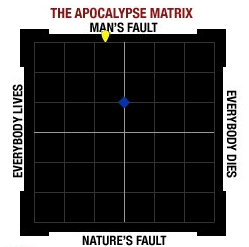
Pretend you’re a USian for a moment, go to Slate and pick up to five things you reckon will bring about the fall of the United States of America.

As for me:

apocalypse

You are a humanitarian internationalist. You’re convinced mankind will terminate America—but at least we won’t off ourselves in the process. You’ll know you’re right when: Everyone on Earth pledges allegiance to a world government; the feds default on the national debt.

The yellow dot is me, the blue dot is the average. Hmm.

(Via bOING bOING.)

L

Contrasting examples of cultural difference

Two very different perceptions of the way cultural difference operates. From Tauhei Notts, commenting on Kiwiblog’s thread about the guilty verdict returned against Taito Phillip Field:

I believe that the jury was not culturally sensitive. Many people in Foreign affairs who dosh out us taxpayers’ funds to Polynesian nations are aware that what Field did was par for the course. Indeed, Field was incredulous at the fact that charges were even laid against him. He could not, and would not, see that what he had done was wrong. This is because what he did had been done for decades by Polynesian leaders. Field is the first one to be found guilty of what most New Zealanders consider to be awful behaviour, but what Polynesian people consider okay. The natives of the South Pacific have always had a different slant on morality and I think it is our job to encourage them to join the 21st century world.

And from Raymond Huo, talking about the case of Danny Cancian, who is in prison for killing a Chinese:

With regard to business, Westerners are generally transaction-orientated. They walk in the door, figure out the deal, sign the contract and get out. Chinese, on the other hand, are relationship orientated. The Chinese concept of friendship, or guanxi, is vital. In a highly centralised state, the use of guanxi is sometimes the only way to get things done.
The core of guanxi is doing business through value-laden relationships. To some extent, guanxi is the counter-part of a commercial legal system. Don’t get me wrong – Asian people do respect contracts. They are ethical. The only difference is that they do business differently. Mostly, obligations come from relationships, not only pieces of paper.

I’ve spent no time in the Pacific islands, but plenty of time living in East Asia, where obligations attach to relationships developed in a more or less organic fashion between individuals, their roles and networks, and the censure of failing to fulfill obligations is rendered by those individuals, roles and networks rather than being imposed by external arbitration. I played the kibun game (I think) very well in Korea for three years, until the very last hurdle – severance pay in our final job. On our second-to-last day in the country, several days after it was due to be paid up, I lost my nerve and called my boss (who’d been good to us and generally trustworthy) and insisted that he pay us immediately. He did. An hour later he cancelled the meal which had been called in our honour for that night (and at which he was planning to present us with the money, all in good time).

Transculturalism is complicated.

L

Some sort of justice

The Australian and many other sources report that Austereo has suspended 2Day FM hosts Kyle Sandilands and Jackie O and their show indefinitely for their revictimisation of a 14 year-old rape victim on-air last week. Advertisers are boycotting the network and Sandilands’ other contracts are in jeopardy. A firm response.

L

On media bias and distortion

BK Drinkwater has posted a good response to some of the comments on Bryce Edwards’ synopses of chapters from the book Informing Voters? Politics, Media and the New Zealand Election 2008 (edited by Chris Rudd, Janine Hayward and Geoff Craig of the University of Otago Politics department). In comments to BK’s post, Eric Crampton recommended Groseclose & Milyo‘s paper on the topic. Having not read the book, I’ll constrain my comments to the posts, comments and paper which I have read.

[Apologies, this is a long and dry post on a topic very dear to my heart. I also banged it up in a spare couple of hours while I ought to have been sleeping, and haven’t proofed it, so it may be incoherent. I reserve the right to subedit it without notice. The rest is over the break.]

Continue reading “On media bias and distortion”

Normalising diversity

May I echo the inimitable Queen of Thorns, and say how great it is that Māori Language Week is being so well observed. Labour MPs on Red Alert are posting in te reo; Nickelodeon has done Spongebob Squarepants in Māori; Lockwood Smith is reading the Parliamentary prayer in Māori and Te Ururoa Flavell on Tuesday raised a point of order during Question Time (in Māori, no less!) to insist that the Minister of Transport pronounce “Kamo” as “Kamo” rather then “Carmow”. Even David Farrar has a post in Māori, and on that count he beats me at least. Well done.

Such usage is the thin edge of a wedge of linguistic diversity becoming normalised in Aotearoa. The wedge was first driven long ago, but one of the more memorable blows was struck by the venerable Naida Glavish who (working as a tolls operator) got in trouble for answering the phone ‘kia ora’ and generated great and unexpected support. When returning sick and exhausted, with no money and a broken shoulder from a long and abortive road trip across Asia (more on which another time), I could have hugged the (Pākehā) Air NZ cabin steward who greeted me with ‘Kia ora, bro, welcome home’. The NZ Herald has redesigned their masthead in Māori (though I can’t find a copy of it on the website just now). Māori introductions on National Radio and other media are commonplace these days and everyone knows what they mean. I recall the Māori Language Week last year, or the year before, when they were formally instituted and then – the horror! – their usage continued after the end of the week. There was apparently a bit of a backlash against it, and Geoff Robinson read some messages calling for a return to English-only introductions. Robinson, bless his English heart, had one word for the complainers: “tough”.

And that’s all they deserve. My high school German teacher had a banner above her blackboard which read “Monolingualism can be cured”, and it can be. Other languages must be used to be known, and normalisation is the first part of usage. Raymond Huo, also on Red Alert, is posting in Zhōng Wén; it is wonderful.

It goes beyond language, as well. Cultures, norms and ways of doing, approaches and modes of understanding are not monopolised by English-speaking WASP culture. I wrote earlier this year about a book by John Newton about James K Baxter and the Jerusalem commune – it is called “The Double Rainbow” and has been published. The title is Baxter’s, and Newton explains it in the introduction:

The double rainbow is Baxter’s symbol for a mutually regenerative bicultural relationship. He recognised that the Pākehā majority ignored Māori culture, not just to the cost of Māori – though few Pākehā have seen this more clearly or objected more trenchantly – but also to its own detriment. Pākehā, he wrote in 1969, a few months before he first moved to Jerusalem, ‘have lived alongside a psychologically rich and varied minority culture for a hundred years and have taken nothing from it but a few place names and a great deal of plunder.’

Diversity is both a means and an end. It is a means by which people may understand one another and live in harmony and all such wishy-washiness; but more importantly, it is an end in itself because two heads are better than one, every culture has its own irrationalities and blind spots and deleterious foibles. Humankind has achieved its primacy as a species through the constant adaptation of cultural and biological systems which spread risk rather than concentrating it. Monocultures are vulnerable; they may be unified and may even be strong against certain threats, but against uncertainty, or against threats or challenges of an unknown or unpredictable nature, homogeneity a weakness rather than a strength. Diversity is resilience. If you won’t believe me, take it from Robert A Heinlein:

A human being should be able to change a diaper, plan an invasion, butcher a hog, conn a ship, design a building, write a sonnet, balance accounts, build a wall, set a bone, comfort the dying, take orders, give orders, cooperate, act alone, solve equations, analyze a new problem, pitch manure, program a computer, cook a tasty meal, fight efficiently, die gallantly. Specialization is for insects.

Who wants a society of insects?

L