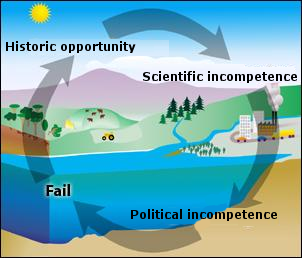
Climate credibility fail

fail

I’ve remained largely silent on the so-called ClimateGate thus far, mostly out of an abject lack of expertise to judge the whys and wherefores of it all. It’s science, I’m not a scientist. But given Poneke’s magnum opus on the topic, the likelihood of an IPCC Himalayan glacier retraction and a NZ Herald survey which found that New Zealanders harbour deep doubts about anthropogenic climate change, I thought it apposite to repost something I wrote the other day at the bottom of a very long (but interesting) thread (somewhat edited). It’s something I’ve argued many times in other contexts.*

Climate change is often couched as an important problem of the sort which democracies fail to address — along with things like the global credit crisis, and fascism. But the failure is not with democracy itself, but with the calibre of certain actors within it. Climate change is an issue which should have been hit out of the park by any political movement with any competence, because the magnitude of the stakes and the weight of both reasoned evidence and benign symbolic matter which it embodies yield raw material for the most profound and powerful sorts of political campaigns — the sort which fundamentally change peoples’ beliefs and allegiances and which, if properly conducted, can grant a political movement incredible license to implement far-reaching policy of the sort which reforms society at its most basic levels. The Great Depression was just such an event for Franklin Delano Roosevelt and Michael Joseph Savage. The miners strike was for Margaret Thatcher. September 11 was for George W Bush. And so on.

And yet, the skeptics are winning the battle of ideas around climate change. The failure to convince the electorates of the free world of the need for urgent climate change policy, a matter of the most critical and immediate importance backed by the best science available, reflects an utter failure on the part of political and scientific elites whose most important job it is to provide such leadership. The political and scientific establishment has squandered a phenomenal opportunity, with the exception of Al Gore, who with An Inconvenient Truth did more to progress the cause of gaining electorate buy-in to the topic than everyone else has done since. They are struggling and failing, not only to implement reforms of the magnitude which are required, but even to maintain the credibility of the scientific establishment.

Some [including Ag, to whom this was originally addressed] argue that it was always impossible to sell climate change to the electorate due to the vested interests amassed against it, cognitive biases, lack of expertise, plain ignorance, etc. Those are important factors, but other factors are more important and more controllable to boot — after all, people in a liberal society can only really control their own actions, and must be prepared to defend their positions against others.

The scientific establishment failed by allowing a tiny minority of skeptics and raving moonbats and vested interests to frame their establishment as a corrupt back-slapping club funded by grant money; by evading and prevaricating and playing dirty when legitimately challenged on important matters of fact and procedure; most recently by covering up emails and giving the conspiracy theorists grist for their mills. In defending their failures, they blame the heterodox minority, the vested interests, the rapturists and the conspiracy theorists.

Politicians have failed mainly by couching their arguments in favour of urgent climate change policy in terms of hard facts and economic figures, assuming that people could connect the dots themselves rather than spelling it out in terms they could understand at a visceral or intuitive level as well as when they whip out their utility calculators. The politicians blame the same people as the scientists, ignoring the fact that a generation of failure on their part to adequately contest the battle of ideas and to safeguard the political process against the influence of vested interests has allowed such lobbyists to become entrenched.

Part of this is systemic — there are problems with the scientific peer review system which politicians can’t understand; there are ruthless and well-resourced lobbyists with vested interests which have been permitted to entrench themselves in democratic political systems. But none of that is any excuse. They should have been able to drive it home anyway, given the raw material at their disposal. This is not a failing of democracy, but a failing of certain actors within the democratic system: particularly, those who believe so deeply that they are right, so they need not prove their case. People who think that inherent truth of the position will simply shine through. If their position was that strong, then it should have been easy, right? This ignores a fundamental reality of a free society: that people are free to be wrong, and must be brought about by reason and persuasion or not at all. I think it is that strong, and should have been easy.

The world is going to pay for the failure of climate scientists to adequately protect their credibility, and for the failure of politicians and policymakers to adequately sell the most politically saleable concept of the past generation — that the planet is going to get inhospitable if we continue to pollute it, and we don’t have a fallback position — and it’s infuriating that those responsible for this failure want nothing more than to shift blame for their own incompetence.

L

* It should be clear, but nevertheless: I’m not arguing that AGW isn’t real; in fact, the opposite: I am arguing that the problem is real but that the credibility of much of the evidence and the policy agenda is critically undermined. I don’t really buy Poneke’s conclusions drawn from his analysis of the emails, although I do accept that they demonstrate severe systemic and credibility failures which call a lot of the evidence into question. But in order to believe that it’s all a hoax, you have to believe in a scientific conspiracy of unprecedented scale, with no credible payoff. I just don’t see it.


The riddle of Key’s incredible popularity

ONE of the year’s intriguing mysteries remains the source of Prime Minister John Key’s popularity when there is no evidentiary reason for the continuing level of public support he enjoys.
In the US, the American public, both Republicans and Democrats, have long realised that President Barack Obama’s “yes, we can” is more accurately defined as “no, we can’t”, despite the passage of his health-care bill on Christmas Eve.
In this, he has achieved rare bipartisanship. Both major parties accept that the bill, in its current form, is a real stinker.
So much for compromising with the states and with every Congressman and Senator to get it passed.
Given Key has achieved nothing of similar magnitude […] he has finished his first year in office with a duck on the political scoreboard.
[…]
The mystery of Key’s incredible popularity may well lie in the sneaky admiration New Zealanders have for those who get away with extraordinary scams.
Remember how the Great Train Robber Ronnie Biggs found a haven (for a while) with his family in Melbourne while on the lam from British authorities and how he managed to stay ahead of the law while making good his escape to Brazil?
Biggs was no Ned Kelly, nor a Robin Hood, but managed to gather a surprising mass of public sympathy despite dudding his wife and children and was in all reality no more than a petty criminal addicted to good-looking women and a lazy lifestyle.
New Zealanders appreciate clever rip-offs and may not yet have cottoned on to the personal cost that they will have to bear from Key’s profligacy with their cash.

If I could spy on you, dear readers, I suspect I would see a few heads nodding in approval.

As the second-to-last paragraph hints, the above wasn’t written about John Key — it was written by conservative columnist Piers Akerman in Sydney’s Sunday Telegraph the week before last. I’ve replaced ‘Kevin Rudd’ with ‘John Key’ and ‘Australian’ with ‘New Zealander’ (and cut it, obviously).

But dedicated partisans on both sides are frequently similar in their thinking, and I’ve read pretty much this sort of argument again and again from Key’s enemies — people whom I hope are embarrased that they deal in the same sloppy generalities and bitter grumblings as Piers Akerman — over the past year. It misses the point, which is that he’s still popular. By definition, he’s doing well. And yet there is no ‘evidentiary reason’ for it to be so.

This provides a clue as to Akerman’s puzzlement, and that exhibited on this side of the Tasman with regard to Key’s ongoing favour: you’re looking at the wrong factors. The main factor omitted by Akerman and others of his sort is that he (Rudd or Key, take your pick) is emotionally resonant with the electorate. This matters; in some cases, it’s enough on its own. He (either of them) won a campaign based on next to no policy at all, leading the incumbent oppositions of the day to ridicule him, ignoring what was right under their noses: that policy wasn’t necessary.

The modern left’s obsession with facts and figures, expected utility and measurable outcomes should, in a rational world, grant them a strong advantage in any political contest. Indeed, the classical analysis is that democratic political systems which apportion votes by population rather than by wealth are inherently biased toward the working classes who are more numerous by definition. Given the assumption that Labour’s policies objectively provide greater material advantage to a larger number of electors than National’s policies, they should win that horserace every time. But they don’t, because politics is not rational. Concrete policy achievements are not the key to political success; their impact is largely limited to how they make the electorate feel about the party and candidates, not how they impact on the electorate in observable, material terms (although, depending on the policy, this can have considerable impact). The link is not direct and linear: there’s a crucial and very complex layer of abstraction which most politicians on the left simply don’t see.

Drew Westen (about whom I’ve been raving to anyone who’ll listen for the past year or so) goes into much more detail about this, and his book The Political Brain should be required reading to anyone who wants to know how people actually think about politics — when they think at all, which isn’t very much or very hard.* He calls this focus on reason ‘trickle-up politics’; as valid, he says, as trickle-down economics. This strategy concentrates its firepower on the dispassionate brain, the least-important part when it comes to making important judgements, and disdains that which lurks beneath — the part which can call upon deep-seated experience and instinct to order the supposedly rational brain to do what feels right, utility calculations be damned.

Generally speaking, the right understands this better, and they tend to lead from the gut. This provides the left with what they think is an opening to debate the matter on facts, not realising that facts aren’t very important in political decision-making. Westen and other researchers have found in a wide range of experimental situations that they can predict with greater than 80% accuracy a person’s position on a given political issue of the day, knowing only how the person feels about the issue. Adding facts back into the equation only improves predictions by a few per cent. They literally don’t matter without the emotional resonance. This is true for everyone from randoms on the street to justices of the Supreme Court. It’s just how people are.

So, my one wish for the NZ left for 2010 is this: stop thinking of political popularity as the result of naked appeals to the material self-interest of utility accountants; stop hectoring those who remain unconvinced and ask why they are unconvinced, without resorting to the lazy option of complaining that they are fools or stricken by false consciousness or that they just like a good scam when they see one. Start thinking of politics as a system for engagement and trust-building, by which to build a mandate to make a better country. National aren’t that strong; it’s just that they’re against opposition who turn up to the battle for hearts and minds armed with a spoon.

L

*Westen’s research is American and focuses solely on the two-horse Republican v Democrat battle, so it isn’t directly analogous to NZ or Australian politics. Nevertheless, most of the traits he observes hold true to a fairly large extent.

More flaggery

Interesting discussion about flags going on at John Ansell’s blog and Kiwiblog and elsewhere. Go and vote on your favourite fern flag. I’m all for a new flag, but these designs are too logo-ish for my taste. Flags seem to me like the sort of things which ought to be made up of geometric fundamentals. That having been said, I think Ansell’s design A is emblematically the strongest, but I don’t think solid black is an appropriate colour for a national flag. If pressed I would reluctantly choose E or C. Is there an obvious reason why green and black aren’t paired somehow?

Fun thought: would the monarchists and traditionalists and nationalists be claiming victory if the government decided to adopt a new national flag which crown agencies would use, with the proviso that other folks could use the old flag if they wanted?

L

Bhadge

I’ve been very busy again this past week, and so the list of things I want to write about copiously exceeds my ability to write about them. My promised post about internecine disputes is in very early draft form but I’ll try and get it finished soon. I still have a post planned looking at the wider implications of the foreshore and seabed review, but I think that’ll have to wait until after I’ve painted the roof.

yep_im_a_redneck_button-p145980559379977550q37f_400I also wanted to write a lot about the final outcome of the h debate, but find that my views have already been pretty well encapsulated by Andrew Geddis and Idiot/Savant. You should also read Scott Hamilton’s latest on the wider topic of Pākehā separatism.

Given that the decision declares both ‘Wanganui’ and ‘Whanganui’ correct, but mandates crown usage of ‘Whanganui’, there’s as clear an implicit statement as can be that the latter is more correct than the former. This has been clearly understood by TVNZ and Radio NZ, who have adopted the latter usage as a matter of editorial policy. They are owned by the crown, after all, and both just happen to be in direct competition with Laws and his media employer. Permitting both spellings but making this declaration as to primacy was a move as shrewd as it was elegant by Maurice Williamson — similarly to John Key’s decision to permit the flying of a Māori flag if only Māori could agree on one. Michael Laws, Tariana Turia and Ken Mair have all claimed victory, so everyone with an actual stake is nominally happy. The Standardistas and the KBR are furious, which is a pretty good sign. It obviates the strongest symbolic position occupied by Laws, the idea that Wellington is coercing Wanganui into doing its PC bidding. Wellington need not — the rest of the country will do that, because the use of the no-h word will be an identity marker, a statement, like a badge; not quite “Yep, I’m a redneck” but something approaching it. The thing is that Laws and his rump of greying die-hards do not simply face a disorganised and discredited bunch of radical natives; they find themselves standing against the inexorable tide of civil society and its evolution, a youthful and browning population for whom biculturalism is the norm and separatism stopped being cool a generation ago (if it ever was).

Who knew that all Michael Laws wanted for his cause was an emasculating partial endorsement and a prolonged death sentence? He could have saved everyone (and his own reputation) a great deal of trouble by making this plain at the beginning. In other circumstances, I would be angry about everyone having been taken for a ride — but as it stands, I’m mostly just quietly pleased that civil society’s tendency toward self-correction will be left to do its thing.

L

The flag: politics either way

It’s impossible to ignore the fact that every single one of those Māori I’ve heard speaking out against the tino rangatiratanga flag has a tribal axe to grind. Shane Jones, Kingi Taurua, Pita Paraone, Winston Peters — they’re all from the iwi of that group of rangatira who established the United Tribes of New Zealand confederation under Busby in 1835, in the Tai Tokerau. They, naturally enough, want the United Tribes flag flown instead of the one which represents the aspirations of wider Māori. The root of this claim is the belief among those groups that theirs was the ‘state of origin’, as it were — the first actual state in these lands. That’s a complex and disputed claim but regardless, the belief abides, and this sense of primacy is no small part of the reason that so many of this country’s Māori statesmen and women, great thinkers and inspirational leaders, come from the tail of Te Ika a Maui.

They say there’s an ulterior motive in the flying of the tino rangatiratanga flag on the part of the māori party, who have adopted it as their own, and I accept they have a case. They also have a case to argue that the United Tribes flag should be flown — especially at Waitangi Marae (Te Tii), where the choice belongs solely to mana whenua. But let’s not pretend there’s no ulterior political motive on their part: they have every reason to decry the flag as ‘separatist’ and ‘divisive’ in order to fly their own. Not only that, but the motive is no more unanimous among Ngāpuhi than among other Māori — the tino rangatiratanga flag is supported (obviously) by Hone Harawira, and was designed by Hiraina Marsden, the daughter of the Rev. Māori Marsden, one of the most important philosophical figures of that iwi, and a mentor to Shane Jones and many others. So the political motives in play are much more complex than they appear.

As for Winston Peters’ objection that the tino rangatiratanga flag is ‘political’ — was there ever a more ridiculous assertion? The whole purpose of such a flag is to symbolise and propagandise political identity, to provide it focus and expression. The United Tribes flag is no less political than the tino rangatiratanga flag — and so it becomes a matter of picking which symbolism is more appropriate.

On the one hand we have a long historical pedigree, and a flag which represents the early unity of the NZ proto-state and the formal beginnings of collaboration between tangata whenua and tau iwi, but which actually represents only a small subset of the Māori population and whose political cause (to establish a client state sympathetic to the English in their manouvres against the French) was superceded by the Treaty of Waitangi only a few years after its establishment.

On the other, we have a relatively new flag, one whose symbolism and history is exclusively Māori, rather than being part of a wider game between colonial powers; a modern flag representing modern, rather than historical aspirations but which has, to an extent, been hijacked by the radical movement.
For me, it comes down to the process enacted by the government: wisely, instead of deciding by fiat, John Key instructed Māori to decide, and decide they did, with more than 80% of the 1200 submissions in favour of the tino rangatiratanga flag. This is not to side with majoritarianism, but to say that choosing another flag would have been manifest politicking. Better from Key’s perspective to devolve the decision and allow an age-old struggle to re-emerge: he looks statesmanlike, and both his erstwhile political friends and his enemies get bogged down in internecine fighting. I had hoped it wouldn’t happen; and it might yet prove minor. But the issue won’t go away — nor should it.

L

Deeply subversive

Some of you will know that I take perverse joy in waking up to Geoff Robinson and Sean Plunket each morning,* and I regard Sean as one of the country’s best interviewers (and the best hard-news interviewer, though Mary Wilson gives him a fair run some days). Pablo has written about Radio NZ’s treatment of him over his bid to write a column for Metro, and I think it’s fair to say he (Sean) is pretty sore about the whole affair. He does not strike me as one to trifle with, and though I can’t quite put my finger on it, I think something very subtle is going on with Sean Plunket’s new blog: Sean Makes Crafts.

Welcome to the blogosphere, Sean. We watch with interest.

Update: It seems Poneke and The Standard got onto this before me.

Update 2: Sean Plunket denies he has anything to do with it. Well, that’s just the sort of thing he would do, wouldn’t he?

L

* Not only me. My daughter, just turned 1, does a little dance when she hears the Morning Report music. Strange, but true.

Back away slowly

Update: This post was a response to an attack on me by Chris Trotter. Since it was published, Chris has graciously apologised for writing it, and for the general bad blood between us. He has deleted the post from Bowalley Road, and I give him my hearty thanks for the reconsideration.

I have also been culpable in this rather nasty exchange, which stretches back almost a year. For that part in it I, too, must apologise. While I retain strenuous objections to Chris’ political positions (as I’m sure he does to mine) these needn’t have become personalised, and are better discussed calmly as befits reasonable adults. While they may yet prove intractable, it should be possible for people in a free society to hold irreconcilable differences and yet remain civil. Much heat, and too little light, has emerged from this meeting of political minds, but I think there is potential for future engagement between Chris and I based on some sort of goodwill and tolerance rather than upon vituperation and political posturing, and I will do what I can to cultivate it.

While Chris has deleted his post, I do not believe in tampering with the historical record in that way. While I might regret things I’ve said, I won’t pretend I didn’t say them. And so the content of my response remains below the fold. It should be read with the subsequent context and this apology (and pledge to more constructive engagement in the future) very firmly in mind. In fact, the most worthwhile thing by far to emerge from the dispute is an unexpectedly useful discussion led by commenter “Ag” on the nature of class consciousness and electorate rationality: I commend that discussion, rather than the post from which it emerged, to the KP readership.

L

Continue reading “Back away slowly”

‘Blue collars, red necks’: triply flawed

To those who stick up for their identity, socialism sticks up two fingers!

In the coming years, core tenets of socialist and indigenist faith will be tested. Labour, with its recently-adopted ‘blue collars, red necks’ strategy, has struck out along a path which requires a large slice of its core constituency — Māori — to search their political souls and choose between the renewed Marxist orthodoxy which privileges class above all else; and the progressive social movements developed over the past three or four decades which have produced a society tolerant enough to permit their unprecedented cultural renaissance.

The strategy indicated by Phil Goff’s speech appears to be substantially based on the simple calculus, most forthrightly argued by Chris Trotter, that ‘social liberals’ are fewer in number than ‘social conservatives’ among the proletariat, and therefore an appeal to ‘social conservatism’ will deliver more votes than the equivalent appeal to ‘social liberalism’. This is couched as a return to the old values of the democratic socialist movement — class struggle, and anything else is a distraction. But because the new political strategy is founded upon an attack on Māori, it requires that working class solidarity wins out over indigenous solidarity and the desire for tino rangatiratanga in a head-to-head battle. Māori must choose to identify as proletarians first and tangata whenua second. Similarly, the māori party’s alignment with National and subsequent intransigence on issues such as the Emissions Trading Scheme asks Māori to privilege their indigeneity over material concerns.

An article of faith of both socialist and indigenist movements is that their referent of political identity trumps others: that all proletarians are proletarians first, and that all indigenous people are indigenous people above all else. In the coming years, unless Labour loses its bottle and recants, we will see a rare comparison as to which is genuinely the stronger. Much of the debate which has raged over this issue, and I concede some of my own contributions in this, has been people stating what they hope will occur as if it surely will. For this reason the test itself is a valuable thing, because it provides an actual observable data point upon which the argument can turn.

A spontaneous interlude: I write this on the train into Wellington, in a carriage full of squirming, shouting, eight and nine year-olds on a school trip to the city. In a (rare) moment of relative calm, a few bars of song carried from the next carriage, and the tune was taken up enthusiastically by the — mostly Pākehā — kids in my carriage.

Tūtira mai ngā iwi (aue!)
Tātou, tātou e.
(In English:
Line up together, people
All of us, all of us.)

Read into this what you wish; one of life’s little rorschach tests.**

Clearly, I don’t believe Māori will abandon the hard-won fruits of their renaissance for a socialist pragma which lumps them and their needs in with everyone else of a certain social class, which in the long term would erase the distinction between tangata whenua and tangata Tiriti. This distinction will fade with time, but that time is not yet come. For this reason I believe the strategy is folly at a practical level. Add to which, the appeal to more conservative social values was always going to be strong among Māori and Pasifika voters, so the left and right hands (as it were) of the socialist conservative resurgence seem unaware of what the other is doing: with the left hand, it beckons them closer, and with the right it pushes them away.

My main objection to the ‘blue collars, red necks’ strategy is not practical — although that would be a sufficient cause for opposing it. The main reason is because of principle, and this question turns on an assessment of the left in politics. Trotter and other old-school socialists (and presumably Pagani and Goff and the current leadership of the Labour party) believe that the left has been hijacked over the past generation by non-materialist concerns and has lost its way as a consequence. I believe that the wider social concern with non-material matters has saved socialism from its own dogma.

Largely discredited as an economic system and its legacy irretrievably tarnished by the catastrophic failure of practically every implementation, socialist-aligned parties on the left have been forced to diversify from a strict focus on what’s in the pockets of the proletariat to what’s in their heads — what they care about and who they are, their identity beyond being ‘the proletariat’. In doing so these movements have embraced liberalism, social equality movements, and environmentalism, and the resulting blend, termed ‘progressivism’ has become part of the political orthodoxy, such that the political right must now pay at least some mind to these considerations if it is to remain viable. This broadening, and the progressive movement’s redefinition of what is right by its general and gradual rejection of racism, sexism, sexual and religious discrimination, among others, has been hugely beneficial to society. For reasons of principle, it should not be discarded out of cynical political expedience.

Furthermore, maintenance of the social liberal programme has strategic, pragmatic value. It has enabled left political movements to broaden their support base and engage with groups often marginalised from politics, breaking the previously zero-sum rules. The modern Labour party has built its political church upon this rock of progressive inclusion, broadening its support base by forming strategic alliances with Rātana from the time of the First Labour Government and less formally with the KÄ«ngitanga and other Māori groups, to which the party owes a great deal of its political success. The progressive programme has broadened to include other groups historically marginalised by the conservative establishment. For Labour to shun its progressive history and return to some idealised socialist pragma of old by burning a century of goodwill in order to make cheap electoral gains by emulating their political opponents is the same transgression many on the economic left have repeatedly levelled against the māori party, and with some justification: selling out one’s principles for the sake of political expedience is a betrayal, and betrayals do not go unpunished. In this case, the betrayal is against the young, who will rapidly overtake the old socialist guard as the party’s future; and Māori, who will rapidly overtake the old Pākehā majority in this country’s future. The socialists might applaud, but Labour represents more than just the socialists, and it must continue to do so if it is to remain relevant.

So, for my analysis, the ‘blue collars, red necks’ strategy fails at the tactical level, because it asks Māori to choose their economic identity over their cultural identity; it fails at the level of principle, because it represents a resort to regressive politics, a movement away from what is ‘right’ to what is expedient; and it fails at the level of strategy, because by turning its back on progressivism the party publicly abandons its constituents, and particularly those who represent the future of NZ’s politics, who have grown up with the Labour party as a progressive movement. It is triply flawed, and the only silver lining from the whole sorry affair is that (again, if Goff and Pagani hold their nerve) we will see the dogmatic adherence to class tested and, hopefully once and for all, bested.

L

* Of course, Goff claims it is no such thing. But Trotter sees that it is and is thrilled, and John Pagani’s endorsement of Trotter’s analysis reveals rather more about the strategic direction than a politician’s public assurance.

** I see this as an expression of how normalised Māori-ness is among young people, and as much as can be said from the actions of nine-year-olds, an indicator of NZ’s political future.

Insensitive and hypersensitive

In the Insensitivity and hypersensitivity paper I referred to previously, Raymond Nairn and Timothy McCreanor studied submissions to the Human Rights Commission in response to the Haka Party Incident in which He Taua, including one Hone Harawira, broke up an offensive Auckland University engineering school mock-haka (this is poorly documented on the internets, but see here). They found that Pākehā responded by conceding that while the students may have been insensitive, He Taua were hypersensitive. This was and remains the default mode of rationalising race relations incidents in NZ: no matter whether it’s having their haka mocked or their Foreshore and Seabed nationalised, those Māoris are always complaining about something.

The insensitive-hypersensitive contrasting pair is a victim-blaming technique: the assertion that while we may have been insensitive, they are hypersensitive. This is presented as a concession but is in fact an attack which minimises the ‘insensitive’ party’s wrongdoing and magnifies the other party’s ‘hypersensitivity’ as a character flaw:

The term ‘hypersensitive’ carries a psychological load for which there is no parallel in ‘insensitivity’. Insensitivity is represented as deriving from ignorance; as such it can be dispelled by information. It is to be regarded as transitory, incidental, and non-deliberate. From a state of insensitivity an individual can act in ways similar or identical to those who are malevolent but is less culpable because a plea of ignorance can be made in mitigation.
[…]
In contrast, hypersensitivity is represented as deriving from emotional sources and is thus internally mediated. Such psychological phenomena are seen as part of the person’s nature and are not easily accessible to adjustment. Hypersensitivity is thus regarded in the same way as aggression, introversion and other personal characteristics. […] The association of hypersensitivity with emotion and indeed with extremes of emotion facilitates the marginalising of the actions and beliefs of people so labelled in ways which removes them from serious contention in social debate.

… and it’s ‘Warrior Gene’ all over again. Moreover, the common lexical root of the terms produces a false equivalence which amplifies this imbalance:

Blaming both sides, albeit one more than the other appeals to readers’ commonsense lore. […] It doesn’t matter that the unequal weighting of the ideas of hypersensitivity and insensitivity prejudices the judgement.

The sweet irony of this device is that, where there is a genuine imbalance of offence perpetrated by one group against another, it requires the offending group to be both insensitive to their own actions, and hypersensitive to the response of the group against whom the major offence was given. So it is with Hone Harawira’s deeply foolish, divisive and unhelpful comments of late: Pākehā New Zealand took hypersensitive umbrage at the terminology while insensitively ignoring the much greater offence caused by the repeated injustices visited upon Māori. I do not defend Harawira; the purpose is only to illustrate that this remains very much the standard means of reasoning around such incidents.

And so it is with Phil Goff, who played the insensitive/hypersensitive Pākehā role to the hilt in his response to Harawira, and has compounded that ill-considered reactionary stance by extending the narrative to the Foreshore and Seabed and the māori party’s decision to coalesce with National. This implies that Labour still thinks that Māori were unreasonable to object to the mass nationalisation of resources to which they had a legitimate claim in law, and that by cutting loose and forming another party they had somehow given greater offence to Labour than the original nationalisation had justified.

The message from Goff’s Labour party is loud and clear: we make no apologies for the decisions taken while being chased by the Brash Iwi/Kiwi monster, and are now prepared to do it all again if need be. This is a damned shame for the country, and for the party. Labour had a great opportunity to mend its bridges with Māori, as the māori party is burdened with an appalling ETS and its more and more fraught partnership with National — and instead of doing so they set another charge and detonated it. The Māori electorate will not support a Labour party which has declared itself the party of blue-collar Pākehā rednecks who are sick of ‘those Māoris’ and their complaining about things which happened the century before last. Where will they go? What will Labour do without them?

L