Torpedoes?

Paula Bennett’s damn-the-torpedoes attitude toward the Attorney-General’s advice regarding the Bill of Rights Act — and Idiot/Savant’s observation that this is just the latest bit of policy in breach of that act — has me wondering. What happens if there are torpedoes?

What happens when a widower has his benefit cut by WINZ, having refused a work test which a woman in identical circumstances would not be required to undergo? Surely he has recourse to sue WINZ for that breach. If that’s so, and it seems like in a civil society governed by the rule of law it should be so, the government will surely open themselves up to considerable legal liability by implementing and enforcing this sort of policy (quite apart from the symbolic side of such cases getting hauled through the courts, and so on).

Can some of you lawyerin’ types out there in the internets give me a pub-argument explanation of the issues in this situation?

L

Yours, not mines

Labour’s campaign against mining Schedule 4 land looks strong, especially at the iconographic level.

The slogan and to an extent the photo frames the issue as a matter of identity, echoing Phil Goff’s “the many, not the few” and Phil Twyford’s “not yours to sell” (though the visual style has come a long way since that campaign, and there’s some subject-object confusion). It also echoes Iwi/Kiwi, undoubtedly the most effective campaign of this sort in recent memory. The hard economic matters — the cost-benefit analysis between mining and tourism and so on — are there, as they should be, but backgrounded to the symbolic concerns.

Goff is clear that he’s not anti-mining, but wants to focus on the 60% of mineral resources outside the DOC estate. That’s the crucial point to make because it draws a bright line between acceptable and unacceptable which is still well north of Schedule 4 — to cross that line the government must first gain electoral consent to mine DOC land, and having done that must gain consent to mine the most precious areas of that estate. The point isn’t that mining is all bad; the point is that mining conservation land is worse than the alternatives. The job of the opposition, environmentalists and anyone who loves the fact that NZ still has wild places which are sacrosanct, or who thinks of those places as a part of them, is to relegate the idea of mining them to the political too-hard basket.

Labour and the Greens are also well-coordinated on this, with Metiria Turei pointing out the government’s duplicity in not revealing its intent to mine areas on Great Barrier Island which are under Treaty negotiations. The māori party should get in on this, as well. It looks good.

L

Sacred illusions

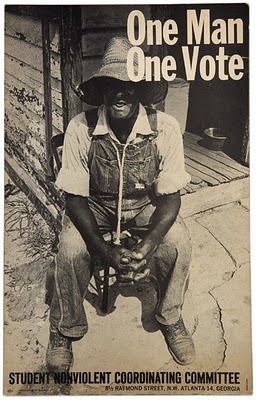
one man one votePita Sharples has severely undermined his own and his party’s credibility with his Race Relations Day speech criticising “one person, one vote”. As a minister in a democratic government, he has taken aim at one of democracy’s fundamental symbolic virtues, in such a way as to give the impression he (and his party) are anti-democracy. After years of fighting for the voices of mana whenua to be heard in democratic politics on strong principled grounds, Sharples seems now to have accepted the extreme right’s framing of that representation as antithetical to democracy.

Let’s just be clear: “one person, one vote” is no sort of actual democracy, it is an illusory ideal which persists only in hearts and minds, placed there by bold principles and the stirring oratories brought by democratic leaders of old looking to appeal to something bigger than they were. Even our present democracy, which is a very great deal closer to the ideal than the original American system, is pretty far from “one person, one vote” at a functional level. For a start, we have two votes. Even if you had one, what sort of vote would it be: first-past-the-post, where you’re at the mercy of geography; or single-transferable, where you’re not sure until after it’s all over who your vote actually got counted for; or what? For another thing, you can be a person and not have a vote — people under 18 don’t, prisoners convicted of serious offences don’t (and that could soon include all prisoners). There are more, but I won’t go on — the point is that “one person, one vote” is symbolic, not literal.

But neither are Sharples’ objections literal, they are symbolic. In the non-literal sense, what “one person, one vote” means is the opportunity for equality of input into the electoral process — whether that be by one or two votes, in a big electorate or a small one. What happens after that is democracy in action. In this regard, an electoral system which pays at least some regard to the principle of “one person, one vote” is a minimal bound for a modern democracy (though there are others also). Sharples’ criticism is that this isn’t enough — that democracy should be about equality of outcome rather than input. I agree — and I think very many other people do as well. Making democracy work takes much more than votes. But when it’s framed in the way he has framed it, this sort of discussion is political poison, because it attacks the heart of our political culture. This “race-based” framing of mana whenua political representation has been expressly developed in order to make those things seem indefensible in a liberal democratic context. Sharples has swallowed the hook, and instead of continuing to defend the Māori Seats and mana whenua representation on the existing and well-proven grounds (that it’s necessary for the establishment and maintenance of tino rangatiratanga, guaranteed by the Treaty) he has made a declaration which amounts to “yeah, they’re anti-democratic: so?” The most ridiculous aspect of it is that the existing mechanism which is so reviled complies with the principle of “one person, one vote”: electors on the Māori roll get get the same vote as anyone else, the only difference is in how they cast it. There is equality of input to the democratic process by Māori at the electoral level — it’s elsewhere in the process which is the problem.

I’ve argued before that the core symbolic and philosophical stuff of modern democracy is liberalism of one brand or another. No mainstream political concern can hope to win a democratic mandate without founding a lot of its agenda in liberalism. The symbolism of “one person, one vote” is crucial to this orthodoxy. Charles Elder and Roger Cobb, in The Political Uses of Symbols presented a typology of political symbols in the American context, organised into “political community” symbols which express political values at the highest level (“America”, “The Flag”, “The Constitution”); through “regime” symbols which express the political values of the current orthodoxy (in this case, American democracy, not a specific administration — the examples given are “The Presidency”, “Congress”, and “One Person, One Vote”); and three classes of “situational” symbols which express particular policy or administrational preferences of lesser affect (“The Reagan Administration; “gun control”, etc.) The higher up Elder and Cobb’s typology you go, the greater the degree of political consensus on the values imbued in a particular symbol. Nobody in American politics gets anywhere if they stand against “America”: the task of politics in that context is to convince people that what you stand for is “America”. “One person, one vote” is pretty high up that symbolic ladder. It is an illusion, but it’s a sacred illusion.

Every party in New Zealand’s parliament at present, except one, lays claim to this broad liberal tradition in one way or another. That one party which does not is the māori party. That is not to say that their agenda isn’t broadly liberal in function, but that it’s largely that way for non-Western-liberal philosophic reasons. This is the māori party’s great electoral purpose: to normalise an indigenous political-philosophical tradition. But they can’t do so this way, by attacking the liberal orthodoxy’s sacred illusions, the bedrock values held even by those who would never dream of calling themselves liberals. The māori party, more than any other, must recognise the value of “one person, one vote” as part of the history of democracy working for downtrodden minorities rather than against them, and adopt this as part of its own political basis.

As libertarians have discovered, if you don’t really believe in democracy it’s best not to bother with it — then you get to maintain whatever you claim as high moral ground and leave the actual business of governing to those who lack your unshakeable principles. But that’s not what the māori party is about. They do believe in democracy; they do recognise the importance of engagement and compromise and consensus, and they do plenty of work toward it, and a misguided outburst like this one puts it all in jeopardy. “Race-based” is National’s catch-cry from just a few short years ago, and they will take any encouragement given them to reach out to New Zealand’s conservatives, who are already distrustful of the māori party. It will force Labour further down the path of attacking the māori party to try to recapture the centre ground, rather than encouraging cooperation and the mending of fences. Most critically, it could create a backlash against the very mechanism Sharples seeks to save, generating opposition to the Māori seats his party needs for its survival, and which exist only by the pleasure of the Pākehā majority whose sacred illusions he has slighted.

While it should have been underway already, the māori party must now redouble its efforts to appeal to voters outside the Māori electorates, and prepare to live in a world without them.

L

Impunity, freedom and student body politics

fat_boy_slim_-_youve_come_aJust before the end of the university term last year, Peter McCaffrey and ACT On Campus gave the Victoria University of Wellington Student Association an object lesson in how democracy works. They successfully passed a resolution that VUWSA make a select committee submission in support of Roger Douglas’ Education (Freedom of Association) Amendment Bill (making student association voluntary) despite various machinations employed by the VUWSA members and officeholders there. These events were well documented in text by Jenna Raeburn and in video with a ridiculously triumphal soundtrack (irony noted by felix).

The fundamental problem of non-democratic (and poor-quality democratic) political systems is that they shelter those in power from the consequences of their actions. Authoritarianism (and authoritarian communism in particular) is deleterious not so much due to the economic failings of the system (such as the economic calculation problem) as due to the fact that in such systems there exists no mechanism to force, require or even encourage the leadership to act in its peoples’ interest. I’ve written a lot about the power transfer problem of orthodox Marxist pragma, and this is an aspect of it. When the leadership is invested with the monopoly power and authority to suppress a counter-revolution, how do you ever get them to relinquish it?

The effect of impunity is similarly evident in other fields; particularly in commerce, where the customary opposition of the terms “freedom” and “regulation” are little more than straw soldiers in a propaganda battle. Peter Drahos and John Braithwaite have written at length about the extent to which so-called free trade mechanisms such as TRIPS are instruments of international coercion more than they are of international trade, and how almost the entire intellectual property system of the modern world has been so thoroughly captured by existing rightsholders that it now functions as a form of privatised regulation by asserting near-impassable barriers to entry into the information marketplace. This suppresses competition, promotes the establishment and maintenance of cartels between existing participants, and all this breeds impunity, where participants have no (or few) reasons to develop their products and services to suit their users’ needs, and so they develop them to suit their own needs. The results are everywhere; for instance, in the fact that people are compelled to purchase Microsoft software with most new computers although they might hate and despise it, or simply not need it; or in the fact that those same users, having reluctantly purchased Windows since there are no easily-accessible alternatives (those having been shut out of the market years ago by patent thickets, bundling, cross-licensing, and so on) are then locked into using proprietary media formats, players, content distribution and communication systems with (in some cases well-known) surveillance functions and which are designed to restrict a users’ rights to their own hardware, content and communication, so that the system — and users’ participation in it — works in the provider’s interest, rather than the interests of its users.

That example is just one with which I’m familiar. Much more socially and economically important examples exist; particularly around medical development and crop research. But the point is that this whole system, billed as being about “freedom”, does not mean freedom for users so much as rightholders’ freedom from the need to cater to their users without fear of someone else eating their lunch.

Returning to student body politics. When a student union compels fees from its students, and when students who disagree with the union’s agenda are unable to withdraw their support, what incentive is there for the union to represent the interests of the student body? The political consequence of that system is a student body politic so complacent due to impunity in charge of millions of dollars a year in revenue that it literally cannot organise a SRC vote to save itself.

I am no great supporter of VSM; I view the threadbare rhetoric of “freedom” employed by Douglas, McCaffrey and so on with a jaundiced eye. I don’t believe people should simply be able to “opt out” of their society if they don’t like it, and I accept that the loss of revenue which will result from the (almost certain) passage of Douglas’ bill will place much of the genuinely good work student unions do in jeopardy. But the integrity of political systems is more important than discrete policy outcomes, and to be perfectly frank VUWSA, for its rank incompetence and duplicity in the face of legitimate challenge, deserves to be humiliated in this way.

I hope that the lesson about how democracy works will be well understood — that is: unless people make it work, it doesn’t. CSM as currently implemented promotes apathy and idiocy in student body politics, to a greater extent than it would exist in any case. That is bad for student body politics, and it’s bad for students. It depresses the quality of candidates and policy, and reduces the system to a comic farce which many students are justifiably ashamed of (if they care about it at all). Much better, for me, would be the the genuine politicisation of student politics, with groups organising and campaigning on their positions, winning a mandate and executing it, as in national and local body politics. If ACT on Campus want to campaign on “letting you keep more of your money”, let them do so, and good luck to them. (Of course, they have been, and it hasn’t been working out for them, so the parent party has resorted to regulation in the name of freedom. Plus ça change.)

So in my view the current threats to compulsory student unionism is largely the fault of the student unionists and their sense of entitlement to membership dues without the need to prove the value of their work to those who pay for it. The Douglas bill, while it will likely prove deleterious to the good work student unions do, may have a silver lining in that it will enforce greater discipline and competence upon student politicians, and require them to prove to their constituents that the work they do is actually valuable in order to win a mandate. If the work they do is genuinely valuable, as they say it is, such a mandate should be winnable. May they go forth and win it.

L

Postscript: Go and submit!
Select committee submissions on the bill close on 31 March 2010. Whatever your views, make them known. As I’ve said, I think it’s likely to pass (bloc support from ACT, National and UF), but that shouldn’t prevent you from making your views known. Incidentally, I approve of the relatively impartial editorial line taken by Salient, the VUWSA magazine. Especially given that this august [sic] organ depends on CSM for much of its funding, this is a bold and principled decision. Well done Sarah Robson.

More narrativium

A fortnight ago I wrote a post about how the government’s conduct in office makes them vulnerable to accusations of cronyism and a tendency to be vague about the boundary between the political and the personal. In the past week, two more events have come to light which fit this narrative.

The lesser of the two is former National minister Roger McClay winding up in court for claiming mileage and expenses from his non-profit employer when they were paid for by the parliamentary service. It’s a long time since he was in parliament, but the episode speaks to the character of senior National party members.

More egregious is the decision to appoint former National Deputy Prime Minister Wyatt Creech to stitch up Environment Canterbury, which makes a great one-two punch with the news that they want to appoint former National Prime Minister Jenny Shipley as Commissioner. Thanks to I/S at No Right Turn for joining these dots.

Christchurch Central Labour MP Brendon Burns has made his views pretty plain, and as a consequence, the scrutiny may discourage the appointment. That’s the thing about keeping an eye on cronyism: it enables an opposition to punish a government brutally for both its past and its current misdeeds, and it brings a level of scrutiny from the media and other public agencies which has a chilling effect on further misdeeds. Even aside from the partisan advantages this brings, that’s good for democracy either way. Of course, in order to take full advantage of this narrative, Labour has to come out and actually denounce Taito Phillip Field’s own corruption during his time as a Labour minister. That’d be good for democracy, too.

L

Heartless commuters


Image used without permission (but with thanks!), by David Fawcett.

Earlier in the week, while having lunch with Pablo and his partner (and a good time it was, too), I mentioned that I’d been meaning to blog about the shambolic state of Wellington’s rail network.

Without straying too far into Poneke’s territory, I catch the train frequently, and rarely does a week go by without some sort of unexplained service failure, mysteriously absent or egregiously late train — sometimes but not always replaced by a bus, or a random stop in the middle of nowhere for half an hour or so. I’ve spent a lot of time — weeks at a stretch — on trains, mostly in Asia where they’re cheap and reasonably comfortable, range in speed from 50 to 350 kilometres per hour and are often simply the most efficient means of getting around.

Let’s just say that almost none of these things hold true in New Zealand. And out of respect for the look of incredulity those two Aucklanders gave me when I mentioned the Wellington network, I won’t complain too much about it, but instead draw your attention to this incredible blog about the travails of taking twins on the Auckland trains. Now, I don’t care much for mummy-blogging, but this is serious in a country which considers itself to civilised and populated by friendly and open people:

So on Thursday night it was with resignation that I saw that most of the seats in the wheelchair section were taken. True to form, most of the passengers carefully ignored us, though if they had just squeezed up a bit there would have been room to lift a seat up and park the twins. Instead I put the pushchair in the doorway (carefully working out which door on the express train would not be used until my stop in Papakura) and sat on the floor. I’d been on the go for 11 hours already, and Finn was awake and fussy. I sat him on my knee and talked to him to keep him happy and quiet. I’m well aware that other people don’t want to listen to grumpy babies on their way home, so I work damn hard to keep them entertained.
The passenger operator for our carriage, an older Indian man, had been up and down the aisle without comment several times. Shortly before Manurewa, three-quarters of the way home, Finn got hungry. I started breastfeeding him, this being what you do with hungry babies. Suddenly the passenger operator freaked out. He finally asked the passengers to move, since we could not sit there! We had to move! It was for security reasons! We had to move now!
I asked him to wait two seconds, as I knew Finn was nearly finished. The PO pulled the pushchair with Vieve asleep in it away from me and the door, then left it in the middle of the aisle without the brake on, leaving me to try to detach Finn hurriedly and discreetly, stand up on a moving train with a baby on my hip, stop the pushchair rolling away with my foot, lift up a seat and secure it, and park the pushchair.
I was angry, but at least I had a seat, and the bubs were out of the way. And then the PO CLICKED HIS FINGERS IN MY FACE, stormed past and slammed the carriage door.
Apparently he went to get the train manager, as next thing I had another large angry man in my face. Who told me I wasn’t entitled to be on the train with my children.
When I challenged him on that, he backtracked to say that I was endangering my children by taking them on the train when there wasn’t room, and he would never take HIS kids on the train like that. (Presumably, if I’m allowed out of the kitchen, I should hang around in town until 8pm when the trains are emptier?)

One thing about trains everywhere I’ve used them — even in China, which is among the rudest countries in the world — is that people tend to look after the frail and elderly, and women with babies,as a matter of some sort of civic responsibility. This is true to an extent on the Wellington buses and trains, so Auckland public transport users, what the hell is your problem? Is this the neoliberal atomisation about which people have been ruminating of late, or what?

L

Let it burn

At the head of a large army [Po-ts’ai] was besieging Ch’ang-she, which was held by Huang-fu Sung. The garrison was very small, and a general feeling of nervousness pervaded the ranks; so Huang-fu Sung called his officers together and said: “In war, there are various indirect methods of attack, and numbers do not count for everything. Now the rebels have pitched their camp in the midst of thick grass which will easily burn when the wind blows. If we set fire to it at night, they will be thrown into panic, and we can make a sortie and attack them on all sides at once, thus emulating the achievement of T’ien Tan.” That same evening, a strong breeze sprang up; so Huang-fu Sung instructed his soldiers to bind reeds together into torches and mount guard on the city walls, after which he sent out a band of daring men, who stealthily made their way through the lines and started the fire with loud shouts and yells. Simultaneously, a glare of light shot up from the city walls, and Huang-fu Sung, sounding his drums, led a rapid charge, which threw the rebels into confusion and put them to headlong flight.
— Sun Tzu, The Art of War, XII.9(4)

I can’t agree less with Grant Robertson’s, response to David Garrett’s latest bit of madness. He says he “doesn’t want to give further oxygen” to Garrett’s “extreme and appalling” views, but that’s exactly what they need: oxygen. At present both Rodney Hide and John Key probably want to forget the fact that Garrett is the ACT party’s Law and Order spokesperson, and that consequently there are no such things as his “personal views” on these topics which are separable from those of the party — he is the ACT party’s mouthpiece on such matters, and the government’s ally. We, the people who elected him and permitted Hide to assign him that role, are entitled to take these views seriously, examine them in the context of other things he has said and done, and the opposition’s job is to prevent anyone from forgetting what this man stands for, and how far his definition of “reasonable” is from that of the wider public. From now until he’s ejected from parliament, Garrett should not be able to show his face to the public without a graphic reminder of the fact that he think homosexuality is morally equivalent to paedophilia; that he favours policy (now implemented) which means more prisoners will suffer rape as a consequence of their punishment; and that he thinks poor brown parents should be sterilised. He must be required to either defend his views robustly, or forced to issue yet another humiliating public apology; and both ACT and the government must be required to defend their association with him, or forced to dissociate, demote or publicly censure him.

The instinct for the opposition to deny a topic like this the spotlight only makes political sense when the opposition is vulnerable on the issue; when they fear it could result in a populist backlash against them. Even then, the principles at stake mean a very strong backlash would be required to justify restraint on simple pragmatic grounds. There is no prospect of such a backlash in this case: as Grant says, the statement is “extreme and appalling”. Does Grant think his own sense of what is extreme and appalling differs so much from that of the electorate that they will not agree with him? The worst possible course of action for ACT and the government is to allow this topic to remain at the top of the political agenda for as long as possible. Failing to even try to keep it there shows a lack of political nerve on the part of the opposition; a continuation of the failed strategy employed prior to the election, which Key won in no small part because the very people who should be fighting against him bolstered his public image as a mild, simple, non-threatening chap. Genuine threats must be neither mocked or minimised; the “extreme and appalling” should not be laughed off or left unchallenged. This is the sort of weak-kneed liberal wimpishness and lack of rectitude which leads many voters to mistrust parties on the left, and cleave to parties and leaders whose convictions are firm and forthrightly held. The good and the just does not speak for itself, much as we might wish it would. It requires champions to stand for it, and evil truimphs when those champions fail to stand and fight.

To do so is not the “dirty” personalisation of politics: the character and views of a man who sits on the Law and Order select committee, and in the future could conceivably hold a warrant for Justice, Corrections or Police are perfectly legitimate matters for political debate, which speak both to his ability to represent the interests of New Zealanders and to the quality of the processes and people which allowed him to attain such a position.

The Garrett Solution, as I’ve argued elsewhere, contradicts almost everything the small-government right claims to stand for. After a decade of howling about “Nanny State in the bedroom” and “social engineering” we now see that their erstwhile objections to both these things were not principled, as they claimed, but were in fact just objections on the merits. Social engineering is wrong, they say, unless it’s at the genetic level. It’s also not new: this sort of thing was enthusiastically embraced during the last government by the more unhinged members of the extreme right, and now it has gone mainstream.

The topic of eugenics is the strongest symbolic matter introduced to the political sphere by any participant this term; it is a topic on which the right can only lose, and introduced by someone who is already vulnerable. The grass is high around the government’s camp, the fire is set by one of their own: now, if they are to gain an advantage, the opposition must fan the flames and beat the drums.

L

Resisting the decline

This is art, can you believe it?After some reflection and consideration of the pretty well-made arguments against my last post on Sensing Murder, I now have a bit more understanding of and sympathy for the position of those who are so infuriated and offended (thanks, Tony, Keir, Andrew and others). While I still think the difference between psychics and other sorts of entertainers is one of degree rather than kind, I accept that it’s a pretty big difference of degree, and that matters.

I wonder if there’s a correlation between those who object most strenuously to shows like Sensing Murder and those who generally bemoan the falling standards of entertainment and current affairs, and particularly the rise and proliferation of reality TV formats, and the consequent “realitisation”, if I may coin the term, of other genres. I’m thinking, here, of shows like Lost, which started out basically as a fictional version of Survivor; and 24, which is basically a video game in serialised form; the talking-head rent-a-quote instant-experts which predominate in news and current affairs programming; and the reality-esque coverage of media heroes and antiheroes like Clayton Weatherston and David Bain.

I reckon there would be, and I reckon that no small portion of the reason people hate on Sensing Murder so much is because it represents the most egregious example of this trend toward manufactured verité — in entertainment, in real life, and in how real life is presented to us. In this, it’s just another example of “resisting the decline” of society, which happens to an extent every generation.

I should hasten to add that I think it’s important that the decline be resisted — but by the same token I think it’s important that the reasons for resisting it be clearly stated and understood. But here’s another thing: while there is undeniably a great deal of dreck in the reality TV ouvre, and a significant amount of bland mediocrity, has the move genuinely brought nothing of value? The most venerated examples of the reality genre — Survivor for one; Idol and so on for another — have given zillions of people a great deal of pleasure, and now form a pretty central part of our* culture. I have a particularly soft spot for Survivor since it’s essentially just a big ball o’ political, social and psychological theory implemented in a handy ritualised narrative form.

In case you think I’m a trendy hipster libertine, I do personally disdain a huge amount of pop-culture — but not to the extent that I wish its absence on others who are into that sort of thing. That’s where I draw the line with Sensing Murder: let those who have been duped of money or faith complain to the small claims tribunal, or Fair Go, or the Advertising Standards Board, or the Commerce Commission. Let those who dislike the programme turn it off, and voice their disapproval to TVNZ and the show’s producers. Let those who object to public money being spent on it, and to the Police becoming involved in it make their objections known strongly, but let it all be done in the knowledge that some folk want it anyway and are willing to pay for it, even if it is all faked (and, deep down, they know it).

Last generation’s trash is this generation’s treasure; and vice versa. So it has ever been. This is part of what it is to live in a liberal society. Is it not?

L

* Permit me this generalisation, since I don’t want to write, nor (I am sure) do you want to read, yet another awkward definition of the “self” in this context.

A walking, talking, living advertisement

… for why civilised societies which hope to remain civilised don’t lock violent children up with hardened criminals in the hope that they’ll magically reform into model citizens.

I’m talking about Bailey Junior Kurariki, whose latest offences, according to criminologist John Pratt, are a sign he has become institutionalised. Of course, his victim’s mother doesn’t think so, and neither do the usual reactionaries. The other lot aren’t all that much better. But perhaps that’s to be expected: when the only tool your populist justice positioning allows you to wield is a hammer, even a screwed-up 12 year-old kid looks like a nail to be smacked down as hard as possible.

L