Posts Tagged ‘Section 59’

Polysemic text, context and objective meaning

datePosted on 14:16, July 11th, 2009 by Lew

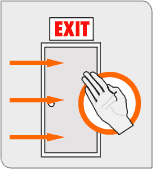
If a door is closed, karate chop it open.

If a door is closed, karate chop it open.

The basic critique I and others have made about the s59 referendum question is that it only makes sense if you accept the implicit assertions with which it is loaded. Linguistic or semiotic texts don’t have wholly objective meanings – their meaning is partially subjective to the interpreter, and meaning approaches objectivity only to the extent to which people can (or will) agree on the interpretation of a text. What we call ‘objective’ meaning in a text really describes a particularly strong agreement on interpretation within a notional audience, and frequently what we call an absence of understanding or comprehension of a text really just describes an absence of agreement on the interpretation between one part of a notional audience and another. It’s easy to overstate this: usually within a given audience there is a reasonable degree of agreement on interpretation, and this is particularly true with regard to ordinary or mundane language or imagery. Some texts are more complex than others, and some are more controversial and will tend to divide the agreement of an audience more than others, but this is not a pure subjectivist or hyper-relativist argument that there is no useful meaning in anything or that definitions or the understanding of common referents are irrelevant or somehow unattainable. Just to say that meaning is not strictly encoded in a text but is as much a function of interpretation. Texts with more than one reasonable reading for a given notional audience (such that ordinary people within an audience group can reasonably differ on interpretation) are called ‘polysemic’, which is just a fancy technical way to say they have multiple meanings.

Broadly speaking the task of a propaganda campaign, or of political speech in general, is to pose a monosemic question or scenario – one which a reasonable person from within the target audience group can only read or answer in one way. This often relies on loading one’s text with as much implicit context as possible so as to avoid the possibility of part (or all) of your audience misreading it; shipping with instructions, as it were. In a strategic sense, it is not the text itself which is the payload – the frame and its implied norms enable the propagandist to construct (manufacture) the audience’s consent for their preferred reading of the wider text.

Returning to the s59 referendum question, it is a fair and credible attempt at freighting a question with an implicit value judgement which renders the answer obvious if the question is read naïvely. But it goes too far; reasonable people don’t need to try very hard to see the payload, which is the implication that (a) a smack can be part of good parental correction and (b) such a smack is a criminal offence. In a successful propaganda campaign of this nature, the textual agenda is more obvious and the contextual agenda less so, and the referendum’s supporters have been working very hard to try to shut down contrary readings of their campaign in order to de-emphasise the frame and context, and emphasise the naïve text. They’ve failed in this, but it is instructive nevertheless, and that isn’t to say they haven’t achieved any of their objectives. The problem is that the referendum question and campaign is essentially preaching to the choir – it makes sense to a conservative segment of the population who care a lot about this issue and are riled up by the constraint on their “freedom” to smack, and it speaks to them because they already accept its premises. But it isn’t much use as a polemic device because, for those who don’t accept its premises, it just looks like a stupid question. This is the problem with developing political strategy in an echo-chamber – just because you believe your own hype doesn’t mean everyone does. To pervert Schneier’s Law: anyone can design a political campaign so clever that he or she can’t imagine why anyone wouldn’t agree with it. This feeds back into my ongoing critique of the state of Labour politics: toward the end they believed their own hype, in much the same way as the AAS lobby believes theirs.

Campaigns which employ symbolic or propaganda methods, whether for beneficial purposes or not, are ultimately about social control. A society which responds uniformly and predictably is, all else equal, easier to control than a diverse society, so a great deal of effort is put into the crafting of messages, delivery systems, textual and contextual input to a society which will generate predictable output. Public campaigns, to be successful, require their audience to share strong agreement about interpretation and common understanding of context for their payload to be effective. Robbed of context and freighted assumptions, even something as apparently intuitive, important and uncontroversial as a FEMA public readiness campaign can be highly puzzling and confusing if read naïvely.

Edit: And sometimes, when the context seems obvious, it’s not:

Get the context at BAGnewsNotes or YouTube. If you read the video right, he’s being a gent, not a cad.

L

Clearly not

datePosted on 16:47, July 8th, 2009 by Lew

(Thanks to Naly D).

L

Thank you, Lyndon Hood

datePosted on 11:38, July 3rd, 2009 by Lew

Your s59 referendum decision-making flow-chart is a thing of beauty.

L

The problem with stupid questions

datePosted on 22:02, June 23rd, 2009 by Lew

… is that they tend to beget stupid answers. Or at least unexpected answers.

Via James at Editing Teh Herald, it seems the UK’s Daily Mail (whose egregious abuses of truth and decency are legend) has gotten bit by this simple truth, with an online poll receiving a response 96% in the affirmative to the question “Should the NHS allow gipsies to jump the queue?” The Daily Mail, bless ‘em, wouldn’t stand for this and it now shows 100% in the negative.

Now, I’m not saying that the s59 poll is that insultingly loaded, and obviously we can’t use twitter to vote in referenda, but groups like The Yes Vote are counting on people being similarly insulted by the dishonest and misleading question that they’ll consider how the framers clearly want people to vote and vote the reverse in order to demonstrate that they don’t appreciate being treated like democratic cattle to be herded in the direction the lobby wants.

So here’s another meaningless poll: have the AAS lobby over-egged their question?

L

Coddington makes sense on smacking

datePosted on 21:55, June 21st, 2009 by Lew

Words I never thought I’d write, but good grief, The Yes Vote has linked me to proof-positive that despite her previous crimes against logic and argumentation, not to mention evidence, Deborah Coddington can write wisdom from time to time. Her HoS column today makes a strong liberal* case against the S59 referendum by killing** the sacred cow that cries of “nanny state!” are pure and unassailable positions of principle, and arguing that when it comes to discipline there’s a gap between principle and implementation into which society must not permit children to fall.

Act’s John Boscawen has a bill to amend Section 59 – again – so it will be “no longer a crime to use reasonable force” if parents discipline a child.
Here we go, loop de loop. Boscawen says he’s sick of nine years of Labour’s nanny state telling parents what to do, but isn’t this more of the same? You can use a light smack, but not a hard smack? Why not a good, old-fashioned razor-stropping like my father used to give me, followed by Mum with the wooden spoon, and while you’re at it John, bring back six of the best in schools for bad girls like me – never did us any harm, did it?
Truth is, no matter how hard politicians try to flannel, they’re always telling us what to do. Paula Bennett said she didn’t think a smack as part of good parental correction should be a criminal offence and she didn’t want to go into homes and tell people how to parent.
Oh really? Not even when they’re disciplining with the jug cord or vacuum cleaner pipe?

But for the last sentence, this could pass for the usual sort of faux-outraged don’t-tread-on-me doggerel. But what’s remarkable about the last sentence is that it rejects the typical anti-statist line that all intrusions into private affairs are equal and equally meritless – it recognises that the state has a role to play in protecting children from the (however well-meaning) depredations of their parents and that there is a strong public good in the appropriate exercise of that role.

This is based on a deeper argument about the rights of the individual – and the assertion that children are individuals with rights of their own, not their parents’ belongings to be treated according to parents’ sovereign wishes.

It’s no wonder children are not valued as individuals in this country, but instead as some sort of chattel belonging to adults until they reach some magic age – 16 or 18 or 20. We do not own our children, a fact that has yet to be driven home to those selfish individuals who fight their way through the Family Court over who has the offspring, ensuring any remaining family happiness is destroyed forever.
Sadly, I don’t ever see a future in this country where all children are treasured, despite all the good work done by many organisations and individuals.
It’s not just about eliminating the beatings, it includes respecting young people’s presence. I hate it when parents don’t introduce their children to me, as if they don’t exist.

Because, in truth, nobody believes that parents have an unassailable right to treat their children as they please*** – it’s just that people of various political stripes like to be seen to support parental sovereignty without also being on the hook for the hard decisions such a position requires.

Policy is about value judgements, and if the AAS lobby were honest they’d be arguing the value of corporal punishment in parenting: arguing that it will strengthen families, grow good children and create a better society; and how it will do so. To an extent Larry Baldock has tried (33 minute audio), but only to an extent, because even those at the heart of the AAS lobby recognise the weakness of their position in strict analytical terms. So they fall back on symbolic arguments they don’t really believe in, but which are malleable enough to be twisted around to support their misguided cause.

People who claim pure and unassailable statements of principle in terms of policy implementation is usually selling you a bill of goods, but it’s nice for someone so strongly (shall we say) ideological to be pointing it out. More power to your typing fingers, Deborah.

L

* The classical kind, not the latte-sipping kind.
** Or at least beating it with a jug-cord.
*** Ok, some people seem to.

Putting the referendum in context

datePosted on 13:15, June 21st, 2009 by Anita

Firstly, a couple of facts:

  • This is Sheryl Savill’s petition not Larry Baldock’s. Savill, a staff member at Focus on the Family’s New Zealand organisation put this forward before Baldock jumped on the referendum bandwagon.
  • MPs from a other parties, including National (Bob Simcock) and NZ First (Brian Donnelly and Barbara Stewart), had placed bills to either repeal or amend s59 in the ballot in the past, they were just less lucky than Sue Bradford.
  • The bill received support from both sides of the house throughout the debate.
  • The bill was eventually passed 113 to 8 – it was supported by a massive majority of MPs
  • The actual text of the new s59 can be found here – it does not actually ban smacking

Secondly, in case any of you are interested in a much more wordy context I have attached, below the fold, a slightly updated piece I wrote for a different purpose earlier this year. It was written to follow on from a summary of the international context, if anyone’s really keen I can post that too :)

S59 referendum: a game theory approach

datePosted on 22:25, June 17th, 2009 by Lew

How* to vote: Yes, [null] or !#gh$u%WfG?

What’s a body to do, who thinks the S59 referendum question is absurd and yet supports the rights of children to be free from violence, even that perpetrated by their well-meaning parents?

Russell Brown asks the question, and elaborates on the options, but doesn’t provide an answer. Essentially, the question is about principle against pragmatism. This approach is pretty elementary (game theory isn’t a speciality) but it does enough to demonstrate my views on the matter. (It looks to me like a weird sort of Stag Hunt with a third quarry thrown in). There are also a few assumptions and assessments as to how the results will play, which I’m happy to argue. I apologise if it all seems a bit bleedin’ obvious.

mehStarting with the worst response, the third quarry or null vote. An argument of principle, advocated by Denis Welch, it holds that people should treat the s59 referendum with utter contempt and dispose of their share of the $9m expense in the circular file. This is possibly best characterised as the Ostrich Strategy, viz. “ignore it and it’ll go away”. Unfortunately, no cause which attracts signatures from the 10% of the electorate required to trigger a CIR will ever just go away on its own. Given that there are a hard core of people who are strongly motivated to vote “no” in this referendum, the adoption of this strategy will send the (incorrect) message that the bulk of the electorate doesn’t care either way, ceding the field to the “no” voters (hereafter “anti-anti-smacking” or “AAS”). We can call this “Lose For Sure”, because no matter what happens, the strategy can’t win.

chadThe main argument of principle, made most forcefully in the PAS thread by Craig Ranapia and Tom Semmens, is that the question is so badly worded that reading meaning into it and voting on the basis of that interpretation accords the question too much respect, and devalues the CIR system which should insist on properly-formed questions. This argument holds that one should respond to a meaningless question with a meaningless answer by invalidating the ballot and submitting it anyway, which I have characterised above as “!#gh$u%WfG”; in other words, leaving the chad hanging or writing something to the effect of “This question is meaningless” on the ballot and returning it. This has some history in previous referenda, and in principle if enough informal ballots were returned, could serve to discredit the question and the questioning lobby group. Which is what we want. We can call this “Win Big”, because if enough people take this approach, the anti-anti-smackers will be roundly shamed in a more thorough manner than simply losing the referendum. On the other hand, if not enough people do this and the votes are split between “yes” and “informal” the AASers will claim victory. We’ll call this “Lose”.

yesThe argument in pragmatic terms is most eloquently put by Judy Callingham: “I’m going to vote “yes” – as I see it if the bastards don’t lose we’ll never hear the end of them”. This illuminates a key aspect of the matter: the AAS lobby doesn’t have to win big, they just have to not lose in order to demonstrate that they represent the “average kiwi”. This means the primary goal of those opposed to the question or what it represents should be to win, regardless of the magnitude of the victory. Put like that it seems obvious, doesn’t it? This position is most strongly put by The Yes Vote, whose banners are currently up all around the progressive NZ blogosphere. Essentially, if enough people interpret the question in the way in which the AAS want people to interpret it and vote “yes” anyway, they will lose, and the outcome will be positive, viz. parents not being allowed to claim correction as a defence for beating their children. We’ll call this “Win”. Those so voting will have favoured the AAS with a formal answer to their ballot, thus granting them some sort of legitimacy, and if insufficient people vote this way such that it boosts turnout and the AAS still win, they will rightly be able to claim that they have a public mandate for their policy of allowing parents to assault children with legal protection. We’ll call this “Lose Big”.

So, how do things stack up? I’ve established five notional outcomes, as follows:

  • Lose For Sure: %No > %Yes > %Informal (low turnout). This would be caused by people who object to the question refusing to vote.
  • Win Big: %Informal > (%Yes or %No) > (%Yes or %No). This would be caused by enough people voting informally to outnumber those who vote any other way, rendering the referendum a public farce. This requires a great deal of work to convince those who would instinctively vote “yes” despite disagreeing with the question, out of native respect for the democratic process or for other reasons.
  • Lose: %No > (%Yes or % Informal) > (%Yes or % Informal). This would be caused by those objecting to the question being split between “yes” and “informal” such that “no” snuck through the gap, allowing the AAS to claim a plurality and thus victory. There would remain some defence in that the cumulative “yes” and “informal” votes might add up to a majority, but I don’t think this would be worth much.
  • Win: %Yes > (%No or %Informal) > (%No or %Informal). This would be caused by enough people voting “yes” to demonstrate that the AAS does not represent the “average Kiwi” as they claim. It seems likely that those who consider the question an affront to the democratic process and are inclined to vote informally or not vote at all would need to be convinced to vote “yes” instead.
  • Lose Big: %No > %Yes > %Informal (high turnout). This would be caused by enough people voting “yes” to demonstrate that those opposed to the AAS were taking them seriously, but were outnumbered by the AAS itself, thereby justifying the claim that they represent the “average kiwi” with the assertion having been properly tested. If some (but not enough) people are convinced that voting “yes” is the right idea, this will be the result. Thus there is danger in an incomplete adoption of the strategy.

So how should one vote? Well, it obviously rests on what other voters will do. Clearly the best outcome in the case of a split requires collusion – members of one group (either the “informal” voters or the “yes” voters) changing their vote. It looks to me like this:

  • Fail to vote: Many people will do this, but it won’t have any positive effect for anyone other than the AAS. P(Lose For Sure) > *
  • Vote informally: Some people will do this, but probably not enough to Win Big, and if the result isn’t Win Big, it’s more likely to be Lose. This rests on your judgement of whether the number of informal voters will be greater than the number of “no” voters. I don’t think they will. Thus in my assessment P(Lose) > P(Win Big) > *
  • Vote yes: If enough people do this, it will result in Win. If nearly enough people do this it will result in Lose Big. I think the natural tendency of voters is to vote according to what they think something means, rather than what it actually means in cold hard terms. In addition, I think voters are generally reluctant to vote informally out of respect for the institutions of democracy. In addition, I think The Yes Vote has been running a fairly good campaign – they’ve had a few mentions in the mainstream media, and their message is clear and forthright. Therefore in my assessment P(Win) > P(Lose Big) > *

So, essentially, my argument based on this is “vote yes, support campaigns to convince others to vote yes, and all those of you who are considering not voting or voting informally in protest – don’t, just vote yes, because the main danger of losing is in splitting the vote. And hope like hell the yes vote doesn’t fall short, because trying and failing will mean a worse loss than just plain old failing.”

L

* I have omitted the “no” vote. People who are going to vote thus have no need to consider the questions I raise in this post.

Smacked down

datePosted on 08:58, June 17th, 2009 by Lew

Sean Plunket delivered a stinging, if metaphorical, spank to Larry Baldock today on Morning Report (audio). Plunket challenged Baldock to demonstrate one case (just one) in which a parent was convicted of a criminal offence for smacking a child. He can’t, because there hasn’t been one. After several minutes of going around in circles arguing symbolic, rather than substantive matters and making excuses, he settles on the case of Jimmy Mason, which is explicitly not a s59 test case, since he denied striking his son at all.

What we have here is an apt and obvious demonstration that Larry Baldock doesn’t actually understand what the question means – and neither does John Boscawen. That, and the pro-smacking lobby is trying to use the referendum for symbolic purposes. They’re arguing that the question doesn’t mean what its words say it means – it means what its proponents say it means. If this was taken on by government it would be a subversion of the purpose of a CIR, which is to give the electorate a chance to answer a specific question which has clear and obvious policy implications – not to give people a chance to tick ‘yes’ or ‘no’ and then have the meaning of that response spun into whatever suits the referendum framers’ agenda. Because there is no possibility of gaining an understanding of what the electorate wants with this question there is no legitimate issue of representation, despite what anti-anti-smackers such as Dave think. John Key has seen this, and has wisely refused to allow his government to be hijacked by populist propagandists with an incomplete grasp of either the issues or the process; that is, people who figure that belief and ideology are all that matter.

Larry Baldock also reveals his larger purpose here, which is to establish himself and the Kiwi Party as NZ’s next populist vehicle, exploiting the vacuum left by Winston Peters’ absence. He started by talking about how both Phil Goff and John Key are “part of the problem” for supposedly ignoring the electorate, and finished this interview, in which he made no substantive points whatsoever in support of his case, with a petulant “the next-best referendum will be the elections in 2011″, a somewhat weak variation on “the eternal court of history will absolve me” which calls on people who believe that both Labour and National are the problem to vote for him.

Well, Larry, we’ll see. You’re no Winston. Perhaps you can sign Michael Laws up; you could use his political competence.

L

I don’t see a test case

datePosted on 23:15, May 20th, 2009 by Lew

Much has been said about the poor reporting of the case of James Mason, who was yesterday found guilty of punching his four year-old in the face, but the thing I can’t figure out isn’t the focus on the ear-flick or whatever, but why anyone thinks it is a s59 test case. From having read the Stuff and Herald stories, I gather the following:

  1. To qualify as a s59 test case the verdict would need to hinge on a question of law in the new section of the Crimes Act. Mason would have had to admit striking his son and claim it was either inconsequential or not for the purpose of correction but for the purpose of preventing harm.
  2. Mason denied having struck his son, thus negating the possibility of any defence on either of those grounds.
  3. Mason’s denial was contradicted by two witnesses who testified to seeing him do so.
  4. The jury found that as a matter of fact Mason did strike his son, and duly found him guilty, there having been no argument that it was justified on the grounds of being inconsequential or for the purpose of preventing harm.
  5. Since Mason didn’t appeal to a matter of law, but to a matter of fact, the case couldn’t have been a test case no matter what the verdict was.

It may be because I haven’t read widely today, but the only other person I’ve seen make this argument is RedLogix at The Standard. Are we missing something here?

Aside from which, let me repeat the sentiment that those who want to burn political capital by defending a man who punches a four year-old in the face in public are more than welcome to do so.

L

Sacrificing families for political gains

datePosted on 16:42, May 12th, 2009 by Anita

The section 59 debate, for the first time in a long time, lifted the lid on the New Zealand “family”. What we found was a fight waiting to happen: the core of the debate was not smacking, it was the nature and role of the family. How should we balance the competing interests of the family, its individual members, the community that surrounds it, and the state which we rely on to intervene when necessary and butt out the rest of the time?

How the 2008-2010 government would address that gulf fascinated me. It seems so intractable, yet addressing it is so necessary. National have chosen Christine Rankin, they have chosen to make the Families Commission incapable of progressing this.

It’s not Rankin’s support of the pro-smacking referendum, it’s not her links to the conservative Christian lobby, nor her links to the crime and punishment lobby, the anti-transparency brigade, or the right wing political donors. It’s her track record of divisiveness, or polarising issues and debates.

By choosing Rankin National may have discharged their debts or paid back their supporters, but in the process they’ve sacrificed progress, safety, and growth for our families.

[Ari and Julie have both written good pieces on Rankin's unsuitability for the role separate from her divisiveness]

12Next