Revealed preference

Former National leader Don Brash addressed the ACT party conference at the weekend, which was half “catching Australia” boilerplate and half a warming-over of the infamous “nationhood” speech given at Orewa in January 2004 (for a thorough rebuttal of which see Jon Johansson, Orewa and the Rhetoric of Illusion). During his address at the weekend (although no mention is made of this in the text of the speech on his website, linked above), Brash correctly stated that the Treaty of Waitangi was ahead of its time, because the contemporary Australian approach, by contrast, was to “shoot the natives”.

At this point, a heckler in the audience piped up: “let’s bring it in“. (Audio).

Moments like these, when people are put in the position of genuinely involuntary response to some stimulus or other, are pretty rare in a political environment dominated by strict stage-management, spin and counter-spin. Their type and quality can tell you a whole lot about a political movement, especially when the response is collective, spontaneous, and embedded within a heightened or aroused political context, such as in the middle of a keynote speech.

What happened next was that the delegates in attendance at the ACT party laughed. At the suggestion that New Zealand implement a system of genocide against its indigenous people which, even back in 1840, was a source of shame for Australia, those in attendance at the annual conference of a New Zealand government party whose ranks include two ministers of the crown laughed. It is hard to be sure from the audio, but it sounds like Don Brash also laughed — someone on-mike did, and in such circumstances only the speaker is miked. Quickly, the laughs turned to disapproving murmurs, and Brash continued speaking as if nothing had happened. But by then the moment was over — the ACT delegates’ true colours had been revealed.

Not all of them, to be sure. No doubt there were those who were agape at the suggestion. Stony, stunned silence from the delegation at large would certainly have been an appropriate response and one which I don’t think would have been too hard to muster. Eric Crampton has suggested (though I suspect he’s by no means committed to this line of argument) that nervous laughter is a fair response to shock; admitting also that nobody seems to be claiming that the laughter was nervous. Eric also placed one in five odds on the heckler being a ringer whose plan was to elicit just this sort of response, in order to discredit the ACT party. Fair enough, I suppose. But it’s not the heckle itself which was disturbing — every party contains its fringe lunatics, those who fly off the handle and say embarrassing things. What’s disturbing is the response, the spontaneous, reflexive, collective reaction to the suggestion of genocide.

Just as Labour are the party of humourless, tuneless harridans after their “John the Gambler” song at the 2008 annual conference, and the Greens are the party of morris dancing hippies because of their 2001 annual conference, the fundamental take-away here is that ACT is the party who laughs at genocide jokes. The ACT delegates own that moment of laughter, just as much as they own the disapproval which followed it. It’s not even out of character for a party which has for some years now campaigned on the basis of arguments that indigenous people represent barriers to the white man’s progress, and was at the time of the interjection revelling in a sustained argument to that very effect: get rid of the bloody natives, and things’ll be a lot easier around here, and then we might catch up with Australia, who solved their bloody native problem good and proper. It speaks to the core beliefs of those in attendance, and what’s more, it largely reiterates what most peoples’ impressions of the ACT party are, based on their rhetoric, their policy positions, and their steadfast opposition to every bit of legislation giving the slightest acknowledgement to Tino Rangatiratanga.

Whether a ringer or an organic outgrowth from the party delegation, whether speaking his own truth to power or having just had a few too many free glasses of capitalist sauvignon, the people of New Zealand are indebted to this anonymous heckler. He has granted the nation a unique insight into the ACT party, and rare basis upon which to judge its underlying character. That’s good for democracy.

L

Double-tracking

Danyl Mclauchlan posits a conspiracy theory:

there is a pretty great opportunity to use the Maori seats to rort the system: if you had two Maori Parties, one that ran electoral candidates in six out of the seven electorates and only canvased for electorate votes, and another that had a safe seat in the seventh electorate and only canvased for party list votes in the other regions then you could, conceivably, end up with a dozen MPs (albeit with some overhang due to your electorate imbalance) and hold the balance of power in perpetuity.

Danyl’s scheme is essentially what the Greens tentatively proposed before the last election: green voters in Māori electorates consider casting electorate votes for the māori party candidate, and māori party voters cast their party vote for the Greens. The proposal was rejected by the māori party, which at the time was (in my view) a tactical error but a wise strategic choice.

It was a tactical error because of the efficiency argument (a positive-sum alliance permitting the two parties to extract more parliamentary representation from the same base of electoral support). But without the benefit of hindsight it was a good strategic move because the māori party’s whole point was not to be shackled to the ‘Pākehā’ parties, and its long-term survival still likely depends on its establishing its own persistent powerbase; one which could stand a chance of surviving even the abolition of the Māori seats. The only way to do that is to grow the party vote by strengthening ‘brand’ support among its electorate. (Also the proposal was made quite late in the campaign, and the potential for voter confusion was high.)

Those factors which made the plan a strong strategic risk for the māori party in 2008 now no longer obtain, or at least not so strongly. It has largely sacrificed its independence from the Pākehā political mainstream anyway, and could potentially lose considerable support for that reason. It may hang onto electorates, but it is likely that ‘brand’ support is lower than before. So with the benefit of hingsight, they might as well have gone with the Greens last time. Nowadays, they have a radical wing-man in Hone, who will work with them and who shares, despite all the rhetorical ructions, considerable common ground with the party’s other members and its foundational kaupapa. They can work together; Hone working to attract the ‘brand’ support for an independent indigenous party, the existing māori party maintaining their electorate positions and continuing to work within the mainstream.

I’m not convinced this will happen — as the Richards say in comments to Danyl’s post, a lot of it is personality-bound — but it could work in principle.

There’s one other factor, though. Although ACT and National have been collaborating in this way since Rodney Hide was gifted Epsom, the moment the māori party and a new radical wing led by Hone start doing it, the headline will be “Maaries rorting democracy to establish an apartheid state”. Those who’ve been benefiting from this sort of positive-sum electoral coordination for years will be those most urgently banging that drum and waving those banners. That’s a powerful disincentive.

Edit to add: Of course, there’s also a referendum on MMP on the day of the election. A scheme such as this would be an outstanding means of undermining MMP’s popular support and endangering its future.

L

Underclass Redux


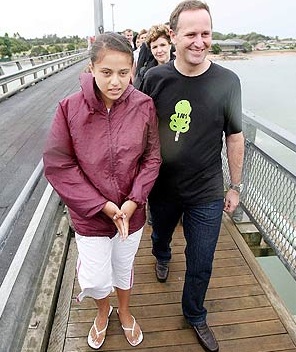
Campbell Live tonight returned to McGehan Close (see the report, by Tony Field, here). This street in Mt Albert — on the boundary of Helen Clark’s and Phil Goff’s electorates — was visited by then-opposition leader John Key before Waitangi weekend 2007 for a particularly cynical stunt. This was Key’s first big symbolic play as leader of the opposition, and it was a hum-dinger. He had already singled out the residents of this street in that year’s State of the Nation address at a whitebread rugby club in faraway Christchurch, branding them archetypal members of the New Zealand ‘underclass’, and the visit saw him glad-handing and patronising a bunch of poor brown people who’d already been used as shot in the National party propaganda cannons.

The purpose of the speech, and visit, was to install one of the core planks of the National party narrative about the Clark government — that it was at best unconcerned with the plight of said underclass; and at worst, actively cultivated such a demographic, which would be permanently dependent on Labour’s welfare policies and would therefore be a permanent source of electoral support for the Labour party. (So the ‘bribing the bludgers to breed’ theme goes, rarely uttered by anyone with authority in public but a commonplace among the usual proxies; check almost any General Debate thread on Kiwiblog from around that time for instance.) This is absurd in more ways than it’s feasible to explain here, so I won’t bother. Let’s just leave it at ‘the underclass doesn’t really vote’.

Nevertheless, the visit was a roaring success. Key, bearing smiles and gifts and wearing a tiki t-shirt, charmed the residents of McGehan Close and evidently persuaded them both of his party’s goodwill toward them and of its social and economic plan to lift them from their grim circumstances. The event culminated in Key taking 12 year-old Aroha to the Waitangi Day celebrations — a move full of potent symbolism, even if it was seen to be somewhat exploitative. Drawn out over a full week of coverage (at the time a rare commodity for Key, who had replaced Don Brash as leader just before the Christmas break) this was a highly successful stunt and should have been an early warning of Key’s great talent for making cheesy set-piece events ‘work’ and feel human. The sentiment he evoked in the people of McGehan Close was certainly real.

It’s just a pity the ‘ambitious’, ‘aspirational’ policy programme Key promised them wasn’t.

Joan Nathan, Aroha’s mother, remains on the DPB (having been let go from her hastily-arranged job working for National MP Jackie Blue) and struggles more than ever to cope, now with a sixth child. Aroha, now 16, is living in the care of Child, Youth and Family, which Joan says is the best thing for her, since she is unable to provide a decent life for her daughter. Nathan and others, although they believed in and voted for Key, are now disenchanted and universally express the sentiment that the government’s policies favour the rich, not the poor, and that they haven’t been helped one iota by the change of government; in fact, things have gotten worse. Not much of this is different than it was this time last year, when the Sunday Star Times visited the Close.

So far, so obvious, you might say — and it is; indeed this sort of outcome was very widely predicted at the time. But this is important because it is as strong a counter-narrative as exists for the opposition in this election year. It reframes Key as a faker, a charlatan, an opportunist who’ll exploit whatever circumstances will advantage him, without loyalty or the willingness or ability to follow through on his word; as someone whose focus is on boardroom issues rather than on peoples’ wellbeing. Discussing and reading around the topic on twitter this evening I’ve seen considerable criticism of this Campbell Live story as a cheap human-interest stunt, as opportunistic and exploitative (or moreso) than the original event. I couldn’t agree less. It is a clear, unambiguous example of an investigative journalist simply revisiting a story where much was promised, and measuring it against what has actually happened. This is crucial to its narrative value: these events reframe Key by measuring his own defining stunt — his signature trick — against the objective reality of lived experience. Theory and rhetoric versus real people, living in the real world governed by the policy built from that theory and rhetoric. It is a reality check in its purest form.

There are disadvantages to this narrative line, also, and the virulent responses to the Campbell Live report this evening — I believe I saw presenter Rachel Smalley shudder a little whilst reading some of them out — hint at them. One is the obvious suggestion that Joan Nathan and the other residents of McGehan Close could have done better for themselves, but have chosen not to; the victim-blaming routinely visited upon the poor by the less-poor. A more serious and related line of critique is that there’s a recession on, and everyone’s hurting. Or that it’s only been three years, and change takes time.

But hang on a minute — wasn’t the point of the whole point of electing a Key-led National government to take advantage of the resulting step-change which would boost economic growth, job growth, provide better opportunities, an end to welfare dependency, safer communities and a general increase in general socio-economic mobility and wellbeing? Key made all these promises quite explicitly, not just in person to the residents of McGehan Close, but to the whole nation throughout the campaign and at almost every opportunity since. There are no jobs. There are no higher wages, and without these things you can’t exactly buy shares in SOEs. There is no greater social mobility. The ‘underclass’, as exploitatively defined by Key, still exists.

Having failed McGehan Close, John Key has failed all of us. Quite apart from the fact that we were all promised these things, or things like them, and by and large have yet to receive them, a central theme of the ‘underclass’ policy argument was that by lifting people out of poverty and bringing then into the ‘overclass’ (? — this shows just how meaningless ‘underclass’ is except as a propaganda term), the government would make society better for everyone. This is a noble goal, and one I agree with in its idealistic entirety. I think you would go a long way to find someone in a position of any political credibility who’d publicly disagree with it. The first order of business for any opposition should be to hold John Key to those promises, and demand of Key the wealthier, more mobile, and socially healthier society we were promised.

But the most vicious response will be the one which the initial stunt in 2007 was meant to evoke — the notion that the ‘underclass’ are breeding in order to get more welfare from the Labour party. The core of this line of reasoning, if I may call it that, will be attacks on Nathan herself as a mother, having had a sixth baby and having had Aroha, the subject of the initial stunt, removed from her care. The attacks will be highly personalised, racist and gendered, and they will be lashed closely to Labour party policy and doctrine. But, assuming a competent and spirited opposition, that’s ok — the National party aren’t in opposition, 18 months out from an election; they’re in government in election year. Having been elected on a moderate, sympathetic platform with strong support from women and Māori, and looking to consolidate that platform into a strong and honestly-won mandate means that the government no longer has such freedom to dog-whistle. Particularly given that an opposition counter-narrative would cast doubt on all those sympathetic characteristics, the resort to the divisive tactics of 2008, such as trying to wedge ‘hard-working kiwis’ against the ‘underclass’, and so on, would be extremely risky for the government.

In light of my last post, perhaps it is a little glib to assume a competent and spirited opposition, and in perfect truth I don’t really think Labour has this fight in them (although Grant Robertson saw the Campbell Live piece and seems to have had a similar response to mine, which is heartening). But it is an argument waiting to be had, and one which must be had sooner or later. The boundaries are drawn up; media interest is already piqued, and this is a bread-and-butter social and economic justice issue for Labour. There’s a wealth of symbolic material and slogans to employ — ‘reality check’ and ‘by failing McGehan Close Key has failed us all’ are two they can have for free, and if a Labour party can’t base a campaign around ‘underclass‘ then they’re not worthy of the name.

Time to engage.

L

Hard rain’s a-gonna fall


The past week has illustrated in clear terms the New Zealand Labour party’s decline as an effective opposition party. In the opening moments of election year 2011, John Key has stepped up to demonstrate the full extent of the National government’s apparent impunity. He has done this in three ways.

First, by fronting Morning Report, Nine to Noon, Campbell Live and other tier-1 hard-news media to outline his intention to partially privatise SOEs. Privatisation, since the Fourth Labour Government, has been a ‘third rail’ issue; one the NZ left is unequivocally opposed to. By going into bat for privatisation personally, and in considerable policy detail, Key confounded criticism which has been (justly) levelled at him throughout the electoral term so far that he often refuses to show up on hard media, while continuing to keep regular spots in soft formats like Breakfast, and on less rigorous media such as Newstalk ZB. He also invested his own (considerable) political capital in the enterprise, making privatisation a matter of his own judgement and credibility.

Second, he sought out and is revelling in the controversy caused by his “Liz Hurley is hot” stunt, undertaken on Radio Sport with convicted back-breaker Tony Veitch. In political terms, the first bit was no meaningful risk; Key has played the ‘frankly, I’m a red-blooded Kiwi bloke’ card several times before, always to good effect, and most notably when he informed a press scrum he’d had a vasectomy. The decision to undertake an interview with the disgraced Veitch was a considerably more risky proposition because of the nature of Veitch’s offending against his partner, combined with the subject matter of their conversation, and the fact that Key’s political appeal to women has been considerably stronger than previous National leaders. This seems clearly calculated to demonstrate what he can get away with; and the gamble has in fact paid off so well that Phil Goff today felt compelled to follow suit, suggesting a slightly sad “me too, me too” narrative.

The third of Key’s big moves was today’s dual announcement that the election would be held on 26 November, 10 months away and following the Rugby World Cup; and that he would not consider a coalition arrangement which included Winston Peters. Coupled with ruling out working with Hone Harawira outside his present constraints in the māori party, this declaration will provide considerable reassurance to National’s traditional base, and will scotch any possibility of wavering conservatives casting a hopeful vote for Winston Peters as an each-way bet. It is a risky proposition, though — Peters remains a redoubtable political force, and it is not beyond possibility that he returns to parliament. However I think Key has read the electorate well; he knows that while a small number of people love Peters, and a small number loathe him, many of those in the middle are vaguely distrustful of him. As Danyl points out, he’s managed to link Peters to Goff in a way which emphasises both leaders’ worst attributes: Peters’ polarising tendency, and the general unease and disdain with which voters view Goff. The decision to call the election so early is also bold. It means relinquishing the incumbent advantage of being able to control the electoral agenda; being able to determine when ‘government as usual’ ceases and ‘campaign season’ begins. This is an intangible but valuable benefit, and it has been traded off against another piece of reassurance: the sense that Key and his government are “playing it straight” with the New Zealand public; that they intend to run an open and forthright campaign and to seek an honest mandate for their second term. The choice of election date isn’t entirely selfless, of course — the All Blacks are odds-on favourites to win the Rugby World Cup, and even if they don’t, the tournament, its pageantry and excitement and revenue boost will bifurcate the campaign. The traditional campaign period will mostly be drowned out by this event, save for the last few frantic weeks.

In most election years, swapping agenda-setting rights for a “playing it straight” feeling would be a poor tradeoff. In most election years, a sexist stunt with a known and publicly reviled wife-beater would be a poor start. In most election years, running a campaign based on privatisation would simply be a non-starter. While the paragraphs above read somewhat like breathless praise of Key’s status as a political playa, that’s not my intent. I think he’s good, but mostly John Key just knows what he can get away with. The reason he can get away with all of these things is because there is no credible opposition to prevent him from doing so. Anyone half-decent can look sharp when playing against amateurs.

It has been Labour’s job to prevent the government from reaching the state of near-impunity they now enjoy, and their failure to do so means there is now a real danger that Key will get the genuine and sweeping mandate he seeks. To a considerable extent they were doomed in the task of preventing this from the outset, because they didn’t think it was possible that he’d ever achieve it. Clark Labour throughout 2008 fundamentally misunderestimated Key, writing him off as a bumbling lightweight, and this was a crucial error. Since well before the election — this example is from July 2008 — I’ve been arguing to anyone who’ll listen that instead of taking easy pot shots at Key based on his weaknesses, any critique should focus on his strengths. Quoting myself, from the above:

Key’s strengths [per the Herald bio], which enabled him to succeed as a currency trader: Decisiveness. Determination. Patience. Ice-cold calm under fire. Willingness to risk it all. Ability to follow through. Remorselessness.
If you want to attack John Key, draw attention to what might happen under a Key government. Given his history, he’s not some motley fool who won’t make sweeping changes – he hasn’t gotten where he is today by being timid. I think he has the wherewithal to roll out a sweeping programme of political and social change the like of which we haven’t seen since Lange, but I think that, unlike Lange, he won’t get cold feet. If you don’t like Key’s politics, I suggest you begin thinking about what might happen if the guy is given the power he seeks.

The delusion that John Key is a hapless fool who’s somehow mysteriously gotten his hands on the reins of power remains very much alive within New Zealand lefties; this was the tired old line I got spun as recently as this afternoon, by one of the internet’s best-known Labourites (with a nice dollop of ‘if you don’t praise Labour, you’re a rightie’ for good measure).

But this tendency to misjudge and underestimate Key is only part of the problem. Denizens of The Standard aside, anyone within the loop who has a modicum of reason has figured out that Key is not the lightweight he was — quite willingly — framed as. But now the narrative is set: it’s That Nice Man John Key, who drinks beer out of the bottle while tending the barbecue with Prince Harry, and thinks Liz Hurley is hot. They don’t have a credible counter-narrative, but they have to say something against the health cuts, education cuts, tax cuts, ACC cuts, pending privatisation and so on — and so they fall back on their usual tired old cliches, which, while superficially looking like what an opposition is supposed to do, lack cohesion and run counter to the established wisdom about Key and his government — wisdom laid down, in the first place, by the Labour party in its 2008 campaign.

The lack of narrative cohesion is so dire that the party claims that privatisation of SOEs is repugnant to the voting public of New Zealand; and almost simultaneously puts out a press release saying that it’s a cynical ploy to “cling to power”. The manifest incompatibility of these two propositions — cynically promoting an unpopular policy to retain power — speaks for itself.

If the inability to construct a viable narrative is symptomatic of a wider lack of ideas and direction within Labour. Election-year spin aside, their policy offering is weak as well. Their big blockbuster kicking-off-election-year policy of a $5000 tax-free zone was big enough to draw plenty of criticism about cost and targeting (including from people like Brian Easton), but timid enough that nobody was made to sit up and take notice for any other reason (sidenote: when Brian Easton, John Shewan, Chris Trotter and I all oppose something, I think you can be pretty sure it’s not a winner).

This is just the most recent example of what we’ve seen throughout the past two years: Labour’s vision, and its execution, simply aren’t up to scratch. I have no internal knowledge of the Labour party, and I don’t know whose fault this is. I guess the leadership blames the strategists, the strategists blame the policy wonks, the policy wonks blame the spin-doctors and the spin-doctors blame the MSMâ„¢. All that’s just excuse-making for losers. There are no socially-just power-redistribution schemes in politics, and if there were they would be rorted. There is no fair. The job of being in opposition is to win despite the odds being stacked against you; to do and say things worthy of the news media’s time, worthy of the government’s concern, and worthy of the electorate’s endorsement. If you’re not doing that, you’re not up to the task.

As the title implies, the political weather this election year is not going to be a warm drizzle. John Key wants a mandate; he wants a strong and broad mandate which will permit him to wreak widespread social, economic and political changes upon New Zealand’s landscape, and he is prepared to put a lot on the line to gain it. He is playing for keeps, and my instinct is that an opposition who couldn’t keep pace with ‘smile and wave’ is going to be crushed by the rampant beast which is currently girding for war. What’s more, by all accounts Key is actually, genuinely coming to the New Zealand electorate with a transparent policy offering in good faith, keeping his promise that nothing would be privatised without his first having sought a mandate to do so, which robs Labour of their strongest symbolic weapon: the “by stealth” bit of their catchcry “privatisation by stealth”. Time will tell if this holds, but at present the Key government is doing exactly what it says on the box. Labour can’t claim they haven’t known about this all along. Privatisation has been the bogeyman about which they’ve been warning the New Zealand public for at least a decade, which makes the incoherence of their recent response all the more unforgivable. That National would consider running an election campaign on this cornerstone issue, loathed and feared by so many New Zealanders, is surprising. That they can expect to do so without trying to get their agenda through on the sly is shocking. That they reasonably expect to do all that and win is unthinkable. Let there be no doubt: if Key wins this election on these grounds, it is because Labour, by failing to adequately discharge their role as a competent opposition, have permitted him to do so.

Perhaps it is not too late. Perhaps Key has overplayed his hand; perhaps Goff has a secret weapon. Perhaps a young Turk is fixing to roll Goff and his cadres and make a break for it. I do not think any of these are likely. So it may be that the one good electoral thing to emerge from 2011 is a heavy and humbling loss which would see the Labour party reduced to a meagre husk. An exodus of the lively and creative thinkers of the party to another vehicle; or the enforced retirement of the deadwood responsible for the present state of affairs; or both would clear the way for a thoroughgoing rejuvenation of the movement’s principles and its praxis and its personnel. While it would be cold comfort to the generation of New Zealanders who will bear the brunt of the Key government’s second and third-term policies, it would be a crucial and long overdue lesson in political hubris, never to be forgotten, and infinitely preferable to another narrow loss and the moribund hope that next time it’ll be different.

L

Politics as the art of hypocrisy revealed (NZ style).

It is said that politics is the art of hypocrisy and that diplomacy is the art of saying one thing when meaning another. The publication of US diplomatic correspondence between its embassy in Wellington and other US agencies in Washington and abroad (see distribution list below) show that the 5th Labour government was much more closely aligned with the US on security and intelligence matters than it let on in public, and that the push to improve ties with the US crossed the aisle in parliament but was deliberately not made public for domestic electoral purposes.
Rather than read what others have to say about the issue, I figured that it is best to just offer KP readers the opportunity to digest one particularly informative cable for themselves. It is long but well worth the effort reading, and comes courtesy of Selwyn Manning at Scoop, which also has the most in-depth analysis of the subject. Of course, by my publishing it and you reading it we have both apparently broken US laws governing classified information.
I wonder if that means that I will hear the words “cavity search” on my next trip to the US.
07WELLINGTON194
Date: 3/02/2007
98719,3/02/2007 4:55 AM,07WELLINGTON194,Embassy Wellington,SECRET//NOFORN,,VZCZCXRO2665OO RUEHPBDE RUEHWL #0194/01 0610455ZNY SSSSS ZZHO 020455Z MAR 07FM AMEMBASSY WELLINGTONTO RUEHC/SECSTATE WASHDC IMMEDIATE 3972INFO RUEHBY/AMEMBASSY CANBERRA IMMEDIATE 4773RUEHPF/AMEMBASSY PHNOM PENH IMMEDIATE 0043RUEHPB/AMEMBASSY PORT MORESBY IMMEDIATE 0637RUEHSV/AMEMBASSY SUVA IMMEDIATE 0573RHEHAAA/NATIONAL SECURITY COUNCIL WASHDC IMMEDIATERUEAIIA/CIA WASHINGTON DC IMMEDIATERUEKJCS/OSD WASHINGTON DC IMMEDIATERHHMUNA/CDR USPACOM HONOLULU HI IMMEDIATE,”S E C R E T SECTION 01 OF 04 WELLINGTON 000194 SIPDIS SIPDIS NOFORN STATE FOR EAP/FO AND EAP/ANP NSC FOR VICTOR CHA OSD FOR JESSICA POWERS PHNOM PENH FOR POL/MCKEAN E.O. 12958: DECL: 03/01/2017 TAGS: PREL, PGOV, NZ SUBJECT: PM CLARK GOES TO WASHINGTON Classified By: Charge D’Affaires David J. Keegan, for reasons 1.4 (b) and (d) 1. (C) Summary: Prime Minister Clark has announced to New Zealanders that she will use her March 20-21 visit to Washington to discuss key regional and world events with the President and other
Senior Officials. In reality, she has a broader agenda as well: to improve the tone of her dialogue with us and to send a message to the NZ electorate that cooperating with the U.S. is normal and advances New Zealand’s interests. Now in her third term in office, Clark has over the years developed a deeper understanding of the breadth and benefits of the US-New Zealand relationship. She recognizes that sound bites matter, and in response has begun to modulate her public statements to be more positive about the relationship. She also strenuously avoids saying anything critical about U.S. policy. Although a strengthened centrist domestic political opposition may motivate Clark to be more open to us, most of her efforts to improve bilateral cooperation have not been made public, indicating genuine commitment. Over the past year, she has quietly filled a number of key positions with officials who are well disposed towards the United States, and she and her Ministers now treat official meetings with us as opportunities to advance common agendas rather than either public relations coups or something to deny. The PM closely monitors and supports the “”Matrix”” process as well as deeper US-NZ cooperation in intelligence and other issues. She particularly appreciates our cooperation in the Pacific and Antarctica. End Summary. 2. (C) A micromanager, Clark will come to Washington extremely well briefed on the issues. She will likely suggest small but concrete ways to cooperate within the boundaries of the Presidential Directive, such as by regularizing our dialogue on scientific and Pacific Island issues. She will probably announce that New Zealand will extend its military deployments in Afghanistan through September 2009. Clark will not seek any dramatic changes to bilateral policy, which she recognizes would be more than either side’s system could bear. Nor will she make a heavy pitch for an FTA as she did during her 2002 visit, instead leaving that for Trade
Minister Goff’s trip to Washington later this year. 3. (C) We should use this visit to urge continued tangible commitments to the improving bilateral cooperation and NZ’s defense modernization. We should also elicit a greater willingness to publicize our successes where possible. Clark will be setting the pace for improving U.S.-New Zealand relations for the foreseeable future. This visit provides us an opportunity to encourage her to stay the course and to resist negative pressures from those in her party who prefer to keep us at arm’s length. ————————————– MOVING UP THE LEARNING CURVE: WE MATTER ————————————— 4. (C) With over seven years in office, Clark is now the longest serving Labour Prime Minister in New Zealand history. Although she has no clear successor and may run for an unprecedented fourth term, she is clearly already focused on her legacy. Arriving in office well to the left of the political spectrum, Clark began her tenure by stressing New Zealand’s role as a small but principled player favoring multilateral (ideally UN-based) solutions to the world’s problems. Since then, she has witnessed such events as 9/11, cooperation between NZDF and US troops in Afghanistan, and shortcomings of the UN system (such as its inability to react to the 2005 Tsunami). As a result, she has over time focused more on New Zealand’s role in the Pacific region and its relations with Australia and other bilateral allies. 5. (C) Through learning on the job, Clark has clearly developed a more sophisticated understanding of the breadth and importance of the US-New Zealand relationship. Her desire to improve relations with the Administration may be due in part to the influence of Foreign Minister Winston WELLINGTON 00000194 002 OF 004 Peters, but we see evidence that Clark herself wants to improve US-New Zealand ties. Contacts tell us she has especially valued our close cooperation following the coup
in Fiji, and during her recent meetings with PM Howard she praised EAP DAS Davies’ trip to the Solomons. The Ambassador reports that Clark is obviously impressed by our dedication to environmental protection and generous support for New Zealand activities in Antarctica, which she witnessed first hand during this year’s celebrations of USNZ cooperation on the ice. 6. (C/NF) Recognizing that her Government had initially resisted improving the U.S. relationship, Clark has since the 2005 election appointed to key positions a number of officials well disposed towards working with the United States. In addition to Foreign Minister Winston Peters (arguably a marriage of convenience), she has appointed Warren Tucker as Director of the NZ Security Intelligence Service (NZSIS), Bruce Ferguson as Director of the Government Communications Security Bureau (GCSB), Roy Ferguson as NZ Ambassador to Washington; and John McKinnon as Secretary of Defence. Together with Peters and Simon Murdoch, second in command at the Ministry of Foreign Affairs, these officials have improved their agencies’ coordination on U.S. policy and instructed staff to be helpful to us wherever possible. For example, NZSIS had for months resisted housing equipment needed to implement a possible HSPD-6 agreement with the United States. Soon after his arrival, Tucker ordered NZSIS to be the host, paving the way for negotiations. 7. (C) Clark has been more mindful of the public side of our relationship as well. She participated in the Embassy’s 4 July reception even though she never attends national day events. She was also gracious guest at a media-covered reception at the Ambassador’s residence last May in honor of her favorite Kiwi composer. Mindful that her 2003 remarks about the Iraq war have not been forgotten, Clark now slaps down her Cabinet Ministers for similar offenses. When on January 12 Duty Minister Jim Anderton issued a blistering critique of
the President’s plan to send more troops to Iraq, Clark quickly disavowed the comments and removed Anderton from duty within the day. She was roundly criticized in the media for her actions, but did not budge. After confirming her visit to Washington on March 1, a reporter asked what Clark would say if the President asked her views on the war. Clark merely said she doubted that would happen, adding that New Zealand is not in Iraq and it would be “”gratuitous to offer any advice.”” ———————————CLARK REALLY DOES WANT CLOSER TIES ——————————— 8. (C) Some observers claim Clark only wants to mend fences with the United States to wrest center ground from the opposition National Party, which is gaining in the polls. We doubt this is her main motive. For one thing, polling suggests up to half of all Kiwis believe New Zealand does not need a closer relationship with the United States, and the anti-American sentiment in the left side of her own caucus is well known. Although Labour is losing ground in opinion polls, Clark is far from being in such crisis that she needs to change her foreign policy to get votes. New National leader John Key is charming and confident, but has been in Parliament for only five years and his practical agenda remains fuzzy. In contrast, while many Kiwis consider Clark cold and some question her integrity, we have yet to meet any who regard her as anything less than competent. The majority seem proud of the way she has helped forge a new, modern identity for the country: clean, green, multicultural, multilateral, creative, and yes — nuclear free. Nor is there a chance of the type of leadership putsch within Labour that has plagued National in recent years. —————————————– WE BENEFIT FROM STRONGER COOPERATION, TOO —————————————- 9. (C) New Zealand is small, but concrete improvements in WELLINGTON 00000194 003 OF 004 bilateral cooperation over the past year, including
via the “”Matrix”” process initiated in Bangkok last year, have brought tangible, positive gains for U.S. interests. We continue to cooperate closely on events in Fiji and have come to value the views of Kiwi officials regarding events in E.Timor, the Solomon Islands, and Tonga. We are increasing behind-the-scenes dialogue on N.Korea and Iran, both of which have diplomatic relations with New Zealand. The “”Matrix”” process has also been helpful in enabling both sides to stay joined up in response to other events, such as ensuring that the recent fire on board a Japanese whaling vessel in Antarctic waters would not lead to an environmental disaster. 10. (S/NF) Improvements on the defense and intelligence side have also borne fruit. As Minister in Charge of the NZSIS and GCSB, Clark is read into all major operations involving U.S. intelligence. She understands the implications of a post-9/11 world for New Zealand’s security. She also realized after the Fiji coup that New Zealand had become too reliant on Australian intelligence. Clark grasps that NZ must “”give to get”” and that some of our cooperative operations — such as monitoring radicalizing Kiwi jihadists — strengthen her country’s security. But she also has been willing to address targets of marginal benefit to New Zealand that could do her political harm if made public. Over the past year, she has supported increased counterterrorism cooperation with us. 11. (C/NF) While the Presidential Directive still limits our defense relationship, New Zealand’s push since 2004 to modernize its forces have improved our ability to work together in those areas in which we can cooperate. In support of NZ military activities in the Pacific Islands, Timor Leste, Afghanistan, and elsewhere, there have been more high-level U.S. military visits to New Zealand over the past 6 months than in the previous two years. This March alone, there will be visits by two Admirals for maritime security consultations with New Zealand, France, and the UK, as
well as a yearly call by PACAF Commander General Hester. There have been more U.S. military waivers for multilateral exercises including the NZDF as well. Unlike in the past, the PM and her Government have focused on the substance behind these visits and exercises instead of touting them to the press as a sign that NZ’s nuclear ban no longer matters to the United States. New Zealand continues to be an active participant in the Proliferation Security Initiative, has helped explain the importance of this effort to Pacific Island states, and will for the first time host an Operational Experts Group Meeting in Auckland March 2628. ———- Key Issues ———- 12. (C/NF) Regional/Global Security: In her public statements announcing the visit, Clark has said that she hopes to discuss with senior US officials common interests in counter-terrorism/Afghanistan; regional security and good governance in the PICs and E.Timor; and DPRK, Iran and other nonproliferation issues. Although she told a journalist that Iraq is unlikely to come up, MFAT staff tells us that she knows that this is a major issue on the mind of the Administration. They also say she is likely to raise concerns over China’s role in the Asia Pacific region. Clark will likely announce during her visit that New Zealand will extend its deployments to Afghanistan through September 2009, the longest extension since the Afghan war began. She may also propose that both sides agree to regular consultations on Pacific Island issues. We agree this could send a positive public signal about our joint work in the region, although in reality fast moving events make it a certainty that we will continue to communicate in real time as well. We would also have to ensure that the search for agenda items and “”deliverables”” did not overwhelm our constructive dialogue. 13. (S/NF) Intelligence: Although it will be obviously impossible to publicly highlight the exact nature of NZ’s WELLINGTON 00000194 004 OF 004 intelligence cooperation during
Clark’s visit, she undoubtedly would appreciate having it acknowledged behind closed doors. We should also encourage New Zealand to agree to some public recognition of the HSPD-6 MOU that we understand will be signed during the visit. A public signing ceremony the Embassy hosted when we concluded the US-NZ Regional Alert Movement agreement received positive press play here, which indicates that not all intelligence cooperation issues are tabu to Kiwis. 14. (C) Environment and other issues: Since the Antarctic celebrations in January, Clark has become more aware of the close level of cooperation between US and NZ scientists both on and off the ice. She may propose new areas for cooperation in Antarctica and suggest both sides review the US-NZ Science and Technology Agreement to consider possible new joint research efforts. GNZ officials were struck by parallel references to climate change and sustainable energy in both the President’s and PM’s opening statements to their legislature this year, and Clark may raise this as well. She may also propose cooperation on efforts towards sustainable fisheries. Clark will almost certainly acknowledge U.S. leadership in WTO Doha negotiations. 15. (C) The Public message: Clark will deliver three speeches while in the United States. Unlike her speech there in 2002 on New Zealand’s desire for an FTA, Clark’s address in Washington will present a more positive focus on overall US-NZ relations. This reflects both her understanding that an FTA is not possible for now and her desire to speak to the broader relationship. Clark will deliver a second speech in Chicago covering WTO and economic issues (including a soft FTA pitch) and a third in Seattle on innovation in New Zealand. ——- COMMENT ——- 16. (C) PM Clark will continue to set the course for improved USNZ relations. It is clear there will be no change in New Zealand’s anti-nuclear policy in the medium term; even the
new opposition leader John Key has announced that the National Party wants to maintain the ban. National also continues to be vulnerable to accusations of being too close to the United States, which cost it significant support at the 2005 election. If elected in 2008, the Nats will have more political room to work with us if they can build on progress made under this Government towards better US-NZ ties. A re-elected Labour Government will do the same. This visit provides a chance to encourage Clark to set the bar high. We may have setbacks along the way, but the better our mutual understanding of what each side can expect from each other, the less likely that these hiccups will undermine our progress. End Comment. Keegan”,2/03/2007

Playing us for suckers.

John Key has announced that changes to the SIS enabling laws that will expand its powers of surveillance of cell phones and computers as well as its use of electronic tracking devices will be pushed through parliament before the Rugby World Cup. He claims it is necessary to do so because “many world leaders” will be visiting during the RWC and appropriate security measures must be in place that require changes to the 41 year old SIS charter. The Privacy Commission advised for a three year review of the pertinent laws but was ignored.

This is the second time that Mr. Key has used the RWC to justify a modification of a security measure, the first being the withdrawal of the NZSAS from Afghanistan in 2011 because they are needed for duty at the RWC. Just as it is ludicrous to believe that NZ’s most elite troops would be used as guards or stand-bys for a sporting event held in Aotearoa, it is also an insult to the NZ public intelligence to claim that the RWC is the reason for the law changes that expand the SIS powers of search and surveillance.

The changes are actually just another continuation of the steady expansion of the NZ security apparatus over the last ten years. It runs in parallel with the proposed Search and Surveillance Bill, which gives wiretapping and eavesdropping authority to a range of local and national agencies that have nothing to do with security. Each year the SIS budget increases, as does its personnel. Police intelligence has also increased in numbers and seen its role expanded. The question is, first, what threats exist now that require such an expansion of the coercive powers of the State?  Are these threats of such a magnitude that basic civil liberties must be curtailed in the purported interest of national security? If so, why are they not publicly identified and enumerated so as to raise public awareness of them? If not, why, in an age of public bureaucracy down-sizing and privatisation, is the repressive apparatus growing, especially in its internal dimension?

Truth be told, all claims about terrorists notwithstanding, from where I sit there appears to be very little in the way of new, imminent and developed threats that constitute a clear and present danger to NZ national security so as to justify the continued expansion of the repressive apparatus at the expense of civil liberties.

We will never hear an answer to the questions I have just posed because John Key says that “it is not in the public interest” for hearings on the proposed changes be open to scrutiny. Instead, submissions on the proposed changes will be open to the public but the hearings on them held in private because–you guessed it–it was “not in the interests of national security” for the hearings to be heard openly. In sum: for John Key, the public logic is that for the sake of a one-off athletic event that is limited to a handful of former rugby-playing Commonwealth countries and some joiners (unlike more universal competitions like the World Cup, the Olympics or Commonwealth Games), the entire fabric of (mostly domestic) intelligence-gathering must be expanded and domestic liberties further curtailed.

One wonders what National’s  private logic is.

What are Mr. Key and his pipe dream team smoking that he can bald-faced say such utter nonsense and expect the NZ to be so gullible as to believe him? Or is the NZ public that stupid that it will believe that these proposed law changes are needed to protect visiting world leaders at the RWC and are so sensitive that their merits cannot be debated openly? Does he think that Kiwis do not care about legislation that curtails their basic rights, or that they believe that it is best to allow the government to just push through tougher ‘anti-crime” laws without public debate?

It could well be the case that the proposed changes are due to the fact that advances in telecommunications have allowed criminal and extremist groups to transfer funds and send instructions more easily and securely in and out of NZ. It could well be that criminal and extremists groups are scheming and plotting in NZ, and the proposed law changes will allow the SIS to better counter them. But that should be publicly explained and justified, not considered privately within the confines of the Parliamentary Security and Intelligence Committee, which is comprised of a grand total of 5 people and in which the government has the majority.

The bottom line is that the proposed legislation has nothing to do with the RWC and all to do with an ongoing expansion of the State’s powers of coercion at a time when its ideological apparatuses are increasingly failing to reproduce mass consent to the elite’s preferred ideological project. Having supported the equation of dissent with terrorism while in Opposition during the 5th Labour government, National is keen to ramrod more encroachments on basic rights in pursuit of the challenged elite project. Having eroded the right to organise and collectively defend worker’s interests while opening up the country to a variety of investors, yet having its hopes for asset sales to foreigners  and de-regulated mining on public lands thwarted by public resistance, National has turned to the old canard of “security” to dupe the public into giving up more rights to the State.

Raising the spectre of security threats provides a convenient cloak for the assertion of State powers of control and punishment on all those who challenge it, criminal or benign. That is why Mr. Key wants hearings on the proposed changes to be held behind closed doors, because if they were made public then open challenges can be made to the justifications for an expansion of SIS powers as well as the underlying reasons for them.

Mr. Key and his minions must be resisted as the closet authoritarians that they are.  In democracy. law changes need to receive a full and open airing, it is changes to security and intelligence laws that threaten the fundamental rights that lie at the heart of democratic society. The proposed changes are one such instance, which makes it too important a matter to be left to the privacy of the Parliamentary Security and Intelligence Committee in the run-up to the RWC. Mr Key cannot have it both ways: either he believes in democratic accountability when it it comes to national security matters and its impact on fundamental rights and restrictions on them, or he believes in elite perogative, to include the issue of balancing of security and rights.

The only way to find out is to force him to choose, and for that to happen requires an Opposition that understands–surprise, surprise– that political advantage can often be gained by standing on principle. One can only hope that is now is such a moment of realisation for Labour, even if it means turning on the monster that it created nearly ten years ago.

Small feels Large, but only to the Small.

From the rhetoric and doe-eyed looks emanating from the PM and Foreign Minister during the signing of the so-called “Wellington Declaration,” one would have thought that NZ had just been awarded most favoured nation status by the US and assumed a place akin to that of France or Germany in US foreign policy. This belief seems to have gone to the head of the PM, who has taken to lecturing larger states such as Japan on NZ expectations when it comes to trading agreements. The truth is a bit different.

The “strategic partnership” announced by Secretary of State Hillary Clinton confirms what has been apparent to the international security community since 2001: NZ quietly dropped its concerns about engaging in military-to-military relations with the US in exchange for the US routinely granting executive permission for these to occur. NZ military deployments in Afghanistan and Iraq (the latter reportedly involving more than just the one year rotation of combat engineers in Basra, something that the NZ government refuses to acknowledge), as well as NZ commitment of intelligence assets to both tactical and strategic intelligence gathering at home and abroad (such as the deployment of GCSB and SIS personnel to Afghanistan) all occurred without fanfare and in spite of the formal ban of military exchanges and exercises in effect since the dissolution of the ANZUS alliance. Not having US Navy surface ship port visits in NZ does not deter US submarines from entering NZ territorial waters with or without NZ government connivance, and any look at video of NZDF troops in action in foreign locales clearly shows that they work in close proximity to US troops and preferentially use US equipment during the conduct of their combat operations.

The Wellington Declaration just makes public this discreet relationship, which even as it deepens and becomes standardised over the long-term will not require signing of a formal alliance treaty. The latter is seen as an encumbrance for domestic political reasons on both sides (since both the US Congress and NZ Parliament would see opposition to the signing of a bilateral security treaty), so much as in the way the US conducts its foreign wars (which is to not seek Congressional ratification of a declaration of war for fear of opposition, but instead to use Executive authority as commander-in-chief to declare a state of national security emergency requiring military combat deployments abroad that presents Congress with a fait accompli), the Wellington Declaration circumvents legislative scrutiny at the same time that it reaffirms the obvious close security ties that exist between the two states.

What changed most clearly is that while Labour prefers to soft peddle the relationship due to its internal factional dynamics, National has always had issues with the “independent and autonomous” foreign policy stance that has characterised NZ diplomatic relations since the early 1990s. Although it cannot reverse the anti-nuclear policy due to domestic political factors, National has always worked to reaffirm its “traditional” security ties, to the point that it supported NZ joining the US-led “coalition of the willing” that invaded and occupied Iraq without UN authorisation. With the Wellington Declaration it has gotten its wish.

But sometimes getting what one wishes for brings with it unanticipated trouble. By formally committing to a strategic partnership with the US, overlapped on National’s commitment to engaging closer military ties with Australia, NZ has in effect become a posse member for the global sheriff and its Antipodean deputy. The closer the level of military engagement between NZ and its larger military partners (quaintly called “interoperability” in the jargon), the more dependent it becomes on them for strategic guidance, material support, operational readiness and deployed force security. This makes it more likely, in spite of National’s assurances that NZ always retains the option to refuse a request, that NZ will wind up becoming involved in conflicts not of its choice but that of its strategic partners. That in turn raises the specter of NZ developing, by way of military coat-tailing, hostile relations with countries and cultures with which it historically has had no quarrel, which will spell the end of its “independent and autonomous” diplomatic posture.

What Mr. Key and his company of advisors appear to not understand is that the US rapprochement with NZ is due to two basic strategic factors, one general and one specific, that have little to do with interest in NZ per se. The first general reason is that, after a delay in responding due to the obsession with counter-terrorism in the Middle East and Central Asia, the US has moved to counter Chinese advances in the Western Pacific basin, which it sees as the next big strategic conflict zone. Not only is it in the process of moving the bulk of its military assets into the Pacific, in a reversal of the century-old Atlantic and Euro-centric orientation that characterised its strategic outlook until recently. It has also reaffirmed its bilateral security ties to all of its Asian partners as well as India. This includes Japan, South Korea, Taiwan, Thailand, the Philippines, Singapore, Malaysia, Indonesia, Australia, NZ and even Viet Nam. This defensive arc covers countries deeply concerned about Chinese neo-imperialist ambitions, many of whom have diplomatic or territorial disputes with the Chinese, and along with its soft power projection in the Pacific Island Forum countries (including Fiji, where the US has just announced the resumption of US AID development work), the US is moving to counter Chinese influence in SE Asia and beyond (most often gained via so-called “chequebook diplomacy” whereby China promotes infrastructure development projects with no apparent strings attached but which all have potentially dual civilian and military applications). The Wellington Declaration just adds NZ to the roster of US security partners that constitute a collective hedge against the looming Chinese presence, which is particularly noteworthy because of NZ’s increased dependency on Chinese investment and trade for its economic fortunes.

With the Wellington Declaration Chinese influence and ambitions in NZ are potentially fence-ringed. That may have been National’s undeclared intent, and if so that is the hypothetical NZ gain from the deal. But all of that remains to be seen  (if nothing else because it would contravene National’s public assurances that it welcomes the Chinese investment and cultural presence on NZ shores–cue revelations about Pansy Wong and her long obviously dodgy failed businessman-husband, who just might have caught US negative interest given the Chinese penchant for placing intelligent assets in their diaspora).

The second, specific strategic purpose that the Wellington Declaration serves is US nuclear counter-proliferation efforts. Unlike its predecessor, the Obama administration has a basic, and apparently sincere interest in reducing nuclear weapons stockpiles and preventing the proliferation of nuclear weapons beyond those that currently possess them. Having a small “neutral” non-nuclear state as a partner in such efforts provides a convenient and effective cover (some might say fig leaf), particularly with regards to “rogue” states such as North Korea and Iran. NZ has already participated in the Six Party negotiations on the North Korean nuclear programme, helping to gain a delay in Pyongyang’s efforts to achieve full weapons capability. In Iran’s case, NZ’s strong economic ties to the mullah’s regime is seen as providing a source of indirect diplomatic access and backdoor entry into the Iranian mindset with regards to nukes (via diplomatic and intelligence service information sharing). In other words, working with and through NZ on matters of nuclear proliferation, the US gains diplomatic cover for its own self-interested reasons to oppose the spread of the universally recognised deterrent.

What NZ does not get out of this strategic partnership, and which the National government continues to wax deluded about, is improved negotiating status with the US with regard to bilateral trade. The US is content to allow the Trans-Pacific Partnership negotiations to take their course with respect to trade with NZ and other small Pacific partners, and domestic political considerations accentuated by the recent midterm elections make it nigh impossible for NZ’s leading export sector, dairy, to make inroads into the subsidised US market. Truth be told, for the US there is no “issue-linkage” between security and trade when it comes to NZ even if its rhetoric continues to hold out the promise of such being the case sometime in the future. Yet the current (and to be fair, the past) NZ government continues to insist that, “difficulties” notwithstanding, bilateral trade with the US in forthcoming if not imminent because of NZ efforts across a range of issues of mutual interest without qualification or constraint.

This is where Mr. Key and Mr. McCully fail the foreign policy leadership test. Given the US strategic interests at play, and its absolute need to secure partnership agreements that catered to these interests given the evolving world balance of power, NZ was in a position to bargain hard and leverage its credentials (mostly Labour-made) as an honest broker and reliable international interlocutor into some form of tangible, immediate benefit in exchange for accepting the role of US strategic partner. That did not happen. Instead, what NZ got was platitudes, promises and bilateral yearly meetings between foreign policy counterparts, something that is par for the course for any number of nations, in what essentially amounted to a stop-over on Secretary Clinton’s trip to more important meetings with the US proxy that is Australia. As a result of that brief rendezvous,  NZ is now saddled with the burden of being internationally perceived to be (if not in fact)  more closely tied to the US without the full benefits of being so. It is a junior partner of the US in security only, and that is bound to be noticed by the international community.

In effect, NZ is just a small cog in a larger US strategic plan that is influenced by factors that have nothing to do with NZ interests and all to do with how the US sees and proposes to shape the strategic environment currently evolving in the Western Pacific and with regard to nuclear proliferation. National believes that it has made NZ a “player” by signing a strategic partnership agreement with the US, but the truth is that it has committed the country to a relationship that has always been one sided and which just got more so. To put it bluntly: the Tories may feel big as a result of the “Wellington Declaration” but they still are small and myopic when it comes to perceiving, much less comprehending the bigger picture, to say nothing of  the realities at stake down the road.

PS: The farce only gets better. NZ announced that it is in FTA negotiations with authoritarian, crime mob-dominated klepto-oligarchic Russia even though it admits that Foreign Affairs and Trade have very limited Russian language comprehension skills and the deal will involve Tajikistan and Uzbekistan (Russia negotiating for them, presumably), two states that NZ has admitted to having”limited” knowledge about (to include comprehension of Tajik or Uzbek dialects). In other words, National has staked its claim to being at the forefront of free trade agreements without understanding the business and political culture, much less language or human rights conditions, of potential partners just after it committed to a long-term security partnership with a country that has a troublesome relationship with all three.  This is amateurism taken to art-level heights.

Class, identity, solidarity and dissent

Recently commenter Tiger Mountain raised the parallel between solidarity with Actor’s Equity regarding The Hobbit and support for the māori party given their coalition with National and sponsorship of some bad legislation. I explained how they’re not equivalent, but leaving aside the main difference of mandate (which the māori party has and AE doesn’t) the wider issue of critical solidarity is an important one, and one which has been raised several times recently. In the wake of The Hobbit fiasco matters of class, identity and solidarity are high in everyone’s minds, and I think in spite of our many differences, we can agree that’s a good thing.

Another contribution to the wider debate is by Eddie at The Standard. For once I find myself agreeing with Eddie’s opening sentence about the māori party, which is:

The problem with any identity-based political movement is it pre-supposes that the common identity of its members surpasses their conflicting class interests.

It’s true, although I would have phrased it as follows:

The problem with any class-based political movement is it pre-supposes that the common class of its members surpasses their conflicting identity interests.

I wrote at length about this dynamic tension at a time when it looked like Labour was going to force Māori to choose between their class identity and their identity as tangata whenua — and how foolish forcing such a choice would be. (It’s still not clear whether Labour has abandoned it, but it at least seems obvious that they don’t have a full-blooded commitment to the blue collars, red necks strategy. But that’s by the way.)

What tends to follow from statements like that one is a series of value judgements about which set of interests ought to take precedence. This can be valuable, but is often tiresome, particularly when those making the pronouncements are “fighting a corner” for only one half of the equation (usually, it must be said, the “class” corner). But Eddie has mostly (not entirely) resisted the urge to do so and focused on the internal dispute within the māori party, and in particular the rather dictatorial stance taken by Tariana Turia regarding opposition to the new Marine & Coastal Area (hereafter MCA) Bill. That’s an important debate and examination of it is valuable, but what’s not really valuable is Eddie’s attempt to frame Turia’s stance as a matter of māori identity v class identity. It’s not. It’s a matter of the tension between moderate and radical factions within the movement; part of the internal debate within Māoridom.

Class is an element of this internal debate, but it is not the only element, and I would argue it is not even the predominant element. I think it’s clear that the conciliatory, collaborative, third-way sort of approach to tino rangatiratanga taken by Turia and Sharples under the guidance of Whatarangi Winiata (and whose work seems likely to be continued by new president Pem Bird is the predominant force. I also think the main reason for the left’s glee at the ascendance of the more radical faction is largely due to the fact that there’s a National government at present (and recall how different things were when the boot was on the other foot from 2005-2008). Those leading the radical charge against the MCA bill — notably Hone Harawira, Annette Sykes and Moana Jackson (whose primer on the bill is required reading) are not Marxists or class advocates so much as they are staunch advocates for tino rangatiratanga, who oppose the bill not so much for reasons based on class, but for reasons based on kaupapa Māori notions of justice. The perspectives of all three are informed by these sorts of traditionally-leftist analyses, but those analyses are certainly not at the fore in this dispute (as they have been in some past disputes). In fact, the strongest (you could say “least refined”) Marxist critiques of the bill advocate for wholesale nationalisation of the F&S, unapologetically trampling on residual property rights held by tangata whenua in favour of collective ownership.

For Eddie’s caricature of the dispute as “identity” v “class” to hold strictly, Turia, Sharples, Flavell and Katene would need to occupy the “authentic” kaupapa Māori position, the legitimate claim of acting in the pure interests of mana motuhake and tino rangatiratanga; while Harawira, Sykes and Jackson (among others) would need to be largely denuded of this “identity” baggage, and be more or less pure class warriors. Neither is true; Harawira, Sykes and Jackson’s critique of the bill isn’t a Marxist critique; they’re arguing that the bill doesn’t serve the imperative of tino rangatiratanga and is therefore not an authentic kaupapa Māori position; an assertion that Sharples has tacitly accepted with his response that the Maori Party must accept compromise. (This is true, of course; I agree with Sharples and Turia as far as that goes. I just disagree that this bill is the issue upon which to compromise so heavily. Because of that, I come down on the side of Harawira, Sykes and Jackson.)

The other misguided thing is how Eddie frames Turia’s insistence that Harawira and others adhere to the party line as some sort of manifestation of Māori over class identity within the party — the quelling of dissent and insistence on loyalty to the leadership elite’s position as a “Māori” way of doing things, opposed to a “Left” way of doing things. This is absurd. The “left” does not automatically stand in defence of dissent or the public airing of heterodox views, much though Eddie (and I) might wish that it should. As I already mentioned, this is shown by Labour’s response to Turia in 2004 and the māori party’s first full term, suspicious at best and hostile at worst. The AE dispute is also an excellent illustration. In that case, the prevailing, “authentic” left position (including that taken by many writers at The Standard, though not — as far as I can recall — by Eddie) was to insist on total public solidarity with the union. In other words, precisely what Turia is insisting upon. I disagreed with this position in AE’s case, and I disagree with it in the māori party’s case. Dissent of this sort (or the imperative of its suppression) is not some innate part of “the left”, nor is it absence a characteristic of “identity politics”. It can exist or not in movements of either type, depending on the merits and specifics. It’s my view that such dissent is the beating heart of a movement, and it is peril to quash it. It is a shame that Turia seems to be making the same error as Helen Clark made regarding this issue in 2004.

But despite these objections, ultimately I agree with Eddie about one other thing: the dispute is really interesting, and the emergence of radical critiques and challenges within the movement is exciting and important. The māori party has a mandate to agree to the MCA act as drafted; after all, according to Edmund Burke’s famous saying, representatives owe their constituents not only their efforts but their judgement on what is just and right and possible. They’re not elected to always take the easy route of political martyrdom, and because of this they may find themselves staring down their constituents. Sometimes they may win. But nowhere are representatives guaranteed that those constituents must not try to stare back. If those who oppose the bill can raise a hÄ«koi in support of their cause, then let them do so, and more strength to their waewae. And let members of the “left” movements, if their enmity to the bill is genuine, rather than a reflexive attack on a National-led government and the māori party orthodoxy which supports it, march alongside them in solidarity. That will be some sort of justice.

L

Enemies like these

I’m getting used to being vilified by the orthodox Marxist left, such as in the latest round of debate with Chris Trotter and some of his commenters, and to an extent in the response by Scott Hamilton. I don’t mind all that much, but it’s rather aimless. The critique that I’m not orthodox enough, not a proper red; that my sense class consciousness is atrophied — it all misses the point somewhat. I’m not a socialist; never have been. I’m a liberal social democrat, with strong emphasis on the “democrat”.

I’m a trade unionist because of this commitment to democracy. Unions, properly run, are strongly democratic — and their democracy enhances the more usual parliamentary and representative forms which govern our society. The question in the AE case, the matter over which I disagree with Chris and Scott and the orthodox Marxists is: from what does a trade union derive its moral authority? From the democratic mandate granted it by the workers it represents and the extent to which its actions serve their interests, or from its ideological rectitude and adherence to Marxist doctrine? I’d argue that both are necessary; the movement’s activities must be informed by a class analysis, but fundamentally the union exists to enact the wishes of its membership. The job of union organisers and so on is to educate and motivate that membership to commit to class struggle. The argument Chris and Scott are making, as if it’s an irreducible truth of trade unionism, is that the ideological rectitude on its own is enough. The quality or value of a union’s actions must not be assessed or tested against their workers’ stated needs, they say; if whatever a self-declared union and its handful of activist representatives decides to do passes the Marxist sniff-test, then anyone who fails to fall into lockstep behind it is a scab, and mandate be damned. (I’m not sure they even believe this, really; I think there would be some things even the most die-hard socialists would balk at — which would mean we’re simply disagreeing over the merits of AE’s case, which I think is a much more useful argument to have. I posed a hypothetical question to this effect on Bowalley Road this morning, but have received no responses at the time of writing this.)

But falling automatically into lockstep behind a union’s actions without consideration of whether they’re any good, or whether they serve their industry’s stated needs is bad for society, and it’s dangerous for the unions.

In our liberal democratic society, the right for workers to join a trade union and bargain collectively derives from the democratic nature of union movements; the fact that they enact workers’ wishes. This is the basis of the strong and very legitimate democratic Marxist critique of corporatism; that businesses in a democratic society ought to be democratic. It is also one of the chief arguments deployed in unions’ defence, and it is a very good one in a social and political context where the idea of democracy occupies such a powerful symbolic position. Unions do not enjoy any legitimacy by virtue of their ideological rectitude; in fact, their commitment to Marxist ideological doctrine is a considerable disadvantage in terms of their survival. Because of this, the trade union which relinquishes its commitment to democracy also risks relinquishing its claim to legitimacy, and if trade unions as a whole start to cut corners on democracy, then the movement as a whole risks granting anti-union governments a pretext to weaken and outlaw unions on the basis that they don’t actually represent workers’ interests. This is quite apart from the points I made in my last post on this topic, to the effect that non-democratic institutions tend to make bad decisions because they lack robust internal processes for developing and enacting their agendas.

So my overarching problem with Actor’s Equity acting without a mandate is that they risk the legitimacy of the trade union movement at large. (I initially predicted, in comments at the Dim Post, that the fallout would be contained by the wider movement — how wrong I was.) I try never to give my allies a pass for incompetence. Doing so breeds more incompetence. I didn’t give Labour a pass for the Foreshore & Seabed Act and I’m not giving a pass to the māori party as they look to be supporting a similarly expropriative replacement bill. So there’s no way I’m going to overlook the real and serious damage caused to the trade union movement and the cause of workers’ rights by this upstart union who took excessive action without a mandate. They’ve done real and genuine harm to the trade union movement and they’ve made industrial relations — which should have been a Labour’s trump suit — an easy source of tricks for the government. And this at the very time the union movement was beginning to gather strength again! There was an anti-union protest on Labour Day — how much worse do things have to get? Sure, blame the Tory government, or the ‘right-wing media’ or the falsely-conscious running-dogs; and to an extent this is justified. The government must bear sole responsibility for the legislation they’re passing, for instance; the details of that bill cannot be blamed on AE. But AE provided them the cover to pass it without much controversy; and indeed, none of these agencies enjoyed the political and symbolic freedom to unleash the sort of anti-worker tirades they have in recent weeks until AE’s egregious overreach — all with the full blessing of Trotter and Hamilton, almost everyone writing and commenting at The Standard and all those orthodox Marxists who claim to be champions of the worker. With enemies like these, Key and his government — and their ideological fellow-travelers — have no need of friends.

L

The Perils of the Dark Side

Via 3 News journalist Patrick Gower on Twitter, the news that Pita Sharples is the keynote speaker at the Destiny Church annual conference this Labour weekend. Concerning news.

Except I’m not sure it’s completely accurate. According to the Destiny press release, Sharples is the keynote speaker at the Friday night Awards & Recognition event which kicks the conference off, while (who else) Bishop Brian Tamaki is the “keynote preacher” for the weekend-long event. I think this is an important distinction: it’s appropriate for Sharples, with a lifetime of support for Māori excellence, to be present for an event which celebrates achievements in “business, management, the health and social services sectors, Pacific arts, family breakthrough and contribution to at-risk youth” for a large and largely Māori organisation, featuring pasifika and kapa haka performances to boot.

But that’s quite a different thing to lending the imprimatur of his status as the co-leader of a government party and Minister of Māori Affairs to the shady cultishness of Destiny’s main event. This is not to say that Sharples should shun Destiny outright: after all, as a kaupapa Māori politician he does represent some of the group’s members, and many non-members who share some of their values. Such ‘Dark sides’ of support exist for almost every party; the Greens have their crazed dark-green environmentalists; Labour has the blue-collar rednecks about whom I’ve written previously; ACT has mostly sucked away the white-collar rednecks (and doesn’t mind admitting it) from National, but the Nats still have the worst offenders among the farming lobby and many of the least-savoury Christian sects (much of Destiny undoubtedly included). For all that they might be abhorrent to some, these are all legitimate interest groups and — within reasonable bounds — they must be tolerated and their needs entertained in a free society. Their members have as much right to democracy as anyone else, but (as with any fringe group) politicians must be extremely circumspect about the type and quantity of support that they grant.

There is a danger that Pita Sharples will be seen to pander too much to Destiny; and indeed a danger that he does pander to them. The māori party paddles turbulent waters at present; having compromised very heavily on the Marine & Coastal Area/Takutai Moana legislation to replace the Foreshore & Seabed Act, and now finds that Faustian bargain under attack both from the ACT party without and from Hone Harawira within. Despite the former, and probably because of the latter, they have been very quiet lately. Although they — ironically — share some common ground with Labour on the Takutai Moana bill, there remains a very large gulf between them; not least because Labour’s own conference signals a much more classical materialist direction than that which has previously obtained. Sharples and Turia are no fools, and can see that remaining a client of Key’s pragmatic-instrumentalist National party is a hiding to nothing — even with the ACT party likely out of the picture after the next election, the likelihood that they can maintain common cause once the other has outlived its immediate use seems slender. So they feel like they need another support base, and it must be very tempting to team up with a charismatic leader such as Brian Tamaki at a time like this.

It would be ruinous to do so. Most obviously, this is because outside of his most loyal followers — his 700 Sons — Tamaki’s is an illusory sort of strength, based on the smoke and mirrors of a showman’s art rather than upon deep loyalty and conviction. This much was clearly shown in the 2005 and 2008 elections, where the Destiny Party (and later the Family Party with Destiny’s express endorsement) failed to come close to success, due largely to a lack of internal cohesion. Destiny has failed to demonstrate — even at the height of its profile five years ago, under a government largely hostile to it — that it could mobilise a meaningful number of votes.

The second, and by far the more important reason, is the abhorrent nature of the policies and principles Destiny stands for — crude Daddy State authoritarian Christian conservatism with a brownish tinge; illiberal, intolerant, homophobic and misogynistic, quite opposed to where Aotearoa is heading. And that’s to say nothing of the corruption and appalling social dysfunction endemic to the evangelical cults of which Destiny is an example. The sorts of scandals which currently rock the church of Tamaki’s own “spiritual father” Eddie Long in the USA must undoubtedly also exist within Destiny. This is essentially the same package of qualities which turned the Exclusive Brethren to political poison for Don Brash’s National party in 2005. Because of this deep and fundamental disconnect, and New Zealanders’ innate distrust of folk who think they’re ‘exclusive’ (especially if they’re brown, wealthy or religious), the reality is that an alliance between the māori party and Destiny would likewise be poison, and would probably circumscribe any future prospects of working with either of the two main parties, not to mention utterly ruling out the Green party — with whom the māori party shares the most policy in common.

So there is no easy course for the māori party in the long term; the swell is heavy and the winds both strong and changeable. But to extend the nautical metaphor, Destiny is a reef; not an island. Better that they paddle on by their own course and seek more solid ground.

L