On Billboards

To state the bleeding obvious: the coordinated actions of a group of Green activists to deface National party billboards is bad form. This is not so much because of the defacement itself (that’s bad enough), but because of the scale and extent of the organisation by members and representatives of another political party, and one which claims to be a good electoral citizen.

The method of defacement — stickers with snarky slogans, mimicking National party campaign material but conveying opposing messages — was clever, well-executed, and the slogans might arguably be true, but that doesn’t excuse the offence against our democratic loix de la guerre, such as they are. That having been said, I would not be so concerned if it had been undertaken on a smaller scale, had been less organised and more “organic”, and particularly if it had not been coordinated and undertaken by members of a rival parliamentary organisation that stands to gain a zero-sum advantage from National’s embarrassment. A certain amount of public-sphere critique and satire is to be expected within a democracy, and at times that means having to tolerate a little vandalism. But these actions crossed well beyond what most people would consider reasonable.

Fortunately for National, and unfortunately for the Greens, this sort of transgression brings its own punishment, and the episode should be a clear lesson to all political parties that dirty tricks of this nature aren’t on (or, more cynically, if you’re going to go there, you need to outsource it). This goes double for the Greens, whose political brand of good-faith, play-the-ball-not-the-man politics would have been ruined if this were seen to be an integral part of the Green strategy. It seems not to have been seen that way, and I think this is largely due to the exemplary response by Russel Norman (and to the best of my knowledge, other senior Greens), coming clean as early as possible (only a few hours after co-leader Metiria Turei urged the Prime Minister to do likewise regarding the “teapot tapes”), and offering the time of Green party volunteers to repair the harm done. This shows excellent faith and genuine respect for the democratic process, and in an ideal world such a response would also be its own reward — though in reality a public opportunity to demonstrate such a commitment may not be worth as much as a dose of (in this case, justified) outrage. It is a black mark against the Greens’ institutional competence that such a stunt could be arranged so close to the leadership, but this shouldn’t be overstated. In general they are pretty good, and given the size, diversity and ideological fervour of their activist community, that this sort of thing doesn’t happen more often is itself quite remarkable.

An unrelated observation regarding National party billboards: most days I travel between Kapiti and Wellington, and on the weekend for my sins I drove to Palmerston North and back. Leaving aside the demographic changes between electorates, it puzzles me that the National billboards are erected in such a slapdash manner. If you’re going to have a billboard campaign setting out an ordered list of priorities, why on earth would you not stage the billboards in order following peak traffic flows so as to establish a coherent, narrative communication platform? Perhaps they have attempted this, but some billboards have been knocked over, obscured or whatever. But I have been able to distinguish no clear patterns, and it seems a missed opportunity.

L

Poll dancing

Chris Trotter suggests that frequent and heavily-publicised polls favour the right and result in a self-fulfilling prophecy, depressing support for the left. Bomber Bradbury has made similar arguments in the past.

There are two parts to this: first, the question of whether polls are inaccurate vis-a-vis the actual views of the electorate, and if so whether they do in fact favour the right; and second, whether this, on its own, has a substantive impact on actual real-world support.

Lyndon Hood FTW

I am aware of no robust research on this topic in the NZ context (which isn’t to say that it doesn’t exist; although if it did I’d expect the many proponents of this line of argument to be citing it all day long.) So to kick off, let me concede that if there was a significant ideological bias to the polls it certainly could have an impact on voter behaviour. But I suspect any impact would be more complicated than the simple “low showing for a party causes low turnout and/or low support” reading of the “spiral of silence” model Chris cites (which is nevertheless a useful model). For one thing, it’s not clear that the impact is very strong in case of a secret ballot; also, the argument doesn’t take into account New Zealanders’ oft-cited peeriness about single-party majority governments in the wake of Muldoon, Lange and Bolger which could have a moderating effect, and it doesn’t take into consideration the usual “narrowing” that occurs in the latter stages of an election campaign as wavering voters begin to make up their minds. So I doubt the size of this effect on Labour’s polling at least; any shift should not be large, and certainly not sufficient to change the election outcome. However where NZ First is concerned it’s different — a percentage point or two makes all the difference in the world there, and whether NZ First returns to parliament or not rests on the collective spirit of Winston’s faithful. Assuming they still make up fiveish per cent of the voting population they must not waver, and must cast their votes together regardless of what they are told about the polls. If they fail to do so NZ First is out, and all those votes are wasted, and that is certainly an outcome that could result from widespread reporting of polls that show NZ First under the threshold (and one that could change the election outcome).

Note, however, that all that is contingent on those polls showing NZ First to be under the threshold actually being wrong. I’m not persuaded of this, and I’m also dubious about the contention that polls favour the right. As Bomber is fond of pointing out, the polls run in the leadup to the Auckland Supercity election favoured John Banks, while in the election Len Brown won handsomely. That’s important to remember, but it’s only one data point so I’m hesitant to draw meaningful conclusions from it, and if it’s evidence of anything, it’s against the simple reading of the “Spiral of Silence” thesis, according to which Brown’s demoralised supporters should have stayed home.

There is also some evidence out of the US to suggest that landline-only polls favour the Republican party over the Democrats (when compared to polling samples that include cellphones). It’s not clear is that this trend is also in effect in New Zealand. Based on no data, I think it has some influence, but our situation here differs in important ways; most notably, we have more than two parties so variance of this sort is more dilute and less zero-sum. And the likely effect would be ambivalent — if landline-only polls tend to exclude the young and the poor and tech-savvy urban liberals, they should overstate support for NZ First, not understate it.

The matter of bias isn’t readily testable because, as an Australian poll analyst put it recently when looking at bias between pollsters in that market, “we just don’t have elections every week to determine the true state of public opinion“.* There is also evidence to suggest that people’s voting behaviour differs in important ways from how they answer opinion polls. So we need to rely on other forms of measurement; proxies being measured against proxies. There are focus-groups, vox pop interviews and 75c text-polls and coffee-bean polls, and the Horizon poll with its radically different weighting system, but I see no firm grounds to believe any of these would be any more reliable than the major phone poll companies. One very strong point in favour of the usual sort of phone-based opinion polling is that it has remained more or less methodologically consistent for a very long time. This gives us extremely large, continuous datasets that we can plot against real-world events including policy releases, major speeches, current events and elections. In this regard they are much like audience/circulation ratings in the media. The utility of these well-established systems isn’t that they have no flaws — they certainly do, and much of the criticism is valid — it’s that they have a reasonably well-known set of flaws that are consistent over time, and we can use the historical record to make inferences about the present day (too few people, I think, are actually doing this, but that’s a different matter). By contrast other systems — Horizon, in particular — are less well-known, and serious questions need to be asked about the quality of their results. They’re worth watching, but they are not as yet a substitute for what we already have.

Returning to the argument. So if the polls systematically favour the right, and if they do so in such a way as doesn’t also favour NZ First’s older, wealthier and more conservative demographic, and if the extent of that bias is significant enough to have a significant zero-sum election night impact despite all the confounding variables of voter behaviour, then Chris might be right.

But that’s a lot of ifs, and a claim as bold as “polling companies and the media steal elections from the left” demands extremely robust evidence to be given credence. I’m open to the argument, but what we have here isn’t evidence, much less the robust kind; it’s supposition, and what’s more it’s supposition derived from partisan loyalty. The argument is unfalsifiable — if the election does deliver a substantial defeat to Labour and NZ First they will take that as proof-positive that they were right all along and the voters were robbed; if it doesn’t no doubt they will cheer those who battled valiantly and overcame the oppressive regime imposed by the forces of evil. In this regard the argument is nearly indistinguishable from that made in 2008 by the Free Speech Coalition who, despite their howls about Stalinist restrictions on political marketing, managed to help their political representatives to a handy win.

My view of Chris and Bomber’s general line of argument is that it’s more of the usual excuse-making and blame-shifting that I see from lefties who can’t bear that their tribe is staring down the barrel of a(nother) heavy defeat. It’s an attempt to make the evil media cabal responsible for poor performance, and to minimise the effect of weak leadership, institutional incompetence, lacklustre campaign and — in Peters’ case — public self-immolation during the last term. It’s a myth; something to keep the faithful warm at night, in the absence of actual victory. Myths certainly have a kernel of essential truth, but they should not be mistaken for evidence. Moreover, as regards Chris’ concerns about the election accurately reflecting voters’ wishes; these would have more credibility if his own history of respecting the solemn integrity of electoral politics was itself less one-eyed. He thunders:

hundreds-of-thousands of New Zealanders will not only be perfectly entitled to say “bugger the pollsters”, but they will also be entirely justified in asserting that the election has been stolen from them

This would ring less hollow if, following the 2005 election, he had not so cravenly excused the Labour party’s own admitted breach of electoral law as being “acceptable corruption” inasmuch as it served the greater ideological purpose of preventing National from being elected. Given that history, his complaints about polling and media conduct look like nothing more than an appeal to ideological tribalism with a bright red smear of electoral integrity lipstick on.

And yet, he has a strong point: if NZ First’s share of the party vote on November 26 comes in fractionally below the 5% threshold, democracy will have been poorly served in 2011, as it was in 2008. My personal views of that party aside, as a matter of natural justice anyone commanding a twentieth of the vote should be entitled to roughly a twentieth of the representation in Parliament. But however unsexy it might be, the solution to this isn’t injustice to attack the pollsters or the media. The argument isn’t supported by the evidence; even if it was nobody’s going to change on Chris and Bomber’s say-so, and we all saw what happened to the Clark government’s regulatory overreach. The pragmatic response here is to work towards reducing or removing the electoral threshold so as to ensure that natural justice is served and variance is less likely to simply exclude a party from representation, and to turn back to the process of returning political rigour to the political left by building competence, vision and leadership so it can succeed despite the obstacles before it. Less myth, more reality.

L

* Pollytics’ analysis plots polling companies against each other, measuring each pollster’s bias from the other polling companies. David Winter has had a go at doing something similar for the NZ context, though he has much less data to work with. While interesting, it’s important to reiterate that none of this addresses the concerns about poll accuracy vis-a-vis the electorate.)

Stop/Go

National’s initial Stop/Go TV ad is a pretty good one. Clean, to the point, not bogged down in detail but jampacked with symbolism:

Toby Manhire, writing on The Listener‘s excellent new website, has already done the analysis so I’ll quote him:

Red STOP Labour sign-guy looks a bit tense, uncomfortable, slouchily off-centre. His fist is closed, zip sloppily undone, and look at the state of those shoes.

He looks like he might just call in sick tomorrow because he feels like it, even though the country’s economy will suffer, while he just lies around, stuffing his face all day.

Green-blue GO National sign-guy looks comfortable but focused. Shoes are good. Sensible. He’s a little unshaven, but that’s because he’s a bit like the All Blacks, don’t you think? Like John Key is a bit like the All Blacks.

Check out the clouds, too. Fluffy, familiar things above Green-blue GO sign-guy; grey, foreboding, riskier bastards above that Red STOP man.

It can be no coincidence, what’s more, that the shadow GO Blue Green GO sign GO the All Blacks sign guy casts a shadow pointing where? The centre, people, the centre of the road.

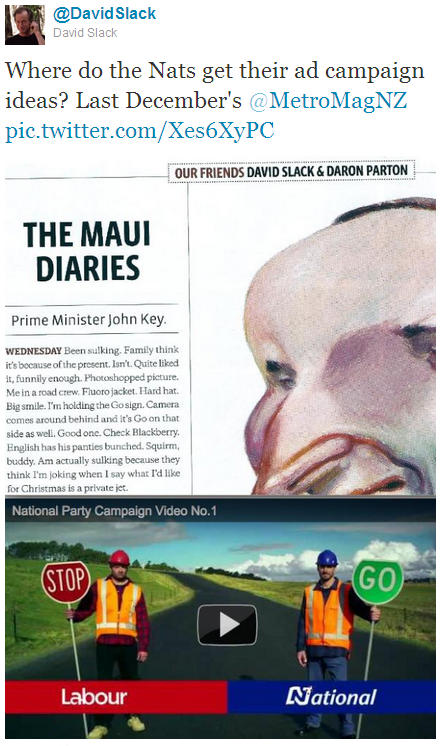
But hang on a moment. The symbolism of a lazy Labourite and a clean-cut Tory is laid on a bit thick — and the scruffy old Labour guy looks just a tiny bit “ethnic”, if you know what I mean. Moreover the whole Stop/Go metaphor is a bit trite — trite enough that it was the basis for a satirical diary piece by David Slack in December last year:

And If you think about how traffic control actually works, the metaphor has coherence problems. Last night, Anna Hodge tweeted the following observation, which in hindsight seems so obvious:

Also, does National understand road works? Or fairness? You need sign-holding dudes with both GO *and* STOP to keep traffic flowing.

Um, quite. For some to go, others must stop (at least until we get reef-fish-inspired traffic management systems.)

Anna’s tweet generated a bunch of responses as the narrative of the ad began to unravel. Mine was that if you’re at the front of the queue, only the GO sign matters; others were about the size of your SUV, the increase in inequality between north- and south-bound traffic flows, and the fact that Stop and Go signs are the same sign, just viewed from different angles.

Aaron Hicks remarked that the STOP sign at road works means that there’s actually work going on, a point you’d have thought might be clear to a government undertaking such an aggressive roading policy. And did the green of the go sign hint at a National alliance with the Greens? But they’ve spent the last decade and a half telling us that the Greens’ green means stop so green is basically red, and now their own green (not even a Blue-green!) means go?

The more you think about it, the more tangled and incoherent the narrative gets. And yet for all its flaws the ad works. It relies on people not thinking too hard about it — upon audiences swallowing whole the top-level symbolic material Toby described, making what Stuart Hall called a hegemonic reading of the text. In Hall’s model the second audience position is a ‘negotiated’ reading — such as Toby’s analysis itself, which recognises the hegemonic aspects of the discourse but doesn’t necessarily accept them, and the third position is ‘contrary’; consciously reading against the text’s hegemonic meaning — what Anna did, as did those of us who responded to her observation.

A lesson from this is that reading a tightly-encoded text counter-hegemonically is hard work. Audiences are not sponges or “sheeple”; they will often take a negotiated position, but in general such a position doesn’t prevent the text from having some impact. This illustrates a point of strategy that my regular readers must be bored tears with by now: you can’t rebut a text like this head-on with wonkish facts and figures. Dry details about Labour’s record and plans on economic progress wouldn’t make a blind bit of difference to the effectiveness of this particular ad, for two reasons: first because the hegemonic material doesn’t lodge in the head, it lodges in the guts (it’s truthiness, not truth); and second because such a rebuttal implicitly accepts the framing of the original text, and that framing is half the payload. But subverting the paradigm, man, that’s where the action is.

I’m not suggesting a comprehensive strategy to counter the National party campaign could be composed around a response to one 15-second ad, but if a counter-strategy was to be composed, that’s how you’d do it. Don’t berate people for accepting the hegemonic position, or for negotiating: find ways to make them see it in a different light.

L

Mr Self Destruct

Labour seems to believe that it’s easier to seek forgiveness than permission. With the missing figures in the Press Debate, they’ve sought forgiveness for failing to perform on the night, with predictable effect, and yesterday on the wireless with Paul Henry, Labour’s finance spokesperson David Cunliffe remarked about Police minister Judith Collins that if she were the last woman on earth “the species would probably become extinct”. That’s a couple of pretty big steps beyond the usual (and also unjustified) fat jokes about Gerry Brownlee and others, and it’s the sort of behaviour we’d expect in Berlusconi’s Italy, from some of the viler denizens of the lunatic fringe, or perhaps from Paul Henry himself — but it is not conduct becoming a former minister and possible Prime Minister-in-waiting.

I anticipate we’ll see a cringing apology today or tomorrow once the media cycle gets hold of it, but it’s too late — the damage is already done. Some lefties will inevitably claim that having a bit of “mongrel” is crucial to win back “Waitakere Man” (more on this later), or will point to examples of comparable outrage on the other side, but again, it doesn’t matter: Labour is dead in the water if it holds itself to the standards of the rabid right, and this reeks of desperation more than it does of strategy. As Pablo wrote recently, negative campaigning isn’t always a losing strategy, but it has to be done right — and this isn’t. [Edit to add: this sort of behaviour also negates a tactical advantage of being able to criticise Key for his media engagements, such as with Tony Veitch.]

As Labour partisans take great delight in reminding me, I have no knowledge of the inside of Labour’s organisation, and all my Kremlinology about its dysfunction is based on near-obsessive observation of what public evidence is on display. With that caveat, let me advance a thesis: Goff is actually coping pretty well with the campaign so far, but Cunliffe is not. After all, Goff’s only major failure has been an inability to produce costings for the fiscal policy — Cunliffe’s portfolio. Goff, as leader, bears ultimate responsibility for not demanding a better performance from his finance spokesperson, but since Goff has enough on his plate as it is, producing those numbers was surely a responsibility delegated to Cunliffe and his people, and they did not do so. Whether we interpret Cunliffe’s outburst about Collins as (charitably) cracking under pressure or (less charitably) the mask of civility slipping, it looks like he’s feeling the heat more than Goff who is performing better than most people expected (and knows it).

Just a final word about Waitakere Man. Yesterday Stuff.co.nz ran a wee video package they called the bloke test in which journalists asked Key and Goff the same set of questions in order to measure their purported blokiness. This has been widely derided (mostly by the same people who think Labour is running good strategy) as an exercise in vapid idiocy, but that’s not so. Just as much as we have a right to demand political and institutional competence from our leaders, we have a right to judge them on their instinctive, bedrock responses; and this was a case where two leaders were asked a series of unpredictable personal questions and expected to answer them off-the-cuff.

While its utility in measuring “blokiness” is highly dubious, this exchange contained a lot of other information about how the leaders respond to pressure, to humour, their attitudes towards social transgression and their place in society and a sense of who they “really” are. In a representative democracy where voters can be expected to have neither the time nor the expertise to become proficient in every policy field that impacts them, they rely on other indicators to determine who is more likely to make appropriate decisions in their stead. I’ll leave the interpretation of who “won” the Waitakere Man test as political rorschach, but suffice it to say that anyone who thinks this sort of thing is irrelevant trivia needs remedial classes in voter behaviour.

L

Winning matters

I’ve been absent for a while, and am still pretty busy but will endeavour to write more often through the election cycle.

This post is just to correct a misunderstanding that persists in some circles about the debate between John Key and Phil Goff, hosted by The Press in Christchurch (highlights here). The conventional wisdom, with which I agree, is that Goff performed very strongly through the first half (re Christchurch), and into the second half (on more general topics) up until the point at which Key challenged him on Labour’s costing, at which point he lost it because he simply couldn’t rebut the allegation that there was a $14 billion deficit hole in Labour’s policy platform. Labourites, however, have complained that this was unfair, that Key’s numbers were made up, that Goff couldn’t produce figures that hadn’t been properly worked out, or that nobody watches the debates anyhow so it doesn’t matter. These claims might be right; some of them certainly are. But it doesn’t make a blind bit of difference: the task was to win the debate, and Goff did not win the debate.

This is the point, though: it doesn’t matter if a leader’s debate is watched by only 100 people if as one of those people is the political editor of a major news outlet.

Winning a leader’s debate in itself doesn’t change people’s minds. Few people watch them, and most who do have already made up their minds and will interpret even the most epic fails as wins (go back and read the Daily Kos response to the ‘Dean Scream’; or for a more immediate example, see John Pagani). There’s a bunch of research been done on this, and the headline finding is that debates have a significant influence only on the politically naïve. For the most part, leader’s debates are about arousing the true believers and persuading the pundits, who will then report the outcome of the debate, which in turn provides signals to the voters about who has advantage, momentum, mad chops, political competence, and so on — including but not limited to who has the better policies. By failing to show John Key (and the rest of the nation) the money, Goff lost the debate, which puts him on the losing side in terms of all those factors — compounding an existing and well-documented leadership deficit. It doesn’t matter if he’s right — if he can’t demonstrate he’s right we’re entitled to believe he’s not. It’s not as if Key shut him down — he was afforded very generous opportunities to make his case, and he failed (or refused) to do so.

What has happened with the “$14 billion” over the past 48 hours is the system working as intended, filtering our presumptive leaders for basic political and institutional competence. Because we are entitled to demand basic political and institutional competence from our leaders. Not only that, we should demand it; and the fact that people — Labour activists in particular — have not demanded it this past 3 years is part of why we’re looking at another three years of John Key as PM.

John (and Jordan Carter, the MPs, Phil himself) and others who have picked apart Key’s back-of-the-envelope figures, insisted that it was more responsible to check and recheck the PREFU numbers before saying anything miss the point of a debate — it’s about winning under the hot lights of the public glare, not about being technically correct in the cool light of the following Friday. You have to be right enough that you don’t look as if you won on false pretences, but the task is to win, and to maintain the momentum of the campaign, the aura of leadership.

Goff failed. Barring some massive set of exigencies, that’s probably the election.

L

Turning Negatives into Positives.

One of the more vexing problems in politics is to turn opposition to something into a virtue. Being anti-something is reactive and defensive rather than a path with which to move forward. It is the antithesis of a proactive, innovative posture where the power of a better future is conveyed in order to secure implicit agreement to the unspoken “Yes” latent in the electorate. The latter is a positive reaffirmation, often couched in crude nationalism or other symbols of consensus and collective identity. In contrast, the implicit or explicit “No” embedded in negative campaigns carries with it connotations of obstructionism, obstinacy and lack of vision.

The negative connotations of a “No” campaign suffer from a structural disadvantage when it comes to mass political psychology. All things being equal, it is harder to successfully engage in “No” campaigns rather than “Yes” campaigns, especially when the former is confronted by the latter in electoral competition. Negative campaigns can also be a sign of defeat. Although all political challengers must attack incumbents on their record, there are ways to do so in addition to simple rejection of the opponent’s policies. In practice, opposition parties that fail to cloak their campaigns in a positive and proactive message are often conceding the outcome and using the electoral process for party rejuvenation rather than truly competitive purposes.

Yet it is possible for negative campaigns to convey a positive message. An example of a successful negative campaign is the opposition to the 1989 referendum on the nature of the Chilean regime. After 16 years of market-oriented military-bureaucratic authoritarianism, General Pinochet sought to continue as a civilian president in a “guarded” democracy installed by “controlled” elections. He and his supporters formed a political party to that effect, relaxed restrictions on the political opposition, and held a referendum that proposed that voters say”Yes” to constitutional revisions that would guide the installation of the “guarded” democratic regime. Pinochet and his followers banked on their control of the media and relative economic successes to ensure that the “Yes” outcome would prevail. The language of the referendum spoke to this fact by asking voters to vote “Yes” or “No” on continuing the unfinished process of national reconstruction under a Pinochet presidency.

Opposition to the “guarded” democracy plan came from a diverse array of groups, who preferred a full transition to democracy and the removal of Pinochet from politics. It did not necessarily have the support of the majority when the referendum campaign began, and besides the advantages accrued to the Pinochet regime, it was hampered by tight campaign regulations, lack of access to publicity, restrictions on public gatherings and the fact that many of its leaders were in exile.

Even so, the Opposition campaigners phrased their negative message so that a “No” vote was a vote for democracy as well as a vote against authoritarianism. It played on the knowledge that most Chileans understood that whatever its successes, the Pinochet regime was an aberration rather than a model, and that the price for its success was not worth the benefits supposedly gained. This organic understanding of Chilean “good sense” in the face of elite-purveyed common sense shifted popular perceptions of the referendum, and the “No” vote won a commanding majority. Confronted by defeat, Pinochet was abandoned by his supporters and the stage set for a fuller transition to democratic rule (I say “fuller” because the terms of the foundational election and the character of the political system for the first post-authoritarian decade were fixed by post-referendum constitutional reforms made by the outgoing Pinochet regime under executive fiat, which were heavily weighed in favour of the elites who benefitted from the Pinochet regime and which was backed by a military commitment to defend them. It was not until the 2000s (and Pinochet’s death in 1999) that Chilean democracy was fully consolidated, and even then the structural and institutional changes wrought by the authoritarians and their successors skewed socio-economic and political power in favour of those who prospered under Pinochet).

Regardless of what happened later, the “No” campaign on the 1989 referendum succeeded in shifting the terms of the Chilean transition to democracy away from those preferred by the authoritarians and towards those of a long-repressed opposition. It is therefore a good example of turning a negative stance  into a political positive.

The success of the 1989 Chilean “No” campaign might provide some insights for Labour as it enters the final phase of the 2011 election. Labour has staked its campaign on opposition to National’s economic policies, epitomized by the “No” on Assets Sales plank.  A little more subtly, the proposal to raise the retirement age is an admission that not all is well in Aotearoa. In other words, it is an admission of a negative, which is also the case for the repeated references to job losses via immigration to Australia. Most importantly, although Labour has “positive” planks in its electoral platform, these appear to be overshadowed (at least to me) by the negative aspects of its campaign. For its part, National can play the role of positive campaigner, using the upbeat character of the Prime Minister, the hopeful nature of its policy message (however devoid of positive content that it may be) and incidentals such as the All Blacks WRC victory to cement its pro-active and affirmative image in the eyes of voters.

Given the late stage of the campaign, it might be worth considering how Labour might cast its “negative” planks in a positive light. The key is to use the implicit “No” as an affirmation of Kiwi (as opposed to class or ethnic) identity, be it in its quest for economic and political independence or in its reification of  individualism as a national trait. Here differences can be drawn with National on issues such as security policy, where National has basically subordinated its military perspective to those of Australia and the US, or on foreign investment in an increasingly deregulated domestic economic context, where National would prefer to ease restrictions on foreign capital flows into the country regardless of their impact on strategic assets, local capital or the integrity of resident labour markets and environmental conditions. Saying “no” to such things is not being obstructionist or reactionary, it is about reaffirming who we are.

I have no expertise in political marketing, but it seems to me that if the 1989 Chilean opposition could turn a negative campaign into a positive statement given the severe restrictions and disadvantages under which it operated, then Labour might consider how to cast its campaign in a way such that its opposition to National’s policy proposals becomes a reaffirmation of Kiwi autonomy and independence. Other than that, it has little else to go on.*

* I am well aware that on economic fundamentals Labour and National are two sides of the same slice of bread, and that many National policies are mere continuations of those originally set by the 5th Labour government. My point here is to show that there is a way, however improbable, for Labour to rescue its election campaign.

Is a Blue-Green Foreign Policy Possible?

Discussion of potential coalitions stemming from the upcoming general election has largely avoided the question of foreign policy. Although the differences between Labour and National are more around the edges than at the core of New Zealand’s approach to international relations, there are some areas of significant difference, to which can be added the perspectives of the minor parties that might serve as coalition partners in a future government.

New Zealand First, Mana and the Maori Party have very little by way of foreign policy platforms, with the former adopting a mix of economic nationalism, anti-immigrant and neo-isolationist perspectives on New Zealand’s position in the world. Mana and the Maori Party’s focus on the defense of indigenous rights, with Mana  adopting a broad anti-imperialist agenda while the Maori Party seeks preferential benefits from foreign trade and investment. As a junior partner in the current National government, the Maori Party secured New Zealand ratification of the 2010 United Nations Defense of Indigenous Rights Convention (which had been opposed by the 5th Labour government), but has been silent on pretty much every other foreign policy issue.   For their part, personality-driven minor parties like United Future have no discernible foreign policy agenda.

Since the mid 1990s there has been a broad consensus on the part of the foreign policy elite with regard to New Zealand’s international relations. Labour and National agree on the trade-oriented and market nature of the New Zealand economy, as well as its general direction. They also agree on its non-nuclear position and support for multilateral resolution of international disputes. On security matters National has, as of the Wellington Declaration of November 2010, made New Zealand a first-tier security partner of the US, in both its military as well as intelligence-sharing dimensions.  Labour started the process of rapprochement with the US on security matters after  9/11, taking advantage of the fact that the US was desperate to enlist international support for its “War on Terror.” Sometimes beggars can be choosy, and the 5th Labour government took advantage of the window of opportunity presented by 9/11 to cultivate a security relationship with the US that had been dormant, apart from core intelligence sharing, since the 1980s. National has followed up by codifying the restored US-NZ security relationship in the Wellington Declaration. This includes closer Australian-New Zealand security cooperation under a US-centric  strategic perspective.

The trouble for Labour and National is that both also want to expand into non-traditional, non-Western markets, particularly in China, Southeast Asia and the Middle East. The minor contradiction is that all of these regions have current and potential trading partners that are authoritarian and habitual human rights violators, thereby giving lie to the stated New Zealand foreign policy goal of being a staunch defender of universal human rights. The bigger contradiction is that the major party approach to international security matters places Aotearoa on the horns of a diplomatic dilemma: its economic fortunes are increasingly tied to regions in which the US strategic perspective sees more rivals than partners. Again, China-US relations are instructive in that regard. By explicitly uncoupling security from trade with the Wellington Declaration, National seeks to split the diplomatic difference between larger strategic rivals, although this may result in a Melian dilemma rather than a bridge between new and traditional overseas partners.

Labour still exercises some discretion around the margins of the pro-US strategic alignment, such as stating that it will withdraw the SAS from Afghanistan rather than renew its deployment in March 2012 even if requested to do so by the US.  It also prefers a more flexible and UN-focused approach to international issues, whereas National is obsequious in its cultivation of US patronage. But on most core matters of foreign policy, National and Labour are reading off the same page.

This is where the potential coalition mix gets interesting. The most interesting possibility is that of a Blue-Green coalition between National and the Green Party. The Greens are poised to receive their largest vote ever. Although they would seem to be more natural allies of Labour when it comes to coalition politics, the Greens were burned by the Clark government on several policy matters such as the Zaoui Case, the Free Trade Agreement with China (and the content of trade agreements in general), deployment of NZDF troops abroad, security and intelligence legislation, human rights and environmental defense, animal rights and a host of other foreign policy issues. However, things may change now that Keith Locke is no longer the foreign policy and defense spokesperson for the Greens, and as I have said before, there is room for neo-realism in the Green foreign policy agenda.

Even so, National’s signing of the Wellington Declaration and extension of state powers of surveillance, detection, detention and control under the banner of countering terrorism is anathema to core Green principles.  To be part of a government that openly overlaps its security with those of the US (to include the possibility of entering wars of choice instigated by the US rather than limiting engagement in war to essential national defense or international peace-keeping), and which curtails basic civil rights in a liberal democratic setting where no serious security threat exists, cannot sit well with the Green rank and file. Selling out these principles to be part of a National-led government may well be a step too far even for the more pragmatic, second-generation leadership that controls the party (which has seen most of the original “red” cadre of which Keith Locke was part leave politics).

But it may not be. If the Greens can extract concessions around the margins of the the foreign policy agenda, say by pushing National to take a firmer stance on whaling or foreign fishery vessel operations or reaffirming New Zealand’s commitment to multilateralism, non-proliferation and peacekeeping, then perhaps its membership and the public at large will be mollified so that the coalition can be sustained. The Greens offer the perfect place to recruit a Minister for Disarmament and Arms Control. The Greens might be able to temper some of National’s trade discussions with environmental and labour-related concerns. Pigs can fly.

A Blue-Green coalition will require the Greens to compromise their foreign policy principles as the price for access to decision-making authority. A confidence and supply agreement might finesse the conundrum, but it could remain as a point of division that could well weaken the government down the road. In fact, Green access to, much less influence in, the foreign policy apparatus (to include MFAT, MOD and the various intelligence agencies involved), could well be a step too far for National and the bureaucracies involved, so the Blue-Green coalition possibility is limited on both sides.

For these reasons a Blue-Green coalition seems unlikely unless the Greens undergo a pro-market, realpolitik transformation or divorce their domestic policy agenda from their foreign policy concerns in order to focus exclusively on the former. As for the rest of the small parties, they will have little or no influence on foreign policy regardless of their electoral fortunes.


About SAS “mentoring.”

When John Key authorized the re-deployment of an SAS company to serve as counter-terrorism advisors to the Afghan Police’s Crisis Response Unit (CRU) in 2009, he was authorizing a mission that differed from the long-range patrol, tracking and infiltration missions that are the mainstay of SAS deployments and which were the basis for its original deployment in that theater from 2001-2005. In doing so he was placing the SAS at the forefront of the urban guerrilla war in and around Kabul (to include Wardak Province) that was part of the Afghan resistance’s two-pronged (urban and rural) irregular war conducted against the foreign occupying force led by the US and NATO under the banner of the International Security Assistance Force (ISAF). By the time Key authorised the deployment the security situation in Afghanistan had evolved into a civil war involving the Western-backed Karzai regime, the Pakistani-backed Haqqani network, and various Taliban factions based in and outside of Afghanistan (with Pakistan facilitating cross-border cover for those based inside its territory).

The SAS inherited the counter-terrorism advisor mission from the Norwegian special forces, who had advised the CRU from 2007-2009. The CRU has its origins in 2005, so rather than a new unit it is almost seven years old and has had foreign professional military training and advice for nearly five years. In most modern militaries the time taken for specialisation beyond basic training (such as sniping, sapping, intelligence-gathering and counter-terrorist response) varies from 6 to 18 months. That means that the CRU, which has 285 members, is lagging behind when it comes to being able to autonomously respond and fight on its own.

The SAS initially sent a light company’s worth of troops (70) in 2009, but the number has been reduced to 38 in the last year. The job consists of providing training on-base in which counter-terrorist assaults are mounted in various scenarios, using abandoned buildings, vehicles and other simulations that replicate the dense tactical environment in which the CRU must operate. Close quarter clearing and entering, airborne rappelling, hostage rescue and a host of other skills are initially imparted in these exercises. But the mission also includes accompanying the CRU into real situations, which means taking leadership roles in responding to live incidents when the CRU forces prove unable to cope on their own. As Taleban attacks on symbolic and military targets have increased over the last year in concert with the announcement that the US will be withdrawing the bulk of its forces by 2014, with other ISAF members already doing so,  the pace of these “live” responses has accelerated as well. Most of the operations conducted by the SAS/CRU consist of pre-emptive strikes against imminent threats based on intelligence flows provided by Afghan and ISAF forces. A smaller percentage is dedicated to responding to terrorist incidents in progress such as the attacks on the Intercontinental Hotel and British High Commission. The accelerated pace of operations now sees the SAS/CRU deployed in “live” mode 2-3 times a week on average. 

Urban guerrilla warfare has no fixed lines or fronts. In fact, by definition the battle space in a guerrilla war is amorphous and permeable. Thus the counter-terrorism mission is a combat mission within an irregular warfare context. Training and advising in such contexts means involvement in close-quarter small unit kinetic operations, which given the dense (heavily populated and urbanised) environment in which they occurs means that support and leadership roles are indistinguishable to the enemy. Thus the SAS has always had a combat role in this mission.

It is evident that the CRU is not performing up to professional standard, particularly when confronted by a committed and well-prepared enemy. This may be due to a lack of will on member’s part, which in turn may be rooted in the deep divisions extant in Afghan society and in the knowledge that a post-ISAF political settlement that avoids massive bloodshed will have to include the Taliban and the Haqqanis. Under such conditions in may appear foolish to be closely identified with foreign forces working with the Karzai regime. That could sap the desire of some CRU members to engage robustly in the counter-terrorism effort, no matter how eager they may appear to their SAS advisors when back on base. This is compounded by faulty intelligence flows in which individuals or groups with personal vendettas supply misinformation about rivals so that ISAF forces, including the CRU/SAS, launch raids against innocent people. There is already at least one incident in which the SAS has engaged in an operation that resulted in the deaths of innocents based upon faulty intelligence. The manipulation of intelligence by Afghan sources, in other words, raises the probability that the SAS will be involved in the deaths of civilian non-combatants.

The SAS dilemma is compounded by the fact that, given CRU unreliability, the risks to SAS troopers increases every time they deploy with them. It is one thing to deploy with fellow SAS on long-range patrols or in a counter-terrorism situation. They are a tightly knit and cohesive fighting unit playing off the same tactical page. But adding the CRU to the mix brings with it a lack of discipline and resolve, which forces the SAS troops to compensate by leading by example. Doing so exposes them to a degree seldom seen when fighting on their own.

The latest raid that resulted in the second death of an SAS soldier in a month demonstrates the problem. In a pre-emptive raid against suspected bomb-makers (or a family feud, depending on who you believe), the SAS deployed 15 advisors along side 50 CRU troops. This is a ratio of 1 advisor for every 3.1 CRU soldiers. That is remarkably low if the SAS were merely “mentoring” in a support role. The fact that the SAS trooper was killed while climbing a ladder to gain a better vantage point on the compound in which the raid was taking place shows that even such basic tasks, usually assigned to the most expendable soldiers of lower-rank,  are having to be done by SAS troops. This demonstrates a lack of faith in the competence or reliability of the CRU personnel and the need for first-responder proaction on the part of the SAS in such situations.

Given that the Afghan resistance have increased the tempo of their operations in and around Kabul, the likelihood is that the CRU/SAS will be involved in an increasing number of armed incidents. That may force the NZDF to re-increase its complement of SAS back to the original 70 personnel, and raises the question as to whether it will be asked to extend the SAS deployment past its March 2012 withdrawal date. Given the strategic dynamics at play in Afghanistan, that is a sticky question.

It also raises the question as to why Mr. Key has from the day he announced the re-deployment insisted that the SAS are in a non-combat “mentoring” and support role. The NZDF and Minister of Defense have now admitted that combat is part of the mission. Mr. Key continues to deny that it is so. Besides the lack of synchronization of the government PR spin, the question rises as to whether the government has misled the NZ public on the true nature of the mission, or the NZDF deliberately misled the Prime Minister and his cabinet on the matter at the time the request for SAS assistance was made by ISAF (it should be noted that Mr. Key’s agreement to redeploy the SAS was based on his eagerness to curry favor with the US, which may not have seen a trade deal as a reward but which has seen NZ elevated to the status of full US security partner with the signing of the Wellington Declaration of November 2010. This may well mean future involvement in US-led military operations that have little to do with NZ’s national security per se).

All of this makes the government and NZDF attacks on the credibility of Jon Stephenson and Nicky Hager, two journalists who exposed the true nature of NZDF missions in Afghanistan and the duplicity surrounding them, all the more contemptible and desperate. It also was very stupid to do so because the conflict environment in which the SAS operates has deteriorated rather than improved since it arrived back in theater, which made the deaths and wounding of its personnel much more likely if not predictable. Once that began to happen (there have been about a half dozen SAS troopers wounded in combat on this mission),  it was only a matter of time before the corporate media began to focus attention on the dubious explanations about the nature of the deployment. With that now happening the house of cards that is Mr. Key’s justification for authorizing it has begun to crumble, and it will not be surprising if senior NZDF heads will roll as a result.


Competing electoral insurgencies, in Epsom and beyond

In this post I argue that ACT’s apparent willingness to undermine the MMP system that has kept them alive isn’t so much a death wish as a wish to be welcomed back into the National party as a faction, rather than a stand-alone party; to ensure influence from within rather than relying on influence without. I wrote most of this late at night and cobbled it together from several pieces I’ve had banging around a while with some more recent stuff appended, so you have my apologies if it’s a bit disjointed.

Fairfax political journalists Andrea Vance & John Hartevelt have a pretty sharp piece up, calling the ACT-National deal in Epsom a shameless power grab. I wrote about this topic a few days ago. Their analysis is pretty good, particularly the argument that National may have difficulty compartmentalising future ACT scandals away from National, having taken such direct responsibility for shielding ACT from the rigours of electoral democracy. They also make the point that I and many others have made about the dual exploitation-illustration of MMP’s flaws:

Double dealing and horse-trading are nothing new in the battle for political survival. Perversely, as we head towards a referendum, this naked and shameless power grab undermines the very system ACT relies on for survival. The ultimate irony is that Brash wants it replaced with the supplementary member system that would probably vanquish his party.

MMP, and particularly exploitation of the free-rider rule, is what has kept ACT alive since the 2005 election, when the party’s support dipped to its record low of 1.5%. Supplementary Member is the system that Brash personally supports, and although there is no official preference, this is widely regarded as being the system most preferable to most National party members and the wider ACT party also. SM, as proposed with a 90-30 electorate-list split, would indeed be worse for ACT as an independent party, requiring it to get something like 3% 2% of the party vote to gain a list seat, even if it continued to win an electorate. Leaving aside for a moment whether this is likely or not (ACT did, in its heyday, poll well), that’s a considerable disadvantage because National would no longer have such a good reason to throw ACT an electorate seat lifeline. National’s doing so is apparently only tolerated by Epsom voters on the basis of the overall positive-sum value proposition made by John Banks: “vote for me, and I’ll bring five MPs with me on current polling”. You’d be a fool to turn that offer down. Reduce the premium to one MP and it suddenly becomes rather less appealing.

So on paper ACT supporting a non-MMP system looks like a turkey voting for an early Christmas. But I think the game goes deeper than that. ACT has in recent years abandoned its claims to being a classical liberal party, and is now basically a more hardline version of National’s dry petit-authoritarian conservatism, with a few casual nods to “freedom”, such as in alcohol policy. In recent months it has been colonised by the former right of the National party (Brash and Banks, most notably; also “National in Gumboots” Federated Farmers former president Don Nicolson). Both the former were until very recently long-standing National members whose tribal loyalty undoubtedly lies with that party. They see it as having strayed from its roots, and while they undoubtedly appreciate its newfound popularity with voters, they have repeatedly expressed strong concerns that the party has lost its way, and an intention to bring it back around by putting “reinforcing steel” into its governments (in the words of John Banks). Both, I think, would join National again in a heartbeat if National would have them, and would permit them any influence. An electoral system switch to SM makes that a more viable possibility, and brazenly exploiting both the two major flaws to which most people object in MMP — the threshold free-rider rule and the “back door” rule that lets a rejected candidate such as Don Brash back in on the list — sets up a reasonably strong case against MMP.

Supplementary Member has the worst features of both FPP and MMP. It has high noise (the variance between the makeup of the electorate’s votes and the makeup of the resultant parliament), delivers huge incumbency advantages to parties that hold many electorate seats (because there are more of them), severely marginalises smaller parties by reducing proportionality, and despite all this does not meaningfully solve the symbolic split between “legitimate” electorate-based MPs and those who ‘only’ come in on the list, nor the threshold, “back door” or “horse-trading” objections that most critics name as MMP’s worst flaws. (BK Drinkwater modeled FPP, MMP and SM against each other using election data since 1996, although bear in mind that for SM, these figures assume a 70-50 electorate-list split, which is considerably more proportionate than the 90-30 proposed).

National holds many more electorate seats than Labour, and has nearly always done so, even when its popular vote has been lower because its base of support is less concentrated in inner-city and suburban electorates. Any system of reapportioning electorates on the basis of population will continue to entrench this advantage. Under MMP, it is not a very significant advantage; under FPP and SM, however, it is. ACT’s electoral support, both in electorates and nationally, is very weak, largely because their policies are purposefully divisive, with the intent of galvanising a small proportion of “right thinking” voters against the mainstream. National’s strategy since 2006 has been to occupy the centre-ground and cannibalise Labour’s votes in a zero-sum fashion. This has been a strategy of necessity — the 2005 election demonstrated pretty categorically that divisive politics, no matter how much money you could throw at it, no matter how favourable the cultural terrain, or how good the propaganda, was not a winner for National in an MMP environment. The incumbency and electorate edvantage delivered by SM, however, would cushion them against voter discontent and permit a more hardline approach: one that included ACT as a faction within the National party, as it previously was. So under SM, ACT doesn’t need National to throw it a bone, and National doesn’t need to rort the system to extract electoral advantage: National under SM will enjoy sufficient advantage to simply absorb ACT and its policy programme, and its governments will be emboldened to enact divisive or unpopular aspects of that programme without the same fear of electoral blowback that now constrains it. ACT’s strategy is therefore an insurgency against National; one that may be permitted by National, contingent upon the adoption of a more beneficial electoral system.

A further comment on Labour’s response in Epsom is also warranted. Arthur (in comments to my post linked above) suggested that the best way to nix ACT in the 2011 election is for all Labour and Green voters to cast electorate votes for the National candidate, Paul Goldsmith, in the hope that this will send a signal to National voters who are unhappy with the horse-trading between ACT and National that it might be worth defecting. This is, in principle, a strong strategy, and it has been picked up by some Green supporters as well. But I think it’s the wrong strategy in this case, for five reasons. First, it’s a complex and counterintuitive strategy, and it’s extremely hard to get so many people (on both sides) to act against their own instincts like that. Second, the value proposition made by ACT (six for the price of one) is simply too good for a meaningful number of National voters to pass up. Third, it would require Labour to publicly endorse a National candidate, which would permit John Key to proclaim that “even the opposition supports the National party”. Fourth, the electorate demographics for Epsom don’t stack up: this electorate bleeds blue and even if a fair proportion of disgruntled Nat voters defected, I don’t think there would be enough Green and Labour voters to prevail. Fifth, it would require Labour to buy into the electoral-system rorting, making them no better than the National and ACT parties.

Labour looks like it will mount an ‘economic dry’ insurgency by standing David Parker in Epsom. This is a better strategy because it is vulnerable only to the objections two and four above (the positive-sum value proposition, and demographics). These will probably still mean that it is unsuccessful in terms of winning Labour the electorate and denying ACT parliamentary representation, but it also has the advantages of fighting the national and ACT parties on their own turf — economic responsibility — and in demonstrating that even when they’re down, Labour fights fair and respects the integrity of the electoral system. Most crucially, however, whatever strategy is adopted by the left in Epsom must be coordinated. The two proposed strategies (vote Goldsmith and vote Parker) are contradictory: one must be abandoned, and soon, in favour of the other. Because if the Green faction goes into Epsom with one strategy and the Labour faction goes in with another, there’s only one winner: ACT.

L

Rotten borough

This evening Paul Goldsmith won the Epsom candidacy for the National party. Goldsmith is was until 2010 a Citizens & Ratepayers Auckland city councillor, and has a long-standing National party affiliation.

He will be standing against ACT candidate John Banks, who is the subject of a hagiography by Goldsmith titled “John Banks: A Biography” and published a few years before Banks stood for his first term as Auckland mayor, which he won in 2001.

ACT is led by Don Brash, who is the subject of a similar tome — I haven’t read this one, so I will refrain from calling it a hagiography in such specific terms — titled “Brash: A Biography”, also by Goldsmith and published as Brash was whipping up race hatred as leader of the National party in order to win the 2005 general election, which he did not.

So unless someone can explain to me again how National is going to contest Epsom strongly by standing the hagiographer against his subjects, this is simply a renewal of the Hide-Worth electoral rort, where a nod and a wink permits National to elect Banks and exploit the free-rider loophole in MMP; all the while campaigning against MMP due to flaws such as the free-rider rule, and the ‘back door’ rule which will in all likelihood get Don Brash back into parliament despite his having been rejected in 2005 — not only by an electorate, but by the whole nation as leader of a failed National party bid for government.

And fair play to them. If the electorate won’t punish them for doing so they’d be rude not to.

L