Quote of the day from Banksie

Well, I don’t happen to take much legal advice from lawyers.

Regarding leaky homes, a problem caused by deregulation under the government of which John Banks was a part. Listen to the whole interview with a somewhat exasperated Sean Plunket. It’s worth it to hear Banksie argue that:

  • That we need to “get money into the hands of Bob the Builder” rather than giving it to the lawyers
  • … even though “of course” (he says) it’s Bob the Builder who caused the problem … and people can still sue Bob the Builder “if they can find these people and get hold of them legally”
  • … while admitting that there’s no real prospect of that since those responsible mostly have “walked away from their responsibilities”
  • … and conceding that the amount spent on laywers so far would cover only a tiny proportion of the total cost of leaky homes in any case.
  • That he “doesn’t think there’s any right and wrong” in the arguments around leaky homes;
  • That some people have been held to account, but he can’t name them;
  • That the magnanimous “John Key government” has said it is “morally responsible” while not being actually responsible;
  • and that he (personally) is taking responsibility, but that he has no recollection of precisely why the regulations were passed (by his government).

Enough to make your head spin.

L

Summary of joke news coverage

“John Key has made a meal out of ongoing Treaty negotiations with Ngāi TÅ«hoe, remarking at dinner with representatives from neighbouring iwi Ngāti Porou that if he were in TÅ«hoe country, it would be him on the menu. TÅ«hoe have found his comments hard to swallow, with lead negotiator Tamati Kruger saying the remark was in “poor taste.” Others believe the gag should be taken with a grain of salt, as a self-deprecating reference to the roasting Key has received since ruling out the return of Te Urewera National Park. The decision has soured iwi relations with the government, and effectively put negotiations on the back burner.”

(Some artistic license employed, but I’ve seen each of these puns in bona fide media coverage over the past 24 hours.)

Update: It seems nobody other than ak and I have the stomach for a pun-fest. Oh well.

Still, better to remain silent than engage in the shrieking, confused and exploitative orgy of idiotude on display at The Standard. Its only meaningful distinction from the response of the KBR seems to be the lack of ginga jokes. And the comments are a bit shorter. A shame, because there was some reasonable sense from both posters and commentariat on this topic yesterday.

L

Insensitive … now wait for the “hypersensitive”

Commenter Alexandra at The Standard picked up on a report by Radio NZ that John Key joked about Tūhoe as cannibals:

“The good news is that I was having dinner with Ngati Porou as opposed to their neighbouring iwi, which is Tuhoe, in which case I would have been dinner,” [Key] said, “which wouldn’t have been quite so attractive.”

Now, a reference to cannibalism in any leader’s speech is bad enough, but joking about it in the context of the government’s betrayal of TÅ«hoe, and Key’s failed attempt to speak for the māori party regarding that betrayal would be absurd if it wasn’t so insulting. Not only that, but the reference to Ngāti Porou was all the worse, given the complex history of those two iwi, which was also in the news recently but of which Key appears to have no awareness.

Two main questions occur to me: first was this a calculated move to distance himself and the government from the sense he has “gone native”, or just an idiotic off-the-cuff remark? (Essentially: bad will, or just incompetence?) And second, what will it take to prevent the māori party from walking away? As Marty Mars says, this is a significant matter of the mana of TÅ«hoe, and the mana of Māori in general. It cannot just be left to lie: either the māori party walks away, or some sort of meaningful reparation — you might call it “mana enhancement” — must be offered by the government, not only to TÅ«hoe and the party, but to Māori in general. The māori party are in a tough spot; as I argued yesterday, Māori don’t have the luxury of just throwing their toys whenever they don’t get their way. But something has got to give.

Oh, and as per Pākehā Standard Operating Procedure on issues like this, wait for the Māori response to be declared hypersensitive.

Update: Same being asked by Lynn at The Standard.

Update (20:25) Much has become clear since I wrote the post. Some updated thoughts follow.

First, it’s clear that this wasn’t an inadvertent, casual comment — it was, if not a planned and sanctioned statement then clearly a calculated one intended, after apparently growing discord at the Lower North Island National party conference this weekend past, to win Key and the government back some of its reputation for driving a hard bargain with Māori, and for not being a PC pounamu-wearing hand-wringer. So the initial diagnosis is “bad will” rather than “incompetence”. This was a simple continuation of the negotiative process which Key chose to stall by unilaterally ruling out the return of Te Urewera National Park; Key providing an opening for TÅ«hoe to continue dialogue, or not.

Second, it’s pretty well-calculated. It would have been easy for TÅ«hoe (and others) to publicly overreact and confirm Pākehā New Zealand’s worst instincts about them. It would also have been easy for the māori party to walk away from the coalition deal, and I do think this is another factor in favour of that course of action. But they haven’t done so. Tamati Kruger’s response that the joke was “not funny, in poor taste and unbecoming of a prime minister” is pretty strongly-worded but shows its own sort of gallows-humour, indicating that Kruger (seasoned negotiator that he is) understands the game being played, and is prepared to continue playing it, given some caveats. Having today said that Key had lost his nerve Kruger has held his. He was magnanimous and humorous when speaking to John Tamihere and Willie Jackson about the topic on RadioLIVE this afternoon, but pretty clear that the deal is still to be closed, and it will now take some closing.

Third, Key has publicly insulted both TÅ«hoe and the māori party in the past week, and this does still need to be addressed. All parties seem to have chosen to address it around their respective negotiating tables, rather than in public, but behind closed doors these people will be furious at having been so treated, and for all that they’ve gained ground with the redneck street, that’s ground National will need to make up inside the wharenui. To put it in terms Key, as a former currency trader who worked a lot in Asia, would understand: the price of doing business just went up. And it went up quite a lot, because failure to accede to that increase means TÅ«hoe can now justifiably walk away from negotiations which are already almost two years underway, claiming that the negotiating team has no legitimacy, having been unilaterally overruled by their own prime minister, apparently just because he changed his minds. If they do that, expect every other current negotiation to go the same way. That’s an unacceptable political cost for Key before the next election, let alone the one after (by which all outstanding claims are supposed to be settled).

Fourth, a public sense is beginning to build of Key as the one who is endangering the relationship, after the opposite sense developed around Hone Harawira’s comments last year. If the coalition between National and the māori party fails, it will be seen as his failure to manage the relationship adequately, and that damages his own master narrative of being an efficient political manager and an all-round nice guy. As marty mars said in another comment on The Standard, the concessions granted to Māori by Key’s government are “barbed” — they can’t be revoked or withdrawn without sustaining substantial political damage, which means that if the māori party sees genuinely irreconcilable differences and an opportunity to dissolve the agreement without being seen as unreasonable, they are able to do so. But as Neil says in the comment thread below, and as I’ve been arguing to little avail for ages, the māori party’s best play vis-a-vis either major party is the threat to go with the other. Labour partisans and much of the wider left wish it were not so, but if Labour get a sense that they have a monopoly on the māori party’s attentions again, then further concessions will be rare and threadbare.

Fifth, the KBR response is just what you’d expect, complete with gratuitous references to the alleged taste of human flesh, and ginga jokes. Sigh.

Thanks for the discussion so far. Responses to other comments below.

L

MMP in NZ is safe

shirtcliffe ad
Evidence:

  • It has been found to work pretty well and all parliamentary parties except ACT support it.
  • The UK election is about to remind people how perverse FPP is.
  • Peter Shirtcliffe is spamming people in order to gain support for his anti-MMP campaign.
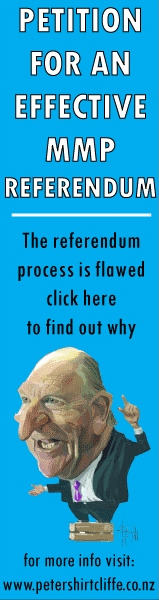
  • His google ad campaign looks like this ====>

Seriously. That’s him. A ranting white middle-aged elderly patrician of the sort New Zealand’s governments were almost exclusively composed before the change in electoral system — and on a soap-box, for goodness’ sake. A starker warning of what’s in store should the electoral system change is hard to envisage. Also: it’s visually busy and garish. The blue is neither National-party royal blue, nor ACT-party aqua-blue, nor flag-Navy; it’s nothing. The message is over-long and confused (campaign for an effective referendum? Don’t you mean to campaign against the electoral system? No? Ok then.) And the cartoon …

Thanks, Peter, you’re doing your country a great service.

(Thanks to Lyndon Hood in the comments to Russell’s thread linked above for the pic.)

[This line inserted to fill whitespace].

L

Thoughts about Key’s Afghan PR Exercise.

I have seen and read the reports of John Key’s much anticipated “secret” trip to Afghanistan.  I must say that it is one of the more amateurish, cringe worthy attempts at symbolic politics I have seen in a long time–not quite as bad as George W. Bush’s “Mission Accomplished” carrier charade, but of the same ilk. Let me explain why.

First, the good part. I think it was entirely sensible for the National spin-meisters and military brass to tie the Afghan detour to the Gallipoli celebration trip. The unfortunate RNZAF chopper accident on ANZAC day forced a change of plans so that the PM could attend  the funerals of the ill-fated crew, but that only added to his  message of military support and remembrance. As for the greedy economic opportunists who have criticised him for abandoning the arse kissing trade mission to the Arab Gulf Coast, they need to realise that given the circumstances in which the tragedy occurred, Mr. Key had no political option but to return for the funerals. How would it have looked if he choose to continue to brown nose the Arabs while some of the nation’s service people were laid to rest?  The likes of one Mr. Langely may put personal self-interest before recognition of service, but most Kiwis understand that not only was it politically necessary for Mr. Key to return, it was the right thing to do.

But that is about as good as it gets. Contrary to the fawning editorial opinion of the NZ Herald, Key’s tiki tour of Afghanistan showed how out of his league he is on international security affairs.

He started out by mentioning that he was flown by helicopter from his arrival point (presumably Bagram Air Force Base, the site of a notorious US “black” detention centre) to the SAS location. In doing so he managed to convey the message that the most heavily defended areas of Kabul are still too dangerous for Western VIPs to drive through, and that the SAS is not located in Kabul as he claims but is actually based elsewhere. He then pointed out that he used heavily armed motorcades to travel in Bayiman and elsewhere because he and his entourage were “juicy fish” for insurgent targeters.

Well, not quite. In a country that is awash in visits by heavy-hitters from a number of countries, Mr. Key is more like  an anchovy.  Moreover, heavily weighted  Western motorcades involving a half dozen armoured SUVs and armed escort vehicles are not immune to roadside bombs (and I bet he traveled in the third or fourth vehicle). In fact, given that they have to travel on main arteries and disrupt local traffic and pedestrian flows as they do so, convoys such as Mr. Key’s actually make for better targets for opportunistic guerrillas deeply embedded in a resentful local population (especially where well-prepared guerillas can deploy efffective IEDs on five minutes notice). If leaving a light footprint is what hearts and minds are partially about, then his mode of land transport was a tactical failure.

Mr. Key prattled on about how he wanted to experience the conditions in which the NZDF operate in that theater. But he choose to spend his evenings at the British embassy. That is a double insult: first to the UN and ISAF patrons of the NZDF mission, which have their own housing compounds or use heavily guarded hotels for visiting VIPs; and secondly to the NZDF itself. Mr. Key could have stayed in officer quarters in any number of bases including at the PRT in Bayiman or the SAS operations centre (which is likely to be on the Afghan military base where its anti-terrorism Crisis Response Unit is headquartered). But instead he choose to take the poncy route and accept accommodation from the colonial master. How quaint of him, and how much it tells us about his sincerity in wanting to understand the conditions that NZ troops face.

Mr. Key managed to offend the Bayiman locals by trying to shake hands with a girl, a cultural taboo in that region. So much for MFAT and NZDF giving him a head’s up about local customs, to say nothing of his lack on intuition about the context in which he was operating. For him, ignorance on that occasion turned out not to be bliss. For the NZDF PRT team, this could have been ther moment where 6+ years of good civil-military relations became unstuck. The question begs: would Helen Clark have been so, uh, uninformed? >>Note to Red Alert and The Standard–while I appreciate your views you must not use this post to score political points because to my mind you are little better when it comes to partisan  issues such as this>>

In defending their role, Mr. Key  said that the SAS had not fired their weapons. This is laughable to the point of tears. The very nature of their “training” mission, as well as the fact that they have participated in at least two well publicised firefights (even if we accept the argument that they did so in “support” roles, which is ludicrous), requires that the SAS  employ their weapons, even if merely as covering or suppressing fire for their Afghan comrades.

And yet, the supplicant NZ press uncritically lapped up his patent lie while he hid under the doctrine of  plausible deniability (that is, because Mr. Key may have believed the lie to be true because his advisers or the NZDF command told him to take their word at face value and he had no reason to doubt them because he simply does not know better). Here, Mr. Key’s ignorance truly is a measure of political insulation, if not bliss.

Mr. Key told this same press that he was “considering” extending the deployments of the Bayiman PRT and SAS past their respective termination dates in September 2010 and March 2011 respectively. This was a forgone conclusion given that the NZDF wanted to do so and given the government’s obsession with tying a bilateral US-NZ free trade agreement to its military commitment in Afghanistan as well as the recent military-to-military reapprochment between the two countries. Heck, the foreign press was told before the trip that the extension had already been authorised but Mr. Key played cagey with the NZ press. Could that be because he wants to appear to be considerate of opposition voices in parliament when in fact he is not?

Mr. Key did his usual name-dropping act. He met with Karzai and General McCrystal. He met with local leaders. Although he waxed lyrical about what they had to say, he made no mention of what he had to say to them. Did he tell Karzai that his corruption and the drug-running antics of his cronies would not be tolerated? Did he press Karzai on not back-sliding on human rights, especially for wimin and ethnic minorities? Did he query McCrystal on continued civilian casualties at the hands of ISAF forces, and did he make clear to the General what the NZDF understanding of the rules of engagement are?  Nothing of the sort has been mentioned, so for all the NZ public knows he could have been exchanging cricket scores and family photographs with the Big Boys.

And then there was the piece d’resistance: John Key fitted out in a journalist flak jacket and helmet, his blood type outlined like a bulls-eye on his chest, grinning like a kid in a GI Joe costume. Then there were the photos of him acting friendly with the pilots on the RNZAF C-130 and acting pensive on the US Blackhawk ‘copter that did the bulk of his tour transfers. Dang. I have no doubt that he needed the body armour when he was not sipping tea with the Poms, but did his minders really think that a photo op in that outfit would come across as warrior-like and decisive? If so, they are clueless because he just looked goofy, somewhat akin to the infamous photo of Democratic candidate Michael Dukakis sitting in a tank turret wearing a helmet in the 1988 US presidential campaign. In both cases the image spells out L-O-O-O-O-O-S-E-R.  As for the aircraft photos: staged and contrived from the get-go. He looked like he was on one of those Air NZ tourist charters to the Antartic summer solstice. Another photo op FAIL.

Mind you, the NZDF brass as well as the troops on the ground would have appreciated the gesture, albeit for different reasons. So there was symbolic worth in the venture. It was in its execution where the enterprise failed.

Because they are clueless National PR flacks will congratulate themselves on a job well done in getting their message about the PM out to the masses, and the supplicant invited press will play the role of willful lapdogs by writing positive stories based on National PR releases (in part, because they share the government’s contempt for the intelligence of the general population, and in part because they would like to be invited along on other future junkets of this sort). But the cruel truth is that the exercise showed yet again how far out his depth the PM is when confronting the intricacies of even the most rudimentary aspects of foreign affairs. For those with a better sense of judgement, the exercise was embarrassing, not encouraging. Or as Pauly Fuemana would have said, “how bizzare.”

Fire in the House

The opposition was strong in Parliament today. I’m stuck for time, so what follows is somewhat stream-of-consciousness.

Front and centre was the government’s failure to perform on unemployment and wage growth, the subject of criticism from both flanks. Bill English had led off with “the budget will be about the many, not the few”, and then “but seriously …”, to a stinging rebuke from David Cunliffe, who listed the government’s failings as he saw them. This adoption by the government of Labour’s own tagline looks like an attempt to muddy the counter-campaign and poach their emphasis, trying to set up National as the party representing “the many”, rather than the policy merits of the government’s program, but if so it’s a fairly ham-fisted one. While “the many” looks on its way to becoming this election cycle’s “hard-working Kiwis”, the government’s attempt here to muscle in indicates that National has accepted Labour’s rhetorical framing, although they disagree with it. If you adopt your opponent’s narrative, you need to be able to make it your own — either that, or you need to dismantle and discredit it. English did neither.

Cunliffe was strong, also raising the variance between English’s aspirational and controversial “Plain English” ad and the policy track he has delivered. Sir Roger Douglas also took aim, and was forced by the Speaker to rephrase the question (to Paula Bennett): “Which is more important? Young people getting jobs, or pandering to the Left?”.

Bennett also took a bit of a pasting on the matter of the identity of one Peter Saunders. The Standard has picked this up so I’ll not elaborate more. Wayne Mapp, standing in for the Minister of Agriculture also stumbled on a line of questioning from Sue Kedgley regarding AgResearch’s GM cattle trials. Not exactly a shock since, not being the minister himself, that information wasn’t top of his mind, but it contributed to the general atmosphere.

Then it was all on in General Debate, with Goff, King and Cunliffe leading off on the same topic matter (jobs/wages) with a couple of fiery speeches, and re-emphasising the “smile and wave/photo-op/government by poll” meme and the retrenchment of the government’s mining plans. Judith Collins concentrated on David Cunliffe’s lack of orthodox economic credibility, and purported concern for Goff having to shoulder the dual burden of leading a party in which Cunliffe was both the finance spokesperson and a leadership contender. Nice concern troll, but what’s more interesting is how much she was looking forward to seeing Cunliffe’s expenses records — and the threats hurled across the House while she thought she was not miked — “You wait, just you wait! …” Some irony in this given that it was just yesterday Collins raised the most threadbare defence of her (or someone else’s) extensive use of the ministerial self-drive car: “All the travel is within the rules – that’s all I’m prepared to say on it.”

So, while superficially an ordinary sort of Wednesday (albeit one where the Member’s Day was not clobbered by urgency), I think this has provided a few glimpses of the 18 months to come: a robust focus on core materialist issues from the Labour party, ahead of the budget, and a clear desire to debate the policy merits; combined with continued attacks on the credibility and perceived competence of English and Bennett in particular; the government attempting to subvert the opposition’s framing rather than exclusively arguing the merits; Collins v Cunliffe shaping up as a key battle. Nothing flash, but it’s starting to look like something resembling a threat. Most importantly, something to require the government to rethink its own gameplan. Until now they’ve had the ability to act almost with impunity, their errors going unpunished. If today’s performance is any indication, no longer.

L

Organic protest, and reframing the mineral debate

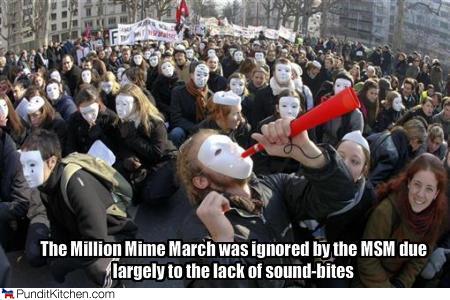
political-pictures-mimes-million-march

Like many others, I was amazed at the turnout for the anti-mining protest in Auckland on Saturday. That 50,000 people would turn out for such an event is remarkable in itself — the NZRU’s financial problems would be solved if they could attract so many people to half a dozen rugby matches each year, and we’re currently rebuilding Eden Park so they can seat that many a dozen or so times next year, and then maybe once or twice a year thereafter.

But the more remarkable thing about this march was its apparently organic nature. From my read — based only on the media coverage, mind — this was not a visually and ideologically cohesive, “branded” demonstration such as “enough is enough” and the more recent child discipline march, which were more or less Boobs On Bikes without the boobs or the bikes, advocating the wholesale adoption of a political product. It was not a heavily stage-managed piece of public theatre as the Foreshore and Seabed hÄ«koi was, and it was not a set-piece undertaken with a specific tactical purpose such as the most memorable marches of the Springbok Tour were. There were t-shirts and banners and so on, but these were not issued like uniforms with marching orders and approved wording for slogans, imagery and talking points. These were not rented crowds, seas of mime-like bodies serving as a vehicle for someone else’s words and sentiments. This was a genuine all-comers march, and if its almost unprecedented turnout did not bring genuine authority, then its authenticity surely must.

The response from the usual authoritarians has been a heady blend of confusion, disbelief and denial — the same sorts of delusions I normally accuse Labour partisans of falling prey to, when the observable data fails to conform to ideological modelling. This is bad for them, and good for those who oppose the government’s mining plans: if the government persists in believing the models instead of the data, it will go the way of the last government which did so.

But I don’t think this government will do that. I think it will see the writing on the wall, and reframe the mineral debate. Key and Brownlee have surely now seen their error: addressing mining in Schedule 4 as a national economic development issue rather than as a set of regional development issues. Going for it all in one bite was greedy, and as Danyl says, reflects the sort of complacency which creeps in when your opposition isn’t up to the task of opposing. But as strong and authentic as the Auckland march was, it has a weakness, and that’s that it’s composed of Aucklanders. Mining schedule 4 as a national strategy has failed, and likely at the cost of the opportunity to mine in the Coromandel and on Great Barrier Island, but it has thrown into sharp relief those areas where local views are less opposed — such as Paparoa, and possibly Mt Aspiring. As I commented on The Standard earlier, West Coasters are overwhelmingly in support of extended mining, a solid turnout in Nelson notwithstanding. Portraying Nelsonites as latte-sipping greeny liberal lifestylers begrudging their honest hard-working brethren on the other side of the hill a chance at the riches of the land will turn this into a classic town/country divide of the sort National and its mining allies are very skilled at exploiting. So watch for a few hundred — or maybe a thousand — Coasters marching in Westport to support the mining proposal being equated to this weekend’s demonstration in Auckland, and watch for well-meaning Aucklanders, Wellingtonians, Nelsonites and those from elsewhere being told in fairly certain terms to butt out of their regional business.

The government will be taking a risk if it proceeds with this plan, even in a regional form, because it has already permitted the debate to be established as a national issue about national parks in which everyone from the Cape to the Bluff has a stake — but it has amassed plenty of political capital, and now is the time in the electoral cycle to use it. Particularly with the Australian federal government unveiling a new resource tax, New Zealand just got more attractive for mining interests, and the imperative to dig, baby, dig will be stronger than ever.

L

As advertised

Late last year, when the ACC ructions were underway, the professionals working in the sector warned that people would die as a consequence of the reforms mandated by the new Clinical Pathway on the assessment and treatment of sexual abuse victims.

Since then, and on the basis of the pathway, ACC has taken to declining claims despite publicly claiming consistently throughout the past six months and as recently as today that there was no cost-cutting imperative. This has resulted in a drop of more than 90% in the number of claims approved year-on-year. Explain that, if you can. Nick Smith couldn’t, though he tried to do so during Question Time. It has also caused a chilling effect in which people are simply not applying, since they’d have to undergo the trauma of the exhaustive documentation and excessive review required by the pathway only to have their claims declined.

It’s impossible to separate these reforms from the overarching government plan to privatise — partially or wholly — ACC, and when viewed in this light it becomes clear what’s going on: this is how insurers make their profits. And, just lilke it said on the box, people are dying. It’s a good thing there’s going to be a review, but what’s better is that the sector is organising their own review in parallel. Should make for an interesting compare-and-contrast. I am aware that certain senior National party MPs are aghast at the conduct of ACC, so there may begin to emerge some pressure from within the party for change, as well as from outside. We’ll see.

L

Current events

I was reluctant to post while I had the chance on ANZAC day, since there was such a good debate going on, and now I’ve (temporarily) run out of time again. So just a few quick observations.

  • Phil Goff’s one-two punch on the top tax rate and Auckland governance is solid, and both are good orthodox Labour positions for him to take. But it’s more of the same: lacking verve and failing to get cut-through as a consequence. I mean to post on the positioning of the taxation pledge at some stage, but in case I don’t get to: this is a good opportunity for Goff to demonstrate compromise as well as differentiate himself, by coupling a reimplementation of the top rate with an increase of the threshold.
  • Even without Sunday’s tragic helicopter crash, Goff’s timing was poor in making these two announcements before ANZAC Day. I guess you take the opportunities you can get, but delaying things by a week would have been more useful in my view.
  • As an aside, my mum knew the three late airmen vaguely through Search and Rescue, and confirms the universal sentiment that they were of the very best sort. I’m pleasantly surprised that the crash hasn’t turned into a witchhunt about why we’re still using Vietnam-era hardware; as true as the sentiment might be, we can all do without people thundering “if we’re going to have a military, we owe it to our troops to have it decently-outfitted” under circumstances such as these. Such is the power of ANZAC day, I suppose.
  • On a related point, the discipline with which the military, government, police and media have adopted the Air Force’s framing terminology in this event is remarkable. All four groups are talking about “the Air Force family” and exploiting the metaphor for all it’s worth. Those words are used almost every time one of these people stands in front of a microphone, and in addition the three deceased are “brothers”; Mark Sainsbury reported live last night from the family’s “lounge”, the squad room at Ohakea air base; all four have referred to the Iroquois as being like “your grandfather’s axe” — the reference being that, although it’s very old, when the handle is worn it gets replaced, and when the head is worn it gets replaced, so while it’s his axe in spirit, it actually contains no parts of the original tool and is as good as new in function. On the one hand, this is compelling symbolic stuff: nobody who deviates from this framing can really be said to be showing the proper sort of respect and deference; on the other hand, it’s a bit creepy for everyone to be falling into lockstep behind Defence HQ communications. There are ways of saying these things without using the exact same words, and the constant repetition spooks me. Maybe I’m just sensitive. [Edit: There was a clean sweep for “Air Force family” or something similar in speeches supporting the Prime Minister’s parliamentary motion of condolence. No shock there, I suppose.]
  • On a somewhat lighter note, Councillor Tony Jack has picked the wrong district council to put a motion banning macrons in council materials. This is the Kāpiti Coast District Council, who moved to put the macrons into Paekākāriki and ÅŒtaki only a month ago. Jack’s motion was voted down, at which point he predictably declared that PC had gone mad. Bless. Of course, the Stuff article doesn’t contain the macrons, so I guess he wins as far as that goes.
  • Tim Watkin at Pundit continues to write excellent sense and ask smart questions about race relations in Aotearoa New Zealand. I think the emphasis in Tim’s piece is just right — there is a legitimate claim to indigeneity for non-Māori, but it’s not so obvious as Trevor Mallard’s “I was born in Wainuiomata”, and there’s a lot to work out before such definitions can be settled upoin comfortably. I’m all for having this discussion. I particularly like the ornithological allegory drawn by commenter “william blake” — we are all PÅ«keko!
  • Also on a lighter note, a (very) atheist friend whose six year-old daughter has chosen to go to Bible study classes recently asked him if, because Jesus had risen from the dead, that meant he was a zombie. It apparently took every ounce of his parental commitment to letting his girl make up her own mind to explain the origins of zombie stories, how myths come about, etc. rather than just saying, yes, Jesus is a zombie. Good on him — not sure I would have had the fortitude.
  • Speaking of things biblical, and of belonging, Joanna Newsom has a new album out, and here’s the first single — about tilling one’s own bit of the Garden of Eden:

Ok, so not so brief after all. Discuss. I’ll dive back in as I can. You can treat this as an open thread as well: post what you want to talk about.

L

Apologies to those who hate rugby metaphors

… but they’re really useful. Here’s another one.

After the election, I ruminated upon the future of the Labour party, employing a fairly hackneyed rugby analogy to describe the crossroads at which they stood. I’ve been meaning to follow it up and write about the fact that they’re very much playing the Crusaders game, rather than the Hurricanes game, but I’ve struggled to find the motivation to do so because it’s just so bleeding obvious that that’s what they’re doing.

But yesterday’s comment by Trevor Mallard on the “Mr Key goes to Washington” story is pretty revealing — especially from such a die-hard Hurricanes fan:

In Super 14 terms this is like a loss with a bonus point.
And what are the odds of the President putting his head into the meeting to give John another chance to smile and wave to the cameras.
Will almost certainly happen but will still be a loss with two bonus points.
Sort of like the Hurricanes rather than the Crusaders –- may be a bit of feel good but no one believes they are really going to be there when the real business is done.

And he has a good point: who wants to back the Hurricanes if they can’t actually do the business, win the matches and bring home the silverware? All the razzle-dazzle in the world is hollow if it doesn’t yield results.

But Trevor could just as well be describing Labour’s performance in opposition. He characterises National and its government as playing the Hurricanes game, while it’s clear that Labour are playing the Crusaders game — but the problem is that Labour are playing the Crusaders game badly. They’re trying to be defensively strong, but they’re not really; the consensus is just that their opponents lack strike power out wide. They’re struggling to win even their own set-piece ball. Despite plenty of opportunities they’ve been almost singularly unable to punish mistakes — and the mistakes they’ve taken aim at have often been the wrong ones. They’ve tried various tactics which are analogous to infringing at the ruck, but have been caught out by the ref, making them look desperate rather than enterprising.

So what’s the half-time talk? I don’t know. It would probably be worse to try to change the gameplan at this stage than to persist, but absent a stunning second-half rally, it’ll be a long and humiliating off-season. Good thing relegation isn’t a possibility.

Update: Naly D reckons I’ve described the Chiefs game, rather than a poor version of the Crusaders game. So if that suits you, imagine it thus. But it sort of ruins the symmetry. Too much accuracy in an analogy isn’t always a good thing.

L