Fear-mongering the “Other.”

One of the signs of desperation of a political campaign, movement or ideology is the resort to fear mongering. Rather than offer a a bias for hope in the form of positive policy initiatives, fear mongerers use stereotypes, scapegoats and distorted narratives to stir anxiety and dread of the “others” in amongst the body politic. The “others” are the usual suspects–immigrants and foreigners, sexual, ethnic, religious and racial communities, social classes, intellectuals (remember Pol Pot?) ideological non-conformists and contrarians, witches and witch doctors, heavy metal Satanists, even tax-and-spend liberals–the list is as long as human history itself. New ones are invented every generation. They often are held to be carriers of disease and other pestilence or are pet eaters, children snatchers, rapists and murderers. They could well be shape-shifters or aliens, so the best precaution against their insidious designs is to beware and vote/follow those who saw the danger first and call it out. Oftentimes fear mongers will try a rock by rock approach, throwing out accusations against one entity to see if they can gain political traction with it, and if not, then move on to another scapegoat. Again, the targets are endless.

In recent times the US Right has focused on Islamicists and communist/socialists. The election of Zohran Mamdani as Mayor of New Youk and Abdul El-Sayed as Democratic candidate for the US Senate from Michigan has galvanised US conservatives into a frenzy of xenophobic bigotry over what they see as the imminent takeover of the self-proclaimed land of the free by Islamocommies. These forces of doom used to be called Islamofacists but once they introduced social democratic views into their political discourse, then they conveniently morphed into “commies” because as we all know, for the Right, socialists and communists are two sides of the same Marxist-Leninist-Maoist-Trotsyite-Castroite coin, with a little Ho Chi Minh, Guevara, Bukharin, Luxemburg and Angela Davis thrown in.

I will leave aside the differences between communism, socialism, social democracy and democratic socialism because my point (beyond the fact that most of the Right would not know the difference between them) is that for the fear mongers the objective is to tar them all with the same “othering” brush, to conflate them as one evil hydra and inflate them as an existential threat to the Republic and the Nation on which it purportedly stands.

NZ has its mini-me variant of that with the peripheral Right parties scapegoating various immigrant communities, most lately Indians (NZ First), and the ACT Party seeing Reds under beds anytime regulations are proposed or rights extended rather than curtailed. They both see Te Pati Maori as Maori-communists and the Green Party as wokester-communists seeking to infringe on the traditional rights of patriarchical white cis male capitalists (or, as they would say, “natural leaders”). The key point is that, because they have nothing positive to offer anyone other than their corporate patrons and pocket-liners and the mouth-breathing troglodytes who find reassurance in their hatreds, the NZ Right, just like the US Right, resorts to fear mongering as its weapon of choice.

Moving past the cut and thrust of the daily political news cycle, this is the lesson of the moment. The Right, both here and elsewhere (there are parallels to be drawn in places like Argentina and Brazil as well), have crested their wave of electoral popularity and run out of ideas for governing besides scripted corporate-speak mantras about financial discipline, governmental efficiency, law and order and traditional values. In fact, it is the lack of new policy ideas and initiatives that have made them electorally vulnerable, which is why they are now resorting to their weapon of choice.

I can only hope that the opposition in the US, NZ and other places like Argentina can focus on this syndrome as a campaign issue while offering a more positive vision for the future based on concrete proposals to improve commonweal conditions in the countries in which they are located. This means rejecting timidity, incrementalism and purely centrist-focused prescriptions in favour of bolder initiatives that move beyond cautious and defensive postures that serve to reaffirm the status quo by tinkering around the margins and onto more progressive actions that seek to accomplish more than just undo the bad Right policies of the recent past. That involves taxation, social policies, macro-economic re-orientation, foreign relations and a re-framing of what government exists to do and what the role of the State is in doing it–both a narrative and a substantive change, in other words–so that the tired recourse to fear-mongering can finally be put to rest based on a new, more inclusive social contract in which the license of consent is granted by the masses, not just by the entrenched elites of the current moment.

All of this must be done as a “sincere” campaign strategy rather than by hiding behind a curtain of centrism while the governing Right defends its position via fear mongering about “extremism” and assorted “other” assaults on the social fabric. Because in doing so, the Right inadvertently demonstrates that the time is ripe for more radical and progressive change. If being radical is to be progressive, then to be status quo is to be regressive. And regression is the breeding ground for fear-mongering “others.”

In this context bold change is not being ideologically extremist. It is being realistic and practical given the circumstances and alternatives. So Carpe diem!
Underclass Redux


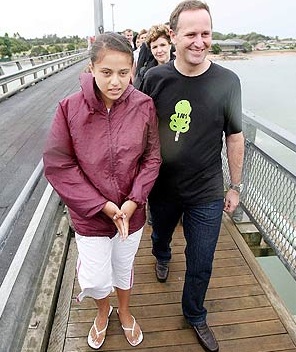
Campbell Live tonight returned to McGehan Close (see the report, by Tony Field, here). This street in Mt Albert — on the boundary of Helen Clark’s and Phil Goff’s electorates — was visited by then-opposition leader John Key before Waitangi weekend 2007 for a particularly cynical stunt. This was Key’s first big symbolic play as leader of the opposition, and it was a hum-dinger. He had already singled out the residents of this street in that year’s State of the Nation address at a whitebread rugby club in faraway Christchurch, branding them archetypal members of the New Zealand ‘underclass’, and the visit saw him glad-handing and patronising a bunch of poor brown people who’d already been used as shot in the National party propaganda cannons.

The purpose of the speech, and visit, was to install one of the core planks of the National party narrative about the Clark government — that it was at best unconcerned with the plight of said underclass; and at worst, actively cultivated such a demographic, which would be permanently dependent on Labour’s welfare policies and would therefore be a permanent source of electoral support for the Labour party. (So the ‘bribing the bludgers to breed’ theme goes, rarely uttered by anyone with authority in public but a commonplace among the usual proxies; check almost any General Debate thread on Kiwiblog from around that time for instance.) This is absurd in more ways than it’s feasible to explain here, so I won’t bother. Let’s just leave it at ‘the underclass doesn’t really vote’.

Nevertheless, the visit was a roaring success. Key, bearing smiles and gifts and wearing a tiki t-shirt, charmed the residents of McGehan Close and evidently persuaded them both of his party’s goodwill toward them and of its social and economic plan to lift them from their grim circumstances. The event culminated in Key taking 12 year-old Aroha to the Waitangi Day celebrations — a move full of potent symbolism, even if it was seen to be somewhat exploitative. Drawn out over a full week of coverage (at the time a rare commodity for Key, who had replaced Don Brash as leader just before the Christmas break) this was a highly successful stunt and should have been an early warning of Key’s great talent for making cheesy set-piece events ‘work’ and feel human. The sentiment he evoked in the people of McGehan Close was certainly real.

It’s just a pity the ‘ambitious’, ‘aspirational’ policy programme Key promised them wasn’t.

Joan Nathan, Aroha’s mother, remains on the DPB (having been let go from her hastily-arranged job working for National MP Jackie Blue) and struggles more than ever to cope, now with a sixth child. Aroha, now 16, is living in the care of Child, Youth and Family, which Joan says is the best thing for her, since she is unable to provide a decent life for her daughter. Nathan and others, although they believed in and voted for Key, are now disenchanted and universally express the sentiment that the government’s policies favour the rich, not the poor, and that they haven’t been helped one iota by the change of government; in fact, things have gotten worse. Not much of this is different than it was this time last year, when the Sunday Star Times visited the Close.

So far, so obvious, you might say — and it is; indeed this sort of outcome was very widely predicted at the time. But this is important because it is as strong a counter-narrative as exists for the opposition in this election year. It reframes Key as a faker, a charlatan, an opportunist who’ll exploit whatever circumstances will advantage him, without loyalty or the willingness or ability to follow through on his word; as someone whose focus is on boardroom issues rather than on peoples’ wellbeing. Discussing and reading around the topic on twitter this evening I’ve seen considerable criticism of this Campbell Live story as a cheap human-interest stunt, as opportunistic and exploitative (or moreso) than the original event. I couldn’t agree less. It is a clear, unambiguous example of an investigative journalist simply revisiting a story where much was promised, and measuring it against what has actually happened. This is crucial to its narrative value: these events reframe Key by measuring his own defining stunt — his signature trick — against the objective reality of lived experience. Theory and rhetoric versus real people, living in the real world governed by the policy built from that theory and rhetoric. It is a reality check in its purest form.

There are disadvantages to this narrative line, also, and the virulent responses to the Campbell Live report this evening — I believe I saw presenter Rachel Smalley shudder a little whilst reading some of them out — hint at them. One is the obvious suggestion that Joan Nathan and the other residents of McGehan Close could have done better for themselves, but have chosen not to; the victim-blaming routinely visited upon the poor by the less-poor. A more serious and related line of critique is that there’s a recession on, and everyone’s hurting. Or that it’s only been three years, and change takes time.

But hang on a minute — wasn’t the point of the whole point of electing a Key-led National government to take advantage of the resulting step-change which would boost economic growth, job growth, provide better opportunities, an end to welfare dependency, safer communities and a general increase in general socio-economic mobility and wellbeing? Key made all these promises quite explicitly, not just in person to the residents of McGehan Close, but to the whole nation throughout the campaign and at almost every opportunity since. There are no jobs. There are no higher wages, and without these things you can’t exactly buy shares in SOEs. There is no greater social mobility. The ‘underclass’, as exploitatively defined by Key, still exists.

Having failed McGehan Close, John Key has failed all of us. Quite apart from the fact that we were all promised these things, or things like them, and by and large have yet to receive them, a central theme of the ‘underclass’ policy argument was that by lifting people out of poverty and bringing then into the ‘overclass’ (? — this shows just how meaningless ‘underclass’ is except as a propaganda term), the government would make society better for everyone. This is a noble goal, and one I agree with in its idealistic entirety. I think you would go a long way to find someone in a position of any political credibility who’d publicly disagree with it. The first order of business for any opposition should be to hold John Key to those promises, and demand of Key the wealthier, more mobile, and socially healthier society we were promised.

But the most vicious response will be the one which the initial stunt in 2007 was meant to evoke — the notion that the ‘underclass’ are breeding in order to get more welfare from the Labour party. The core of this line of reasoning, if I may call it that, will be attacks on Nathan herself as a mother, having had a sixth baby and having had Aroha, the subject of the initial stunt, removed from her care. The attacks will be highly personalised, racist and gendered, and they will be lashed closely to Labour party policy and doctrine. But, assuming a competent and spirited opposition, that’s ok — the National party aren’t in opposition, 18 months out from an election; they’re in government in election year. Having been elected on a moderate, sympathetic platform with strong support from women and Māori, and looking to consolidate that platform into a strong and honestly-won mandate means that the government no longer has such freedom to dog-whistle. Particularly given that an opposition counter-narrative would cast doubt on all those sympathetic characteristics, the resort to the divisive tactics of 2008, such as trying to wedge ‘hard-working kiwis’ against the ‘underclass’, and so on, would be extremely risky for the government.

In light of my last post, perhaps it is a little glib to assume a competent and spirited opposition, and in perfect truth I don’t really think Labour has this fight in them (although Grant Robertson saw the Campbell Live piece and seems to have had a similar response to mine, which is heartening). But it is an argument waiting to be had, and one which must be had sooner or later. The boundaries are drawn up; media interest is already piqued, and this is a bread-and-butter social and economic justice issue for Labour. There’s a wealth of symbolic material and slogans to employ — ‘reality check’ and ‘by failing McGehan Close Key has failed us all’ are two they can have for free, and if a Labour party can’t base a campaign around ‘underclass‘ then they’re not worthy of the name.

Time to engage.

L