Return to the Big Stick, with some carrots thrown in.

A while back I wrote about Trump’s nostalgia for the “gilded” era (defined by tariffs and wars) and his return to a “neo” version of Gunboat Diplomacy with his threats to annex Greenland, Canada and the Panama Canal. The term “gilded age ” was bestowed before but came to focus on William McKinley’s time in office by none other than Mark Twain, who noted that by “gilded” he meant all glittery on the surface and thoroughly corrupt underneath. How prescient he was, because what was true then certainly is true now.

Here I propose to extend the US imperialist theme that was part of that era by moving onto a famous phrase from McKinley’s successor, Teddy Roosevelt. McKinley was assassinated while in office and Roosevelt, as Vice President, at age 42 assumed the presidency. More than his extensive political career, including serving as governor of New York, he was famous for his leadership of the Rough Riders during the Spanish-American War and had served as an assistant secretary of the Navy before joining McKinley on the 1900 Republican presidential ticket. In 1906 he was awarded the Nobel Peace Prize for his mediator role in ending the 1904-05 Russo-Japanese War., so perhaps that is another legacy of that era that Trump (he of “I have ended eightor nine wars” fame) would like to emulate. Roosevelt was also the president who authorized the building of the Panama Canal, so the historical tie-backs do not end with Trump’s preposterous fixation on the Nobel Peace Prize or on (re) claiming pieces of other country’s territory..

Roosevelt coined the phrase “speak softly and carry a big stick.” This aphorism guided his approach to relations with the Western Hemisphere, where it came to be known as the Roosevelt Corollary to the Monroe Doctrine. The corollary stated that beyond declaring the Western Hemisphere off-limits to non-hemispheric foreign military powers such as Spain, France, Germany and Russia (the Monroe Doctrine) , Roosevelt added the notion that the US would be the hemispheric policeman enforcing that doctrine as well as imposing peace on “uncivilized” and restive post-colonial Latin American societies.

The “Speak Softly/Big Stick” approach had five component parts:  First, it was essential to possess a serious military capability that would force adversaries to tread carefully when it came to challenging US power, especially in Latin America. At the time that meant a world-class navy (not only was Roosevelt a former Assistant Secretary of the Navy but he had written a book on the 1812 naval war between the US and England as well as several articles on naval power projection that were deeply influenced by the pioneering naval geopolitical analyst Alfred Thayer Mahan). The other qualities of the Speak Softly/Big Stick posture were to act justly toward other nations, never to bluff, to strike only when prepared to strike hard, and to be willing to allow the adversary to save face when being deterred, or when demurring, or if push comes to shove, in defeat.

It should be clear that Trump is incapable of speaking softly in any setting and that he bluffs, lies and dissembles as a matter of vulgar and bullying course. It is also clear that Trump is following Steve Bannon’s advice to “flood the zone” with an endless barrage of inane and serious initiatives, to the point that it is hard to disaggregate and differentiate between them in order to discern the details of the content because every day brings another scandal, Executive Order, or presidential musings on any number of things.

But in the approach towards what his former national security advisor (and now indicted defendant in a Trump political relation scheme) John Bolton called the “Triangle of Tyranny” (Cuba, Nicaragua, Venezuela), now expanded to include Colombia, Trump is clearly brandishing the big stick of US intervention, including of military attack, against them. At the same time, he is bestowing selective favors (let’s call them “carrots”) on rightwing governments like those of Javier Milei in Argentina and Nayib Bukele in El Salvador while overtly and covertly providing assistance to rightwing opposition leaders in states led by leftists, such as the case with the (reportedly) CIA-backed, recently announced Nobel Peace Prize recipient Maria Corina Machado in Venezuela. This regional foreign policy approach is worth breaking down in further detail.

Since the early 1960s US foreign policy in Latin America has been dominated by Cuba, Cuban exiles and anti-communism. The exiles are an important domestic lobby with deep reach into the Republican Party but they also line the pockets of Democrats in key districts and recently have now been joined by anti-Chavez/Maduro (anti-Bolivarian) Venezuelan exiles, anti-Sandinista exiles from Nicaragua and rightwing nationalists from other Latin American countries, Chileans most recently. Concentrated in places like South Florida, New Jersey and the Washington DC area, these groups of voluntary and involuntary expatriates wield disproportionate influence over US foreign policy in the region. And a fair few of them, Cuban and not, are violently inclined.

The Trump administration is not just brandishing the Big Stick in Latin America. It is welding it to bash its perceived enemies and hapless people caught up in its machinations. It began by broadening the definition of terrorism to include narco-traffickers, who it argues sow fear in the US by supplying drugs and via associated criminal activities. It has particularly focused on Mexican cartels like those in the Northern states of Sonora and Sinaloa, Venezuelan gangs like Tren de Agua and Salvadorean gangs like MS-13 that, ironically, grew and became powerful syndicates inside the US rather than their countries of origin. The expansion of the term terrorist to include drug gangs allows the US latitude when engaging them with force, because irregular warfare groups like ideological non-State actors (say, ISIS) that use terrorist tactics are not covered by the Laws of War and Geneva Convention. Labelling criminal drug traffickers “narco-terrorists” therefore clears the way for the US to engage in extra-judicial execution of those suspected on being so. But in order to do so, the US must ignore the fact that under US, international and regional national laws, drug running is not a capitol offence even if due process is followed. So, as Trump himself has openly said, they “are just killing them.”

Perhaps in recognition of this and not wanting to be charged as a war criminal, the 4 star admiral who leads the US military command responsible for Latin America, the Southern Command or SOUTHCOM, is taking early retirement, perhaps forfeiting his fourth star retirement pay because he did not serve out a full year in that rank after promotion. He may also had in mind Secretary Hegseth’s advice to the assembled general and admirals this month that if they had any “cringe” about his order, then they should do the honorable thing and resign.

The US pirate approach to the use of force at sea has led to the murder of over 50 individuals (Colombian, Ecuadorian, Venezuelan and Trinidadian citizens) by US forces without charge, arrest, trial, sentencing or any evidence of drug-smuggling (e.g. no floating bales of drugs after the strikes even while other debris was observed on the surface). In fact, imagery of the targeted vessels indicate that they were wooden outboard motor boats that could not reach the US mainland from Venezuela (which the US claims without evidence was the originating point) without multiple refuelling stops at sea or on land, (where they could be detained with relative ease by any number of regional law enforcement agencies). The same is true for the boats presumably coming our of Colombia that have been targeted in the Eastern Pacific. By its actions the US choses to be judge, jury and executioner without warrant, which effectively make its behaviour acts of piracy. The fact that none of the countries whose nationals were killed in these extrajudicial strikes are at war with the US only highlights the outlaw impunity with which Trump’s Big Stick is wielded.

Eight of the twelve kinetic operations against” narco-terrorists” happened in the Caribbean off the coast of Venezuela in international waters. Four strikes have killed people in wooden boats in the Eastern Pacific off the coast of Colombia (the Colombians claim one of the strikes was in Colombian territorial waters) and Central America. Trump is threatening to expand US military operations onto land in Venezuela and Mexico, where left-centre president Claudia Scheinbaum has clashed with Trump over his immigration and border control policies. Now Trump has cast his malevolent eye on Colombia, apparently because president Gustavo Petro, the first left centre president to survive and win a presidential election campaign in decades, had the temerity to criticise Trump’s immigration policies and join anti-ICE protests in New York City during the UN General Assembly meetings at which he spoke. That angered Trump, who revoked Petro’s visa and began to launch baseless accusations that Petro was somehow in cahoots with the narco-traffickers. The message was then backed with the kinetic strikes off Colombian shores.

Ironically, Colombia has traditionally been the US’s strongest ally in Latin America, especially as part of the so-called “War on Drugs,” and it definitely has the most experienced armed forces in the region thanks to its decades-old wars with various leftist guerrilla groups like the FARC and ERP. US special forces embedded with their Colombian counterparts for many years and the Colombians use US weapons platforms, equipment and training doctrine. They are no push-over military with generals sporting good conduct medals. They are also very proudly nationalistic, so they will not be walk-overs in the event the US decides to up the ante with them. It is therefore doubtful that the US will significantly step up physical attacks on Colombian territory and nationals, limiting itself to personal, diplomatic and economic sanctions, and, of course, noisy bluster from the loudmouth-in-chief.

The image of the fat armchair general that Secretary of Defence/War Pete Hegseth railed about in his talk to the US military brass a few weeks ago is more suited to Venezuela, which has slid from the lofty “pink tide” aspirations of the Bolivarian Revolutionary colonel and president Hugo Chavez in 1999 to a venal, bloated, corrupt one party “elected” kleptocracy under his former Vice President and one-time bus driver, now fraudulently re-elected president, Nicolas Maduro. Recognising the deep weakness under the veneer of Bolivarian solidarity, the US has threatened to invade Venezuela and Trump has openly claimed that he has authorized CIA covert operations in that country. The not-so-subtly declared objective is clear: regime change and replacement with a US-friendly leadership.

That would not be surprising given that several US -backed plots have been uncovered against both Chavez and Maduro, but in this instance Trump appears to be playing a crude psychological pressure game designed to foster paranoia and factionalism with the Venezuelan political and military leadership. And if the reports of Nobel Peace Prize winner Machado’s links to the CIA prove true, then those leaders have good reason to be concerned. After all, rightwing Cuban, Nicaraguan and Venezuelan exiles are openly plotting and scheming along with rightwing US groups to overthrow their respective home governments as soon as possible, and organising to that end in enclaves like Weston, Florida, northwest of Miami. The CIA is on friendly terms with these groups. Could this be the makings of Bay of Pigs 2.0 even if the exiles think of scenarios like the invasions of Grenada or Panama? We shall see.

Interestingly, although the US is putting direct heat on Colombia and Venezuela at the moment, it has taken as more subdued approach to Cuba and Nicaragua. On a scale of openness, Colombia is clearly first–it is democratic after all–but Cuba is in a slow process of liberalisation itself, while Nicaragua has regressed into a quasi-Stalinist kleptocracy much like Maduro’s Venezuela. So why the difference when it comes to waving and welding the Big Stick? In fact, Cuba, Nicaragua and Venezuela all have close ties with Iran, the PRC, Russia, North Korea and assorted non-state actors like (what is left of) Hamas and Hezbollah. And yet Colombia is lumped in with Venezuela as a narco-terrorist State according to the Trumpian world map. The answer may lie in domestic politics–Trump has made numerous false claims about Venezuelan gangs taking over US cities, including Tren de Agua, while the US cocaine trade is largely controlled by Colombians–and personal hubris: Trump hates Petro because the latter showed up at a demonstration against Trump and Stephen Miller’s version of the Gestapo, while Maduro is an easy to ridicule tinpot clown posing as a revolutionary strongman.

Cuba and Nicaragua, on the other hand, are getting the kid glove treatment in comparison. This may be an admission that the White House does not see them as easy push-overs, worth confronting, or as places against which the MAGA base will rally. Perhaps they simply are seen to be undesirable scapegoats given their low drug-running profiles, even if the truth is that both autocracies have hand-in-glove connections to the narcotics trade.

The dissimilar approaches are made odder by the ongoing presence of a Russian naval base in Cuba (Cienfuegos) and Nicaragua’s expansion of ties with obvious US adversaries. One would think that the Trump Big Stick would be applied equally to all of the leftist “Fearful Foursome” countries, but perhaps this is just a reflection of Trump’s personalist policy making and attention span rather than ideological enmity or geopolitical calculation. Alternatively, perhaps the US thinks that regime change in Venezuela will stop the flow of oil and other resources from it to its regional allies, thereby indirectly squeezing them as well.

What is most ominous in the evolving scenario is that Trump appears determined to forcibly impose regime change on Venezuela. He obviously does not understand the lessons of Afghanistan, Iraq, Libya, and Syria in recent years and instead is hell-bent on showing his toughness by picking on a country that cannot put up a legitimate fight against US forces. His pretext is the claim of drug-running out of Venezuelan bases, although there has been no concrete proof yet provided to that effect. To buttress his bully move (which is an odd stance for a guy who campaigned on withdrawing the US from foreign conflicts), Trump has ordered the deployment of a carrier task force (a carrier with 5000 sailors, +/-100 aircraft, including 70 warplanes, 5 destroyers, a submarine and tenders) to the Southern Command area of operations (AOR) where an additional 8 warships are already stationed along with a US Marine Expeditionary Force. SOUTHCOM also uses Army, Marine, Navy and Coast Guard assets on specific occasions as deemed warranted, and is already conducting strategic and tactical bomber runs near Venezuelan airspace by B-52s and B-1s stationed on the US mainland.

One can get a sense of what US forces have deployed to the Caribbean to date here.
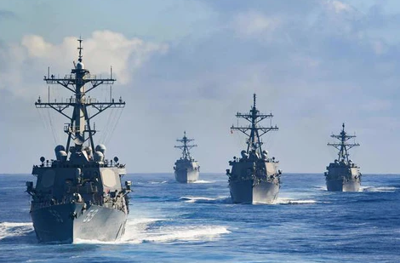
US Navy ships in Southern Caribbean. Source: Trinidad Express.

What all of this means is that the game is on. Moving this amount of assets to the Caribbean Basin, especially given the presence of land forces in the deployment, is no bluff. Trump seems to think that he can make an example out of Venezuela, contrary to historical precedent when it comes to the forced regime change going as planned or producing the desired results. One things is certain. It will be Venezuelans who suffer the most from any eventual escalation, and their scotch-swilling wealthy exile “leaders” will do nothing to shield them from a US assault.

In contrast to all of this Big Stick manoeuvring, Trump has offered Argentine president Javier Milei a USD$40 billion bridge loan as a form of bailout for Milei to make interest payments on outstanding public loans. No international lender like the IMF or World Bank would do so because of concerns about Milei’s reckless fiscal and macroeconomic policies (at one point he wanted to dollarize the Argentine peso and shipped off Argentina’s gold reserves to England on a private plane). Private investors took advantage of Milei’s public sector asset sale program to strip them of what value they held, repatriated the profits from the re-sale of those assets, then left the economy. What private investors remain are engaged in dodgy crypto schemes and destructive enterprises like critical mineral mining (lithium, in particular) where regulation is lax and where profits are largely sent abroad.

Milei himself is embroiled in an investigation into a memecoin “pump and dump”/”rug pull” scheme concocted along with Trump-allied US crypto billionaires, where he touted on social media a specific coin called $Libra that rapidly rose, then fell in value, making the 9 founding $Libra accounts around USD$82 million and leaving 72 thousand other investors with USD$251 million in losses in just over 3 hours. Milei later distanced himself from the scheme but it was discovered that he was one of the 9 founding accounts, which as per usual were managed by his sister and chief personal advisor, otherwise known as “Ms. 3 percent” for the price of the “commissions” she demands of entities doing business with the Argentine State (the most recent involving a pharmaceutical company). Milei’s sister, Karina, is also being investigated for links to–surprise!–narcotraffickers and assorted other dark forces in the Argentine landscape.

The Trump bridge loan bailout for Argentina was in fact a political rescue line thrown to Milei. His party (Libertad Avanza or Freedom Advances) did very poorly in provincial and first round congressional elections in September and at the time of the bailout it was assumed to be posted to suffer a similar fate, or at least not improve its minority Congressional representation in the national midterm elections this past weekend. That would jeopardize his reform agenda for the remainder of his presidential term, making him a lame duck and paving the way for a return of either a Peronist party faction leader or a newer centrist coalition-backed candidate. Either of these option would spell the end of the “chainsaw” approach to public sector restructuring as well as Milei’s pro-US (and pro-Israel and anti-climate change) position, something that Trump seeks to avoid.

As it turns out, Libertadad Avanza won 41.7 % of the congressional electorate vote, defeating the opposition coalition, which won 40.4% of the total number of party votes. This improves the government’s bloc position in Congress and strengthens Milei’s hand in imposing more reforms, but it also sets the stage for ongoing deadlocks and resort to rule-by-Executive decree on the part of the Argentine president. But for the moment, chalk this up as a win for Trump’s bailout carrot/election interference gambit because even if short term in nature, it may have influenced things in a US-favorable way when it comes to Argentine foreign policy. Since Trump threatened to rescind the bailout of Milei’s party did not win, it is quite possible that tis weighed significantly on the minds of voters (who still turned out in record low numbers–67.8%– in spite of voting being mandatory).

What is also interesting is not that the bailout was given for political rather than sound economic reasons. That happens. What is of note is that the bailout comes at a time when US tariffs on Chinese goods resulted in retaliatory tariffs on US agricultural products, especially soybean exports. Most of these are grown in Red Trump-voting states. When the retaliatory tariffs kicked in Argentina dropped its export taxes on soybeans, and along with Brazil rapidly took advantage to increase soybean exports to the PRC. In just a few months Argentine and Brazilian soybean exports have taken over the previous US share of the PRC soybean import market. So in effect Trump has bailed out a foreign government for ideological reasons even though it directly hurts a core voting block in the MAGA coalition. That makes neither economic or political sense.

In response to criticism of this deal, Trump puzzlingly announced that he would reduce tariffs on Argentine beef imports so that it could increase its US market share. At a minimum that means reducing US beef prices in the face of Argentine import competition., which is now the stated intention of the plan (beef price reductions across the board). Once again, US beef is mostly produced in Red states, so here too the economic and political logic at play appears to be contrary to the interests of key MAGA voters. It seems that for Trump ideological buttressing of an ally abroad is more important than the material fortunes of US farmers, and he does not fear electoral retribution as a result. That is another oddity, unless he has a plan for avoiding electoral backlash in the first place, which may be what the overall beef price reduction plan is all about..

In El Salvador, Trump has courted Nayib Bukele, the self-styled “world’s coolest dictator” who offered to house US deportees at his infamous CECOT prison in exchange for money, diplomatic favours and the betrayal of several FBI informants tied to the Salvadorean gang MS-13. Regarding the latter, Secretary of State promised the FBI that he would not divulge the informant’s names to Bukele but then did so, whereupon Bukele demanded they be returned to El Salvador rather than stay in US detention. Secretary Rubio obliged and it is now presumed that the informants are dead. Here the Big Stick was wielded on behalf of a foreign government in conjunction with domestic objectives rather than used against it for strategic gain.

Further afield, MAGA operatives have close links to former Brazilian president (and coup plotter) Jair Bolsonaro’s party and his revanchist sons while the Trump administration has imposed a 50 percent across-the-board tariff on Brazilian goods as well as travel sanctions against the judges that convicted Bolsonaro and sentenced him to six years in prison for sedition earlier this year. The Trump connection to Latin American opposition groups includes rightwing Chilean figures, adherents of the old Pinochet dictatorship and new tech moguls, as it is reported to be quietly influencing the policies of Paraguay (led by a conservative) and rightwing opposition factions in Peru. In effect, in these instances the Big Stick used by one foreign policy hand is complemented by a more subtle and covert velvet glove approach on the other.

In the end, Trump’s return to a US gilded age is very much true in the original Twain sense of the phrase, and its adoption of a crude form of Gunboat Diplomacy characterised by a Big Stick/Carrot approach is playing out in contradictory but obvious ways in what Trump considers, to Latin American revulsion, to be the US’s backyard where the Roosevelt Corollary to the Monroe Doctrine gives it the right to act with wanton disregard for International law and imperialist impunity with regard to the rights of individuals and States. Much like demolishing of the White House East Wing serves as an allegory for the destruction of the US constitutional system and social fabric, the return to the Big Stick and selective carrots is symbolic of an increasingly feckless approach to US foreign policy, regionally defined.

As the saying from former Mexican president Porfirio Diaz goes (amended here to include the entire region): “Poor Latin America. So so far from God and so close to the United States.”

Que Pachamama los proteja!

Declaration: I was the Regional Policy Analyst for the Interamerican Region and Caribbean Desk Officer in the Office of the US Secretary of Defense (OSD/ISA/IA), co-Team Leader of the Cuba Task Force and a consultant to the CIA, US Southern Command, US Air Force Special Operations and US Navy Special Operations Commands in the 1990s. In those roles I was engaged in exactly the sort of exercises that go into this type of war-planning/preparation and am well aware of the long history of US anti-drug campaigns in the region as well as the US military involvement in them (including the infamous Pablo Escobar/Cali Cartel years). My commentary is informed by those experiences and by the certain knowledge that the norms and restraints that governed the actions of my colleagues and I no long apply when it comes to the application of US military force.

A Fool’s Pied Piper.

For a while I have mentioned that too much of NZ political “thought” is re-hashed and often washed up ideas brought in from abroad. Both neo-liberalism and “Third Way” Labour positions were imported rather than organically generated from inside the NZ body politic and/or academia. With importation of foreign political ideas all too often comes stripping of the original ideas of any intellectual depth and nuance, particularly in the fields of public policy and political debate.

The latest example of this is ACT’s pimply-faced Ann Rand adolescent devotee’s use of libertarian thought as the basis for its policy approach. In recent years its leader, an Alfred E. Newman look-alike with serious racist and misogynist inclinations, has taken to exalting the virtues of the incestuous gnome that is currently president of Argentina, a Trump-loving mutton-chopped heavy metal grunting, formerly cross-dressing evil munchkin who takes advice from his cloned dogs, thinks orphaned children should be sold on open markets, denies that the Argentine dictatorship engaged in a “dirty war” that resulted in 30,000 deaths and countless tortured and disappeared people, believes blue-eyed people are more aesthetically and intellectually superior to brown eyed people, and who is now embroiled in a crypto currency meme fraud and a narco-trafficking scandal, all while his “chainsaw” approach to public sector reform has resulted in increased poverty, lower health and education standards, increased basic good prices like those of groceries and electricity, a hollowing out of the nation’s productive base and resultant wide-spread public unrest that is answered with indiscriminate police repression. Yep, that guy.

Which is why I say again, we are currently being governed by a crazy clown posse pushing a dumpster fire of anti-social, foreign inspired ideological garbage disguised as public management best practice. Stuff that.

But do not take this just from me. Have a look at this:

https://www.currentaffairs.org/news/this-is-why-you-dont-let-libertarians-run-your-country?fbclid=IwY2xjawNaSotleHRuA2FlbQIxMQABHrKnIv4av64qdH339gFOGvGkGitLcQD-i6TN5dvgzWwXKTzCETs-JBy8FVUw_aem_6RfYz1vosbUC6-WP9FIxxg

Torture works.

I have been working my way through a 47,000 document tranche of declassified US government communications related to Argentina and the “Dirty War” of 1976-83. I grew up in Argentina in the period leading up to the March 24, 1976 coup d’état that ushered in the so-called “Process of National Reorganisation,” the euphemism that the military junta used to justify its actions. That was the period when I was politically socialised and which has marked my approach to politics ever since.

I also do so because I did human rights work in Argentina in the early 1980s and wrote a Ph.D. dissertation on the Argentine state that required repeated primary source field research in the country throughout that decade. Those trips afforded me the opportunity to complement my human rights work with documentary and interview data that, while tangental to the dissertation, were central to my interest in what happened to people I knew who were caught up in the “Process.” I continued this interest as a sidebar to my academic work and official obligations while serving in and with US government agencies in the late 80s and early to mid 1990s. Even so, I did not have the time or authority to access what has emerged in this tranche of documents.

The documents (known as “cables” in diplomatic parlance) come from the CIA, FBI, State Department, Department of Defense and other agencies such as the Commerce Department that had involvement in Argentine issues during that period. The quality of the reporting and analysis is surprisingly good and the tone often brutally frank. Even so, thousands of pages in the declassified tranche are redacted or completely blank, attesting to ongoing sensitivity of some of the subjects being discussed. On a more personal level, the documents reveal the names of people that I knew while growing up, both embassy officials as well as private businessmen, school officials and missionaries (they were all men) who were fathers of kids that I went to school with and who either wrote the cables in question or served as informants to the embassy.

One of the most disturbing aspects of the reporting is the constant references to the Argentine security forces use of murder and torture. Time and time again the cables detail how torture was used to extract information and confessions, often followed by the murder of prisoners. The cables report things such as corpse disposal techniques improving after scores of bodies were discovered in public places with clear signs of torture and execution-style bullet wounds (among others, the “disposal-via-plane” method–where prisoners were sedated, loaded onto Air Force planes and dumped over the South Atlantic away from shore–was perfected after weighed-down bodies surfaced in the River Plate and many others were identified on land even though efforts had been made to destroy any possibility of identification). They note that many of the dead were said to have been killed in armed confrontations with security forces that never happened, and that many of those killed were students, unionists, academics, journalists, politicians and others unconnected to the various guerrilla groups (Montoneros and Ejercito Revolucionario del Pueblo or ERP, primarily) that were operating at the time.

The more I read the more I began to question a long held belief of mine: that torture does not work as an interrogation method, but instead is simply a cruel form of punishment. Readers may remember that, following on earlier academic and policy writing on the subject, I blogged here at KP about how torture does not work. But as I read the horrific descriptions of the methods used by the Argentine inquisitors and what happened as a result, and even though I had interviewed a few torture survivors during my human rights work, it dawned on me that I was wrong. Torture does, in fact, work as a means of extracting time sensitive tactical as well as strategic information from victims. Allow me to explain.

Torture only works in specific circumstances. Where it does not work is in democracies with strong institutions and the rule of law. Take, for example, the US torture program known as “enhanced interrogation.” This was an extension of coercive interrogation techniques that US military counter-intelligence officers developed by adapting a blueprint provided by the Survival, Evasion, Resistance and Escape (SERE) programs operated by the US military for personnel at high risk of capture in hostile territory. Those programs emulated the unpleasantness of foreign interrogations (say, by North Vietnamese) so that those going through the SERE programs would have the mental and physical ability to cope without breaking.

After 9/11 the CIA decided to turn SERE on its head and use it as a basis for enhanced interrogation of suspected jihadists. That in turn led to its use by the US military against jihadists and insurgents in places like Iraq and Afghanistan. Supervised by psychologists and medical doctors, techniques like water-boarding, exposure to extreme temperatures, sleep deprivation, painful binding by ropes, simulated executions and threatened electric shocks (where captives were hooked up by wires to car batteries or wall power outlets), simulated attacks by military working dogs (reportedly suggested by Israeli intelligence because of Arabs’ aversion to dogs) and sexual degradation were used by interrogators to try and extract both real-time and broad picture information from prisoners. The pictures that emerged from the Iraqi prison at Abu Ghraib–where US Army military police went rogue because of the environment created by their commanders–alerted the world to the fact that the US was routinely employing torture as an interrogation method, something that also occurred at detention facilities at Baghram Military Air Base in Kabul and in at the detention centre (Camp X Ray) operated by US Marines at the US Naval base at Guantanamo Bay, Cuba. This stopped when the Obama administration took office.

There were limits to what the US torturers would do. Deaths, rapes and other atrocities did occur but the overall thrust of US torture programs was to avoid such “excesses” and to remain within the broadly defined limits of US military codes of justice and the laws of war. It can be argued whether that in fact happened, but the point is that the US military, the CIA and the US government all wanted to give at least the appearance of norm adherence and legal cover. This forced the interrogators to engage in self-limiting strategies when it came to the treatment of prisoners, even if the boundaries of that self-limitation were broad. They were constrained by both the institutional and legal apparatus under which they operated and perhaps by their internalisation of cultural mores and norms regarding acceptability and limits to what can be done in defence of the State’s interests.

Whatever the reason for the relative self-limitation of the US torturers, the end result is that, rightwing apologist’s bluster to the contrary, limited “actionable” intelligence was obtained via the enhanced interrogation program (this was detailed in the Congressional Report on the matter).

Bottom line? Torture does not work when practiced by agents of modern democratic states with strong institutions and laws and a concern for human rights and civil liberties even when dealing with foreign enemies.

No such thing happened during the “Dirty War.” There were no limits set on what interrogators could do to prisoners other than what their consciences dictated. Moreover, the torturers were required to observe each other’s work, to include murdering people, so as to cement the bonds of group complicity (presumably in the hope of securing group silence in future years). The barbarity unleashed on suspects was medieval, modern and mind-bending in its depravity. The interrogators used flame, electricity, water, blunt, bladed and teethed tools, surgical instruments, pneumatic machines, vices and industrial presses. They removed body parts without anaesthesia for no medical purpose. They made captives perform grossly degrading acts and penetrated them with an assortment objects. They raped and sodomized both men and women alike and used animals to do so as well. They mutilated, tortured and murdered children, spouses, siblings, parents and grandparents in front of prisoners. There was simply nothing they would or could not do in pursuit of a confession and/or information about others. Worse yet, many of these evil beings still walk amongst us, either in exile or still in Argentina in spite of the various trials of officials implicated in the atrocities of the Dirty War.

Beyond the personal tragedies of those victimised, this is the saddest part: The torturer’s methods worked. Time and time again the US cables document Argentine security officials stating that prisoners identified other members of political resistance groups after “hard” interrogations. Time and time again the cables detailed how one by one “terrorist” cells were dismantled thanks to information gleaned from such interrogations. From the time the military took power on March 24, 1976 to the time of the Soccer World Cup held in Argentina in June-July 1978, tens of thousands of people vanished (some into exile) and levels of political violence declined from an average of half a dozen murders a day to near zero. Both urban and rural guerrilla groups were decimated and thousands of people disappeared. By the time the World Cup started under the watchful eyes of the junta and celebrity guests like Henry Kissinger, Argentina was once again at peace, even if it was the peace of the dead.

Two things stand out for me. First, why did the victims give up the names of comrades, friends, acquaintances and family rather than just accept the fact that they were going to die? Surely they must have known that they and the people tortured in front of them would not make it out alive, so why give the torturers what they wanted? All I can think is that while many people broke because of the physical horrors inflicted on them and hoped to escape death in their moment of agony, an equal number broke because they wanted to save the lives of their loved ones even if they knew that they would die and their loved ones or others would likely die anyway. Between desperation and pain, it seems that the captive’s minds searched for futile hope in the midst of darkness.

The second standout point is what made the torturers do what they did? There certainly was both individual and collective psychopathic behaviour involved (such as in the case of the infamous “Angel of Death” Lt. Carlos Astiz, later captured by the British in the first confrontation of the Falklands/Malvinas War), but it also appears that to reach the state of mind that they operated in they had to believe that a) democracy and human rights were useless concepts; b) the rule of law was no longer viable as a social construct; c) ideological enemies were sub-human; d) they were part of a greater good; e) morality was relative and the ends justified the means; f) they were inured to violence given the ongoing and escalating social conflict of the previous decade; g) they had impunity, both present and future; h) their cause was existential (in this case defence of the Catholic, capitalist, heterosexual, patriarchal and white-dominant parameters of Argentine society).

Which is to say, when unconstrained by democratic norms and (at least concern about) the rule of law, torture works. It works because once there is no limit to what torturers can do, their victims have only one–even if futile– hope to save themselves or others, and that is to talk. The democratic “variant” of torture simply cannot enter this realm unless the very values that underpin democratic socialisation are absent in the interrogator.

That explains why I was wrong about the utility of torture. I used to think that torture persisted because it was useful as a punishment that reminded potential victims of the costs of engaging in specific courses of action and thereby deterred them from doing so. I also thought that it involved sadistic pleasure on the part of desensitized socio- or pyschopathic perpetrators.

Now I believe that, along with both of these motives, torture persists throughout history because it is a useful interrogation method under specific conditions where democratic norms, values, institutions and legal codes do not apply. Since democracies have historically been a minority among world governance structures, this can explain the wide-spread use of torture to this day.

I am belabouring the obvious.

I will not go into how the Catholic Church and several democracies were active supporters of the Argentine dictatorship (including the US until Jimmy Carter was elected, and then after he was replaced by Ronald Reagan). Nor will I delve into how civil wars often see more atrocities committed than in foreign wars. What I will note is that when democracies begin to be corroded from within and respect for institutions and laws and basic norms about civility begin to be supplanted by partisanship, opportunism and treachery, then the slide into darkness has begun.

Perhaps that is what happened to the Bush 43 administration, and which may be happening now under Trump. Perhaps it is what led the French to go feral when trying to cling on to their colonial possessions in the 1950s and 1960s.

Whatever the case there is one more thing to ponder. If a liberal democracy like New Zealand had anything to do with the extraordinary rendition and black site programs that the US ran as conduits into and locations for its “enhanced interrogation” efforts, then merely having strong institutions and respect for the rule of law is not enough to guard against complicity in torture when fear of “the other,” bureaucratic opportunism and security partner pressure is involved. That is a major reason why I am interested in reading the Inspector General of Intelligence and Security’s (still delayed) report on whether New Zealand had anything to do with that part of the US “war on terrorism.”

Recuerdos de la Muerte (Memories of Death).

Today (March 24) is the 35th anniversary of the coup that ushered in the “dirty war” in Argentina that cost 30,000+ lives, more than 10,000 “desparecidos”  (“disappeared,” or those who were last seen in custody but whose bodies have never been discovered), with tens of thousands tortured and exiled. Never has the dark side of the Argentine psyche been on worse display than during the so-called “Proceso de Reorganisacion Nacional” (“Process of National Reorganisation”), and hopefully the bitter lessons learned will prevent a repetition of that wretched episode in Argentine history. The hard truth is that although the September 11, 1973 golpe that ousted Salvador Allende in Chile is more well-known (as was the dictator Pinochet), and the Argentine coup followed others in Uruguay (1973), Bolivia (1974), Peru (1968), Brazil (1964) and several previous ones in Argentina itself (1962, 1966, with an internal military coup in 1970), the dictatorship installed in 1976 was the most sadistic, murderous and cruel of them all. In its brutality and efficiency it was the exemplar of South American authoritarianism.

For people like me–raised in Argentina and directly exposed to the dictatorships of the 1960s and 1970s–the horrors of those days do not go away easily. For a generation of Argentines, to say nothing of their counterparts in Chile and elsewhere such as in Central America, the traumas of those years will linger forever, and it is only now, with the birth of a generation completely unaffected by the dictaduras, that the process of psychological healing can begin in earnest. While people who came of age in the 1960s and 1970s continue living, it will be impossible to erase from the collective memory the pervasive climate of fear that characterised life during those times.

The immediate result of the climate of fear was known as “atomizing infantilisation:” the body politic is forcibly stripped of its horizontal solidarity networks by the imposition of state terror, which paralyses resistance and reduces the individual social subject to the level of a child’s nightmare. Just as children fear the monsters under their beds and are powerless to stop their depredations, so too a society subjected to a systematic campaign of state terror is reduced to a sense of utter helplessness and vulnerability. After all, in the case of the dictatorships, the monsters were real and death or torture could occur at any time, for seemingly any reason. Terror appeared arbitrary but was in fact systematic, with the objective being to break the will of anyone who might oppose the dictatorial project.

The result was a condition of survivalist alienation: people just tried to go about their personal business, retreat into their immediate private lives and avoid trouble by relinquishing public commitments. The Argentines had a phrase for this: “de la casa al trabajo y del trabajo a la casa:” From the house to work and from work to home. Under such conditions there is no collective social subject. There is just submission.

It was under these conditions that the beginnings of the neoliberal macroeconomic experiments began in the Southern Cone. It was not just a matter of outlawing unions and political parties. It was about “cleaning the slate” of all those who could thwart the laboratory experiment that was the imposition of monetarist policies in South America. It was about using the climate of fear to reforge collective identities  so that the working classes would never challenge the primacy of capital again. It was about elites taking advantage of the window of opportunity provided by dictatorship to restructure the economy in a more favourable image, setting in place structural changes that would fundamentally alter class relations and the relationship of the state and society to capital in a way that the latter would always have the dominant say in social life. It was about, in the language of the time, “forcibly extirpating without anesthesia the malignancies of communism, atheism, feminism and homosexuality from the body politic” (the phrase is attributed to Argentine General Benjamin Menendez, who was one of the dictatorship’s most bloodthirsty leaders). In sum, the project was about using systematic application of state terror to sow the seeds of fear, alienation and despair in which market-driven projects could be imposed. Above that, the use of state terror was focused on social cleansing–in Chile it was about eliminating class challenges to capatilist rule. In Argentina it was about preserving an elite way of life. In either case, the dictators stopped at nothing to make their point.

These are the projects from which Roger Douglas, Richard Prebble, Ruth Richardson, John Key and the Business Roundtable take inspiration. These are the models upon which the NZ economic reforms are based. And if we think of the way in which NZ macroeconomic reform and other aspects of social policy have been “reformed,” we can see that the authoritarian example has been emulated in more than the economic realm. In other words, the NZ market “model” is a softer version of the Southern Cone dictatorial projects, absent the repression but with the same thrust.

We should also remember the climate of fear when we observe the Middle East. Populations that have been victimised, brutalised and traumatised by long-standing dictatorships are unlikely to have forgiveness and conciliation on their minds as the dictators begin to tremble. But the dictators and their allies know this, which stiffens their resolve to not suffer the retributions that they richly deserve. That does not easily make for a democratic “spring.”

All of which is to say, when it comes to contemplating the virtues of dictatorial regimes because they provide economic models or security partnerships, the answer in the first instance should be the rallying cry of the heroic Mothers of the Plaza de Mayo: “Nunca Mas!!”

NB: The title of this post comes from Argentine author Miguel Bonasso, who wrote a book by that name.

Two Bicentennials, and two disappointments.

Although the NZ media did not pay much attention to them, Argentina and Mexico celebrated the bicentennials of their independence from Spain this year (Argentina on May 25 and Mexico on September 16). Much fanfare and parading happened in both nation’s capitals, and a wide array of patriotic rhetoric was heard. But the sad truth is that both states are disappointments and long time failures. They certainly are not in the same league as Somalia or Yemen, but for the majority of citizens in each country the hallowed promise of independence has come up short. The failure in both instances rests not with foreign imperialists but with the respective political and economic elites.

Argentina and Mexico are the fourth and fifth largest countries in the Western Hemisphere and blessed with abundant natural resources, a variety of climates and geography, extensive coastlines and close commercial ties to greater Europe dating to 1810. They have well defined borders and are peace with their neighbours (even if those borders are permeable and historic resentments occasionally arise–but none of this compromises trade or good relations with neighbours big and small). The strategic sectors of their economy are under state or domestic capitalist control (or both). They both exhibit considerable foreign policy independence.

Yet, 200 years after independence, neither has fulfilled its promise. Mexico is in the midst of a vicious civil war between a variety of drug cartels and the state that poses the risk of it disintegrating into neo-feudal enclaves and autonomous regions barely under the nominal authority of a failed central state apparatus. Argentina, although not the financial basket case that it was in 2001-02 or the state terrorism experiment that it was from 1976-82, remains a nation in which corruption at all levels of society is an art form and in which patronage and nepotism are the hallmarks of political life.

This really should not be. Both countries have produced, among many other lines of contribution, Nobel laureates, writers, artists, musicians, actors, medical pioneers, legal scholars, diplomats, human rights champions, renown architects and more than a few good political scientists. The number of such luminaries is disproportionate to the total population of each country, so it is clear that the talent pool runs deep in each case. Yet time and time again, year after year, decade after decade, the tides of national fortune ebb and fall so that neither country has come close to fulfilling the promise of its naturally-given and human potential. That is a pity, and a waste.

I grew up in Argentina and have spent a fair amount of time, both personal and professional, in Mexico. In my younger years, when my leftward tilt was more pronounced, I joined those who blamed the US and imperialism in general for the woes of these and all other countries in the region. Dependency theory was my theoretical crutch and, as a prescription, revolution was to me the best answer to the region’s problems.

I was wrong. Mexico had its revolution in 1917 and although the nature of its authoritarianism changed, the fundamental socio-economic and political problems underpinning it did not (the 1994 Zapatista rebellion in the southern state of Chiapas was a reminder of that). Although a looming presence, the US is not the primary source of Mexico’s ills (although its drug consumer market is certainly a part of it). Although nominally democratic for a decade, Mexican politics remains infested with cronyism, corruption (now often drug related) and a lack of transparency. Socio-economic actors of all types see the state as a trough from which to feed when in power or in favour rather than as a neutral mediator in redistributive conflicts.

Argentina has not had a revolution but not for lack of trying. I was personal witness to the Montonero/ERP campaigns of the late 1960s and early 1970s as well as the last gasp of the Peronist mythos in person (Peron died in1974 after returning from exile the year before). That only precipitated the state terror experiment and the return to shallow consumerism for which Argentines–or least those living in Buenos Aires–are famous. The attitude towards holding power is similar to that of Mexico, and the “state-as-money bag” approach is also endemic amongst the Argentine elites.

After the neo-liberal experiments in both countries, the gap between rich and poor is worse now than it was 50 years ago. Working class dissent remains a simmering pool that remains unmitigated in each case. Crime haunts the streets (more in Mexico than in Argentina, but both at much higher rates than before 1960 or even 1990), and uncertainty about the future is rife amongst all but the upper ten percent of society. Even the national soccer teams have failed to live up to popular expectations, which in of itself is symptomatic of the larger malaise each is living through. And yet the politics of elite greed continues unabated in both countries, now under ostensibly democratic aegis.

All of which is to say that as much as it is nice to celebrate longevity, it is human folly that has prevented these two countries from developing into fully mature states that are nourishing and representative of their citizens. My hope is that the younger generation of citizens exposed to the excesses of the past 25 years in both places will work harder than their parents and ancestors at giving them the political leadership that they so rightly deserve and which was sorely missing from the official grandstands during the celebrations.