Framing marriage equality to win

On Wednesday night Parliament voted 2:1 in favour of marriage equality, as defined by Louisa Wall’s Marriage (Definition of Marriage) Amendment Bill, which would permit two people of the same sex to marry. I haven’t been involved in any of the organised aspects of this movement, but I have watched it closely and lent some ad-hoc support to it. Here are some observations on some of the symbolic and framing issues in the campaign for marriage equality, and some discussion of why, and how, it was successful.

Unity and commitment
This campaign had two features that many do not. First, its proponents worked to find common cause with their erstwhile political opponents. This iteration of the debate was sparked by Barack Obama’s “coming out” a few months ago (I wrote about this here.) It has been a bipartisan project; groups and people from across the spectrum worked together. As many National MPs voted for the bill as did Labour MPs (30 each), splitting the National caucus almost in half. The United Future, ACT, māori Party and Mana MPs also voted for the bill. That is a diverse ideological range.

Second, they committed to really making the case, even though they believed it to be self-evident. Too many many good causes fail because, believing them to be oviously right, their originators fail to organise and articulate their “rightness”. This was not so with marriage equality. They employed a broad range of complementary strategies to appeal to different demographics and constituencies. The campaign spoke to queer people, obviously, but it also spoke to straight people; to the families and friends of those who might benefit from it. It spoke to urban liberals and rural conservatives and Māori and Pasifika and other groups. It spoke to atheists, but it did not generally alienate people of faith. It spoke to peoples’ heads, and to their hearts.

These themes — unity and commitment — are central to marriage, and they were central to this campaign for marriage equality.

Naming rights
One of the great battlegrounds in the Culture Wars is over names, and marriage equality won this hands down. This framing was not the incumbent: early battles were waged for “marriage equality” to supplant “gay marriage”/”same-sex marriage” as the preferred term, and it was successful. One example of this was by Wellington Central MP Grant Robertson, who appeared on the TV show Back Benches and suggested the change in terminology, insisting that “I didn’t just do gay parking or have gay dinner”.* This groundwork was laid long ago — there’s a substantial discourse about this piece of terminology, and all Robertson and others did was articulate it effectively. But that was important to do.

“Marriage equality” frames the cause as being about non-discrimination, a universal civil right nominally guaranteed in law and accepted (again, nominally) by a vast majority of people. It’s also an emotively-neutral term, which in this case worked to exclude stereotypically negative or controversial words — words like “gay” and “(same)-sex” — from the frame. These terms may not be generally offensive, but they do retain some valence as insults and evoke an “ick” factor in some people. Largely for this reason, opponents of marriage equality continue to use “gay marriage” and “same-sex marriage” almost exclusively. (In other contexts these terms, and stronger terms, were used within the campaign to shock or challenge, or were owned & celebrated — I certainly am not suggesting that such terminology be erased from the discourse.)

Note that there’s no discussion of “civil union” as a frame here. This was rejected outright by proponents of marriage equality as being a half-measure, a technocratic institution, and simply not an equal form of marriage.

Hearts and minds
“Marriage equality” is a strong intellectual and symbolic frame with some emotional undertones. Its intellectualism played a key role: it provided a rights-based analysis of the issues, and that rights-based analysis, in turn, provided a platform for a broader, less threatening set of frames.

The rights-based analysis on its own would probably not have won this battle. Intellectual arguments rarely win on their own, particularly when the issues are emotionally-bounded and tied into deep non-intellectual sentiments of culture, history, identity, family, faith and the role of the state, as marriage is. But an emotionally-oriented argument would probably have lacked the necessary rigour to succeed, as well, since the reasoning that marriage ought to be extended to all couples is not self-evident. The “marriage equality” frame appealed strongly to people who were willing and able to articulate the rights-based analysis, to coordinate and disseminate it, and to establish it in the public consciousness. They did so forcefully, with flair and humour, they scored the points and won the policy battle.

This activist community, who mobilised in the social and mainstream media, on the streets and outside the electorate offices, were not themselves the target audience — there aren’t enough of them and they are not widely-enough distributed to strongly influence politicians’ sense of electoral self-preservation. But these actions provided cover for the less-intellectual, but ultimately more emotionally resonant frames — especially “legalise love” — to thrive, and to reach the wider non-activist community and make them care.

“Legalise love” framed marriage equality as being about the recognition of already-existing reality, of acceptance, and diversity, and contemporary family values. Whereas “marriage equality” made a case for what was just, “legalise love” made a case for what was right. Like the best Australian Greens campaign ad the Australian Greens never made, it asked people to think of marriage as being “about love, not laws”; it evoked peoples’ experience of the gay people in their lives — their parents and children, brothers and sisters, friends and colleagues — and asked people to identify with gay couples, not in terms of their practices in the bedroom or their sense of fashion, but in terms of the quality of their love. It asked people to consider how hard it would be for their own relationships to have been declared verboten by a state and society that just didn’t get it. These are deep, emotional arguments that strike people in ways that an intellectual policy debate, no matter how clever, cannot.

Another strength of “legalise love” was its breadth. Whereas the intellectual “marriage equality” arguments were focused and direct, arguments about love and the quality of relationships touched on more expansive religious and moral themes. Importantly, the cause was framed as being integral to conventional morality, not a subversion of it, and as modern “love thy neighbour”, “live and let live” Christianity in practice, the bloviations of a handful of self-appointed conservative demagogues notwithstanding. Marriage equality was not framed as a challenge to family values, but as a manifestation of family values; to paraphrase a number of politicians, including London’s Conservative mayor Boris Johnson: marriage is great, let’s have as many as possible. David Farrar made this case well, here.

Double-framing a cause like this — running complementary intellectual and emotional arguments in parallel — is quite hard to do without getting your narratives mixed up and turning incoherent, and too often the weakest aspects of either frame can be exploited by an opponent. But if you can pull it off, it really works. It worked for Obama in 2008 (“hope” and “change”), and it worked in this case. Where the cause came under attack from rational arguments (admittedly this was rare), rational arguments were able to be deployed in defence, and when it came under attack from moral and emotional arguments, those were available as well.

But while the intellectual arguments were effective at laying the groundwork, in my view it was these emotional and moral themes, rather than the logical, rational arguments that underpinned them, that did the heavy lifting of persuasion, of shifting peoples’ consciences, not just their brains. The diverse range of arguments and appeals permitted the campaign to reach a wide demographic range, to reach into faith communities and to appeal to people outside the activist clique. Most importantly, this reach made clear to the MPs whose job it was to vote on the matter that they could, but also that they should vote in favour.

Not done yet
I have used the past tense throughout this as my reference has really only been the campaign so far, but it cannot be emphasised enough that the battle is not won. An unknown but significant number of MPs have voted for marriage equality to go to select committee for further public discussion, but have made no guarantees to support the bill in future. As Jane Clifton argues, there is a coterie of socially-conservative MPs who saw which way the vote was going to go and decided to be on the right side of history as “both a tactful and a time-buying” strategy. There will be attempts to derail this cause, to minimise and distract from it, to dilute and to neuter it. The first of these may have already emerged: Whanganui MP Chester Borrows, perhaps seeking to reprise his role as the great diplomat who proposed the “sensible” compromise position on the Section 59 child discipline repeal, is said to have proposed a compromise position on marriage equality.**

New Zealand’s Parliament passed marriage equality legislation through its first reading, and the lower house of the Tasmanian legislature is set to pass its own. I have not followed that campaign closely, but from what I have seen, many of its framing and symbolic characteristics are similar to those observed here. It is a policy whose time has come, and this is a winning strategy to enact it. Marriage equality holds the high ground; now we must retain it.

L

* Not 100% sure about the phrasing of this, and since TVNZ removed old TVNZ7 episodes from their on demand site, the video is no longer available to check. I’va amended this to match Grant’s recollection. Another twitter user, Jessica Williams points out that it was originally American comedian Liz Feldman.
** I missed this announcement and have been unable to find any detail on Borrows’ proposed compromise but I understand it was announced on Wednesday — if you have details, I would appreciate hearing them.
ACT and National Front to announce merger.

That is about all I can figure after reading this about Louis Crimp, Act’s largest individual donor in the 2011 election. The line about Invercargill is priceless but there are several other gems as well. Mr. Crimp appears to be getting PR advice from Kyle Chapman or Jim Beam, so why keep up the pretense any more and not just announce the merger of the two white rights movements?  Better yet, once John Banks gets the inevitable boot from parliament, perhaps the AKKKT Party can dip into some of that NF talent pool for a replacement.

AKKKT–a political cough in the larger scheme of things, but a full throated sputum of the NZ Right.

Perverse incentives

The National-ACT spending cap:

The spending cap legislation will “within the next two years provide that core Crown operating spending … will be subject to a spending limit”, which will allow spending growth “no faster than the annual increase in the rate of population growth multiplied by the rate of inflation.”

The new regime will exclude spending on unemployment benefits, asset impairments and natural disasters.

Doesn’t that create an incentive to the public sector to increase inflation? (Only in things that individuals and families need, of course)

Not to mention incentives to:

  • not remove overstayers
  • write off assets to avoid the on-going depreciation
  • import loads of cheap foreign labour
  • increase the birthrate (that’s a longer term strategy :)
  • categorise more things as national disasters (see – I didn’t suggest they should create national disasters :)
  • and so on.

(I expect the incentives to suppress public sector wage growth and casualise the workforce are deliberate)

There may be many criticisms of the Public Sector, but no-one has ever said they can’t read the hidden signals and navigate government policy.

The Agony of Defeat.

Well, it was a grim morning of the day after in my household on Sunday. The evil-doers prevailed and the forces of righteousness and progress were soundly spanked, with the exception of a formerly progressive party that now has gone managerial as it mainstreams to the political centre. Sure, there were some points of solace in the otherwise dark landscape of electoral outcomes, but overall the egalitarian side of the NZ political spectrum got hammered.

But all is not lost. In the scheme of things, this was not the worst election defeat I have experienced as a voter. For me, as an ex-pat Yank, that dubious honor rests with the election of Ronald Reagan in 1980. The idea that someone who epitomized prejudice, elitism, ignorance, racism, war-mongering, corporate-backed chickhawk cowardice and the utter insipidness of campaign promises could defeat a decent fellow such as Jimmy Carter actually made me fear for basic freedoms and civil rights in that country. Sure, it was not as bad as living through coups or revolutions in Latin America, where losers in the regime change had very real reason to fear for their lives. But is was as close as I have felt in a democracy to being politically at risk as a result of an election. That feeling was reaffirmed a few months later when Reagan was shot, where the response on the working class African American street where I lived was to “hope that a brother did not do it.” Such was the tone of the times that we worried more about the backlash then the fact that the president was almost killed off (and boy, were we relieved when it turned out to be a white nutter who fired the shots).

I felt nearly as bad when W. Bush was fraudulently installed as president after losing the US popular vote in 2000. However, by that time I had moved to NZ and did not have to worry about directly suffering the consequences of yet another silver spoon-fed corporate chickenhawk imperialist stealing his way into power. But I feared for what he was about to wreak on the US (where my family and close friends live) and the world at large. A decade later the proof of his folly is everywhere to be seen. Helen Clark was right: things would have been different had Al Gore rightfully been awarded the 2000 election. But all that is water under the bridge and the person copping the most flak in the aftermath is Barack Obama. Talk about inheriting a mess!

Given that backdrop I am not catatonic because the currency speculator and his band of money-grubbing bullies have been re-elected under the banner of “stability.” It could be worse, and I am thankful that when compared to the US, the bulk of the NZ political spectrum is less reactionary or retrograde. Even so, with expanded anti-terrorism laws and powers of search, surveillance and seizure all passed by the National government in recent years (something that went unnoticed in the buildup to the election), I can see encroaching authoritarianism in its second term. One only has to watch the Prime Minister’s response to hard questions to see his sense of arrogance and entitlement on display. This is a guy who is used to getting his way, however he can, without much regard for the consequences except with respect to his corporate peers. So regardless of public opinion, the PM will push his asset sales agenda, will continue to suck up to both the US and the Chinese while pursuing trade for trade’s sake, and will play as loose with the rules of the democratic game as his weakened opposition will allow him.  And by playing divide and conquer with the Maori Party and the Greens, he could well get his way across the board.

I take solace in the fact that electoral defeats are the lifeblood of democratic politics. It is not so much what the victor does after an election. It is how the losers respond that makes the difference. Losing allows parties to remove the sclerosis from their ranks and rejuvenate both personnel and policy platforms. Losing allows parties to reinvigorate in opposition. Losing forces parties to explore new policy options and ideological possibilities. Should Labour understand this simple law of democratic politics, it can regroup and compete more effectively in three years. If it does not, we could be saddled with the corporate-cuddling cabal for a third term. The question is: does Labour have it within itself to make the serious changes required for it to have relevance in the years forward?

I do see the Green Party vote increase as a positive sign even if its support is coming from disaffected Labour voters more than anywhere else. Between the Greens and Labour there is still a solid 35-37 percent of the vote, figures that could grow should National’s economic policies continue the trend of growing income disparities, elite enrichment, environmental degradation and foreign control. Since voter turnout was so low this year, a mere rise in those who vote in 2014 is bound to increase support for the Left (such as it is) because people tend to vote when they are unhappy about the status quo (apathy such as that seen in this year’s election had less to do with serious discontent and more to do with complacency and belief in a foregone outcome). Thus this moment of defeat is a ripe time for Labour to undertake the necessary changes required to come back and compete successfully in 2014. That means a major leadership shuffle as well as policy change away from the “National-lite” pro-market stance it has maintained for nearly 20 years. In other words, it needs to turn back Left, both in terms of recapturing a class line as well as more sincerely embracing post-modern progressive causes.

I do not claim any particular expertise in NZ politics and this ramble was merely sparked by my reflection on which electoral defeats were the worst for me as a voter in a democratic country. But I do think that one big redeeming feature of liberal democracy, no matter how manufactured, manipulated and corrupted it has become, is that losers are allowed to compete again at regular intervals, which gives them the opportunity to engage the internal reforms that will allow them to emerge from the ashes of even a catastrophic defeat in a better condition to win down the road. This holds true not only for the biggest loser in this year’s election, Labour, but also for such parties as ACT. After all, Winston Peters has shown that even political mummies can be resurrected without being reconstituted, so there is hope yet for even the smallest losers this time around.

Competing electoral insurgencies, in Epsom and beyond

In this post I argue that ACT’s apparent willingness to undermine the MMP system that has kept them alive isn’t so much a death wish as a wish to be welcomed back into the National party as a faction, rather than a stand-alone party; to ensure influence from within rather than relying on influence without. I wrote most of this late at night and cobbled it together from several pieces I’ve had banging around a while with some more recent stuff appended, so you have my apologies if it’s a bit disjointed.

Fairfax political journalists Andrea Vance & John Hartevelt have a pretty sharp piece up, calling the ACT-National deal in Epsom a shameless power grab. I wrote about this topic a few days ago. Their analysis is pretty good, particularly the argument that National may have difficulty compartmentalising future ACT scandals away from National, having taken such direct responsibility for shielding ACT from the rigours of electoral democracy. They also make the point that I and many others have made about the dual exploitation-illustration of MMP’s flaws:

Double dealing and horse-trading are nothing new in the battle for political survival. Perversely, as we head towards a referendum, this naked and shameless power grab undermines the very system ACT relies on for survival. The ultimate irony is that Brash wants it replaced with the supplementary member system that would probably vanquish his party.

MMP, and particularly exploitation of the free-rider rule, is what has kept ACT alive since the 2005 election, when the party’s support dipped to its record low of 1.5%. Supplementary Member is the system that Brash personally supports, and although there is no official preference, this is widely regarded as being the system most preferable to most National party members and the wider ACT party also. SM, as proposed with a 90-30 electorate-list split, would indeed be worse for ACT as an independent party, requiring it to get something like 3% 2% of the party vote to gain a list seat, even if it continued to win an electorate. Leaving aside for a moment whether this is likely or not (ACT did, in its heyday, poll well), that’s a considerable disadvantage because National would no longer have such a good reason to throw ACT an electorate seat lifeline. National’s doing so is apparently only tolerated by Epsom voters on the basis of the overall positive-sum value proposition made by John Banks: “vote for me, and I’ll bring five MPs with me on current polling”. You’d be a fool to turn that offer down. Reduce the premium to one MP and it suddenly becomes rather less appealing.

So on paper ACT supporting a non-MMP system looks like a turkey voting for an early Christmas. But I think the game goes deeper than that. ACT has in recent years abandoned its claims to being a classical liberal party, and is now basically a more hardline version of National’s dry petit-authoritarian conservatism, with a few casual nods to “freedom”, such as in alcohol policy. In recent months it has been colonised by the former right of the National party (Brash and Banks, most notably; also “National in Gumboots” Federated Farmers former president Don Nicolson). Both the former were until very recently long-standing National members whose tribal loyalty undoubtedly lies with that party. They see it as having strayed from its roots, and while they undoubtedly appreciate its newfound popularity with voters, they have repeatedly expressed strong concerns that the party has lost its way, and an intention to bring it back around by putting “reinforcing steel” into its governments (in the words of John Banks). Both, I think, would join National again in a heartbeat if National would have them, and would permit them any influence. An electoral system switch to SM makes that a more viable possibility, and brazenly exploiting both the two major flaws to which most people object in MMP — the threshold free-rider rule and the “back door” rule that lets a rejected candidate such as Don Brash back in on the list — sets up a reasonably strong case against MMP.

Supplementary Member has the worst features of both FPP and MMP. It has high noise (the variance between the makeup of the electorate’s votes and the makeup of the resultant parliament), delivers huge incumbency advantages to parties that hold many electorate seats (because there are more of them), severely marginalises smaller parties by reducing proportionality, and despite all this does not meaningfully solve the symbolic split between “legitimate” electorate-based MPs and those who ‘only’ come in on the list, nor the threshold, “back door” or “horse-trading” objections that most critics name as MMP’s worst flaws. (BK Drinkwater modeled FPP, MMP and SM against each other using election data since 1996, although bear in mind that for SM, these figures assume a 70-50 electorate-list split, which is considerably more proportionate than the 90-30 proposed).

National holds many more electorate seats than Labour, and has nearly always done so, even when its popular vote has been lower because its base of support is less concentrated in inner-city and suburban electorates. Any system of reapportioning electorates on the basis of population will continue to entrench this advantage. Under MMP, it is not a very significant advantage; under FPP and SM, however, it is. ACT’s electoral support, both in electorates and nationally, is very weak, largely because their policies are purposefully divisive, with the intent of galvanising a small proportion of “right thinking” voters against the mainstream. National’s strategy since 2006 has been to occupy the centre-ground and cannibalise Labour’s votes in a zero-sum fashion. This has been a strategy of necessity — the 2005 election demonstrated pretty categorically that divisive politics, no matter how much money you could throw at it, no matter how favourable the cultural terrain, or how good the propaganda, was not a winner for National in an MMP environment. The incumbency and electorate edvantage delivered by SM, however, would cushion them against voter discontent and permit a more hardline approach: one that included ACT as a faction within the National party, as it previously was. So under SM, ACT doesn’t need National to throw it a bone, and National doesn’t need to rort the system to extract electoral advantage: National under SM will enjoy sufficient advantage to simply absorb ACT and its policy programme, and its governments will be emboldened to enact divisive or unpopular aspects of that programme without the same fear of electoral blowback that now constrains it. ACT’s strategy is therefore an insurgency against National; one that may be permitted by National, contingent upon the adoption of a more beneficial electoral system.

A further comment on Labour’s response in Epsom is also warranted. Arthur (in comments to my post linked above) suggested that the best way to nix ACT in the 2011 election is for all Labour and Green voters to cast electorate votes for the National candidate, Paul Goldsmith, in the hope that this will send a signal to National voters who are unhappy with the horse-trading between ACT and National that it might be worth defecting. This is, in principle, a strong strategy, and it has been picked up by some Green supporters as well. But I think it’s the wrong strategy in this case, for five reasons. First, it’s a complex and counterintuitive strategy, and it’s extremely hard to get so many people (on both sides) to act against their own instincts like that. Second, the value proposition made by ACT (six for the price of one) is simply too good for a meaningful number of National voters to pass up. Third, it would require Labour to publicly endorse a National candidate, which would permit John Key to proclaim that “even the opposition supports the National party”. Fourth, the electorate demographics for Epsom don’t stack up: this electorate bleeds blue and even if a fair proportion of disgruntled Nat voters defected, I don’t think there would be enough Green and Labour voters to prevail. Fifth, it would require Labour to buy into the electoral-system rorting, making them no better than the National and ACT parties.

Labour looks like it will mount an ‘economic dry’ insurgency by standing David Parker in Epsom. This is a better strategy because it is vulnerable only to the objections two and four above (the positive-sum value proposition, and demographics). These will probably still mean that it is unsuccessful in terms of winning Labour the electorate and denying ACT parliamentary representation, but it also has the advantages of fighting the national and ACT parties on their own turf — economic responsibility — and in demonstrating that even when they’re down, Labour fights fair and respects the integrity of the electoral system. Most crucially, however, whatever strategy is adopted by the left in Epsom must be coordinated. The two proposed strategies (vote Goldsmith and vote Parker) are contradictory: one must be abandoned, and soon, in favour of the other. Because if the Green faction goes into Epsom with one strategy and the Labour faction goes in with another, there’s only one winner: ACT.

L

Rotten borough

This evening Paul Goldsmith won the Epsom candidacy for the National party. Goldsmith is was until 2010 a Citizens & Ratepayers Auckland city councillor, and has a long-standing National party affiliation.

He will be standing against ACT candidate John Banks, who is the subject of a hagiography by Goldsmith titled “John Banks: A Biography” and published a few years before Banks stood for his first term as Auckland mayor, which he won in 2001.

ACT is led by Don Brash, who is the subject of a similar tome — I haven’t read this one, so I will refrain from calling it a hagiography in such specific terms — titled “Brash: A Biography”, also by Goldsmith and published as Brash was whipping up race hatred as leader of the National party in order to win the 2005 general election, which he did not.

So unless someone can explain to me again how National is going to contest Epsom strongly by standing the hagiographer against his subjects, this is simply a renewal of the Hide-Worth electoral rort, where a nod and a wink permits National to elect Banks and exploit the free-rider loophole in MMP; all the while campaigning against MMP due to flaws such as the free-rider rule, and the ‘back door’ rule which will in all likelihood get Don Brash back into parliament despite his having been rejected in 2005 — not only by an electorate, but by the whole nation as leader of a failed National party bid for government.

And fair play to them. If the electorate won’t punish them for doing so they’d be rude not to.

L

Frayed at the edges.

Coming home after witnessing the Singaporean elections in May, it has been interesting to watch the preludes to New Zealand’s elections in November. In SG it was a matter of all against one, with the “all” in opposition being heavily constrained in what they could  do or say by the ruling party. Even so, opposition to the PAP gained parliamentary seats and an increased popular vote. Voter turnout was higher than in previous years, and the youth vote was an important factor in the outcome. There was a clear dividing line between pro-regime and opposition parties, with political identities drawn over issues of authoritarian efficiency versus increased accountability, material entitlements, transparency and representation. There was a focus to the electoral debate.

It seems that in New Zealand there is no such clear-cut divide along the political centre. Instead there exists a political spectrum that is frayed along the edges and which has an ideological void in the middle.  ACT is splintering, as did the Maori Party once Hone Harawira quit. The common denominator is that on both ends of the New Zealand electoral divide, where the most ideological elements of political society reside, there is a complete lack of unity, much less understanding of the need for a common class line. This plays into the hands of the mainstream parties. At the risk of over-simplification and claiming no particular expertise, let me sketch the broad contours.

The putsch against Rodney Hide was a triumph of the market ideologues over the social conservatives in the ACT party. The Garrett scandal, the odd views of some of its MPs and Hide’s increasingly populist rhetoric are seen as deviations from the neoliberal market ideology that is supposedly the core of the ACT belief system. When Hide became vulnerable over his use of taxpayer money (the perk-buster was found to be more of a perk-consumer), the market ideologues moved against him. Concerned about demographics, ACT has managed to secure a commitment to stand from an influential female ex pat blogger with a reputation for brutal honesty and corporate savvy. It also recruited a farmer.

Once the Don was installed as the new Leader, ACT showed another face–that of racial revanchist. Crossing the market ideologue/social conservative divide, there is some serious opposition within ACT to maori redistributive claims and the erosion of Pakeha prerogatives under the banner of political correctness. Rather than delve into the reasons for its opposition, ACT has chosen to publicly focus on individual maori that it describes as extremists who are holding the country financially hostage with their ongoing demands. Among these is Hone Harawira. This is not a view shared by all market ideologues in the party, so the “white cowards” have been called out by the revanchists. What is lost in the intra-party discussion about identity and cultural claims is the common class line that ostensibly binds ACT together–that of the trade-oriented corporate elite. Whatever they think in private, this elite is bound to be horrified by the presence of racial revanchists in the Party, which could reduce the amount of material and political support that they will pledge to it. Absent a coherent structural underpinning to its other ideological claims, ACT has little to offer even them.

The Maori Party has done likewise. It was never a progressive party, but instead is a socially conservative vehicle that represents the interests of the maori economic elite and important iwi (specifically, leadership hierarchies). Its major focus is on ownership within the legal structures as given, and on specific budgetary earmarks for maori given Crown obligations under the Treaty. This is a source of division with the likes of Harawira, who sees things from a working class, indigenous sovereignty perspective.

The Mana Party is a reflection of the latter view, to which have been added those of assorted communists, socialists, anarchists and maori rights activists who can be roughly divided between (mostly Pakeha) anti-imperialists and (mostly maori)  indigenous sovereignty supporters. There is considerable overlap between the two camps, although the issue of native ownership is a thorny subject for the marxists. Here too there is a lack of a consistent class line, or structural foundation, upon which to build the cultural and socio-political bases of the party. Some in Mana put indigenous rights above all other things; others put working class interests to the fore. Neither side has a realistic economic agenda given New Zealand’s structural realities.

There is also a cult of personality aspect to Mana that belies its progressive label. Rather than represent a Kiwi version of Malcolm X as some have suggested, Hone is more akin to the Reverend Al Sharpton. He is loud, he is proud, but he is not exactly a revolutionary threat to the system. Unlike X, who did not allow whites into his party and who preached on the merits of  voluntary self-segregation and the need for a separate black state within the US based upon economic independence, Hone accepts Pakeha support while fulminating against colonial injustices and their modern legacies. He acts as an agent provocateur rather than an agent for change. Given the views of the anti-capitalists in the Mana party whose priorities are more class-based than identity-driven, this does not make for ideological coherence between the base and the leader.

The Greens have moved away from their Left origins and settled into the role of responsible middle class party with a focus on sustainable development. Having mostly removed the red from the party watermelon, the second generation of Green party leaders have become the preferred channel of expression for environmentally aware voters with an interest in universal rights, egalitarianism, sovereignty and non-intervention (to include opposition to trade agreements without environmental and human rights provisions). This makes it a comfortable partner for Labour, a bridge between the Maori and Mana parties in areas of common concern, and an inoffensive adversary of National that can be worked with on specific issues. In spite of their attractiveness to the enlightened bougeousie, the Greens have no class line.

The absence of strong class orientations, be it Right or Left, along the fringe of NZ politics is  in part a deliberate result of the blurring of class lines and focus on economic individualism promoted over the least two decades by the two major parties. Both parties subscribe to market-driven logics, tempered by populist appeals around election time. Both represent the interests of corporate, rather than class actors–National defends the logic of the Round Table while Labour defends that of the union movement and domestic market capitalists. Neither represents the interests of a given class, but instead attempt to cross over voter preferences with catch-all appeals oriented towards the economic centre: the salaried middle classes. The latter are the swing voters who are less inclined to see themselves as a distinct interest group, are less ideological in their views, and who have not collectively organised to that effect. By  targeting this segment of the electorate the mainstream parties are able to give the interests of their supporting corporate class fractions much broader political appeal.

In New Zealand the electoral fringe holds less popular sway than before, and has less of an influence on mainstream politics. It will not matter in November’s electoral math, and some parties may well disappear. This is a pity because at a minimum the ideological fringe in an MMP system is useful as a means of keeping the centrist parties more honest when it comes to issues of class, race and public policy interest. Ideally, fringe parties provide the outer ideological markers that frame policy debate at any given moment. Absent a coherent ideology embedded in a class line amongst fringe parties, the parameters for policy debate narrow considerably. Given non-ideological competition between the major parties, this leads to unrepresentative distortions in the way in which policy reform is argued and made.

Admittedly, this is a very broad, subjective and impressionistic overview. Supporters of the parties in question will no doubt take exception to my views. Others will see my emphasis misplaced or that I am just plain wrong on specifics. I will happily stand corrected where necessary. What I have tried to do is not argue the details but note the larger trend. The lack of a class line in New Zealand’s political fringe is both a product and a reinforcement of the corporatisation of mainstream politics and popular culture, with policy debates stripped of structurally-based ideological content and confined to those areas in which corporate solutions are possible. Stripping ideological content from public policy debates diminishes the quality of democracy. In a society anchored in structural inequalities (however mystified by issues of identity and post-modernism), the absence of class-based ideological debate leaves the field of politics open to corporate elite domination, no matter how much “trickle down” policy proposals are offered during political campaigns. There is, in other words, no substantive class focus to political debate even during elections.

In November we will be reminded of that fact.


An Open Letter to the ACT Party Regarding Candidate Selection

Dear ACT Party Leaders,

As you may know, I was brought up in Wanganui, and keep an eye on events there. So it was with great interest that I received the below letter, published in the Wanganui Chronicle on 8 July 2011.

ACT’s announcement of the second ‘Don’ in the ‘Don and John’ lineup today was well-received, and if I may be so bold as to say so, I think the author of this letter also has a lot to bring to their table. I quote it in full:

Taniwha real
In reply to Dusty Miller (letters, July 1), I’m not one of those experts, but I do believe the taniwha to be real, not imagined, and I’ll tell you why.

Perhaps the ancient Celts of New Zealand may never have known war or possessed weapons, as prior to Maori being brought here by Zheng He New Zealand had never been threatened internally nor externally and there was no need.

However, New Zealand was visited by Viking ships and Scottish birlinns (a birlinn is similar to a Viking ship) which used to trade with resident Celts. The sailors of these vessels were fierce, battle-hardened warriors with far superior weaponry and military discipline compared with Maori.

As the bow and stern design of these ships is similar to the head and tail of the taniwha, I could well imagine that the sight of them would strike paralysing fear into the heart of any Maori confronted by them, and for this reason I believe the taniwha represents these ships.

Believing this to be the truth of the taniwha, I would not think these ships could be found in a small creek or marshland because of their size.

Taniwha artwork is yet another example of Maori following the culture of those who came here before them, the Celts.

IAN BROUGHAM
Wanganui

I believe Mr Brougham’s Qualifications for Candidacy are Strongly Evident in this Letter. It provides a striking yet unconventional Insight into New Zealand history, weaving back together the varied strands of the rich Tapestry of our origins which Revisonist Historians who hate their own Culture have spent hundreds of years unpicking. In particular, he illustrates comprehensively how Maori, far from being Indigenous, were simply the first wave of Hostile Asian Immigrants to these fair shores. He shows due respect for our Noble Celtic Elders, who were clearly Men who thought like Men, and he recognises their manifest superiority over the Maori, in Warfare, Navigation, Art, and undoubtedly in other Fields as well. Despite his modest claim to not being an Expert, he is clearly Learned, but this does not prevent him Sharing his bountiful wisdom with others, as Readers can see by his patient Explanation of what a ‘birlinn’ is.

Furthermore, Mr Brougham has confirmed himself to be of Sound Mind regarding other crucial policy topics of our Time — protesting strongly against the ‘h’ being forced into ‘Wanganui’ by those same forces of Revisionism, and against the Emissions Trading Scam, by supporting the Endeavours of that noble veteran of the ACT ranks, Muriel Newman — herself also a believer in the undeniable Truth of New Zealand’s Celtic Settlement, and who herself certainly thinks like a Man.

Moreover, Mr Brougham already has more than a Decade’s political experience, having stood under the mighty Equal Rights banner in local body Elections, and for the OneNZ Party (a Sister to the redoubtable One Nation party in Australia) at the National Level. Indeed, while the 0.67% of the Vote he received in the 2005 General Election is unjustly low, it is similar to what the ACT Party is presently polling.

As one final thing, everyone knows that to succeed in politics you need a strong Hand. With the unfortunate departure of John Ansell, ACT presently has Two Pair — Don Brash and Don Nicolson, John Banks and John Boscawen. As everyone knows, Two Pair is a strong Hand, but not strong enough to ensure Victory. Adding Mr Brougham would restore ACT to Full House status, giving the party a Hand that could only be beaten by Four of a Kind (which I think we can all agree is unlikely); or a Smith & Wesson which, as the lore of our American brethren confirms, even beats Four Aces (this is also unlikely because the Liberal Culture-Hating Revisionists are too afraid to permit Noble Celts from arming themselves against Tyranny). Mr Brougham would complete the Full House because, as you wise Celts of the ACT leadership are surely aware, “Ian” is simply a Celtic rendition of “John”.

Mr Ian Brougham is well Qualified to join the Great ACT party, and he has the courage to speak Truth to Power. New Zealand needs him to return it to Celtic Glory. Nevertheless I must state I have not Approached Mr Brougham to ascertain his Willingness to stand for ACT, an exercise I shall leave to the ACT Leadership.

Trusting that you will consider this Recommendation with all the Gravity it deserves,

L

Dollar dollar bill y’all

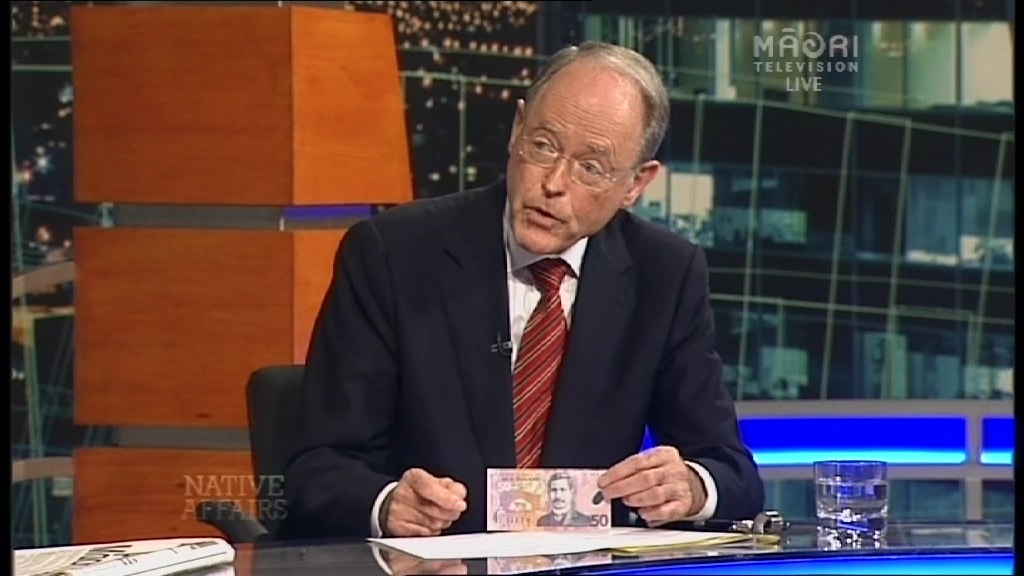
Tonight’s Native Affairs debate between Pita Sharples and Don Brash is now up on their website, and it is must-watch television for a few reasons. The first and most immediately evident is Julian Wilcox’s quality as an interviewer and moderator — this was not a structured debate, with time allotted and mechanical switches between speakers, nor preset, pre-scripted questions. It was a free-flowing affair, with Wilcox acting as both interviewer and moderator; and throughout the two speakers were respectful, genuine, and both had ample opportunity to get their points across. It was superbly done. (Hone Harawira, in a later discussion, twice jokingly invited Wilcox to stand for Te Mana, but for mine he’s too valuable in the media.)

Another reason it was remarkable was because of Don Brash’s bizarre, out-of-touch equation of sentimental or cultural attachment to natural features — maunga, awa, moana and so on — with “animism”. It’s a perverse position to take, given the deep connection New Zealanders — both Māori and Pākehā — have to their landscape, about which I’ve written before. Imagine, if you will, a series of billboards featuring Aoraki Mt Cook, the Waitemata Harbour or Rangitoto, the Waikato or the Whanganui, Wakatipu, Taupo, or my own ‘home’ mountain of Taranaki — with the legend “Brash thinks this is just a lot of water”, or “Brash thinks this is just a rock”. If ACT were politically relevant, it might be worth doing.

Cash Rules Everything Around Me
C.R.E.A.M, get the money
Dollar dollar bill y’all
— Wu-Tang Clan

Like the gangstas of Staten Island legend, this sense that only what’s literal and material matters, that when push comes to shove, money trumps everything is integral to the faux-rational actor model to which ACT subscribes, and this leads into the major thing which made this interview important:

(Image snapped by Michael John Oliver, via twitter, thanks!)

And a brief transcript:

Brash: “Pita, I put …”
Sharples: “No, you didn’t.”
Brash: …”Apirana ta…Ngata on …”
Sharples: “The country put that on. Let’s be clear about that.”
Brash: “I made the decision. I made the decision, as governor. And I put him on that because I think he’s one of the greatest ever New Zealanders.”

Don Brash, the archetypal white rich guy, brought along a fifty dollar note — a note that many poor Māori voters rarely even see — to a debate that was substantively about the reasons why Māori are politically, socially, and economically deprived.

To appeal to Sir Apirana Ngata in a newspaper advertisement — as Brash did this weekend — is merely crass. To bring that actual visage in as a prop in an argument to dismantle the Aotearoa that Ngata and others had worked to build — that, as Sharples said, Ngata was criticised for being a “radical” by rich white guys like Don Brash — and seeking to imprint his divisive and offensive policies with Ngata’s mana is offensive to the man’s memory. To seek to take personal credit for Ngata’s mana being properly recognised — “I made the decision” — is obscene. To play a statesman’s memory like a chip on a weak hand at the last-chance saloon is no sort of respect. It is the ultimate “I’m not racist” gambit — “look, some of my best banknotes have Maaris on”. I wonder if he would treat the memory of Sir Edmund Hillary or Kate Sheppard in this way. Distancing himself from John Ansell’s misogyny by saying “hey, I put a broad on the $10” would be a thing to see. He had a decent crack at “I’m not racist, my wife’s from Singapore” back in the day.

Don Brash, during his brief run in politics, accumulated a series of bad images — “poor optics” as the lingo goes. Walking the plank, struggling to climb into the racing car, scooping mud out of his mouth at Waitangi, and so on. This image — of Brash big-noting to Māoridom, if you’ll excuse the phrase; showing them who’s got the Benjamins, or the Apis — should be one of the enduring memories of the campaign. Brash probably thinks it’s a smart symbolic play, but it calls to mind a bunch of things he doesn’t want to call to peoples’ minds — his own wealth, the extent to which he’s economically out of touch with those he claims to want to represent, and perhaps most of all an almost unspeakably flawed sense of political and historical reverence, which places him out of touch at a deeper level; a level of shared sentiment and aspiration, of common culture and values.

In television, the rule is: don’t tell, show. No matter how often he tells Aotearoa that he shares our views and aspirations, we won’t believe it unless he shows us. Since storming the lofty heights of the ACT party Brash is busily telling us that what we stand for what he stands for, despite 98.3% of the evidence contradicting that assertion. And now he’s showing us exactly the same.

L

Under fire

Just one semi-randomly chosen article, on the Otago Daily Times website, but here are some numbers from it:

A. Don Brash denying allegations or refusing to comment: 4
B. Don Brash distancing himself from views of senior ACT people (incl former): 4
C. Mentions of Don Brash’s failed 2005 campaign: 3
D. Don Brash making an open statement of his position (incl the ad): 2
E. Don Brash attacked by ministers in the government of which ACT is a part: 2
F. Don Brash attacking ministers in the government of which ACT is a part: 1

That, right there, is a party leader under fire.

A is a problem because it shows Brash as weak and evasive.
B is a problem because the fact is that these people are or were his party and its brand — they are what people think they know about ACT. If it turns out they don’t actually speak for ACT, something has to fill that vacuum. This is also indecisive, and because of the nature of the views he is backing away from, weak.
C is a problem because it reminds everyone that they got rid of him six years ago, and why.
D is a problem because Brash hasn’t filled the vacuum caused by B.
E and F are problems because they threaten the integrity of John Key’s National government during an election campaign framed by narratives of unity: the Stadium Of Four Million narrative of the Rugby World Cup, and the Spirit Of The Blitz narrative mandated by the Canterbury earthquakes.

For my money, it’s the last one which is most likely to sink ACT. If Brash doesn’t pull his head in sharpish, Key will be justified in cutting it off. And I reckon he would, sharpish. He’s not called the Smiling Assassin because of his gentle nature and tolerance toward poor performers. And even if Key doesn’t, Brash is up against some powerful stuff in those unity narratives. Nobody wants to back a splitter at a time when Aotearoa is supposed to be thinking and feeling and hoping as one.

L