It might be unpatriotic to say so, but …

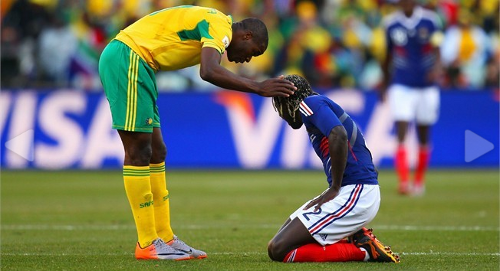
… the All Whites’ unbeaten record at the FIFA World Cup was not the tournament’s greatest underdog performance. That accolade should go to the hosts, for beating France, who were a perfect illustration of all that’s wrong with football in 2010. High-strung Ferrari-driving show-ponies who failed to perform and behaved like rebellious toddlers when expected to do so; led by dictatorial, egomaniac management who refused to accept the results of their own uselessness with any sort of humility.

South Africa were ranked second-lowest in the tournament, lower even than the All Whites, and they demonstrated that if you hang tough and play as a team you can beat a side which, on paper, is far better than you are (and keep them out of the second round). The footballing world owes South Africa a rich debt of gratitude, not only for organising what was by all accounts a cracking tournament, but for humiliating France.

A fitting end to a tournament for which they shouldn’t have qualified in the first place.

L

The Racial Basis of a Small SE Asian State.*

From my perch in SE Asia I have observed with some bemusement what passes for immigration debate in the US, UK, Europe and NZ. I am bemused because the place that I live has a very non-PC approach to immigration and yet is held out as a beacon of ethno-cultural diversity, toleration and meritocratic entrepreneurship. Were it that it be so.

In most of the West the dominant discourse on immigration is phrased in terms of labour market necessity. Countries need skilled and/or unskilled labour as the case may be because their domestic reproduction rates cannot keep pace with economic growth. Since capitalism must grow to survive, it needs labour inputs to provide the human fuel for that growth. Depending on the human resource base of the country in question, skilled or unskilled labour is imported and allowed to settle in order to fill labour market demand and to increase inter-generational reproductive rates conducive to eventual labour market self-sufficiency. Or so we are told.

Yet there is a demographic aspect to this labour-market immigration strategy as well.  In the contemporary US Hispanics fill many of the unskilled labour needs; in Germany Turks do the same; in France Algerians fulfill that function; in Greece Albanians perform the role; in Portugal Romanians, Angolans and Brazilians play that part. In NZ it has been traditionally Pacific Islanders who fill the ranks of unskilled labour, and receive preferential immigration treatment as a result. Skilled labour shortages are filled by Indians, Chinese and Europeans in the US, by Spaniards, Greeks, Italians and Eastern Europeans in “old (Northern) Europe,” and by Indians, Asians and expat Europeans and South Africans in NZ (the list is not meant to be exhaustive and recognises overlap in skill categories in some instances). There is, in other words, an ethnic component to inter-state labour market migration.

The unspoken question, and the elephant in the room in such approaches to labour market necessity requiring the import of foreign labour, involves the intertwined issues of race, culture, ethnicity and religion. Until recently, with the exception of conservative or right-wing cultural supremacists, it was simply unacceptable to wonder out loud whether certain races, cultures or creeds were more or less likely to assimilate and contribute to the dominant culture and society of their adoptive countries.  Race-baiting politicians in the US, Europe and NZ have regularly played that card for electoral purposes, but by and large the majority of “proper” people in Western democracies prefer to not to confront the thorny issue of racial and religious composition of immigrants under conditions of labour market necessity. Yet not talking about it does not make the issue of ethnicity in immigration go away. Put bluntly, elites may see immigration in purely labour market terms, but the masses may just as well see it in ethno-religious and cultural terms, with all the baggage that entails.

The SE Asian country I live in has no PC qualms when it comes to the issue of work force demographics. This country is ethnically Chinese dominant (they make up 65% of the population). The ethnic totem pole then descends through Indians (the faithful lieutenants to the Chinese), Europeans (read: white people who are the managerial class for both local and foreign enterprise, and who are derogatorily called ang mor  or ang moh (red haired, which goes to show that NZ is not the only country in which “gingas” are reviled), other Asians (Koreans and Japanese preferably), Malays, Indonesians, Tamils, Sri Lankans, Ceylonese, Filipinos, Burmese and other sub-continental ethnicities. Immigration and reproductive policy is explicitly crafted to favour ethnic Chinese over all others when it comes to immigration, residency and citizenship. Because the country is labour-starved on both ends of the skill spectrum and the local Chinese reproduce at unsustainable rates, mainland Chinese and Taiwanese are given preferential immigration treatment even though the local Chinese look down their noses at their mainland counterparts as uncouth and unwashed uneducated provincials (their disposition is more generous towards Taiwanese but the attitude of superiority of Singaporean Chinese towards other Asians is pervasive). The country makes no secret of its determination to keep the present racial balance so as to maintain ethnic Chinese dominance, and makes no secret of what it sees as the superior cultural values of the dominant ethnic group (familial piety, ambition and discipline being foremost amongst the supposedly “Confucian” traits). For the rest of us it is a take it or leave it proposition, with money being the great leveler when it comes to attracting both top end and low end talent.

The very good public housing system is based on forced racial integration schemes, with the percentage of units allocated in any given housing bloc reflecting the proportional mix of ethnicities in the country. Although promoting racial and religious “disharmony” is prohibited by law and vigorously enforced in the main, racial integration and harmony are construed on Chinese terms and in their favour. From where I sit, it looks a lot like, albeit in a more disguised and benign way, aspects of the Jim Crow Southern US, except that here everything is written in Orwellian terms so that racial “harmony” actually means Chinese dominance. So long as everyone understands their place, play by the rules as given, bow to the rule of the one party state and accept material gratification and commodity fetishism as their reward, the racial status quo is preserved and the business of making money (or in the official jargon,  “pursuing prosperity”) can continue unimpeded.

Even so and despite the official line on racial harmony, racism is a constant latent fact of life here. Besides resistance to inter-marriage and barely disguised inter-racial contempt (particularly by the local Chinese towards Malays, Indonesians and Filipinos), things like housing blocs are divided in such a way that resident Malays can only sell to Malays and Indians to Indians, thereby depressing house prices and impeding upwards mobility for the majority of these subordinate groups. Non-citizens and non-permanent residents cannot own housing bloc units. Although there is much official palaver about being a meritocracy, the unspoken truth is that nepotism and patronage networks are equally if not more the key to economic success, and these unofficial channels are, given the demographics, Chinese-centric (although ethnic Chinese are not alone in the use of informal vehicles for economic advancement, nor is this phenomenon confined to this one state–NZ has its well-known system of old boy and new boy-girl networks that are anything but meritocratic). Here the bottom line is simple: accept the racial status quo as given and toleration of difference will be the order of the day. Challenge that status quo and run the risk of running afoul of the Internal Security Laws and their very broad definition of sedition. A pervasive system of domestic intelligence gathering, particularly but not exclusively focused on the resident Muslim community, ensures that challenges to the status quo are thwarted early and often.

Non-citizens and permanent residents do not receive anywhere close to the health, welfare and housing benefits accorded to citizens. To the contrary, they are actively discriminated against in allocation of public goods. This goes as much for the high end immigrants as for their low end counterparts, but it is only the former who have the personal income or corporate subsidies to cover costs in the private health, retirement and housing  markets (this is the case with most Kiwis, Australians and Americans living here). Low skill foreign workers, mostly coming from ethnics groups such as Tamils, Bangladeshis, Nepalese and Sri Lankans, do not have the financial resources to engage private care, so most often are deported with token compensation should they fall ill or otherwise unable to work (that includes pregnancy). Most low end foreign workers live in subsistence dormitories provided by employers who sign them to three year minimum wage contracts (some of these dormitories are converted shipping containers housing 30-50 individuals with a single toilet and shower). 

In fact, foreigners in general fall into three categories, investors, employees and dependents, with the first two being the only basis for residency. Should a foreigner lose his or her job or withdraw or lose their investment capital in the country, their visas are withdrawn and they and their families summarily issued orders of deportation (usually with a 30-60 day expiration date; overstayers are regularly caned as part of their punishment). In some cases, such as those of Chinese construction companies, foreign investors bring their own employees with them and subject them to their own labour standards via exclusionary clauses in local labour legislation. Add to that the very lax labour laws governing dismissals and redundancies, and you have a structural bias, in the form of labour market regulations and working visa controls, in favour of ethnic Chinese socio-cultural dominance.

I note all of this with agnosticism. Readers can make whatever inferences they choose to. The larger point I am trying to make is that here is a small state that is considered to be a model of capitalist development in the late 20th and early 21st century that uses an explicitly race-based labour market-driven immigration model in pursuit of the cultural, social and political dominance of the majority ethnic group. The system works; in fact, it is hegemonic by any definition.  Given that success, is it worth broaching the uncomfortable subject of cultural dominance when it comes to immigration in a place like New Zealand? Or is that simply a bridge too far and labour market logics should be the sole rationale (other than refugee quotas) upon which immigration policy is formulated and implemented? But if it is indeed unacceptable for a liberal democracy like NZ to use race-based criteria when confronting labour-market driven immigration  and social policy, then why does the NZ political-economic elite use my current country of residence as a developmental model or example to be emulated?

*Because there has been some misreading of the post in the comments thread, I have updated it in order to clarify some of the argument.

Sleeping dogs

Tim Watkin usually writes good sense, but with the latest post on gun control it’s clear he just doesn’t know his subject. Toughening gun control in NZ is basically a hiding to nothing, both in policy and in symbolic terms. It’s pointless for three main reasons:

  1. We already have pretty sane firearm laws and gun culture which regulate legitimate gun owners, and constrain the sorts of weapons most useful to criminals;
  2. As a country, we own a lot of guns, and they’re important to our way of life and identity, and this importance is the subject of bipartisan political consensus;
  3. We have very low rates of gun-related crime already, and any regulation which would be effective would be very costly, both in financial and political terms.

Just to preface this: I own a hunting rifle, and as a bit of a propaganda geek I’ve paid close attention to gun control as a matter of symbolic politics (alongside abortion, it’s a leading “touchstone” rhetorical issue in US domestic politics). I’ve been watching the way NZ is beginning to develop a (rather amateurish, but effective enough to not be laughable) US-modeled gun-ownership lobby with interest as well. But I’m not one of those “don’t tread on me” gun nuts who thinks bringing a loaded assault rifle to a town hall meeting is a core part of the democratic process. Owning a firearm is useful, but it’s not an absolute right — rather one which must be weighed against other consequences, including those which stem from arming communities. But I object to knee-jerk policy proposals which misoverestimate the problem, won’t solve it in any case, and will come at considerable cost.

What problem?
The most significant objection I have to Tim’s analysis is that he assumes gun crime is a serious enough problem to warrant harsh regulatory consideration; and seems to think that tackling it like the government has “tackled” knife crime is a sensible approach. I reckon both are suspect assumptions.

According to a UN survey from 2000 (the most recent I can easily access), 13% of our homicides (including attempts) were committed with a firearm, at an annual rate of 0.18 per hundred thousand population. That is a rate slightly higher than the UK (0.12 per hundred thousand, with much more strict firearm laws); just over half the rate of Australia (0.31, also with much more strict firearm laws, including a hugely expensive buyback programme undertaken in 1996 with the intention of solving the problem). I don’t think things have changed all that much; in 2009, the year of Jan Molenaar, the figure was 15% of our recorded murders (incl. attempts). You can use the Statistics NZ tools to get data here. You can also compare a bunch of countries’ rates here, but be sure to read the disclaimer. The bottom line is that we have extremely low gun crime rates by world standards, especially given that we have very high gun ownership rates. By far the highest proportion of gun-related deaths in NZ are suicides — I don’t have the numbers to hand but I recall it being above 70%. That’s a consideration, since suicides are usually committed with weapons of opportunity, and a firearm is particularly effective. But this is not the argument being made.

Knives are a much more serious problem, accounting for about twice as many homicides in NZ, and “other weapons” and “manual” which I assume includes unarmed homicides are also generally more common than firearm murders. The government has seen fit to “crack down” on knife crime by trying to prevent youths’ access to knives at the retail level using a voluntary code of practice. This is pure security theatre. Everyone credible knows it won’t make a blind bit of difference because kids don’t go and buy a knife from a shop, they just take one from the kitchen drawer or the toolbox in the garage. Firearms are already much more heavily regulated than this, and as a consequence people wanting one but who lack a license don’t roll into Hunting & Fishing and buy one — they get them illegally because we have no idea how many there are or who owns them (more on this later). So the comparison between guns and knives, while tempting, is bogus. Knife crime is much more serious than firearm crime, much less-heavily regulated, and the trivial additional regulation proposed won’t change anything — but it also won’t cost anything.

What guns?
Part of the reason gun crime is such a minor problem in NZ is due to our history and culture with guns, and in particular the fact that “personal defence” has never been a justification for firearm ownership. Tim also gets this wrong: citing “personal defence” as a reason for needing a firearms license will mean you get denied one, especially if you’re trying to apply for a restricted weapons license (which is the example he uses).

Excluding the post-settlement period, firearms in NZ have generally been conceptualised in law and culture as tools rather than weapons — for hunting, sport shooting, or the defence of the realm. Most in existence today are .22 calibre rabbit guns, or bolt-action ex-infantry rifles from the first and second world wars, passed down from father to son, or modern firearms based on near-identical designs, or shotguns designed for gamebird hunting. Partly due to length, partly due to action design and calibre, these are pretty useless for self-defence except for the appearance of threat and as clubs. By the same token, they are far from ideal for offensive use. Part of the reason criminals are rarely armed with firearms is because they are nearly impossible to conceal (which makes carrying or using them a riskier proposition than, say, a knife), and if sawn off below the regulation length of 30 inches, they are still not very convenient, and give police instant cause for book-throwing if discovered.

There are relatively few pistols or assault rifles in NZ, and those which are owned are very tightly controlled, with extremely high standards required of the owners. The NZ Police apparently operate a “sinking lid” policy on restricted weapons: to gain permission to import or produce one, you need to destroy another. This has driven the market price of such weapons through the roof, putting them out of the reach even of many legitimate collectors; although it must be said that the distinction between a “military-style” semi-auto and any other semi-auto is largely (not entirely) cosmetic, and one is no less deadly than the other. As the rather grim saying goes, the seven-round magazine restriction on an ordinary semi-auto centrefire rifle just means that if you want to kill more than eight people, you’ll need to reload.

Firearm licenses, especially those for restricted weapons like military-style semi-automatics and pistols, are issued at the discretion of an Arms Officer on the basis of the applicant being of “fit and proper” character. The threat of losing the license acts as a firm constraint on legitimate gun owners’ behaviour, with most hunters, collectors, etc. living in fear of having their license revoked. This constraint comes into force, for example, when deciding whether to keep a firearm for self-defence purposes in a country where most potential assailants, burglars, etc. are not themselves armed: if you happen to use it as such, you must then explain to your arms officer how come you had it handy, rather than locked up in its safe, with the bolt and ammunition separated. Most people comply to avoid this inconvenience, and because they know that the chances of a family member actually meeting a life-or-death situation are much higher with a loaded firearm lying around than otherwise.

In general (and again, I don’t have the figures to hand) the vast majority of gun crime in NZ is committed by people without a legal right to own or use a firearm in the first place (being not “fit and proper”). Jan Molenaar was just such a person, so using him as an exemplar of all that is wrong with the system is a bit misleading. It’s certainly an indictment on police procedure following the last shake-up of gun laws. Probably the biggest failure in our gun licensing regime is the lack of a registration system for specific firearms. It’s expensive, time-consuming and bureaucratic but would have been of some use had it been implemented when suggested by the Thorp report, even if just to draw a clear demarcation line between compliant and non-compliant owners. I think that horse has bolted now.

As for the matter of private internet sales of arms and ammunition — Tim clearly hasn’t used Trade Me for this purpose. It’s considerably more robust than any comparable method other than a brick-and-mortar shop (and many B&M shops use the same methods to sell nationwide). Anyone can view restricted auctions, but to bid or ask a question you need to enter your firearm license number. Repeated failure to do so (or entering made-up numbers) gets you blacklisted. If buying otherwise than by a face-to-face meeting, you are required to complete a form designated by the Police for this very purpose, and have it counter-signed by your local Arms Officer, who sights your license. The first step (needing to enter your number) prevents anyone without access to a license even bidding or making contact with a seller. This is probably the most effective safety mechanism in the system.

Sleeping Dogs
These are policy and cultural reasons which explain why trying to crack down on gun ownership in NZ is likely to be pointless. But Tim’s post was largely about the political aspects of the issue: the tension between the imperative to be Tough On Crime and the danger of getting tarred with the Nanny State brush. In symbolic terms, I reckon gun control is a loser for both of the major parties because, unlike the knife measure which is empty theatre, any meaningful changes to the gun ownership regime will come at a considerable costs. One important consideration with this is that in NZ (and Australia), unlike in the USA, gun control is seen as a matter of bipartisan consensus, with both National and Labour generally occupying the middle ground (and ACT and the Greens taking up the flanks). This means there’s little or no partisan advantage to be gained by either side.

The first of these costs is purely financial. A registration, licensing audit, inspection-reclassification or buyback scheme to remove firearms (or certain firearms) from circulation (or from the hands of those not “fit and proper”) is hugely expensive. The Australian Federal Government raised a special tax for the purpose and spent hundreds of millions of dollars on its buyback scheme, and even given the dramatic reduction in gun crime rates which resulted, it was generally seen to be wide-open for rorting. In New Zealand, with a much lower baseline level of gun crime, much less money and much more pressing law and order policy issues, this simply wouldn’t fly. Quite apart from the money, the drain on already-stretched police time would make a mockery of the government’s pledge to deliver resources to the front lines and away from the “bureaucrats”. And for all of that, it would still predominantly capture guns possessed by licensed owners: the “good guys” who, of all people, should retain their gun-owning privileges.

The second, and probably weightier cost is about the NZ identity. As I’ve argued before, wild places matter to us in identity terms. While most New Zealanders don’t own firearms, and never will, many more than the 250,000 who do like to think of themselves as potential outdoorsfolk who might go and shoot a possum and do their bit to save the rata. I don’t want to overstate this, though. Gun owners and hunters are viewed with considerable ambivalence by the general public, and with some cause. The gun lobby doesn’t do itself or the more reasonable branches of the sporting community any favours, and to a large extent they’re thought of in similar terms to Jan Molenaar and the various flavours of SHTF nutters.

But Nanny State also comes into this. Tim suggests that Labour couldn’t afford to do this for fear of strengthening the narrative established by the last term of the Clark government (I agree), but that National might just be able to get away with it. I disagree. Half of National’s support base are farmers or rural/semi-rural men of above-average income who are generally law-abiding and consider themselves responsible citizens in partnership with the authorities — of the view that the government “works for us”, rather than the view that the government is an agent of their oppression. (There are exceptions to this last, but mostly they vote for ACT and are thus irrelevant to this calculus.) This is almost exactly the same demographic which wants to be able to take care of his own rabbit problem and hunkers down in a cold maimai before dawn on the first weekend of winter for a laugh, and they greatly value the illusion that doing so is an inalienable right akin to that laid down by the Second Amendment. They tolerate (often with considerable reluctance) the existing licensing regime partly as a pragmatic solution to the social problem of crime, and partly because it accords them the status of being officially deemed “fit and proper”. But they will not tolerate further incursions on these privileges, and it is this demographic whom the gun lobby, with its US-imported “armed society is a polite society” rhetoric, is targeting using the present hysteria about violent crime as a springboard. These are the guys who already feel under threat from policies like the ETS, which prevents them from buying the V8, forcing them to settle for the V6.

This demographic might be the sort of people who could be persuaded to support tighter restrictions if there were a strong crime-reduction case to be made for it. But since there’s so little to gain, and since the existing regime is already at the margins of what is acceptable, National rouses these sleeping dogs and permits their radicalisation at its peril.

L

Conservative dementia in the US

One has to hand it to the US conservative movement. They have no shame, or at least plenty of chutzpah.

They love to bark about the evils of Democrats while having no regard for the consistency of their own positions. Take the issue of corporate responsibility. Conservatives railed against the bail-outs of the Wall Street banks and Detroit automakers, arguing against the “they are to big to let fail” logic of the W. Bush and Obama administrations when these came to the financial rescue of the beleaguered  giants. “Let ’em fail” they screeched, since “the market will sort ’em out.” Yet, when Toyota lied about the causes of sudden uncontrolled acceleration in its cars and delayed recalls while “investigating” the incidents (which resulted in over a dozen deaths and more than a hundred injuries), these same groups demanded that the US government step in to investigate and charge those responsible for everything from criminal negligence to consumer fraud. Likewise, the US right wing is now raving that the US federal government has done too little too late to respond to the BP oil spill even though–surprise surprise–the US federal government does not have the deep water capping technology available to the private oil industry, had previously deregulated that industry at its request in order to stimulate production (and profits) and was initially relying on that industry to give honest estimates of the disaster and rectify the situation based upon its own expertise and record in controlling spills of that nature. Some conservatives even demanded that the US accept offers of foreign assistance in controlling the spill, and scolded the Obama administration when it declined to do so. Fancy that, conservatives calling for foreign aid at a time of domestic crisis. Thus, when it comes to issues of corporate responsibility, US conservatives cannot make up their minds about the why, how and when of government intervention.

As far as taxation is concerned, the likes of the Tea party movement are opposed to current federal taxation rates and demand cuts across the board without considering that it is taxes that pay, as just one example, for the US military’s trillion dollar budgets and prosecution of a seemingly endless procession of wars abroad in defense of the “freedom” they so much rhetorically cherish. They appear ignorant of the fact that without taxation the US would not be able to maintain its preeminent global position, and that the current federal budget deficits originated in the W. Bush administration’s deficit spending to fuel the wars while lowering the taxation rates for corporations and high income individuals. In fact, in this regard W. Bush was emulating the champion of all American conservatives, Ronald Reagan, who massively increased defense spending and the overall size of the federal budget while lowering taxes for the upper third of the population. How is this “fiscally responsible?”

Finally, although all conservatives are self-styled “patriots” who literally wear their flags on their sleeves, bumpers and lapels, some are of the “America first” persuasion whereas others are of the “US superpower” kind. The former prefer that the US concentrate on its own affairs and limit its foreign entanglements, while the latter wants to see the US as the major player on the world stage. One view is isolationist; the other is imperialist. The two views are irreconcilable.

In effect, American conservatives are not the limited government champions they claim to be, nor are they consistent in their linkage of national necessities with taxation. They are divided on their views of the US role in the world. Instead they are a collection of blustering fools, economic retrogrades and illiterates, corporate toadies, religious zealots, assorted bigots, xenophobes and militarists mixed in with a minority of true libertarians and honest believers in the primacy of individual over collective rights and responsibilities. That means that even if they make major gains in the November 2010 elections, the centrifugal forces within the US conservative movement, as well as the lack of a coherent core rationale underpinning it, will prove deleterious to their chances for successful overhaul of the US political system. In fact, such a victory could well make the crisis of US politics even worse.

A Quarter Million Page Views.

In the scheme of all blog things, it is a small milestone but still worth a mention. Yesterday we passed 250,000 page views. It has been 18 months since KP started up, and we have built a steady readership base since then. We tend to get between 300-600 page views per day, 200-300 on the weekends. Given that we average around +/- 20 posts a month, that is not too bad. I expect that readership will increase once Anita comes back on line after her hiatus.

I tend to think of KP as a”boutique” blog: non-partisan. non-orthodox and non- doctrinaire Left,  more studied (some would say over-intellectualised) than slanted, as much class-oriented as it is post-modern (especially when it comes to identity, environment and gender), with posts that are considerably longer than the norm. For NZ it is also different in the amount of coverage dedicated to comparative politics, international relations and security affairs. It takes a certain type of reader to enjoy such a mix, and given our rules of decorum, a certain type of commentator to reflect on the posts.

All of which is to say thanks for the reading. We shall endeavour to keep providing informed commentary and critical analysis of contemporary issues, and we hope that you will keep us honest with your thoughtful critiques and points of order.

Incidentally: The Gruen Nation

While I’m on the topic of Australian politics, the news that the team behind ABC’s The Gruen Transfer will be producing a series of episodes on the upcoming federal election campaign, during the campaign.

For those who’re not familiar with it, the show is named for Victor Gruen, the architect who designed the now-ubiquitous shopping mall to disorient patrons and sap them of their agency — at which moment the “Gruen transfer” is said to have taken place. It’s a frank weekly look at the nuts and bolts, tricks and traps of advertising, fronted by comedians, tricksters and advertisers themselves and you can watch it on the ABC website.

Of course, the techniques employed to sell soap or soft drink or summer holidays can be and often are equally applied to politics — the howls of those who would rather pretend it were otherwise, that politics is somehow different notwithstanding. So during the campaign is the very best time to air such a look at how the same techniques apply to political marketing. Well done ABC. I’d love to see such a thing here. This is the machinery at the sharp end of democratic consent-manufacture.

(And for interest, here’s a long article about Gruen and mall design from The New Yorker.)

L

Depicting Julia Gillard

I’ll be watching with interest the characterisation — and caricaturisation — of Australia’s new PM, especially as compared to Helen Clark. Some of you might be aware that I once wrote a research paper on the characterisation of Clark by John Banks and Lindsay Perigo in talk radio during 2007. I was informed at the time that, via the usual academic networks, a copy made its way from Victoria University of Wellington to someone at the Australian National University in Canberra who had contacts within the then-Deputy Leader’s office, and that Gillard had read it with some interest. I’m not sure how true that is, but I do know she took a keen interest in Helen Clark’s public image, likely with this very eventuality in mind, so it isn’t altogether implausible.

The Clark-Gillard comparison is a natural one, due partly to geographical and temporal proximity; but also due to genuine similarities between their politics, manner and ascent to power. The comparisons have been highly ambivalent. The usual slanderers have already begun spreading the same ludicrous assertions that Gillard, like Clark, is a closet lesbian, on the grounds that she hasn’t had children and is more apparently bolshy than her husband. Apparently very deep in the closet, since she’s come out against gay marriage. (But then, she would, wouldn’t she?)

Peter Cresswell described her as Helen Clark with lipstick, which I guess is negative as to her politics but positive as to her perceived femininity, notwithstanding that Clark did in fact wear lipstick herself. Auckland University’s Jennifer Curtin pointed out some comparisons as to the two women’s assumption of their roles, though I can’t help but think she must have a more nuanced and complex position on the topic than was suitable for an AAP statement:

“They’ve both started off on the left but moved kind of to the centre of their party,” she said. They both appear to be hard workers, good speakers and have made similar choices in selecting their political allies and portfolios – opting to avoid women’s policies specifically. “If they represent women they do it in a more mainstream kind of way,” Curtin said.

Clark’s biographer Brian Edwards, speaking on ABC Radio National, outlined the similarities in more detail:

Well there are extraordinary similarities. I’ve been reading some of the reports about Julia Gillard in the papers here in New Zealand, and it’s absolutely uncanny, and what we’ve just heard is also true, that from the start, Helen Clark was a professional politician, she was absolutely focused, her intention I guess, long term, was to be prime minister, and she would do everything possible to do that. And if you look at the two women, as I say, the similarities are remarkable. Both unmarried, both decided, clearly, that being a politician and aiming to be prime minister did not go with having children, that was the decision, a positive decision which Helen Clark made, she and her partner, Peter Davis. Helen in fact, never wanted to get married and was actually more or less pushed into it by the Labour Party, and wept on her wedding day, which was relatively unusual. She was an atheist, she received some of the same sort of criticisms that I gather Julia Gillard has received in your country for her voice, she had a strong Kiwi accent, a rather deep voice; for her looks, people didn’t like the look of her hair, they didn’t like the look of her teeth; she was accused of being a lesbian, primarily by her opponents admittedly in those early days, and had an extraordinarily hard struggle to make it at all.
And these were all things that a man would not expect to happen at all in politics. None of those things would have come up if the man was a bachelor or was married or didn’t have any children, or any of those other things.

Clark fought these attacks, in part, by recourse to a “makeover” in mid-2005, when she appeared on the cover of women’s magazines — notably Woman’s Weekly — more heavily made up, more softly and sympathetically portrayed and generally appealing more directly to women, and to men who, if they had to be led by a sheila, wanted to be led by a real sheila. This was probably crucial to her winning the 2005 election. Gillard, The Australian tells us today, already has a similar glossy campaign well underway. It’s a good move. (Anyone who wants to call it fake or staged or a cheap trick or blatant media sycophancy to make such an appeal had better first recall John Key’s appearance on Gone Fishin’ (audio), and accompanying article by host Graeme Sinclair in — you guessed it — Woman’s Weekly. Incidentally, if anyone has or can find a copy of the video of that Gone Fishin’ episode, I’d love to see it. I missed it at the time.)

Other Gillard comparisons have also been made: to Margaret Thatcher (as Clark before her was), and to British Labour’s present acting leader Harriet Harman. In contrast with Jennifer Curtin’s observation that neither Clark nor Gillard emphasise their femininity in policy terms, The New Statesman‘s Alyssa MacDonald argues that the public treatment of Harman illustrates that it’s still not politically viable to be an overtly feminist female leader, even in 2010:

Both come from legal backgrounds, hold multiple political posts, have strong union connections, speak with distinctive voices and are always politically “on”. But while Gillard is popular and respected, Harman is often, very unfairly, spoken of as hectoring, dowdy and not very bright. Even before Gordon Brown’s departure, her chances of becoming Labour leader were the same as the number of forthcoming Harman biographies: zero.
Politically, there’s a glaring difference between Gillard and Harman. One has fought consistently for a feminist agenda, while the other has approached her political career with individualistic ambition. Not to do Gillard down — she’s very good at her job and she deserves her success — but her premiership isn’t necessarily any more of a great lunge forward for women than Margaret Thatcher’s was thirty years ago.
Meanwhile, Harman’s drive to push issues such as rape laws and the Equality Bill into the spotlight has undoubtedly been good for British women — and a huge contibuting factor to her unlovely public image.
Gillard’s success is still a symbolic step forward, signalling that the presence of women in Australian politics has become normal. And it looks likely to be good news for the country as a whole. But it’s not as if Australian women now have a Harman at the top to look out for their interests.

As MacDonald notes, Gillard is much more favourably-portrayed than Harman (and I would add, than Clark was at any point during her leadership). I think a lot of this is down to the “lipstick” to which PC refers: a metaphorical sort of lipstick which speaks to a particular notion of femininity, like the kind which Sarah Palin made famous. For one thing, Gillard’s attractiveness has been emphasised by the favourable comparison to Scottish actress Tilda Swinton:

This distinctive visage, the “bricklayer” voice to which Brian Edwards alluded, and her speaking style have been welcomed by the Australian media and satirical communities, who found Rudd “almost irritatingly bland”, according to editorial cartoonist Bill Leak. This from an article, also in today’s Australian on the topic:

Gillard’s wealth of striking anatomical attributes is almost too much of a good thing, says Cathy Wilcox of The Sydney Morning Herald and The Sun Herald. “She’s got so many features that if you just go for one, it isn’t enough. The challenge is how to get all those things in there without her head being enormous.”
Since Gillard took power, editorial artists have been studying her face with the obsessiveness of a lover, poring over photos and freeze-framing the TV to parse her every angle and expression.
Australia’s first female Prime Minister, seen through their eyes, has a “striking head of hair”, “incredibly beautiful skin”, eyes that manage to be simultaneously “squinty” and “big and distinctively shaped”, “chubby cheeks” with “pronounced cheekbones” and a mouth that “sits small and low” above “a small chin that tucks into an incredibly long neck”. Not even her earlobes escape attention.
And who else but an artist would notice that the new PM has “a reasonably ample bottom in relation to her head”?
But there is one facial feature in particular about which they all rhapsodise: Gillard’s “pointy”, “assertive”, “wonderful” nose. A nose, as Leak puts it, “that looks like you could chop wood with it”.
Fiona Katauskas, freelance cartoonist and producer of the Talking Pictures segment on the ABC’s Insiders, says Gillard’s nose is a defining feature that artists can utilise to express her character, just as the jutting lower-lip of former PM John Howard came to represent his determination, or obstinacy.
“I will take a punt and say Gillard’s nose will become the equivalent of Howard’s lip,” she says.

What’s interesting about all this is that, unlike most of the discussion of Clark and Harman’s appearance, it is robust but not unkind. Gillard’s relatively warm reception is being put down to her status as Australia’s first female PM, and I think there’s some legitimacy to that view; a genuine preparedness to “give her a go” tinged by a fear that bagging her too early would come off as sexist. We’ll see how long that persists, and how long her distinctiveness — of appearance, manner, and political character — is portrayed as quirky and endearing rather than bizarre and threatening.

L

New Zealand and Uruguay as sporting equivalents.

As some readers know, I was raised and have worked professionally in South America, primarily in Argentina, with extended stays in Brazil, Chile and Uruguay. I also played soccer for 30 years and coached and refereed for ten of those. Eventually, injuries took their toll but the blessing is that even while growing slower I was able to play into my 40s. Then I moved to NZ.

Needless to say, I am following the World Cup closely and am quite pleased with the results so far. Before the games began my rooting  preferences (as in fan support, less the dirty-minded get other ideas) were 1) Argentina; 2) Uruguay; 3) Chile; 4) Paraguay; 5) USA; and 6) Brazil. Being an adoptive Argentine I am not a big fan of Brazil (because the rivalry is pretty intense and often ugly), but will take any South American country over others in the final. So far so good.

What struck me as I watched Uruguay advance to the semi finals is how much they are the mirror image of NZ when it comes to sporting history. Uruguay is a small, agro-export dependent country with a population of 4 million. It has won two soccer world cups, the last 60 years ago, and has never fully realised its footballing potential ever since. Uruguayans love their soccer with passion and most boys grow up dreaming of being soccer heros (it remains a largely male sport in Uruguay). But until now, the last decades have been one of World Cup frustration for the “charruas.”

NZ is another agro-export dependent country of about 4 million. Rather than soccer it is rugby that is the national sport. In spite of being a perennial favorite it has only won one World Cup, and that was 25 years ago. In spite of dominating the world rankings and being the stuff of boyhood dreams, the All Blacks have failed to live up to the hopes and expectations many Kiwis place on them when it comes to the ultimate rugby prize.

Which is what makes the All Whites accomplishments all the more remarkable in comparative perspective. In making the World Cup and then achieving three ties against teams ranked far higher than them, including defending champions Italy, the national soccer team overachieved beyond reasonable expectation. This would be the equivalent of Uruguay qualifying for the rugby World Cup, then managing to tie Scotland, Ireland and South Africa in the group stage! The latter is simply inconceivable even though rugby is in fact played in Uruguay and some of its players have played professionally abroad. 

All of which is to say that what the All Whites did, however modest their ambitions, is truly remarkable. Now if only the All Blacks can emulate the charruas and at a minimum make the semi-finals of the rugby World Cup next year. Playing at home should at least guarantee that, which makes the charrua return to form in a tournament held abroad all the more satisfying for supporters like me. That having been said, my heart and hopes always rest with Argentina in spite of their mercurial coach, who may seem crazy to outsiders but who has hit all the right buttons in bringing his team to the verge of World Cup glory (and I must admit to being very skeptical about Maradona’s coaching abilities until the World Cup began). Should the albicelestes get by Germany tonight (no  mean feat), they stand a good chance of making the nation proud, although that could mean playing Uruguay in the final. So, for the moment, all I can say is “Viva Uruguay!’ and “Vamos Argentina!”

PS: Kate Nicholls and I wrote a book in 2003 that explicitly compared NZ and Uruguay in terms of their insertion in the global political economy and their labour politics, so it is not that crazy to see the sporting parallels as well. I am also aware of Kiwi accomplishments in a slew of other athletic endeavours (such as triathlon, my other sporting love), but am limiting this comparison to the major national sport and its lesser valued (male) team equivalent in terms of how they have performed on the world stage.

You can’t mess with the messers

[Note: Idiot/Savant stole my initial title for this post — word for word! — forcing me to get more creative. The definitive version is here. Not sure about the video, though.]

Education minister Anne Tolley has tacitly threatened to go nuclear on primary principals who refuse to comply with National Standards directives, or who speak out against them. In a speech to the Principals’ Federation conference in Queenstown today, she said:

It’s much quicker [contacting me with concerns] and you will get results, rather than going to the media and making threats, which is just politicking, and achieves little.
And while we’re on that subject, you are pretty unique among public servants who can speak freely in the media. May I remind you that I made representations to make sure that continues.
However – no public servants have ever been granted the privilege of picking and choosing which Government laws they choose to administer. Lawyers, accountants and all the other professionals working in Ministries can offer opinions. But it’s the Government that makes policy decisions.

Now, there’s an implication here that the minister might retract her “representations” to make sure that the rights of teachers to speak freely are preserved, but there’s nothing to this. Any move to constrain teachers’ views or their expression would immediately draw furious and justified denunciations of the government for politicising and propagandising the education system, such as no liberal political movement could withstand.

In the final analysis she’s 100% correct about the government setting policy and the sector implementing it. By way of remedy, the ministry can take over the running of a school which fails to implement education policies adequately, and Trevor Mallard suggests the ERO has already started heavying truculent schools to set an example to others.

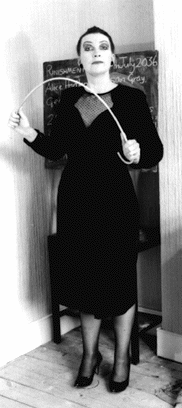
But it is an empty threat. For one thing, you can’t play the bossy schoolmarm with schoolteachers and principals — they wrote the book on it, and know all the tricks of the game, having put up with them from students for their entire professional lives. Not to mention that, as career educators they have far more invested in the quality of their education system than a minister who’s only been in the job two years and could be gone in the next cabinet reshuffle.

More crucially, though, the minister is up against old-fashioned collective action: a heavily unionised workforce which knows it is indispensable and irreplaceable. So what happens if it’s not just one school? What happens if it’s a dozen, or a hundred, or almost all the primary schools in the greater Auckland area, or the schools of two National heartland electorate regions at either end of the country, or as much as 94% of the sector overall?

Later in the speech, Tolley said:

I’ll say it again – we are going to get this right, for the students, and for their parents.

But when push comes to shove, National Standards simply cannot be implemented by fiat. Teachers, directed by principals, are those who must undertake the implementation of the policy. While I cite them reluctantly because I don’t entirely agree, it’s somewhat like what the Randians are saying about Obama’s response to the BP oil spill: no amount of threat or bluster can provide any additional incentive to progress a cleanup whose failure or undue delay will spell a certain end to the company. No matter how you slice it, there are not enough Ministry of Education staff members, non-unionised part-time relievers or teachers who are happy with National Standards as proposed to do the complex and important work of assessing all the students who need to be assessed; cataloguing, moderating and communicating those assessments to parents and the ministry in a coherent manner. This is ignoring the fact that you can’t simply parachute a compliant teacher or apparatchik into an unfamiliar classroom and have them do it with any legitimacy. The teachers who stand up in front of that class of kids day-in and day-out are the only ones who can properly assess them, and they know it.

The sector also knows it’s in the right. Educators’ opposition to National Standards is neither ideological nor capricious, and they have have consistently levelled principled and pragmatic arguments against only the proposed implementation of the policy, backed by the best local and international experts in the field. They support assessment standards in principle, and have repeatedly suggested reasonable alternatives to the proposed implementation. The problem isn’t with their willingness to work with the minister; it’s that the minister isn’t interested in working with the sector.

So ultimately one of two things will happen: one side or the other will compromise sufficiently for the issue to progress, or the minister will be faced either with backing down in abject failure or sacking a significant proportion of the education workforce, with the consequent failure of the policy by default, not to mention a massive outcry from parents who’re forced to take time off work because their kids can’t go to school (and from their bosses, and bank managers, and almost everyone else). There’s no better way to bring the country to its knees.

Tangentially, this situation illustrates a branding risk I’ve been meaning to post on for a while: if you name a policy initiative after your party or some other core bit of your identity, you had better be damned sure you can get it through to full implementation without a hitch, lest its failure tarnish your good brand. Quite apart from any concerns with the policy, his National government has failed to do so with its National Standards. Not only is the policy programme and its attempted implementation against the wishes of the only people who can implement it a catastrophic mistake, but its naming looks like a spectacular failure as well. If it’s not pulled out of the fire soon, in future, all National’s political enemies will have to do to score a point is recount some of the more embarrassing events of this episode and say “these are National’s Standards”. It’s already happening — I’ve seen that very sentence used at Red Alert, for instance, regarding something unrelated to education reform. Instant conversion of a wonkish policy criticism to a gut-level identity observation which will resonate with the folk who just wanted their kids to go to school, those who wanted nothing more than to teach them as best they could, and ultimately the kids themselves. For this reason, my instinct is that the long-term damage to National’s brand and electability on this matter will become too high a price to pay for the perceived win over the sector, and those with a more strategic view of National’s situation will require that the wound be cauterised. Although it’s a backdown, over the long term this will be good for the party. More importantly, it will be good for the country.

L

Broad Bows Out.

I cannot say that I regret the news that Howard Broad is ending his tenure as Police Commissioner. Regardless of what positives he brought to the job–and I know that certain people on the Left think that he is a great guy who can do no wrong–for me he is to the NZ Police what Richard Woods was to the NZSIS: a person who allowed overtly political criteria to intrude on what should have been autonomous decision-making based on assessments of real threat and practical priorities. Just like Wood’s disgraceful behaviour in the Zaoui case, Broad was the man at the helm during the Urewera raids, raids that just happened to be timed to coincide with the final reading of the revised (and more draconian) Terrorism Suppression Act and which targeted well-know dissidents who, whatever their crazed (or intoxicated) rhetoric and antics in the bush, were as far removed from a terrorism plot as are medieval war reenactment societies. Broad is the man who has lobbied in favour of expanded (domestic) surveillance and search powers for the Police and other state agencies. Broad is the man who ran the show at a time when a culture of criminal abuse within the Police was exposed, only to preside over a corporate whitewash of the culture rather than a wipeout of it. Truth be told, Broad was handpicked for the job by the Labour leadership  because of his ties to the party, and given the position when his  (less compliant) predecessor committed a personal  indiscretion that cast doubts on his professional judgement. In sum, Broad may be a nice guy in person, but under the 5th Labour government he allowed his political masters to exert too much influence on the Police as an institution, IMO.

All of which makes Pita Sharples’ tribute to Howard Broad, particularly his honoring Broad for services to the Maori community, as sickening a piece of political syncopathy as has been seen in recent years. On this one, I think Hone Harewira is right: the less said the better.

Having stated my view, let me also state that I do not believe that National will do anything to diminish the politicisation of Police decision making. In fact, Key and co. could well make it worse.