Countering threats as a growth industry.

News that the US has a network of over one thousand agencies employing more than 800,000 people involved in counter-terrorism efforts comes as no surprise. The post 9/11 reaction to the threat of armed Islamicist extremism by the US government was as visceral as it was knee-jerk, with a blanket call put out to increase every aspect of the country’s counter-terrorism capability. From intelligence gathering to emergency response and everything in between, counter-terrorism agencies proliferated from the local to the state to the federal level, as did the number of private firms engaged in direct counter-terrorism efforts as well as support roles.

But there are problems with this expansion, and it is not just the waste of resources associated with the duplication of functions and overlapping of roles that comes with it. Nor are the problems confined to the US. Let me list a few.

Around the world concerns about terrorism has seen the expansion of government security apparatuses dedicated to fighting it. Intelligence agencies, police forces and the military of virtually all Western states, to say nothing of those in the Sunni Arab world, Africa, Asia and the Antipodes, have increased the amount of resources directed towards countering potential terrorist threats (South America is the exception to the rule because traditional inter-state rivalries and the lack of Islamicist grievances in the region have led authorities to focus attention elsewhere). In New Zealand, for example, both the Combined Threat Assessment Group (an inter-agency combine that analyses intelligence flows and threat assessments from such as the SIS, Police, NZDF, MoD, Immigration, Customs and Foreign Affairs) and the Counter Terrorism Tactical Assault Group (CTTAG, a combined military and police specialist unit trained to respond to terrorist incidents) were created after 9/11. Similar agencies now litter the state security landscape throughout the world.

Along with the proliferation of agencies comes increases in their funding and personnel, and more perniciously, the scope of their responsibilities. Again, in New Zealand this is evident in the Terrorism Suppression Act (TSA), which is modeled on similar legislation in the UK and US and which gives broad powers to the government to infringe on basic civil liberties in its efforts to detect and stop suspected terrorism-related activities on NZ soil. The same goes for the Search and Surveillance bill now before parliament. In the US the so-called Patriot Act, which is still in force, grants US security agencies broad powers of arrest and detention on the mere suspicion of terrorism-linked behaviour. The expansion in both the number and legal authority of counter-terrorism agencies has been facilitated by politicians who, in an effort to not look weak on the issue of terrorism, approve budgetary increases and laws that fuel the growth of the counter-terrorism industry. In the post 9/11 rush to promote security, only a few brave politicians have attempted to resist the trampling of civil rights that the expansion of the security apparatus inevitably entails.

Besides the obvious problems that come with the “squeezing” of civil society by the security state (since the expansion of the state’s counter-terrorism powers come at the direct expense of the right to privacy and presumption of innocence), there is another downside that needs to be considered: the construction of threats in order to justify the existence of counter-terrorism networks. What is more, this phenomena extends beyond government security agencies and into private enterprise and academia.

In order to justify their existence, security agencies have to be able to identify and counter threats. In some countries the threats are real, as is the need to thwart them. But in much of the world the threat of terrorism is no more than it was in the 1990s, 1980s or 1970s. One such place is NZ. In these countries security agencies have a bureaucratic self-interest in identifying “threats,” because if there are no new threats then the rationale for their role and resource expansion goes out the window. Thus in 2005 the NZSIS identified “home grown jihadis” as the gravest security threat to NZ. A year later it dropped all reference to local Islamic extremists and highlighted foreign espionage networks operating on NZ soil. The following years have seen it highlight foreign-based computer hacking and industrial espionage as sources of concern. Each year appears to bring with it a new threat, even as the others are quietly dropped from annual reports.

Along with state security agencies conjuring up or exaggerating threats, so has an army of private security firms, including open source intelligence providers, security guard outfits and private military corporations sprung up to take advantage of the post 9/11 climate of fear. They bandwagon with state security agencies to emphasize the dangers of terrorism and other threats so as to nurture a client base for their services. The infamous Blackwater (now known as XE) private military corporation is an example of a “one-stop” private contractor that has its own intelligence, airborne, naval and ground units ready to serve both public and private clients for handsome fees (one of their latest ventures is in anti-piracy operations).  Thousands of other such firms now dot the global security landscape, all emphasizing the dangers of  the threat environment in the pursuit of profit. Not only does this industry work neatly with state security agencies’ agendas, but it further squeezes civil society in the measure that its surveillance capabilities and quasi-police powers increase as well.

Even academia is not immune from this trend. Over the last decade “counter-terrorism” centres have sprung up in dozens of universities world-wide. They receive their funding from governments, hold conferences, and churn out reports, books, even specialised journals that are dedicated to the subject (including “Perspectives on Terrorism” and “Terrorism and Political Violence,” although my favorite journal along these lines is “Small Wars and Insurgencies”). Here too the push is on to identify threats so as to justify continued funding. Places like Nanyang Technological University in Singapore, home of the S. Rajaratnam School of International Studies, have dozens of highly paid researchers working on counter-terrorism and threat analysis projects (including one analyst at RSIS who declared that NZ faced a domestic Islamicist threat without ever having been to the country). Since funding for its facilities and personnel is directly related to its threat analyses, NTU has a vested interest in helping ensure that the perception of the global and regional threat environments is that they are variegated and “dense.” NTU is certainly not alone in pursuing the counter-terrorism dollar–this is a world-wide trend.

And of course, there are the countless terrorism “experts” that have sprung up as analysts and talking heads in the corporate media. No matter how tenuous their qualifications for discussing issues of threat posed by terrorism and irregular warfare groups, these pundits materially benefit from the exposure afforded to them by the sound-bite crowd.

Which brings up the thought for the day. Threats to international and national security do exist and terrorism is real. But pragmatic threat assessment and better use of extant security agencies and criminal law to counter terrorism have been overwhelmed by the urge to manipulate the impression of threats for individual, corporate, bureaucratic or political gain. That in turn has seen a shrinking of the civic space and private sphere in inverse proportion to the expansion of integrated (private-public) national security networks.

When money combines with a climate of fear, impressions of threat can be manipulated (if  not invented) in order to pursue profit or bureaucratic power. Threat manipulation in pursuit of corporate self-interest and the expansion of state security apparatuses poses a serious risk to democratic society. In another life long before 9/11 I participated in actual threat assessment exercises for the US government. The ethos then was to call things as they were, objectively, so as to not allow political agendas or ideological bias to divert resources away from real dangers. Now that logic has been reversed: threat mitigation is seen as a potential source of income and power, with the more threats identified the more resources will be directed towards them by political elites and a fearful public. By that logic, counter-terrorism is the mother of all cash cows, and as NZ prepares to host the Rugby World Cup, we can assume that there will be plenty of interested parties working hard to milk it regardless of the real threat environment in which the tournament is held.


The Blues go Black.

The announcement that National will undertake labour legislation reform has revealed the dark side beneath its happy face veneer. Riding high in the polls and 14 months before having to call an election, the Key-led government has dropped its populist pretense and unveiled its anti-worker credentials with the thrust of its proposed reforms. It also violates a 2008 campaign promise not to substantially revise the Employment Relations Act (ERA). In fact, the reforms are a return to the old Employment Contracts Act (ECA), one of the most draconian, overtly authoritarian pieces of labour legislation seen in the modern liberal democratic world. Rather than address all of the proposals, to include making dismissals easier, narrowing the scope of personal grievance claims and extending the 90 day probationary period to all industries, I would like to focus here on just one: the proposal that unions must secure the permission of an employer before accessing a work site. 

Due to the asymmetric power relationship between employers and workers, collective action is the best way for the latter to secure rights and protections within the productive process. Collective action requires organisation, and the ability to organise is contingent on the ability of prospective agents to access workers in an effort to persuade them to act collectively in defense of their common interests. Access does not mean compulsory membership or even recruitment success. It just means that prospective collective agents have the ability  to approach workers at their work places in an effort to organise them collectively.

Under International Labour Organisation Convention 87 on freedoms of association, such access is defined as an absolute democratic right for both workers and agents. In fact, it is a cornerstone of most democratic labour legislation that employers not have the right to interfere with the right of workers to organise, including organisation efforts by collective agents such as unions. Thus National’s proposal that unions must secure employer consent before approaching employees on a work site, and that such consent must not be withheld “unreasonably” (with the definition of reasonable left purposefully vague), is a direct violation of one of the most cherished international labour standards.

There is a historical precedent for this move, and that is where National’s real darkness shows. The 1991 ECA entered into law by the Bolger government had exactly such provisions. In 1993 the ILO upheld a complaint that the ECA violated convention 87 on rights of association as well as convention 98 on freedom to bargain collectively. The Bolger government ignored it and it was not until 1999, after the 5th Labour government came into office, that the more egregious anti-worker sections of the ECA were eliminated in the revamped ERA.

National’s black side runs even deeper. The ECA explicitly borrowed many of its provisions directly from the 1979 Chilean Plan Laboral. The Plan Laboral was the Pinochet dictatorship’s labour code, and was championed by its then Labour Minister Jose “Pepe” Pinera, the father of the current Chilean president. Under the pretense of promoting “labour market flexibilisation,” the Plan Laboral was an outright assault on the Chilean union movement, using both structural as well as politically-focused clauses to atomise the Chilean working class and forever break union influence on economic decision-making. To a large extent, and even with subsequent reforms by successive post-Pinochet democratic governments, it largely succeeded in doing so.

Pepe Pinera, somewhat unsurprisingly, was a friend of Roger Douglas and made regular Business Round Table visits to NZ in the 1980s and 1990s before his death. Ruth Richardson, the main instigator behind the ECA, was also an admirer of Pinera. These two individuals, with their direct and immediate past dictatorial connections and coalition relationship with National, are believed to be the prime movers behind this attempt to return to the ECA as the framework in which the social relations of production are determined. In other words, National is proposing changes to the labour relations system that have their origins in the Pinochet dictatorship, and which were suggested by people with direct links to that dictatorship. Beyond the violations of ILO convention 87, that alone should give reason for concern.

Hence, while some of the other proposed reforms can be the topic of honest debate keeping in mind where the balance between efficiency and fairness in production should be located, the attempt to curtail union access to workplaces is an overt assault on working class collective rights. This proposed clause is not about getting unions to ring employers up in order to make an appointment to see employees. This is about shutting them out.

It remains to be seen if this time around the CTU and other mainstream unions will offer more than token resistance to these proposals (as was the case when the 90 day probation period was introduced). It also remains to be seen if the NZ working classes will do anything other than bow meekly to the powers that be. But if ever there was a moment to rise up against the resurgent union-busting, anti-worker tide, that time has come. Remember: the reforms embodied in the ERA where at best minor adjustments meant to “humanise” the ECA. But the thrust of NZ labour law under the ERA was by no means a bold step towards worker’s control of production, and in fact retained much of the pro-business biases of its predecessor. Thus the current labour reform proposals are very much about putting the boot into the working class, and the union movement in particular.

It may take defection from mainstream, Labour-affiliated union ranks to more independent and militant unions for any effective resistance to happen, but whatever the case, if the worker’s movement stands silent on this one, then further rollbacks of worker’s rights can be expected the longer National is in power. For workers, those will be dark days indeed.

I write like…

Via PC, a nifty tool: feed it some text and it tells you who you write like.

From a more-or-less random sample of my writing on this site, more than 50% comes back telling me I write like David Foster Wallace. I’d never heard about him until now, but wikipedia lists his form as “postmodern literature” and “hysterical realism”. I can see how that cap would fit. But Wallace hanged himself in 2008. That’s not so good.

Outliers include the post from the other day about tits and teeth news presenter selection, which is like Stephen King, possibly confirming Pablo’s dim view of it. The dam breaks, my only real attempt at satire, apparently reads like James Joyce. My epic and furious response to Chris Trotter from a while back is in the style of H P Lovecraft, which I think is rather fitting.

L

Iti and Bomber: response to “The Big Dog”

Rather than further sidetrack the discussion about police and firearms at The Dim Post, quick answers here to inquiries there by “The Big Dog” as to my views on two topics:

Lew, I’d be interested to know what you think of Tame Iti?

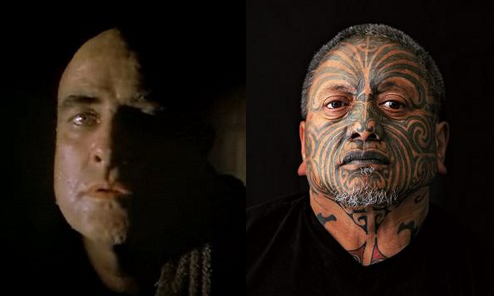
Tame Iti is a convenient symbol of all that whitey wants to fear. Since the events of October 2007 he’s been dressed up as our very own Colonel Kurtz.

Likewise Hone Harawira to an extent; Danyl’s brilliant commentary on this is here. The reality is — to put it very mildly — somewhat different. This isn’t to say that either are utterly blameless, or that this depiction is entirely unwanted; only that their notoriety is rather greater than is really deserved.

Lew, What did you think of Bomber Bradbury’s take?

(Assuming Bomber’s take on police and firearms here.) Bomber distrusts and fears the police, and he has his reasons for doing so. In that context the response is not unreasonable or unusual. While I agree with a lot of what he says in principle, I essentially see police as part of a healthy civil society, not as its enemy, so I ascribe those concerns somewhat less weight. So where Bomber insists on hard restrictions on police powers, I am more content with soft restrictions and strong civilian oversight. It’s an open question as to whether our present oversight is sufficient, though.

Edit: TBD was actually asking for my views on Bomber’s response to the October 2007 Urewera Terra raids. I’ve answered in the comments below.

L

Personal narrativium

From the NZ Herald, Why I should be the mayor:

Len Brown:

Every day I wake up and, for one thing, I’m thankful I do wake up. But secondly, I have the greatest job in the world and it’s a job that enables me to make a difference, to really change people’s lives, to deliver change, new direction and positive growth in the community. I can sort of perform little miracles around our place. When the change occurred I wondered whether I could shift this position to the community that has raised me since I was 7. I have very quickly found that passion. It has been an extraordinary journey thus far and the opportunity to deliver something by the way of step change and extraordinary redirection of Auckland and taking up of its potential, a marrying of our business dynamic with our community aroha and love is something I believe is an extraordinary opportunity, and I would like to take that opportunity.

John Banks:

At age 18, I decided that I would balance the family ledger by joining the police. The Auckland police told me in no uncertain terms that I was a lowlife son of two shitbags and there was no place for me in the New Zealand police. Twenty-five years later, I became the Minister of Police. I’m doing this to balance the family ledger.

So it’s “boundless enthusiasm for community miracles” squaring off against “individual crusade for redemption, nothing to do with Auckland” in the Supercity mayoral battle. If that’s all there was to it, Banksie would be a lost cause.

L

Firearms, no debate

I generally agree with r0b’s reasoning on the police need — or lack — for firearms. This is a mostly-empty moral panic.

But how things have changed for Greg O’Connor of the Police Association. This from 1 June 2009:

Mr O’Connor, who is currently studying policing in Scandinavia, did not support all police carrying guns but said the matter had to be looked at. […] “We said the debate should take place outside the emotion of Len Snee’s death and it’s disappointing to see that now there’s not going to be any debate there needs to be.”

A year ago Greg O’Connor was careful to frame the Police Association response in this way. He repeatedly said he didn’t want to arm all officers, he just wanted “a debate”, and one which would take place in the cold light of reason rather than as a knee-jerk in the aftermath of a police shooting. That’s a mature and responsible position. But even though the debate has not really occurred in the intervening year, his position has congealed — or perhaps he now just feels more at liberty to express it — into “all guns, all the time”.

What’s changed in the past year? The agenda has changed, that’s all: how firearms are framed in the public discourse about policing. Any time a firearm is used — regardless of the outcome — it’s a big media deal. Recent events such as the Urewera Terra raids of October 2007, the retrial of David Bain, the story of a large number of dogs being “massacred” using a firearm, and of course a number of police shootings have imprinted the prominence of firearms as public menace on the public consciousness. This has progressed alongside a police and crime-reporting discourse which has as its basic theme the notion that our plucky boys and girls in blue are under constant attack from all sides. Contrary to O’Connor’s noble aim, there has been no meaningful debate about arming police. This fact suits his arm-the-cops purposes, and it’s now clear that those cries for a debate, and the appearance of a debate within the Police, were made with the primary purpose of simply keeping the issue primed and on the public agenda. It’s lurked there, undebated, for a while, and with these most recent events it’s moving rather rapidly closer to actually happening. That’s a dangerous way to set policy.

Although I accept this is a contentious position, I generally believe that we need to trust the operational discretion and instincts of frontline police staff, as long as we have tough and independent disciplinary oversight as to their policy, and conduct in implementing that policy. On this basis, I’m not categorically opposed to the notion of police vehicles containing a lock-box with firearms in it, which police can use in accordance with firm and well-documented policy in light of the tactical circumstances in which they find themselves. But I would say that this isn’t very different to the current status quo, and the use of firearms must not be left to the sole discretion of an individual officer. The deployment policy and tactical decisions to deploy must be matters for which police command can be held accountable, for which the police as an organisation are responsible.

But what I’m more interested in is a public debate on this, and other policing matters. We really need one.

L

Sinecures and Shoulder-Tapping in another Small State.

It must be my week for thinking about small states in personal terms. I only took an interest in the specific dynamics of small states when I moved to NZ, having previously written mostly about larger states (although I did write a bit on Cuba and Uruguay before moving to NZ). Living in NZ exposed me not only to the political dynamics of a small democracy, but the social dynamics as well. Things like the 2 degrees of separation that make putting distance on ex-partners very difficult. Things like the rapidity with which one’s personal life becomes the object of professional speculation, and how quickly rumors in one dimension transfer to the other. Things like blacklisting, sinecures and shoulder-tapping.

I write this more as an open question to readers. My question rests against the backdrop of NZ being proclaimed as the least corrupt country on earth by one polling outfit, and the general consensus that it is one of the more successful liberal democracies in existence. But if liberal democratic success is defined as the absence of corruption in and ascriptive rationales for social advancement, plus the universal presence of merit, equality and transparency in public and private upward mobility, can we really claim that NZ is a “success” on those terms?

I may stand corrected on this, but it strikes me that for a democracy NZ has an unusually high incidence of shoulder-tapping and sinecure-mongering. Shoulder-tapping is the practice of rigging a competition by pre-selecting the favorite candidate or outcome, then going through the motions of a transparent and equitable process so as to disguise the pre-determined choice. As an example, consider this from NZ academia. A well-known academic with international credentials is encouraged by the Director of a university research centre to apply for a newly opened position. The invitation is accepted, letters, resume and referee names forwarded, only to have the application rejected within weeks. When asked for the reasons why the application was rejected after the applicant was encouraged to apply, the Director stated that internal competition for the position was fierce and better candidates emerged. Months later it is revealed that weeks before the “search” began for a candidate, an academic at another NZ institution with ties to the Director was approached for the job and eventually awarded it. The international candidate “search” in other words, was a cover for the selection of the shoulder-tapped individual.

In another instance drawn from academia, a search committee was formed to find suitable candidates for a specific disciplinary sub-field. Unbeknown to two of the committee members, the other three members, including the Chair, as well as the external faculty representative, were all co-authors of  a husband-and-wife candidate duo vying to be short-listed. Not surprisingly the duo were listed as the best candidates out of ten finalists by their four co-authors. No conflict of interest is declared. When one of the other committee members discovers the connection and complains to the Faculty Dean about the clear conflict of interest involved in the search process he is given a warning not to disparage the professional integrity of his colleagues. But his protestations continue. The search ends with a compromise candidate being selected, but in the next year the Chair resigns and joins the husband and wife team at a foreign university while the whistleblower winds up being (as it turns out unjustifiably) dismissed on another matter in which one of the committee members with a conflict of interest played a decisive role . The Lesson? Interfere with a shoulder-tapping exercise at your peril.

This are just two illustrations from one profession. I have been told of or have seen myself dozens of other cases–including in such places as my old surf lifesaving club–where the shoulder-tap, with or without a wink and a nod, is used as a means for advancement under the cover of ostensibly “fair” elections, tenders and searches. Sports associations, voluntary organisations, service societies, public bureaucracy, the education system, unions, the media, local councils, the legal profession, political parties, a wide swathe of private businesses and business interest aggregators, perhaps even the Police and Fire Services, hopefully not the military–is there any part of NZ society in which this is not part of the unwritten norms governing career and personal advancement? My question then is: am I wrong in seeing something amiss here? Am I exaggerating the extent to which this occurs?

Likewise goes for the issue of sinecures. A sinecure is a position offered to someone that entails little actual responsibility and is awarded not on merit but as a form of patronage or reward for services rendered. In NZ there appears, again to my uninformed mind, to be a lot of sinecurism in virtually every walk of life. Ex-politicians, ex-bureaucrats and ex-ministers get comfy senior positions in state entities and private boards regardless of their backgrounds or records in a given field. Individuals with much private wealth but little other distinction serve on boards, committees and trusts. There is an affirmative action sub-type in which persons from ethnic minorities are awarded well-paid “honorary” positions or those mentioned previously regardless of their qualifications. From local councils to national-level politics and enterprise, sinecurism seems to be endemic.

NZ is not alone when it comes to such practices, so my question is whether these are just more obvious in a small (democratic) state when compared to a  larger one, or is the practice itself more frequent in small democracies, NZ in particular? 

It needs to be noted that these practices are not equivalent to clientalism. Although shoulder-tapping and sinecurism are seemingly endemic in NZ and can be considered to be institutionalised, they are not recognised as such and in fact occur beneath the mantle of egalitarianism, transparency and merit. They are therefore informal, nepotistic institutional practices that operate under the cover of a rationalist meritocratic Weberian ideal. Clientalism, on the other hand, is a formal institutionalised practice whereby political or personal networking lines combine with merit-based criteria into channels of upward mobility. Such is the case in the small state in which I live, where political allegiance to the dominant party is a requirement, along with professional competence, for career advancement in both the public bureaucracy as well as in state enterprises. In the private sector personal networks outweigh political ones in the clientalist scheme, but here too there is an overlap between the personal and political.

What is different is that in clientalist systems patronage is based on the combination of relative merit and political or personal connections. In the sinecure and shoulder-tap system patronage has little or no relationship to relative merit–it is in fact a non-meritocratic form of favourtism based upon ascriptive rationales of social advancement and mutual entitlement.

As I said before, I could be all wrong about this and am merely extrapolating widely from my own personal observations and experience. Nor would any of this matter if NZ were not a liberal democracy supposedly committed to fair play, social justice and equal opportunity. But since it is, and because Kiwis tend to think of themselves as being better on these dimensions than most other democracies, then my questions about the role shoulder-tapping and sinecures play in NZ society are worth consideration.

I shall leave for another post the prevalence of professional blacklisting in NZ, but suffice to say that I have some experience with it.

Faces not for radio

A post by Janet Wilson expresses a general conspiracy theory I’ve held for a long time about why radio news is usually better than TV news: because the people are chosen for different qualities. To an extent the “beauty bias” is present in every field, and of course, even in news it is simplistic — there are a host of other factors to do with resourcing, format, training and so on. As in almost all fields — and for the same sorts of reasons — these pressures weigh much more heavily on women journalists than on men, and consequently the aesthetic homogeneity of NZ’s top female TV presenters is striking:

What Janet calls “tits and teeth” selection really matters: people instinctively trust attractive people more than unattractive people (as long as they’re not too attractive), and broadcast news is all about projecting authority and trustworthiness via a predominantly visual medium. Dress and bearing are also relevant — as is voice, which is even more important in radio. But those things can, to a much greater extent, be worked on or around.

So TV news is biased in favour of attractiveness. In general, a presenter’s job is to present — their newsgathering, interviewing and editorial skills are backgrounded to a considerable degree. So this bias isn’t entirely unjustified for presenters, but the problem is that it’s also clearly evident in the journalistic ranks from which presenters are drawn. While it does not exclude journalistic quality the beauty bias does weight against it. Because the jump from reporter to presenter is a crucial part of a broadcast journalist’s career arc, and being unwilling — or unable — to fit the pattern is an explicit and well-known limitation to advancement, it likely dissuades people who might otherwise make outstanding broadcast journalists — which society desperately needs — from entering the profession. As Janet notes, the bias also selects against experience, because while men tend to become “distinguished” as they age (strengthening their gravitas) women do not, and those who don’t retain their youthful dash paradoxically become less favoured as their screen experience increases.

A case in point on this last point has lately been evident in the most trivial forum: Breakfast, on TV One. My wife, at home with our daughter, remarked on the greater capacity of One News anchor Wendy Petrie to deal with co-host Paul Henry’s soft-gonzo screen persona while she covered for Pippa Wetzell recently: a sort of dismissive indulgence, as if of a poorly-behaved child on his birthday. The customary pairing is a classic mismatch: Henry dominates the studio while Wetzell — herself a quality presenter, as we occasionally see when Henry is absent — is often forced into the role of slightly-embarrassed fall-gal. Petrie, with close to a decade’s primetime hard-news presenting experience under her belt, is out of Henry’s league and she knows it.

Of course, she herself has the beauty bias on her side. But the question is: how long does she have left? And how many other talents have we lost — or never found — due to the dire ravages of crow’s feet, a poor hairdo, a few additional kilos, or a mismatched outfit?

(Thanks to Naly D for the link to Janet’s article.)

L

PS: I’d like to endorse Nicola Kean’s campaign to go to Columbia Journalism School, as others are doing. Go and vote for her, and perhaps she’ll do better than another well-known graduate from these parts.

MMP in NZ is really safe

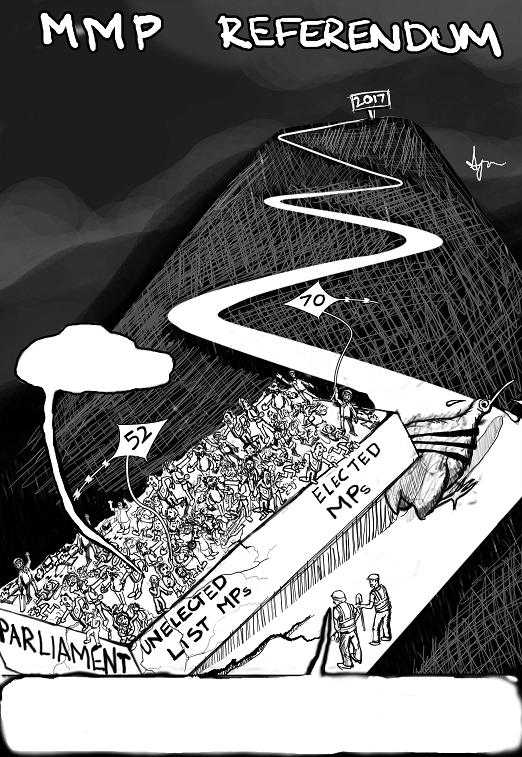
As I’ve said before, Peter Shirtcliffe’s campaign to scupper MMP (again) is probably a blessing in disguise for the electoral status quo in New Zealand. If any further evidence were required, the following should suffice for now:

The speech bubbles are blank because Peter is running a caption competition to find a punchline. Demonstrating piercing insight into his relevance to NZ politics, he has chosen the Kiwiblog Right for these words of inspiration. Personally, I think that leaving them blank perfectly captures the character of this campaign: inchoate, futile, tone-deaf irrelevance.

Hopefully he won’t be too disheartened by the far-from-enthusiastic response of Farrar’s captive authoritarians.

L