The US as the new Greece.

Watching the lead up to what will be a major Republican and Tea Party comeback in the upcoming US midterm elections, and having spent an earlier part of the year in Greece, I cannot but help but be struck by the parallels between the two countries. This may seem crazy, but sometimes what is obvious is not necessarily apparent.

The US and Greece are saddled with immense debt, most of it public. Both have extremely large state bureacracies that consume an inordinate amount of the tax base. Both have lived, in their personal and public consumption, way beyond their means over the last two decades, riding the wave of financial sector excess and lving off real estate and other speculative bubbles that did not, in fact, significantly contribute to national productive rates.

In each case immediate past centre-right governments contributed to the false sense of security by allowing the financial sector to operate with considerable degrees of autonomy and lack of oversight, reduced taxes for the wealthiest sectors of the population and corporations, and spent money well in excess of state revenues. In Greece state expenditures went into a bloated welfare system that was designed to prop up living standards that are seen as a birthright of all Greeks; in the US, the excess state spending went into war. In both instances the center-right governments increased state spending and the public deficits that accompanied them. In both cases they were turned out at the polls in the past two years.

Center-left governments replaced the discredited right. They inherited unsustainable deficits that will take years to redress and embarked on economic reform programs that were designed to cut the public deficit and increase economic efficiency over the long term. In Greece this meant slashing the public workforce, decreasing public salaries and welfare benefits while offering a package of tax incentives to small and medium business so that they could innovate, expand and thereby take up the slack produced by reductions in the public workforce.

In the US the economic stimulus program was designed to prop up and revitalise at-risk major industries (the automobile and financial sectors in particular) while providing tax relief for 95 percent of the working population. A national health program was instituted that, even though watered down and more pro-business than pro-consumer and nowhere close to socialised medicine,  provides for minimum health coverage for the majority of the population. Selective regulation on the financial sector was legislated, although this worked more on the margins of the system rather than at its core. Military spending was cut at the corners, and in a number of cases companies that received financial bail-out packages have begun to re-pay their debts.  In effect, although in the US public spending increased over the short term with the stimulus and health care packages, the design is oriented towards lowering the overall public spending bill within five to ten years while maintaining a  disproportionate emphasis on “defense.” That is the American way.

In both instances some or most of the center-right opposition in the legislature supported the economic reform packages of the government, but backtracked when confronted by public reaction. In both cases that backtracking led them to move towards the zealot wing of their popular base. That has consequences.

The reason? In each case there was an immediate, reflexive and largely unthinking  public backlash against the reform measures. Following Greek protest tradition, often violent strikes and demonstrations have engulfed the country from the moment austerity measures were announced. Although the protests are led by unions and other elements of the agitational Left, the real beneficiaries of the crisis are the hard Right, who have seen an opportunity to engage in nationalist-populist demagogery in which “foreign interests,’ illegal migrants, “Communists” and a host of other suspected culprits are blamed for the country’s woes.

In the US attempts at reform have been met by a wave of right wing backlash among the mostly white middle classes, who also blame illegal migrants, “Socialists” and other purported “progressives” as well as atheistic liberal homosexual-enabling secular humanists for the decline of Empire. At public forums many vented their anger by calling for a “revolution” or at least the ovethrow of the Washington elite. Some of them turned up armed to make their point.  They have a movement not unlike the Greek ultra-nationalists. It is called the Tea Party.

What is striking about both hard right wing resurgences is that they stand to gain the most from upcoming elections simply by blaming the governing center left administrations without offering a plausible solution to the problems of the day and near future. Both want to return to something long gone. Both want lower, not more taxes, apparently not understanding that in the case of Greece that national pasttimes of tax avoidance, island vacation homes and reliance on the state for pensions, social security and universal health care are contradictory and incompatible. In the US the pejoratively labeled “Tea Baggers” apparently have not connected the dots between maintaining a massive military apparatus that consumes 6 percent of GDP, is fighting two wars of occupation and at least a dozen small irregular conflicts simultaneously, has a presence in 150 countries and deploys three carrier task forces comprised of 7 ships and 75 aircraft at sea at any one time (no other country can deploy even one), and the need for a substantial tax base. Nor can they see that the party that they support is the one that has the most extensive ties to the Wall Street giants that played loose with their money in the game of financial roulette known as the sub-prime lending market that has now come a cropper. Instead they rail against welfare queens and “illegals” stealing the jobs most Americans disdain.

In both countries the conscious anti-intellectualism of the Right is manifest.  They want simple solutions to complex problems, they want the solutions to benefit them without requiring any sacrifice, and they want it all to happen yesterday. Reflexively ignorant political champions lead the charge and rally the masses in each case.

Most of all, it is historical myopia, an overdeveloped sense of entitlement, the lack of acceptance of responsibility and the shifting of blame that ties the US and Greek public together in their rightwards march. Both cultures prefer to forget the immediate past that led to these tough times and instead focus on a mythical past in which the Nation was strong, proud and united in its demographic homogeneity and cultural mores. Both cultures believe that they are special and especially deserving because fortuitous circumstance determined that they were born Greek or American. Neither culture embraces the notion of individual and collective responsibility as a majority ethos anymore. Instead, the common approach is to blame others for individual failure and collective misfortune.  Both right wing movements have little to offer than hatred for central government elites, current reform policy, bankers of “dubious” persuasion and all the “others” who instigated the entire mess. Mutatis mutandis, there are faint echoes of interwar Europe in all of this.

That may be a basis for victory in any contemporary elections given the circumstances, but it is certainly no blueprint for national regeneration. History has repeatedly shown that national-populist lurches to the right produce more anomie and retrogression than progress. For the latter to occur, people will have to first take individual and collective responsibility about their role in the process of decline. Then they will have to accept the costs of redressing that decline which means that they will need to assume the burden of altered lifestyles no longer easily bought on the back of cheap credit, deficit spending and overinflated notions of national grandeur. They will then have to grin and bear it during the tough times so that their children and grandchildren will prosper under different conditions.

None of that is going to happen anytime soon.
Lessons from The Hobbit: more unionisation, not less

The Hobbit saga has been an ugly but edifying lesson in the realities of how industrial action interacts with political posturing and national identity. My own view is that Actor’s Equity did their industry and their country — I would say ‘their membership’, but when they set this ball rolling they didn’t have one — an enormous disservice. Lacking a mandate and any legal standing, they undertook almost the worst possible course of action of calling an international SAG boycott. They attempted to hold a national icon and his nationally-iconic production to ransom at the apparent behest of an Australian union (the MEAA) with a history of this sort of aggressive mismanagement and who stands to gain from any reputational damage suffered by the New Zealand film industry. Their cause is worthy, but they picked the wrong fight with the wrong person at the wrong time, on the wrong basis, employing the wrong tactics, and did so without the support of their industry. Almost everything they could do to lose this battle, they did.

But too much has already been written on that topic, and I won’t add to it any further. The point I’d rather make is that the incompetence shown by AE in this dispute would never have thrived in a more robust industrial relations culture: that is to say, one in which union membership and participation was the norm rather than the exception, in which more workers had an understanding of what their union was there for and the union in question understood their industry’s needs and agenda better.

Fundamentally, the entire problem here is AE’s lack of a mandate: even leaving aside the fact that they had no legal standing as a NZ union until this time last week, the trouble is that they represent a tiny fraction of the actors who form a tiny fraction of those responsible for the production of any film, and yet they have the apparent ability to blacklist that entire industry (whom they don’t represent). Even the most ardent trade unionist can surely see the moral hazard here. All those who we’ve seen fronting AE have been the best-respected and most-established actors; actors whose careers aren’t in material danger regardless of the outcome of The Hobbit. But what of those actors who are genuinely struggling, whose faces don’t appear in tens of thousands of living rooms every Tuesday night, and who don’t top “best-of” lists? And what of the silent legions of drivers, designers, artists, labourers, riggers, electricians, carpenters and caterers who are the real motive engine behind the film industry? Are their needs well-served by the actions of a few prima donnas who represent them without their consent? Apparently not, which is why a thousand of them turned out to protest the actions of that unelected few. Orcs, Chris Trotter called them; useful idiots said Idiot/Savant.

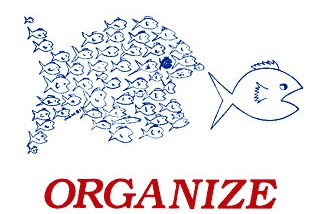
To an extent it’s their fault for not being adequately organised to mount a counter-insurgency against AE’s hijack of their industry. And that’s why my suggestion is for film industry workers to arm themselves and prepare to fight for their needs. Whether it’s in separate unions by sector or a single, unified screen workers’ union doesn’t much matter, as long as there is strong and robust organisation behind it which elects leaders who hold a genuine mandate to speak for the real needs of their industry. Nature abhors a vaccuum, and the only way that a handful of pretty faces and household names with little or no industrial relations experience and an Australian carpetbagger with a reputation for mischief-making get to speak for an entire industry is when the alternative is nothing. Conventional wisdom — particularly from the government — is to de-unionise, and already the veiled threats about the consequences of a general strike during the 2011 Rugby World Cup are beginning. But de-unionisation at a time like this simply cedes the field. Efforts must be redoubled — not only to negotiate the sorts of concessions gained by Irish actors for collective bargaining among independent contractors, but to ensure that whoever claims to have a union mandate in future has the crowd with the torches and pitchforks following them, rather than chasing them.

L

Headed home, looking to contribute.

Tomorrow evening I fly back to Auckland for the beginning of a phased return to NZ. I have some pending obligations and personal commitments in SE Asia so  after two months in NZ will be doing a long distance commute between NZ and SG until the middle of next year. But I have made the decision that it is time to permanently return to NZ and find a way to contribute in a non-academic capacity. To that end I am registering a NZ-based political risk, market intelligence and strategic analysis consultancy under the name Buchanan Strategic Advisors, Ltd.  As far as I can tell it is the first of its kind in NZ: a consultancy solely dedicated to international and comparative industry and market analysis, political context assessment and security threat evaluation. I will also focus on labour market characteristics, industry-political relations, futures forecasting (both strategic and sector-specific) and ethical and sustainable investment. The firm will have a public outreach component that will provide expert commentary to general and professional audiences as well as the media on matters of contemporary international import. As readers may know, I have long been concerned about the lack of strategic vision, both in its long-term and in-depth dimensions, exhibited by NZ public and private entities when it comes to foreign affairs. This is my way of helping to fill that analytic and policy gap.

It may seem counter-intuitive but I believe that basing the firm in NZ enhances its “brand” because of NZ’s reputation and image as a fair, transparent, honest and autonomous country, We may know that in fact NZ does not quite live up to its image in many respects, but having lived in nine countries I believe that it comes the closest to doing so. Since we operate in an age of telecommunications and rapid transport, I do not see NZ’s size and location as a major disadvantage to providing the intellectual value added services embodied in the firm. To the contrary, I see the firm as an ideal interface between NZ and foreign partners, complementing and reinforcing existing diplomatic and business networks.

I have been fortunate to have a number of Kiwis encourage me in this venture and have some leads on business opportunities. The real test is to see if public and private entities in NZ will pay for such services. I believe that it fills a niche for actors that do not have in-house expertise on specific subjects or whom do not wish to pay the full costs of maintaining a full-time, in-house political risk capability. But I also have offered this type of service for free to several NZ entities, only to have them baulk at continuing receiving my analysis and opinion on a fee-paying basis (this includes some specialised security agencies that clearly lack in-house capabilities in the areas that I am competent to discuss). Thus the real make-or-break issue is whether private firms and public agencies are willing to pay for this type of specialised advice. The next year or so will tell.

In any event, I am thrilled to be heading back home. I get to reclaim my house in the Waitakeres and breathe clean air (the Indonesian smoke haze in SG at the moment is at dangerous levels), feel the nighttime silence of the bush, and reacquaint myself with friends. That will make the pressures of setting up the firm all the more bearable. It may be a challenge after so many years of doing full-time academic work and part-time consulting, but if there is an ideal place in which to undertake a new venture like this, Aotearoa is my choice.

A press release on the establishment of the firm can be found here.

Coming this Fall: the Battle for America’s Soul

Imagine that title in scary-movie-narrator-voice. Via Pascal’s Bookie, a simply magnificent piece of propaganda from Personhood USA.

This two-minute ad is superbly done. It frames Colorado’s 1967 abortion law as the beginning of the end, and Amendment 62 in Colorado, which aims to declare that personhood begins at the moment of fertilisation, as the beginning of the battle to save America. Amendment 62 is up for the vote at the mid-term elections in November.

What we have here is clearly not the work of amateurs, nor of itinerant cranks in trailer parks, as many (including myself) have mocked the Tea Party movement. It draws together all the conventional Tea Party wisdom about what’s wrong with America into powerfully truthy narrative: start with a misappropriated Jefferson quote; follow up with Semitic “men in black robes” who hate truth, justice and the freedom and “legislate from the bench”; portray the fringe radical rump of conservative white folk as a valiant oppressed minority group; intolerant millennial-cult hypervigilance as the American Way; Obamacare as morality and human life being bought and sold as a commodity (oh, the irony!); and most crucially, Obama himself as the Grim Reaper, the lynchpin of it all, with the caption “Then the Angel of Death arrived, and Hell followed with him”. The whole thing is capped with fireworks and the Statue of Liberty, a Daisy-esque girl fading to black and a fist-pumping don’t-tread-on-me baby. And the soundtrack really just speaks for itself.

The whole thing is absolutely barking. In the cold light of day it’s nothing more than a Dan Brown plot. It’s fevered stuff, wound up to eleven to inflame passion and suppress reason. But that’s the whole point: this ad is basically the movie trailer for the upcoming battle for America’s soul, coming soon to a screen near you. Just sit back, let it wash over you, and marvel at what that country has become.

L

The Perils of the Dark Side

Via 3 News journalist Patrick Gower on Twitter, the news that Pita Sharples is the keynote speaker at the Destiny Church annual conference this Labour weekend. Concerning news.

Except I’m not sure it’s completely accurate. According to the Destiny press release, Sharples is the keynote speaker at the Friday night Awards & Recognition event which kicks the conference off, while (who else) Bishop Brian Tamaki is the “keynote preacher” for the weekend-long event. I think this is an important distinction: it’s appropriate for Sharples, with a lifetime of support for Māori excellence, to be present for an event which celebrates achievements in “business, management, the health and social services sectors, Pacific arts, family breakthrough and contribution to at-risk youth” for a large and largely Māori organisation, featuring pasifika and kapa haka performances to boot.

But that’s quite a different thing to lending the imprimatur of his status as the co-leader of a government party and Minister of Māori Affairs to the shady cultishness of Destiny’s main event. This is not to say that Sharples should shun Destiny outright: after all, as a kaupapa Māori politician he does represent some of the group’s members, and many non-members who share some of their values. Such ‘Dark sides’ of support exist for almost every party; the Greens have their crazed dark-green environmentalists; Labour has the blue-collar rednecks about whom I’ve written previously; ACT has mostly sucked away the white-collar rednecks (and doesn’t mind admitting it) from National, but the Nats still have the worst offenders among the farming lobby and many of the least-savoury Christian sects (much of Destiny undoubtedly included). For all that they might be abhorrent to some, these are all legitimate interest groups and — within reasonable bounds — they must be tolerated and their needs entertained in a free society. Their members have as much right to democracy as anyone else, but (as with any fringe group) politicians must be extremely circumspect about the type and quantity of support that they grant.

There is a danger that Pita Sharples will be seen to pander too much to Destiny; and indeed a danger that he does pander to them. The māori party paddles turbulent waters at present; having compromised very heavily on the Marine & Coastal Area/Takutai Moana legislation to replace the Foreshore & Seabed Act, and now finds that Faustian bargain under attack both from the ACT party without and from Hone Harawira within. Despite the former, and probably because of the latter, they have been very quiet lately. Although they — ironically — share some common ground with Labour on the Takutai Moana bill, there remains a very large gulf between them; not least because Labour’s own conference signals a much more classical materialist direction than that which has previously obtained. Sharples and Turia are no fools, and can see that remaining a client of Key’s pragmatic-instrumentalist National party is a hiding to nothing — even with the ACT party likely out of the picture after the next election, the likelihood that they can maintain common cause once the other has outlived its immediate use seems slender. So they feel like they need another support base, and it must be very tempting to team up with a charismatic leader such as Brian Tamaki at a time like this.

It would be ruinous to do so. Most obviously, this is because outside of his most loyal followers — his 700 Sons — Tamaki’s is an illusory sort of strength, based on the smoke and mirrors of a showman’s art rather than upon deep loyalty and conviction. This much was clearly shown in the 2005 and 2008 elections, where the Destiny Party (and later the Family Party with Destiny’s express endorsement) failed to come close to success, due largely to a lack of internal cohesion. Destiny has failed to demonstrate — even at the height of its profile five years ago, under a government largely hostile to it — that it could mobilise a meaningful number of votes.

The second, and by far the more important reason, is the abhorrent nature of the policies and principles Destiny stands for — crude Daddy State authoritarian Christian conservatism with a brownish tinge; illiberal, intolerant, homophobic and misogynistic, quite opposed to where Aotearoa is heading. And that’s to say nothing of the corruption and appalling social dysfunction endemic to the evangelical cults of which Destiny is an example. The sorts of scandals which currently rock the church of Tamaki’s own “spiritual father” Eddie Long in the USA must undoubtedly also exist within Destiny. This is essentially the same package of qualities which turned the Exclusive Brethren to political poison for Don Brash’s National party in 2005. Because of this deep and fundamental disconnect, and New Zealanders’ innate distrust of folk who think they’re ‘exclusive’ (especially if they’re brown, wealthy or religious), the reality is that an alliance between the māori party and Destiny would likewise be poison, and would probably circumscribe any future prospects of working with either of the two main parties, not to mention utterly ruling out the Green party — with whom the māori party shares the most policy in common.

So there is no easy course for the māori party in the long term; the swell is heavy and the winds both strong and changeable. But to extend the nautical metaphor, Destiny is a reef; not an island. Better that they paddle on by their own course and seek more solid ground.

L

Performance art

Listening to Tao Wells’ stone-cold crazy performance on Radio New Zealand’s The Panel this afternoon (audio, starts at about 19:30) it’s pretty clear that the whole thing is simply a continuation of The Beneficiary’s Office, his performance art project.

I’m not sure what the endgame is, beyond driving publicity for Wells and ‘The Wells Group’, the self-styled PR agency running The Beneficiary’s Office. But fundamentally this is the only explanation for the character who fronted The Panel. The studied eccentricity of his characterisation and rhetoric — the Leninesque styling and cheap, ill-fitting suit; the suggestion that he might replace Paul Henry on Breakfast, using the scandal du jour as a springboard for publicity; the incoherent, aggressive, entitled, self-indulgent indignant victimhood of his media presence — he is exploiting the fourth wall illusion, the audience’s naïve impression that they’re separate from the performance; that the show stops at the proscenium arch. To do so Wells is reading from the big book of Glenn Beck and Sarah Palin. His project is a little bit of inchoate Tea Party wingnuttery turned back on an issue so close to the wingnuts’ hearts that they can’t see the mockery in it. No matter that his actual argument doesn’t bear the slightest bit of rational scrutiny and is all but completely obscured by his outrageous delivery — this isn’t the point. The point is to suck people in and involve them in the performance by lighting the flame of their hatred. To make them attack the tar-baby. As Palin’s own idol Ann Coulter said, paraphrasing Joseph Göbbels and George Orwell in her diatribe Slander: “Any statement whatever, no matter how stupid, any ‘tall tale’ will be believed once it enters into the passionate current of hatred.”

So to everyone who’s found themselves incandescent with righteous fury, uttered slogans like “the world doesn’t owe you a living!” or called for the disestablishment of Creative NZ or defended Wells and his absurdist position — this includes the media who’ve covered it from the ‘benefit scandal’ angle; obviously WINZ, who’ve cut his benefit; and most notably David Farrar and the KBR, whose response has been nothing short of magnificent — you’re part of the show. You have been trolled.

So as far as that goes, well done, Tao Wells.

L

System re-equilibration on a global scale.

I was fortunate to have been taught by the father of modern international systems theory (Morton Kaplan) while in graduate school. Although it has fallen out of theoretical fashion to neo-realist and constructivist arguments, from time to time events conspire to remind me of its utility as a broad interpretive framework for understanding international relations. Once such moment is now.

One of the axioms of international systems theory is that the international system will always seek equilibrium, and that this most often comes about by achieving a balance of power between rival state actors. That balance can be bi-polar, multi-polar or even unipolar, although the latter is inherently unstable if all other actors do not accept the moral authority of the so-called “hegemonic” power. In a modern world comprised of nearly 200 nation-states with a multitude of divergent ideological views, to which are added a host of non-state actors both armed and unarmed, unipolar systems are inevitably unstable and short-lived as states move to counter-balance the hegemon. 

One such moment is the post Cold War period. Although it initially brought to the fore the US as the world’s sole superpower, a situation of unipolar dominance that lasted almost twenty years, the current international context has seen a move towards a new multi-polar balance of power that is different than the US dominated status quo as well as the tight bipolar balance of power that characterised the Cold War. Much of the move has been precipitated by China’s emergence as a global power, but it is also fueled by the rise of the other members of the BRIC  collection: Brazil, India and Russia. Although these countries are leading the push for a new multi-polar world, other states have joined the bandwagon, most notably Turkey, Iran, Australia and South Africa. To this emergent geopolitical landscape  can be added the shifting alliance perspectives of countries like Japan, Indonesia, Venezuela and the arc of “Stans” made up of former Soviet Republics along Russia’s broad southern flank. Then there are the status quo powers, all of whom have to re-calibrate their foreign policies and strategic perspectives as a result of the shifts within and around them: the US, Britain, France, Germany, Spain, Italy, Israel and Mexico, most notably.

The current international moment is therefore one of transition, with the transition marked by a rapid increase in new alliance formation and increased fluidity of international exchange across physical borders.

As an example, consider that both the US and Russia have moved to reaffirm military and diplomatic ties with India as a hedge against Chinese advances in Pakistan and Central Asia. Likewise, Thailand, Singapore, Malaysia, the Philippines and Vietnam have all rekindled defense ties with the US as a result of increasingly aggressive Chinese power projection in the East and South China Seas. China has worked hard to carve out a sphere of influence in Sub-Saharan Africa as both a source of raw materials and as a potential forward power projection location, something that it is also in the process of doing in Latin America and the Western Pacific basin. Brazil has opened up ties with Russia and Iran, as has Venezuela. Venezuela has worked for over a decade on creating a so-called “Bolivarian bloc” as a counter-weight to US influence. Iran has aggressively supported Hamas and Hezbollah as proxies in the anti-Israel fight, something that was made amply evident in Iranian president Ahmadinejad’s visit to Lebanon last week. It has also materially and financially supported Shiia dissident groups in the Sunni Arab world and exerted its influence in post-Saddam Iraq, positions it would not have been capable of or dared to do a decade ago. Germany has worked to reaffirm its position as the leader of Europe while moving to strengthen ties with Russia, leaving France and the UK working to counter Germany’s dominance by reaffirming ties with both old and new European partners. South Africa has worked to expand its circle of economic partners beyond its traditional colonial ties while asserting its position as Africa’s emerging giant. Wracked by financial crisis and declines in productivity, Southern Europe has increasingly looked to the East for developmental support. While continuing to retain close defense ties with the US, Turkey has asserted new found diplomatic independence by challenging Israel and improving ties with Iran while establishing new ones with Brazil.

The pattern of realignment is broad and deep and not confined to great and middle powers, new and old. Small states are also in the process of redefining their alliance commitments and diplomatic priorities, although not always in a coherent manner informed by a long-term strategic perspective (as is the case with NZ, which can be contrasted with Singapore or Chile when it comes to its lack of strategic vision). And then there are the non-state actors working the interstices of the nation-state system in ways that serve to both uphold and undermine it.

The sketch outlined above does not do justice to the full measure of the geopolitical shifts now underway. I have used it to illustrate the point that the international system is in flux in pursuit of a new multi-polar balance of power in which cross-cutting and overlapping alliance commitments, some new and some rooted in previous alliance structures, will generate a new power equilibrium within the global community. That may take another decade or  more to fully materialise, but in the interim it is worth noting one last axiom of international systems theory: it is the times in between equilibrating balances of power that are the most prone to conflict, and the intensity of those conflicts during period of international systems transition is directly related to their impact on core national interests of the actor’s involved. In a world with ascendant and descendant powers vying to influence the shape of the emerging international system at a time when irregular armed actors ply their trade on a global scale, it is safe to say that an era of world peace is still a ways off from becoming reality.  It therefore might behoove foreign policy elites in countries big and small to re-familiarise themselves with international systems theory as an analytic guide to the context in which they frame their diplomatic, military-strategic and economic decision-making. It should not be the only tool that they use, but it is part of the decision-maker’s conceptual workbox that although long neglected, appears to have particular utility at the present moment.

The real Chilean miracle.

The rescue of the 33 trapped miners in Chile is an epic feat. It is a testament to Chilean tenacity, discipline and ingenuity that the rescue operation was a sterling success. Bien hecho y felicitaciones, companeros!

There are some less covered aspects to the incident that are worth highlighting.

First, contrary to what US TV coverage may lead one to believe, the US did not spearhead the rescue efforts. A total of four US private contractors were sent to supervise the rescue bore drilling, and the derrick for that bore was US-made. There were also Canadian, Austrian and Kiwi experts on scene, but the majority of those involved in planning and carrying out the operation were Chilenos. Of course that should obviously be so: mining is the foundation of Chile’s export economy so it has a long history of expertise in that field. However, the accident itself has origins in policies that obviated any expertise. And in that regard it had a direct US connection: the Chicago School (as translated by Arnold Harberger) and the so-called “Washington Consensus.”

Under the market-driven edicts imposed by the Pinochet dictatorship and followed by the democratic Concertacion governments that ruled from 1990 until March of this year (the last two under Socialist presidents), the mining industry was deregulated and partially privatised. Although the Chilean state retains a majority interest in the largest copper mining ventures because copper is Chile’s hard income export earner (40 percent of the world’s copper comes from Chile), many smaller mining outfits proliferated under successive resource extraction plans developed by each of the democratic governments. That included allowing non-union workers into the mines and the proliferation of non-union “bargaining agents” at the shop level, all of which decreased worker input into the management of the deregulated and privatised mines (the larger state-owned mines are almost completely unionised). The mine in question is owned by one of these smaller private operators and has a long history of equipment failures, accidents, regulatory violations (such as the disarming of tunnel alarm systems) and maintenance problems. Plus, it was going broke (one of the ironies of the accident was that many of the rescued miners were about to be laid off due to the company’s financial difficulties). Thus the accident was a direct result of privatisation and deregulation leading to a lax workplace safety environment on the part of the mine’s owners.

Confronted by the mine owner’s inability to cope with the disaster the state-owned mining corporation, CODELCO, assumed control of the operation and brought its experts in. It was these people, effectively state employees, who directed, planned, staffed and executed the rescue (in fact, several of the six man rescue team were military personnel trained in advanced search and rescue operations). Or to put it very bluntly: it was the consequences of free market capitalism that caused the accident, and it was state capitalism that fixed it.

One thing that may not have been apparent to non-Spanish speaking viewers but which was quite clearly audible to those who do understand the language, was that several of the rescued miners, including the shift foreman who came out last as well as several of the rescuers sent underground to retrieve them, specifically said to Chilean president Sebastian Pinera that the accident was preventable and that measures must be taken to avoid a repetition of the event. Some of these remarks were quite pointed given that Pinera is of the centre-right and has benefited personally and professionally from Pinochet’s policies because he is the son of Pinochet’s Labour Minister and started his fortune by capitalising on the deregulation of the health insurance and private credit markets in the 1980s. To his benefit, president Pinera announced to the nation that he has ordered a review of the entire occupational safety framework, not just in mining but across the spectrum of economic activity, saying that it was clear that there was “gaps” and “failures” in the workplace protection of Chilean workers that needed tighter regulatory controls.  If he is true to his word and the review is genuine, that could result in a very positive outcome stemming from this near-tragedy.

As for Pinera’s role, he has acquitted himself very well. He monitored the operation from day 1 and did not just show up at the end to bask in the glory of the rescue. For a Righty, he came off as remarkably clued into the needs of his working class charges.  The same can be said for the Minsters for Health and Mining as well as the senior management team brought into supervise the rescue operation. From the erection of “Camp Hope” on the mining site (where relatives of the trapped miners held a vigil), to the flow of communication to the press and supply of necessities to the miners themselves, the pressed-into-service bosses performed admirably. And they all are public sector employees, even if the Ministers originated from the dark side of the political spectrum. Whatever the case, credit is deserved where it is due, and the president and the management team he sent to the rescue deserve gratitude and respect for their handling of the crisis.

One element of farce in the rescue was the arrival of Bolivian president Evo Morales on the scene. Morales was there because one of the rescued miners is a Bolivian. Morales promised him a house and a job if he returned home with him on the specially charted plane Morales arrived in. Trouble is, the miner left Bolivia at the age of 14 (he is now 24) to seek better economic fortune in Chile, has a Chilean partner and a network of friends, and for all outward appearances seems disinclined to return to his native country. So that left Morales to grandstand in his public speech in an effort to pressure the miner to return with him. To his credit, president Pinera noted that a medical evaluation would have to take place first, at which time the miner could make up his mind about what to do. Morales left a few hours later, alone.

There are of course many other sub-plots to this remarkable story of survival. But as someone who has lived and worked in Chile as a youth and adult, has several Chilean friends and who has written professionally on aspects of its political and economic development, it reminds me of how quietly and humbly efficient they are as a nation. They have suffered hardship and  disaster, both human and nature-made, yet they display a measure of stoicism, discipline and tenacity that is truly remarkable. The last 68 days has offered proof of that above and below ground. Viva Chile y sus mineros!

PC priorities

The media beat-up du jour is the non-story of Te Papa Tongarewa “barring” (or “banning”, “forbidding”, other such absolute terms) pregnant and menstruating women from entry due to the nature of some tāonga on display.

Except they’ve done no such thing. The “ban” isn’t actually a restriction at all — they’ve been clear that it’s a request, not an ironclad edict; and in any case, the exhibit isn’t open to the public, but to staff from other museums. It’s an invite-only behind-the-scenes tour. And the crucial point is that the tāonga in question have been given to Te Papa on condition that this advice is given to prospective viewers. Let me be crystal clear: nobody would be barred from attending on the grounds that they are pregnant or menstruating. If someone wanted to turn up and say “bollocks to all of that, me and my unborn child are going to see those taiaha!”, it’s been made clear that she would be permitted to do so. That might be inflammatory and offensive, like farting in church or wearing a bikini to a funeral, but nobody is forbidding it. And that’s as it should be: Te Papa is our place and nobody should be barred outright. If the condition required exclusion, then that would be fair enough on the part of the owners — who can reasonably impose whatever conditions they please — but quite explicitly not ok for Te Papa, who would be better to decline the opportunity outright to maintain its public mandate.

Of course, this hasn’t stopped everyone with a platform from winding up to rage against the imposition of archaic, alien superstitions upon their civil liberties. But almost without exception, the restriction-which-isn’t-really-a-restriction doesn’t apply to them, since — as far as I’m aware — none of those objecting are in fact museum staff who would be eligible for the tour. And amongst this vicarious umbrage there’s an awful lot of squawking about misogyny and imposition of cultural values, and much more uncritical repetition of the misleading language of “bans” and such. It goes as far as idiotic and lurid suggestions about personal searches using sniffer dogs, for crying out loud.

All this has manifested as a soft and rather opportunistic sort of anti-Māori racism, where Māori are the casualties of our sticking up for the rights of pregant and menstruating women. There’s a common implication that they are the oppressive stone-age patriarchy using whatever means they can to victimise our women; and “forcing” their rude barbarian culture into our civilised and noble times. This is understandable from the usual PC gone mad crowd who’ve suddenly — conveniently — found their inner feminist, but somewhat more disappointing from those who would often be described as the hand-wringing PC liberals, people who ought to know better that it is possible to reconcile conflicting cultural values of this sort in an amicable fashion via the standard tools of live-and-let-live liberalism. And while those same hand-wringing PC liberals do rail against the worst excesses of those illiberal institutions which make up mainstream NZ society — chief amongst them the Catholic church — the response to this case has generated anger out of all proportion. Te Papa had to make the decision: take the tāonga on with the advisory condition, or not at all. Perhaps those objecting to this policy would prefer that nothing of this sort ever go on display. There is a genuine cultural conflict here, but it can quite simply be resolved: those pregnant and menstruating women who believe their right to attend trumps the request to the contrary may do so then and there. Not only are they not prevented from doing so by those hosting the tours, they actually have the right to do so should they choose, and that right should be defended. Those who do not may do so at another time which is convenient to them. The tragedy is that for most of the liberals in this battle of PC priorities, women must be given categorical superiority over Māori. They are arguing for their own culture to be imposed across the board; the very illiberalism they claim to oppose.

There are (at least) two people who are making good sense on this matter: Andrew Geddis, whose liberal argument is very close to my own views, but much better formed; and Lynne Pope who, almost uniquely among the bullhorns sounding around this topic, is a Māori woman who’s actually been on the tour in question. Neither of them have lapsed into the myopic, reflexive Māori-bashing which is the most unbecoming aspect of this situation.

The lesson for New Zealand’s liberals is this: it isn’t necessary to trample on the cultural needs of Māori to accomodate the needs of women. Liberalism itself provides tools to reconcile these differences. They just need to be used.

Update 20101018: As usual, Scott Hamilton makes good sense on this topic.

L

Horizontal versus Vertical Bigotry (somewhat revised but on point)

The national discussion about racism occasioned by Paul Henry’s ill-considered remarks have given me pause for reflection on the nature of bigotry. Although I claim no professional competence in the field, I offer the following by way of discussion points on theme.

Bigotry is the visceral attribution of negative traits to groups and individuals based on innate features, or the attribution of individual traits to perceptions of collective behaviour.  Most often, it is opprobrium directed at people for who they are rather than what they do. Racism is just one form of bigotry, which covers ethnic, religious, linguistic, gender, sexual orientation, mental state, physical handicap and other physical or cultural characteristics. It also has an economic component, as evident in the animosity between rich and working class beyond their often antagonistic positions within production. It can work deductively, where traits collectively ascribed to particular groups are attributed to all individuals in that group (e.g. all Latinos are lazy or take siestas, or all Jews are Zionist money-grubbers). It also works inductively, where individual behaviour or attributes are assigned to a whole group (e.g., I was cheated by a Chinese person so all Chinese must be cheats. Or, Chris Carter is a troughing, entitlement-addicted vindictive gay MP so all other gay MPs are the same.  Or better yet, because some Muslims are terrorists, all Muslims are (potential) terrorists). Above all, it is an expression of irrational fear and distrust of “otherness” phrased as negative stereotyping that can or cannot be rooted in a sense of historical grievance or sense of superiority.

Vertical bigotry is located in social hierarchy.Often rooted in socioeconomic class status but generally based on the social dominance of some groups over others, it is the attribution of negative traits to groups located below or above a particular reference group in the social hierarchy. Although most often visible in dominant group contempt for subordinate group characteristics, it is also evident in the contempt of subordinate groups for their dominators. One example of the latter is the general resentment of some members of indigenous groups towards descendants of colonial occupiers, be these Spanish, English, German, French, Portuguese or Dutch, and the attribution by these indigenous actors of collective guilt and attitudes on the part of colonial descendants. On the other hand, and much more prevalent, is the attitude of contempt of dominant groups towards subordinate groups and the attribution of negative cultural traits  to them (e.g. laziness, backwardness, savagery, etc.). 

There is more to the picture of vertical dimension of bigotry, but the point is that it is a two-way street, however asymmetrical the flow of bigotry may be, between dominant and subordinate groups in society. This is as true for capitalist as it is for non-capitalist societies (for example, Burmese treatment of ethnic minorities today or Chinese treatment of non-Han before and after the transition to capitalism), although capitalism tends to reinforce the non-economic stratification of society and the vertical bigotry that comes with it. What is important to note is that, contrary to the claims by some that subordinate groups cannot be racist or bigoted because they are historical victims of oppression, my view is that both dominant  and subordinate groups are quite capable of bigotry. Blaming historical oppression for “reverse racism” is just an excuse for but not a negation of it. Being justifiably aggrieved does not justify being bigoted.

Horizontal bigotry, in contrast, is the negative stereotyping between economically or socially similar groups. As classic case is the traditional loathing of Jews amongst Catholic and Protestant elites in Europe and North America, in which relative economic status of Jews did and does not preclude the use of pejoratives by Christian elites to characterise Jewish culture and modes of social interaction. Another example would be the animosity felt towards Europeans (read: whites) by Asian elites in a variety of countries, even though Europeans have been instrumental in the rise of the Asian “dragons.” Although this Anglophobic loathing may have its origins in 19th and 20th century Western imperialism, it defies the current state of global economic and political affairs, which has seen a reversion of the historical model and the evening of the socio-economic, cultural and political playing field between East and West. And yet it persists: whites are loud, hairy, dirty, smelly, promiscuous drunkards with a penchant for fighting (it would be tempting to insert some wisecrack about Ozzies or Poms here but I shall desist).

This form of bigotry is not confined to elites. Consider the animosity between African-Americans and Latinos (particularly Mexicans and Cubans) in the US, or the mutual prejudices of Maori and Pacific Islanders in NZ. Although it may be the case that such horizontal bigotry is not a generalised sentiment in any of these populations, it should be recognised that it does in fact exist, and by the mere fact of its existence it reinforces and perpetuates the vertical dimension of bigotry that serves as a non-structural barrier to subordinate group advancement in society. And here again, it demonstrates that members of historically subordinate groups can and are often bigoted in their approaches to others, including members of other subordinate groups as well as the descendants of their common historical oppressors.

Less readers think otherwise, I am not saying that any one group is more prone to bigotry than others, although that may be a valid point of discussion. Nor am I attributing bigotry to the majority of any one group, although it is clear that in some instances whole populations are socialised with primordial hatred of targeted out-groups regardless of the historical record between them. Finally, I do not equate bigotry with good natured yet sharp comedic parody, self-deprecation or barbed humour. For me, bigotry involves malice and malice posing as “humour” is what Paul Henry was expressing  when he made his disparaging remarks about a number of people or groups (including Mexicans, as it turns out) during the course of  his tenure on Breakfast.

Which brings up a very thorny question. Could it not be that Mr. Henry’s remarks evidence his anxiety about the vertical dimension of  NZ  bigotry becoming a horizontal contest of bigoted equals?

In any event, what I have merely tried  to do here is clarify my thoughts on the subject in light of my observations and experience in the hope that it serves as food for thought for those who may interested in such things.