In Defense of Responsible Cyclists.

I have ridden a bicycle of one sort or another since I was 7 years old. I got my first race bike at 14 and I spent most of my adulthood in the US riding bikes as a commuter, triathlete, and occasional mountain biker (even on a tandem MTB!). I did some long road races for training, and continued all of the above when I moved to NZ in 1997. When I stopped competing in 2002 I continued commuting and riding for fun, even after my precious triathlon bike– a 2000 Cervelo P2 fitted to me–was stolen in a burglary (if anyone sees a red 26 inch wheel P2 with Ironman Hawaii stickers on it–it is mine and I want it back). All told, I have ridden well over 100,000 miles in a variety of places, on and off road, urban and rural, solo and tandem. I love bicycles, from old beaters to beach cruisers, classic Italian road bikes, dual shock MTBs and, as my foremost love, the bicycle equivalent of my partner’s mind: time trial bikes–sharp edged, aero, lively and fast, deep dished and big geared, yet immediately responsive and intuitively attuned to where I want to go and what I need to do to get there sooner rather than later (I may get in trouble for this since a bike has no soul, but for me it is an attempt at making a material comparison to a precious intangible. Competitive cyclists and tri-geeks will know what I mean).

As for the relationship between competitive rider and bike, I shall defer to the wisdom of an old Mexican mechanic who serviced my ride while I was racing in El Paso, Texas: “it is not the machine but the monkey that rides it that matters.” Competitive or not, it is the monkey who ultimately pays the price for riding on public roads. As an insentient object,  a bicycle may be broken or destroyed but not injured or killed when it crashes. For the human rider, that substantive difference does not obtain.

Anyway, I moved to an island state in SE Asia in late 2007 and took my nice commuter bike with me. In the first 14 months in country I was hit by cars twice, once by the side rear view mirror of a van passing at 50 kph and the other by the back end of a city bus that cut in front of me  in order to pull into a bus stop (when it could have waited 2 seconds to allow me to pass the bus stop entry). Although the first driver stopped to see if I was Ok after he heard the thump, the bus driver and passengers on the bus berated me for being in the road (this, while I was laying on the curb checking to see if I was injured).

But SG is not too bad. During the 10 years I lived, trained and raced in NZ I was hit five times–two sideswipes, two at roundabouts by motorists who would not cede although I had the right of way, and one T-bone when a car turned left across my bow on a steep hill during a rainstorm. In two instances I was assaulted by the drivers involved (one whom was on his way home from church), and in one case the driver attempted to flee. In four of the cases the driver was a middle aged pakeha male (the other was a chinese male), with two of the five driving panel vans. In the US I was hit once, in Florida, by a a slow moving geriatric in a Cadillac who wanted to “move me along” down the road because I was moving too slowly (at 40 kph on a Sunday morning at 7AM). I also had a gun pulled on me in Tucson (at 6:30AM!) by a redneck in a pickup truck who swerved into a bike lane to show me and my riding buddy who was boss–but then ran into a red light half a block down the road. When I rode up to confront him he kindly produced his penis-substitute.

I tell this story because once again cyclists have been killed and injured in NZ by careless motorists. Every year, it seems, the triathlon and road racing community loses someone to a car crash. Simple bike commuters die as well, every year. What ensues is discouraging: motorists angrily denouncing cyclists as road hogs, irresponsible, effete, possible gay lycra-clad wankers with too much time on on their hands and too much money invested in bikes. They rail about cyclists needing licenses and taxes in order to ride public streets, and generally stress the inconvenience of having to slow down for the oxygen and blood powered vehicles in the way between them and whatever important destination it is that cannot be impeded by the two wheeled laggards blocking the road.

Inconvenience? Let me explain some very simple physical facts. Even if rude and inconsiderate, cyclists are human beings with spouses, children, parents and others who love them, riding on a self-propelled unarmoured vehicle wearing nothing but a helmet and normal clothes (or lycra). The rider’s points of contact with the pavement are two 5 centimeter patches of 21-25 mm rubber rolling at anywhere from 70-130 rpm, at speeds that can be as low as 5 kph or high as 60kph under normal variable terrain conditions in NZ. A rider and bicycle might, if the rider and bike are big, weigh 150 kilos. The bicycle is a vehicle in the road, as is any other, but with the twist that it shares with horses (which are also vehicles in their own right), the virtue of being self-powered. Yet no one in their right mind would sideswipe or fail to yield to a horse and rider. So why do it on a bike? The very attitude of some towards cyclists–that they are lesser beings, inconvenient, in the way, tax-dodgers etc., betrays an authoritarian mindset that speaks to the darkness within the NZ psyche. After all, bicyclists are people too, and in a democracy those people have just as much right to the road as anyone driving a fossil fuel powered vehicle. They may be slower, but they are equal when it comes to sharing the road.

The root problem of the conflict between cyclists and motorists is a matter of simple physics. An automobile weighs a ton, has 4 surface contact points of over a quarter meter each, travels from 0 to 150 kph as a matter of course, and has a metal and composite-encased passenger compartment with air bags as basic safety measures between the flesh inside and the kinetic effects of hitting the road or another object at speed on the outside. A bicycle rider has none of those, and is at the mercy of elements, road surfaces, the disposition of motorists and his or her own spatial and situational awareness in order to ensure safe passage during the journey. At the end of the day, cyclist is not in complete control of his and her fate when riding on public roads. The largest part of a cyclist’s fate that is not under his or her control is the attitude and behaviour of motorists.

Of course there are irresponsible cyclists. These should be ticketed, fined, and if causing injury, prosecuting for vehicular assault depending on the gravity of their transgressions. But motorists need to understand that a touch of fenders between two cars merely results in a dent in each, whereas the touch of a fender on the rear or front wheel of a bicycle, to say nothing of a full-fledged sideswipe or frontal collision, has the very serious, even likely potential for catastrophe for the cyclist. Do motorists really want to maim or kill cyclists just because the latter are rude, inconsiderate, slow or inconvenient? As it turns out, even the behaviour of cyclists can be classified and spotted a priori.

There are the four types of cyclists usually seen in the public streets: road riders, triathletes, commuters and bike messengers (MTB folk wisely tend to stick to non-paved rural tracks where trees, rocks and precipices are the main obstacles). Triathletes ride what are known as time-trial bikes given the individual nature of the sport. These bikes have aerobars jutting off the front handlebars on which the rider can rest their elbows in order to lower his/her aerodynamic profile (since most of the gains in bicycle speed come from overcoming wind resistance). Triathletes mostly ride alone except on occasional social rides, mainly because the triathlete must learn to suffer, fuel, eliminate and otherwise cope by his or herself given the nature of the sport (this is especially true of the long-distance triathlete, although some short distance triathlons now allow drafting in packs–see below).

Road riders (known as “roadies” and identified by their curled handlebars and stylised clothing) usually ride in groups, do not use aerobars (which are dangerous in packs if one is stupid enough to try to ride on them), and lessen their wind resistance by drafting. Drafting is a practice where one rider “pulls” the others by leading out front for a short spell of time while taking the brunt of the frontal air flow, upon which the following rider moves up front and the lead falls to the back of the “train” of riders behind him/her (I should note that the drafting effect is even greater when swimming given water resistance, and is even possible while running). This allows all riders to rest and give maximum effort during their short “pulls.”

The trouble with this practice is that it produces a double line of cyclists, those going forward and those going backwards, which on narrow open public roads can lead to lane blockages even if the pack is riding at 50-60 kph.  As a result, roadies are the cause of most motorist rage, although triathletes often cop the blame from road raging cowards because they are alone rather than sheltered by a pack and hence are  easier to intimidate from a moving vehicle (a situation that is often worse for female riders). Roadies often compound the problem of group rides by spreading 3 or more abreast in order to converse or gain some space in the pack. The trouble is that the law prohibits cyclists from riding more than 2 abreast, so in going beyond  the “2 wide” rule they are illegally blocking the road. No wonder motorists get angry. Road riders in groups tend to be the the cause of most of the more egregious examples of anti-cyclist road rage, be it in the moment or later.

Commuters come in all sizes and shapes and ride all sorts of bikes, and are seen mostly in cities rather than in towns. They mostly stick to surface streets but have been known to ride footpaths and stray onto major arteries. They often share bike lanes with buses, which makes them hated by and targets of bus drivers. Many use what is known as a “California” stop at street lights and stop signs, which is a slow roll-through when cross-traffic is clear rather than a full stop (this practice spans all types of bike rider, especially those wearing “clipless” bike shoes with special soles and peddles to maximise rotational efficiency throughout the peddle stroke, which if efficient makes for cumbersome foot plants at short notice. I have been guilty of employing the California stop from time to time, given that I have fallen more than once while trying to quickly unclip out of a clipless peddle).

Bike messengers ride hybrid bikes (road frames with MTB bars and gearing), and tend to exhibit an unhealthy regard for personal safety as they play a form of bicycle parquet during the course of their errands. They often are the most accomplished bicycle handlers and often are competitors in some form of cycling when not working, but they also tend to have the loosest view of traffic regulations and the interface between street, footpath, alleyway, steps and any other potential riding surfaces. They are a major source of motorists’ ire in large urban areas.

This brief exegesis is offered so that readers who are motorists but not cyclists will understand what they are dealing with when they come upon bicycle riders in the road. Virtually all cyclists are acutely aware of how vulnerable they are and most take pains to avoid confrontations with motorists. But sometimes terrain, context or circumstance conspire to bring them together in an untoward way. The fundamental thing that a motorist needs to understand in such instances is that, no matter how rude, inconsiderate, wankerish or otherwise inconvenient that rider’s presence may be, he or she is a living, breathing person made out of flesh and blood who has a right to life as much as you do. Injuring or killing them with your metal steed in an effort to prove a point or teach them a lesson is not only stupid–it is criminal. Even if it takes a minute or two (or five) to get around a cyclist or group of riders, perspective has to be maintained: a slow delay versus a thwarted life–is that a fair or reasonable trade off? Moreover, motorists need to understand that most of the roads they transit now have cyclists on them, and that cyclists have a legal right to be there. That means that motorists need to drive as if horses with riders were on the road–caution must taken in blind spots, on curves and hill summits and the two meter legal separation distance between cyclist and motorist must be respected when overtaking.

In the case of the irresponsible, arrogant or generally tosser rider(s), better to call the cops to the scene and/or demand more stricter enforcement of cycling and road safety regulations so that the minority of those who make up the bulk of the conflict with motorists are made to understand that with the right (and freedom) to ride a bike comes the responsibility to behave according to the universal rules of vehicle conduct. Otherwise homicidal or negligent motorists will have the final word on every cyclist’s fate on any given day.
Small feels Large, but only to the Small.

From the rhetoric and doe-eyed looks emanating from the PM and Foreign Minister during the signing of the so-called “Wellington Declaration,” one would have thought that NZ had just been awarded most favoured nation status by the US and assumed a place akin to that of France or Germany in US foreign policy. This belief seems to have gone to the head of the PM, who has taken to lecturing larger states such as Japan on NZ expectations when it comes to trading agreements. The truth is a bit different.

The “strategic partnership” announced by Secretary of State Hillary Clinton confirms what has been apparent to the international security community since 2001: NZ quietly dropped its concerns about engaging in military-to-military relations with the US in exchange for the US routinely granting executive permission for these to occur. NZ military deployments in Afghanistan and Iraq (the latter reportedly involving more than just the one year rotation of combat engineers in Basra, something that the NZ government refuses to acknowledge), as well as NZ commitment of intelligence assets to both tactical and strategic intelligence gathering at home and abroad (such as the deployment of GCSB and SIS personnel to Afghanistan) all occurred without fanfare and in spite of the formal ban of military exchanges and exercises in effect since the dissolution of the ANZUS alliance. Not having US Navy surface ship port visits in NZ does not deter US submarines from entering NZ territorial waters with or without NZ government connivance, and any look at video of NZDF troops in action in foreign locales clearly shows that they work in close proximity to US troops and preferentially use US equipment during the conduct of their combat operations.

The Wellington Declaration just makes public this discreet relationship, which even as it deepens and becomes standardised over the long-term will not require signing of a formal alliance treaty. The latter is seen as an encumbrance for domestic political reasons on both sides (since both the US Congress and NZ Parliament would see opposition to the signing of a bilateral security treaty), so much as in the way the US conducts its foreign wars (which is to not seek Congressional ratification of a declaration of war for fear of opposition, but instead to use Executive authority as commander-in-chief to declare a state of national security emergency requiring military combat deployments abroad that presents Congress with a fait accompli), the Wellington Declaration circumvents legislative scrutiny at the same time that it reaffirms the obvious close security ties that exist between the two states.

What changed most clearly is that while Labour prefers to soft peddle the relationship due to its internal factional dynamics, National has always had issues with the “independent and autonomous” foreign policy stance that has characterised NZ diplomatic relations since the early 1990s. Although it cannot reverse the anti-nuclear policy due to domestic political factors, National has always worked to reaffirm its “traditional” security ties, to the point that it supported NZ joining the US-led “coalition of the willing” that invaded and occupied Iraq without UN authorisation. With the Wellington Declaration it has gotten its wish.

But sometimes getting what one wishes for brings with it unanticipated trouble. By formally committing to a strategic partnership with the US, overlapped on National’s commitment to engaging closer military ties with Australia, NZ has in effect become a posse member for the global sheriff and its Antipodean deputy. The closer the level of military engagement between NZ and its larger military partners (quaintly called “interoperability” in the jargon), the more dependent it becomes on them for strategic guidance, material support, operational readiness and deployed force security. This makes it more likely, in spite of National’s assurances that NZ always retains the option to refuse a request, that NZ will wind up becoming involved in conflicts not of its choice but that of its strategic partners. That in turn raises the specter of NZ developing, by way of military coat-tailing, hostile relations with countries and cultures with which it historically has had no quarrel, which will spell the end of its “independent and autonomous” diplomatic posture.

What Mr. Key and his company of advisors appear to not understand is that the US rapprochement with NZ is due to two basic strategic factors, one general and one specific, that have little to do with interest in NZ per se. The first general reason is that, after a delay in responding due to the obsession with counter-terrorism in the Middle East and Central Asia, the US has moved to counter Chinese advances in the Western Pacific basin, which it sees as the next big strategic conflict zone. Not only is it in the process of moving the bulk of its military assets into the Pacific, in a reversal of the century-old Atlantic and Euro-centric orientation that characterised its strategic outlook until recently. It has also reaffirmed its bilateral security ties to all of its Asian partners as well as India. This includes Japan, South Korea, Taiwan, Thailand, the Philippines, Singapore, Malaysia, Indonesia, Australia, NZ and even Viet Nam. This defensive arc covers countries deeply concerned about Chinese neo-imperialist ambitions, many of whom have diplomatic or territorial disputes with the Chinese, and along with its soft power projection in the Pacific Island Forum countries (including Fiji, where the US has just announced the resumption of US AID development work), the US is moving to counter Chinese influence in SE Asia and beyond (most often gained via so-called “chequebook diplomacy” whereby China promotes infrastructure development projects with no apparent strings attached but which all have potentially dual civilian and military applications). The Wellington Declaration just adds NZ to the roster of US security partners that constitute a collective hedge against the looming Chinese presence, which is particularly noteworthy because of NZ’s increased dependency on Chinese investment and trade for its economic fortunes.

With the Wellington Declaration Chinese influence and ambitions in NZ are potentially fence-ringed. That may have been National’s undeclared intent, and if so that is the hypothetical NZ gain from the deal. But all of that remains to be seen  (if nothing else because it would contravene National’s public assurances that it welcomes the Chinese investment and cultural presence on NZ shores–cue revelations about Pansy Wong and her long obviously dodgy failed businessman-husband, who just might have caught US negative interest given the Chinese penchant for placing intelligent assets in their diaspora).

The second, specific strategic purpose that the Wellington Declaration serves is US nuclear counter-proliferation efforts. Unlike its predecessor, the Obama administration has a basic, and apparently sincere interest in reducing nuclear weapons stockpiles and preventing the proliferation of nuclear weapons beyond those that currently possess them. Having a small “neutral” non-nuclear state as a partner in such efforts provides a convenient and effective cover (some might say fig leaf), particularly with regards to “rogue” states such as North Korea and Iran. NZ has already participated in the Six Party negotiations on the North Korean nuclear programme, helping to gain a delay in Pyongyang’s efforts to achieve full weapons capability. In Iran’s case, NZ’s strong economic ties to the mullah’s regime is seen as providing a source of indirect diplomatic access and backdoor entry into the Iranian mindset with regards to nukes (via diplomatic and intelligence service information sharing). In other words, working with and through NZ on matters of nuclear proliferation, the US gains diplomatic cover for its own self-interested reasons to oppose the spread of the universally recognised deterrent.

What NZ does not get out of this strategic partnership, and which the National government continues to wax deluded about, is improved negotiating status with the US with regard to bilateral trade. The US is content to allow the Trans-Pacific Partnership negotiations to take their course with respect to trade with NZ and other small Pacific partners, and domestic political considerations accentuated by the recent midterm elections make it nigh impossible for NZ’s leading export sector, dairy, to make inroads into the subsidised US market. Truth be told, for the US there is no “issue-linkage” between security and trade when it comes to NZ even if its rhetoric continues to hold out the promise of such being the case sometime in the future. Yet the current (and to be fair, the past) NZ government continues to insist that, “difficulties” notwithstanding, bilateral trade with the US in forthcoming if not imminent because of NZ efforts across a range of issues of mutual interest without qualification or constraint.

This is where Mr. Key and Mr. McCully fail the foreign policy leadership test. Given the US strategic interests at play, and its absolute need to secure partnership agreements that catered to these interests given the evolving world balance of power, NZ was in a position to bargain hard and leverage its credentials (mostly Labour-made) as an honest broker and reliable international interlocutor into some form of tangible, immediate benefit in exchange for accepting the role of US strategic partner. That did not happen. Instead, what NZ got was platitudes, promises and bilateral yearly meetings between foreign policy counterparts, something that is par for the course for any number of nations, in what essentially amounted to a stop-over on Secretary Clinton’s trip to more important meetings with the US proxy that is Australia. As a result of that brief rendezvous,  NZ is now saddled with the burden of being internationally perceived to be (if not in fact)  more closely tied to the US without the full benefits of being so. It is a junior partner of the US in security only, and that is bound to be noticed by the international community.

In effect, NZ is just a small cog in a larger US strategic plan that is influenced by factors that have nothing to do with NZ interests and all to do with how the US sees and proposes to shape the strategic environment currently evolving in the Western Pacific and with regard to nuclear proliferation. National believes that it has made NZ a “player” by signing a strategic partnership agreement with the US, but the truth is that it has committed the country to a relationship that has always been one sided and which just got more so. To put it bluntly: the Tories may feel big as a result of the “Wellington Declaration” but they still are small and myopic when it comes to perceiving, much less comprehending the bigger picture, to say nothing of  the realities at stake down the road.

PS: The farce only gets better. NZ announced that it is in FTA negotiations with authoritarian, crime mob-dominated klepto-oligarchic Russia even though it admits that Foreign Affairs and Trade have very limited Russian language comprehension skills and the deal will involve Tajikistan and Uzbekistan (Russia negotiating for them, presumably), two states that NZ has admitted to having”limited” knowledge about (to include comprehension of Tajik or Uzbek dialects). In other words, National has staked its claim to being at the forefront of free trade agreements without understanding the business and political culture, much less language or human rights conditions, of potential partners just after it committed to a long-term security partnership with a country that has a troublesome relationship with all three.  This is amateurism taken to art-level heights.

Isolated

This brief report from Radio Waatea brings into crispish focus a few issues regarding the māori party’s support for the new Marine & Coastal Area (Takutai Moana) Bill, and perceived collaboration with the National-led government against its constituents’ own interests:

Sharples upset at Maori Media Ingratitude
Maori Party co-leader Pita Sharples says he’s disappointed at the heat coming on him from the Maori media over the Marine and Coastal Area Bill.
Criticism of the bill by iwi such as Ngai Tahu and Ngati Kahungunu and from Taitokerau MP Hone Harawira has been extensively reported.
But Dr Sharples says it’s better than the existing Foreshore and Seabed Act, and the Maori media should reflect that.
“They forget we’re there on their side to do stuff for them. Instead of sort of helping us knock down the barriers, they try to knock us down as the barrier. And yet without as it were the initiation of us in there, there would be no efforts at all and in the context of past Maoris in government, we have really achieved outstanding results,” he says.
Dr Sharples says the Maori Party hasn’t got enough credit the whanau ora welfare delivery model and for his rehabilitation units in prisons, which will open next year.

Sharples is right in several important respects. The role the māori party party has played in getting take Māori and tino rangatiratanga on the government agenda has been crucial. The māori party really does have a unique claim to an “authentic” kaupapa Māori politics, and this should make Māori media such as Waatea, Māori Television and TVNZ’s Māori programming division (which produces Te Karere and Marae) should be strongly sympathetic towards their policy programmes. Should, I say, if the end policy result was seen to be consistent with those kaupapa.

But these agencies do not owe the māori party any favours. As media outlets their job is not to shill for a party line but to present a considered view of current events in context, and by reporting the deep dissatisfaction within Māoridom regarding the MCA bill they are doing just that. Māori media have generally shown a strong commitment to independence and impartiality — which is a particularly tricky thing to do given their cultural focus — and their coverage of the māori party’s policy platform is simply an extension of that commitment. Long may it continue, and would that it were more broadly shared.

What this episode really illustrates is the extent to which the māori party is isolated from its support structures with regard to its position on the MCA bill. Just as the party has failed to persuade its own constituency, and indeed its own caucus, that the MCA bill is worth supporting, it has failed to persuade the only media establishment which might be sympathetic to its cause as to the merits of that cause. All this illustrates one of two things: either the party is way off base; the strategy of supporting the bill is bad for Māori and Māori know it; or that the strategy of supporting the bill is actually a great deal better than anyone knows, but the party has largely failed to articulate this.

I know which I’m tending toward, and I invite readers to argue their case. But no matter which you believe, I think it’s clear that attacking the media is neither a mature nor a useful response. Successful actors in modern democracy lead the media, like they lead their electors — in the knowledge that both must follow willingly, by consent (however grudging), or not at all. If, as a politician, you ever find yourself running a sustained campaign of trying to shove either the media or your constituents in a certain direction against their will, berating or harassing or whipping them for their stupidity or intransigence or for simply failing to follow instructions — then you have very probably already failed.

L

The Problem with Trading Down.

Jane Kelsey’s latest  book on trade, an edited collection titled No Ordinary Deal, was launched last night in Auckland. Other launches will follow in Hamilton, Wellington and Christchurch this week before the road show heads to Australia. As a contributor to the book I attended the launch and enjoyed the speech given by another contributor, Lori Wallach, a trade specialist at the US research institute Public Citizen (founded by Ralph Nader in 1971). Lori, who wrote the chapter on the US domestic agenda and approach to the so-called Trans-Pacific Partnership (TPP) negotiations, noted that the model for the TPP is not the General Agreement on Tarriffs and Trade (GATT) but instead the North American Free Trade Agreement (NAFTA), which essentially is an investor’s guarantee agreement rather than one about free trade per se.

In her chapter and her speech, Lori noted that among many other downsides to the TPP, it would exempt foreign investors from domestic regulations in NZ, and should the investor be made to comply with those regulations by court order, the costs of compliance would be borne by the NZ taxpayers in the form of mandatory compensation. She went on to note how local pharmaceutical regulations and control boards would be circumvented in favour of US drug company standards, and explicated the dumping and market monopolisation efforts of US agri-businesses under this type of trade regime. As a sidebar she noted how NZ dairy exports would not appreciably increase to the US under the agreement, as well as the fact that the recent midterm elections have ridden on a backlash against trade because of presumed US job losses tied to it, which means that the possibility of the US ratifying the TPP in the next two years under the new congressional leadership (even if negotiations are concluded, which itself is unlikely) are improbable at best. Her basic premise was that she would not object to the TPP if it were about free trading of goods and services as per the Ricardian ideal. What she objects to is the use of free market rhetoric to cloak cross-border commercial arrangements that are less than free or fair and which contain pernicious costs for smaller national partners and wage labour-dependent consumers in general.

The bottom line is that the TPP is fraught and the public need to be aware of the very large downside to it. It is not a genuine “free trade” agreement in the proper sense  of the term. Instead, it is a US-centric investor’s agreement skewed in favour of large (mostly foreign) corporate interests rather than consumers and local producers. Among other topics, chapters (there are 19 in all) explore the impact of the TPP on indigenous rights, climate change, intellectual property, cultural exchange and, in my contribution, security. They are well worth reading, and often eye-opening.

The book is designed to promote informed debate on the matter by offering a critical counter-point to the received wisdom of the policy elites who attempt to sell it as as “win-win” universal good for all involved. As I have noted previously when writing about asymmetric trade, this is a far cry from the truth and carries with it not only the potential for a loss of economic freedom and sovereign control of strategic assets, but also the very real danger of increasing both physical and emotional insecurity in the smaller partners involved in such agreements. Since insecurity breeds fear (be it fear of job loss, fear of environmental harm, fear of forced dislocation from one’s land or cultural roots, to say nothing of fear of physical harm by direct or indirect means), and freedom from fear is considered to be an inalienable human right, the downside of the TPP needs to contrasted againt the supposed upsides championed by those who stand the most to benefit from the deal, and who constitute an elite and often unaccountable minority among the constituencies involved.

More publisher information on the book and the launches can be found at www.bwb.co.nz.  An information sheet on the book is here:

No Ordinary Deal
Unmasking the Trans-Pacific Partnership Free Trade Agreement
Jane Kelsey
The Trans-Pacific Partnership is no ordinary free trade deal. Billed as an agreement fit for the twenty-first century, no one is sure what that means. For its champions in New Zealand a free trade agreement with the US is a magic bullet – opening closed doors for Fonterra into the US dairy market. President Obama sells it as the key to jobs and economic recovery, while protecting home markets. Australia hails it as a foundation stone for an APEC-wide free trade agreement.

None of these arguments stacks up. All nine participant countries except Vietnam are heavily liberalised, deregulated and privatised.* They already have many free trade deals between them. Who really believes that US dairy markets will be thrown open to New Zealand, or that China, India and Japan will sign onto a treaty they had no role in designing?

No Ordinary Deal
Experts from Australia, New Zealand, the US and Chile examine the geopolitical and security context of the negotiations and set out some of the costs for New Zealand and Australia of making trade-offs to the US simply to achieve a deal. ‘Trade’ agreement is a misnomer. The TPPA is not primarily about imports and exports. Its obligations will intrude into core areas of government policy and Parliamentary responsibilities. If the US lobby has its way, the rules will restrict how drug-buying agencies Pharmac (in New Zealand) and the Pharmaceutical Benefits Scheme (in Australia) can operate, and the kind of food standards and intellectual property laws we can have. Foreign investors will be able to sue the government for measures that erode their investment. The TPPA will govern how we regulate the finance industry or other services, along with our capacity to create jobs at home.

Above all, No Ordinary Deal unmasks the fallacies of the TPPA and exposes the contradictions of locking our countries even deeper into a neoliberal model of global free markets – when even political leaders admit that this has failed.

*The US, Australia, New Zealand, Brunei Darussalam, Chile, Peru, Singapore and Vietnam. Malaysia joined in October 2010.

  • RRP: $39.99
  • 288 pages
  • 270 x 140 mm
  • ISBN 9781877242502
  • Publication November 2010

Distributor: HarperCollins, PO Box 1, Shortland Street, Auckland
Contact: customerservices@harpercollins.co.nz
Sales Manager: Tony Moores, tony.moores@harpercollins.co.nz
PO Box 12474, Wellington 6144
Phone: 04 473 8128
Email: info@bwb.co.nz
www.bwb.co.nz

The Contributors: Jane Kelsey, Bryan Gould, Patricia Ranald, Lori Wallach, Todd Tucker, José Aylwin, Paul Buchanan, John Quiggin, Warwick Murray, Edward Challies, David Adamson, Geoff Bertram, Tom Faunce, Ruth Townsend, Susy Frankel, Jock Given, Ted Murphy, Bill Rosenberg, Nan Seuffert.

Back into the Bush.

It took me a while but I finally have moved back into my home in the Waitakeres and established an Internet connection. The whole experience has been out-of-body: transported from an SE Asian unnaturally manicured urban landscape into the sub-tropical wilderness overlooking a black sand beach. In the time I have been away the bush has reclaimed its place in the surrounds of the house so there is much work to be done in re-establishing a clear space before winter shadows set in. The silence and darkness at night, save the calls of the moorporks and a porch light, is simply incredible after 3 years of traffic noise and human chatter. I can now jog on a beach rather than on cement or a treadmill (which means that I will actually be motivated to do so). I can (semi-) safely ride a bike and swim in unpollluted waters. Rather than entirely store-bought produce I am now once again gathering chicken and duck eggs and using the garden for veggies (my tenant kindly left the garden in good shape). A neighbor moved his cow and her calf into my upper paddock, reminding me of the quality fertiliser production that would ensue from the natural lawn-mowing and weed control efforts of the friendly bovines. The simple acts of walking up and down stairs, chopping wood, shoveling, sawing, pushing barrows etc. is a marked contrast to the sedentary elevator and escalator-driven existance that cushions the Little Red Dot from the natural world. In fact, that was one thing that was startling about the SG experience–people no longer seem to know how to cope with nature, be it small animals or big rainstorms. Everything is delegated to the state for management and control, which is pretty much the antithesis of what is going on out in the West Auckland hills.

People are different too. From the crassly materialistic, commodity fetichist, money and vanity-obsessed culture in which I have lived for the past few years I am now in a place where people wear track clothes and gumboots in malls. The lack of pretense is refreshing, but perhaps that take on things has less to do with “proper” notions of civility and more to do with my working class orientation.

Be that as it may, such dress in public spaces would invite open derision and possible police intervention in SG, given that people dress to the nines before embarking on the national sport of shopping and shoddy clothing is associated with foreign workers who are considered to be inferior and criminally-minded by many of the local majority (I should note that this can happen in certain elite shopping districts in the US as well). The Asian fixation on cosmetic beauty and displays of wealth has been replaced in West Auckland by something more earthy, even frumpy or bogan (although this may simply be a Westie thing–I presume that if I lived in Mission Bay or Remuera there would be a bit of “sniffy” attitude there as well). Out in the supercity West, there seems to be much less of a concern about status and “keeping up with the Jones,” although I am reminded that equality and politeness goes out the door as soon as some people get into vehicles (this is especially true for middle aged Pakeha males driving panel vans). Children actually play, and with their parents to boot (with no maids in sight to do the housework and child-raising).

Then there is the racial mingling, which in West Auckland involves all persuasions consentually and freely associating but which in the Little Red Dot is either middle aged white males consorting with young Asian females or third generation Sino-Indian mixes (much to the disapproval of parents on both sides). Hence, homicidal drivers notwithstanding,  it has been delight to return to a tolerant and diverse place even if I am re-discovering all the aches that come with living in a semi-rural environment. But that is exactly why I prefer to live here rather than there–this existance is grounded and real. 

I have been fortunate in having word of my return leak to the media, which has resulted in a few interviews on topics of contemporary import (of which I will post more later). One of the interviews is here:

So long as that contributes to public debate and gainful employment in some capacity down the road, the more the better. I also may have some real business leads in the making, so fingers crossed that they materialise.

Anyway, this is just a quick brief on my return to Aotearoa. Many people may seek to leave NZ for greater economic opportunity, but as far as I am concerned this is the best place to call home. Once my partner joins me, it will be, once again.

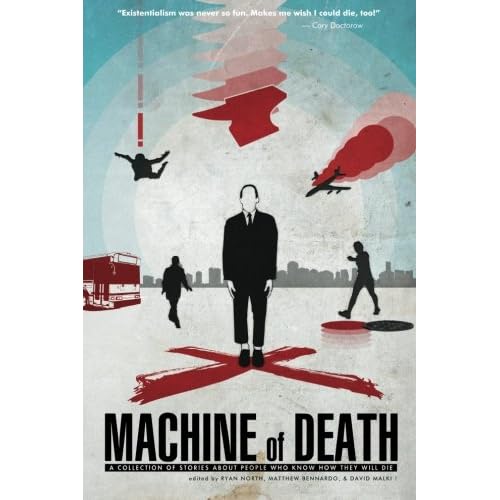
On a lighter note: Machine of Death

Not that the Rolling Stones have destroyed us — I mean, you can’t always get what you want. You know what I’m saying? Brown sugar. I have no idea what that means.  -- Glenn Beck, The Glenn Beck Program, October 27, 2010

On 26 October 2010, the guy who writes the marvelous Dinosaur Comics and a bunch of others self-published a book (because nobody would publish it for them) of short stories based around the idea of a machine which could tell you how you would die. The book is called Machine of Death. They happened to choose October 26 as the publication date without knowing that Glenn Beck’s latest tome of dangerous absurdities with the suitably loony title “Broke: The Plan to Restore Our Trust, Truth and Treasure was to be released on the same day. While it’s nice that Machine of Death pipped Beck’s book in the amazon.com sales rankings on opening day (proof), what’s most wonderful about this little episode is that it so incensed Glenn Beck that he had a wee rant about the book on his widely syndicated radio programme. It’s so gloriously insane, there’s nothing to do but quote it in full:

And I want to tell you that, um…our books are ALWAYS #1. And I find it REALLY fascinating, FASCINATING, that if you go to Amazon.com, Broke is number THREE. And the two books that are ahead of it — one is Keith Richards’ Life, which is getting a TON of — you know, that’s everywhere.
But this is a book about, you know, how he snorted his father’s ashes, after death. (sarcastically) THAT’S cool. This is the SDS [Students for a Democratic Society] book. This is for all of the — this is for [union leader] Andy Stern who’s all, I guarantee you he’s on the phone and has been the last few days, you know, with people like, you know, Bill Ayers going “All right, DUDE! Ah, do you remember when we were rolling around in the mud like animals? Remember that? This guy was smoking ash — you know, smoking his dad, and, and, popping stuff into his veins? Ah, those were the DAYS, man.” And then William Ayers was like, “Whaddaya mean, those were the days? I’m still doin’ that stuff, man!”
So that… “culture of death.” And it’s an escape into the past, of, you know, the Woodstock stuff.
And then, the #1 book — TODAY, at least — is Machine of Death. And it’s a — collected stories about, you know, people who know how they’re gonna die. Haowww!
So you have DEATH — I know it’s called Life, but what a life it is, really! It’s a culture of death! OR, “How do we restore ourselves?”
These are the — this is the left, I think, speaking. This is the left. You want to talk about where we’re headed? We’re headed towards a culture of death. A culture that, um, celebrates the things that have destroyed us. Not that the Rolling Stones have destroyed us — I mean, you can’t always get what you want. You know what I’m saying? Brown sugar. I have no idea what that means.
— Glenn Beck, The Glenn Beck Program, October 27, 2010

This, as if it needs to be said, is the other side of the Angel of Death ad I wrote about the other day; what happens if the font of inchoate hatred which powers the Tea Party movement isn’t carefully channeled through propaganda wizards and filmmakers and spin doctors. Wonderful. Frightening.

L

Class, identity, solidarity and dissent

Recently commenter Tiger Mountain raised the parallel between solidarity with Actor’s Equity regarding The Hobbit and support for the māori party given their coalition with National and sponsorship of some bad legislation. I explained how they’re not equivalent, but leaving aside the main difference of mandate (which the māori party has and AE doesn’t) the wider issue of critical solidarity is an important one, and one which has been raised several times recently. In the wake of The Hobbit fiasco matters of class, identity and solidarity are high in everyone’s minds, and I think in spite of our many differences, we can agree that’s a good thing.

Another contribution to the wider debate is by Eddie at The Standard. For once I find myself agreeing with Eddie’s opening sentence about the māori party, which is:

The problem with any identity-based political movement is it pre-supposes that the common identity of its members surpasses their conflicting class interests.

It’s true, although I would have phrased it as follows:

The problem with any class-based political movement is it pre-supposes that the common class of its members surpasses their conflicting identity interests.

I wrote at length about this dynamic tension at a time when it looked like Labour was going to force Māori to choose between their class identity and their identity as tangata whenua — and how foolish forcing such a choice would be. (It’s still not clear whether Labour has abandoned it, but it at least seems obvious that they don’t have a full-blooded commitment to the blue collars, red necks strategy. But that’s by the way.)

What tends to follow from statements like that one is a series of value judgements about which set of interests ought to take precedence. This can be valuable, but is often tiresome, particularly when those making the pronouncements are “fighting a corner” for only one half of the equation (usually, it must be said, the “class” corner). But Eddie has mostly (not entirely) resisted the urge to do so and focused on the internal dispute within the māori party, and in particular the rather dictatorial stance taken by Tariana Turia regarding opposition to the new Marine & Coastal Area (hereafter MCA) Bill. That’s an important debate and examination of it is valuable, but what’s not really valuable is Eddie’s attempt to frame Turia’s stance as a matter of māori identity v class identity. It’s not. It’s a matter of the tension between moderate and radical factions within the movement; part of the internal debate within Māoridom.

Class is an element of this internal debate, but it is not the only element, and I would argue it is not even the predominant element. I think it’s clear that the conciliatory, collaborative, third-way sort of approach to tino rangatiratanga taken by Turia and Sharples under the guidance of Whatarangi Winiata (and whose work seems likely to be continued by new president Pem Bird is the predominant force. I also think the main reason for the left’s glee at the ascendance of the more radical faction is largely due to the fact that there’s a National government at present (and recall how different things were when the boot was on the other foot from 2005-2008). Those leading the radical charge against the MCA bill — notably Hone Harawira, Annette Sykes and Moana Jackson (whose primer on the bill is required reading) are not Marxists or class advocates so much as they are staunch advocates for tino rangatiratanga, who oppose the bill not so much for reasons based on class, but for reasons based on kaupapa Māori notions of justice. The perspectives of all three are informed by these sorts of traditionally-leftist analyses, but those analyses are certainly not at the fore in this dispute (as they have been in some past disputes). In fact, the strongest (you could say “least refined”) Marxist critiques of the bill advocate for wholesale nationalisation of the F&S, unapologetically trampling on residual property rights held by tangata whenua in favour of collective ownership.

For Eddie’s caricature of the dispute as “identity” v “class” to hold strictly, Turia, Sharples, Flavell and Katene would need to occupy the “authentic” kaupapa Māori position, the legitimate claim of acting in the pure interests of mana motuhake and tino rangatiratanga; while Harawira, Sykes and Jackson (among others) would need to be largely denuded of this “identity” baggage, and be more or less pure class warriors. Neither is true; Harawira, Sykes and Jackson’s critique of the bill isn’t a Marxist critique; they’re arguing that the bill doesn’t serve the imperative of tino rangatiratanga and is therefore not an authentic kaupapa Māori position; an assertion that Sharples has tacitly accepted with his response that the Maori Party must accept compromise. (This is true, of course; I agree with Sharples and Turia as far as that goes. I just disagree that this bill is the issue upon which to compromise so heavily. Because of that, I come down on the side of Harawira, Sykes and Jackson.)

The other misguided thing is how Eddie frames Turia’s insistence that Harawira and others adhere to the party line as some sort of manifestation of Māori over class identity within the party — the quelling of dissent and insistence on loyalty to the leadership elite’s position as a “Māori” way of doing things, opposed to a “Left” way of doing things. This is absurd. The “left” does not automatically stand in defence of dissent or the public airing of heterodox views, much though Eddie (and I) might wish that it should. As I already mentioned, this is shown by Labour’s response to Turia in 2004 and the māori party’s first full term, suspicious at best and hostile at worst. The AE dispute is also an excellent illustration. In that case, the prevailing, “authentic” left position (including that taken by many writers at The Standard, though not — as far as I can recall — by Eddie) was to insist on total public solidarity with the union. In other words, precisely what Turia is insisting upon. I disagreed with this position in AE’s case, and I disagree with it in the māori party’s case. Dissent of this sort (or the imperative of its suppression) is not some innate part of “the left”, nor is it absence a characteristic of “identity politics”. It can exist or not in movements of either type, depending on the merits and specifics. It’s my view that such dissent is the beating heart of a movement, and it is peril to quash it. It is a shame that Turia seems to be making the same error as Helen Clark made regarding this issue in 2004.

But despite these objections, ultimately I agree with Eddie about one other thing: the dispute is really interesting, and the emergence of radical critiques and challenges within the movement is exciting and important. The māori party has a mandate to agree to the MCA act as drafted; after all, according to Edmund Burke’s famous saying, representatives owe their constituents not only their efforts but their judgement on what is just and right and possible. They’re not elected to always take the easy route of political martyrdom, and because of this they may find themselves staring down their constituents. Sometimes they may win. But nowhere are representatives guaranteed that those constituents must not try to stare back. If those who oppose the bill can raise a hÄ«koi in support of their cause, then let them do so, and more strength to their waewae. And let members of the “left” movements, if their enmity to the bill is genuine, rather than a reflexive attack on a National-led government and the māori party orthodoxy which supports it, march alongside them in solidarity. That will be some sort of justice.

L

Squandering Political Opportunity.

The dramatic reversal in the Democrat’s fortunes since November 2008 and their impending defeat in Tuesday’s mid-term elections raises the question of how things went so wrong for them in such as short time. Needless to say, the situation they inherited did not help: a major recession with near record unemployment, bankruptcies and home foreclosures, two wars of occupation, immigration concerns and a deeply polarised electorate. Even so, President Obama had a wave of popular support, the Democrats gained control of Congress, there was a mood for change in the country and the world was sympathetic to the incoming administration. Inherited obstacles notwithstanding, the scene was set for a major shift in direction under consolidated Democratic leadership for years to come.

Instead,  the Democrats have foundered while the GOP-Conservative opposition has rebounded and mounted a formidable challenge that threatens to undermine any hope for significant alterations in US policy direction. The immediate reasons for this Republican resurgence and the pallorous state of the Democratic Party (and the President) in the run-up to the midterms has more to do with the latter’s strategic and tactical errors rather than the former’s platform for governance. The Democrat errors can be enumerated, and will be summarised here.

The first strategic error was to believe that playing a centrist game was going to work. That may have succeeded in years gone by, but with an Republican opposition operating off a script of obstructionism, fear-mongering, personal denigration, xenophobia and cultivation of populist ignorance, it was never going to prosper in today’s political climate. Appeasing a disloyal opposition simply encourages it to become more vicious in its attacks, particularly when it has a partisan media working on its side. Thus the “Kenyan-Muslim-Socialist” and “Pelosi-Reid deficit spender” memes that have reverberated from the moment the Obama administration took office and the Democrats gained control of Congress.

What the President and his party should have done is staked out an explicitly Liberal-Left policy agenda that starkly differentiated their (relatively, given that it is in the US) progressive and pro-active  approaches to the nation’s woes. They were going to be vilified anyway, so the stark differentiation of their platform from the reactionary and failed GOP approach would have clarified the lines of debate in ways that the public could clearly understand, both in terms of where the fault lay with regards to the economic woes of the country as well as in the solution set being offered as an alternative. After all, the US has not had anything remotely close to a “progressive ” policy agenda (and I say this phrase advisedly simply because what passes for progressive in the US is centrist is most other liberal democracies) since the early days of Jimmy Carter’s presidency, and the inherited economic and political conditions were ripe for a bold move away from the failed policies of the Bush 43 administration. That would have been a real agenda for change.

Since the Democrats did not do so, they failed on a second strategic level: they failed to impose the terms of the policy debate and ceded that space to the Fox and talkback-led conservative opposition. Since the latter had little to offer other than invective, this allowed them to turn to the usual diversionary wedge issues in order to gain political traction: ethnic conflict, cultural mores, “socialism,” and taxation. Whatever the administration’s accomplishments (and there have been a number, including nuclear arms reductions with the Russians and the gradual military exit from Iraq), these have been lost amid the din of conservative outrage about sins more imaginary than real.

Thus the Democrats found themselves on the defensive even as they tabled their policy agenda. Since those who dictate the terms of debate are those who win the debate, that meant that they were fighting a losing battle from the get-go.

They compounded these strategic errors at a tactical level. President Obama granted leadership of the legislative agenda to his Congressional counterparts. That was a mistake. The November 2008 elections were about him, not the Congressional leadership. The Democratic take-over of both Congressional majorities was more a result of coat-tailing on the President’s popularity than on the intrinsic merits of Democratic candidates themselves. Obama had a mandate, and he had the political capital surplus to spend; Congress did not, and in fact remained one of the country’s most detested institutions even after his election. Thus, by delegating leadership on the legislative agenda to the likes of Pelosi and Reid (which he likely did in deference to his former senior colleagues), President Obama ceded his bully pulpit to the circus on the Hill. That gave the impression that he was weak and insecure, which in turn gave the Republicans space to go on the attack against “entrenched interests” and all the other failures of the DC-based “liberal elite.”

The tactical error was compounded by the choice of battles to commence with. Instead of focusing on mortgage relief and rescue for desperate homeowners, serious financial market reform, education opportunity enhancement, immigration policy adjustment and re-orientation of US military commitments abroad (among any number of policy areas), the President and Congress chose to address health care first. Although it is obviously needed given the deficiencies of the US private health care system, it was simply too contentious and big a problem to tackle at the onset given the image of Presidential lack of experience and his conciliatory nature. Democratic strategists may have believed that they had to spend the President’s political capital early so as to ensure its passage, but in fact taking that policy issue as the first order of business under Congressional leadership direction hamstrung the Democrats even if they succeeded in passing a watered-down version of health care reform that provides some level of universal benefit to all citizens.

Put another way: the last thing the American public wanted to hear at a time of deep recession and after the financial bail-outs of the banking and automobile industries was that more public money would be spent of health care and that future taxes would reflect that increased level of deficit spending. Compared to the billion dollar figures being bandied about with regard to health care reform, Obama’s “middle class tax cut” (for those earning US$250,000 or less) and tax rebate (amounting to $500 per household) were seen as negligible drops in the bucket and meaningless political sop thrown for opportunistic purposes. For those who had spent a lifetime of paying for private insurance, it also seemed be a case of the indolent, irresponsible and unmotivated being gifted, at taxpayer expense, benefits that they did not deserve. Once the Republican-conservative spin machine got a hold of the issue, the spectre of “socialised” medicine replete with “death panels,” lack of individual choice, limits on care, endless delays and assorted other deficiencies soon dominated public discourse regardless of Democrat attempts to clarify the issue.

The combination of these four factors–failure to head to the Left and carve out a distinct position, ceding the terms of political debate to the opposition, allowing Congress to set the legislative agenda and choosing to reform health care as the first priority–set the stage for the political train wreck that is the Democrat’s midterm election campaign. To that can be added a failure to realise early that Republican operatives are using the Tea Party movement as a Trojan Horse with which to re-gain political momentum and a return to power. Similarly, the White House chose to ignore rather than frontally confront the “Kenyan-Muslim-Socialist”  allegations until they were well entrenched in the public consciousness–a full twenty percent of the US electorate now believe that the President is one, the other, or all three. It is too late to bolt the door against such attacks.

Some argue that the Democrats are playing to lose because the inevitable gridlock that will follow from Tuesday’s vote will allow the President to paint the Republicans as do-nothing obstructionists without a real agenda for solving national problems. That could be true if the Republicans do not win the Senate as well as the House, but if they win both branches then they will have the ability to impose a legislative agenda that among other things will repeal the health care reforms and other aspects of the Democrat’s agenda that have been accomplished so far. That puts the ball in the President’s court because it forces him to exercise his veto in order to salvage his original program, which in turn casts him as the obstructionist during the two years leading into the 2012 presidential election.

The bottom line is that although the Republican-conservative opposition play extremely dirty, the Democrats have no one but themselves to blame for this impending election fiasco. If Clausewitz is correct in his assertion that war is politics by other means, than the reverse is equally true: politics is war by other means. The goal is to win, pure and simple, and that means that if the opponent is going to play dirty then the governing party must understand what it is up against and counter it decisively without equivocating about the niceties involved. Rather than understand this very simple logic, the Democrats returned to form, tried to play nicely to the center, tried to respect the separation of powers mythos that is ingrained in US political folklore, tried to be civil in the face of a disloyal opposition and tried to embark on big policy reforms before the the President and his new Congressional counterparts had fully moved into their offices. For their efforts they are going to get hammered on Tuesday.

Enemies like these

I’m getting used to being vilified by the orthodox Marxist left, such as in the latest round of debate with Chris Trotter and some of his commenters, and to an extent in the response by Scott Hamilton. I don’t mind all that much, but it’s rather aimless. The critique that I’m not orthodox enough, not a proper red; that my sense class consciousness is atrophied — it all misses the point somewhat. I’m not a socialist; never have been. I’m a liberal social democrat, with strong emphasis on the “democrat”.

I’m a trade unionist because of this commitment to democracy. Unions, properly run, are strongly democratic — and their democracy enhances the more usual parliamentary and representative forms which govern our society. The question in the AE case, the matter over which I disagree with Chris and Scott and the orthodox Marxists is: from what does a trade union derive its moral authority? From the democratic mandate granted it by the workers it represents and the extent to which its actions serve their interests, or from its ideological rectitude and adherence to Marxist doctrine? I’d argue that both are necessary; the movement’s activities must be informed by a class analysis, but fundamentally the union exists to enact the wishes of its membership. The job of union organisers and so on is to educate and motivate that membership to commit to class struggle. The argument Chris and Scott are making, as if it’s an irreducible truth of trade unionism, is that the ideological rectitude on its own is enough. The quality or value of a union’s actions must not be assessed or tested against their workers’ stated needs, they say; if whatever a self-declared union and its handful of activist representatives decides to do passes the Marxist sniff-test, then anyone who fails to fall into lockstep behind it is a scab, and mandate be damned. (I’m not sure they even believe this, really; I think there would be some things even the most die-hard socialists would balk at — which would mean we’re simply disagreeing over the merits of AE’s case, which I think is a much more useful argument to have. I posed a hypothetical question to this effect on Bowalley Road this morning, but have received no responses at the time of writing this.)

But falling automatically into lockstep behind a union’s actions without consideration of whether they’re any good, or whether they serve their industry’s stated needs is bad for society, and it’s dangerous for the unions.

In our liberal democratic society, the right for workers to join a trade union and bargain collectively derives from the democratic nature of union movements; the fact that they enact workers’ wishes. This is the basis of the strong and very legitimate democratic Marxist critique of corporatism; that businesses in a democratic society ought to be democratic. It is also one of the chief arguments deployed in unions’ defence, and it is a very good one in a social and political context where the idea of democracy occupies such a powerful symbolic position. Unions do not enjoy any legitimacy by virtue of their ideological rectitude; in fact, their commitment to Marxist ideological doctrine is a considerable disadvantage in terms of their survival. Because of this, the trade union which relinquishes its commitment to democracy also risks relinquishing its claim to legitimacy, and if trade unions as a whole start to cut corners on democracy, then the movement as a whole risks granting anti-union governments a pretext to weaken and outlaw unions on the basis that they don’t actually represent workers’ interests. This is quite apart from the points I made in my last post on this topic, to the effect that non-democratic institutions tend to make bad decisions because they lack robust internal processes for developing and enacting their agendas.

So my overarching problem with Actor’s Equity acting without a mandate is that they risk the legitimacy of the trade union movement at large. (I initially predicted, in comments at the Dim Post, that the fallout would be contained by the wider movement — how wrong I was.) I try never to give my allies a pass for incompetence. Doing so breeds more incompetence. I didn’t give Labour a pass for the Foreshore & Seabed Act and I’m not giving a pass to the māori party as they look to be supporting a similarly expropriative replacement bill. So there’s no way I’m going to overlook the real and serious damage caused to the trade union movement and the cause of workers’ rights by this upstart union who took excessive action without a mandate. They’ve done real and genuine harm to the trade union movement and they’ve made industrial relations — which should have been a Labour’s trump suit — an easy source of tricks for the government. And this at the very time the union movement was beginning to gather strength again! There was an anti-union protest on Labour Day — how much worse do things have to get? Sure, blame the Tory government, or the ‘right-wing media’ or the falsely-conscious running-dogs; and to an extent this is justified. The government must bear sole responsibility for the legislation they’re passing, for instance; the details of that bill cannot be blamed on AE. But AE provided them the cover to pass it without much controversy; and indeed, none of these agencies enjoyed the political and symbolic freedom to unleash the sort of anti-worker tirades they have in recent weeks until AE’s egregious overreach — all with the full blessing of Trotter and Hamilton, almost everyone writing and commenting at The Standard and all those orthodox Marxists who claim to be champions of the worker. With enemies like these, Key and his government — and their ideological fellow-travelers — have no need of friends.

L

Bananazelandia.

There is a small island country in which, in spite of their avowedly private market-oriented ideology, government leaders have directly involved themselves in negotiations with foreign film makers in order to keep production of a film series on the islands. The foreign studio bosses threaten to take their production elsewhere; the famous director–a local boy made good– fumes and blames union organisers for raising production costs (in a film that is mostly based on computer animation and special effects rather than humans acting, in a country where the local currency is less than 80 cents of the US dollar). Although the film production is no long-term investment and will not bring employment stability or trickle down benefits beyond those connected to its production and its purported positive impact on tourism (supposedly because foreign tourists will come to the islands to see a movie set called “Hobbitown” in which gnomes abound), the government agrees to offer the foreign studio bosses NZ$100 million in tax and marketing breaks and to change local employment law so that actors are classified as contractors rather than employees while working on feature films (should the law apply to all actors this could well extend to TV, stage and radio actors working on local productions as well).

Although the film industry is currently an significant source of revenue for the country and has spawned a considerable technological base associated with it, it does not add to the long-term national development growth of the island state. Compared to core national industry, it is much like a diamond in a coal mine–a source of pride and joy but not a basis for long-term prosperity.

All of which is to say: foreign corporate masters involved in an industry that does not add long-term value to a nation’s economy have managed to get the island country’s leaders to bow before them in order to secure short term economic gain for a small local industry with limited direct ancilliary impact and a more hypothetical than concete follow-on revenue generation effect. To do so, not only was money offered to appease the foreign masters. The basic law of the land was changed at their behest as well.

Since the country has been engaged in a long-term debate about changing its national flag and its status relative to its colonial master, perhaps it is time to also consider changing its name.

Bananazelandia. Say it with a Spanish, French or Portuguese accent and it just rolls off the tongue.