Noticeboard: Events for Wellingtonians

Apologies to the rest of the country :)

Monday 18 May 12noon-1pm Cake stall to support Lane Walker Rudkin workers. Outside Westpac House on Willis St. Turn out to show the government and Westpac that the workers deserve to get their redundancy paid out now (plus for the baking of course :)

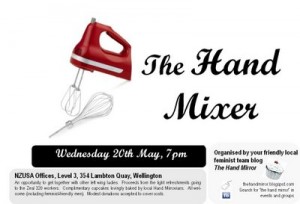
Wednesday 20 May 7pm- Wellington Hand Mixer

hand-mixer-wgtn

Saturday 23 May 7pm- Terrorizing Dissent & community solidarity dinner, New Crossways, Roxburgh St. Curries and movies to support NZ and US activists arrested in terror raids.

Hat tip: The Hand Mirror and Indymedia

Memo to the left: the māori party is not your enemy

Eddie at The Standard has posted the latest in a long line of post-election attacks on the māori party, this time for Tariana Turia criticising Labour’s filibuster against the supercity bill. Leaving aside the fact that I disagree with Tariana’s remarks on the filibuster, this attack is typical in that it picks up some specific decision and applies a convenient ideological misinterpretation of its purpose and likely consequences to prove the existence of a traitorous conspiracy against Māori, the working class, the broader left, freedom, truth, justice, motherhood and apple pie. The Standard is far from being alone in this – others on the left resort to this tactic, and the the original and most egregious example of the form is Chris Trotter’s rabid “Kupapa” attack on Tariana Turia (which doesn’t seem to be online but was helpfully reproduced in full by DPF).

There are good grounds upon which to criticise the māori party, but engaging with the government in good faith and using their independence to progress their agenda, however incompletely, isn’t one. Or to put it another way, it’s reasonable to criticise them on the success or failure of their programme, but not for having a programme at all. Having been caught between the devil and the deep blue sea the māori party decided that the devil needed to be taken at his word for once, and at this point their good relationship with National is all that stands between us and a National/ACT government with a clear mandate to enact precisely the sort of jack-booted majoritarian agenda against which Labour and the Greens are now filibustering. The decision to work with National was a risky one, and if that risk doesn’t pay off they will be sorely punished by their electorate. Labour supporters seem intent on undermining the relationship in order to regain the political allegiance of Māori, and that’s a very big risk. They are also intent on undermining the Greens’ more recent relationship with National, thereby undermining what few progressive options exist for this term. Just because Labour has to sit out the coming three years doesn’t mean others on the left must do so – or even that they should, because every progressive voice involved in the governmental process has a moderating effect on what would otherwise be a very ideologically homogeneous group. The māori party isn’t strictly a left party but it remains a potential ally which Labour alienates at its peril.

If it is to be a credible force, progressive politics in this country should be about more than the kind of `my party, right or wrong’ partisan blindness that these sorts of attacks suggest, and which Trotter’s columns make explicit. The greatest weakness historically faced by progressive movements is their fractiousness in the face of a united opposition movement who are just as strongly factionalised but are prepared to put their individual differences on hold in service of common goals. The greatest strength of progressive movements is their independence and tactical diversity, but this is only of value when that diversity is allowed to stand, rather than being cut down if it does not conform. The left must be as politically inclusive as the society it wishes to create. Howling denunciations and ostracising those who disagree plays directly into the hands of the massed forces opposite.

The impression given by attacks like this is that Labour want three disastrous years, so they’ll have an easier time regaining the treasury benches in 2011. I hope, for all of our sakes, that they have a Plan B.

L

There’s nothing wrong with Melissa Lee being a woman

To borrow from The Sprout for a moment

One of these things is not like the other…

  • Racist
  • Dishonest
  • Stupid
  • Shrill

When Lee is described as any of the first three it is a comment on her behaviour. When people say “shrill” of someone they are simply attacking their gender: they are saying “she sounds like a woman” and semaphoring “that is unacceptable”. Apparently they think MPs shouldn’t sound like women.

Over the last few weeks and days more and more lefties are using “shrill” to describe Lee in blogs posts and comments. What do you mean? Would it be an adjective you would use about a male candidate? Why is it negative? And, more importantly, why is a bad thing to sound like a woman?

P.S. You could consider whether writing “looks slitty eyed” would be acceptable in place of “sounds shrill”

Kissing babies

… or in this case, trying to brainwash them. Ali Ikram’s Political Week in Review includes a clip of John Key at a rally against the Waterview decision telling a wee kid in a stylish National-Blue jersey with ACT-Yellow shoulder pads:

Your favourite colour is blue, ok? Not red. Those people, they’re cold and desperate.

Now, he’s clearly hamming it up for the camera crew and present adults, but this is nasty, divisive stuff. Leave the kids out of it, at least until they’re old enough to know that you can’t always believe what strange men tell you.

This isn’t quite as outrageous as those parents who took their hapless kids along to protest in favour of violence against children, but it’s more evidence against the moderate, inclusive Brand Key.

(Thanks to D for the tipoff.)

L

It ain’t news

Late last year I wrote to the Police asking them for the current status of the recommendations of the Bazley Report (the report of the Commission of Inquiry into Police Conduct). Several months later, after much to-ing and fro-ing and the involvement of the Ombudsmen, I have some documents, some redacted documents, and an out of date status report. I’ve probably got more paperwork about their non-answers, denials, forgetting and delays than I do in answers.

I still don’t know the current status of the implementation of the recommendations, I do know that the out of date status report says they’re still slipping and not making progress at the rate they’d committed to. I also know that if you redact a report, repaginate it but release it with the original table of contents and index it’s really annoying.

So, if Guyon Espiner, Tracey Watkins, TV3 or Rob Hosking would like to run big high profile stories saying it’s a “whitewash” or a “cover up” I’m totally open to that! Plus if any right wing blogs would like  to weigh in and show that it’s all part of a massive conspiracy run by the Labour government that would be grand too.

But seriously, it just ain’t news.

Rational responses to trauma

The Sharks Sex Saga continues. Tania Boyd, the victim’s former workmate says the victim bragged about “bedding” players, and goes on:

It was definitely consensual, absolutely.
She is saying she is still traumatised etcetera, well she wasn’t for five days, or four days at least, after that affair.
I can’t work out what’s happened. Does it take five days for it to sink in?

Tania Boyd, having not been there, can’t know whether consent was given – only if Clare – the victim – implied (to her, after the fact) that consent was given. She can’t know the truth of the situation since the victim may well have implied to her that there was consent when there wasn’t. The question of consent is a complicated one, as well – Clare might well have agreed to some sort of sexual contact, but at each escalation consent needed to be renewed, and according to her it wasn’t. There’s a good discussion of this involving our Anita at The Hand Mirror.

Ms Boyd has begged the question of consent by assuming that a woman having been raped by a lot of powerful, famous men would act in a way which someone who hadn’t had such an experience would consider rational – that is, by immediately calling a halt, or immediately reporting the events, or whatever. But trauma, especially sexual trauma, especially when it involves power imbalance, is a complicated thing, and it does screwy things to one’s sense of reason. Incidents like this can have many responses which might seem rational to the traumatised person at the time but utterly irrational to others. Bragging about the event could be seen as a form of post-purchase rationalisation; that is, Clare may have thought it started off as a good experience and perhaps even initiated it, and tried to mask the fact that it turned nasty (to herself as much as anyone) by bragging about the event. This could also be seen as a call for attention; an invitation to workmates, friends or family to offer support. Cognitive dissonance is a powerful thing.

As to the second statement, if Clare genuinely is traumatised now, then it follows that she was traumatised in the initial four days, it just wasn’t apparent to Tania Boyd, which isn’t really surprising at all given that her response was not one of support but of disgust. Not that that wasn’t a reasonable response – I have no idea how close these people were or what the nature of the workplace was, and bragging about one’s sexual exploits is pretty polarising.

As to the third statement, the answer to Ms Boyd’s question is – yes, these things do take time to sink in. According to a family member with extensive professional experience in this field, the median period of time between incidence and reporting of rape is eighteen and three-quarter years; viewed in this light four days seems very rapid indeed.

This story is being deployed without qualification in apologia for the men in this incident, whereas articles advocating Clare’s perspective are strongly hedged so as to make clear that the facts of the case haven’t really been established. The headline goes beyond euphemistically describing the events as `group sex’ and calls it a `romp’, for goodness’ sakes.

L

Mutual exploitation

marris

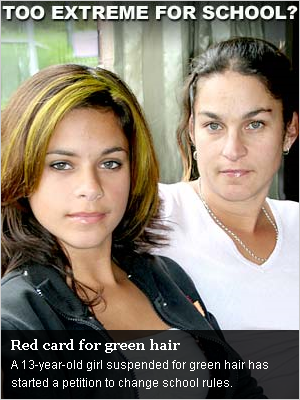
Teenager objects to school uniform policy is hardly news – unless the teenager is as photogenic as young Sheridan Marris, whose green streaks have landed her on the front page of today’s Rodney Times and Stuff’s splash image.

It works – this non-story is (as of the time of writing) on Stuff’s `Most Viewed’ list, along with stories such as “League’s group sex romps to continue”; “Man finds wife and mate on porn DVD” and “Babysitter sentenced for sex with boy”. Sheridan now has excellent publicity for her petition to have the rules at Rodney College changed, while her image has been employed to the same effect as those headlines. That’s how the mutual exploitation model of the media works; but is the payoff worth it?

Update 19:15: On the Stuff front page, the headshot of `world’s hottest woman’ Olivia Wilde is now positioned right next to the similarly-composed headshot of 13 year-old Marris.

wilde-marris
Classy.

L

How well did the media do on the Napier siege?

Ethical Martini asked the question on Sunday. Out of largely professional interest I watched, read and listened to the coverage on the two main TV newses, National Radio, Stuff, the Herald online and their various dead-tree editions from Thursday to Monday so perhaps I’m too close to it, but I’ve been pondering the question since, unsure how to answer because it comes down to one’s assumptions about what the media is supposed to do in such a case. That’s a tricky question.

If it’s supposed to maximise value for its shareholders, then it sure as hell did that, with garish wall-to-wall coverage and plenty of breathless speculation, really hitting the spectacle out of the park in such a way as to ensure that the name of Jan Molenaar will long be remembered as shorthand for `paranoid survivalist with guns, dope and death-wish’; our own little Ruby Ridge (but without all that annoying moral/ethical/legal equivocation).

If it’s supposed to perform a civil defence or public order function, keeping those in immediate need of information informed for the purpose of ensuring their safety, security, peace of mind, etc, then I would have thought they did a pretty decent job – from Wellington, I thought I had a pretty clear picture of what was going on, despite not ever having been to the place in question or in such a situation. Comments from those in the local area, however, are mixed on this count – and those who know Napier express some frustration at the constant mangling of street names, landmarks, etc.

If it’s supposed to be keeping the wider public informed on a matter of national significance, then I think the media did an exceptional job of keeping everyone engaged and updated with massive amounts of information, although with the proviso that much of that information was speculative at best.

If it’s supposed to act as a communication medium from authority to gunman in the sense of megaphone diplomacy, then I think it failed miserably. Although this was largely down to police command not using it in such a way, the media also framed coverage of Molenaar in the third person and spoke to his family members in othering ways, hardly making it possible to reach out to him. I think the first broadcast message I heard which addressed him directly was on Friday night.

If it’s supposed to act as a balm for a shocked nation, then I think it did a pretty good job of that as well, bolstering public confidence in the Police by portraying them as calm and disciplined rather than vengeful and reactive, and local businesses, charities, schools, Civil Defence and local government as united in solidarity, working well together for the public good, as we might hope they would in what I hope it isn’t too churlish to term `a proper emergency’.

If it’s supposed to tell us who to cheer for and who to boo at, once again it did a cracking job. You know you’re dealing with a real villain when all the people who can’t go home for their own safety are classified as `victims’ and even the people who make cups of tea for them are `heroes’.

If it’s supposed to stimulate and inform public debate on the wider political and social issues which are germane to the case – drug law, gun law, alienation, the role of the coercive arm of the state in private affairs, police doctrine and posture, the complexities of entrenched tactical operations – then it gets a bit more complicated.

On the one hand, I’m inclined to think it did an execrable job. If I may cram a whole lot of mixed metaphors in here: the lobby groups, armchair experts and those with an axe to grind on such matters have played the media like a fiddle, and the media has tuned itself up and rosined the bow to allow it. We’re going to get an awful lot of heat and precious little light. Instantly we have people calling for more guns, less guns, more guns but only for some people, guns to be licensed like cars rather than owners being licensed, the absurd notion I heard on NatRad this morning that all privately-owned firearms should be stored at a central, secure facility and be checked out and back in again. The battle of the slogans is well underway – `if you’ve nothing to hide you’ve nothing to fear’ counterposed against `when you outlaw guns, only the outlaws have guns’, for a start. And then there’s the debate about marijuana, with the frankly idiotic counterfactual that if the police didn’t prosecute minor drug crime then they wouldn’t have been in this sorry mess at all – possibly true, but only until something else brought the red mist down on Jan Molenaar.

On the other hand, the free flow of information around this case – the fact that every idiot on Your Views and talkback radio gets to listen to the so-called experts and decide what to think – should mean in principle that we have the basis for a good fact-based debate. Is not free expression via the media, with everyone putting their arguments up to be judged in a market of information, the most efficient means of determining which views have merit and which are bogus? If not, by what other means should we determine the relative merits of conflicting views and arguments?

I’m still no closer to an overall answer to the question Martin posed. I think it’s pollyanna-ish to say that the coverage did what it needed to do because everyone got a say, we all got our little reality TV fix and all the experts got a chance to climb up on their hind legs and argue the world to rights, but I think it’s curmudgeonly to decry the whole affair as a lurid farce.

What do you reckon?

L

Sacrificing families for political gains

The section 59 debate, for the first time in a long time, lifted the lid on the New Zealand “family”. What we found was a fight waiting to happen: the core of the debate was not smacking, it was the nature and role of the family. How should we balance the competing interests of the family, its individual members, the community that surrounds it, and the state which we rely on to intervene when necessary and butt out the rest of the time?

How the 2008-2010 government would address that gulf fascinated me. It seems so intractable, yet addressing it is so necessary. National have chosen Christine Rankin, they have chosen to make the Families Commission incapable of progressing this.

It’s not Rankin’s support of the pro-smacking referendum, it’s not her links to the conservative Christian lobby, nor her links to the crime and punishment lobby, the anti-transparency brigade, or the right wing political donors. It’s her track record of divisiveness, or polarising issues and debates.

By choosing Rankin National may have discharged their debts or paid back their supporters, but in the process they’ve sacrificed progress, safety, and growth for our families.

[Ari and Julie have both written good pieces on Rankin’s unsuitability for the role separate from her divisiveness]