I’ve been very busy again this past week, and so the list of things I want to write about copiously exceeds my ability to write about them. My promised post about internecine disputes is in very early draft form but I’ll try and get it finished soon. I still have a post planned looking at the wider implications of the foreshore and seabed review, but I think that’ll have to wait until after I’ve painted the roof.
I also wanted to write a lot about the final outcome of the h debate, but find that my views have already been pretty well encapsulated by Andrew Geddis and Idiot/Savant. You should also read Scott Hamilton’s latest on the wider topic of PÄkehÄ separatism.
Given that the decision declares both ‘Wanganui’ and ‘Whanganui’ correct, but mandates crown usage of ‘Whanganui’, there’s as clear an implicit statement as can be that the latter is more correct than the former. This has been clearly understood by TVNZ and Radio NZ, who have adopted the latter usage as a matter of editorial policy. They are owned by the crown, after all, and both just happen to be in direct competition with Laws and his media employer. Permitting both spellings but making this declaration as to primacy was a move as shrewd as it was elegant by Maurice Williamson — similarly to John Key’s decision to permit the flying of a MÄori flag if only MÄori could agree on one. Michael Laws, Tariana Turia and Ken Mair have all claimed victory, so everyone with an actual stake is nominally happy. The Standardistas and the KBR are furious, which is a pretty good sign. It obviates the strongest symbolic position occupied by Laws, the idea that Wellington is coercing Wanganui into doing its PC bidding. Wellington need not — the rest of the country will do that, because the use of the no-h word will be an identity marker, a statement, like a badge; not quite “Yep, I’m a redneck” but something approaching it. The thing is that Laws and his rump of greying die-hards do not simply face a disorganised and discredited bunch of radical natives; they find themselves standing against the inexorable tide of civil society and its evolution, a youthful and browning population for whom biculturalism is the norm and separatism stopped being cool a generation ago (if it ever was).
Who knew that all Michael Laws wanted for his cause was an emasculating partial endorsement and a prolonged death sentence? He could have saved everyone (and his own reputation) a great deal of trouble by making this plain at the beginning. In other circumstances, I would be angry about everyone having been taken for a ride — but as it stands, I’m mostly just quietly pleased that civil society’s tendency toward self-correction will be left to do its thing.
Is it me or is there a lot of simmering anger percolating in NZ? A church puts an “edgy” advert on a billboard in order to promote thought on the meaning of Christmas and it gets attacked  and vandalized four times while bible-bashers and fundies go ballistic in the blogosphere defending the attackers and condemning the perceived insult. The government allows a (not “the”) Maori flag to fly alongside the conventional national (post-colonial) standard, and people go bat crazy over the”affront.” Words and phrases like “traitor” and “real patriot” get thrown about, and even otherwise civilized commentators set to ranting in invective-laden terms. Meanwhile news reports speak of increased violence throughout the land, many times within families and whanau , but not exclusively among the poor and disadvantaged. Contrary to NZ’s supposed reputation, tales of corruption high and low are now almost daily occurrences (be it nepotistic or corporate). Were one to just read the press, racial and ethnic conflict is the norm (understanding that press coverage does not lead but responds to public perception). Drink driving blitzes nab dozens of people on the piss (in spite of blanket coverage caution messages and a host of cheap or free driver services), parties degenerate into riots for trifling reasons, bullies continue to thrive, acts of senseless stupidity of various sorts are carried out on the streets and roads by quick to rage groups and individuals, and the “me-first, the hell with the rest” attitude permeates social discourse and interaction–all during what is supposed to be the season of peace.
What is up with that? New Zealand may have problems, but it it is a country with no real enemies, a benign climate, spectacular scenery and ample natural resources, an egalitarian social culture, and a traditionally  “can-do” attitude and spirit of volunteerism. It has no existential threats, a history of (pretty) good ethnic relations, a preference for tolerance, compassion and understanding, and, perhaps until recently, a record of good governance and political transparency. All of these traits are considered to be the exact requirements for peace and social stability, and in fact are considered to be the best insurance against social disharmony and anger.Â
And yet, NZ is exhibiting signs of a polarised society stretched at the seams. This is more than annoyance at “dole bludgers,” ” troughers” and assorted easy to scapegoat miscreants and “others.” It does not seem to be entirely related to unemployment rates, arguments about climate change, or concerns about immigration. It is more than being fed up about political correctness or neoliberalism (although both may contribute to the syndrome). Instead, this appears to be an increasingly generalised symptom of a pervasive malaise deep at the core of Kiwi society. In fact, I may be alarmist but I see this as a society inching towards the end of its civilized rope. I have my own opinion as to what caused the decline (and have previously posted on it), but this recent spate of visceral anger, even if cloaked in virtuous or self-righteous terms, speaks to something darker in the NZ psyche.
So I ask again: am I crazy or is there something seriously wrong at the core of NZ society, and if so, where does it come from?
It’s impossible to ignore the fact that every single one of those MÄori I’ve heard speaking out against the tino rangatiratanga flag has a tribal axe to grind. Shane Jones, Kingi Taurua, Pita Paraone, Winston Peters — they’re all from the iwi of that group of rangatira who established the United Tribes of New Zealand confederation under Busby in 1835, in the Tai Tokerau. They, naturally enough, want the United Tribes flag flown instead of the one which represents the aspirations of wider MÄori. The root of this claim is the belief among those groups that theirs was the ‘state of origin’, as it were — the first actual state in these lands. That’s a complex and disputed claim but regardless, the belief abides, and this sense of primacy is no small part of the reason that so many of this country’s MÄori statesmen and women, great thinkers and inspirational leaders, come from the tail of Te Ika a Maui.
They say there’s an ulterior motive in the flying of the tino rangatiratanga flag on the part of the mÄori party, who have adopted it as their own, and I accept they have a case. They also have a case to argue that the United Tribes flag should be flown — especially at Waitangi Marae (Te Tii), where the choice belongs solely to mana whenua. But let’s not pretend there’s no ulterior political motive on their part: they have every reason to decry the flag as ‘separatist’ and ‘divisive’ in order to fly their own. Not only that, but the motive is no more unanimous among NgÄpuhi than among other MÄori — the tino rangatiratanga flag is supported (obviously) by Hone Harawira, and was designed by Hiraina Marsden, the daughter of the Rev. MÄori Marsden, one of the most important philosophical figures of that iwi, and a mentor to Shane Jones and many others. So the political motives in play are much more complex than they appear.
As for Winston Peters’ objection that the tino rangatiratanga flag is ‘political’ — was there ever a more ridiculous assertion? The whole purpose of such a flag is to symbolise and propagandise political identity, to provide it focus and expression. The United Tribes flag is no less political than the tino rangatiratanga flag — and so it becomes a matter of picking which symbolism is more appropriate.
On the one hand we have a long historical pedigree, and a flag which represents the early unity of the NZ proto-state and the formal beginnings of collaboration between tangata whenua and tau iwi, but which actually represents only a small subset of the MÄori population and whose political cause (to establish a client state sympathetic to the English in their manouvres against the French) was superceded by the Treaty of Waitangi only a few years after its establishment.
On the other, we have a relatively new flag, one whose symbolism and history is exclusively MÄori, rather than being part of a wider game between colonial powers; a modern flag representing modern, rather than historical aspirations but which has, to an extent, been hijacked by the radical movement.
For me, it comes down to the process enacted by the government: wisely, instead of deciding by fiat, John Key instructed MÄori to decide, and decide they did, with more than 80% of the 1200 submissions in favour of the tino rangatiratanga flag. This is not to side with majoritarianism, but to say that choosing another flag would have been manifest politicking. Better from Key’s perspective to devolve the decision and allow an age-old struggle to re-emerge: he looks statesmanlike, and both his erstwhile political friends and his enemies get bogged down in internecine fighting. I had hoped it wouldn’t happen; and it might yet prove minor. But the issue won’t go away — nor should it.
There is a woman, a victim of rape, who knows that every time any acquaintance  looks at her they know what her husband did to her. When she walks through the supermarket every shopper may be looking at her and thinking about her terror, fear and shame.
In a healthy society she would have no reason to feel ashamed, but ours is not a healthy society: most victims of rape do feel shame, embarrassment and humiliation.
When a blogger decided to court fame and media attention by making a political point about name suppression he not only outed the man whose name was suppressed, he also revealed the victim’s identity – he revictimised a woman who has already suffered enough.
[The blogger’s name has been removed as suggested in a comment as the name of the blogger, in turn, leads toward the woman’s identity]
The recent debates engaged here and elsewhere on the “proper” course to be taken by NZ Left/progressive politics has given me pause to think about the larger issue of Left/progressive praxis in a country such as this. I am on record as defending the class line-first approach, whereas Lew has quite eloquently expressed the primacy of identity politics (and, it should be noted, I am not as hostile to Lew’s line of thought as some of his other critics). But I do not think that the debate covered the entirety of the subject of Left/progressive praxis, and in fact may have detracted from it. Â Thus what follows is a sketch of my view of how Left/progressive praxis needs to be pursued in Aotearoa.
First, let’s set the stage. NZ is dominated by market-driven ideologies. In its social, cultural, political and economic expression, capitalism is the primary and undisputed organising principle. Counter-ideological resistance can be found in all of these domains, but the supremacy of capitalism as a social construct is clear. Even so, when compared with the 1990s, this supremacy is not as unshakable. The global financial crisis, corporate greed, predatory lending, financial market manipulation and fraud, increasing income disparities, assorted mendacious acts of venality and corruption have all contributed to a decline in the ideological legitimacy of market-driven logics, including those espoused by its political representatives. That provides a window of opportunity for Left/progressives, even if their traditional sources of strength in the union movement are no longer capable of exercising decisive leadership of a counter-hegemonic sort. Hence the need for a different type of praxis.
The Left/progressive cause needs to be organized into two branches: a political branch and a social movement branch. In turn, each branch needs to be divided into militant and moderate wings. The political branch would encompass Left/progressive political parties such as the Greens and the Alliance as well as fringe parties willing to cooperate in a common venture such as the Communists, Socialist Workers and the like. Because Labour is no longer a genuine Left Party, its inclusion is problematic, but it is possible that its leftist cadres could be invited to participate. The idea is to form a genuine Left/progressive political coalition that serves as a political pressure group on the mainstream parties while offering real counter-hegemonic alternatives to voters in selected districts. One can envision a Left coalition banner running slates in targeted districts with strong subaltern/subordinate group demographics. The idea is to present a Left/progressive alternative to the status quo that, at a minimum, pressures Labour out of its complacency and conformity with the pro-market status quo. At a maximum it will siphon disaffected voters away from Labour and into a genuine Left/progressive political alternative. This may be hard to do, but it is not impossible if properly conceived and executed.
In parallel, the social movement branch should encompass the now somewhat disparate assortment of environmental, union, animal welfare, indigenous rights, GBLT rights and other advocacy groups under the banner of common cause and reciprocal solidarity. The unifying pledge would be that of mutual support and advocacy. It goes without saying that the political and social movement branches will have areas of overlap in the guise of individuals with feet in each camp, but their strategic goals will be different, as will be their tactics. But each would support the other: the social movement branch would endorse and actively Left/progressive candidates and policy platforms; the Left/progressive political branch would support the social movement causes. This mutual commitment would be the basis for formal ties between and within each branch.Â
That brings up the moderate-militant wings. Each branch needs to have  both moderate and militant cadres if they are to be effective in pursuing a common agenda. The moderate wings are those that appear “reasonable” to bourgeois society, and who engage their politics within the institutional confines of the bourgeois state. The militant wings, on the other hand, are committed to direct action that transgresses established institutional boundaries and mores. Since this involves transgressing against criminal as civil law (even if non-violent civil disobedience such as the Plowshares action against the Echelon listening post in Blenheim), the use of small group/cell tactics rooted in autonomous decentralized acts and operational secrecy are paramount for survival and success.  The need for militancy is simple: it is a hedge against co-optation. Political and social militants keep their moderate brethren honest, which in turn allows the moderate wings to exploit the political space opened by militant direct action to pursue an incremental gains agenda in both spheres.
For this type of praxis to work, the key issues are those of organization and contingent compromise. Endongeonously, all interested parties in each branch will have to be capable of organizational unity, which means that principle/agent issues need to resolved in pursuit of coherent collective action, presumably in ways that forestall the emergence of the iron law of oligarchy that permits vanguardist tendencies to predominate. There are enough grassroots leaders and dedicated organisers already operating in the NZ milieu. The question is whether they can put aside their personal positions and parochial concerns in the interest of broader gains. That means that exogenously, these actors will need to find common ground for a unified platform that allows for reciprocal solidarity without the all-to-common ideological and tactical hair-splitting that is the bane of Left/progressive politics. The compromise between the political and social movement branches is contingent on their mutual support, but is designed to prevent co-optation of one by the other (such as what has traditionally tended to occur). If that can be achieved, then strategic unity between the political and social movement branches is possible, with strategic unity and tactical autonomy being the operational mantra for both moderate and militant wings.
On the face of things, all of this may sound quite simplistic and naive. After all it is only a sketch, and far be it for me, a non-citizen pontificating from my perch in authoritarian Asia, to tell Kiwi Left/progressives how to conduct their affairs. It may, in fact, be impossible to achieve given the disparate interests and personalities that would come into play, to say nothing of the resistance to such a project by the political status quo, Labour in particular. But the failures of Left/progressive praxis in NZ can be attributed just as much to its ideological and organizational disunity as it can be to the ideological supremacy and better organization of the Right. Moreover, Labour is in a position where it can no longer ignore groups that it has traditionally taken for granted, to include more militant union cadres who are fed up with being treated as corporate lapdogs and political eunuchs. Thus the time is ripe for a re-evaluation of Left/progressive strategy and action, particularly since the NACTIONAL agenda is now being fully exposed in all of its profit-driven, privatization-obsessed glory. Perhaps then, it is a time for a series of Left/Progressive summits in which all interested parties can attempt to forge a common strategy of action. It may take time to hash out such a platform, but the political rewards of such an effort could be significant. After all, la union hace la fuerza: with unity comes strength.
My first “real” job involved creating a Latin American Studies program for US military and civilian intelligence officers at a military post-graduate institution. One of the factors that contributed to my being hired was that I had familiarity with how Latin American guerrilla organizations fight. When asked at the job interview about how to “counter” them, I noted that the very term “counter-insurgency’ was self-defeating on two levels, one semantic and one practical. That impressed and surprised my  interlocutors, who then allowed me to teach my interpretation of counter-insurgency (COIN) theory to my Latin-America bound students. In return, I got to learn and participate in their business. But that was two decades ago. Since the doctrine of counter-insurgency has resurfaced and been applied in recent years to Afghanistan and Iraq, and is seemingly back in vogue and unchallenged in those settings, I thought I would reprise my argument against its use.
“Insurgency” refers to counter-hegemonic or anti-status quo groups that use armed struggle as the means to the end of political victory. It is not a form of warfare per se, but instead a term used to describe the nature of a particular guerrilla (or irregular or unconventional) group using irregular warfare as the means to their end. Thus one does not “counter” insurgency by fighting, but by ideological means. Hence “counter-insurgency” properly applies to non-coercive measures employed by political status quo regimes to thwart the ideological appeal of (most often nationalist) guerrillas. The term is therefore misused when applied to the kinetic part of asymmetric warfare, which more properly can be termed “counter-guerrilla” or irregular warfare operations.
But even then the practical problem remains: by defining kinetic operations as “counter-guerrilla” or (mistakenly) “counter-insurgency,” Â the conventional fighter begins on the back foot. Anyone familiar with guerrilla warfare knows that you do not “counter” it, or merely respond to guerrilla operations. That is because such an approach gives the guerrilla forces the initiative as to how and when to stage their operations. Such a “countering” strategy inevitably allows guerrillas to remain on the offensive and dictate the timing, nature and tempo of armed confrontations. It is, therefore , often a self-defeating strategy doomed from the onset.
In order to be successful, counter-guerrilla operations need to be offensive, irregular and consequently symmetrical to those of the guerrillas themselves. The idea is to fight guerrillas on their own terms but with all of the capabilities afforded to conventional militaries (e.g. air cover, precision-munitions, satellite guidance, signals and technical intelligence). That involves small group operations–such as what the NZSAS is trained to do–acting with excellent and precise tactical intelligence to strike preemptively at guerrilla targets, focusing on leadership and command, control, communications and intelligence (C3I) structures. Rather than large group operations that rely on massed force and kinetic friction, the irregular approach emphasizes fluidity and maneuver. In other words, it operates the way guerrillas do.
Therein lies the problem with Western counter-insurgency strategy. It confuses the nature of a guerrilla grievance with a type of irregular warfare, and in doing so legitimizes the grievance in contexts in which the status quo regime is unpopular. In such contexts “insurgents” are awarded popular appeal as symbols of resistance to the unpopular regime and foreign oppressors, thereby undercutting any “hearts and minds” efforts undertaken by the latter. This in turn undermines efforts to obtain precise, reliable and timely intelligence on guerrilla targets, which is a function of the rapport between the civilian population and various armed actors. Instead, the intelligence flow preferably goes to the guerrillas, and what passes for intelligence to the conventional actor is often disinformation.
To that can be added the mindset created by the “countering” posture of irregular operations. Such a strategic posture condemns the countering party to react to the actions of the guerrillas, which although leading to tactical success on occasion, denies the countering side the possibility of strategic victory. So long as guerrillas can avoid confrontations with massed force, they survive to fight another day, another week, and years thereafter. “Countering” strategies also have the drawback of not being fine-tuned to the cultural norms and fighting styles of irregular opponents. Although much has been written about the different approaches to conventional warfare adopted by different nations (such as American, Arab, British, Chinese, Israeli and Russian fighting styles), much less attention has been paid to different unconventional or irregular fighting styles. Not all guerrillas copy the Guevara, Guillen, Marighella or Mao  playbook when undertaking their campaigns, and many hybrid versions of guerrilla warfare exist that are rooted as much in local armed  custom as they are historical examples. A “countering” strategy is less capable of embracing that fact.
I have refrained here from taking a position on the worthiness of the cause (pro or anti-guerrilla) in a given case. Readers can choose sides in any conflict as they deem fit. What I am doing here is briefly explaining why Western counter-insurgency strategy has elementary problems that seriously impede the possibility of success in any context in which its adversaries are well organised and highly motivated, particularly if the latter adopt a guerrilla strategy of fighting prolonged wars of attrition on their home soil against foreign forces that are not as committed to the long-term struggle (or who do not have the support of their home populations to do so).
As the old saying goes, in asymmetric wars, strategic stalemates are victories for the militarily “weaker” side. However, if the militarily “superior” side bases its campaign on erroneous assumptions and faulty strategic logics, then more than a stalemate is within the grasp of the ostensibly “weaker” side. After all, asymmetry in warfare works both ways.
Â
PS: I have updated the post. For those interested, here is a link to US counter-insurgency doctrine. The Spec Ops community understands the problem, but as a minority component of a large conventional military, they ultimately are not determinants of the solutions offered.
Some of you will know that I take perverse joy in waking up to Geoff Robinson and Sean Plunket each morning,* and I regard Sean as one of the country’s best interviewers (and the best hard-news interviewer, though Mary Wilson gives him a fair run some days). Pablo has written about Radio NZ’s treatment of him over his bid to write a column for Metro, and I think it’s fair to say he (Sean) is pretty sore about the whole affair. He does not strike me as one to trifle with, and though I can’t quite put my finger on it, I think something very subtle is going on with Sean Plunket’s new blog: Sean Makes Crafts.
Welcome to the blogosphere, Sean. We watch with interest.
Update: This post was a response to an attack on me by Chris Trotter. Since it was published, Chris has graciously apologised for writing it, and for the general bad blood between us. He has deleted the post from Bowalley Road, and I give him my hearty thanks for the reconsideration.
I have also been culpable in this rather nasty exchange, which stretches back almost a year. For that part in it I, too, must apologise. While I retain strenuous objections to Chris’ political positions (as I’m sure he does to mine) these needn’t have become personalised, and are better discussed calmly as befits reasonable adults. While they may yet prove intractable, it should be possible for people in a free society to hold irreconcilable differences and yet remain civil. Much heat, and too little light, has emerged from this meeting of political minds, but I think there is potential for future engagement between Chris and I based on some sort of goodwill and tolerance rather than upon vituperation and political posturing, and I will do what I can to cultivate it.
While Chris has deleted his post, I do not believe in tampering with the historical record in that way. While I might regret things I’ve said, I won’t pretend I didn’t say them. And so the content of my response remains below the fold. It should be read with the subsequent context and this apology (and pledge to more constructive engagement in the future) very firmly in mind. In fact, the most worthwhile thing by far to emerge from the dispute is an unexpectedly useful discussion led by commenter “Ag” on the nature of class consciousness and electorate rationality: I commend that discussion, rather than the post from which it emerged, to the KP readership.
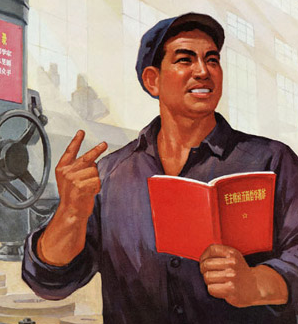
To those who stick up for their identity, socialism sticks up two fingers!
In the coming years, core tenets of socialist and indigenist faith will be tested. Labour, with its recently-adopted ‘blue collars, red necks’ strategy, has struck out along a path which requires a large slice of its core constituency — MÄori — to search their political souls and choose between the renewed Marxist orthodoxy which privileges class above all else; and the progressive social movements developed over the past three or four decades which have produced a society tolerant enough to permit their unprecedented cultural renaissance.
The strategy indicated by Phil Goff’s speech appears to be substantially based on the simple calculus, most forthrightly argued by Chris Trotter, that ‘social liberals’ are fewer in number than ‘social conservatives’ among the proletariat, and therefore an appeal to ‘social conservatism’ will deliver more votes than the equivalent appeal to ‘social liberalism’. This is couched as a return to the old values of the democratic socialist movement — class struggle, and anything else is a distraction. But because the new political strategy is founded upon an attack on MÄori, it requires that working class solidarity wins out over indigenous solidarity and the desire for tino rangatiratanga in a head-to-head battle. MÄori must choose to identify as proletarians first and tangata whenua second. Similarly, the mÄori party’s alignment with National and subsequent intransigence on issues such as the Emissions Trading Scheme asks MÄori to privilege their indigeneity over material concerns.
An article of faith of both socialist and indigenist movements is that their referent of political identity trumps others: that all proletarians are proletarians first, and that all indigenous people are indigenous people above all else. In the coming years, unless Labour loses its bottle and recants, we will see a rare comparison as to which is genuinely the stronger. Much of the debate which has raged over this issue, and I concede some of my own contributions in this, has been people stating what they hope will occur as if it surely will. For this reason the test itself is a valuable thing, because it provides an actual observable data point upon which the argument can turn.
A spontaneous interlude: I write this on the train into Wellington, in a carriage full of squirming, shouting, eight and nine year-olds on a school trip to the city. In a (rare) moment of relative calm, a few bars of song carried from the next carriage, and the tune was taken up enthusiastically by the — mostly PÄkehÄ — kids in my carriage.
TÅ«tira mai ngÄ iwi (aue!)
TÄtou, tÄtou e.
(In English:
Line up together, people
All of us, all of us.)
Read into this what you wish; one of life’s little rorschach tests.**
Clearly, I don’t believe MÄori will abandon the hard-won fruits of their renaissance for a socialist pragma which lumps them and their needs in with everyone else of a certain social class, which in the long term would erase the distinction between tangata whenua and tangata Tiriti. This distinction will fade with time, but that time is not yet come. For this reason I believe the strategy is folly at a practical level. Add to which, the appeal to more conservative social values was always going to be strong among MÄori and Pasifika voters, so the left and right hands (as it were) of the socialist conservative resurgence seem unaware of what the other is doing: with the left hand, it beckons them closer, and with the right it pushes them away.
My main objection to the ‘blue collars, red necks’ strategy is not practical — although that would be a sufficient cause for opposing it. The main reason is because of principle, and this question turns on an assessment of the left in politics. Trotter and other old-school socialists (and presumably Pagani and Goff and the current leadership of the Labour party) believe that the left has been hijacked over the past generation by non-materialist concerns and has lost its way as a consequence. I believe that the wider social concern with non-material matters has saved socialism from its own dogma.
Largely discredited as an economic system and its legacy irretrievably tarnished by the catastrophic failure of practically every implementation, socialist-aligned parties on the left have been forced to diversify from a strict focus on what’s in the pockets of the proletariat to what’s in their heads — what they care about and who they are, their identity beyond being ‘the proletariat’. In doing so these movements have embraced liberalism, social equality movements, and environmentalism, and the resulting blend, termed ‘progressivism’ has become part of the political orthodoxy, such that the political right must now pay at least some mind to these considerations if it is to remain viable. This broadening, and the progressive movement’s redefinition of what is right by its general and gradual rejection of racism, sexism, sexual and religious discrimination, among others, has been hugely beneficial to society. For reasons of principle, it should not be discarded out of cynical political expedience.
Furthermore, maintenance of the social liberal programme has strategic, pragmatic value. It has enabled left political movements to broaden their support base and engage with groups often marginalised from politics, breaking the previously zero-sum rules. The modern Labour party has built its political church upon this rock of progressive inclusion, broadening its support base by forming strategic alliances with RÄtana from the time of the First Labour Government and less formally with the KÄ«ngitanga and other MÄori groups, to which the party owes a great deal of its political success. The progressive programme has broadened to include other groups historically marginalised by the conservative establishment. For Labour to shun its progressive history and return to some idealised socialist pragma of old by burning a century of goodwill in order to make cheap electoral gains by emulating their political opponents is the same transgression many on the economic left have repeatedly levelled against the mÄori party, and with some justification: selling out one’s principles for the sake of political expedience is a betrayal, and betrayals do not go unpunished. In this case, the betrayal is against the young, who will rapidly overtake the old socialist guard as the party’s future; and MÄori, who will rapidly overtake the old PÄkehÄ majority in this country’s future. The socialists might applaud, but Labour represents more than just the socialists, and it must continue to do so if it is to remain relevant.
So, for my analysis, the ‘blue collars, red necks’ strategy fails at the tactical level, because it asks MÄori to choose their economic identity over their cultural identity; it fails at the level of principle, because it represents a resort to regressive politics, a movement away from what is ‘right’ to what is expedient; and it fails at the level of strategy, because by turning its back on progressivism the party publicly abandons its constituents, and particularly those who represent the future of NZ’s politics, who have grown up with the Labour party as a progressive movement. It is triply flawed, and the only silver lining from the whole sorry affair is that (again, if Goff and Pagani hold their nerve) we will see the dogmatic adherence to class tested and, hopefully once and for all, bested.
L
* Of course, Goff claims it is no such thing. But Trotter sees that it is and is thrilled, and John Pagani’s endorsement of Trotter’s analysis reveals rather more about the strategic direction than a politician’s public assurance.
** I see this as an expression of how normalised MÄori-ness is among young people, and as much as can be said from the actions of nine-year-olds, an indicator of NZ’s political future.
I do not mean to be unkind, but does it not seem like John Key is gallivanting around the world looking to stuff his nose into major leader’s derrieres without substantive returns for his efforts? He claims to be exercising “leadership” and showing the flag at various and sundry conferences (recently APEC, now Copenhagen), but in reality he is an incidental player looking for a photo op. At the APEC meeting he did not have a single bilateral meeting with anyone of import–his breakfast handshake with Obama does not count. Heck, even other small players did not give him the time of day, and that much vaunted agreement to continue discussions about enlarging the Transpacific Partnership (TPP) was no more than a US delaying move while it sorts out trade issues with bigger regional players such as Malaysia and Indonesia (even if the P4 agreement involving Chile, NZ, Brunei and Singapore is used a possible model for the larger deal). In reality, NZ got nothing from the APEC meetings (the bilateral trade deals announced during the time of the meetings had already been finalised and the occasion was merely used to reveal that fact), and the way advanced economies are feeling the heat (no pun intended) over extending climate change controls in the midst of a global recession as of yet in course, the Copenhagen conference  looks to produce a lot of hot air and little concrete action.
Meanwhile political tensions in NZ are picking up, and in fact are the tip of a growing iceberg of social unrest that has seen recent divisions over race, corruption, social policy and cultural mores all hit the media front pages. Meanwhile Mr. Key burns a few carbon credits and gets his passport stamped every two weeks on his way to “summits” in which he has no real say, while Bill English actually runs government policy direction. As an example, think of the Don Brash’s 2025 recommendations–it was English, not Key who dismissed them as unreasonable, and Key has not voiced an opinion to the contrary (perhaps Mr. Key choose to be charitable to the guy he rolled). In fact, Mr. Key presents himself as Mr. Milquetoast–nary a hard word can be heard emanating from him regardless of the skullduggery happening beneath/over/behind him.
That makes  me wonder whether what we are seeing is a National version of the French system, where there is a figurehead president who does diplomatic work but has no real policy making power, and a PM who does the real business of governing. From the looks of things Mr. Key is National’s president, but it is Mr. English who pulls the strings of his globe-trotting puppet. This may be an unkind thing to say, but the more important question is whether it is untrue.

 I also wanted to write a lot about the final outcome of the h debate, but find that my views have already been pretty well encapsulated by Andrew Geddis and Idiot/Savant. You should also read Scott Hamilton’s latest on the wider topic of PÄkehÄ separatism.
 On the one hand we have a long historical pedigree, and a flag which represents the early unity of the NZ proto-state and the formal beginnings of collaboration between tangata whenua and tau iwi, but which actually represents only a small subset of the MÄori population and whose political cause (to establish a client state sympathetic to the English in their manouvres against the French) was superceded by the Treaty of Waitangi only a few years after its establishment.
  On the other, we have a relatively new flag, one whose symbolism and history is exclusively MÄori, rather than being part of a wider game between colonial powers; a modern flag representing modern, rather than historical aspirations but which has, to an extent, been hijacked by the radical movement.