False mean

idt20070815
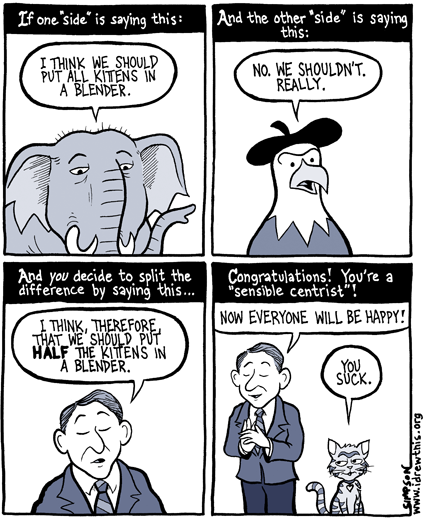
I never get tired of this cartoon. It reminds me what being a Sensible Moderateâ„¢ is not at all about.

The latest proposal for the foreshore and seabed is PC gone mad — put it in the public domain, but not really the public domain per se, and everyone’s happy. Or not unhappy. Hopefully. And if they are, they’re just being unreasonable.

It’s blending half the kittens in order to avoid tackling the complex and painful political and historical problem which the issue represents. It’s the cop-out option which aims to offend nobody, but really only achieves that goal on the surface. It’s like a butchered mihi delivered by someone who’s not really well-meaning but wants to appear so, ignorant of the fact that wairua matters.

This has Peter Dunne’s fingerprints all over it, and he’s the one tying himself in verbal and conceptual knots: “no one owns it but we all own it and so therefore we all have an interest in it”. The unnamed sources are no better, arguing that since there are no rights, “everyone’s rights are protected.” You couldn’t make this up.

The trouble is that Māori — and the māori party in particular — don’t just want everyone to get along; they want their historical claims to the takutai moana tested and upheld, or negotiated to mutual satisfaction. This will necessarily include some positive determination as to the ownership status of those stretches of land and sea, from which will derive other rights — to development, to exercise kaitiakitanga, and so on — which can and should be negotiated on the merits of the original determination. This proposal commits a similar legal fallacy to the Foreshore and Seabed Act, in reversing the legal test as to customary title. Prior to the FSA all land was presumed to be in customary ownership unless alienation could be proven — the FSA reversed this, forcing claimants to prove that their rights to the foreshore and seabed had not been alienated. To be satisfactory to Māori, any resolution must address this change, and either provide recourse to that pre-existing legal framework, or a negotiated framework which satisfies all parties. Māori don’t want a Clayton’s solution in which they gain nothing except by losing slightly less than the Foreshore and Seabed Act took away, while things literally do not change for Pākehā.

Let me be clear, though: I don’t so much mind the function of the proposal as its justification. I prefer Hone Harawira’s proposal — full customary title, inalienable, with guaranteed access for all New Zealanders in perpetuity — but recognise that this is probably too ambitious in reality. A solution which mimics public domain in function while resolving the question of customary title could work. But this isn’t such a proposal. There is no short-cut, no easy way out of this. It’s time for both major parties to stop avoiding this fact, and face up to the responsibilities — and the opportunities — these historical times present.

Update: Yikes, even Marty G sort-of agrees with me!

L

The glow of the furniture, piled high for firewood

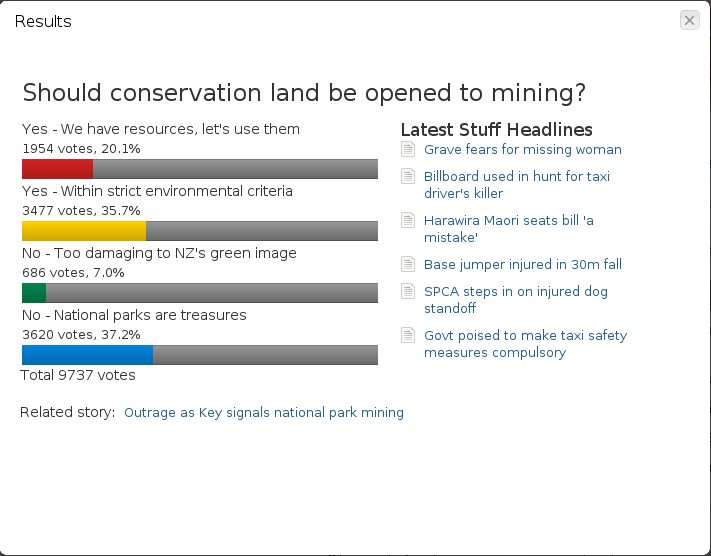
There’s been much analysis, wisdom, whimsy, and snark about Gerry Brownlee’s plans to mine the conservation estate. But rather than talk about it, I’m going to repair to a rather dubious poll from stuff.co.nz:

stuffminingpoll

Two things are interesting about this poll. First, for an internet poll, the options are uncharacteristically nuanced. This leads to the second interesting thing: these results are deeply incoherent.

I’m going to work from two assumptions (both of which are pretty arguable). First, I’m going to go out on a limb and assume that stuff.co.nz poll respondents are pretty similar to NZ Herald poll respondents and the commenters on “Your Views” and Stuff’s equivalent — putting it very charitably, let’s just suppose that they’re somewhat further economically to the right, less environmentally conscious and with stronger authoritarian tendencies than Gerry Brownlee. Second, I’m going to assume that a poll like this should break roughly along partisan lines, since it’s a government policy opposed by the opposition, part of an overall strategy to mimic Australia, a complex topic of national significance with which people generally have little first-hand experience (the sort of thing they tend to entrust to their representatives), and the poll answers are heavily propagandised using the government and opposition’s own sorts of terms.

The poll result is incoherent because it doesn’t break along (rightward-slanted) partisan lines, although it initially looks like it does. A total of about 56% of respondents approve of mining in principle, and this is roughly what I would expect given this framing, the current government position on the topic, and the demographic characteristics of this type of poll. It’s what the government is banking on in terms of support with this policy: if it drops much lower, they’ll probably back down. But where it gets incoherent is in the other two options. The third option (“too damaging to NZ’s green image”) is about what the Green party is polling, and the fourth (“National Parks are treasures”) is about what the Labour party wishes it was polling. That’s bass-ackwards, because the third option is the Labour party’s actual position on many environmental matters (even Carol Beaumont’s passionately-titled post falls back on NZ Inc. reasoning), while the fourth position is the Green party’s actual deeply-held position of principle. A second source of incoherence is the political framing of the second (most popular) question. By definition, if conservation land is mined it’s not being conserved any more.

Both Labour and the Greens have huge opportunities here, but they need to position themselves to properly take advantage of them. Labour, for its part, needs to tone back the NZ Inc. reasoning which plays into all the assumptions of the second question: that it is a simple trade-off of one type of economic value against another type and come out looking good on the margin. This is classic trickle-up politics, rationale which appeals to the brain instead of the gut. The people who are picking options one and two probably think they’re doing so on solid rational bases: more money, more efficient use of resources, etc. — but the real reasons are probably more to do with ideology (mastery of the environment) and nationalism (catching up with Australia). Labour’s best move here is to appeal to peoples’ identity: New Zealanders think of themselves as people who live in a wild and pristine country, and they like having that country to go and ramble about in (even if they hardly ever do it). The Greens could also adopt such a position, abandoning the wonkery for things which matter to people. Russel Norman tried with his speech in reply yesterday, but I swear, whoever wrote it needs the ‘G’, ‘D’ and ‘P’ keys removed from their keyboard. He needs to take a few hints from the team who got an organic farmer elected to the Senate in Montana on an environmentalist platform by telling him to stop talking about environmentalism and start talking about how much he loved the land. The Greens also need to rethink their deeply confused firearm policy, but that’s a minor thing. In a country with such a strong constituency of outdoorsfolk and wilderness sportspeople it’s an absolute travesty that the MP who represents the hunting lobby is the urbane Peter Dunne, and the only party who genuinely values wild places is represented by earnest city-dwelling vegetarians.

But Labour and the Greens can’t divide this constituency between them; they need to make this appeal positive-sum, and steal back some of those who voted option two. The way to do this is to attack the implicit logic of option two, the idea that you can mine something and still be conserving it, and to remove the idea that this sort of thing is for a government to decide, that it’s somehow too complex or technical for ordinary people to understand. This shouldn’t be hard to do — it’s a plain old political education campaign. But it requires framing and a narrative whereby reasonable people can really only bring themselves to choose the wilderness; causing them to lose faith in the assurances of the government’s “strict environmental criteria”. The narrative needs to be about who we are in New Zealand, and it needs to be one which appeals to socially-conservative rural and suburban folk who would never think of voting for earnest city-dwelling vegetarians even though they share many of the same bedrock values. It needs to be like the lyric in the title: we are burning our furniture, and that’s not what civilised people do. New Zealand is not a nation of environmental degenerates, except when insufferable environmentalist smugness forces them to choose degeneracy as the less-bad identity position.

This is an issue on which the left can win, because it’s already a pretty marginal issue for the government. It cuts against a long-standing bipartisan reverence for National Parks, and it cuts against New Zealand identity as New Zealanders see it. Even on what should be a pretty reactionary online poll, the government only wins by 6%. Turn one in six of those people around and the issue gets put on ice for good.

L

Musical interlude

I’m snowed in with work today (as I was yesterday), hence lack of commentary on the speeches and such.

But thanks to Simon Sweetman, I know that the mighty Gil Scott-Heron has released his first album in a decade and a half, titled I’m New Here. And it’s good. The Guardian is streaming the whole thing. Go and listen to it.

L

The “I” thing

iAs much as there are great expectations on John Key’s statement to Parliament today, the pressure on Phil Goff is only slightly less. He may not have the responsibility of running a country, but that’s the problem: little or nothing indicates he will have a country to run in the foreseeable future, the optimism of the activist left notwithstanding. Goff’s reply needs to be a game-changer; it needs to reframe the past year, foreshadow the coming “middle year” when the policy engine runs at full noise, and it needs to demonstrate that Goff has got some game and is willing to bring it.

It looks like Labour have just such an event in mind, but I have substantial misgivings about Goff’s planned reply to Key’s throne speech.

If the article in the Sunday Star Times is to be believed, the speech’s greatest asset will also be its greatest weakness: it’s to be delivered in the first person. There’s going to be a lot of “I have failed to” and “I should have” sort of statements coming out of Goff’s mouth which will undoubtedly be taken out of context, and on a more subtle level, it will reiterate the fact that Goff is in a pretty impotent position at present. Labour is disconnected from key constituencies, and there remains a perception that it still doesn’t really get why it lost. People will more naturally associate “failure” and “sorry” and so on with Labour than with National. The task of this speech and the coming months is to turn that around, but it will be hard work to sufficiently remind the audience that these things relate to Key rather than Goff himself, given that they’re coming from Goff’s mouth and because it runs counter to the established narrative about Key and what people want to believe about him.

He’s staking his own personal and political appeal against that of the PM. It’s a big risk, but hey, boldness is what’s needed. It’s not as if Goff has much to lose, and if he can make it work, it has potential to reframe the debate from being about the opportunities of the future to the missed opportunities of the past.

L

Life mimicking art: we can handle the truth

Tom Cruise’s finest hour.

Cameron Slater will appear in court tomorrow to defend charges relating to name suppression breaches. Based on my non-legal understanding of the situation, he will defend the charges on a series of technicalities when it has been obvious even to casual observers that he knew what he was doing, that he doesn’t believe he has done the slightest thing wrong, and indeed that he is intensifying and expanding his campaign for reform of (some aspects of) the justice system.

Defending this through spurious legal chicanery seems wrong-headed to me. I disagree (vehemently) with what Slater has said and done, but I am wholly in favour of his right to hold the opinions he holds and think that if he acted on them in good conscience then those acts should be robustly defended on their merits as social critique. If they are to have any legitimacy, acts of civil disobedience (though some might call this uncivil) must not be resiled from, because backing away and making excuses to get off on a technicality robs the enterprise of its only strength: that it is a principled stance against a status quo which is wrong or unjust.

I think it should be obvious enough that there is some dissatisfaction with the state of name suppression law at present, and while the Law Society have released an excellent review, the debate has not filtered down into the general public in any meaningful way as yet. Even though I largely approve of the current state of affairs, I think it’s a debate worth having; I’m not afraid to have it, but I think it should be had in the cool light of day, unshielded by shady innuendo and legal fiction.

So, Cameron, my suggestion to you is this: if you really want to reform name suppression laws (and the wider justice system), get up on your hind legs in court, say something along the lines of “you’re goddamn right I did”, take your lumps and kick off the public debate with some credibility. Standing up for what you believe is not only a right; in civil society it’s a responsibility. If you gave action to your conscience and you do not resile from it, don’t hide behind lawyers: be proud of what you did. We can handle the truth.

L

Brief, subjective reflections on the Tino Rangatiratanga flag

In January and February 2008 my wife and I did a road trip the length of the country, twice — from Wellington to Bluff, back to Wellington, up to Cape Reinga, and back to Wellington again. For most of the trip, we flew a small Tino Rangatiratanga flag, one of those small ones which clip onto a car window. It was partly a matter of literally “flying the flag” of my political views at this time of year — I must note, with some misgivings on her part — and partly an experiment to see what response it would get.

Photo by Adrienne Rewi.
(Photo by Adrienne Rewi — because its surprisingly hard to take a shot of your own car-flag while driving and we didn’t take one. Used without permission but with thanks — I’ll take it down on request.)

Most obviously, traffic seemed to treat us somewhat differently, though this might be down to regional and seasonal driving variations. Some cars honked, some flashed their lights or waved; others rode closer behind or seemed to overtake more aggressively. Many times I saw drivers staring or otherwise reacting with surprise at seeing a couple of Pākehā in a white station wagon flying such a flag. Truck drivers were particularly well-represented in all these reactions; the road is their territory, and visual vehicular statements of identity or loyalty mean a lot to them.

This was especially true when driving around Otago and Southland with my ZZ Top-bearded and bemulleted uncle in the car. Mostly in the South, though, people were cool but not hostile, and too polite to mention anything they might have thought. The response, both positive and negative, was strongest in the central North Island, Northland and the Bay of Plenty. In Taumarunui we got into town late and a group of local Māori were drinking and singing karaoke at the hotel where we stopped. They were intrigued and after a few friendly waves and “kia ora bro”s a couple of kuia came over to suss us out — asking us who we were, where we were from, and so on. Learning that we were from Whanganui, and that I have family connections to Jerusalem put it in context and they treated us with easy amiability. Their only mention of the flag was to remark that it was probably a pretty good guard against theft; said with warmth and irony and humour. There were several of these sort of encounters. Later, stopping for side-of-the-road hāngi on the road between Wellsford and Whangarei, the young guy gave us $2 off and claimed it was because it was the last, though I could see there was plenty left and it was only just lunch time. Especially in the Far North, and through the Bay of Plenty from Te Puke through Whakatane down to about Rotorua, Māori pedestrians and kids playing near the street would shout and point and wave. Usually, this was in run-down areas, and the people waving and shouting “chur bro!” often wore gang colours.

The “anti-theft device” line was replayed unbidden in Tauranga while visiting some in-laws, though this time in all seriousness, with none of the warmth of the Māori in Taumarunui. This was combined with a rather heated debate as to the relative merits of the Clark government, Foreshore and Seabed Act and general state of the bicultural nation. The two events were on consecutive days, and the contrast could not have been more stark.

In a couple of cases — once in Lyttelton in the carpark of the Wunderbar, and again outside a petrol station in Whitianga — we were asked by random strangers if we were Māori, and if not, why were we flying the flag. In Lyttelton this was good-natured and curious; in the other case, the question was asked with gruff suspicion, and the answer — an explanation of what the flag means and its origin — didn’t cut any ice with the chap who looked and seemed rather like Garth George. I’ve encountered that sort of reaction before — once a guy called me a “race traitor” in Molly Malone’s because I was wearing a Tino Rangatiratanga hoodie — and that one didn’t even have the flag, just the words.

But on a trip of 7,500km on the busiest roads in the country, passing through all the main population centres at the time of our national holiday, in an election year, not long after the Urewera Terra arrests and with issues of racial separatism and colonialism very squarely on the agenda, the thing which was most obvious was how little such a statement changed anything. It reiterated to me that New Zealand is a pretty tolerant and easy society, as long as that tolerance is not stretched too far. Another example of this was this evening’s “Great Debate” on Māori TV between celebrities and comedians and such folks on the moot “now is the time for Aotearoa to close the immigration gates”. I won’t spoil the result, because it really is worth watching (and I assume Māori TV will put up a video), but while the moot was robustly (and often very personally) contested, it was all done in wonderful good humour. The same good humour as of a Māori joking ruefully about Māori crime — and the opposing siege mentality the following day. Happily, I think the former predominates in this country, and provides a sound basis for the ongoing development of a bicultural — and eventually multicultural — society.

L

Fragile Democracy, Authoritarian Persistence and Strategic Competition in the Western Pacific Rim.

That is the title of the talk I will be giving at the AUT Pacific Media Centre in Auckland on Friday February 12 at 5PM. I am starting to formulate the bases of the talk now because I arrive in Auckland just a couple of days before it happens, so I thought that I would kill two birds with one stone by outlining my thoughts on the matter here. Call it a trial run.

For all the comment about growth, Asian Values and a geopolitical shift towards the East, SE Asia (Indochina) and the Western Pacific are a region suffering from poor governance, primordial divisions and simmering conflict. All of this is influenced by the US-China competition for influence in the Western Pacific, and has significant consequences for the long-term future of places like New Zealand.  Let me outline the major reasons why.

1) Democracy. Where and such as it exists, democracy in SE Asia and the Pacific is a joke. Looking from the South China Sea southwards, the “democracies” in question–Taiwan, Malaysia, Thailand (if it can be called that),  the Philippines, Indonesia, Papua New Guinea and those grouped under the rubric of the Pacific Island Forum, are hotbeds of populist demagoguery, corruption, criminal influence, ethno- religious division and electoral manipulation. With the exception of Indonesia, which has made good strides towards holding legitimately open and competitive elections and which has seen the “democratization” of civil-military relations for the first time in its history (but which below the procedural level remains profoundly authoritarian), the state of democracy throughout the Western Pacific Rim is pallorous to say the least. Taiwan is essentially rule by organised crime with a semi-civilised electoral facade using Cold War ideological precepts as dividing points (the same corporate/criminal networks fund and provide organisational support to both major parties and economic prosperity buys off any pointed examination of the regime). The Philippines and Malaysia are oligarchic rule with populist veneers in which ethnic and religious appeals contribute to centrifugal, often outright conflictual political competition (Malaysia still has Sultanates who lord over their geographic areas and the Philippines has regional overlords who rule as neo-feudal political bosses). Thailand is a certifiable basket case on too many levels to count (e.g., thieving politicians, sectarian mobs, a comatose monarch that cannot be criticised because of purportedly god-like attributes, a seriously fractured military hierarchy involved in political skullduggery and murder). East Timor is a failed state that has shown little or no signs of development in spite of millions of dollars of UN aid and a contingent of Kiwi, Australian and Portuguese peacekeepers and civilian nation-building advisers. The Cooks, New Caledonia and Tahiti are post-colonial protectorates in which what gets protected is the corporate interests and life-style of the servitor local elite. Or in other words, the Pacific Island democracies are oligarchic or crony rule by another name.

That gives legitimacy to the authoritarians in their midst. Vietnam, Cambodia, Laos and Singapore are all relatively “soft” authoritarian regimes with electoral facades. Myanmar is a hard authoritarian regime whose best trading partners are its authoritarian neighbors (especially Singapore, and to the North, China). Brunei is a semi-medieval oil Sultanate. Fiji is a military-bureaucratic regime, Tonga is a degenerate monarchy that Samoa is working hard to emulate.  All of these dictatorships, be they junta, party, personalist or elected in nature, point to the inefficiencies and disorder of their democratic neighbours as “proof” that Western style (read: liberal) democracy is ill-suited for Asian/Pacific societies. Often couched in “Asian Value” or “Island style” arguments (which is no more than an ideological justification based on revisionist historical interpretations by authoritarian elites that have no basis in current actual fact), the authoritarian claim is that the Asian and Pacific Island psyche and civil society (such as it exists) is simply not amenable to Western-imposed democratic standards. There may be some truth to the Asian civil society argument, because there is a noticeable absence of volunteerism and solidarity with non-ethnic, religious or linguistic kin regardless of common nationality. But that is not the issue. Whatever the root cause, the bottom line is that the quality of democracy in the Pacific Rim is poor at best, miserable at worst, and in all cases a comparative justification for authoritarians throughout the region writ large.

2) Arms races. SE Asia is in the midst of a dramatic arms race. Fueled by strong economic growth and spurred by emerging power rivals China and India’s military modernization programs, every single country in SE Asia is upgrading and expanding its military capabilities. All of the SE Asian countries spend more than 3% of GDP on “defense,” (in line with Chinese and Indian outlays as a percentage of GDP),  with some like Singapore allocating 6% of GDP to  its military. Beyond the controversial US weapons sale to Taiwan that has the Chinese in a snit, Malaysia has ordered new submarines and an entire tactical air wing from European and Russian suppliers. The Singaporeans, Thais, Filipinos and Indonesians are preferred US weapons customers all in the midst of major force upgrades, whereas Myanmar purchases a mix of Chinese, North Korean and Western weaponry (often using Singapore as a conduit and middleman). In the case of the authoritarians, defense expenditures include regime defense as well as external threat deterrence and countervailing. The democracies focus more on a mix of internal security and traditional external concerns. This has led, among other things, to a counter-insurgency focus in the Philippines and Thailand (in which Islamicist insurgencies show no signs of being defeated), with external defense taking a secondary role, whereas in Indonesia and Malaysia the external defense role is now paramount. Among other things, the mix of strategic perspectives and push to rearm has led to armed border clashes between Thailand and Cambodia (over the border placement of a temple), Vietnam and Cambodia, and Myanmar and Cambodia (one might argue from this that the Cambodians have issues). Malaysia has picked arguments with both Indonesia and Singapore about relative weapons capabilities, piracy and border controls. The reason why these fragile democracies act belligerently is that irresponsible politicians pursuing electoral agendas engage in both domestic ethnic/religious/race-baiting as well as jingoistic appeals in order to consolidate popular support. Be it originated in government or opposition, these appeals have a corrosive effect on both domestic democratic tolerance as well as regional peace. Even piracy, a problem that all of the region’s governments agree is a common scourge, is in fact abetted by willful government inaction–for example, Malaysian pirates ply the Eastern Malaysian coast with some impunity (especially east of Tiomen Island and North of Sabah (Malaysian Borneo), while Indonesian pirates do the same in the Western reaches of the Malaccan Straits. In each case the pursuit of pirates is seen by rivals as a drain on military resources better spent elsewhere, which makes passive facilitation of pirate activity a neat form of low-level proxy attritional warfare. The same goes for cross-border guerrilla havens (say, in northern Malaysia or Sabah), where insurgents are provided sanctuary by governments with ethno-religious rather than national interests at the heart of their concerns.

3) The China-US strategic competition. Since I have written about this before I shall not repeat myself. The bottom line here is that the competition between the US and China over strategic influence in the Western Pacific Rim has seen both powers increasingly disregard issues of good governance in favor of straight influence-peddling. This adds to the issues mentioned above, as arms and influence buy favors in a measure that principled support for democracy does not. Beyond so-called cash diplomacy, foreign aid and military-to-military relations, this includes ostensibly “free” trade relations with authoritarians or weak democrats whose interests are more self-serving than what the language of trade agreements suggests, and who use the legitimating mantle of trade with liberal democratic states as further proof that their rule is just.

I shall leave aside for the moment the role of organised crime in all of this, particularly with regard to its relationship to trade and elected government. Suffice it to say that the picture is not pretty.

Thus my tentative prognosis is that, rather than moving towards an era of peace, stability and growth in the Western Pacific, we are about to find out what the dark side of globalisation looks like, at least in terms of its manifestation in this part of the world. And that can be summed up in one word: conflict, both of an internal as well as of a cross-border sort.

Lesson for the NZ government (not that it would listen): Know exactly who you are dealing with and the context in which your dealings occur. Be risk adverse, pragmatic and principled in your approach to medium term futures. Hedge against uncertainty  and beware of the temptation of  positive short-term economic horizons that are divorced from the political risk environments in which they occur. Do not allow ideological belief to blind you to the political, social and economic realities on the ground. This is not a Lehman Brothers world–and it ain’t Confucian either.

Life mimicking art: ask and tell

Following President Obama’s undertaking in the State of the Union address, Admiral Michael Mullen (Chairman of the US Joint Chiefs of Staff) and Robert Gates (US Secretary of Defense) have recommended an end to the “don’t ask, don’t tell” policy preventing homosexuals from openly serving in the US military, in testimony to the Senate Armed Forces Committee. While the arguments are not quite the same, the general position and line of rhetoric (“the troops will get over it”) was memorably presented a decade ago in The West Wing:

All that having been said, it’s neither the Chairman nor the Secretary nor the President’s call. It’s for Congress to decide, and at present the bill is thirtyish votes shy of passing. But if it is done, this will be a genie of sorts; once out of the bottle, no force will put it back in. If the armed forces are even faintly representative of wider society, there will be thousands — tens of thousands, even — of demonstrably capable, patriotic, decorated soldiers, including perhaps some in the very highest ranks of the service who, while perhaps not having a coming-out parade, will nevertheless feel gradually more free to leave the closet. A future administration will court political and military ruin if it embarks on a witchhunt to purge them all from the nation’s ranks, particularly given the extensive nature of the USA’s current military deployments.

Update: Thanks to Hugh and Pablo (in comments) for correcting me on whose “call” it is.

L

Incoherence about national education standards

There’s incoherence in the government’s rollout of the new national educational standards regime which goes beyond the unreasonable use of statistics I noted yesterday, and it’s illustrated most crisply in the differing approaches taken to mainstream schools and kura kaupapa Māori. Simply put, standards are being implemented on a trial basis (audio link) in KKM, and without a trial process in mainstream schools. The problem is not about a lack of background: Anne Tolley made this clear last year in response to a Parliamentary question from Te Ururoa Flavell, saying that there existed “a significantly robust research basis from which to develop national standards in kura kaupapa Māori.”

The mainstream education sector — without whose buy-in any such implementation will certainly fail — are understandably furious since their main problem with national standards has not been one of principle so much as a lack of confidence in the details of any regime’s implementation and an understandable desire to have input into a system which will fundamentally change the nature of their work. A substantial part of the reason they are suspicious is because National spent its nine (long) years in opposition taking every possible opportunity to deride the education sector as Labour toadies and teachers as walk-sock-and-cardigan-wearing fat-bottomed do-nothings, and as NZ Principal’s Federation president Ernie Buutveld says in the interview above, the sector’s suspicions have been confirmed: national standards is less about measuring students and more about measuring teachers, with a punitive view to demonising them in the eyes of parents. This is the political motive: driving parents to vote for National rather than for Labour. I suppose the reasoning goes something like, if teachers are well-respected and regarded and generally vote Labour, Labour will be similarly well-respected and regarded amongst parents. Or something like that.

The problem with measuring teachers on the performance of their students, however, (and I speak as a former teacher), is the same as the problem of judging a football team by its fans. A team doesn’t choose its fans, and schools or teachers don’t choose their students. There is only a certain extent to which a given teacher, however inspired or well-meaning, can influence the social, cultural, economic, health and other factors which feed into educational success; even more so when there exists a strictly results-focused teaching culture, rather than an improvement and engagement-focused culture, as there certainly will once standards are bedded in.

This is not to say that KKM should be denied their national standards trial process. But that is what National should be saying, in order to be consistent. Because the stated reason a similar trial has been repeatedly denied the mainstream education sector is urgency — the sense that we must move swiftly and make the changes so that not one more child will be left behind. This sort of incoherence in policy and rhetoric (or, as it is in this case, between policy and rhetoric) always yields flaws which can and should be exploited, and here’s the flaw in this. One of the two following statements is necessarily true:

  • The Government’s justification for rolling out national standards in mainstream schools without a trial period (urgency) is false and misleading, and accordingly the government’s motives in rolling out the trial period are different to their stated motives; or
  • The Government doesn’t care about kura kaupapa Māori students or schools, and doesn’t consider their educational standards a matter of urgency or substantial importance.

So, Anne Tolley and John Key, which is it?

L

Update: Sage wisdom on this topic from Gordon Campbell.