Niwa Knobs.


***THIS POST HAS BEEN UPDATED ON APRIL 17 TO ACCOUNT FOR NEW INFORMATION RECEIVED***

Niwa has announced that a contract to upgrade the research vessel RV Tangaroa has been let to a Singaporean company rather than a NZ-based consortium. The EPMU and Labour Party have criticised the move, citing the fact that local jobs were at stake and a chance to up-skill NZ workers was lost. And of course, the flow-on effects of employing NZ workers is obvious, because they will spend their  wages a bit on beer but more on nappies, mortgages, rent and DIY projects. All that is true and reason enough to oppose the Niwa deal, but there is much more to the story. That is because the bottom line boils down to what I shall call a dirty money savings. Here is how it works.

The Niwa chief knob, John Morgan, refused to state what the bids were, but other sources have noted that at $9 million the NZ contractor bid was more than double the $4 million Singaporean bid. Sounds like he got his maths right. Mr. Morgan then went on to say that the Singaporean contractor had a lot of experience and 3000 staff  dedicated to the task as well as many resources to do the upgrade, which he claimed was a complex operation that involved cutting holes in the hull of the ship in order to install a dynamic positioning system (DPS) that holds the ship steady and precise over an undersea target in variable conditions (how he thinks that 3000 people will work on that one job is another question,  as is the complexity of cutting holes in a boat, but I am just quoting from the NZPA article on the decision).

He defended the decision as a cost-savings bonus for the NZ taxpayer, and the Minister for Research, Science and Technology the vainglorious “Dr” Wayne Mapp (Ph.D.s in Law are not usually addressed as Dr.) pontificated that although he was not involved in the decision he supported it because the NZ consortium was not dependent on that contract (presumably that resource-rich Singaporean outfit was) and, quote, “after all we have an FTA with Singapore.” File that one under “another Mapp moronity.”

Here is why the deal is dirty. Unskilled and semi-skilled Singaporean shipyard workers (e.g. stevedores, drivers, loaders, builders and roustabouts)  are paid between SG$10-15 dollars per day. Non-engineer skilled workers (divers, torchmen, pipefitters) may earn double or triple that. They are mostly foreign workers on temporary visas (mainly from Bangladesh, mainland China and India) who cannot bring their families with them and who are housed in containers and squalid dormitories with occupancies of 20-50 men per room and one toilet amongst them (women are not allowed on the docks). They are not allowed to independently organise or collectively bargain. They work 12 hour days and suffer extremely high rates of industrial accidents–over 50 workers died in 2009 from injuries received on the job, and dozens if not hundreds more were crippled by accidents. In the vast majority of cases, seriously injured foreign workers who are unable to return to work are left dependent for months on private charity until their claims for compensation are resolved or are deported once they leave hospital (and often repatriated in any event).

Mr. Morgan is reported as saying that the Singaporean bid, at $30/hour (it is not clear if he is speaking of US, NZ or Singaporean dollars), was half the NZ $60/hour labour costs. But whatever the currency, $30/hour would only apply to supervisory and managerial staff who would not be doing the physical labour involved in installing the DPS system (which would be done by the foreign workers mentioned above). That means that his claims of labour costs savings on which the decision partially rested is either a willful misprepresentation of  the true Singaporean figures or, worse yet, a sign that Niwa did not undertake due dilligence in ascertaining the veracity of the $30/hour figure. In other words, if the latter is true then Niwa got fleeced by the Singaporean contractor, who then pocketed the difference between its real labour costs and the $30/hour figure. If the former is true, the Mr. Morgan needs to be held to account for his miserepresentation.

There is a bigger picture to consider. Singapore is an authoritarian state in which political  party competition and elections are rigged, freedom of speech is restricted and foreign workers are  not covered by the same labour laws as Singaporean citizens. Instruments for foreign worker redress, compensation and mediation are virtually non-existent. The Singaporean lifestyle, so admired by John Key and other acolytes of the Singaporean regime, is based on the gross exploitation of these foreign workers who, after all, build the buildings Singaporeans live and work in, provide the food, transport and maid services they are accustomed to, construct their highways and polish their cars, and staff the hundreds of foreign MNCs the use the country as an operational hub. Foreign workers comprise a quarter of Singapore’s nearly 5 million population, so the economic debt owed to them is great.

That is why the decision is about dirty money savings. Forget the job-related issues in NZ. Niwa’s decision is based on its knowingly countenancing the human rights abuse of a vulnerable group of people in a foreign country. It violates ILO standards, it violates NZ labour law, and it violates nominal notions of decency in doing so. Mrs. Morgan and Mapp may argue that Niwa is saving the NZ taxpayer money, and that it is not responsible for the behavior of foreign contractors, but in doing business with the Singaporean firm it could well wind up with blood on its hands. Put succinctly: the money Niwa saves on the deal comes directly from the sweat and blood of these foreign workers.

None of this would matter if NZ was an authoritarian state unconcerned about human rights and fair labour standards. The problem is, NZ spends a lot of time in international fora banging on about exactly such things. However, this appears to be more a case of  “do as I say, not as I do” because NZ in recent years has seen fit to cozy up to regimes like those of  Singapore, China and a host of Middle Eastern autocracies, in which the very concepts of universal rights and fair labour standards are not only disputed, but rejected out of hand on “cultural difference” grounds. Well, that may be the case because as Lew so nicely put it a while back, “NZ foreign policy is trade,”  but NZ does not have to contribute to the perpetuation of exploitation in foreign cultural contexts, especially if its reputation depends on its rhetorical championing of human rights. That is a matter of choice, and the choice in this instance is clear.

There is such a thing a trading fairly and doing business in an ethical way in which the bottom line is not just about money, but about human decency as well.  A restrained rate of profit or reduced savings on cost are often a better guarantee of long term investment than short term profit maximisation or miserliness,  and an interest in foreign worker conditions can contribute to the betterment of international business practices. But the choice here has been to save costs rather than stand on principle and improve by example. For a country that prides itself on its international status based upon fairness principles, decisions like this one give the lie to the cheap talk in international confabs.

All of which is to say–shame on both of you, Misters Mapp and Morgan. But then again, we would not expect otherwise.
Perspective and colonial counterfactuals

It’s hardly the stuff of rigorous historico-social investigation, but Simon Schama sees much to celebrate in NZ biculturalism — particularly in comparison to our Anglo comparators:

But it’s the story of Maori and pakeha, the settlers of European origin, that – for all the pain, betrayals and suffering – still deserve to be known and celebrated as offering a different model of cultural encounter than anywhere else in the world. […] Of course there have been serious problems of unequal social opportunity, of street gangs. But if there is anywhere in the post-colonial world where two cultural worlds truly live an engaged life alongside each other, it’s in New Zealand.
Such stories don’t come along very often. Cherish them. Chant them. Dance them.
Upane upane, kaupane, whiti te ra! Up the ladder, up the ladder, the Sun Shines.

This is broad-brush stuff, and minimises the genuine grievance and disquiet which exists on both sides of the cultural divide — his “divided no longer” caption to a stock photo is altogether too pat. And his assessment of Paul Holmes as a “tough” and “a reproach to dozy thinking” is marginal at best. But Schama’s observation that what we have in this country is quite unlike any other postcolonial nation is exactly right. It provides a glimpse at what might have been been elsewhere, and what might have been here if the post-Treaty settlement had been undertaken in better faith.

This raises a question Pablo and I discussed in email after he wrote this post (I didn’t want to hijack the excellent discussion there): do those who hate and fear Tino Rangatiratanga and consider the Treaty a “simple nullity” really believe that the people of Aotearoa — of all colours — would be better off if the typical colonial counterfactual were true — if Hobson’s marines and settlers had simply driven the natives into the sea or exterminated them as animals? In my email to Pablo, I wrote:

I’ve often argued (as a wind-up or a devil’s advocate position) that the Māori are ungrateful whingers who don’t appreciate what an incredibly good deal they got from Hobson, and that NZ would have been better off if Europeans had just landed with boatloads of armed soldiers and done to the natives what they did in the rest of the world. Anything for a peaceful life. What’s interesting is that, even when discussing the topic with people who genuinely believe that the Treaty is a gravy train and the natives are taking the piss and actually are ungrateful, they generally balk at this suggestion. That consent [given by the colonised to the colonisers], however fraught and limited, is important to how we see ourselves. That’s one of the reasons I’m generally pretty hopeful about the bicultural future.

I expressed somewhat similar views in comments to this post of Chris Trotter’s a short time later. Neither Chris, nor the other commenter to that post (RedLogix, with whom I’ve had robust but usually cordial disagreements on this topic) responded to my comments, which I took as a sort of confirmation of my thesis.* As I say, this is the usual response to the argument I’ve made many times before — all but the most unrepentant rednecks are repelled by the view that colonialism NZ-style was worse than what might have happened if we’d undertaken it Australian-style. This indicates to me that even for those who are highly critical of it grudgingly accept that the Tino Rangatiratanga movement, Waitangi Tribunal and attendant concessions to Māori in our political and social systems are better than the counterfactual alternative of a white monoculture in the South Pacific, even if it were more peaceful. The importance of this for a bicultural future is profound.

L

* I don’t want to put words in Chris and RL’s mouths, though — it may be that they simply thought my remarks too ridiculous to bother engaging with. Happy to accept clarification on this point.

(Schama article via Tim Watkin at Pundit. Thanks! And as it happens, Idiot/Savant at No Right Turn has excerpted it as well.)

Apologies to those who hate rugby metaphors

… but they’re really useful. Here’s another one.

After the election, I ruminated upon the future of the Labour party, employing a fairly hackneyed rugby analogy to describe the crossroads at which they stood. I’ve been meaning to follow it up and write about the fact that they’re very much playing the Crusaders game, rather than the Hurricanes game, but I’ve struggled to find the motivation to do so because it’s just so bleeding obvious that that’s what they’re doing.

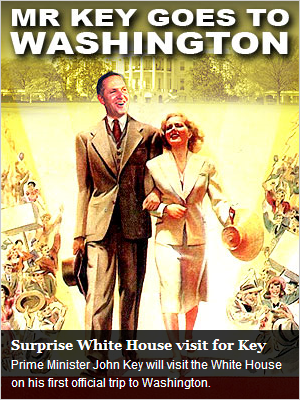
But yesterday’s comment by Trevor Mallard on the “Mr Key goes to Washington” story is pretty revealing — especially from such a die-hard Hurricanes fan:

In Super 14 terms this is like a loss with a bonus point.
And what are the odds of the President putting his head into the meeting to give John another chance to smile and wave to the cameras.
Will almost certainly happen but will still be a loss with two bonus points.
Sort of like the Hurricanes rather than the Crusaders –- may be a bit of feel good but no one believes they are really going to be there when the real business is done.

And he has a good point: who wants to back the Hurricanes if they can’t actually do the business, win the matches and bring home the silverware? All the razzle-dazzle in the world is hollow if it doesn’t yield results.

But Trevor could just as well be describing Labour’s performance in opposition. He characterises National and its government as playing the Hurricanes game, while it’s clear that Labour are playing the Crusaders game — but the problem is that Labour are playing the Crusaders game badly. They’re trying to be defensively strong, but they’re not really; the consensus is just that their opponents lack strike power out wide. They’re struggling to win even their own set-piece ball. Despite plenty of opportunities they’ve been almost singularly unable to punish mistakes — and the mistakes they’ve taken aim at have often been the wrong ones. They’ve tried various tactics which are analogous to infringing at the ruck, but have been caught out by the ref, making them look desperate rather than enterprising.

So what’s the half-time talk? I don’t know. It would probably be worse to try to change the gameplan at this stage than to persist, but absent a stunning second-half rally, it’ll be a long and humiliating off-season. Good thing relegation isn’t a possibility.

Update: Naly D reckons I’ve described the Chiefs game, rather than a poor version of the Crusaders game. So if that suits you, imagine it thus. But it sort of ruins the symmetry. Too much accuracy in an analogy isn’t always a good thing.

L

Farewell to Vapidness–and hello to insipidness.

When I was in NZ in February-March, after a year away from the country, I was alarmed by the deterioration of what passed for news in the MSM. This was a continuation of a long-term trend that I have called the “Australianisation” of NZ news coverage, something that Lew and I talked about when we had lunch during my time in Wellington. But the gross decline over the last year was what disturbed me. Whereas the front pages of the major newspapers and lead segments of the major TV and radio news shows used to contain world and national stories of real import, by the time I arrived back in country in early 2010 even those were occupied by celebrity news, scandal and other so-called “human interest” rubbish that catered to the most purient, salacious aspects of public interest. There is war, famine, corruption, epidemics, natural disasters, corporate sleaze, international intrigue and host of other pressing news on any given day, but what is served up in the NZ media is pablum in which wardrobe malfunctions compete with drunken/drugged socialite antics and sex tapes for headlines. I blame Rupert Murdoch for the lot of it, because like PT Barnum and the Roman Emperors, he realised that by catering to the basest of human instincts and desires, media empires can be built. All you have to do is provide a carnival that diverts mass attention from the realities surrounding them, add a few creature conforts via sweepstakes and sponsor tie-ins and prizes, and voila!–you have both bread and cricuses for the masses. Worse yet, this media approach is something that very conveniently dovetails with the interests of political and corporate elites who would prefer to pursue their interests unencumbered by press or public scrutiny.

Which is why I do not lament the demise of the Sunrise program. Not withstanding the fact that all  “Australianised” morning shows are much puffery with little substance, that particular example was strinkingly moronic. Forget the tired use of yet another blond female to handle the  “soft” stories. Forget the organ grinder monkey act that passed for weather reporting. Forget the blokey rugby/cricket dude and or leggy former netballer who read sports. All of that is par for the course and shared by the risible Breakfast show as well.

No, what set Sunrise apart was the sheer rubbish that it passed off as stories, the sheer inanity of the commentary, and, with few exceptions, the sheer ignorance of the presenters of anything other than their own personae. For Pete sake, they even had a dog as a regular on the show, in an apparent effort to a) appeal to animal lovers; or b) appear more friendly/approchable/likeable. Crikey, it was bad.

Mind you, Breakfast is hardly better. But at least it first segment still contains some real news taken from sources other than its own radio affliliate (although in-house reporting has been cut back dramatically while reliance on newsfeeds from the BBC, CBS, ABC has increased, so perhaps the Mediaworks approach will eventually become the standard at TVNZ). But after 7:20 AM or so, save for the top and bottom of the hour news bulletins, the show deteriorates markedly, and after 8AM it might as well be called Sesame Street for adults. What I find particularly offensive with both of the morning shows on TV is that the content gets dumber as the morning progresses, and judging from the adverts, that is because the producers apparently believe that housewives are the main audience after 8AM, and housewives do not think much when watching a television show. Go figure.

The proof that vapidity has seeped deeply into the public consciousness is provided by the response to the announcement that Sunrise was cancelled. With very few exceptions, be it on talkback radio, newspaper reader comments, blogs or Facebook, most of the reaction pro and con is about the talking heads/presenters and their perceived “chemistry” or lack thereof when compared with the buffoon/giggles act playing over at the competitor during the same time slot.  Barely a word is mentioned about the lack of real substance in the show, or of the sheer idiocy that it passed off as news on a daily basis. Heck, if they needed that brick in human guise known as Rick Giles to increase their ratings, then it is clear that the writing was on the wall.

I fail to understand why a news content-driven morning TV show cannot succeed in NZ. There are successful news radio shows at that time of day, and while the presenter(s) is/are often a  media personality as well, their status is made by their being able to discuss news and current events in something approaching a rational and informed manner (I exclude Michael Laws and Leighton Smith from this category, although neither of them can touch John Banks when it comes to on-air hubris combined with ignorance). So why cannot that happen on TV? Could it be that the TV-watching public are, uh, less intellectually endowed than the radio-listening public? Cannot one be both?

At first it seemed like TV3 might decide to get serious and provide a real alternative to the morning carnival side show at TVNZ. But noooooooo. Sunrise is to be replaced with reruns of Magnum PI, Frasier, Everybody Loves Raymond and Campbell Live (which has gone from hard-hitting to ethically questionable rabble rousing and scandal mongering).  @#$% Me!

The goods news is that, having departed the Land of the Vacuous and Insipid Morning Shows, I do not have to watch this fare. The bad news is that in my current location there is more real news to choose from on radio and TV, but beyond that the situation is not much better. Heck, if you think “American Idol” is bad, then take a look at “Asian Idol” (or any number of other reality show rip-offs).

Best then, that I read a book or a “real” newspaper while having my morning tea.

Fighting symbolism with symbolism

So the Crown, having had their appeal against the Waihopai 3’s acquittal (about which Pablo wrote an excellent post) dismissed, is considering a civil case against them, to recover the $1.1 million cost of the damage to the dome and fences surrounding the satellite dish.

In politics it is usually best to fight symbolism with symbolism; once a topic or policy matter is being debated in symbolic terms, in general no amount of fact or logic or reason will prevail against it. This often promotes an arms race — the party to a debate who introduces symbolic aspects to their discourse gets to set the agenda, to define what the debate is about, and this is clearly so with the Waihopai 3. While the customary analysis of the protest action is that it took place one morning in April 2008, with a slight return in the criminal court during March 2010, but all this demonstrates is that people don’t really understand the nature of this protest. It is ongoing. This morning, Peter Murnane responded with some puzzlement to Sean Plunket’s question “Do you have any further protest actions planned?” by saying “No […] well, we’re busy with this one.” That’s the point: Defending their actions on truthful, legitimate and principled grounds in the full glare of public scrutiny is the protest. Contrary to another current case, the Waihopai 3 have stood up and said the non-blasphemous equivalent of “you’re goddamned right I did”, and are willing to accept the consequences of their actions — but only once they’ve made their position clear. And they expect that their commitment to principle and legitimate due process is reciprocated by the Crown, and if sued will call for representatives of the GCSB to face them in court. This places the Crown in an invidious position: it cannot permit senior intelligence and security staff to be dragged into this matter, but if it fails to do so it will cede the symbolic field to Ploughshares, and the legitimacy of its position will be further eroded.

For the Crown to seek reparation would be fair and just: the actions of the Waihopai 3 cost the NZ taxpayer money and the Crown has a right to recover that via legitimate legal means. But because the Waihopai Three have set the terms of the symbolic debate and have everything to gain and nothing whatsoever to lose from the case, it is a fool’s errand. While, as Bill Hodge says, the Crown has an “invincible case” in the civil court, the battle is not being waged in the court, but in people’s hearts and minds. The Waihopai 3 claim they have no money, and this seems plausible. So the only reason for the Crown to take a case against them is to demonstrate that the organs of power are not to be trifled with, and that even if a jury will acquit for a good cause, an appealing idealistic argument, or an integrous and principled stand such actions cannot be undertaken with impunity. A display of power, if you like, though not an especially vulgar one. Such a display may serve the social purpose of quelling the urges of overenthusiastic and legally (not to mention ethically) illiterate anti-abortionists, and will have some currency among the not-so-closeted authoritarians who bayed for the blood of these peaceful protesters in April 2008 and again in March 2010. But to the extent that the government seeks to retain its dignity, this will be cold comfort indeed.

L

An Armed Crowd is a Polite Crowd.

I heard this phrase when living on a ranch on the Arizona-Mexico border in the early 1990s. It was prompted by my asking a bartender at a local saloon if she felt threatened by the crowd of drunken, armed cowboys in the establishment one evening.  In that environment, it made perfect sense (in fact, Arizona has just legislated that a person can carry a concealed firearm without a permit, loosening the laws in force during my time in the state which allowed for the open carrying of firearms without a permit but which required a concealed weapons permit). In fact, on repeated visits to that watering hole I never once saw anyone raise their voice in serious anger.

I mention this because statistics have recently been released that show that the incidence of violent crime in NZ has increased exponentially in the last five years. That has led to the National government talking about “getting tough” on crime along the lines frequently barked by its ACT closet authoritarian partners.

But what does it mean to “get tough” on crime? More incarcerations? Longer sentences? More arrests? More convictions? More confiscations of property? More severe punishments? Reinstitution of the death penalty for heinous crimes? More tasering? Arming the community constables? Expanding the armed offenders squads? Increasing liquor bans in public places?  Having the police using more armed force when dealing with crowd control, gang and other collective disturbances? Increasing youth sentences?

I mention this because “getting tough” on crime, at least when phrased in the above terms, does not address the causal mechanisms behind the upsurge in violent crime (which I agree has increased and now become a serious pathology in NZ civil society). One can seek explanations for causes in many places: exposure to media-provided violence at a young age, dysfunctional familities, bullying culture, the pervasive influence of alcohol, the long-standing tradition of civil disobedience and passive resistance practiced by some communities and individuals, now taken to new extremes, the degeneration of popular and civic culture into venal self-absorption–the list of possible causes is long.  But what does “getting tough” have to do with any of these possible causes? Unless a more draconian criminal system is seen as a deterrent to violent crime (and there is much dispute about the deterrent value of things such as capital punishment), how exactly is “getting tough” on crime going to solve the problem?

I must confess to being of two minds, because as an immigrant from the US I have always felt that punishment for serious offenses was a bit of a joke in NZ and that there are not enough resources dedicated to crime-fighting  (in fact, I still believe that NZ is a country where one can literally get away with murder if cunning and meticulous). But I also know that the “tougher” US approach to crime also has done little to nothing to drive down crime rates (in fact, the “broken windows” approach to petty crime adopted in New York City in the 1990s, and in which worked marvels in lowering the overall crime rate in that city, was focused on early intervention at the lower end of criminality rather than on increased punishment for more serious offenses). Instead, US violent crimes rates, not surprisingly, lowered as the economy expanded in the late 1990s and early 2000s, and, not surprisngly, have increased since the recession began to bite hard in 2008. Which is to say, although the violence of socio and psychopaths is unaffected by economic cycles, much of the residual acts of violence tend to overlap with economic downturns when unmitigated by early intervention or causal prevention schemes.

Which brings back the cause-effect–response syllogism mentioned earlier. There is a reason why that crowd in the border town saloon was armed. At the time there were only 2 sherriff’s deputies avaliable to patrol over 1000 square miles of national forest and ranchland strung along the border and extending some 20-50 miles northward. Besides the various stinging and biting small critters and large predators (bears, big cats) that stalked the Sonoran high plateau and mountain ranges in which our properties were located, there were human dangers emanating from across the border as well as from within Arizona itself (organised crime drug smuggling and survivalist militas, respectively). Absent the protection of the state in such remote locales, people actually practiced the concept of self-defense because to not do so invited serious victimisation, often of a terminal sort. As the saying goes, the best home insurance policy one can have in such a personal threat environment is the sound of a pump action shotgun chambering a buckshot round. The point being, that armed crowd had reason to be so given the causal mechanisms at play in that particular crime environment (which I must say, remains one of the most beautiful landscapes I have had the pleasure to experience first hand). Unfortunately, perhaps, things changed after 9/11 and the region is now swarming with Border Patrol, National Guard, roadblocks, fences, audiovisual sensors and motion detectors as well as increased numbers of north-bound migrants, to the point that many long-term residents have moved away in search of solitude and workable land. It turns out, at least in that regard, I left just in the nick of time.

That brings me back to NZ, my adopted home since 1997 and in which I have seen a steady decline in civility during the last decade that is now confirmed by crime statistics. Not being a criminologist or a social welfare expert, I cannot offer any concrete prescriptions, much less a panacea for the upsurge in criminal violence now afflicting Aotearoa. But what I can say is that it does no good to play the role of chickenhawk or attack poodle by fulminating about getting tough on crime without linking the thirst for punishment to an understanding of what drives violence and insecurity in the first place. In fact, until the latter is identified, addressed and ameloirated, then the former is just another way of pouring salt into a gaping wound.

Chris hitting his stride

It’s well known to most that Chris Trotter and I have had considerable differences. But despite them, I must say that when he’s on form it can be a sight to behold.

So it is with his latest set-piece about Auckland governance, which gives voice to the intuitive disquiet felt by many, weaving many of the themes behind the sometimes tentative and incoherent criticism of the (aptly-named) Supercity plan into a cohesive polemic narrative, putting meat on those bones and placing these recent events in a historical context which resonates.

Required reading, whether or not you agree with it, and deserving of a wider audience than the blogosphere generally provides.

L