I voted Yes today

It is a sunny Wellington spring day; I walked past crocuses and the beginning of daffodils to get my ballot paper, and past trees starting to show their spring growth to post it.

I voted yes because I believe smacking children is wrong.

I voted yes because I want to reaffirm that the Christian right do not speak for me. Many many (many) Christians in New Zealand believe, as I do, that smacking is wrong.

I voted yes because countless people gained the signatures of 300,000 voters to give me the opportunity to say out loud what I believe.

I voted yes because I want to live in a country where children are hugged, held, comforted, and raised to be non-violent adults.

I voted yes because I love.

Allowing people a voice

Sam speaks out publicly about the fact that ACC payments for counselling do not cover the full cost of each counselling session and victims of crime like Sam are left to scrape together the difference. What information should Nick Smith be able to release about Sam’s circumstances? Should that include that Sam, who was sexually abused by a female caregiver when he was a child, insists on seeing a male counsellor, and in his small town there is only one appropriately qualified male counsellor and his rates are higher than average?

Chris is on the sickness benefit and speaks out publicly about the fact MSD won’t help with the high transport costs of getting to specialist appointments. What information should Paula Bennett be able to release about Chris? Should that include the fact that since Chris’ last psychotic episode, in which she threatened to stab her nieces and nephew, she has moved out of her sister’s home near the specialist and back to her parents who live in a semi-rural area with no public transport?

Moana, who has a full time job, speaks to the select committee considering leave provisions about the hardship that compulsory christmas closedowns cause non-custodial parents and talks about her employer requiring a three week closedown. What information should Moana’s employer be able to release? Should that include the fact that Moana’s leave situation is atypical in that workplace and is due her taking extended leave earlier in the year to attend a residential alcohol programme and using annual leave to have supervised contact with her children whose father moved them out of town when her violence and drinking became dangerous?

Sam, Chris and Moana should feel safe speaking publicly about those issues of government policy. None are lying, none are misrepresenting their own situation, each is raising a genuine issue of policy. For each the disclosure of their personal circumstances could cause significant shame, damage to relationships and support networks, and provide a huge disincentive to speaking publicly.

Being a democracy is about more than giving everyone a vote, it’s about allowing everyone a voice.

[This post was originally a comment in reply to jcuknz in this thread.]

Normalising diversity

May I echo the inimitable Queen of Thorns, and say how great it is that Māori Language Week is being so well observed. Labour MPs on Red Alert are posting in te reo; Nickelodeon has done Spongebob Squarepants in Māori; Lockwood Smith is reading the Parliamentary prayer in Māori and Te Ururoa Flavell on Tuesday raised a point of order during Question Time (in Māori, no less!) to insist that the Minister of Transport pronounce “Kamo” as “Kamo” rather then “Carmow”. Even David Farrar has a post in Māori, and on that count he beats me at least. Well done.

Such usage is the thin edge of a wedge of linguistic diversity becoming normalised in Aotearoa. The wedge was first driven long ago, but one of the more memorable blows was struck by the venerable Naida Glavish who (working as a tolls operator) got in trouble for answering the phone ‘kia ora’ and generated great and unexpected support. When returning sick and exhausted, with no money and a broken shoulder from a long and abortive road trip across Asia (more on which another time), I could have hugged the (Pākehā) Air NZ cabin steward who greeted me with ‘Kia ora, bro, welcome home’. The NZ Herald has redesigned their masthead in Māori (though I can’t find a copy of it on the website just now). Māori introductions on National Radio and other media are commonplace these days and everyone knows what they mean. I recall the Māori Language Week last year, or the year before, when they were formally instituted and then – the horror! – their usage continued after the end of the week. There was apparently a bit of a backlash against it, and Geoff Robinson read some messages calling for a return to English-only introductions. Robinson, bless his English heart, had one word for the complainers: “tough”.

And that’s all they deserve. My high school German teacher had a banner above her blackboard which read “Monolingualism can be cured”, and it can be. Other languages must be used to be known, and normalisation is the first part of usage. Raymond Huo, also on Red Alert, is posting in Zhōng Wén; it is wonderful.

It goes beyond language, as well. Cultures, norms and ways of doing, approaches and modes of understanding are not monopolised by English-speaking WASP culture. I wrote earlier this year about a book by John Newton about James K Baxter and the Jerusalem commune – it is called “The Double Rainbow” and has been published. The title is Baxter’s, and Newton explains it in the introduction:

The double rainbow is Baxter’s symbol for a mutually regenerative bicultural relationship. He recognised that the Pākehā majority ignored Māori culture, not just to the cost of Māori – though few Pākehā have seen this more clearly or objected more trenchantly – but also to its own detriment. Pākehā, he wrote in 1969, a few months before he first moved to Jerusalem, ‘have lived alongside a psychologically rich and varied minority culture for a hundred years and have taken nothing from it but a few place names and a great deal of plunder.’

Diversity is both a means and an end. It is a means by which people may understand one another and live in harmony and all such wishy-washiness; but more importantly, it is an end in itself because two heads are better than one, every culture has its own irrationalities and blind spots and deleterious foibles. Humankind has achieved its primacy as a species through the constant adaptation of cultural and biological systems which spread risk rather than concentrating it. Monocultures are vulnerable; they may be unified and may even be strong against certain threats, but against uncertainty, or against threats or challenges of an unknown or unpredictable nature, homogeneity a weakness rather than a strength. Diversity is resilience. If you won’t believe me, take it from Robert A Heinlein:

A human being should be able to change a diaper, plan an invasion, butcher a hog, conn a ship, design a building, write a sonnet, balance accounts, build a wall, set a bone, comfort the dying, take orders, give orders, cooperate, act alone, solve equations, analyze a new problem, pitch manure, program a computer, cook a tasty meal, fight efficiently, die gallantly. Specialization is for insects.

Who wants a society of insects?

L

If Bronagh Key is a solo mum then I’m an Iraqi refugee

Bronagh Key has a husband who is home a couple of nights a week, who brings in a good income, who loves her and supports her, who goes shopping for tea pots and oven mitts with her in the weekend, who attends their kids sports matches and events, and who goes on family holidays with her and the kids. Apparently that’s what John Key thinks is the life of a solo mum.

Now I’m not saying that her life is as easy as it would be if he wasn’t PM, but it is nothing like the life of a solo mother. That Key thinks it’s a sensible comparison says a lot about the rose tinted world he lives in, and how disconnected he is from the real lives of real New Zealanders.

We live in a country where thousands of children will go to school hungry tomorrow, where nutrient deficiencies affect the health of one in ten children in our largest city, where poor overcrowded housing is linked to outbreaks of TB amongst children, and where about quarter of a million children live in households below the income poverty line. National has done nothing for those children and it has done nothing for the thousands of actual solo parents in New Zealand.

In the midst of the noise about the cycleway, the jobs summit, the recession, the credit rating and the fortification of bread the poor have been forgotten again as National, Labour and the media talk up the difficulties of the middle class.

So next time John Key waxes lyrical about the need to “balance the demands and requirements of all New Zealanders” it might be worth asking if he’s actually aware that there are poor New Zealanders, or perhaps we should just borrow Bronagh Dougan’s response to John Key’s aspirations:

“Whatever”


If you’re interested in more detail about our child poverty problem I recommend these reports by the Children’s Commissioner and the Child Poverty Action Group.

NZ Police says stopping rape is women’s responsibility

From this morning’s DomPost

Nineteen young women have been sexually assaulted after partying in Wellington’s central city this year, with most too drunk to remember what happened.

Police say the number of attacks on drunk young women is growing. “They are binge-drinking, make poor choices and can’t keep themselves safe,” Detective Senior Sergeant Paul Borrell said. “That’s a worry and that’s the preventable part of it.”

I won’t even try to compete with Queen of Thorns ability to express (out)rage, so this is after several deep breaths.

Is Detective Senior Sergeant Paul Borrell seriously intending to say that women are responsible when someone sexually assaults them? And that addressing rapists’ behaviour is not the way to prevent rape?

To be fair to him, he does go on to say that

“It’s up to friends of victims and potential offenders to do something about it. In my view, if something does happen, all of us have failed that person.”

So apparently it’s not entirely the young victim’s fault, it’s also the responsibility of her friends and (yay) the rapist’s friends, oh and pretty much everyone except the rapist (whose behaviour is apparently unpreventable).

I’ll leave the final words to Helen Sullivan, Wellington Sexual Abuse Help Foundation general manager, who says what the Police should have

“Why should the whole responsibility for a situation be put on women? The bottom line is we should be able to walk down the street or do anything without the threat of sexual violence.”

s169: enshrining a murderer’s right to blame the victim

Clayton Weatherston put a knife in his bag, went to his ex-girlfriend’s house and stabbed her to death. He admits to all of that but he is pleading not guilty to murder, and s169 of the Crimes Act means he may only be found guilty of manslaughter. s169 says that blaming her is a defence, it says that if she provoked him and he killed her it is not murder.

It sounds far fetched, but it’s happened many times before. In 2006 Tevita Noa was found not guilty of murder; he had beaten his wife to death with a cricket bat after finding explicit photos on her cell phone. Amsheen Arif Ali stabbed Colin Hart five times, only manslaughter because Hart had made sexual advances toward him. Phillip Edwards bashed David McNee in the face 40 times, stole his car and possessions and boasted about it afterwards, only manslaughter because McNee, paying Edwards for sex, had touched Edwards’ anus.

s169 enshrines blaming the victim in law – it says that in New Zealand a man may beat a woman or a gay man to death as long as it’s their fault, her fault for wanting to leave, his fault for being gay.

In 2007 the Law Commission recommended the repeal of the section and … nothing.

Earlier this year Simon Power’s office told me

I expect to consider these proposals later this year, and will assess, at that stage, how any reforms of this nature might fall within the Government’s current legislative priorities.

But … nothing.

So, if you want to live in a country which doesn’t enshrine victim blaming in law, write to Simon Power and ask him to repeal s169 of the Crimes Act, ask him to treat the murder of wives, gay men and ex-girlfriends as murder.

[Many thanks to Idiot/Savant who has kept this issue on the agenda]

Convincing the Police we have a right to protest

It is good to see that – after a 12 year battle – the right to protest in Parliament grounds is finally being reaffirmed. The short version is that in 1997 the then speaker Doug Kidd authorised the arrest of 75 people protesting against education reforms in Parliament grounds and later trespassed them all. It has taken 12 years for the speaker’s office and the Police to finally agree to apologise and pay compensation.

It is frustrating that in a supposedly open democratic society there are so many example of the Police and authorities trying to stifle dissent, and that it takes many years and many costly lawyer hours to get to a point the courts finally make them back down. Recent examples that spring to mind are people being arrested and prosecuted for writing in chalk on a footpath, using a loud hailer and blowing a whistle again on a public footpath, and burning a NZ flag (which required a High Court appeal). If you’re interested in more examples I found this article while I was checking I remembered the chalk incident correctly.

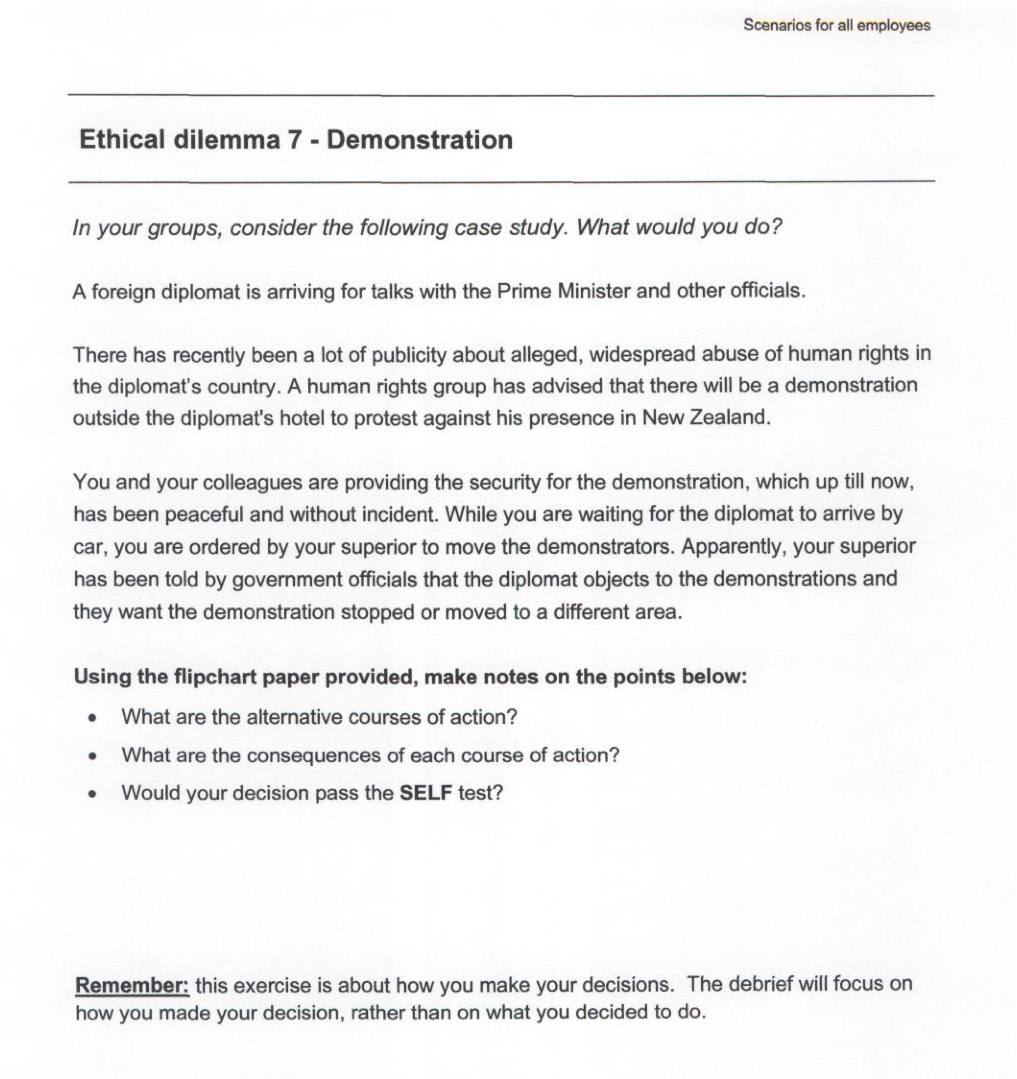
In theory the Police are there to protect our rights, including our right to participate in democratic protest, but it frequently feels like their main goal is to protect the dominance of the current power elite. It was interesting to see this scenario appear in the ethics training material the Police have developed since the Commission of Inquiry into Police Conduct (driven by the Police rape trials)

Ethical dilemma example 7
I would like to imagine this is a sign of a turning tide, and the Police will now be protecting our right to protest, but recent examples of deliberate and exploitative infiltration of protest groups, and the use of defenders of torturers like Mark Lowenthal by the Police for training and advice is hardly a good sign. Do these recent examples pass their own test?

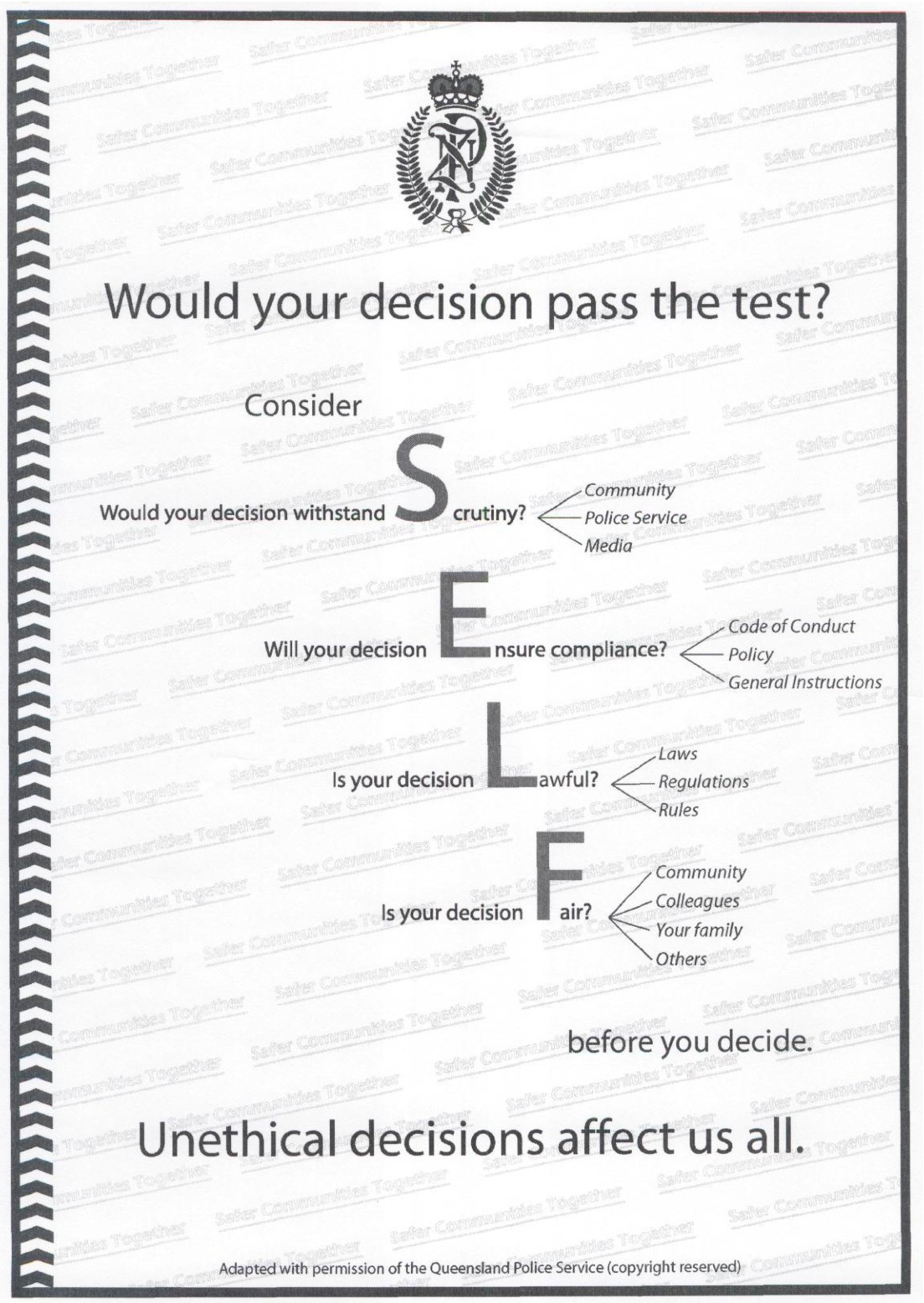
NZ Police SELF test

The class element in recent Middle Eastern elections.

Lost in the chorus of outrage over the Iranian election results and subsequent repression of protest is the socio-economic cleavages evident in the polls. The same is true of the coverage of the Lebanese parliamentary elections held two weeks earlier.  It is therefore worthwhile to examine this dimension.

President Amadinijhad represents not only the militant Islamicist ideological wing embodied in the Revolutionary Guard and the paramilitary Basij, who are now purportedly in a power struggle with the clerics in the Guardian Council over the direction of the post-revolutionary leadership movement. Amadinijhad also represents, both in tone and demeanour, the urban working and rural classes. Against him are poised the supporters of Mir Hossein Mousani, a former Prime Minister and Minister of Foreign Affairs who his supporters and Western analysts see as a reformist. He is also a millionaire who receives his support from the urban bourgeousie, secularists, the better educated and university students. In most aspects he is not discernably different from Amadinijhad with regard to major policy issues (such as the civilian nuclear energy program), but he does represent a modernizing element within the revolution, one that is more secular, more technologically savvy and more attuned to Western mores than the mullahs and Revolutionary Guards (at the elite level) and the working classes (at the base) that see Amadinijhad as a bastion against corrosive secularisation of the revolutionary ethos.

The election was a referendum not on Iran’s foreign policy (which the West is obsessed about), but on Amadinijhad’s economic management, which by any measure is poor and which, like in any other country, occupies the attention of the mass electorate. Iran is a net oil importer that cannot feed itself in spite of its large land mass and variegated geography, access to the sea and ample fresh water. It was also a contest between the cell phone and twitter generation and the rest, since only 30 percent of Iranians have access to computer facilities and less than half have access to cell phones. Clearly, Amadinijhad and the mullahs underestimated the power of cellphone and computer access, particiularly when the regime itself is now dependent on computer services and cell phones in order to conduct its daily business (which practically speaking means that universal shut downs or denials of service are nigh impossible). 

My belief is that Amadinijhad won the election, but by a narrow margin that spooked him and his supporters who felt that a close vote would undermine the face of strength and unity they wish to present to the West with regards to the nuclear progam, support for Hamas and Hezbollah and foreign relations in general, to say nothing of their relationship with the Sunni Arab world. Unfamiliar with the subtleties of vote fraud so well refined in advanced democracies, the Amadinijhad government–which controlled the balloting–padded their lead too much and hand counted votes too quickly to be credible. Hence the uproar.

But the genie is out of the bottle no matter what happens. Amadinijhad is dead in the water as far as having influence and leverage at home and abroad. In terms of foreign policy, he cannot purport to be the representative of any consensus vis a vis relations with the West, which undermines any bargaining position he hopes to maintain on key foreign policy issues (simply due to the lack of acknowledged majority support for his views). Domestically, the Revolutionary Guard and Basij has been sent a clear message that their ideological project is not shared by a wide swathe of Iranians. Moreover, the class divisions that precipitated the election crisis will not go away just because the government quells the protests. Thus, whether or not the West would like to intervene in the post-election process (a move that has never been proven to be successful over the long-term), the class conflict underpinning the electoral dispute will continue so long as both sides play the dispute in zero-sum terms. In the measure they do, they risk the possibility of civil war, since significant elements in the conventional military (particularly in the more technologically or professionally oriented branches of the Air Force and Navy) will not follow Revolutionary Guard orders to kill their own people  (if nothing else because the officer corps and non-commisioned officers are part of the middle classes), and because the “real” military will be needed to quell any mass revolt. In the measure that the Amadinijhad and Mousavi factions cut a deal and marginalise the Revolutionary Guard and Basij pustchists, the clerics and conventional officer corps will back them. The question is, can they reconcile the class conflicts in a political compromise that is mutually binding, universally acceptable and stable over time?

In Lebanon, Saad el-Hariri assumed the mantle of his assassinated father Rafic and gained a majority in the June 7 parliamentary elections, winning 71 of 128 seats . Hezbollah, led by Hassan Nasrallah, won 57 seats and accepted the outcome. Hezbollah represents the working class and Shiia vote in Lebanon; Hariri represents the Sunni, Christian, Druze, secularist and bourgeoise vote. The West applauded the result and urged Hariri to proceed with his father’s anti-Syrian and anti-Iranian project, which includes marginalising (and criminalising) Hezbollah. Understanding the realities on the ground, Saad el-Hariri has opted instead to form a  national unity government that includes Hezbollah because he apparently understands that class, not religious conflict, is what drives many to support the Shiia extremists (who deliver on their promises of social services far better than any of their pro-Western counterparts).

 What is remarkable is the unmentioned premise for Western political support in a Middle Eastern (or any other)  election: defense of upper class (read capitalist) interests at the expense of all others. To be sure, religious, ethnic and cultural conflicts are bound up in these electoral contests, but one thing remains clear: even in societies rendered by such superstructural forms of primary identification, it is class that drives the major political divisions, and it is class interest, capitalist class interests specifically, to which the West responds most favorably when it comes to electoral outcomes. All of this is obvious: for the West it seems electoral democracy is not so much about the freedom to choose but about the “freedom” to choose bourgeoise leaders who uphold the national capitalist class interest as well as an affinity for Western economic orientation and macroeconomic logics (in spite of the obvious debacles such orientation has produced in both the developed and developing world). The response to Hamas’s electoral victory is an indication of that view, above and beyond its problematic approach to violence, Iranian connections and  non-recognition of Israel. 

I should note that the current trend in both elections indicates a move away from religious militancy and towards moderate-secularism, which to my mind is a good thing. It also represents a specific repudiation of Shiia militancy, either in the form of the Revolutionary Guard ideology or the perspective of its Hezbollah and Hamas proxies in Lebanon and Palestine ( fully understanding the local conditions underpinning their respective support), something that will undoubtably comfort elites in the Sunni Arab world.

For the social democratic Left the elections pose a conundrum: who to support? The “bad guys” (at least in Western eyes) are supported by the working masses and rural poor; the “good guys” are supported by elites and other propertied groups as well as well-meaning sorts such as intellectuals and artists. The class line does not suffice to chart a course of response to such situations. For social democratic governments, this poses a major problem; for right wing governments such as that temporarily governing NZ, it does not. Thus the question begs: when confronted by this type of class conflict viewed through the prism of contested elections, does the democratic Left (in government or in opposition) choose democracy over class interest or vice versa? If so why, exactly? If not, why not?

All talk, no trousers – Labour’s position on pig farming

On Thursday last week Brendon Burns, a Labour MP on the primary production select committee, posted on Red Alert about pig farming. More precisely he said he was horrified by sow crates, and he’d had a little dig at the Minister about MAF’s Chief Vet. So far so average, aware of issues, making political mileage, but there might be more… 

So we asked, a whole bunch of comments on Red Alert and a whole bunch on a related post on The Standard, we asked “What is Labour going to do?”

You see this is an area where Labour, although in opposition, could make a real difference right now. All they need to do is say with conviction “Within two months of Labour next winning an election and leading a government we will introduce the necessary small change in legislation, and big change in the animal welfare code to ban sow crates etc[1], we would have the changes in place in our first 12 months, they would come into force 2 years later”. So every single pig farmer in New Zealand, because they might not support Labour but they know Labour will lead a government again, will know when they plan a new piggery or do maintenance on an old one, that they should make the necessary changes now, because it’s cheaper to do it now that retrofit later. So if Labour stood and and said it with conviction, the conditions of pigs would start changing – not as fast as they should, but some pigs would live less horrible lives in 2010.

But anyway, back on with the story, commenters asked what Labour would do, suggested changes that could be made, and Rochelle even offered a private members bill she’s drafted.

Brendon Burns and his Labour friends? Not a peep, not a word, not a comment. So on Saturday I bumped the post, and got a reply from Brendon Burns:

Might be that other Labour MPs are onto this but I am happy to receive suggestions on amending legislation and have a look.
And, btw, MPs are eating free range pork (and chicken.) I asked a question of Bellamys months ago and they have assured me, via their suppliers, that no sow-crate pork is used, none imported and all free range.

Yeah, that’s right, we’ve already offered a private members bill, and the best he can do is say Bellamies don’t use sow crated pork and chicken. 

But y’know he might just have forgotten to read any of the comments, so I posted another comment to check that he has actually got a copy of Rochelle’s bill and… silence.

Perhaps Labour has a Plan, and will be announcing their animal welfare policy any day now. Sadly, however, it appears that, for Labour, the suffering of pigs is nothing more than an opportunity for political point scoring.

How decidedly average.


[1] Where etc includes all the cruel things done to intensively farmed pigs and chooks.

How to guess the political will of the country

Logic says that the recent Key/National scandals and a week budget have got to be damaging National’s popularity, yet the polls are barely moving. l’ve been thinking about why this is and I have come up with three possibilities (others very welcome!)

  1. Outside the beltway no-one actually cares – none of the issues resonate with swing voters. Worth and Mt Albert were a side show for politics geeks, and no-one holds National responsible for the economy tanking.
  2. People are turning off National but they’re not turning to anything else. National may be losing its gloss, but Labour doesn’t look any more appetizing than it did in November last year.
  3. The election is a long way away and people will stick to their 2008 preference for a bit longer.it would seem fickle to switch allegiances so soon, and perhaps people feel they need to give Key a little longer to show his true mettle.

How, in the face of polls which simply ask how you would vote (a lagging indicator of mood), can we really judge the mood of the country?