A useful press release generator, or three

DPF’s post mentioning MediaCom, which allows you to get/send press releases via NZPA feed, reminded me of this, which I’ve been meaning to post for awhile. The reason PR companies need to spam people with press releases is because at a basic level they’re so easy to write that almost any idiot can hack one out in half an hour, and so people do. If you’re someone who relies on them, by the time you’ve read the title and the first three paragraphs in order to figure out whether the press release has anything relevant for you, its writer has already won.

Not to say that writing good press releases is easy – far from it, writing genuinely good press releases is extremely hard; so hard that very few people actually can, and even for those people it can seem futile because nobody knows whether your press release is any better than all the rest of the guff which is clogging their intertubes until they’ve read the title and the first three paragraphs. If you’re a CommsTart,* this is a very important skill, however, because by writing good press releases you give the overworked, underpaid minions of the Corporate News Machine a labour-saving device, and if you can consistently write to spec they will gladly shortlist your releases for pre-publication, sight unseen, because they don’t have time to read the title and the first three paragraphs because … well …

That stuff in them there press releases ends up in your media. I don’t have it to hand (Kate, can I have it back?), but I seem to recall that very thorough Cardiff University research commissioned by Nick Davies’ for his excellent book Flat Earth News found that no more than 12% of articles published in major British papers were entirely free from material published by someone’s PR department or agency. In my work as a media analyst, if I actually want to find out about a major issue I go to Scoop and try to triangulate the facts from everyone’s press releases before I bother with the actual end-user media outlets. It’s rare they can tell me something the stakeholders’ CommsTarts haven’t already.

These facts – it’s easy to do badly, hard to do well, indispensable and ubiquitous – are not lost upon the wags of the media world, who have taken delight in lampooning this most cherished aspect of their craft. There are lots of press release generators out there. Most are good for a black bit of fun – this by one of our few remaining satirists Lyndon Hood only deals with the the one topic of child abuse, but it has good bones.

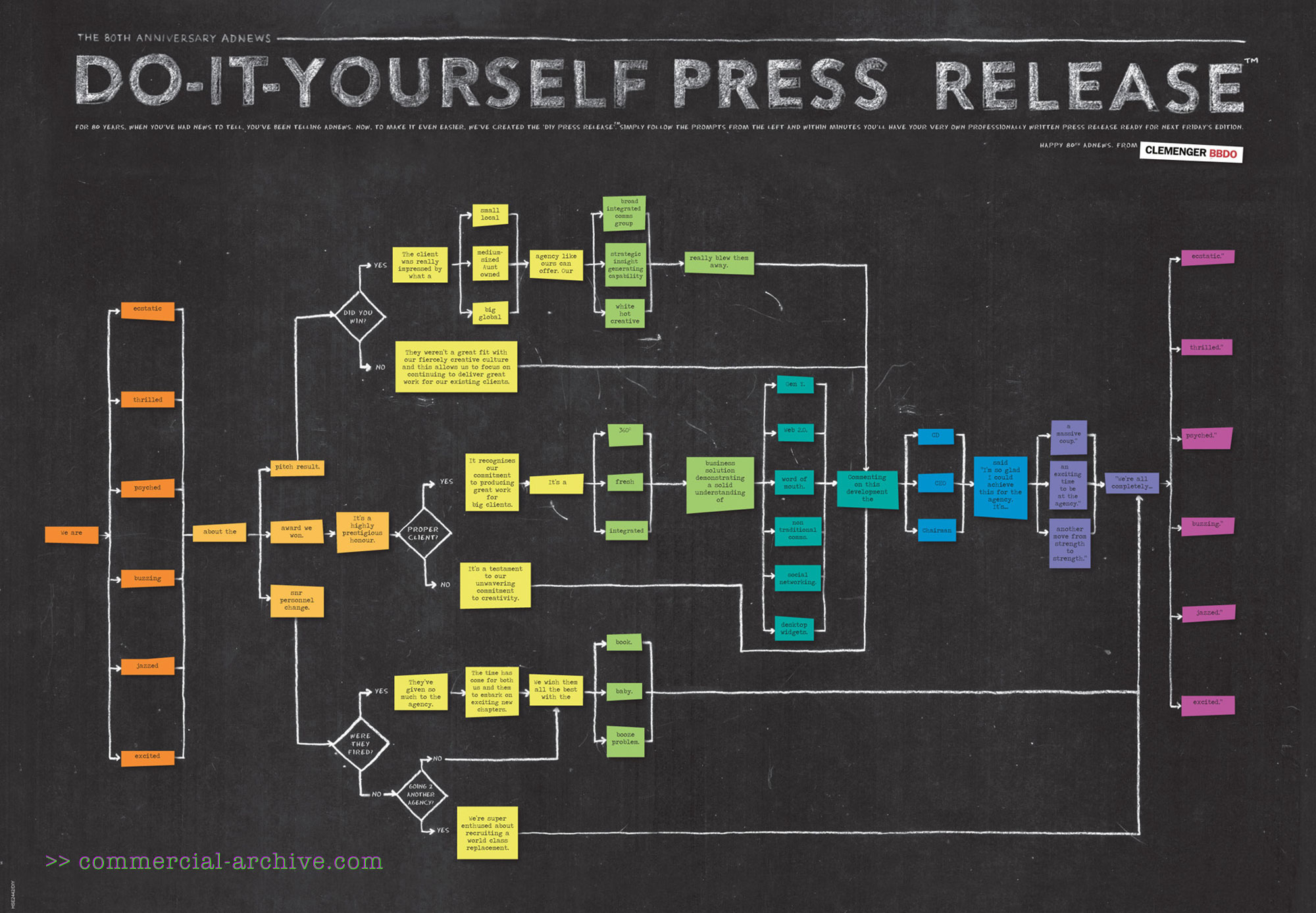
For the 80th birthday of AdNews, the Sydney office of Clemenger BBDO made this handy visual self-congratulatory press release generator:
adnews80thclem
(From commercial-archive.com.)
They know their stuff: this remains one of the best ways of quickly and efficiently putting together a quality press release – chop all the information up into bits of paper and arrange it so it flows, with just (barely) enough glue to keep people reading. Remember: the title and three paragraphs, and you win.

If you want industrial-strength, this one is made of much sterner stuff. Written by a computer programmer back in the Nineties and endlessly hacked on since, it and its variations will generate a dense blob of impressive verbiage – Bush-speak, web jargon, whatever you want. If fed the right source material, it would probably generate a halfway-competent press release.

It goes the other way, too – David Slack, in homage to George Orwell and Christopher Ketcham, created a DuckSpeak Translator which, if fed media-ready prose, would deliver you a lot of QUACKs and perhaps (if you were very fortunate or the author was very clever) a few actual words and even an idea. The DuckSpeak Translator is sadly no more, brought to its knees by the fact that David allowed any old idiot to add phrases to its vocabulary, so that by the time I got to using it sometime in 2006 it was so thoroughly clogged that you could put anything in and get nothing back but quacks – which may have been the intention after all. I think the project should be revived with a clean database, and phrases only admitted to its vocabulary if they have been taken cleanly from some rich source of such matter – such as the Hansard, or press releases. That’d be something worth quacking about.

L

* I use the term in gender-neutral reference to anyone whose work is tarting up their client’s self-interest so it can be mistaken for news.

Edit: Heh, the `or three’ on the end of the title was an afterthought added without reference to the previous post, which also contains it :)

Hate crimes law so that the Police can collect stats?!

TV3 had a piece in the first segment tonight about the Police wanting hate crimes legislation. Oddly they twice said that the reason the Police want the change in legislation is so that they can collect statistics on racially motivated crimes.

This makes me puzzle about four things:

  1. What are the racially motivated incidents that the Police currently can’t prosecute but would like to?
  2. Can’t the motivation of a crime already be used as part of the sentencing decision?
  3. If the Police want to capture statistics about racially motivated crimes why can’t they do that now?
  4. The Police are abysmal at responding to information requests, often saying they don’t have the data (even when it’s clear they once did), what would they do with these extra statistics?

Either way around, I’d be pretty uncomfortable with the idea that something is criminal because it is motivated by racism, rather than because of its actual outcomes – if you hit someone because they’re Asian it’s just as wrong as hitting them because they’re queer, or remind you of your ex, or because you’d had too much to drink.

[I recommend Rich and Lew‘s posts about hate speech legislation which canvas some of this area]

National: cutting their way into the recession

At Pundit Nicky Hager has an article up about National’s “spending” plans. Based on leaked material he shows that, having started to realise the gravity of the recession, English has increased capital expenditure by no more than an additional $250 million of capital spending a year: in terms of government spending that’s nearly nothing. As Hager concludes:

As the country heads into the worst recession of our lifetimes, John Key and Bill English have decided against any significant economic stimulus package. As other countries acknowledge the magnitude of the crisis and spend, our Cabinet will be putting their energy into finding places to cut.

At the same time the National cabinet is taking a knife to operational spending: 10% here, at least 500 jobs there, 30 more over here. These cuts of operational cuts will very quickly add up to $250 million, not to mention poorer services for all New Zealanders,

So National’s plans to get us out of the recession are… exactly what their plans always were: cut, cut and cut. Less service, less support, and what money there is will be redirected to the private sector labelled “infrastructure investment” and “improved competition”.

The Police brought this on themselves

Why are so many of us making so much noise about the investigations into Halatau Naitoko’s death?

There are three things that are influencing me:

  1. The Police have a history of failing to properly investigate their own, and even of covering up for colleagues. 
  2. There is a recent history of the Police undertaking disproportionate investigation and action on firearms charges against activists, and I’m still pretty riled by it.
  3. Their employees have behaved dishonourably in so many ways in recent memory and the Police have not apologised or truly addressed the actions.

Does this mean there was necessarily anything wrong with the Police’s action on Auckland’s Northwestern motorway? No

Does this mean there was necessarily anything wrong with actions of the individual AOS members? No.

Does it mean I am even remotely comfortable with the Police determining what investigation will be undertaken, how it will be undertaken and who will do it? Hell no!

The reality is that the Police brought this storm on themselves, by having behaved so badly in the past they have damaged our trust in them and they have made little attempt to rebuild it.

Several years ago I knew a man who had worked in the AOS for many years; a good and honourable man. When I heard what had happened on Friday I had two first instincts, the first was to imagine the officer who had pulled the trigger and think of the man I knew and feel for the officer’s pain and guilt. The second was to think “Oh here we go, let’s see how fast the spin kicks in and how fast and deep they bury the investigation”.

The individual officers who were there on Friday deserve and have my thoughts and sympathy. I can’t imagine the pain and guilt they are feeling right now, and I am so very grateful to them for everything they do to keep us safe.

The Police organisation, however, deserves every piece of cynicism and distrust I direct its way.

The Police Officer or the Police?

Idiot/Savant puts forward the case that the Police Officer who shot and killed Halatau Naitoko should be charged:

Look at the precedents: hunters kill their mates in tragic accidents fairly frequently. They are usually made to stand trial for careless use of a firearm, or in cases where there is clear negligence, manslaughter. Some are discharged, some are convicted, some end up on home detention, some (in very serious cases) end up in jail. We do this, despite the tragic circumstances, because we as a society have decided that people who play with guns need to exercise the utmost care and responsibility when doing so.

To take a different set of analogies, however, sometimes when someone kills with a vehicle they are charged, sometimes it is the employer that is charged when it is clear that it was the practices of the employer that was at fault. Perhaps this is a case where the Police should be charged with having work practices that led to a death.

When there is a bad outcome of a Police action it is sometimes the fault of the Police, sometimes of the individual officer, sometimes both, but by focussing on the individual Officer we allow the Police off the hook. It seems to me that there are times when the Police plays on that focus on the individual to move the spotlight away from their poor culture or organisational practices.

Having just skimmed the Health and Safety and Employment Act and the Crown Organisations (Criminal Liability) Act it appears that the Police could be prosecuted (although I may have become very confused by the nature of “person”s). If so, then if the death was caused by a Police practice there is an opportunity to hold the Police to account without needing to prosecute the individual Officer for their employer’s mistake.

What do they mean by private healthcare provision?

In a number of threads people have brought up the idea that our existing publicly provided health system is fundamentally flawed and should be replaced by a privately provided healthcare system. Every time I read that argument I want to make a single (bold face) point:

The vast majority of our healthcare is provided by private providers.

The vast majority.

Take me for example, I see my GP (private provider), I have blood tests (private provider), scans (usually a private provider), take medication (private provider) and see a number of specialists (my main one is public but occasionally other public or private specialists). All except the specialists are private providers at least partly funded by the government.  One specialist is a public provider entirely publicly funded.

The only surgery I ever had was in a private hospital fully funded by the government.

So why, if the current health system is so broken, does anyone think that private provision is the answer?

I can see three possible reasons National and Act are arguing for “private health provision”:

  1. Transfer the last of the public money to the private sector to create private sector profits for shareholders.
  2. They don’t mean “private provision” they mean “private funding”, they actually want to cut the government spend and rely on individuals funding their own healthcare. Advantageous for the wealthy (who already have health insurance and would benefit from the tax cuts), disastrous for the poor who can’t afford private cover or care and don’t get tax cuts from the Nats.
  3. Ideological blindness.

Two are awfully cynical and the other requires a level of stupidity I don’t believe they have, any other offers?

Catching the train to work

Yesterday I caught the train to work; I live in Wellington, I’m working in Palmerston North a couple of days a week.

On the trip I had breakfast, did an hour’s work, read and wrote some email, wrote a post, and did some good stretches. It cost less than the petrol would have done, it got me to PN in a comparable time, and in heaps of time for my first meeting.

That service exists solely because of public intervention, it runs on publicly owned rolling stock on publicly owned track.

As I whizzed through the countryside in the sunshine I wondered two things

  1. Why were there so many cars on the road? So many cars with only a single person in them. Why weren’t they on my train (or the one in the other direction), or the bus, or even car pooling?
  2. Why does it take government intervention to create a way for me, a private sector worker, to commute to my private sector job in a cost-effective environmentally friendly way?