Another locked closet.

The old saying that the two things one does not want to see being made are sausage and legislation comes to mind given that the Security Intelligence Amendment Bill public submission hearings commence this week (the first reading on the Bill was held in December, during the usual Xmas lull in which serious media scrutiny of pretty much anything unrelated to the season is negligible). Labour and the Greens wanted the submission hearings to be held in public, but the government has knocked that back and declared that they will be held in “private” ( that is, in secret). Although submitters can disseminate their submissions as they see fit, the content of the meetings, including questions by committee members and submitters, are subject to non-disclosure provisos. 

Regardless of the  subject of the hearings, which has to do with specifying the scope of SIS authority and the warrant process involved in conducting surveillance of new electronic technologies such as mobile phones, GPS systems and other gadgets, the failure to hold public hearings is yet another sign of the ingrained authoritarianism of the political elite and its disdain, if not contempt, for the pubic at large. For example, one of the reasons for the surveillance upgrade, according to the government, is the security concerns surrounding the Rugby World Cup. To use that as a rationale beggers belief and just shows the disconnect between the thinking public and what National believes the public will swallow (the reasons why the RWC is not going to be a terrorist target are many but suffice it to say that NZ security agencies have a vested bureaucratic interest in hyping the threat. And should they come, RWC threats will be of a local dissident-protest rather than terrorist in nature, and will not require anything beyond what is already in place in terms of warrants for electronic eavesdropping).

Labour’s call for public hearings is pretty rich given that during its term in office it never held a single one when it came to SIS matters. The Greens, as always when it comes to such things, stand on principle. What is interesting is that the Maori Party and ACT, which have members on the Intelligence and Security oversight committee that will chair the hearings, have sided with National on the issue of transparency–that is, they have opted for the closet rather than the open door when it comes to airing contending views on juxtaposed issues of national security and civil rights. What this says about the Maori Party and ACT leadership, given the targeting of the former’s members by the SIS and the supposed championing by the latter of civil rights, individual freedoms and governmental accountability, I am not not in a position to say. But what I can say is this: the move to hold the SIS Amendment Bill public submission hearings in private is designed to cover the fact that the oversight committee is going to disregard submissions against the granting of expanded surveillance powers to the SIS and will rubber-stamp the legislative changes in any event. There will be no incisive or critical questions offered by committee members with regard to how the electronic spying will be carried out, under what circumstances, for what purposes and with whom it will be shared. 

Instead, there will be a collective nod and wave by the majority of the committee behind closed doors, and the SIS Amendment Bill will pass. What is being protected is not state secrets, not confidential material, or anything remotely connected to national security. The reason the hearings will be held behind closed doors is to conceal the lackey lock-step into which the committee will fall. It is about saving coalition face in an election year rather than addressing the serious concerns of intelligence service power-expansion. That shallow political PR calculation is the sole reason why these hearings will be held in secret.

So much for informed public consent and parliamentary accountability when it comes to security and intelligence in this small democracy.

Off the hook

On Red Alert, Clare Curran has a hapless pro-forma whinge about the standard of media coverage in New Zealand vis-a-vis in the UK, where a quarter million people are presently engaging in running battles with police; compared with here, where the media are obsessed with Darren Hughes.

Excuse me if I sound like a broken record, but the fundamental issue here isn’t exactly uncharted territory, and the fact that Clare has a lower opinion of the media than I do should make it easier to accept my advice, which is this: If you want the media to talk about something, Clare, give them a reason to talk about it. Make a stink, cause a scene, do something which makes not talking about it impossible. As a quote attributed to Benjamin Franklin says: write a book, or do something worth writing a book about.

If you don’t give the media a compelling reason to care, don’t be surprised if they don’t. If you don’t provide them with something powerful to cover, they’ll go with scandal and innuendo every time. In the fable of the scorpion and the frog, the scorpion stings the frog. Why? To do so is in its nature. Frogs, while unable to prevent scorpions from stinging, would at least be wise to deny them the opportunity.

With that in mind, some of the following in this case might also have helped:

  • Have frontbench MPs not do stupid stuff which appeals to the public (not the media) sense of scandalous voyeurism;
  • Have your party leader do more than the absolute minimum possible in response to said scandal;
  • In doing more than the absolute minimum, have the party leader respond in just one move rather than in several successive ineffectual steps which maximise the coverage across several news cycles, including a weekend leading into a Parliamentary recess when political news is going to be thin on the ground anyway;
  • Ensure the party president is sufficiently apprised of said scandal that he finds out about it by some means other than reading the papers;
  • Even in the incredibly unlikely event that you can’t do the preceding, at least have your party leader and president sit down together for long enough to agree on a unified position, so as not to give credence to rumours of a leadership challenge.

It’s not that Labour didn’t give the media something to cover, so the media covered the Darren Hughes scandal by default: it’s that Labour gave the media the Darren Hughes scandal to cover, covered in juicy scandal juice, and then didn’t give them anything more compelling to cover instead. (As if there is something more compelling than a sexual investigation into a male frontbench MP’s alleged dalliance with a teenaged male youth MP in the house of the deputy leader after a Parliamentary function, which was covered up for two weeks by the party leader.)

Let me be crystal clear: the issue here is not about right and wrong, or about justice. Perhaps it should be, but electoral politics is not about what should be; it’s about what is. If you choose to privilege ‘justice’ over ‘politics’, as Phil Goff claimed on Q+A this morning, there’s a political cost to doing so; a political cost which, while it might be regrettable, isn’t something to whinge about. After all: if you made the choice you’re presumably better off than if you’d chosen differently. To behave as if it were otherwise, and to blame the media for their role in exacting that price is to blame the scorpion for having a sting in its tail.

Anyone to whom this dynamic isn’t clear has no business running strategy for a Sunday book club, much less a political party which aspires to government. As long as Labour continue to fail at this, one of the most basic tasks of politics, the phone will remain off the hook.

L

Shame on the Herald

… for trying to run game on New Zealand, scaremongering the Foreshore and Seabed hÄ«koi:

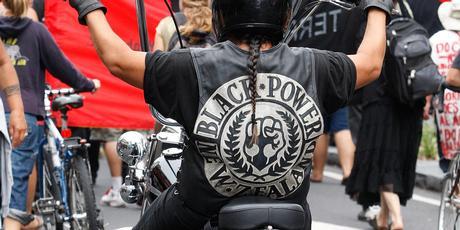
That was on page four of the dead tree edition, and online here, under the headline “Opponents put up roadblocks to bill”. Use of this outrageously unrepresentative photo makes a number of unjustified implications which aren’t present in Claire Trevett’s generally factual and balanced article. These include:

  • Most obviously, the suggestion that the marchers are gang members, with the implication of violence and public menace that creates, despite the fact that the march was peaceful having been mentioned in the opening sentence of Trevett’s article;
  • Creation of a general equivalence between Māori protesters and gang members, with all the racism that implies;
  • The suggestion that opponents of the foreshore and seabed legislation are acting on a separatist “black power” imperative, when the article makes clear that the opponents mentioned in the headline are an ideological grab-bag consisting of the ACT and Green parties, and Hone Harawira;
  • The suggestion that the marchers are literally blocking roads, when the article makes clear that the roadblocks referred to in the headline are metaphorical, and little more than the usual sort of procedural delaying tactics employed in Parliament to drag out the progress of a bill — in this case until next week, when the hÄ«koi reaches Wellington.

The core message of this choice of photo to accompany what is mostly a story about the trivial frustrations of a government trying to pass an unpopular law is this: Māori radicals and gangs are forcibly blocking this law, and they will block you from the beach as well.

It would be absurd if it wasn’t so offensively misleading.

(via Pascal’s bookie)

L

Gulp!

ACT MP and lawyer Hilary Calvert, on the Marine & Coastal Area (Takutai Moana) Bill, in Parliament last night:

“Historical use of the seabed any significant distance from the shore seems impossible to prove, and allowing for title over it to be granted over it to iwi allows for unjust and potentially divisive future claims. No one historically crawled about on the seabed miles from shore. There was just no chance of anybody holding their breath from 1840 til now on the seabed. It’s not gonna happen.

(My emphasis.)

Once again, I think we all owe a debt of gratitude to the ACT party for illustrating so plainly to us what — and how — they really think.

L

Double-tracking

Danyl Mclauchlan posits a conspiracy theory:

there is a pretty great opportunity to use the Maori seats to rort the system: if you had two Maori Parties, one that ran electoral candidates in six out of the seven electorates and only canvased for electorate votes, and another that had a safe seat in the seventh electorate and only canvased for party list votes in the other regions then you could, conceivably, end up with a dozen MPs (albeit with some overhang due to your electorate imbalance) and hold the balance of power in perpetuity.

Danyl’s scheme is essentially what the Greens tentatively proposed before the last election: green voters in Māori electorates consider casting electorate votes for the māori party candidate, and māori party voters cast their party vote for the Greens. The proposal was rejected by the māori party, which at the time was (in my view) a tactical error but a wise strategic choice.

It was a tactical error because of the efficiency argument (a positive-sum alliance permitting the two parties to extract more parliamentary representation from the same base of electoral support). But without the benefit of hindsight it was a good strategic move because the māori party’s whole point was not to be shackled to the ‘Pākehā’ parties, and its long-term survival still likely depends on its establishing its own persistent powerbase; one which could stand a chance of surviving even the abolition of the Māori seats. The only way to do that is to grow the party vote by strengthening ‘brand’ support among its electorate. (Also the proposal was made quite late in the campaign, and the potential for voter confusion was high.)

Those factors which made the plan a strong strategic risk for the māori party in 2008 now no longer obtain, or at least not so strongly. It has largely sacrificed its independence from the Pākehā political mainstream anyway, and could potentially lose considerable support for that reason. It may hang onto electorates, but it is likely that ‘brand’ support is lower than before. So with the benefit of hingsight, they might as well have gone with the Greens last time. Nowadays, they have a radical wing-man in Hone, who will work with them and who shares, despite all the rhetorical ructions, considerable common ground with the party’s other members and its foundational kaupapa. They can work together; Hone working to attract the ‘brand’ support for an independent indigenous party, the existing māori party maintaining their electorate positions and continuing to work within the mainstream.

I’m not convinced this will happen — as the Richards say in comments to Danyl’s post, a lot of it is personality-bound — but it could work in principle.

There’s one other factor, though. Although ACT and National have been collaborating in this way since Rodney Hide was gifted Epsom, the moment the māori party and a new radical wing led by Hone start doing it, the headline will be “Maaries rorting democracy to establish an apartheid state”. Those who’ve been benefiting from this sort of positive-sum electoral coordination for years will be those most urgently banging that drum and waving those banners. That’s a powerful disincentive.

Edit to add: Of course, there’s also a referendum on MMP on the day of the election. A scheme such as this would be an outstanding means of undermining MMP’s popular support and endangering its future.

L

A PRC Fifth Column in NZ? (With Updated Links)

In early December the New Citizen Party registered with the Electoral Commission and declared its intention to contest this year’s elections, starting with the Botany by-election caused by Pansy Wong’s resignation in disgrace from Parliament. Taking a page from the Maori Party, the NCP declared that it would be a vehicle for the representation of new, mostly Asian, migrant’s interests in the NZ political system, interests that are not fully given voice within extant political parties. With an emphasis on economic policy and law and order issues, the NCP proposes to represent not only mainland Chinese migrants, but also Koreans, Taiwanese, Japanese, Singaporeans, Indians, non-native Whites and even Maori and Pakeha (i.e. the Botany demographic). That will be a tall order.

The announced leaders of the NCP include Jack Chen, who was involved in the Chinese takeover bid for Crafar Farms (as a representative of Natural Dairy NZ, a subsidiary of the Chinese government controlled Jin Hui Mining Corporation); disgraced Labour Party candidate Stephen Ching (who solicited bribes for political favours in 2005); the pro-PRC Chinese-language newspaper editor Jerry Wen Yang; and Paul Young, who is also of Chinese descent and a principle of Asia Marketing and Advertising Consultants (Mr. Young handled the registration process and has said that his role as NCP Secretary is a temporary formality in order to meet legal requirements, and that he will stand down once the party leadership is finalised. As it turns out, he is NCP candidate for Botany). Although unconfirmed, there are reports that Sammy Wong, Pansy Wong’s husband and the cause of her demise by involving her in a commercial transaction during a taxpayer trip to the PRC, is part of the NCP leadership or at least involved in its strategic decision-making and financing.

In early January the NCP leadership, minus Mr. Young, met in Beijing to discuss a strategy for winning the by-election and to chart a course for its campaign this year. Holding a major party meeting in a foreign capital is interesting enough, because it shows an overt connection with the PRC that is bound to raise eyebrows in some circles (which is a tame reaction by comparison–some democracies forbid the funding, meeting  and sponsorship of political parties in and by foreign powers). What is more interesting is the question of whether the connection to Beijing is more intimate than the NCP has revealed to date, and extends beyond the usual business links that all political parties cultivate in order to peddle influence and financially support their activities (although the direct connection to a foreign government and/or corporations would be a a step beyond what is the usual course of affairs in NZ business-political party relations).

Under MMP, people have a right to organise a political party as they see fit, and as far as I can tell there are no prohibitions on such parties being organised and funded by foreign agents. But there remains the question as to whether the NCP is not so much a vehicle for the representation of new migrant’s interests in the NZ political system as it is a front for PRC economic interests and a means of political influence-mongering and intelligence gathering. In other words, is the NCP a PRC fifth column?

The reason this question must be asked is that, given its disadvantages in Signals (SIGINT) and Technical Intelligence (TECHINT)-gathering capabilities,  the PRC invests heavily in the ethnic Chinese diaspora for human intelligence gathering work. Using business, student and permanent resident visa schemes in targeted countries, the PRC places intelligence-gatherers in places where they can collect tactical as well as strategic intelligence using a variety of means. It also uses monetary incentives to curry favourable attitudes amongst local elites, all in the interest of furthering PRC strategic objectives in the country in question. Such activities have been amply evident in places such as Fiji, Papua New Guinea, Tonga and the Cook Islands, as well as regional organisations such as the Pacific Island Forum.

All of this is well known to Western security agencies and measures have been implemented to monitor, if not counter PRC initiatives in that field. But what if the PRC were to secure political representation in a foreign government via open electoral contestation within the limits of the law? NZ has already seen a case where a cabinet minister (Wong) was influenced by an individual (her husband) with direct and close connections to the PRC regime. Although her portfolio was not strategically sensitive, she did attend cabinet and caucus meetings where more sensitive issues of national and party policy were bound to have been discussed, and it is not improbable to think that her pillow and dinner table talk with Sammy Wong might involve some of those issues (note that I am not saying that Mrs. Wong would necessarily have any idea that Sammy Wong was a PRC agent if he were one. What I am saying is that the appearance of a conflict of interest extends beyond the use of taxpayer dollars to pay for her travel when on private business on her husband’s behalf, and that may be the more serious reason why she was forced to resign).

If the PRC has direct involvement with the NCP, an electoral victory by the latter would raise the possibility of its entering into coalition with one of the major parties, most likely the party in power. That would give it direct access to NZ government policy deliberations, privileged information about business and security matters as well as offer a means of extending its influence directly into the NZ cabinet. This may or may not be a bad thing, depending on one’s perspective. But the question has to be asked whether Kiwis would accept similar direct US, Iranian, British, Afghan or Australian influence in government decision-making even if it did not involve adversarial intelligence-gathering. Judging from the reaction to revelations in wikileaks cables that some NZ citizens in positions of power provided “insider” information to the US embassy in Wellington, one would suspect that the answer is “no.”

The (hypothetical) situation of the NCP being used as a PRC front with intelligence-gathering duties within parliament is made all the more interesting by recent changes ordered by the National government with regards to the SIS spying on MPs. The result of the scandal caused by revelations that the SIS spied on Green MPs for decades, John Key ordered that the SIS no longer spy on MPs. That means that a NCP MP working for the PRC could conduct his or her intelligence-gathering activities with relative impunity unless there are provisions in the revamped domestic espionage and counter-espionage charter that specifically provides for exceptions to the no-spying-on MPs rule. But if the exception is invoked that could undermine broader counter-intelligence efforts with regards to the PRC. The conundrum produced by this hypothetical but potential scenario, in other words, is quite exquisite.

Less people feel that these questions are occasioned by racial or ethnic bias, let it be clear that it is not. The questions refer to the PRC, an authoritarian regime, and not to the Chinese or any other ethnic group. As mentioned in a previous paragraph, the same questions could be asked of local political parties directly controlled or overtly influenced by any other foreign power regardless of regime type. So the issue is about who controls the NCP as opposed to who ultimately will represent it.

Bringing the issue up may seem provocative and perhaps un-PC, but given the Beijing meeting, the people currently in NCP leadership positions and given the PRC’s modus operandi when it comes to deploying intelligence assets and extending its influence into foreign governments, it needs to be raised.

In light of the above, for its own sake and in the interest of democratic transparency it behooves the NCP to open its books and reveal its links (should they exist) to the PRC, directly or indirectly. It behooves the NCP to make clear where its loyalties lie and to disprove apriori the suspicion that it may be working as a foreign-backed front in the NZ political system. And given that the Botany by-election will be held in less than two months, that process of proactive accountability needs to begin now.

UPDATE: Since there is some debate as to how I came to my speculation in this post, here are a couple of links that detail PRC intelligence-gathering characteristics: http://www.stratfor.com/node/156898/analysis/20100314_intelligence_services_part_1_spying_chinese_characteristics

and : http://www.stratfor.com/weekly/20110119-chinese-espionage-and-french-trade-secrets

Upon reading the links, does my conjecture still seem crazy (or bigoted)?

Playing us for suckers.

John Key has announced that changes to the SIS enabling laws that will expand its powers of surveillance of cell phones and computers as well as its use of electronic tracking devices will be pushed through parliament before the Rugby World Cup. He claims it is necessary to do so because “many world leaders” will be visiting during the RWC and appropriate security measures must be in place that require changes to the 41 year old SIS charter. The Privacy Commission advised for a three year review of the pertinent laws but was ignored.

This is the second time that Mr. Key has used the RWC to justify a modification of a security measure, the first being the withdrawal of the NZSAS from Afghanistan in 2011 because they are needed for duty at the RWC. Just as it is ludicrous to believe that NZ’s most elite troops would be used as guards or stand-bys for a sporting event held in Aotearoa, it is also an insult to the NZ public intelligence to claim that the RWC is the reason for the law changes that expand the SIS powers of search and surveillance.

The changes are actually just another continuation of the steady expansion of the NZ security apparatus over the last ten years. It runs in parallel with the proposed Search and Surveillance Bill, which gives wiretapping and eavesdropping authority to a range of local and national agencies that have nothing to do with security. Each year the SIS budget increases, as does its personnel. Police intelligence has also increased in numbers and seen its role expanded. The question is, first, what threats exist now that require such an expansion of the coercive powers of the State?  Are these threats of such a magnitude that basic civil liberties must be curtailed in the purported interest of national security? If so, why are they not publicly identified and enumerated so as to raise public awareness of them? If not, why, in an age of public bureaucracy down-sizing and privatisation, is the repressive apparatus growing, especially in its internal dimension?

Truth be told, all claims about terrorists notwithstanding, from where I sit there appears to be very little in the way of new, imminent and developed threats that constitute a clear and present danger to NZ national security so as to justify the continued expansion of the repressive apparatus at the expense of civil liberties.

We will never hear an answer to the questions I have just posed because John Key says that “it is not in the public interest” for hearings on the proposed changes be open to scrutiny. Instead, submissions on the proposed changes will be open to the public but the hearings on them held in private because–you guessed it–it was “not in the interests of national security” for the hearings to be heard openly. In sum: for John Key, the public logic is that for the sake of a one-off athletic event that is limited to a handful of former rugby-playing Commonwealth countries and some joiners (unlike more universal competitions like the World Cup, the Olympics or Commonwealth Games), the entire fabric of (mostly domestic) intelligence-gathering must be expanded and domestic liberties further curtailed.

One wonders what National’s  private logic is.

What are Mr. Key and his pipe dream team smoking that he can bald-faced say such utter nonsense and expect the NZ to be so gullible as to believe him? Or is the NZ public that stupid that it will believe that these proposed law changes are needed to protect visiting world leaders at the RWC and are so sensitive that their merits cannot be debated openly? Does he think that Kiwis do not care about legislation that curtails their basic rights, or that they believe that it is best to allow the government to just push through tougher ‘anti-crime” laws without public debate?

It could well be the case that the proposed changes are due to the fact that advances in telecommunications have allowed criminal and extremist groups to transfer funds and send instructions more easily and securely in and out of NZ. It could well be that criminal and extremists groups are scheming and plotting in NZ, and the proposed law changes will allow the SIS to better counter them. But that should be publicly explained and justified, not considered privately within the confines of the Parliamentary Security and Intelligence Committee, which is comprised of a grand total of 5 people and in which the government has the majority.

The bottom line is that the proposed legislation has nothing to do with the RWC and all to do with an ongoing expansion of the State’s powers of coercion at a time when its ideological apparatuses are increasingly failing to reproduce mass consent to the elite’s preferred ideological project. Having supported the equation of dissent with terrorism while in Opposition during the 5th Labour government, National is keen to ramrod more encroachments on basic rights in pursuit of the challenged elite project. Having eroded the right to organise and collectively defend worker’s interests while opening up the country to a variety of investors, yet having its hopes for asset sales to foreigners  and de-regulated mining on public lands thwarted by public resistance, National has turned to the old canard of “security” to dupe the public into giving up more rights to the State.

Raising the spectre of security threats provides a convenient cloak for the assertion of State powers of control and punishment on all those who challenge it, criminal or benign. That is why Mr. Key wants hearings on the proposed changes to be held behind closed doors, because if they were made public then open challenges can be made to the justifications for an expansion of SIS powers as well as the underlying reasons for them.

Mr. Key and his minions must be resisted as the closet authoritarians that they are.  In democracy. law changes need to receive a full and open airing, it is changes to security and intelligence laws that threaten the fundamental rights that lie at the heart of democratic society. The proposed changes are one such instance, which makes it too important a matter to be left to the privacy of the Parliamentary Security and Intelligence Committee in the run-up to the RWC. Mr Key cannot have it both ways: either he believes in democratic accountability when it it comes to national security matters and its impact on fundamental rights and restrictions on them, or he believes in elite perogative, to include the issue of balancing of security and rights.

The only way to find out is to force him to choose, and for that to happen requires an Opposition that understands–surprise, surprise– that political advantage can often be gained by standing on principle. One can only hope that is now is such a moment of realisation for Labour, even if it means turning on the monster that it created nearly ten years ago.

The Perils of the Dark Side

Via 3 News journalist Patrick Gower on Twitter, the news that Pita Sharples is the keynote speaker at the Destiny Church annual conference this Labour weekend. Concerning news.

Except I’m not sure it’s completely accurate. According to the Destiny press release, Sharples is the keynote speaker at the Friday night Awards & Recognition event which kicks the conference off, while (who else) Bishop Brian Tamaki is the “keynote preacher” for the weekend-long event. I think this is an important distinction: it’s appropriate for Sharples, with a lifetime of support for Māori excellence, to be present for an event which celebrates achievements in “business, management, the health and social services sectors, Pacific arts, family breakthrough and contribution to at-risk youth” for a large and largely Māori organisation, featuring pasifika and kapa haka performances to boot.

But that’s quite a different thing to lending the imprimatur of his status as the co-leader of a government party and Minister of Māori Affairs to the shady cultishness of Destiny’s main event. This is not to say that Sharples should shun Destiny outright: after all, as a kaupapa Māori politician he does represent some of the group’s members, and many non-members who share some of their values. Such ‘Dark sides’ of support exist for almost every party; the Greens have their crazed dark-green environmentalists; Labour has the blue-collar rednecks about whom I’ve written previously; ACT has mostly sucked away the white-collar rednecks (and doesn’t mind admitting it) from National, but the Nats still have the worst offenders among the farming lobby and many of the least-savoury Christian sects (much of Destiny undoubtedly included). For all that they might be abhorrent to some, these are all legitimate interest groups and — within reasonable bounds — they must be tolerated and their needs entertained in a free society. Their members have as much right to democracy as anyone else, but (as with any fringe group) politicians must be extremely circumspect about the type and quantity of support that they grant.

There is a danger that Pita Sharples will be seen to pander too much to Destiny; and indeed a danger that he does pander to them. The māori party paddles turbulent waters at present; having compromised very heavily on the Marine & Coastal Area/Takutai Moana legislation to replace the Foreshore & Seabed Act, and now finds that Faustian bargain under attack both from the ACT party without and from Hone Harawira within. Despite the former, and probably because of the latter, they have been very quiet lately. Although they — ironically — share some common ground with Labour on the Takutai Moana bill, there remains a very large gulf between them; not least because Labour’s own conference signals a much more classical materialist direction than that which has previously obtained. Sharples and Turia are no fools, and can see that remaining a client of Key’s pragmatic-instrumentalist National party is a hiding to nothing — even with the ACT party likely out of the picture after the next election, the likelihood that they can maintain common cause once the other has outlived its immediate use seems slender. So they feel like they need another support base, and it must be very tempting to team up with a charismatic leader such as Brian Tamaki at a time like this.

It would be ruinous to do so. Most obviously, this is because outside of his most loyal followers — his 700 Sons — Tamaki’s is an illusory sort of strength, based on the smoke and mirrors of a showman’s art rather than upon deep loyalty and conviction. This much was clearly shown in the 2005 and 2008 elections, where the Destiny Party (and later the Family Party with Destiny’s express endorsement) failed to come close to success, due largely to a lack of internal cohesion. Destiny has failed to demonstrate — even at the height of its profile five years ago, under a government largely hostile to it — that it could mobilise a meaningful number of votes.

The second, and by far the more important reason, is the abhorrent nature of the policies and principles Destiny stands for — crude Daddy State authoritarian Christian conservatism with a brownish tinge; illiberal, intolerant, homophobic and misogynistic, quite opposed to where Aotearoa is heading. And that’s to say nothing of the corruption and appalling social dysfunction endemic to the evangelical cults of which Destiny is an example. The sorts of scandals which currently rock the church of Tamaki’s own “spiritual father” Eddie Long in the USA must undoubtedly also exist within Destiny. This is essentially the same package of qualities which turned the Exclusive Brethren to political poison for Don Brash’s National party in 2005. Because of this deep and fundamental disconnect, and New Zealanders’ innate distrust of folk who think they’re ‘exclusive’ (especially if they’re brown, wealthy or religious), the reality is that an alliance between the māori party and Destiny would likewise be poison, and would probably circumscribe any future prospects of working with either of the two main parties, not to mention utterly ruling out the Green party — with whom the māori party shares the most policy in common.

So there is no easy course for the māori party in the long term; the swell is heavy and the winds both strong and changeable. But to extend the nautical metaphor, Destiny is a reef; not an island. Better that they paddle on by their own course and seek more solid ground.

L

Frogs, toadies and tadpoles


There’s been a long and turgid discussion about the Greens’ support for the Canterbury Earthquake Response & Recovery Act (CERRA) on Frogblog, with commenters including many of the usuals from around the blogosphere, Russel Norman and Kevin Hague, and someone called BJ Chip (who I assume is a comms flack) running defence for the Green party. (I can’t figure out how to link to individual comments, sorry). Another commenter, Geoff Fischer, makes a persuasive case against the Greens’ newfound pragmatism, both on the Frogblog thread and on his own site. Whilst I don’t entirely agree with Geoff (I’m a pragmatist at heart) I think his critique is a good one, particularly for the Greens (who aren’t). But there are also strong pragmatic grounds to attack the Greens’ decision to support the CERRA; grounds which, if the Greens are serious about their new realpolitik posture, they’d do well to consider.

I’m often disappointed by the Greens’ persistent — even pigheaded — reliance on the ‘principled stand’ in politics. While valuable among a suite of tactics, it’s overused as a one-size-fits-all response which pigeonholes them as idealistic zealots who don’t compromise and can’t be worked with. But although I think its consistent use is a poor strategy in the general case, it gives the Greens a valuable trump card: the ability to say “these are our principles; if you don’t like them, go ahead on your own”. While it all too often results in other parties abandoning the Greens as irrelevant and going ahead on their own, it does build a powerful narrative about the Greens which speaks to characer and reliability and permanence. Principled politics, as Geoff says in other words, has an objectivity about it which is often lost in modern pragmatic discourse where what often passes for ‘true’ is whatever you can argue. When all the other parties in parliament — even the other parties who (however unjustly) appeal to the ‘principled’ brand, such as ACT — are falling over themselves to betray their principles, it’s all the more important that you stick to your own. Put another way: when your political strategy is to be principled, refusing to act on principle is not a pragmatic decision.

Most obviously, taking a uniquely principled stance at the time when the pressure is greatest to cave in hugely strengthens that narrative mentioned above, ensuring the long-term strength of the brand. It’s easy to be principled when nothing is on the line — the measure of a party’s commitment to principle is how it performs when the stakes are highest. That measure has now been taken.

Secondly, principled politics is what the Greens know. It’s their realm of competence. An idealistic stance would have given them the ability to critique whatever misdeeds the government undertakes in the name of this act with a clear and objectively indisputable line (“we voted against it”), whilst the best they can muster at present is the equivocal, inconsistent line which Norman is running in the Frogblog thread (“we objected to it and we don’t like it but we voted for it anyway because we thought it was the right thing to do”). BJChip demonstrates a fundamental lack of understanding how public-sphere political communication works with (her or his, I’m not sure) defence: “if they give us such idiotic cr@p [as “you voted for it”] we can give it back chapter and verse”. I replied with the following:

And not a word after “but you voted for it” will be worth a damn out there in the cold, pragmatic world of realpolitik which the Greens have now decided to enter. In that world “but you voted for it, so STFU” is the super-hero version of the “Nine Long Years” gambit which paralysed the Nats from 1999-2004 and has paralysed Labour for the term so far. You can’t beat it; in the battle of the soundbite, it’s political kryptonite because when they say it, they’re right. You voted for it: it’s your law, you swing by the same rope as the rest if and when it all comes apart. And so you should.

As much as they might believe themselves to be big-game players, the Greens have never even made a serious attempt to master the complexities of pragmatic politics, preferring to leave the cut-and-thrust to others. In the realm they have now entered they aren’t so much frogs as tadpoles. Judging by Norman and Hague’s statements and the spirited defence of BJChip (and others who use the pronoun “we” on behalf of the party), it seems they will attempt to defend the decision to support CERRA as they would any principled stance, with a clear restatement of the whys and wherefores behind the decision, omitting any discussion of the political consequences. This is impossible, because it is clear to even the most casual observer that the decision was a pragmatic one based on the politics.

Third and most importantly, at the electoral sharp end a uniquely principled stand positions the party as a ‘safe harbour’ for voters from other parties who are disillusioned by those parties’ too-enthusiastic embrace of pragmatism. This is where I think the Greens got their political calculus most badly wrong. The Greens’ own membership and support base was not going to be unduly turned off by the fact the party refused to support a bill granting dictatorial powers to Gerry “sexy coal” Brownlee; they may have taken some sort of hit, but the risk was not as dire as it is being spun. But a principled stance against this manifest assault on the constitutional framework of the country would have permitted the Greens to position themselves as the last line of defence against Shock Doctrine authoritarianism; a rallying point for liberal values. “Even if you disagree with our policy orientation,” they might say, “at least you know where we stand, and can rely on us to stand against the worst excesses of government impunity.” Coupled with the ideological moderation signalled by the departure of Sue Bradford and Jeanette Fitzsimons, I believe the Greens stood to gain considerable support from disappointed Labour voters, particularly those who wanted the party to act as a functional opposition to the government — and they might have even picked up a little bit from the other parties, as well.

So the decision manifestly fails on grounds of principle, and because the Greens are a self-declared party of principle with neither a strong history nor any particular skills in the exercise of realpolitik, it is doomed to be a failure in practice as well. One silver lining, though: since the Greens stand to gain nothing from it, their support for CERRA doesn’t really indicate that they’ve sold their principles out for power as “Tory toadies”; more that they simply lost their nerve. This stands in contrast to Labour, whose support for the act was obviously based on pragmatic grounds of political calculus, and principles of good governance be damned. This is especially the case for Christchurch-based MPs like Brendon Burns, who is leading the red team’s defence in a particularly distasteful fashion. They are complicit in the power grab. The Greens and their principles are just casualties of it.

L

When kindness is retold unkindly

A few years ago I had a staff member who was working long hours and many days away from home. His job required a lot of travel, and a lot of time away from his partner, friends and family. At one point his partner’s son was undergoing treatment for cancer and he was working away and couldn’t be there to support his partner. One of the staff in the office arranged for flowers to be sent to his partner – a small token of caring at a hard time.

Looks fine to me, I’ve authorised flowers, movie tickets, and more for family members whose lives have been disrupted by work I’ve given my staff. I was once given plane tickets to spend time with my family after work kept me tied up through Christmas and New Year.

But time passed, and my staff member made some enemies, and that purchase of flowers was used to humiliate him and damage his career.

This makes me wonder a couple of things:

1) Was the decision to buy flowers a bad one?

2) Was the use of the purchase of flowers by his enemies, repeatedly retold by the media, fair?

3) Is my gut feeling right that this particular purchase was used by his enemies to remind us all that this partner is male, and imply that there is something distasteful about that fact?

I’m not for a moment suggesting that spending on and by employees should be uncontrolled, unmanaged or concealed; just wondering where to draw the line between transparency and self-serving malicious prurience.