On the need for intelligence accountability and oversight reform.

One thing has become clear after the revelations of multiple New Zealand intelligence agency failures, malfeasance and incompetence over the past few years. That is what happens when there is no effective oversight on, or accountability by those agencies. As things stand the Prime Minster is the sole oversight on New Zealand’s intelligence community. The parliamentary intelligence and security committee is a toothless wonder that gets semi-regular general briefings on intelligence matters (at a rate of less than once a month), and the inspector general (IG) of intelligence–the person who is supposed to independently investigate the actions of the intelligence community–is currently a geriatric former judge who has the equivalent of a .5 full time employee and whose office and resources are provided by the agencies he is supposed to independently assess. His predecessor, another retired judge, resigned under a cloud brought about by the Ahmed Zaoui political asylum  case, where the Security Intelligence Services (SIS)  was shown to have clearly manipulated analysis of intelligence flows derived from foreign partners and the IG demonstrated bias in favor of  the SIS version  of events prior to releasing his findings.

Add to that the fact that the IG has limited powers of investigation and a parliamentary committee that cannot be told about operational matters and has no powers to subpoena or authority to force testimony under oath, and what you have is a recipe for institutional “stretch:” the tendency of institutions to exceed and play loose with the rules, laws and regulations governing their charter in the absence of effective oversight and accountability. That has become glaring apparent in recent weeks.

The problem is somewhat mitigated when the Prime Minister is a hands-on type of manager who is knowledgeable about intelligence matters, to include methods of collection and analysis. Although it raises the possibility of PM misuse of intelligence flows for political purposes, it does have the merit of forcing intelligence officials to be accountable to someone. However, if the PM is disinterested, ignorant or laissez-faire in managerial approach to intelligence matters, then the possibility of intelligence agency institutional stretch becomes quite real, as we have now seen.

Given the revelations about the GCSB and prior instances of SIS “stretch,” the time is now perfect for a reform of the intelligence oversight apparatus. Although the PM can and should remain as the minister for intelligence and security, the parliamentary committee needs to be granted effective and binding oversight authority that includes powers to investigate operational issues and force intelligence agency officials of all ranks  to respond under oath to questions about the how, when and why of specific intelligence matters. Likewise, the Inspector General’s position needs to be expanded into a three person panel that includes a mix of people with experience in handling sensitive information and knowledge of how intelligence collection and analysis works, and who answer to and are resourced by parliament rather than the PM and SIS, respectively.

Unchecked executive oversight of intelligence agencies is prone to what might be called the authoritarian tendency (by which elected executives assume quasi-dictatorial powers of managerial control), and is in fact the mark of many authoritarian regimes. This avoids the system of checks and balances that is not only a hallmark of democratic political systems, but of their institutional component as well. The issue, as the intelligence community well knows, is about triangulation: there needs to be at least three independent (if overlapped) sources of critical institutional scrutiny for information or oversight to be validated (which are manifest in policy or administrative decisions).

That system of institutional checks and balances is what provides oversight and promotes accountability within public bureaucracies as a whole. Such accountability is horizontal–between different public agencies such as the judiciary and security apparatus–as well as vertical (where public agencies answer to political authorities separated into legislative and executive components). The institutionalized oversight aggregate mitigates against public agency stretch and political manipulation.

Having one individual, whatever his or her persuasion with regard to issues of intelligence collection, analysis and political impact (something driven by the political context of the moment, including  the relationship between government and opposition and the  personal and partisan implications of any given decision regarding security and intelligence) is, in a democracy, antithetical. In mature democracies policy decisions are not individualized; they are institutionalized and subject to effective oversight.

This is simply a matter of democratic good practice. Effective, independent oversight not only keeps intelligence agencies honest and prevents institutional stretch. It reassure the voting public that the larger common interest, rather than narrow political, diplomatic or corporate concerns, are served by the intelligence and security agencies charged with defending the commonweal.
In Hellas, out with the new and in with the old.

The outcome of the latest Greek election is not surprising. When faced with uncertainty and dire predictions of collective and individual doom in the event that radical change occurs, voters often tend to go with the status quo or what is already in place. Confronted with the “valley of transition” to an unknown future, voters rationally calculate that their interests are best served by staying with what is known rather than leap into the unknown. Add to that the orchestrated litany of woes predicted by bankers, capitalist-oriented politicians, and lender nations, who pretty much predicted the end of the world as we know it if Greece were to default on its debts and withdraw from the Eurozone currency market, and it is easy to see why a plurality of Greeks decided to stay with the hand that they have been dealt with.

The trouble is that hand, in the form of a New Democracy/PASOK coalition (the so-called “bailout coalition”) is exactly the hand that got Greece into the debt crisis in the first place. It was first New Democracy, then PASOK governments that set new records of corruption, clientalism, patronage and nepotism while running up the public debt on state-centered labor absorption and entitlement projects that did nothing for productivity or the revitalization of the Greek private sector (which remains fragmented and dominated by oligarchic interests in the few globally viable Greek industries such as shipping). It is to this pro-Euro political cabal that the responsibility for “rescuing” Greece is entrusted. That is not going to happen.

True, the terms of the bailout will be relaxed even further now that a pro-Euro government can be formed. That much is clear given that Andrea Merkel has hinted that the repayment terms can be “softened.” The hard truth is that repayment can be softened because what is being repaid in Greece is the compound interest on the foreign loans. The logic is that of the credit card: the issuer of the card would prefer for users to not pay off their total debt on a monthly basis and instead accumulate interest-accruing cumulative debt while paying off less than the total owed. If the user reachers a credit limit with interest debt accruing, the limit is raised. If the user defaults on the debt after a series of credit limit raises, measures are taken to seize assets of worth comparable to the outstanding amount.

States are different than individual credit card users because as sovereign entities they can avoid asset seizure on home soil even while bankrupt. As Argentina proved in 2000, they can default and renegotiate the terms of debt repayment according to local conditions (after Argentina defaulted on its foreign debts it was eventually able to negotiate a repayment to creditors of US 36 cents on every dollar owed. The creditors took the deal, then began lending again, albeit more cautiously. The devalued Argentine peso sparked an export boom of agricultural commodities that led to post-default growth rates unseen for 50 years). The short-term impact of default can be painful (witness the run on Greek banks as people try to cash in and export Euros), but measures can be taken to curtail capital flight and to mitigate the deleterious effects of moving to a devalued currency (the Argentines did this by placing stringent limits on currency transfers abroad in the first months after they de-coupled the Argentine peso from the US dollar while at the same time issuing interest-bearing government bonds to dollar holders in the amount valid at the exchange rate of the day before the de-coupling). Greece has not adopted any of these measures as of yet, but that is because a pro-Euro caretaker government, as well as the PASOK government that preceded it, wanted to heighten the sense of doom should an anti-Euro coalition look to be winning majority support.

That scenario emerged in the form of Syriza. Although it is formally known as the Coalition of the Radical Left it is anything but “radical” (no matter how many times the corporate media tries to emphasize that point). Instead, it is a coalition of Socialists, Social Democrats, Greens, Trotskyites, Maoists and independents not associated with the Greek Communist Party (KKE). It has an agenda that includes a possible default, and will now be the largest opposition bloc in the Greek parliament. Contrary to the perception that it came out of nowhere in this year’s elections, Syriza has been steadily building a popular voting base since 2004, increasing its electoral percentage significantly in 2007, 2009 and May 2012. Although it has had splits and defections (which are endemic in Greek politics, particularly on the Left), Syriza was the second largest vote-getter in the May 2012 elections and its margin of loss to New Democracy in the second-round elections held last weekend is less than it was in May. The bailout coalition may have a narrow majority, but Syriza and other Left minority parties will prove to be a formidable parliamentary obstacle to the implementation of  its pro-Euro agenda.

That is why the new Greek “bailout” government will not be successful even if it renegotiates the terms of the bailout along more favorable lines than in previous iterations. It will be forced to deal with the combined pressures of Syriza opposition in parliament and the angry–and I reckon increasingly violent–opposition of the non-parliamentary Left in the street. Greece has a long tradition of student and union militancy and urban guerrilla warfare. Even during the best of times militant groups have used irregular violence to make their points about Greek capitalism and its ties to Western imperialism. They have burned and they have killed (including a CIA station chief, a British embassy official and various Greek security officers) during the decades after the Colonel’s dictatorship fell in 1973. These militant strands have not gone away and instead have been reinforced as the debt crisis drags on and the impact of austerity measures take their toll on the average (and increasingly unemployed) wage-earner. With unemployment at 20 percent and youth unemployment at 50 percent, the recruitment pool for Greek militants has grown exponentially.

Some of this has been siphoned off my neo-fascist parties like Golden Dawn. But the bulk of popular rage has been channeled by the Left, divided into the institutional vehicles of Syriza and the KKE (and various off-shoots), and the direct action, non-institutionalized vehicles comprised by the likes of Revolutionary Sect (who favor political assassinations) or Conspiracy of Fire Nuclei (who appropriately enough favor arson), that follow a long line of militant groups with a penchant for violence such as the N-17 and Revolutionary Struggle (and may in fact include former members of the latter), to say nothing of various anarchist cells.

These militant groups are not going stay quiet. Instead, I foresee a rising and relentless tide of irregular violence coupled with acts of passive resistance and civil disobedience so long as the political elite continues to play by the Euro rules of the  game. Every Greek knows that the solution to the crisis is political rather than economic because the bankers have made more than enough profit on their loans and it is now time for them to draw down or write off the remaining interest owed. A softened bailout package only goes halfway towards easing the collective burden of debt, and the continued imposition of fiscal austerity deepens the stresses on Greek society (urban crime has ramped up significantly this year, and it already was pretty bad when I lived in Athens in 2010). Instead of continuing to cater to banks, the political decision palatable to most (non-elite) Greeks is not a softened bailout package, now into its fourth iteration. It is a complete re-structuring, with or without default, of the economic apparatus so that national rather than foreign interests prevail on matters of employment, income and production. This may require a retrenchment and drop in standards of living over the short-term, but it at least gives Greeks a voice in the economic decisions that heretofore and presently are made by Euro-focused elites more attuned to the preferences and interests of European finance capital than they are to those of their own people.

If there is a domino effect in other countries in the event that Greece eventually (I would say inevitably) defaults, then so be it simply because that is the risk that bankers and their host governments assumed when they lent to PASOK and New Democracy governments in the past. Perhaps it is time for bankers to pay the piper as well. After all, although their profit margins may fall as a result of the Greek default, they have already insured against the eventuality (the write-off of Greek debt by large financial institutions in the US, UK and Europe is the story that never gets mentioned by the corporate media). Moreover, and most importantly, the banks can accept the default and take their losses on projected interest as a means of keeping Greece in the Eurozone market, thereby avoiding the contagion effect so widely predicted at the moment. Default does not have to mean leaving the Euro currency market. Greece can default and stay in the Eurozone so long as the banks accept that it is in their long-term interest to shoulder the diminished profits (not real losses) that a default will bring.

Again, the economic decisions about Greece had already been made by the European banks, and they are now simply waiting, while claiming gloom and doom, for the political decision to terminate their interest-based revenue streams. The PASOK/New Democracy bailout coalition only delays that political inevitability, and Syriza and the militant Left will ensure that the next bailout is just another stopgap on the road to default and regeneration along more sustainable lines.

Whatever happens, it looks to be another long hot summer in the Peloponnese. Expect a lot of wildfires.

They Never Learn.

There is an old rule in politics that states that it is not the original sin that gets politicians in trouble. It is the cover-up or lying about it that does them in. The examples that prove the rule are too numerous to mention and span the globe. This week we have another classic case in point: Shane Jones and his explanation as to why, as Associate Minister of Immigration (the Minister of Immigration at the time, David Cunliffe, had earlier refused to revoke Liu/Yan’s residence visa and for some reason unknown to me was not involved in the granting of citizenship), he ignored expert legal advice and granted a Chinese fraudster expedited citizenship.

According to Jones he did so on humanitarian grounds because he was told by an unnamed Internal Affairs official that the applicant–he of at least three different names and an Interpol warrant out for his arrest–would be executed and his organs harvested if he were sent back to China. Forgive me if I cough. That is up there with Annette King’s claims that no one in the Labour government knew about Operation 8 until the weekend before it began.

Others have already torn Mr. Jone’s supposed rationale to shreds. Beyond the fact that not even the Chinese execute people for common fraud, even if they are members of Falun Gong (a claim supposedly made by but never proven by Mr. Liu/Yan), a legitimate fear of a politically-motivated death sentence would result in an asylum request, not a citizenship application based  upon a business visa. Nor would Mr. Liu/Yan speak of traveling back to China with a delegation of Kiwis in order to explore business opportunities in the PRC (as it is claimed he did in his conversations with immigration officials now testifying at his trial on false declaration charges). But according to Shane Jones, not only was he facing certain death but also certain organ harvesting (which raises the question as to how the unnamed Internal Affairs official could know this in advance given that the Chinese do not harvest organs from all executed prisoners because the health of the condemned varies). Put bluntly, Mr. Jones is simply not credible, and unless that unnamed official comes forward to take responsibility for the bogus claims (which Mr. Jones could have ignored), his justification simply does not wash. Add in the fact that Mr. Liu/Yan had donated considerable sums of money to Labour coffers in the lead-in to his citizenship application, and the smell of something fishy permeates the affair.

What is amazing is that when confronted with the evidence presented in court, David Shearer continued to back Mr. Jones and even allowed him to go public with is ridiculous justification. That violates a second rule of politics, which is that when smoke begins to surround a politician on ethical issues his or her party needs to move swiftly to prevent a full-fledged fire from erupting by distancing the tainted one from the party as a whole. By not doing so immediately and only leaving open the possibility of standing Jones down if an investigation proves him guilty of wrong-doing in the Liu/Yan affair, Mr. Shearer has failed the basic test of leadership that involves saving the party from further uncomfortable scrutiny on the issue of campaign financing and political donations.

Once again, let us remember the iron law of oligarchy that governs all political parties: the first duty of the party is to preserve itself. Individual political fortunes come second. Legalities aside, it is the appearance of unethical behavior on the part of Mr. Jones that is at play here.

What is even more amazing is that this comes on the heels of the John Banks-Kin Dotcom scandal and John Key’s equally egregious mistake in not removing Banks from his ministerial post while the Police investigated whether Banks violated political finance laws in his dealing with Mr. Dotcom. Regardless of whether the press played this sequence of events on purpose, the scenario unfolded as follows: National was on the ropes in the weeks leading up to a dismal budget announcement, beleaguered by policy and personal conflicts and dogged by an increasingly assertive mainstream press. Rather than strike a contrast in approach that would give it the moral high ground that would allow it to score major political points against its weakened rival, Labour’s response to revelations of the dubious ethics of one of its senior members in a past government–dubious ethics that are being aired in court for crikey’s sake–is to bluster and blow more smoke on the matter. Do they never learn?

Just as Mr. Key should have removed Mr. Banks from his ministerial position as soon as his denials and lies about his relationship with Mr. Dotcom were exposed, so Mr. Shearer should have moved quickly to demote Mr. Jones until such a time as an independent investigation exonerated him. Given the passing of a few news cycles and the issue would have faded into the political “bygones be bygones” category. By not doing so Mr. Shearer has allowed the Jones-Liu/Yan relationship to become a distraction away from National’s peccadillos and policy failures. He has, in fact, thrown National a life line in the days before the budget announcement and the decision to demote Banks (who could stay in government but not be a minister pending the resolution of the Police investigation), and I would imagine that the National caucus are high-fiving and back-slapping each other in delight.

Of course there are political calculations in all of this. By-elections are costly, list candidate replacements are unproven or unreliable, internal Party factional disputes run the risk of being aggravated or exposed.  National is clearly waiting for the Budget to be announced before moving on Banks. Labour does not want to lose a senior figure who “ticks the boxes” of important internal constituencies. And yes, there is a difference between illegal and unethical activity.

But in putting these calculations ahead of ethical considerations given the appearance of impropriety, both parties have once again shown their contempt for the NZ public. And on this score, Labour’s contempt is much worse. After all, Mr. Banks was just a greasy-palmed private citizen seeking to be mayor when he approached Mr. Dotcom for support. Mr. Jones, on the other hand, was a Minister of State who apparently used his office to bestow special considerations on an individual in exchange for, uh, party “favors.”  Both actions were slimy, but it is the official nature of Mr. Jones’s intercession that makes his behavior worse. Which is why he should have been stood down straight away, because rightly or wrongly, it is the attempt to downplay or cover up past impropriety, rather than the potentially unethical or illegal behavior itself, that will cling to the Labour Party long after Mr. Liu/Yan’s case is adjudicated.

ACT and National Front to announce merger.

That is about all I can figure after reading this about Louis Crimp, Act’s largest individual donor in the 2011 election. The line about Invercargill is priceless but there are several other gems as well. Mr. Crimp appears to be getting PR advice from Kyle Chapman or Jim Beam, so why keep up the pretense any more and not just announce the merger of the two white rights movements?  Better yet, once John Banks gets the inevitable boot from parliament, perhaps the AKKKT Party can dip into some of that NF talent pool for a replacement.

AKKKT–a political cough in the larger scheme of things, but a full throated sputum of the NZ Right.

Fortune-cookie strategy and the Labour leadership

Since at least the mid-20th Century it has been fashionable in our culture to adopt postures derived from Asian martial manuals — most notably Sun Tzu’s The Art of War, and Miyamoto Musashi’s The Book of Five Rings — in diverse civilian contexts including business, and politics.* There is much to recommend in these texts, but too often they are poorly understood and are reduced to fortune-cookie wisdom, lazy magical thinking of the sort that’s only good enough to bamboozle those who are susceptible to such things. Sun Tzu in particular is a rich mine of sage-sounding aphorisms, and I have indulged in quoting him at times. But it is no get-wise-quick scheme; it’s like a cargo-cult.**

While I have no direct knowledge of the extent to which these ideas hold sway within the New Zealand Labour party, their present strategy bears considerable resemblance to this sort of magical thinking. I’ll cover two specific points brought to light by Claire Trevett’s recent article on the goings-on in the Office of the Leader of the Opposition.

Attitude of No Attitude

Attitude is the spirit of awaiting an attack. … I dislike the defensive spirit known as “attitude”. Therefore, in my Way, there is something called “Attitude-No Attitude”. (Musashi, The Wind Book)

This is the most obvious manifestation of magical thinking: that an official posture of David Shearer “staying above the fray” will necessarily confer a non-politician or statesmanlike aura upon him. Of course, such an attitude can have this effect, but whether or not it does in a given situation is not such a simple matter. Such a strategy could have worked for Shearer, given the right people and the right circumstances, but the right people and circumstances were not present. So the result has been a Labour-party-sized hole in the NZ opposition narrative for most of the past four months.

This hole is not entirely of Labour’s own creation — Shearer took the leadership just before the holidays, and the Ports of Auckland lockout took place within the blessed month between Christmas and Wellington Anniversary where most reasonable New Zealanders will hear nothing of politics. Engaging too strongly with the lockout issue risked alienating the very people Shearer was asking to give him a chance. But the period of inaction has lasted well beyond the silly season, and although some of the Labour caucus have been beavering away, people have not noticed. They have been waiting for the leader, and the leader has not been leading.

I can see the logic: “when we zig, people complain we should have zagged; when we zag, it turns out we should have zigged. Let’s hold steady, bide our time, and become at one with the Universe. At least that way we can guarantee there will be no blunders, and the wheels are bound to fall off this Tory bus sooner or later.” But attitude-no attitude is not merely a damage-mitigation strategy. It is effortlessness, not lassitude. It is creating opportunities to strike, not awaiting them. The opportunities have presented themselves — industrial relations, charter schools, Treasury figures, paid parental leave and the veto, others — and the only time Labour has gotten any traction is with regard to ACC (not of their making), and only then by getting sued by a Cabinet minister!

The past four months have been what another lot of military jargon would refer to as “target-rich”, and Labour largely refused to take advantage of it. Either a zig or a zag would have been preferable to an OM.

The Sovereign and the General

Sun Tzu said: In war, the general receives his commands from the sovereign, collects his army and concentrates his forces … There are roads which must not be followed, armies which must be not attacked, towns which must not be besieged, positions which must not be contested, commands of the sovereign which must not be obeyed. (Sun Tzu, Variation in Tactics)

The “above the fray” strategy noted in Trevett’s article suggests an attempt by Nash and Pagani to position David Shearer as a “Sovereign” — someone who issues orders that are interpreted and then executed by his “generals”, in cabinet and the staff (led by Nash and Pagani.***) Conversely, the strategy said to have been argued by Fran Mold seems to be to position Shearer more as a general, leading from the front.

Both can work, and both do work in the present NZ parliamentary context. But again, the problem with this framing is that it is simplistic — the leader of a Labour movement, as Shearer referred to the party upon attaining the leadership, cannot be above and aloof from the movement, he must be down in it; but he must not lose sight of the bigger picture. It is a near-impossible job and he must own it. He must determine the balance between the various roles that best suits his own strengths, and those of his cabinet and advisors. He cannot do all of it, but how it is distributed must be congruent.

This last — congruence — is crucial. Its absence is what makes a strategy cargo-cultish. To be strategically successful, whatever David Shearer does must be authentic to David Shearer and to the political narrative that he has cultivated; it must not be some get-popular-quick scheme thought up by clever bastards in expensive suits, it has to be his. That it has required such effort to maintain Shearer’s studied aloofness is a strong indication that it is not an authentic strategy, but a pose struck for dramatic effect, and therefore worthless. Bouncing from cloud to cloud, as good as the strategy of aping Key might have seemed on paper, has not rung true because David Shearer is not Teflon John.

One of the most important tasks of leadership — and Sun Tzu goes on and on about this as well, but I’ll spare you — is to surround oneself with good people, and people suited to their tasks. It is also crucial that a leader has the strength of will to maintain his own strategic direction, and this is doubly true of Shearer, who was elected leader on the claim that he was beholden to no-one. His performance at these tasks has been very poor. It may be that he was drawing from a shallow pool of talent, it may be that he was continuing the network of patronage, it may simply be that he thought John Pagani was the best guy for the job — but his team failed to match Shearer’s strategy of action to the narrative he has built around his leadership, and ultimately that’s his responsibility.

So what now? It’s beyond me. And so as not to provide further opportunities to take an inauthentic path, I’ll refrain from giving any sort of detailed advice, beyond “find your own damned way, choose good people, and avoid magical thinking”. I continue to note the irony that folks who, for years, have pooh-poohed the need for polish and presentation in politics now insist that Shearer’s inability to talk good is what’s holding him back, and even greater irony that staunch supporters of Phil Goff are now abandoning Shearer for having failed to accomplish in four months what Goff failed to accomplish in three years. I also can’t get too cut up about his alienating the old leftist revolutionary guard.

David Shearer now has an opportunity to refresh some of his underperforming staff, and that at least shows an awareness that Goff’s office did not show until much later in his term. It may yet be that he has to go; it may be that he really has no authentic vision, style or strategy, and even if he has them, if he can’t articulate them then it’s all moot. Things are not good, but there’s still plenty of time to roll him if that’s what’s needed. Patience, though not lassitude, remains a virtue.

L

* Machiavelli’s The Prince and Clausewitz’s On War are also popular, and justifiably so, though they lack that easy Orientalism of the former two.
** I have seen it persuasively argued that this sort of thing had a central part to play in both the boom and the bust of Wall Street in the 1980s.
*** While it is tempting to suggest that this was part of a Tuckeresque scheme to concentrate power with the senior staff, I think the truth is more depressingly mundane.

A question of citizenship.

I am a US citizen permanent resident in NZ. I got here on  a normal (i.e. not a business or student) visa after going through a “good character” check and because there was an employer vouching for me. I am now beginning the process of taking out NZ citizenship and am amazed by the level of detail and bureaucratic hurdles I need to go through to get it after living in NZ for nearly 15 years (things like the names and last addresses of my long deceased parents and name and address of my long-divorced American ex-wife are just the start). The process is said to take 6-12 months and I need to surrender my US passport during that time. I guess that is a good thing as it verifies my bonafides.

I say this because I have read reports that Mr. Kim Dotcom, the Jabba the Hut of the internet world according to the US government, purportedly has a NZ passport. He also apparently has a Hong Kong passport as well as that of his birth country Germany. These are said to be legitimate, not fraudulent passports.

My understanding is that you have to be a NZ citizen to hold a NZ passport, and that applies even though one may have entered the country in the investor plus scheme by buying 10 million dollars of NZ government bonds. This makes me curious because Mr. Dotcom arrived in NZ in 2010, which means he was granted citizenship very quickly (as a contrast, a friend of mine of British birth lived in NZ for 30 years, married a Kiwi, served in various official roles including as a JP, and it still took him a year to get his NZ citizenship even though he has never been arrested anywhere and had several NZ people of import vouching for his good character). I am thus curious as to how, with his prior convictions and assorted other odd baggage, Mr. Dotcom managed to get a NZ passport so quickly, especially if there are residency and character requirements involved in acquiring citizenship and he is not claiming refugee status. I also wonder if he surrendered his foreign passports during the time his application was being processed because I have read that he traveled extensively after his arrival in NZ.

I also understand that in order to be an MP one has to be a citizen. I remember some minor scandals a few years back surrounding MPs who turned out to be non-citizens, something that forced their resignations. That also makes me curious because there is a new list National MP who may or may not be a NZ citizen as far as I know. He is a decent chap for a Righty and certainly will improve the intellectual calibre of the NAT backbenches, so good on him for making a go of it. But I am not sure that he is a citizen even though he arrived in NZ about a decade ago. I could be wrong and certainly harbor him no malice, but wonder if all the ticks were checked off on his citizenship prior to the election.

More generally, I am just curious about the flexibility of NZ citizenship laws and the process of granting citizenship because I too hope to join the NZ citizen ranks in the near future. Since I do not have 10 million bucks and am not the darling of any political party, can I instead run for local office with my PR status? I already own property, pay taxes, married a Kiwi etc., so if my citizenship application is rejected (presumably on “good character” grounds), can I still make a nuisance of myself at the local political level?

Further thoughts on Team Shearer

These things occurred to me while making my daughter’s birthday cake:*

Endorsement games continue, with a range of people from across the political spectrum still out for Shearer; including Goff’s erstwhile strategist John Pagani and that notorious Mooreite Phil Quin alongside the rest of us Tory plants. Meanwhile, David Cunliffe has the endorsement of the Young Nats, here and here. Cheap shots, but it is the Young Nats after all. When they’re not photoshopping your head onto a dictator they obviously have the hots for you.

This sudden and spontaneous outbreak of public-sphere democracy is sending Labourite dittoheads into a panic; they’re convinced it’s a trap — one so cunning they can’t see what the right has to gain from it, but it must be something. It’s like they’ve forgotten what they believe; they just read Farrar, Slater, Hooton and Odgers and believe the opposite. Tragic. Those guys are good and all, but they only have so much power because so much of the NZ left is stricken with paranoiac idiotosis.

Meanwhile Trevor Mallard has it all figured out: the Vast Right-Wing Conspiracy decision to endorse Shearer is not a trick to ship Labour with an easybeat leader (or worse, a wolf in sheep’s clothing) — in fact it’s a double-bluff designed to give Labour second thoughts about choosing the obviously-best candidate. (Incidentally James Meager, formerly of the now-defunct Mydeology blog, called this on Thursday.) Someone should redo the poison scene from The Princess Bride with such rationalisations. It’s positively Kremlinesque; parallels to the well-documented phenomenon of impending-collapse paranoia within authoritarian regimes seem almost too obvious.

Nevertheless, amongst all the bogus objections, I think there are two legitimate concerns about Shearer’s potential leadership. The first I noted in the Close Up interview: his presentation is not strong. He ums, stutters and hesitates, speaks too softly and lacks cut-through. When he’s been put on the spot he has struggled. He is much better at the set-piece but that on its own is not enough. What he does have to say is often very good; he is a very perceptive listener and he has a pretty remarkable grasp on a wide range of issues. (There’s a comprehensive archive of his weekly in-depth interviews with interesting and important people on the radio here.) That having been said, our present PM is akshully not the world’s greatest public speaker, and the public may view a less-polished performance as a common touch. Whatever the case, this weakness can be overcome by training; presentation is one of the few things in politics that can really be taught. Key and Clark are both great examples.

(Incidentally, it amuses me greatly to see folk who’ve always been focused on wonkish detail and hard policy, to the stern exclusion of doing anything that might win elections, now complaining about a candidate on the grounds that he talks a bit funny.)

The second objection is a bit more substantive, and was raised separately by Anita and by Chris Trotter, and also by Audrey Young: Shearer is reputedly aligned with Damien “gaggle of gays” O’Connor, and perhaps other members of what I have previously termed the blue collars, red necks faction of Labour. Because of this, Young suggests, a Shearer-led Labour will be “a more pragmatic party, with less emphasis on gays and feminists”, or as others might say, he might mean the end of identity politics. Leaving aside the offensive dichotomy between pragmatism and support for equal rights, I don’t think this necessarily follows. O’Connor’s views as expressed in his infamous “gaggle of gays” comment were somewhat archaic, but it’s not clear they will greatly shape the party’s culture. In addition, O’Connor has a point: homophobia aside, his critique of the faction politics of the Labour party has some merit (he also criticised “self-serving unionists”, Trotter’s latest target). Absent any indication that Shearer himself shares O’Connor’s unreconstructed views I think it’s a long bow to draw. Even so, I think the priority for Labour now is sorting its institutions out, and that will mean deemphasising some other projects. I can see this being a touchstone issue for some people; vive la difference.

Lastly, what we have before us is a Labour leadership candidate that can be supported by the right-wingers and former strategists noted above, Sanctuary, AK, myself and presumably because of his potential appeal to Waitakere Man and supposed opposition to identity politics, Comrade Trotter. A person like that doesn’t come along very often.

L

* Huhu grub cake made of rolled lemon sponge filled with fresh cream and bush honey, lemon cream cheese icing. Yeah, colonial-bourgeois Kiwiana is how we postmodern Gen-X long-spoon suppers roll.

Team Shearer

I have little useful to add to the voluminous discussion about who the Labour party will choose to succeed Phil Goff. I’m on the outside. This is Labour’s decision to make, and I don’t have a dog in the fight, except inasmuch as a good opposition and a strong Labour party is going to be crucial to Aotearoa. So I don’t know which way the caucus votes are headed, but like any other punter I have views, and I thought I’d sketch them out anyhow.

First of all it is positive that Goff and King have not stepped down immediately, forcing a bloodletting session 72 hours from the election. Two weeks is, I think, long enough to come to terms with the “new normal” and for a period of sober reflection (and not a little lobbying), but not long enough for reflection to turn to wallowing, or lobbying to degenerate into trench warfare. Leaving it to brew over summer, as some have suggested by arguing Goff should remain until next year, would be the worst of all possible options and I am most pleased they have not chosen this path.

As for the options: after some preliminary research the other day I declared for Team Shearer. I am still somewhat open to persuasion, and he lacked polish on Close Up this evening. But he seems to have unusual intellectual substance and personal gravitas. His relative newness to parliamentary politics is offset by extensive experience in other fields, particularly with the UN where tales of his exploits are fast becoming the stuff of urban legend. Most crucially, I understand he is the least institutionalised or factionalised of the potential leaders, the one with the greatest capacity to wrangle the “political wildebeest” that is the Labour Party, to use Patrick Gower’s excellent phrase. This last is, I believe, the most crucial ability. I said before the election that the next long-term Labour leader will be a Great Uniter, as Clark was (although possibly not in the same way Clark was; awe and fear aren’t the only ways to unite a party), and while there are not broad ideological schisms within the Labour party*, it is deeply dysfunctional in other ways and needs to be deeply reformed. This is a hard task, and it may be that no one leader can manage it, and it may take many years in any case, but it looks to me like Shearer’s external experience and outsider status make him the stronger candidate on this metric.

One other thing about Shearer: he seems to have strong support among non-Labourites, including Labour’s ideological opponents. In the Close Up spot he was reluctant to declare Labour a “left-wing party” which will make him unpopular (though I consider this just a statement of fact). I’ve seen some tinfoil-hattery around this — “if people like Farrar and Boag like him, it must be a trap” and so forth. This notion that “the right” has nothing better to do than wreck the Labour party, that every endorsement or kind word is an attempt to undermine, or the suspicion that the muckrakers must surely have some dirt on a favoured candidate borders on a pathology. Such reasoning leads to perverse outcomes, and adherents to this kind of fortress mentality make excuses for poor performance, and congratulate themselves for narrow wins and near losses, rather than challenge themselves to build a strong, disciplined unit capable of winning more robust contests in the future. An example of this in the recent election, where a small but crucial group of Labour supporters abandoned their party, campaigning and voting for New Zealand First in a last-ditch effort to produce an electoral result in their favour, without concern for the strategic effects this might have on the party’s brand and future fortunes. In spite of the lesson of 2008, they swapped sitting MPs Kelvin Davis, Carmel Sepuloni, Carol Beaumont, Rick Barker and Stuart Nash for Winston Peters and his merry band of lightweight cronies. Plenty of dirt there; it would have been a miserable term in government for Phil Goff if the numbers had broken slightly to the left, and (depending on the intransigence of Peters and the other minor parties) one from which the Labour Party may never have properly recovered.

Ironically, Labour has those defectors — about 3% of the electorate if the polls are to be believed — to thank for the opportunity now presented to it by the resounding defeat. If the result had held at around 30% (and NZ First been kept out by the threshold), temptation would have been to revert to the mindset post-2008 election that it had been close enough, that the left had been robbed by the electoral system and the evil media cabal, and that little change was really needed. With support at its worst since the Great Depression, no such delusions can persist, and there is, it would seem, a strong will for reform within the party.

I don’t think the other two likely Davids would make bad leaders either (concerns about Cunliffe that I expressed during the campaign notwithstanding). Cunliffe’s platform with Mahuta is strong, in particular because it will enable the party to reach out to Māori, which they desperately need to do to remain relevant. Parker reputedly has greater caucus support than Cunliffe, and he is also apparently standing with Robertson, who is also said to be standing for the leadership himself. All three Davids are talking about reform, and it will be harder for any of them to paper over the cracks or pretend that nothing is wrong, as Goff and King did. But whatever their will, it is not clear that Davids Cunliffe or Parker have the same conflict-resolution, negotiation and strategic development experience that Shearer does. And they are themselves a part of the problem, having been ministers (however excellent) under Clark, and supporting and sharing responsibility for the abysmal strategy and see-no-evil mentality evident within Labour since 2008.

But the party must do what is right for the party. It is important that the final decision remains with the caucus because as the past year has shown, no matter what the public and commentariat thinks no leader can be effective who is at odds with his team. Ideological congruence also matters; Shearer may be have the best skillset for the reform job, but he may legitimately be considered too centrist by the caucus.

I’ve always been clear that I want the NZ left to win, but I want them to have to work hard for it. I don’t want easy outs, excuses or complacency; I want Labour to be able to beat the toughest, because that’s what produces the smartest strategy and the strongest leaders, and the best contest of ideas. I am sure principled right-wingers hold similar views; they are just as sick as I am of a dysfunctional opposition obsessed with its own faction-wars and delusions of past glory, stuck in the intellectual ruts and lacking in strategic and institutional competence, even though it might make their electoral challenge easier. Good political parties don’t fear the contest of ideas; they embrace it. So my hope is that Labour does not concern itself overmuch with second-guessing the views of their ideological foes, or those on the periphery, but puts the candidates through a thorough triage process and then lets him get on with the job of putting their party back together. It’s not a trap, it’s a challenge.

L

* The lack of ideological diversity is a problem; a healthy political movement should always be in ferment. But it is not the most pressing problem facing the party at present.

The Agony of Defeat.

Well, it was a grim morning of the day after in my household on Sunday. The evil-doers prevailed and the forces of righteousness and progress were soundly spanked, with the exception of a formerly progressive party that now has gone managerial as it mainstreams to the political centre. Sure, there were some points of solace in the otherwise dark landscape of electoral outcomes, but overall the egalitarian side of the NZ political spectrum got hammered.

But all is not lost. In the scheme of things, this was not the worst election defeat I have experienced as a voter. For me, as an ex-pat Yank, that dubious honor rests with the election of Ronald Reagan in 1980. The idea that someone who epitomized prejudice, elitism, ignorance, racism, war-mongering, corporate-backed chickhawk cowardice and the utter insipidness of campaign promises could defeat a decent fellow such as Jimmy Carter actually made me fear for basic freedoms and civil rights in that country. Sure, it was not as bad as living through coups or revolutions in Latin America, where losers in the regime change had very real reason to fear for their lives. But is was as close as I have felt in a democracy to being politically at risk as a result of an election. That feeling was reaffirmed a few months later when Reagan was shot, where the response on the working class African American street where I lived was to “hope that a brother did not do it.” Such was the tone of the times that we worried more about the backlash then the fact that the president was almost killed off (and boy, were we relieved when it turned out to be a white nutter who fired the shots).

I felt nearly as bad when W. Bush was fraudulently installed as president after losing the US popular vote in 2000. However, by that time I had moved to NZ and did not have to worry about directly suffering the consequences of yet another silver spoon-fed corporate chickenhawk imperialist stealing his way into power. But I feared for what he was about to wreak on the US (where my family and close friends live) and the world at large. A decade later the proof of his folly is everywhere to be seen. Helen Clark was right: things would have been different had Al Gore rightfully been awarded the 2000 election. But all that is water under the bridge and the person copping the most flak in the aftermath is Barack Obama. Talk about inheriting a mess!

Given that backdrop I am not catatonic because the currency speculator and his band of money-grubbing bullies have been re-elected under the banner of “stability.” It could be worse, and I am thankful that when compared to the US, the bulk of the NZ political spectrum is less reactionary or retrograde. Even so, with expanded anti-terrorism laws and powers of search, surveillance and seizure all passed by the National government in recent years (something that went unnoticed in the buildup to the election), I can see encroaching authoritarianism in its second term. One only has to watch the Prime Minister’s response to hard questions to see his sense of arrogance and entitlement on display. This is a guy who is used to getting his way, however he can, without much regard for the consequences except with respect to his corporate peers. So regardless of public opinion, the PM will push his asset sales agenda, will continue to suck up to both the US and the Chinese while pursuing trade for trade’s sake, and will play as loose with the rules of the democratic game as his weakened opposition will allow him.  And by playing divide and conquer with the Maori Party and the Greens, he could well get his way across the board.

I take solace in the fact that electoral defeats are the lifeblood of democratic politics. It is not so much what the victor does after an election. It is how the losers respond that makes the difference. Losing allows parties to remove the sclerosis from their ranks and rejuvenate both personnel and policy platforms. Losing allows parties to reinvigorate in opposition. Losing forces parties to explore new policy options and ideological possibilities. Should Labour understand this simple law of democratic politics, it can regroup and compete more effectively in three years. If it does not, we could be saddled with the corporate-cuddling cabal for a third term. The question is: does Labour have it within itself to make the serious changes required for it to have relevance in the years forward?

I do see the Green Party vote increase as a positive sign even if its support is coming from disaffected Labour voters more than anywhere else. Between the Greens and Labour there is still a solid 35-37 percent of the vote, figures that could grow should National’s economic policies continue the trend of growing income disparities, elite enrichment, environmental degradation and foreign control. Since voter turnout was so low this year, a mere rise in those who vote in 2014 is bound to increase support for the Left (such as it is) because people tend to vote when they are unhappy about the status quo (apathy such as that seen in this year’s election had less to do with serious discontent and more to do with complacency and belief in a foregone outcome). Thus this moment of defeat is a ripe time for Labour to undertake the necessary changes required to come back and compete successfully in 2014. That means a major leadership shuffle as well as policy change away from the “National-lite” pro-market stance it has maintained for nearly 20 years. In other words, it needs to turn back Left, both in terms of recapturing a class line as well as more sincerely embracing post-modern progressive causes.

I do not claim any particular expertise in NZ politics and this ramble was merely sparked by my reflection on which electoral defeats were the worst for me as a voter in a democratic country. But I do think that one big redeeming feature of liberal democracy, no matter how manufactured, manipulated and corrupted it has become, is that losers are allowed to compete again at regular intervals, which gives them the opportunity to engage the internal reforms that will allow them to emerge from the ashes of even a catastrophic defeat in a better condition to win down the road. This holds true not only for the biggest loser in this year’s election, Labour, but also for such parties as ACT. After all, Winston Peters has shown that even political mummies can be resurrected without being reconstituted, so there is hope yet for even the smallest losers this time around.

Threshold analysis of the preliminary results

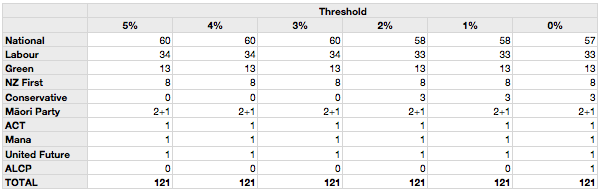
One of the debates in the MMP review will be the thresholds, so here’s the effect on the preliminary results:


At a 1% or 2% threshold the Conservatives would have got three seats (two from National, one from Labour) giving their 55,070 voters a voice in Parliament. National + Conservatives would have held a bare outright majority of 121, add in United Future and ACT and they have 123 and a comfortable bloc without any reliance on the Māori Party.

With no threshold ALCP would have taken another seat off National. National + Conservatives would no longer have an outright majority, National + Conservative + UF + ACT would hold 122.

Obviously this is without the special votes, and ignore the fact that with a lower threshold more people may have been willing to vote Conservative or ALCP as their votes would not have been wasted.