Is Israel Democratic?

An interesting thing happened after I wrote last week’s first blog post about Venezuela ( https://www.kiwipolitico.com/2019/02/on-the-venezuelan-mess/). A gentleman from the Israel Institute of New Zealand wrote me at my business email address to request a correction or retraction for something I had written in that post. The objectionable phrase was my reference to Israel as “semi-democratic.” He pointed out that Israel ranked just one point away from France as a “flawed” democracy in the latest Economist democracy ratings, not far behind Germany. In that post I characterised France and Germany as Right-leaning “advanced democracies” so he reckoned that I had slighted Israel when I labeled it as “semi” democratic instead.

We backed and forthed on the subject for a day or so. I told him that I based my characterisation on the fact that Arab Israelis are treated as second class citizens. I told him that I would leave it at that and not get into the subject of settlements on occupied land, the drift rightwards towards extremism and intolerance in its politics under the Likud Party (created by those paragons of democratic virtue Menachem Begin and Ariel Sharon and now led by Benjamin Netanyahu), the corruption of its government under Netanyahu (and his predecessor), its approach to Palestinians etc. He countered by pointing out that Arab Israelis have all rights given to non-Arabs, that they do not have to do compulsory military service but can vote and that a High Court judge who will hear Netanyahu’s corruption trial is an Arab.

I explained to him that I do not take the Economist’s ranking as gospel. In fact, I think that they are flawed due to an Anglo-Saxon bias and formal procedures and frameworks rather than substantive interactions (for example, I believe that New Zealand is ranked too high and Uruguay is ranked too low in the Economist list). I pointed out that I had an academic background that included writing about democratic theory (and democratisation in practice), so understand democracy to involve procedural (free and fair elections), institutional (impartial application the rule of law), societal (toleration, equality as mass values), and economic (fair distribution of productive wealth) dimensions, all of which I believe are deficient in Israel. He replied that Israel fulfilled the first three criteria. I also told him that I was raised in a strongly pro-Israel household and that I understood its unique security and geopolitical conditions as well as the fact that, when compared to pretty much every other nation in the Middle East, Israel was the most democratic of them. But that is just damning it with faint praise.

Perhaps I expect more of the Israelis, but its behaviour in the last two decades (and more) leads me to believe that it is no longer (if it ever was) a liberal democracy. Just because people have formal, de jure rights on paper does not mean that they have de facto rights on the ground. It may not be apartheid but in its treatment of Arab Israelis, African migrants and other non-European Jewish peoples, it falls very short of the “equality for all” mark that I would expect of a truly substantive democracy and well short of most European, North American and Antipodean democracies. This is not to say that the latter are all healthy and above reproach. It just means that Israel does meet even their lowered standards.

We agreed to disagree. I did not print a reaction or correction. I invited him to explain his views in a comment on the thread but he declined. After our correspondence I found myself thinking about how KP readers would classify Israel. I realise that given the ideological leanings of the blog many will be firmly in the anti-Israeli camp, but I wonder what, upon honest reflection, readers think about Israel’s form of governance. In other words, what argument do readers make to themselves about where they stand on Israel?

So here is an invitation for readers to express their views on the matter, formally posed as this question: is Israel democratic? . That way we can get a sense of how intelligent (mostly Left and Kiwi) readers see the Jewish state. But first a few rules:

No anti-Semitic anything. One can be anti-Zionist without being anti-Semitic (as an example, see this). One can criticise Israel without running nasty alt-Right tropes. One can defend Israel without resorting to false charges of anti-Semitism against those who oppose it, and one can defend Israel without making bigoted or other prejudiced remarks about Arabs, Palestinians etc. No re-litigating history. Israel is here to stay regardless of what some might prefer. And, as other democracies have done, it has behaved ruthlessly towards its enemies. So please, do not go down the worm-hole of who did what to who first.

IT goes without saying but is worth repeating nevertheless: No personal attacks on other commentators. Keep the discussion polite, rational and on-topic. I say this because any time Israel is mentioned people tend to lose their senses when confronted with contrary views. It really is a hot button issue.

I shall moderate the comments section a bit more vigorously given the subject matter. But by all means have at it because I am genuinely curious as to how people come to form their opinions on Israel.

On the post-truth moment.

For a while now I have been wondering about how we have come to the current state of affairs where objective facts and reality-based truths are subject to question at the same time that blatant falsehoods and denials of fact are promoted and increasingly accepted as part of contemporary social discourse. We now live in a world of “fake news” and “alternative facts” where reality denial and abject lying are regular features of the cultural landscape.

I cannot claim any expertise in tracing the origins of the phenomenon. What I can say is that fake news and truth relativism follow a long line of disinformation, misinformation and propaganda aimed to deceive or distract from a particular reality or fact. It has roots dating back to ancient times, where the practice of seeding public debates with false narratives was employed by Egyptians, Greeks, Persians, Romans and Chinese dynasties. In the late 20th century it was associated with a type of “yellow” journalism as practiced by the Daily Mail and National Enquirer, where stories about alien abductions and pregnancies shared space with false stories about celebrity deaths, illnesses, criminality, two-headed babes and assorted other lunacy. This overlapped with conspiracy theories peddled by Right and Left wing extremists, who saw dark machinations behind an array of global events.

As of the late 1980s another factor entered into the mix. The rise of post-modernism and its attendant notions of epistemological, cultural and moral relativism, liminality, intersectionality, post-structuralism, rejection of “objective” reality in favour of subjective, contingent and socially-constructed interpretations of “truth” and concern for the narratives of subordinated and traditionally unheard of voices (e.g. indigenous peoples, women, LGBT communities) gave intellectual foundation to the idea that nothing real was truely “objective” and that no fact was universally factual. Like four blind people groping an elephant, reality is defined by the position of the subject as much as it is by the empirical conditions in which s/he is located. And as Isaac Asimov noted with regard to his extraterrestrial beasts and characters, they only appear grotesque, scary and outlandish because we are trapped in the physical constraints of our own Earthly reality, which in turn determines the mental framework we use to categorise what is real, imaginary and unimaginable.

Post-modernism has been deservedly critiqued for its focus on subjectivity and relativity, particularly where it intersects with hard science (say, with regards to the laws of physics and biological imperatives). But it also is correct in bringing attention to the fact that history as well a values lie in the eye of the beholder, and that perspective is often socially constructed and not universally shared.

9/11 gave conspiracy theorists a major boost and the false pretences under which the US invaded Iraq (non-existent WMD “ready to launch” in Tony Blair’s words) spawned wide-spread skepticism about official claims and narratives once the ruse was exposed and the consequences revealed. Meanwhile, the rapid rise of social media and telecommunications technologies gave state intelligence agencies and non-state actors new channels of communication through which they could manipulate and distort “reality” for partisan, political, military, economic and diplomatic advantage.

It appears that the right-wing propaganda outfit Breitbart was one of the first Western agencies to introduce fake news into mainstream political coverage. Steve Bannon honed his skills in this dark art at Breitbart and used them very successfully during the course of the Trump campaign for the US presidency. He got a boost from Wikileaks, which was used by Russian intelligence as a conduit for hacked communications by and disinformation about Hillary Clinton’s campaign. This in turn fed into the Rightwing echo chamber fronted by Fox News and conservative talk radio, who willingly and unknowingly parroted fabricated lies deliberately planted by Bannon and his coreligionists.

Trump then turned everything on its head. Although the mass propagation of “fake news” began with Brietbart and its ilk, Trump started (probably at Bannon’s behest) to use the term as an attack on mainstream, corporate media coverage of his campaign and later presidency. His assault on the free press has been relentless yet very effective because it depends on doubt about factual veracity in the media as a whole. On top of that Trump uses another tactic that seems absurd but which works: he denies obvious things he has said and done even if they have been recorded the day before and lies on top of lies to the point that it is near impossible to determine when the falsehoods began.

In Trumpworld objective reporting is fake and outright lies and deceptions are truth. Climate change is a hoax; the security threat posed by undocumented migrants of colour is real.

His advisors and surrogates imitate his style and add their own flourishes, such as Kelly Anne Conway’s remark that the administration deals in “alternative facts.” A whole machinery of Republican-linked PR and crisis management agencies now engage in institutional whitewashing and blacklisting via dissemination of fake narratives and denial of reality. Witness the case of the catholic school punk who confronted an Omaha tribe elder outside the steps of the Lincoln Memorial. Within days of his smirking gob going “viral” on cellphone videos he was fronting up to leading television outlets spouting the manicured lies of a Republican advisory agency that he, in fact, was the victim of the encounter. Also consider the Republican-backed campaigns to link the Clintons to various murders and the infamous pizza parlour pedophile ring. And of course the “Obama is a Muslim non-citizen” trope.

The practice of using fake news and accusing honest media agents of doing so has spread world-wide particularly in rightwing political circles. Although authoritarians like Putin are masters at the art of disinformation, even upstart despots like Erdogan, Bolsonaro and Dutarte have trotted out their variations on the theme.

But that is not the only realm where the post-truth moment has gone. It is now considered–at least in large parts of the US– to be a socially accepted strategy to deny, dispute and lie about objective facts rather than take responsibility for what actually happened. It is now acceptable to flout ignorance of facts, be they scientific or political, in support of a particular world view. It is now common for bigots to not only come out fo the closet but to openly display prejudice while denying doing so. One is no longer a racist; one is a proud white nationalist simply sticking up for his/her heritage and cultural values.

It is like a kid caught out stealing cookies from a bakery display jar. When confronted about stealing cookies, he yells “says who?” When told that he was seen by several people in the act of committing the deed, he yells “who are they?” When told they are responsible adults who just happened to be on the scene he yells that they saw wrong and even of they did see right they are plants and snitches out to get him. And when his parents turn up, they angrily take his side of the story even though he has crumbs on his hands and chin. At that point the baker and witnesses just want to move on, thereby allowing the kid to get away with his misbehaviour. So it is with Trump and an ever growing number of people enamoured by his type of approach to facts that do not accord with his notion of a preferred reality.

New Zealand has so far been largely spared the ignominy of embracing the post-truth moment. But if the actions of certain ideological circles are an indication, the introduction of Bannon-style politics is on its way, at least in terms of using fake news to cloud public perceptions of what is fact and what is not.

For the time being I remain confident that Kiwis have the ability to identify and call out the BS artists and purveyors of mistruths. And I am reminded of something that I have said to my children over the years as they came of age and found it difficult to discern fact from fiction when reality is contested:

“May your path be that of the gentle warrior, steeled by conviction. And may your eyes always shine brightly with the beacon of truth.”

Pebbles under the mattress.

The structure of capitalism can be likened to that of a bed. The productive apparatus serves as the bed frame. Although there is plenty of variance to the exact configuration of the frame, its structure and purpose is the same: to underpin capitalism as a social construct, here meaning the social relations that emerge from the combination of private ownership of the means of production (productive assets) coupled with market steerage of the macroeconomy and the political relations that emerge from them.

Upon this frame lies a mattress made up of the social relations of production. In earlier times the capitalist mattress was heavy and rigid, with class lines sharply and simply defined and social roles strictly prescribed. Over time, as capitalism evolved and got more sophisticated and complex, moving from the industrial revolution to advanced industrial capitalism and then post-industrial production linked via commodity, supply and financial chains to less advanced economies in earlier stages of capitalist development, the social mattress above it developed accordingly, becoming less rigid and more sensitive to variation in collective and individual connections with the productive base. The clear-cut and strongly defined class relations of previous stages of capitalist development have been replaced in advanced societies by a more variegated tissue of social relations that blur class distinctions and add increased diversity to the way in which people interact in and out of production.

As this capitalist bed frame and mattress get more refined, elements previously unnoticed or quashed by the weight of more primitive capitalist relations have begun to be felt. Some predate capitalism, some emerged with it and some are byproducts of its trajectory. These can be called pebbles of identity.

Pebbles of identity unrelated to production in a direct way have existed between the capitalist base and superstructure all along but were previously eclipsed (when not suppressed) by the dominance of socio-economic class identifiers: blue and white collar workers, managers and owners encompassing the proletariat, peasantry, lumpenproletariats, bourgeoisie and what is left of the aristocracy sharing space with entrepreneurial elites.

In the post-industrial, post-modern contemporary era pebbles of identity play a major role in determining social relations, so much so that their presence can prove disruptive to the tranquility of the body politic as traditionally constituted. Identities previously unrecognised become apparent and are acutely felt in social discourse and political action. The question is whether the post-industrial capitalist mattress can comfortably accomodate them or whether it will prove incapable of buffering the inevitable tensions that emerge from the interplay between pre-modern, modern and post-modern identifiers in present day economies. Likewise, the evolution of capitalist modes of production accentuate or reduce the impact of some pebbles of identity over time. Identities associated with agrarian societies may not be not be felt as strongly in post-modern service sector economies. Religion and dialect may diminish in importance as the social mattress of capitalism changes secularly over time, and what were once mere grains of hidden or downplayed identity become prominent to the point of feeling like rocks underlying social intercourse.

The relative import of pebbles of identity is unique to a given capitalist society. In some, pre-modern identities such as gender, race, religion or language are felt more widely than post-modern identities tied to consumption preferences (be it music, arts, food or  automobiles). In others sexual orientation and gender identity overlap and/or compete with activist causes of various stripes. The way in which these are felt is conditioned by the socio-economic class structure embedded in the social fabric of the capitalist mattress.

Most social scientists, including economists, agree that understanding the characteristics of the capitalist frame is a necessary but not sufficient condition for understanding the dynamics of contemporary capitalism as a whole. The question for political analysts and students of social science in general is therefore where to put the emphasis when factoring superstructural features into the equation: the mattress or the pebbles? Identity politics have become very much a dominant theme in left-leaning politics as of late, much to the delight of alt-Right strategists like Steve Bannon who see the durability of socio-economic class as an organising principle for political action and who see the Left’s emphasis on pebbles of identity unrelated to production as the basis for political organising as a guarantee of failure.

Their belief, one that I concur with, is that emphasising identity over socio-economic class leads to a fragmentation of political action to the detriment of unity of purpose. Horizontal solidarity lines based on objective relationship to the means of production (say, as wage earners) are superseded by vertical silos of self-identification (say, as anime or steam punk fans), something that makes effective collective action of any sort very difficult at best when dominant class adversaries are united.

When identity tribalism triumphs over the class line, the Left is atomised and partitioned rather than consolidated.

This does not deny the fact that there are many for whom the socioeconomic class mattress is very thin and for whom the pebbles of non-class identity loom large underneath their notions of individual and collective self. These people emphasise identity as the locus of political action in capitalist societies precisely because the traditional social mattress of capitalism is threadbare and worn, thereby requiring a more granular understanding of the social relations of factors outside of production.  Adding these into the analytic mix helps supplement class analysis and in doing so paints a more representative picture of contemporary capitalism that helps inform  a more responsive form of praxis that is better in step with the tenor of the times.

It is left for readers to decide which approach is best suited to understanding contemporary capitalism. I for one continue to rest easy on the mattress made of the class-based social relations of production. Beyond that my interest in pebbles of identity derives from the explanatory weight I put on different attributes of the society where I have analytically chosen to place my pillow.

The beginning of the end of an error

There were no winners in Kim Hill’s interview with Don Brash this morning. Not Kim, and not Don, not Guyon Espiner’s unflinching use of te reo on Morning Report, and certainly not the people of Aotearoa. Pākehā liberals wanted the bloodsport spectacle of their champion vanquishing the doddering spectre of our reactionary past, and Pākehā right-wingers craved the sweet outrage of Hill’s rudeness and dismissive scorn towards people like them. Māori people mostly were just dismayed at Brash getting a platform to debate the value of their existence, again. Everyone except for Māori got what they wanted, but nobody got anything more.

In a way, this morning was a last gasp of credence for the notion that debate is possible with people who are oblivious to evidence. Kim got in her zingers, ably skewering Brash’s incoherence and inconsistency, but there’s nothing new there. All the evidence was as incidental as it was anecdotal. We were treated to discourses on the population density of Māori in proximity to kindergartens, based on nothing at all. Concerns about the use of te reo on RNZ cannibalising the audience of Māori language radio and TV stations, without any reference to what those flaxroots practitioners of te reo want. And discourses about actual cannibalism and the stone-age pre-settlement society, where listeners were asked to accept the claim that the deliverance of the Māori from their horrid existence was worth any price, up to and including their cultural erasure. Nobody who has given even modest consideration to these topics could have learned anything or changed their views this morning.

The discussion mocked the very rationality it sought to demonstrate, because it was all about feelings: Brash’s feelings of alienation from his country and his time, and Hill’s need to defend her employer and her worldview. Centred around Pākehā feelings, with no regard given to what Māori felt, or for their agency, it was merely the latest in two hundred years of discussions about Māori, without Māori.

It was a question of evidence that brought the interview to an end, though. Brash finally went one small step too far, with the claim that the Māori are not the indigenous people of Aotearoa, but merely its second-most-recent invaders. This notion has been debunked for almost a hundred years, since Skinner’s work on the Moriori in the 1920s, and there was enough scholarship done on it through the 20th Century that reliance on these claims in the 21st is a straightforward flag that whatever is going on here, it’s not an evidence-based discussion. There was nowhere left for Kim Hill to go. Nobody can debunk arguments advanced with such disregard for reality.

So she shut it down. But better than shutting it down would have been not entertaining it in the first place — which is, by and large, what Māori seem to have wanted. The error of this interview was not merely giving Brash a platform, but its objectification of Māori, the idea that their right to existence on their own terms was a matter for debate. It was an exercise in discursive theatre, a ritual sacrifice performed to appease the savage gods of fair-minded middlebrow liberalism, in the hope that rational discourse will deliver us into salvation. The sacrificers — yes, Kim Hill was one of them — were Pākehā, and inevitably, the sacrificees were Māori.

I was in the crowd for this sacrifice. Loath as I am to continue focusing on Pākehā feelings, I have to say: my only remaining feeling is the horror of being responsible for all this. Not only for today’s sacrifice, but the small sliver of the past that is my contribution to what got us here. We Pākehā need to take care of our own embarrassments, it should not fall to Māori to do that. So we need to stop treating the right to Māori existence on their own terms as conditional on our goodwill, and start treating it as a fact of life. Which, in the letter and spirit of Te Tiriti o Waitangi, is what it is. It’s not hard to do. When people want to debate the legitimacy of te reo Māori in public, here’s a simple response: “Like the right of Māori people’s physical existence, the right of Māori people to cultural existence is not a matter for debate.” We have, in polite society at least, stopped talking about “maoris”. We have stopped mocking haka, waiata, and karakia, and even people like Brash have stopped mocking te reo, making honest attempts at decent pronunciation and using what kupu they know in ordinary speech. We can stop treating the existence of Māori as debatable, too, and it’s about time we did.

L

Letters from America, take eleven: Secular rituals and the commercialization of everything.

Thanksgiving Weekend is ending here in Boston. For the first time in 15 years I spent it in the US with family and friends. It struck me that Thanksgiving is one of the few remaining symbols of common values left in the US. Independence Day, Christmas, New Years and Super Bowl Sunday all have broad appeal, but only Thanksgiving has the single unifying thread of family to keep it above partisan, religious, ethnic, racial and assorted other divisive tendencies within US society.

Buchanan family Thanksgiving table in The Barn, Holliston, MA.. Photo courtesy Kathy LaCroix Buchanan
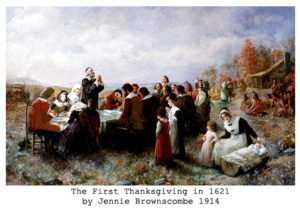

Not that all believe Thanksgiving to be controversy-free. Plenty of indigenous people believe that the Pilgrims were complicit in the subjugation and expulsion of eastern tribes from their ancestral lands. The Pilgrims, we may recall, were 40 religious refugees (“Separatists” or “Saints”) who were among the 102 passengers from England who landed first at what became known as Provincetown (on Cape Cod), then Plymouth, Massachusetts (on the mainland) on November 11, 1620 after crossing the Atlantic from the southern English port of Plymouth on the Dutch-made merchant (“fluyt’) ship Mayflower. Originally intending to settle on the Hudson River where an earlier European settlement was already in place, the Pilgrims were thwarted by bad weather and sailing conditions and decided to seek shelter further East. Armed with a grant from the London Company and Crown for the exchange of goods for religious autonomy and self-governance, the Saints/Pilgrims and their fellow travelers were decimated by illness and harsh winter conditions, with only half surviving until the next winter.

Conventional history has it that the Pilgrims arrived in peace and interacted amicably with the native Wampanoag and their sub-tribes (mostly grouped as Alonquian peoples). They also established the Mayflower Compact as the governing framework for the new colony, something that guaranteed all male colonialist participation in collective decision-making and which is considered to be one of the foundations of US democracy. It was in this context that the first shared meal with the local Pokanoket tribe was held in 1621, something that has passed into folklore as Thanksgiving. That meal followed on the heels of the Wampanoag-Pilgrim Peace treaty of April 1, 1621, which bound the settlers and all Wampanoag tribes together against other tribes (such as the Mohawk and Mohegan).

Critical interpretations paint a less rosy picture, noting prior conflict between earlier European settlers and Eastern tribes, with the first shared meal being less an act of cross-cultural friendship than a forced terms of settlement ceremony by which the Pilgrims began a divide-and-conquer process against the indigenous people. Whatever the intent of that breaking of bread, and admitting that colonization did result in the loss of land and displacement of the indigenous majority over the next centuries, “Thanksgiving Day” entered into US mythology as a moment to pause in order to give thanks for the blessings received and ties that bind.

Fast forward to today and one can see that the divide and conquer process is now being used on the settler colonizers in an extremely effective way, yet one that is different to that used on the original indigenous inhabitants. The instrument of division is called “commercialization” and it employs retail therapy as a form of community dismemberment.

For the last decade consumer non-durable retailers have pushed the day after Thanksgiving as “Black Friday,” not so much because it is a deadly day to be avoided but because it is a day for so-called “black” sales of retail goods: everyone gets a heavy discount on whiteware, electronics, toys,clothes and other merchandise so long as they are able to get their hands on the discounted goods. This causes thousands of commodity fetishistic numbskulls to line up 24 hours in advance of opening at assorted malls and other shopping venues in the hope of snagging a 20 dollar 60 inch TV and whatever else is within grasp amongst the grappling hordes. This has caused crushes, riots and a few deaths over the years, but the urge to shop on Black Friday is now reified in the media and popular culture to the extent that the original point of Thanksgiving–to give thanks for family and the benefits at hand–has been replaced by the urge to engage in competitive shopping. This no joke: on Black Friday the retail zombies literally fight each other over bins of discounted goods less than a day after the day of thanks. The media cover the crowded malls and traffic chaos as if they were national celebrations (or disasters, depending on your point of view), with person-in-the-street interviews suggesting that for many the importance of the weekend is the sales, not in spending time with family.

Although the day after Thanksgiving Thursday is not a statutory holiday, it has traditionally been treated as the middle of a long family weekend. Football has been added to the mix, with a range of college “rivalry” games and professional football contests serving as backdrops to the reunions. In recent years it has morphed into Black Friday, which in turn has also become a weekend affair culminating in Cyber Monday: the day in which telecommunications devices are fire-sold, especially via on-line retailers. In fact, on-line sales are rapidly approaching in-store sales, which has prompted shopping outlets such as malls to turn the Thanksgiving weekend into a sales event masquerading as a cultural moment, but without the historical linkage back to 1620. Today it is all about pumpkins, autumn colors, pilgrims and turkeys as caricatures rather than historical legacies, and the vibe is about using Thanksgiving as an icon in order to sell an infinite array of product. Fathers and sons can bond over ride-on lawn mowers and ratchet sets as they undertake autumn outdoor chores; moms and daughters can get their pumpkin baking mojo going together with the latest Martha Stewart oven accessory line. Granddads and grandmas can hug the little ones as they fiddle the consoles of their Pilgrim-themed electronic games.

The commercialization frenzy brought on by Black Friday has not only eclipsed the meaning of Thanksgiving but is in fact just the start of a month-long sales push leading towards Christmas, which in turn is followed by its own returns-and-exchanges day (Boxing Day). The entire month between the two holidays is an orgy of conspicuous consumption and brand tie-ins (to the military, football, Santa Claus and whatever else can entice a purchase). Whatever the spirit of togetherness fostered by the communal offering of thanks in late November, the ensuing four weeks is an exercise is materialist self-gratification.

This extends to petty thieves. The advent of on-line shopping has led to a proliferation of so-called package thefts, whereby thieves follow delivery vehicles around and steal packages from front doorsteps. The distinctive packaging used by Amazon is particularly irresistible to the low-lifes, but the general trend is to let others do the shopping and treat doorsteps deliveries as an invitation to help oneself to the surprises that they contain. Let here be no doubt about it: there is a country-wide epidemic of this type of theft, something that is a microcosmic distillation of how the spirit of Thanksgiving is well and truly gone.

Therein lies the tale. What wars and internal political divisions could not do (even Trump was silent on Thanksgiving Day!), the consumerist mentality and grotesque commercialization of everything has done. It has further broken many of the horizontal solidarity ties that once held communities together and promoted a form of nihilist alienation that is abetted and deepened by the advent of social media and individual telecommunication devices. The result is a society of self-gratifying materialists unconcerned with and unencumbered by the responsibilities of civic engagement.

There are just 2700 Wampanoag left today and they are dependent, as is the case with so many tribes, on gambling for economic sustenance. Things might have been different had they discovered that the best way to undermine the Mayflower Compact and its historical sequels was to push commodities on the white man rather than share a meal and foster community with him.

PS: Here is the RadioLive interview counterpart to this post. It begins with Thanksgiving, then wanders into a range of other subjects: http://www.radiolive.co.nz/home/audio/2017/11/-thanksgiving-is-being-degraded-in-the-states—-paul-buchanan.html

Letters from America, take eight: on the fear of “good negro government.”

One notable aspect of contemporary US politics is the re-emergence of so-called culture wars. Orchestrated by Steve Bannon, assorted alt-Right platforms and Murdoch media outlets in response to what could be called the de-WASP (White Anglo Saxon Protestant)-ification of US society, the conflict is centered on symbols and messaging. The regression into appeals to tradition, “culture” and “values” (read: white privilege) is a modern version backlash against what author and sociologist W.E.B. Du Bois (1868-1963) called “good Negro government” after the Reconstruction Era in US history (1863-1877). The theme that today’s culture wars hark to the backlash against “good Negro government”  has been picked up by the writer Ta Nehisi Coates in his latest book “We Were Eight Years in Power,” where he argues that Trump’s electoral victory in 2016 was in large part due to white voters fears that Barack Obama had conclusively proved that people of color could run the federal government competently and that whites could no longer claim that colored people were ill-suited, emotionally, tempermentally, intellectually and culturally, to govern. It is one thing to have “good” Negros portrayed as equals on TV shows. It is quite another for them to actually wield power over whites.

Du Bois outlined his thoughts on “good Negro government” by watching the sequels to post Civil War reconstruction in the South, in South Carolina in particular. After the civil war US authorities mandated a period of social reconstruction in the defeated Confederacy in which free slaves were, by federal mandate, integrated into municipal and state governments and other social institutions. This forced intervention was designed to lay the foundations of a more egalitarian Southern society, and in many instances free Negros took up managerial positions in a variety of public and private agencies. However, after Reconstruction and federal government intervention ended (along with the withdrawal of federal troops), Southern states set about undoing the social changes that it had wrought. In 1895 South Carolina held a state constitutional convention in which most of the gains made by blacks were reversed and they were legally reduced to second class citizens prohibited from holding political offices and purged from public and private bureaucracies. This was also the time when the Klu Klux Klan was founded (as an extrajudicial enforcement arm of the socially revanchist South), the period of building monuments to heroes of the Confederacy was begun and the foundations of Jim Crow were laid.

For Du Bois, this backlash demonstrated that what White Southerners feared most was not a “bad Negro government” rife with incompetence and corruption, something that was already evident in pre-war Southern white governments. Instead, the greatest fear of Southern whites was of “good Negro government” that did the things that only whites were purportedly capable of doing due to their supposedly superior attributes. To that was added the battlefield record of black Union troops, who Southerners thought would be cowards and run from battle but who instead proved to be very competent soldiers, and the fact that instead of rioting, raping and pillaging once they were freed, former slaves went about peacefully rebuilding the South without major problems of their own (in fact, the majority of violence during the Reconstruction was white-on-black as white Southerners resisted treating recently freed slaves as equals).

This combination of factors destroyed the myth of white supremacy that Southerners clung to, so legislative reforms such as the 1895 South Carolina constitution were enacted in order to restore and enshrine the “proper” racial hierarchy under slave-free conditions. In effect, although unable to return to slavery, post-reconstruction legal reforms that restricted the citizenship and human rights of free slaves amounted to an early American version of apartheid, the origins of which were rooted in the fear of usurpation of white privilege.

Coates sees the Trump phenomenon as a repetition of the fear of “good Negro government.” The election of Barack Obama and the success of his administration in the face of disloyal opposition by Congressional Republicans and the Right-wing media was a nightmare for white (mostly working-class male) social revanchists who had been forced to suppress their racism and bigotry since the 1960s, when the Civil Right Act (1964), opposition to the Vietnam War and the adoption of anti-status quo and “countercultural” lifestyles upended traditional hierarchies. In the ensuing 40 years the white wage labouring classes have seen their social status eroded along with their jobs vis a vis competitors, most of them people of colour, emanating from home as well as abroad.

Objective explanations for white working class decline offer no relief to those suffering within it. It is bad enough for them to have to compete on US wages with undocumented immigrants and foreign wage slaves. It is particularly bad for them to have to compete with robotics and other aspects of computer generated productive automation. They have to find explanation for their plight in something other than the inevitable progression of US capitalism in a globalised system of production, communication and exchange. For the white demographic in decline, the answer to their plight lies in no fault of their own under conditions of capitalist competition, but in the social changes occuring corollary to it. That is, the explanation for white decline has to be socio-cultural rather than structurally capitalist in nature, specifically seen in the decline of WASP “values” and emergence of non-WASP perspectives as dominant influences in contemporary US society.

In that light the election of Barack  Obama to the presidency and his subsequent success at mastering the art of governance compounded white social revanchist fears by promoting and celebrating Hispanics, Asians, gays and other minorities in leadership roles in government, business, academia and communities, and by openly embracing minority cultures as part of the mainstream of US society.

Steve Bannon has seized on this to lead the cultural charge in support of “tradition” and against “unAmerican” values, which are now open code words for a return to white supremacy. He and his political acolytes have been successful in orchestrating a pushback that has prompted a regression in US social development, with a white backlash against the gains made by minorities of all persuasions now growing stronger than in the previous three decades. The cultural wars are between an ascendant multicultural, multi-ethnic, poly-religious yet increasingly secular, pro-choice, pro-gun control, pacifist, sexually diverse and egalitarian-minded, “keep your hands off unless invited,” post-modern demographic with a rationalist and normatively relative global perspective, on the one hand, and a monocultural, white dominant, Judeo (but mostly) Christian, heterosexist, patriarchical, sexually aggressive hands -on, pro-gun, militarist, anti-choice, anti-science, industrial, xenophobic, normatively absolutist and economically insular demographic on the other. For the moment, the struggle is even but the numbers do not lie: given current and projected birth rates, the Bannon target demographic is in decline.

The last time there was a cultural clash in the US anywhere similar in scope was in the mid-60s. Until the early 60s the US was run in the image that Bannon and Trump supporters now hark back to: Dad at a good paying manufacturing job that allowed him to own his own home, Mom happily tending to the domestic front, both regularly attending a Christian church with 2.2 kids and a car in every garage (or, for those who may remember such things, basically operating as Ozzie and Harriet of 1950s TV fame).

But the 1964 Civil Rights Act, opposition to the Vietnam war and counter-cultural lifestyles pushed by rock music broke the consensus on the national myth and prompted a major ideological struggle. In that instance, progressive forces won over the rednecks and defenders of tradition. Now the struggle is being repeated but is sparked, as it were, from the other side–conservative whites are pushing back against the progressive secularization and egalitarianism of US society, as exemplified by Barack Obama and his good Negro government. The champion of these social revanchists is Trump, but it is Bannon who is the puppeteer.

There is a popular saying in the US these days: “Stay in your lane.” It is taken from car culture and references highway traffic dynamics. But it has a subtext of implicit or threatened road rage and it is in fact a substitute for “know your place.”  “Stay in your lane” is now used widely to address stroppy females, uppity Negros, recalcitrant children, surly teens, overly camp gays or butchy lesbians–basically any minority individual or community that dares to challenge WASP conventional wisdom about social hierarchy. For Steve Bannon, who has been doing the rounds of talk shows and conservative conventions this past week, it is all about getting the usurpers of white privilege to either get back into their traditionally prescribed roles or return to hiding.

Bannon believes that his 20-25 percent of the electoral base is homogenous, scared and united through social and corporate media. It is a short term vision, but given the uncertain shadow of the future it is possible that short term political gains based on a socially revanchist ideology could seep into the broader electoral fabric. Whatever their antipathy towards Trump aand the GOP, his opponents are heterogeneous, hopeful and yet fractious and divided. The erosion of horizontal solidarities in an age of ideological individualism is abetted and pushed by adavances in telecommunications technology–the same technology that social revanchists use so effectively.  Bannon has already invited Democrats to continue to play the identity politics game (and there is a lesson for New Zealand here), because that allows him to successfully impose the weight of his demographic against those aligned against it. The Bernie Sanders/versus Hillary Clinton campaigns show one end of the “liberal” internecine division in the US; the feminist arguments about the #metoo hashtag show another. There are many more sources of liberal/progressive cleavage, and in Bannon’s eyes they spell “Achilles Heel.”

The success of the cultural wars pushback is concerning. The Right-wing (including alt-Right) media, both corporate and social, have very much influenced the discourse with their attacks on the Obama legacy (him being “weak” in foreign affairs etc.) and in their support for Trump’s demeanour and his dismantling of that legacy via Executive Orders. The impact is real. Things that one would have thought were done and dusted years ago–arguments about gender differences as they apply to employment and wages, racial differences as they apply to law and order, whether being native born as opposed to foreign born should be a criterion for security clearances, are homosexuals trustworthy with kids, what constitutes patriotism, etc.–are now back in the public domain in a measure not seen in decades.

All of which is to say that things in the US are pretty tetchy at the moment, and the possibility of physical conflict between those who embrace “good Negro government” and those who fear it are quite real.

Let us not think that this is exclusively a US problem. Be it in the “I told you so” comments of white South Africans or Zimbabweans about the bad Negro governments that followed the abolition of white supremacy in those countries, or in the similar comments about poor governance of black-ruled cities like Detroit or the District of Columbia in the US, or those who point to problems with aboriginal self-governance in the Northern Territory, there are many who find comfort in black failure and find threats in black success. That is true for some quarters in Aotearoa, where the possibility of “good Maori government” or “good Pasifika government” is dismissed out of hand not so much because of their outright impossibility due to some instrinsic traits of those involved, but because of Pakeha fear that they could do no worse, and perhaps even better than Pakeha dominated government.

Let’s remember this if there is pushback against the notion of “good Negro government” in New Zealand.

A tacit admission of decline.

In international relations theory, there is one standard that is commonly used to differentiate between superpowers and great powers. Superpowers intervene in the international system in order to advance systemic interests. That intervention can maintain or alter a balance of power or systemic status quo, but the point of  the move is to tinker with the system as a whole, something that is not done out of pure self-interest but in pursuit of something bigger or long-term in nature.

For their part, great powers intervene in the international system in order to pursue national interests. They do not have the capacity nor the desire to pursue systemic objectives outside of immediate national concerns.

Lesser powers can not make systemic changes but instead are subject to the actions of great powers and superpowers and the systemic effects of those actions.

I mention this as a prelude to a comment about the US position in the international system and Trump’s foreign policy actions to date. It has been clear for some time that the US is in decline. Once a pole in the bipolar balance of power that marked the Cold War, then the unipolar hegemon in the post-Cold War era when notions of the “American Century” and “Pax Americana” prevailed in US policy circles, the US has since 9/11 and the invasion of Iraq been forced to deal with the rise of new and old powers when saddled with all of the hallmarks of domestic decline and yet remaining committed to a policy of perpetual war against non-state as well as state actors (although the form that conflict takes varies depending on the opponent and the nature of the battle space in which conflict occurs). Whereas once the US pushed liberal internationalism as a systemic virtue where international norms, regulations, law and institutions were seen as the foundations of a stable and peaceful world order, in the last decade or so the US has seen itself over-extended militarily in fruitless wars of convenience or opportunity that have eroded its international reputation and influence while its home front is rendered by decay and increased social division. Barack Obama tried to stem the adverse tide but a viciously disloyal political and media opposition undermined him at home and abroad.

No US politician can say, much less get elected or re-elected on the idea that the US is in decline and is no longer the first amongst equals in the international system. Barack Obama appeared to have understood the fact of US decline but could not admit it publicly. To this day US commentators, politicians and most of the general public believe or at least pay lip serve to the notion that the US remains an exceptional country, as the so-called “shining house on the hill” to which all other nations look for leadership as well as its role as the world policeman. They talk about defending freedom and American values as if those truly are the basis for US military interventions abroad and an increasingly coercive approach to ideological, ethnic, economic and cultural differences at home.

Enter Donald Trump, but with a twist. Trump also genuflects at the alter of American Exceptionalism. But his “America First” message, with its neo-islolationist, nationalist, monocultural and xenophobic undertones, is actually a tacit admission that the US is in decline. That is interesting because Trump was anything but tacit on the campaign trail when lamenting the state of the Union. Now, as president, he changed his tune and behaves as if the US as a nation-state is equivalent to himself in that it can buy, bully or negotiate its way to getting whatever it wants from others. That is where he is wrong, and his actions demonstrate otherwise.

By pulling out of the Trans-Pacific Partnership Agreement (TPPA) and Paris Climate Accords, refusing to endorse NATO’s notion of collective defense, demanding that other nations pay more for US “protection” (as if it was a Mafia racket), deriding international institutions and regional organisations, rejecting international law (such as those prohibiting the use of torture), threatening firms with retaliatory penalties if they do not invest more in the US and dismantling years of cross-border environmental and corporate regulatory frameworks in the supposed interest of creating US jobs, Trump has tacitly admitted that the US is no longer a super power that can manage the international system in its preferred image and in fact can no longer do anything more than what a great power in decline can do–pursue its interests at the expense of all others in order to try and arrest the slide.

It is too late for that. As one meme put it, “Trump is cancelling Netflix so that he can give more jobs to Blockbuster.” The decline of the US is not just a reversible economic phenomenon. It is ideological, political, moral and ethical in scope. It is institutional as well as material in nature. The very character of the US is in crisis, where a history of idealism and virtue has met its match in a culture of excess, greed and venality. Solidarity and an egalitarian ethos have given way to opportunism and survivalist alienation.

The US decline is also a product of advancing technologies in an age of globalised production, communications, consumption and exchange. It exists in a context where other nations no longer look to the US first for support on many fronts, and in which competitors have grasped the fact of American decline and moved to capitalise on it. It may not be exactly Rome before the Fall, but the US is in many ways starting to resemble the USSR in decline–all military muscle but with no heart, dead eyes and a silly orange comb over.

The good news for the US is that it can work well as a great power if it understands that is what it has become. The Bush 43 administration tried to reassert US supremacy with its foreign adventurism and only succeeded in accelerating its (albeit unrecognised) decline. Now that its diminution is in full sway, the US needs to address its internal contradictions, something that perhaps requires a (however temporary) retreat from systemic tinkering and intervention. This could be a good thing because international systems theory posits that unipolar systems are inherently unstable whereas multipolar systems with 3, 5 or 7 great powers balancing each other on specific strategic issues and geopolitical fronts are more stable over the long term. With the US backing away from international commitments and systemic engagement, it may be a moment for other great power aspirants to fully shine. Theoretically, that could work out for the better.

Practically speaking and whether it works out for the better or not, multipolarity is the where the international system is headed. The current moment is one of international systemic transition, and the fact is that conflict is the systems re-equilibrator under conditions of semi- or restricted anarchy (in which adherence to some international institutions and norms is paralleled by non-adhernce or respect for others). Absent uniform and effective enforcement authority, states decide which norms to follow and which to violate until such a time a new consensus is achieved on the contours and rules of the emerging international system. When universal norms are not uniformly followed, that is when conflicts occur. We are in such a moment.

Admit it or not, under Trump the US is at this transitional moment retreating into its shell and away from its superpower pretensions. For rising and resurgent powers, this is a window of opportunity that can lead to systemic realignment. And at least for the time being, for many around the world having the US out of their lives is not a bad thing.

One thing is certain: the decline of the US as a superpower may not be acknowledged but it is real.

Where to draw the line?

Here are some thoughts for readers.

It is reported that former US Sen Scott Brown (R-MA) has been nominated by the Trump administration to be US ambassador to New Zealand. Besides a record that includes being a centrefold model, party to a sexual harassment lawsuit, and an undistinguished US Senator after a career in local politics in his home state, Mr. Brown is on record as saying that he supports the use of water boarding and other forms of torture. This is of particular note because Mr. Brown is a lawyer who served in the Massachusetts National Guard as a Judge Advocate General’s (JAG) officer, that is, as part of the Army legal system. He should therefore presumably be familiar with Jus in Bello, Jus ad Bellum and other international conventions that, among other things, prohibit the use of torture in war and peacetime.

NZ is a signatory to the Geneva Convention, which prohibits torture (as a war crime). It also supports the International Court of Justice, which prosecutes war crimes and crimes against humanity (which include torture).

Every country has the right to refuse to accept the credentials of foreign ambassador-designates.

So the question is: as a responsible member of the international community and a strong supporter of the rule of international law, should NZ refuse to accept Scott Brown as the incoming US ambassador? Or should it adopt a policy of diplomatic necessity and cast a blind eye on Mr. Brown’s support for state-sanctioned criminal acts in order to curry favour with the Trump administration?

And, as a sidebar: Inspector General of Security and Intelligence Cheryl Gwyn is currently undertaking a lengthy investigation into whether NZ, via the SIS and/or NZDF, was involved in the extraordinary rendition and black site programs run by the US under the Bush 43 administration (which involved the extrajudicial kidnapping and secret detention without charge of suspected Islamicists, several of whom wound up dead as a result of their treatment while in captivity). These  programs included the use of water boarding and other forms of torture as supposed interrogation techniques at the US military prison in Guantanamo Bay (Camp Xray) as well as a network of black sites around the world (not all of whom have been identified yet and which it is possible Ms. Gwyn’s investigation might shed light on). Given this background, will the decision on Mr. Brown’s acceptability as the US ambassador be indicative of what we can expect from the government when it comes to her findings?

I would love to hear your opinions.

Darkness at heart.

Lets consider a hypothetical scenario.

A group of women appear to be well on their way to intoxication at a polite venue on an island known to cater to the affluent. They are not caucasian. A well-heeled older white male patron observes them and decides, perhaps after a few tipples of his own, to take it upon himself to caution them about the perils of drinking and driving in an area that has a heavy police presence over the holidays. He assumes that they are not locals.

His unsolicited advice is not welcome and he is told by one of the women, a 23 year old, that as local born and indigenous to boot, she “can do what she pleases” (according to his account).

His response, according to her, is to say that she needs to acknowledge that it “is also a white people’s island.” He says that it was just joking banter.

My questions at this point are this: even if she was being drunk and dismissive, of all the things he could have said, why that particular line? Could he not have replied in a myriad other ways, such as by telling her that her behaviour was drawing unwanted attention? Was he trying to say that the rule of law applies to everyone regardless of origin, but that the law is made by white folk? Even more to the point, why did he feel the need to go over and caution them? Is he in the habit of approaching strange women in public venues and giving them the benefit of his unsolicited advice? If so, why?

In any event, in the real world the young woman hits social media with her displeasure and the incident becomes a media frenzy. Various celebrities weigh in to defend the old guy, leaning on his good deeds for sport and various charitable contributions. Others are not so charitable.

The scenario gets stickier because he uses as a PR spokesperson a well-known reactionary woman who, in response to the furore over this remarks, at first says that the 23 year old is too fair skinned to have been the subject of racism and then says that she has never heard of the term “casual racism” until today.

The Race Relations Commissioner, herself of disputed background when it comes to issues of racial awareness, at first says that the old white gent is not a racist but then backtracks and introduces the term casual racism that the PR spokeswoman had previously never heard of. The term is certainly not new but it seems that the PR woman travels in insulated circles.

The questions that arise at this point are: seriously, the old white guy uses an even more clueless old white woman with a rightwing track record to defend him against charges of “casual” racism? And she then decides to use the 23 year old’s skin tone as a defense against the charge of racism (because the young woman is light skinned)? And in 2017 she claims to not know what “casual” racism is (perhaps because she casually is one)?

As for the Race Relations Commissioner–was she conflating her personal and official views when she made either or both of her statements?

Anyway, like I said, this is just a hypothetical scenario about race, gender and generational difference referencing current events in a post-truth age.

in a weird way, it reminds me of another (not so) old guy getting into some strife because of his penchant for serial hair-pulling of (sometimes very) young women in public venues or at events. He too claimed that his actions were just playful, joking physical banter that was misconstrued by one recipient of his attentions (and to be fair, none of his other instances of hair pulling were even noted, much less protested until a waitress complained). According to his many defenders, he was not a sexist or a fetishistic creep.

I guess offence is taken in the eye of the beholder, but in both cases the offence was taken after an older white male in a position of power decided to unilaterally approach and engage younger women in ways that were unwanted. In each case the older male felt entitled, or privileged, to initiate contact with a younger woman without first ascertaining whether that contact was welcome, and continued the contact after it became apparent that it was not. That others defended their actions as, at worst “misunderstandings,” speaks to a number of things.

What could they be and why, in 2017, should they be?